By: Bashaer M. Al Kilani
GAME-BASED LEARNING: TURING GAMING INTO A
STUDENT CENTERED APPROACH TO LEARNING
GAME-BASED LEARNING
• What is Game-based learning?
• Why should educators adopt it?
• How can educators get started with Game-based
Learning?
• How to integrate Games in learning
• Demo of educational games utilization
GAME-BASED LEARNING
• Worldwide revenues for Game-based
Learning products reached $2.6 billion in
2016 and will surge to $7.3 billion by 2021
(Adkins, 2016)
Sam S. Adkins (2016). The 2016-2021 Worldwide Game-based
Learning Market, Ambient Insight, LLC.
WHAT IS GAME-BASED LEARNING
•Game-based learning (GBL) is a type of game
that has defined learning outcomes.
•Game-based learning broadly refers to the
use of video games to support teaching and
learning
Perrotta, C., Featherstone, G., Aston, H. and Houghton, E. (2013). Game-based Learning: Latest
Evidence and Future Directions (NFER Research Programme: Innovation in Education). Slough: NFER.
WHY SHOULD EDUCATORS
ADOPT GAME-BASED LEARNING?
GAME-BASED LEARNING MOTIVATES
LEARNERS
• Game-based Learning captures learners’ attention,
which leads to engaging them in a joyful learning
experience where learners are intrinsically motivated.
(Edutainment)
• The majority of the studies examining the impact of
video games on student motivation and engagement
found positive results.
Perrotta, C., Featherstone, G., Aston, H. and Houghton, E. (2013). Game-based Learning: Latest
Evidence and Future Directions (NFER Research Programme: Innovation in Education).
Slough: NFER.
GAME-BASED LEARNING IS A DIFFERENTIATED
ACTIVE LEARNING APPROACH
• The studies consistently found that video games
can impact positively on problem solving skills,
broader knowledge acquisition motivation and
engagement.
Perrotta, C., Featherstone, G., Aston, H. and Houghton, E. (2013). Game-based Learning: Latest
Evidence and Future Directions (NFER Research Programme: Innovation in Education). Slough:
NFER.
GAME-BASED ENHANCES ASSESSMENT
• It encourage self-assessment through instant
feedback
• Video games seem to allow more powerful and
‘always-on’ forms of assessment in which all
actions, interactions, successes and failures
can be constantly tracked and logged.
Perrotta, C., Featherstone, G., Aston, H. and Houghton, E. (2013). Game-based Learning:
Latest Evidence and Future Directions (NFER Research Programme: Innovation in Education).
Slough: NFER.
HOW TO GET STARTED WITH
GAME-BASED LEARNING?
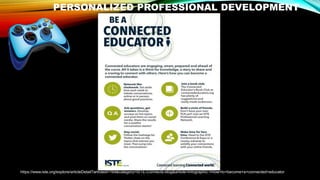
PERSONALIZED PROFESSIONAL DEVELOPMENT
https://www.iste.org/explore/articleDetail?articleid=164&category=ISTE-Connects-blog&article=Infographic:+How+to+become+a+connected+educator
AVAILABLE RESOURCES IN SCHOOL
• Get in contact with the IT team to check on
connectivity and hardware software platforms
and AUPs in use.
• Start by using the available resources .Electronic
games are becoming more generic.
• It is key to be flexible and to try alternative
solutions.
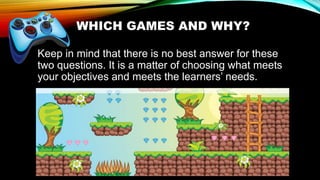
WHICH GAMES AND WHY?
Keep in mind that there is no best answer for these
two questions. It is a matter of choosing what meets
your objectives and meets the learners’ needs.
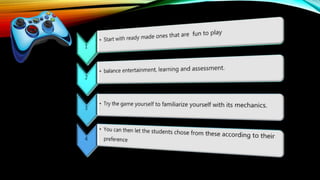
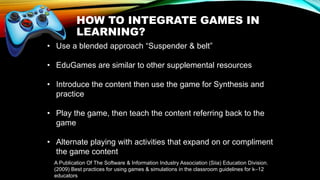
• Use a blended approach “Suspender & belt”
• EduGames are similar to other supplemental resources
• Introduce the content then use the game for Synthesis and
practice
• Play the game, then teach the content referring back to the
game
• Alternate playing with activities that expand on or compliment
the game content
A Publication Of The Software & Information Industry Association (Siia) Education Division.
(2009) Best practices for using games & simulations in the classroom guidelines for k–12
educators
HOW TO INTEGRATE GAMES IN
LEARNING?
HOW TO INTEGRATE GAMES IN
LEARNING?
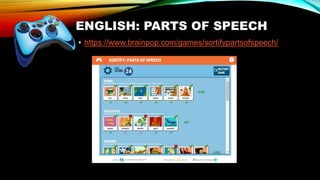
ENGLISH: PARTS OF SPEECH
• https://www.brainpop.com/games/sortifypartsofspeech/
ENGLISH: PARTS OF SPEECH
• https://www.brainpop.com/games/sortifypartsofspeech/
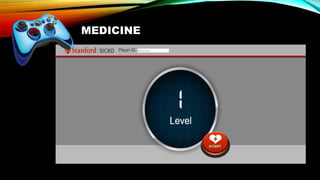
MEDICINE
Stanford University – Medicine School
http://med.stanford.edu/sm/archive/sicko/game/SICKO.html
MEDICINE
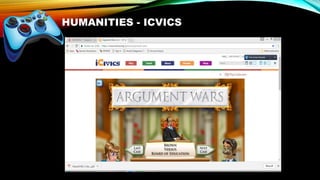
HUMANITIES - ICVICS
https://www.icivics.org/games/argument-wars
HUMANITIES - ICVICS
SCIENCE: GUTS & BOLTS
https://www.brainpop.com/games/gutsandbolts/ /
SCIENCE: GUTS & BOLTS
https://www.brainpop.com/games/gutsandbolts/ /
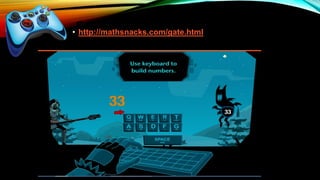
SCENARIO BASED MATH QUIZ• http://mathsnacks.com/gate.html
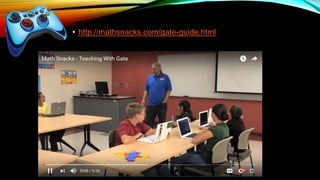
SCENARIO BASED MATH QUIZ• http://mathsnacks.com/gate-guide.html
Bashaierk@me.com
@Bashaierk
#edchatMENA
USEFUL RESOURCES
• http://www.siia.net/Portals/0/pdf/games_final.pdf
• http://educade.org/
• https://www.edutopia.org/game-based-learning-
resources
• http://gamifi-ed.wikispaces.com/
• https://www.brainpop.com/games/
USEFUL RESOURCES
SCENARIO BASED :ATH QUIZ

Game Based Leaning

  • 1.
    By: Bashaer M.Al Kilani GAME-BASED LEARNING: TURING GAMING INTO A STUDENT CENTERED APPROACH TO LEARNING
  • 2.
    GAME-BASED LEARNING • Whatis Game-based learning? • Why should educators adopt it? • How can educators get started with Game-based Learning? • How to integrate Games in learning • Demo of educational games utilization
  • 3.
    GAME-BASED LEARNING • Worldwiderevenues for Game-based Learning products reached $2.6 billion in 2016 and will surge to $7.3 billion by 2021 (Adkins, 2016) Sam S. Adkins (2016). The 2016-2021 Worldwide Game-based Learning Market, Ambient Insight, LLC.
  • 4.
    WHAT IS GAME-BASEDLEARNING •Game-based learning (GBL) is a type of game that has defined learning outcomes. •Game-based learning broadly refers to the use of video games to support teaching and learning Perrotta, C., Featherstone, G., Aston, H. and Houghton, E. (2013). Game-based Learning: Latest Evidence and Future Directions (NFER Research Programme: Innovation in Education). Slough: NFER.
  • 5.
    WHY SHOULD EDUCATORS ADOPTGAME-BASED LEARNING?
  • 6.
    GAME-BASED LEARNING MOTIVATES LEARNERS •Game-based Learning captures learners’ attention, which leads to engaging them in a joyful learning experience where learners are intrinsically motivated. (Edutainment) • The majority of the studies examining the impact of video games on student motivation and engagement found positive results. Perrotta, C., Featherstone, G., Aston, H. and Houghton, E. (2013). Game-based Learning: Latest Evidence and Future Directions (NFER Research Programme: Innovation in Education). Slough: NFER.
  • 7.
    GAME-BASED LEARNING ISA DIFFERENTIATED ACTIVE LEARNING APPROACH • The studies consistently found that video games can impact positively on problem solving skills, broader knowledge acquisition motivation and engagement. Perrotta, C., Featherstone, G., Aston, H. and Houghton, E. (2013). Game-based Learning: Latest Evidence and Future Directions (NFER Research Programme: Innovation in Education). Slough: NFER.
  • 8.
    GAME-BASED ENHANCES ASSESSMENT •It encourage self-assessment through instant feedback • Video games seem to allow more powerful and ‘always-on’ forms of assessment in which all actions, interactions, successes and failures can be constantly tracked and logged. Perrotta, C., Featherstone, G., Aston, H. and Houghton, E. (2013). Game-based Learning: Latest Evidence and Future Directions (NFER Research Programme: Innovation in Education). Slough: NFER.
  • 9.
    HOW TO GETSTARTED WITH GAME-BASED LEARNING?
  • 10.
  • 11.
    AVAILABLE RESOURCES INSCHOOL • Get in contact with the IT team to check on connectivity and hardware software platforms and AUPs in use. • Start by using the available resources .Electronic games are becoming more generic. • It is key to be flexible and to try alternative solutions.
  • 12.
    WHICH GAMES ANDWHY? Keep in mind that there is no best answer for these two questions. It is a matter of choosing what meets your objectives and meets the learners’ needs.
  • 14.
    • Use ablended approach “Suspender & belt” • EduGames are similar to other supplemental resources • Introduce the content then use the game for Synthesis and practice • Play the game, then teach the content referring back to the game • Alternate playing with activities that expand on or compliment the game content A Publication Of The Software & Information Industry Association (Siia) Education Division. (2009) Best practices for using games & simulations in the classroom guidelines for k–12 educators HOW TO INTEGRATE GAMES IN LEARNING?
  • 15.
    HOW TO INTEGRATEGAMES IN LEARNING?
  • 16.
    ENGLISH: PARTS OFSPEECH • https://www.brainpop.com/games/sortifypartsofspeech/
  • 17.
    ENGLISH: PARTS OFSPEECH • https://www.brainpop.com/games/sortifypartsofspeech/
  • 18.
    MEDICINE Stanford University –Medicine School http://med.stanford.edu/sm/archive/sicko/game/SICKO.html
  • 19.
  • 20.
  • 21.
  • 22.
    SCIENCE: GUTS &BOLTS https://www.brainpop.com/games/gutsandbolts/ /
  • 23.
    SCIENCE: GUTS &BOLTS https://www.brainpop.com/games/gutsandbolts/ /
  • 24.
    SCENARIO BASED MATHQUIZ• http://mathsnacks.com/gate.html
  • 25.
    SCENARIO BASED MATHQUIZ• http://mathsnacks.com/gate-guide.html
  • 26.
  • 27.
    • http://www.siia.net/Portals/0/pdf/games_final.pdf • http://educade.org/ •https://www.edutopia.org/game-based-learning- resources • http://gamifi-ed.wikispaces.com/ • https://www.brainpop.com/games/ USEFUL RESOURCES
  • 28.