The document summarizes time management skills presented by Dr. B. Victor. It discusses prioritizing tasks, identifying time wasters, making schedules, and setting goals. Key points include using the "pickle jar theory" to prioritize important vs. urgent tasks, recognizing good and bad use of time, and overcoming barriers like poor planning and inability to say no to take control of one's schedule.
Improving the Time management Skills Presented by dr. b. victor ., Ph.D.
2.
Objectives To increaseawareness of your attitude toward time. To learn to plan time by setting priorities. To identify signs of poor time management. To recognize the benefits of time management
3.
Introduction Time isscarce resource. It is more valuable than money as money can be earned.
4.
In professionallife one have: Red time = your wasted time Green time = your efficiently used time Good days Bad days
5.
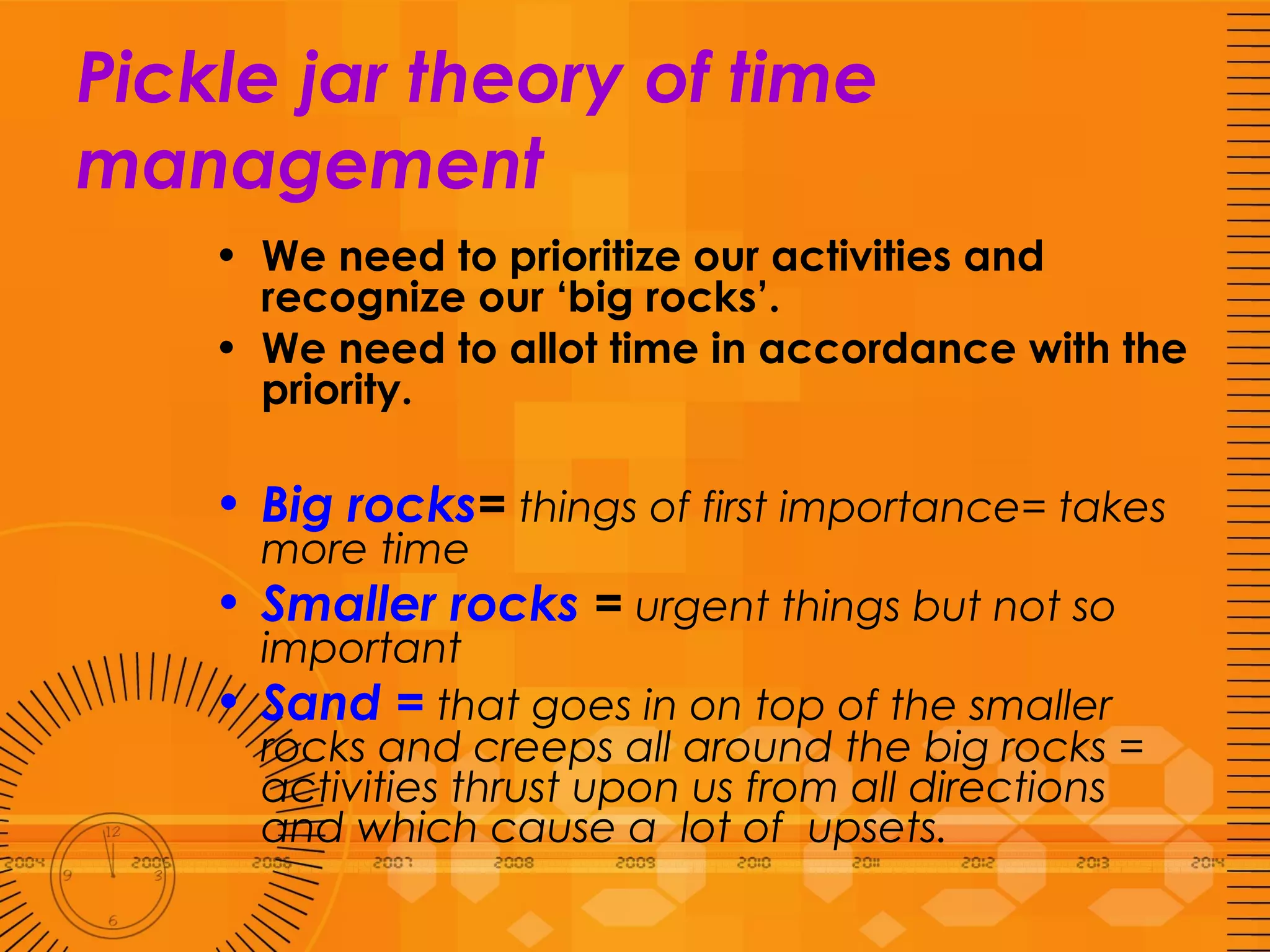
Pickle jar theoryof time management We need to prioritize our activities and recognize our ‘big rocks’. We need to allot time in accordance with the priority. Big rocks = things of first importance= takes more time Smaller rocks = urgent things but not so important Sand = that goes in on top of the smaller rocks and creeps all around the big rocks = activities thrust upon us from all directions and which cause a lot of upsets.
6.
The 80/20 RuleWe devote 20% of our time to activity that is central to our aims and 80% on activity that is of marginal importance.
The Problem isSevere By some estimates, people waste about 2 hours per day. Signs of time wasting: Messy desk Can’t find things Miss appointments, unprepared for meetings Volunteer to do things other people should do Tired/unable to concentrate
12.
You’ve Got enoughTime! Time is an equal opportunity resource: everyone gets 168 hours per week Time is elusive and easy to ignore Time is a non-renewable resource Time seems to pass at varying speeds
Time Management InvolvesKnowing what your goals are Deciding what your priorities are Anticipating future needs and possible changes Controlling your life by controlling your time Making a commitment to being punctual Not procrastinating Carrying out your plans
15.
Ask yourself :Why am I doing this? What is the goal? Why will I succeed? What happens if I chose not to do it?
16.
Planning Failing toplan is planning to fail Plan Each Day, Each Week, Each Semester You can always change your plan, but only once you have one !
17.
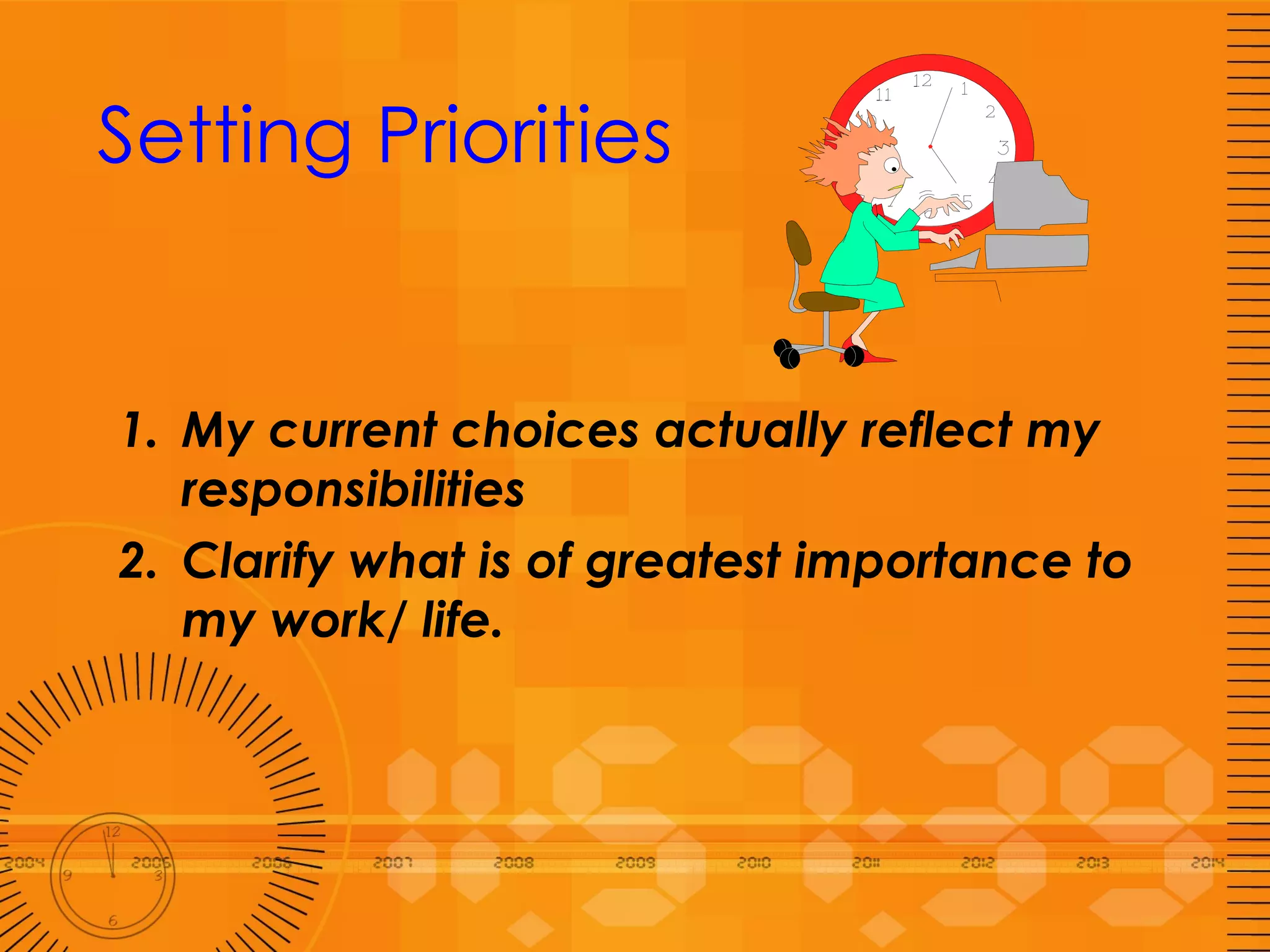
Setting Priorities Mycurrent choices actually reflect my responsibilities 2. Clarify what is of greatest importance to my work/ life.
18.
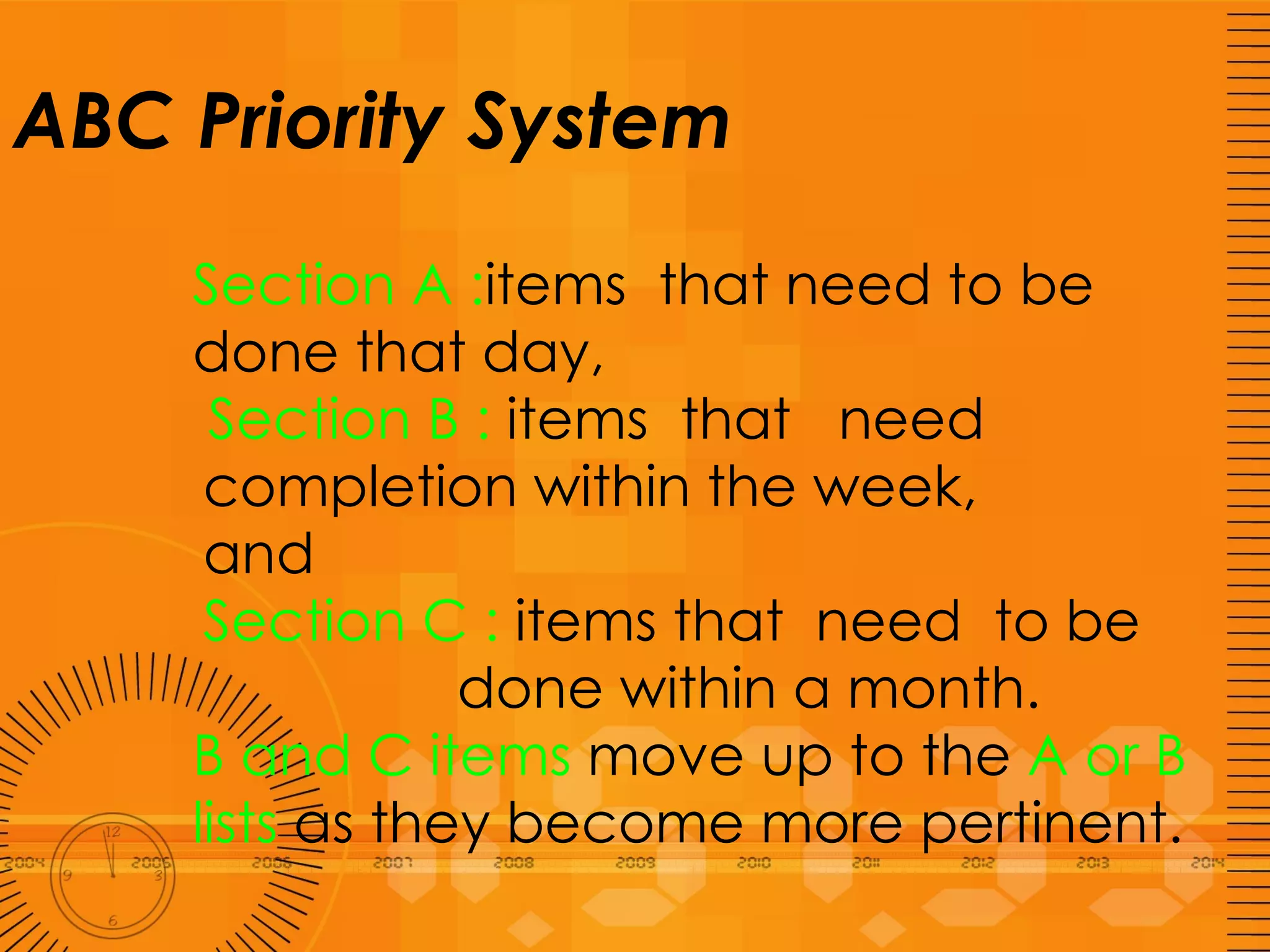
ABC Priority SystemSection A : items that need to be done that day, Section B : items that need completion within the week, and Section C : items that need to be done within a month. B and C items move up to the A or B lists as they become more pertinent.
19.
Help for DecidingWhat Comes Next Define responsibilities Clarify objectives Prioritize activities Identify development vs. maintenance activities Clarify as needed Negotiate deadlines
20.
Revise and PreviewImmediately note all changes. Preview the upcoming week making any adjustments. Preview each day to further specify plans.
21.
Symptoms of PoorTime Management A lack of achievement. Deadlines always missed. More time spent socializing at work. More time on the telephone. Indecisiveness leading to delayed work. Constantly interrupting others and being interrupted.
22.
Barriers to goodtime management Keeping too many things in your head Doing whatever grabs your attention next Doing very efficiently that which need not be done at all Not spending enough time on your top priorities Poor Planning
23.
Barriers to goodtime management Working in a disorganized and distracting environment Attempting to do “too much” Always saying “YES” Not managing your inflows Confusing activity with productivity
24.
Sticking to aschedule provides greater control. encourages relaxation saves time provides freedom increases flexibility
25.
Standardtime schedules Dividing time in to blocks Makes tasks more manageable Helps you work at peak efficiency
Using a DailyPlanner Complete a term assignment preview. Use a “week at a glance” organizer. Enter in due dates and social events as soon as you can. Review your calendar daily for the current week and upcoming week. It just takes a moment to review your calendar and it can help relieve stress.
28.
Two main waysto control time Saving it Allocating it with schedules
29.
Time Management TipsLearn to say no assertively. Plan for rewards after an unpleasant task. Plan for change; it’s inevitable. Finish fully; it’s energizing & motivating. Remember: Spending one minute planning saves four or five minutes in getting a task done.
30.
Time wasters Telephonecalls Poor planning Attempting to do too much Drop- in visitors Poor delegation Personal disorganization Lack of self discipline Can’t say ‘no’ ! Procrastination.
31.
Using Time toYour Benefit Can create a sense of satisfaction. Can help you to balance work and personal life. Can reduce stress and improve your health. Can improve your career since you will spend more time satisfying internal and external customers.
32.
Conclusion “ Ifyou keep doing the same old thing in the same old way, you will keep getting the same old results.”
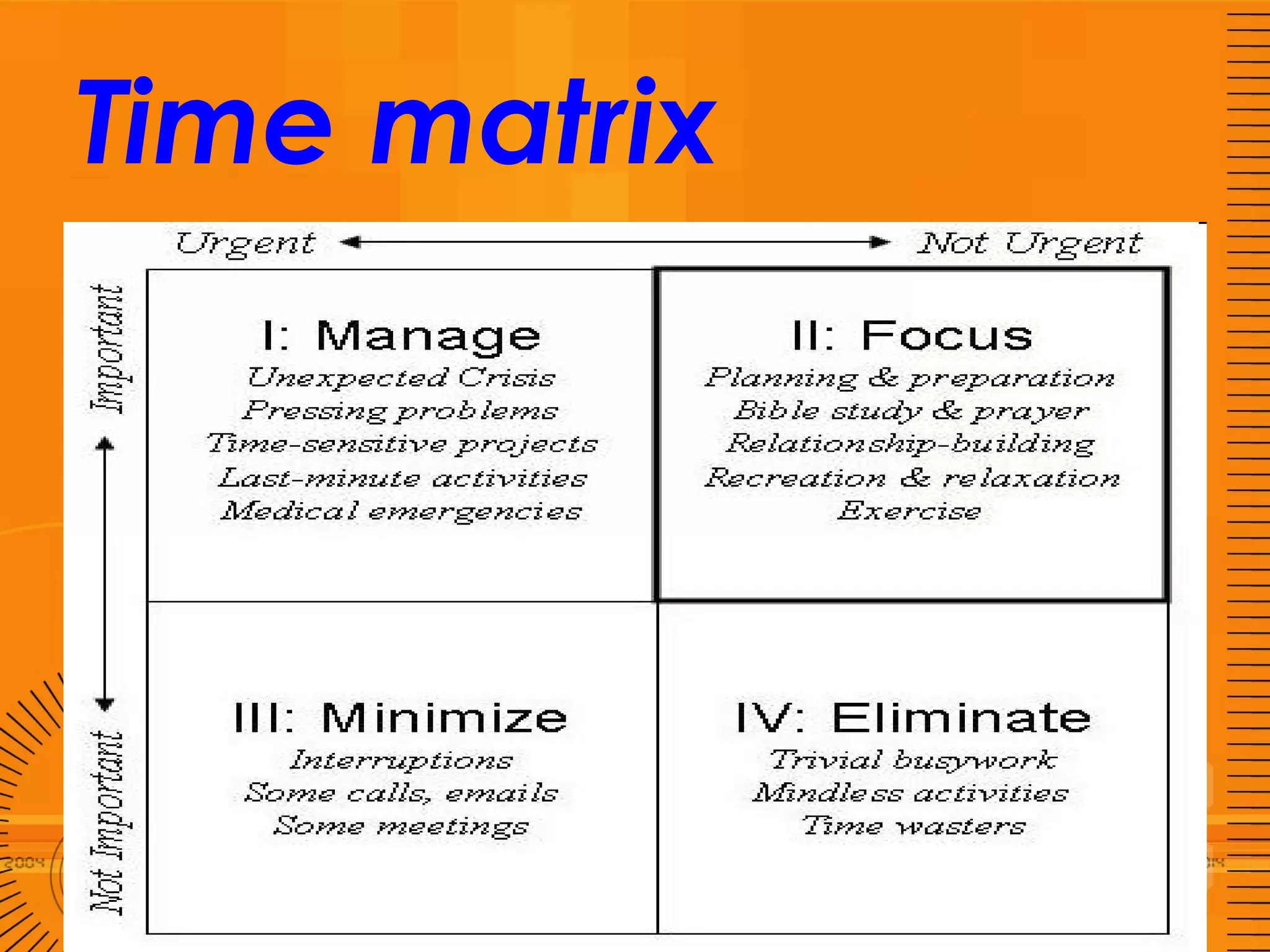
#23 1. A common Time management mistake is trying to use your memory to keep track of all the things you need to do and places you need to be The fact is that you simply cannot rely on your memory alone to keep track of all these details without getting overloaded. Information overload is a growing problem in the corporate environments, and is a major source of stress and anxiety. 2. Things that grab your attention are not always very important, and they often don’t represent your best way to spend your time. URGENT things are not always important, and IMPORTANT Things are not always urgent. 3. Spending your time doing unnecessary work is not a good time management practice, since you could spend that time doing other important things. 4. Symptoms of Poor Prioritization TOO MUCH TO DO AND NOT ENOUGH TIME FEELING OVERWHELMED AND OUT OF CONTROL FEELING UNDER CONSTANT TIME PRESSURE NOT MAKING SIGNIFICANT PROGRESS ON IMPORTANT GOALS Effective time managers have to be selective with their limited amount of time and consciously choose to spend it on what is important 5. Without adequate planning, it is difficult to understand what it will take to complete a project successfully. Lack of planning leads to inadequate preparation, unexpected problems and poor execution IT IS ESTIMATED THAT FOR EVERY MINUTE SPENT PLANNING CAN SAVE THREE MINUTES IN EXECUTION
#24 Organize your work space. Piles of paper become a problem when the level of disorganization causes you to misplace information, forget important deadlines and assignments and waste time searching for things You simply can not do everything that is available. Whenever you choose to do something, you are automatically rejecting everything else that could have been done during that time. WHEN EVERYTHING IS IMPORTANT – NOTHING IS IMPORTANT Establish your limits and stick to them. 3. Always saying YES is a major source of overload and stress and it can lead away from your top priorities into less important tasks. If you want to the work and stress associated with attempting too much, you need to decide carefully whether to accept new tasks or not. 4. Inadequate inflow management leads to forgotten requests, incomplete work, misplaced information, and general feelings of anxiety and overwhelm. Use a daily journal/calender/day timer to manage your inflow information and a “to do” list to help in prioritizing your tasks 5. You can stay very busy doing meaningless work that doesn’t bring you closer to your objectives, or spending countless hours fixing problesm and putting out fires that could have been avoided. Once you master the dundamentals of time management, you can begin to look at the higher levels to continue improving your productivity and effectiveness.