Managing People


ARE YOU A MANAGER
   OR A LEADER?
Managing People
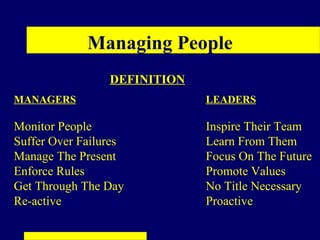
                 DEFINITION
MANAGERS                      LEADERS

Monitor People                Inspire Their Team
Suffer Over Failures          Learn From Them
Manage The Present            Focus On The Future
Enforce Rules                 Promote Values
Get Through The Day           No Title Necessary
Re-active                     Proactive
Managing People

               Definition:

Skills used to achieve success with people
                     or
      The ability to help people and
      companies surpass themselves


     (Easier to observe than explain)
Managing People

       FACT
  LEADERS DO NOT HAVE
  TO BE GOOD MANAGERS

          BUT

    MANAGERS HAVE
   TO BE GOOD LEADERS
Managing People
 Could you still achieve good results
With your team if you did not have your
  Title or the power to hire and fire?
Self
Belief
Managing People
                  Self mastery

•   Total self belief
•   Clearly defined values
•   Positive mental attitude
•   Self discipline
•   Credibility
•   Continual learning
Managing People
Before you manage others you
   have to manage yourself
Time
Management
Time Management
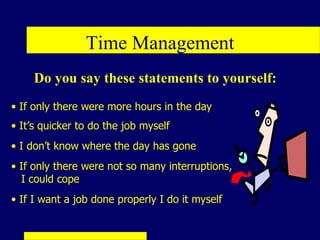
     Do you say these statements to yourself:
• If only there were more hours in the day
• It’s quicker to do the job myself
• I don’t know where the day has gone
• If only there were not so many interruptions,
  I could cope
• If I want a job done properly I do it myself
Time Management
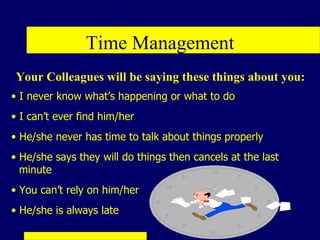
 Your Colleagues will be saying these things about you:
• I never know what’s happening or what to do
• I can’t ever find him/her
• He/she never has time to talk about things properly
• He/she says they will do things then cancels at the last
  minute
• You can’t rely on him/her
• He/she is always late
Time Management


Define the purpose of your
         company
Time Management
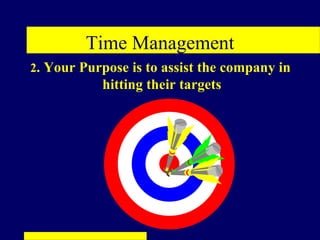
2. Your Purpose is to assist the company in
           hitting their targets
Time Management
                 Prioritising

• Active tasks - Important (your purpose)

• Re-active tasks - Everything else that
                    hits your desk
Time Management


It’s easier to be busy
than to get things done.
Time Management
     Focus
    Focus
   Focus
   Focus
Work styles
 Psycho-
Geometric’s
Choose a shape
Motivation
What motivates you?
Why do you get out of bed in the morning ?
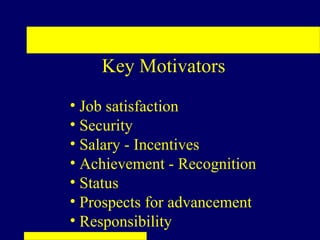
Key Motivators
• Job satisfaction
• Security
• Salary - Incentives
• Achievement - Recognition
• Status
• Prospects for advancement
• Responsibility
Management
   styles
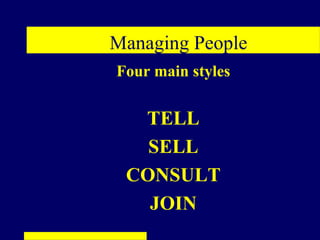
Managing People
Four main styles


  TELL
   SELL
 CONSULT
   JOIN
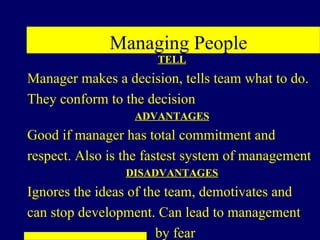
Managing People
                      TELL
Manager makes a decision, tells team what to do.
They conform to the decision
                  ADVANTAGES
Good if manager has total commitment and
respect. Also is the fastest system of management
                 DISADVANTAGES
Ignores the ideas of the team, demotivates and
can stop development. Can lead to management
                       by fear
Managing People
                         SELL
Manager makes a decision, then sells the idea
to them persuasively. Gives them all the benefits.
                     ADVANTAGES
Overcomes resistance to decisions, flatters people.
We like to be sold to.
                   DISADVANTAGES
Ignores ideas of team, could be seen as manipulative
or perceived as dishonest.
Managing People
                  CONSULT
Manager makes a provisional decision,
 presents decision to team. This can then be
 modified or changed.
                ADVANTAGES
By listening to teams ideas, decision may be
 modified for the better.
               DISADVANTAGES
Managers can find it difficult to be neutral,
 may then resort to “SELL” Decisions may
Managing People
                      JOIN
Manager makes no decision, manager chairs
decision meeting. Joint decision is reached.
                  ADVANTAGES
Encourages free flow of ideas, team is
therefore committed. Good motivating tool.
                 DISADVANTAGES
Leadership skills may be questioned, and
teams resistance may be strong. May cost respect
                                    and takes
Managing People

                 SUMMARY
•   Leadership requires skill
•   Ability to adapt to different situations
•   Ability to use more than one style
•   Knowing when to take command
Delegation
  Skills
Delegation Skills


Delegation is not
 ABDICATION
Delegation Skills
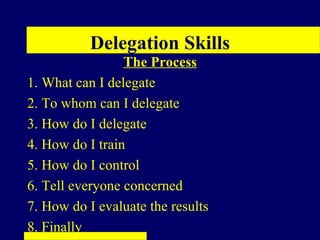
                 The Process
1. What can I delegate
2. To whom can I delegate
3. How do I delegate
4. How do I train
5. How do I control
6. Tell everyone concerned
7. How do I evaluate the results
8. Finally
Delegation Skills
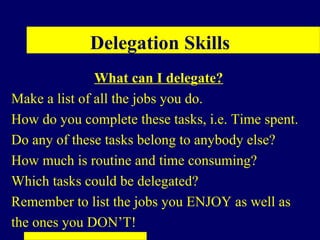
               What can I delegate?
Make a list of all the jobs you do.
How do you complete these tasks, i.e. Time spent.
Do any of these tasks belong to anybody else?
How much is routine and time consuming?
Which tasks could be delegated?
Remember to list the jobs you ENJOY as well as
the ones you DON’T!
Delegation Skills
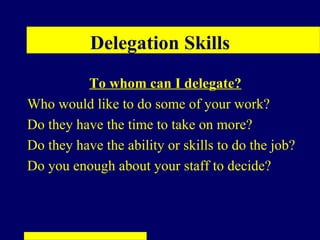
          To whom can I delegate?
Who would like to do some of your work?
Do they have the time to take on more?
Do they have the ability or skills to do the job?
Do you enough about your staff to decide?
Delegation Skills
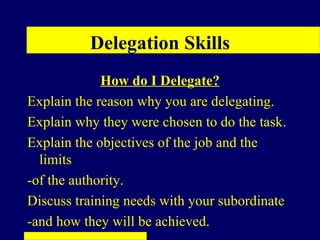
             How do I Delegate?
Explain the reason why you are delegating.
Explain why they were chosen to do the task.
Explain the objectives of the job and the
  limits
-of the authority.
Discuss training needs with your subordinate
-and how they will be achieved.
Delegation Skills
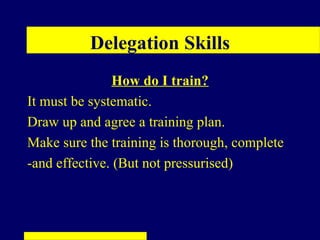
               How do I train?
It must be systematic.
Draw up and agree a training plan.
Make sure the training is thorough, complete
-and effective. (But not pressurised)
Delegation Skills
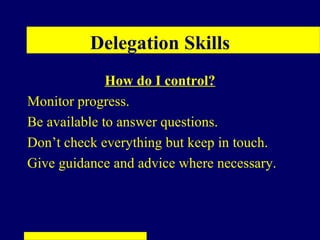
              How do I control?
Monitor progress.
Be available to answer questions.
Don’t check everything but keep in touch.
Give guidance and advice where necessary.
Delegation Skills
       Make sure everybody is informed
Tell everybody concerned about the delegation.
Make sure everything to do with the job goes
-directly to your subordinate.
Delegation Skills
        How do I evaluate the results?
Is the job being performed satisfactorily?
If so, give praise.
If not, find out why and take necessary action
-to rectify, i.e. further training, more time.
Has a better way of doing the job evolved?
Delegation Skills
                  Finally
Can I now delegate any more tasks?
How much time have I saved?
HOW ARE YOU GOING TO USE THAT
TIME MORE EFFECTIVELY?
Delegation Skills
                   Things to remember
•   Think very carefully about which jobs to delegate.
•   Remember to include jobs that you enjoy,
    -it probably means that your subordinate will enjoy
    them to.
•   If you get it wrong it will not be taken seriously next
    time.
•   Finally observe from a distance.
Summary
Managing People
• MANAGERS
• Deal with people where they are

• LEADERS
• Take people to where they need to be!
LEADERSHIP SKILLS
       Managing People
       Definition of a Professional
• Someone who does their best even
  when they don`t feel like it

• Do one tough challenging task per day

• Do one fun task every day
Managing People


To be successful in your business
  you must be a student of your
            business
Managing People
Differences between efficiency and effectiveness

• EFFICIENCY is doing the job right

• EFFECTIVENESS is doing the right job
Managing People
                 SUMMARY
• Designing a blueprint for the future
• The future belongs to the people who see
  opportunities before they become obvious

  “If you see a bandwagon it is to late”
Action Plan

Managing people

  • 1.
    Managing People ARE YOUA MANAGER OR A LEADER?
  • 2.
    Managing People DEFINITION MANAGERS LEADERS Monitor People Inspire Their Team Suffer Over Failures Learn From Them Manage The Present Focus On The Future Enforce Rules Promote Values Get Through The Day No Title Necessary Re-active Proactive
  • 3.
    Managing People Definition: Skills used to achieve success with people or The ability to help people and companies surpass themselves (Easier to observe than explain)
  • 4.
    Managing People FACT LEADERS DO NOT HAVE TO BE GOOD MANAGERS BUT MANAGERS HAVE TO BE GOOD LEADERS
  • 5.
    Managing People Couldyou still achieve good results With your team if you did not have your Title or the power to hire and fire?
  • 6.
  • 7.
    Managing People Self mastery • Total self belief • Clearly defined values • Positive mental attitude • Self discipline • Credibility • Continual learning
  • 8.
    Managing People Before youmanage others you have to manage yourself
  • 9.
  • 10.
    Time Management Do you say these statements to yourself: • If only there were more hours in the day • It’s quicker to do the job myself • I don’t know where the day has gone • If only there were not so many interruptions, I could cope • If I want a job done properly I do it myself
  • 11.
    Time Management YourColleagues will be saying these things about you: • I never know what’s happening or what to do • I can’t ever find him/her • He/she never has time to talk about things properly • He/she says they will do things then cancels at the last minute • You can’t rely on him/her • He/she is always late
  • 12.
    Time Management Define thepurpose of your company
  • 13.
    Time Management 2. YourPurpose is to assist the company in hitting their targets
  • 14.
    Time Management Prioritising • Active tasks - Important (your purpose) • Re-active tasks - Everything else that hits your desk
  • 15.
    Time Management It’s easierto be busy than to get things done.
  • 16.
    Time Management Focus Focus Focus Focus
  • 17.
  • 18.
  • 19.
  • 20.
    What motivates you? Whydo you get out of bed in the morning ?
  • 21.
    Key Motivators • Jobsatisfaction • Security • Salary - Incentives • Achievement - Recognition • Status • Prospects for advancement • Responsibility
  • 22.
  • 23.
    Managing People Four mainstyles TELL SELL CONSULT JOIN
  • 24.
    Managing People TELL Manager makes a decision, tells team what to do. They conform to the decision ADVANTAGES Good if manager has total commitment and respect. Also is the fastest system of management DISADVANTAGES Ignores the ideas of the team, demotivates and can stop development. Can lead to management by fear
  • 25.
    Managing People SELL Manager makes a decision, then sells the idea to them persuasively. Gives them all the benefits. ADVANTAGES Overcomes resistance to decisions, flatters people. We like to be sold to. DISADVANTAGES Ignores ideas of team, could be seen as manipulative or perceived as dishonest.
  • 26.
    Managing People CONSULT Manager makes a provisional decision, presents decision to team. This can then be modified or changed. ADVANTAGES By listening to teams ideas, decision may be modified for the better. DISADVANTAGES Managers can find it difficult to be neutral, may then resort to “SELL” Decisions may
  • 27.
    Managing People JOIN Manager makes no decision, manager chairs decision meeting. Joint decision is reached. ADVANTAGES Encourages free flow of ideas, team is therefore committed. Good motivating tool. DISADVANTAGES Leadership skills may be questioned, and teams resistance may be strong. May cost respect and takes
  • 28.
    Managing People SUMMARY • Leadership requires skill • Ability to adapt to different situations • Ability to use more than one style • Knowing when to take command
  • 29.
  • 30.
  • 31.
    Delegation Skills The Process 1. What can I delegate 2. To whom can I delegate 3. How do I delegate 4. How do I train 5. How do I control 6. Tell everyone concerned 7. How do I evaluate the results 8. Finally
  • 32.
    Delegation Skills What can I delegate? Make a list of all the jobs you do. How do you complete these tasks, i.e. Time spent. Do any of these tasks belong to anybody else? How much is routine and time consuming? Which tasks could be delegated? Remember to list the jobs you ENJOY as well as the ones you DON’T!
  • 33.
    Delegation Skills To whom can I delegate? Who would like to do some of your work? Do they have the time to take on more? Do they have the ability or skills to do the job? Do you enough about your staff to decide?
  • 34.
    Delegation Skills How do I Delegate? Explain the reason why you are delegating. Explain why they were chosen to do the task. Explain the objectives of the job and the limits -of the authority. Discuss training needs with your subordinate -and how they will be achieved.
  • 35.
    Delegation Skills How do I train? It must be systematic. Draw up and agree a training plan. Make sure the training is thorough, complete -and effective. (But not pressurised)
  • 36.
    Delegation Skills How do I control? Monitor progress. Be available to answer questions. Don’t check everything but keep in touch. Give guidance and advice where necessary.
  • 37.
    Delegation Skills Make sure everybody is informed Tell everybody concerned about the delegation. Make sure everything to do with the job goes -directly to your subordinate.
  • 38.
    Delegation Skills How do I evaluate the results? Is the job being performed satisfactorily? If so, give praise. If not, find out why and take necessary action -to rectify, i.e. further training, more time. Has a better way of doing the job evolved?
  • 39.
    Delegation Skills Finally Can I now delegate any more tasks? How much time have I saved? HOW ARE YOU GOING TO USE THAT TIME MORE EFFECTIVELY?
  • 40.
    Delegation Skills Things to remember • Think very carefully about which jobs to delegate. • Remember to include jobs that you enjoy, -it probably means that your subordinate will enjoy them to. • If you get it wrong it will not be taken seriously next time. • Finally observe from a distance.
  • 41.
  • 42.
    Managing People • MANAGERS •Deal with people where they are • LEADERS • Take people to where they need to be!
  • 43.
    LEADERSHIP SKILLS Managing People Definition of a Professional • Someone who does their best even when they don`t feel like it • Do one tough challenging task per day • Do one fun task every day
  • 44.
    Managing People To besuccessful in your business you must be a student of your business
  • 45.
    Managing People Differences betweenefficiency and effectiveness • EFFICIENCY is doing the job right • EFFECTIVENESS is doing the right job
  • 46.
    Managing People SUMMARY • Designing a blueprint for the future • The future belongs to the people who see opportunities before they become obvious “If you see a bandwagon it is to late”
  • 47.