DELEGATION


     What is it?
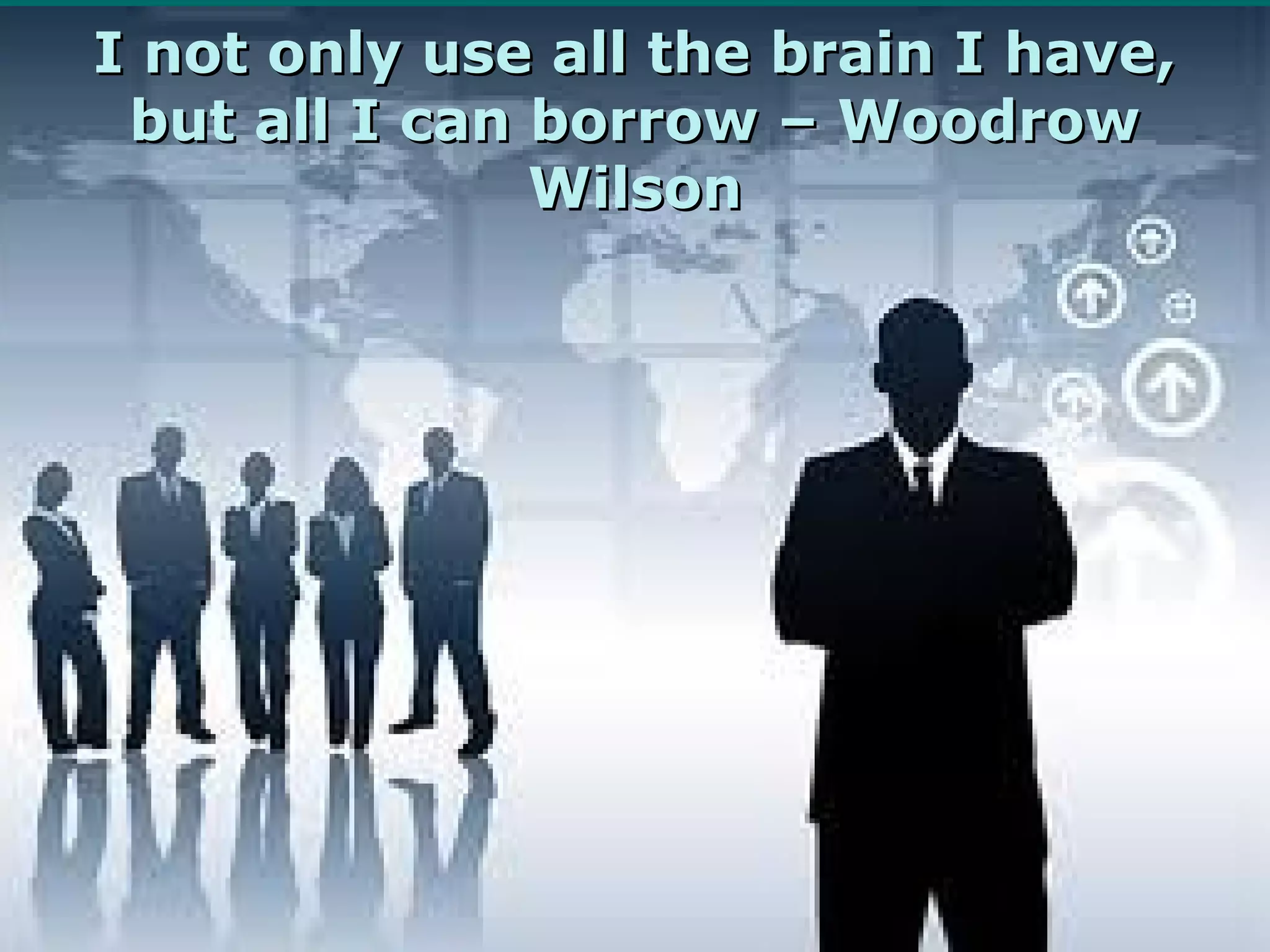
I not only use all the brain I have,
 but all I can borrow – Woodrow
               Wilson
Delegation is ..

• Appointing a person to act on one’s
  behalf.
• Entrusting of Authority, Power and
  Responsibility to another.
• Delegation is also called Deputation
  in the assignment of authority and
  responsibility to another person.
Why Delegate ?
It takes a strong person and a good
  leader to effectively delegate tasks.
• Delegate for Quality
• Delegate for Even Distribution
• Saves Time
• Develops people’s skill and ability
Why managers’ don’t
             delegate
•   The belief that, ‘I can do it better myself’
•   Attachment with previous responsibility
•   Lack of confidence and trust in subordinates
•   Low self-confidence and insecurity
•   Unwillingness to accept risk
•   Time involved in explaining the task
•   Fear of loss of power
•   Lack of availability of competent subordinate
•   Subordinates’ resistance to delegation
What to Delegate ?
• Things subordinate can do better

• Things subordinate needs to do for
  growth

• Operational work

• Things for which you don’t have time
What not to Delegate ?
• What you yourself is not able to do
• What you are directly contributing to
  your business
• Work your subordinates cannot
  perform effectively
• Management Decision
• Personal Accountability
Successful Delegation
• Makes work easier
• Improves efficiency
• Increases employee effectiveness
• Develops employees
• Ensures that the right person does
  the right job
Impact of Delegation
Good delegation              Bad delegation
•   Saves your time
                             • morale buster for
•   Develops your people
                               the team
•   Grooms a successor
•   Motivates employees      • May lead to bad
•   Allows you to take up      blood within the
    bigger assignments         team
•   Improves productivity    • Frustration
•   Improves communication
•   Improves trust
                             • Confusion
•   Improves outcomes        • Failure in
                               completion of work
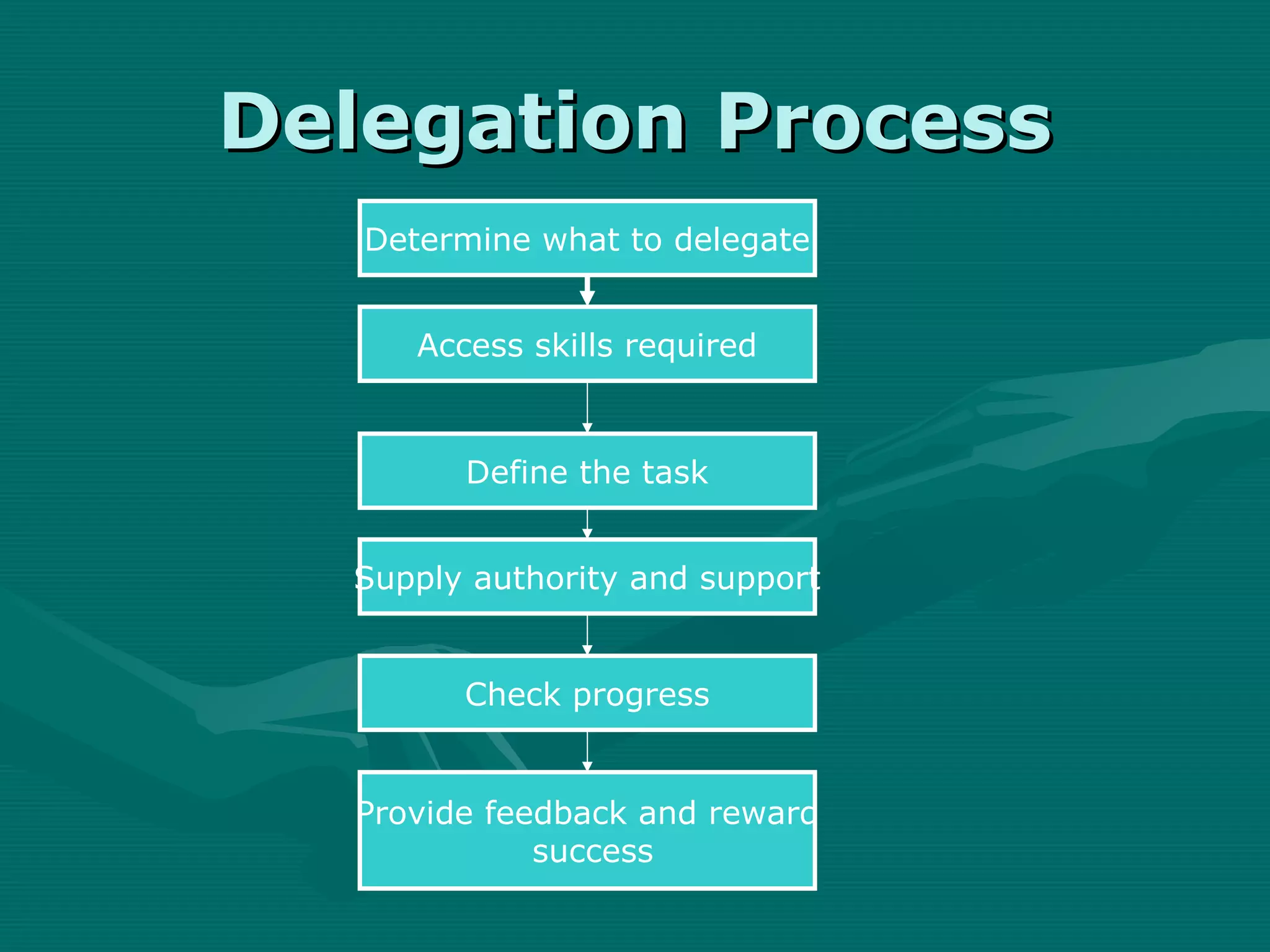
Delegation Process
   Determine what to delegate


      Access skills required


         Define the task


  Supply authority and support


         Check progress


  Provide feedback and reward
             success
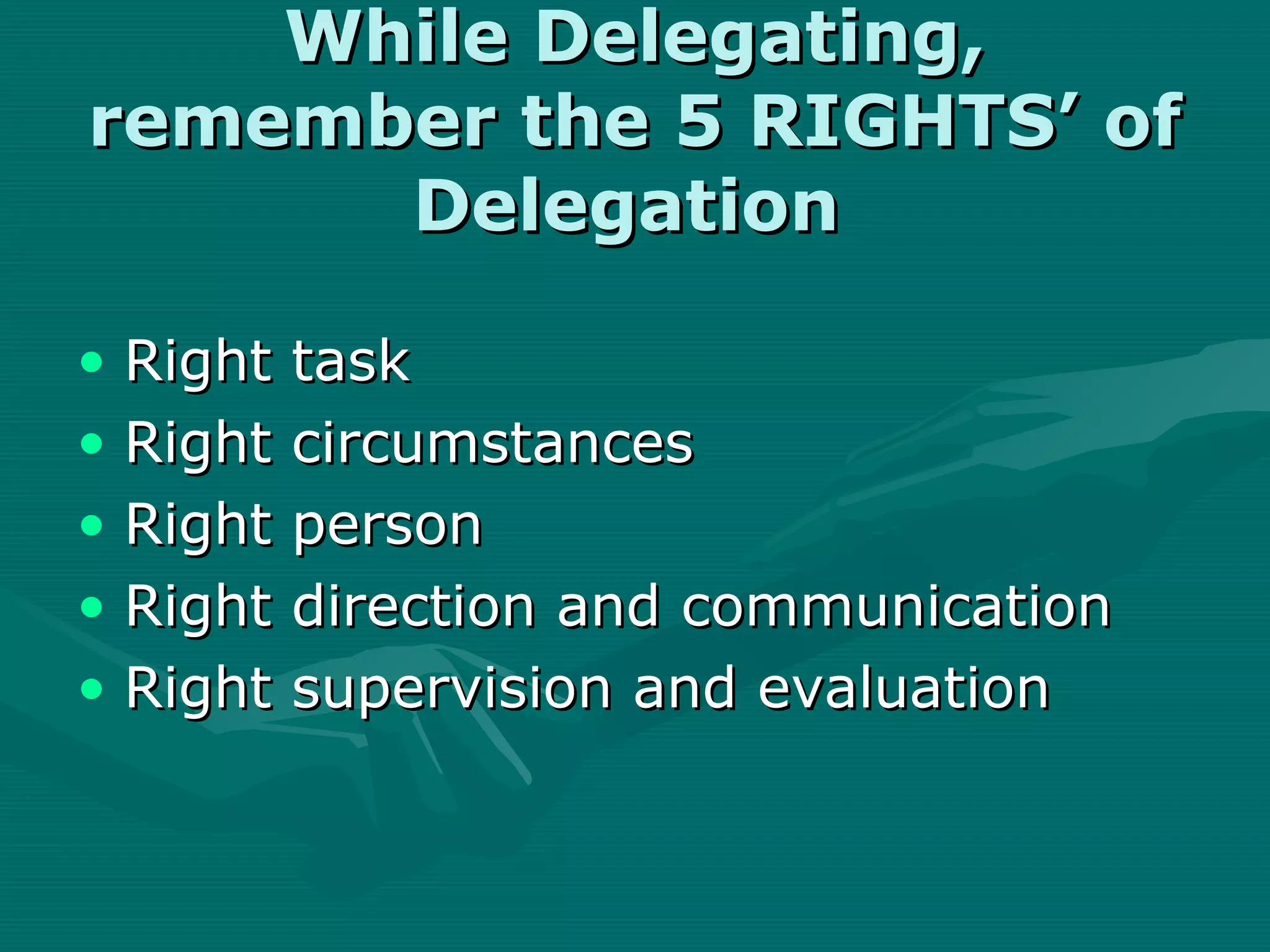
While Delegating,
remember the 5 RIGHTS’ of
      Delegation

• Right task
• Right circumstances
• Right person
• Right direction and communication
• Right supervision and evaluation
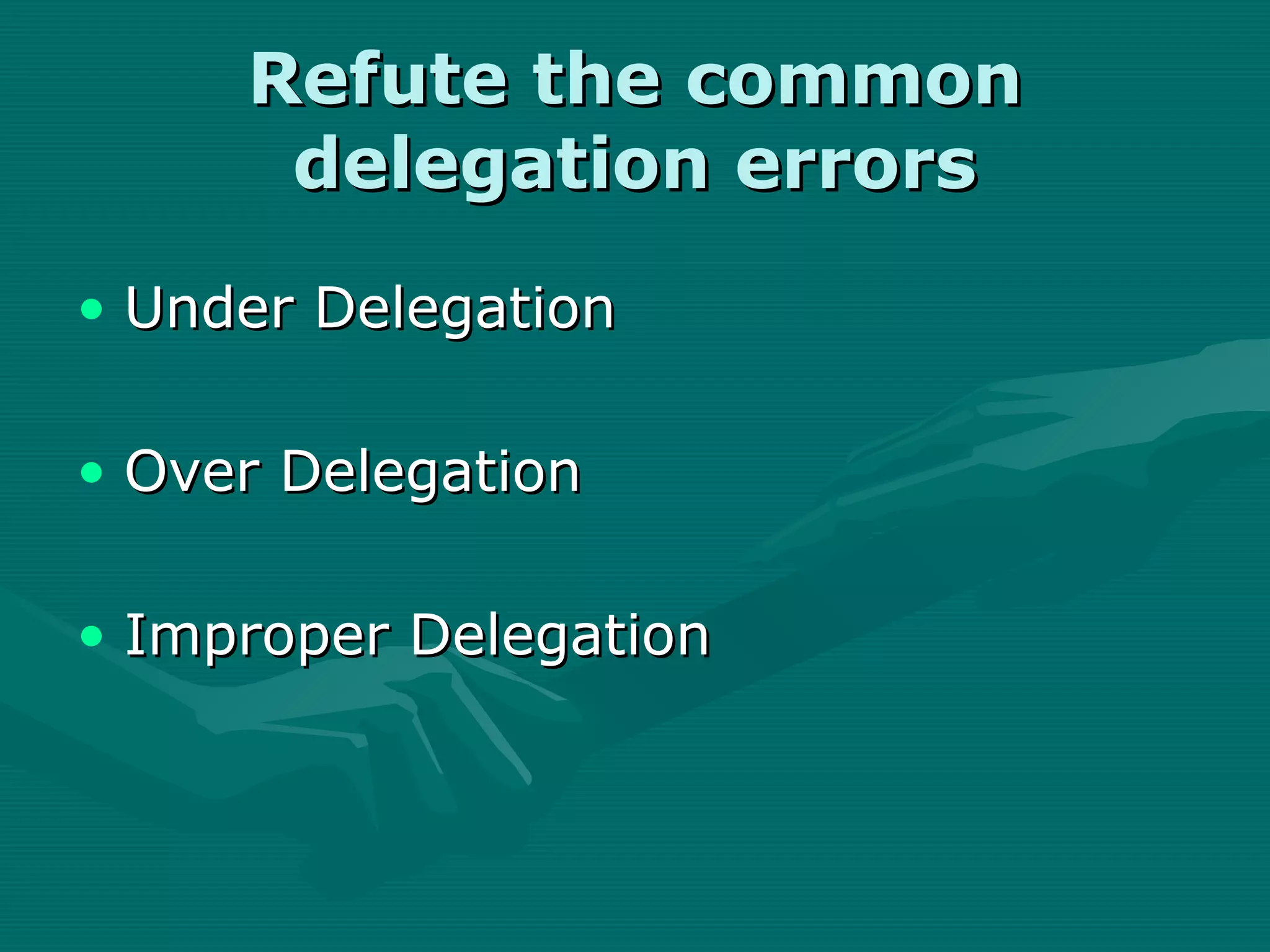
Refute the common
      delegation errors
• Under Delegation

• Over Delegation

• Improper Delegation
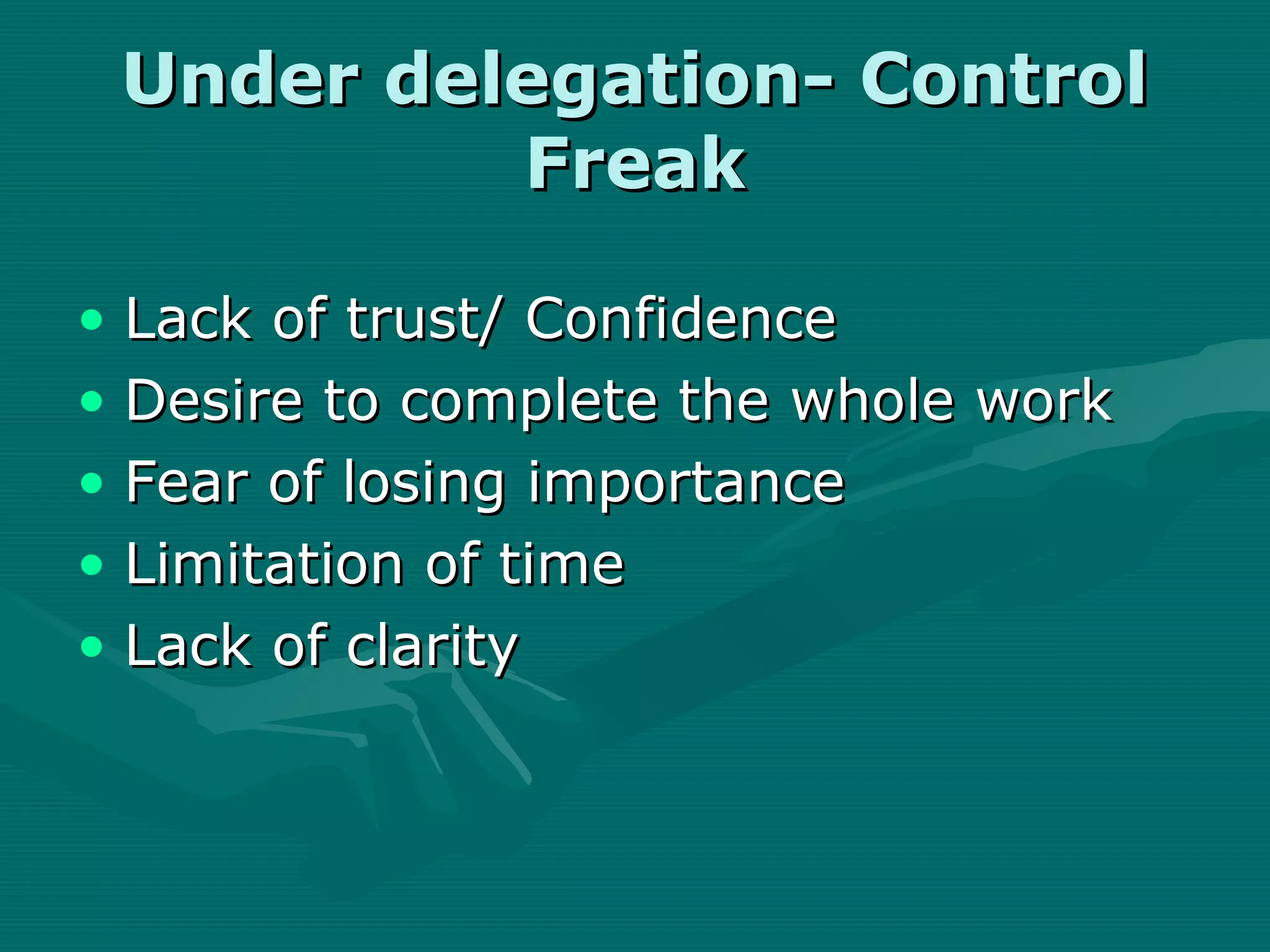
Under delegation- Control
          Freak

• Lack of trust/ Confidence
• Desire to complete the whole work
• Fear of losing importance
• Limitation of time
• Lack of clarity
Over delegation- Desk
           Cleaner
• Don’t want any kind of load
• Quality work ISN’T their priority
• Freaks around
• Over-confident
• Poor management of time
• Feels insecure in their ability to
  perform a task
Improper delegation

• Wrong   time
• Wrong   person
• Wrong   reason
• Wrong   task
Why subordinates don’t
     accept delegation
• Perpetual dependence on superiors

• Lack of confidence

• Lack of positive incentive
Types of Delegation
• Downward delegation

• Upward delegation

• Sidewise delegation
Dual characteristic of
         Delegation
• As a result of delegation the
  subordinate receives authority from
  the superior but at the same time
  the superior retains all original
  authority
• Therefore authority and responsibility
  can be delegated by a manager, they
  can never be abdicated.
The best executive is the one who has sense enough to pick
  good men to do what he wants done, and self-restraint
  enough to keep from meddling with them when they do it.

                - Theodore Roosevelt
Delegation Vs.
      Decentralization


Effective delegation of authority is a
    pre-requisite for the success of
           decentralization
Delegation Vs.
      Decentralization
  Decentralization can be called as
    extension of delegation. When
delegation of authority is done to the
fullest possible extent, it gives use to
           decentralization.
THANK YOU

Delegation

  • 1.
    DELEGATION What is it?
  • 2.
    I not onlyuse all the brain I have, but all I can borrow – Woodrow Wilson
  • 3.
    Delegation is .. •Appointing a person to act on one’s behalf. • Entrusting of Authority, Power and Responsibility to another. • Delegation is also called Deputation in the assignment of authority and responsibility to another person.
  • 4.
    Why Delegate ? Ittakes a strong person and a good leader to effectively delegate tasks. • Delegate for Quality • Delegate for Even Distribution • Saves Time • Develops people’s skill and ability
  • 6.
    Why managers’ don’t delegate • The belief that, ‘I can do it better myself’ • Attachment with previous responsibility • Lack of confidence and trust in subordinates • Low self-confidence and insecurity • Unwillingness to accept risk • Time involved in explaining the task • Fear of loss of power • Lack of availability of competent subordinate • Subordinates’ resistance to delegation
  • 8.
    What to Delegate? • Things subordinate can do better • Things subordinate needs to do for growth • Operational work • Things for which you don’t have time
  • 10.
    What not toDelegate ? • What you yourself is not able to do • What you are directly contributing to your business • Work your subordinates cannot perform effectively • Management Decision • Personal Accountability
  • 12.
    Successful Delegation • Makeswork easier • Improves efficiency • Increases employee effectiveness • Develops employees • Ensures that the right person does the right job
  • 13.
    Impact of Delegation Gooddelegation Bad delegation • Saves your time • morale buster for • Develops your people the team • Grooms a successor • Motivates employees • May lead to bad • Allows you to take up blood within the bigger assignments team • Improves productivity • Frustration • Improves communication • Improves trust • Confusion • Improves outcomes • Failure in completion of work
  • 14.
    Delegation Process Determine what to delegate Access skills required Define the task Supply authority and support Check progress Provide feedback and reward success
  • 15.
    While Delegating, remember the5 RIGHTS’ of Delegation • Right task • Right circumstances • Right person • Right direction and communication • Right supervision and evaluation
  • 16.
    Refute the common delegation errors • Under Delegation • Over Delegation • Improper Delegation
  • 17.
    Under delegation- Control Freak • Lack of trust/ Confidence • Desire to complete the whole work • Fear of losing importance • Limitation of time • Lack of clarity
  • 18.
    Over delegation- Desk Cleaner • Don’t want any kind of load • Quality work ISN’T their priority • Freaks around • Over-confident • Poor management of time • Feels insecure in their ability to perform a task
  • 19.
    Improper delegation • Wrong time • Wrong person • Wrong reason • Wrong task
  • 21.
    Why subordinates don’t accept delegation • Perpetual dependence on superiors • Lack of confidence • Lack of positive incentive
  • 22.
    Types of Delegation •Downward delegation • Upward delegation • Sidewise delegation
  • 23.
    Dual characteristic of Delegation • As a result of delegation the subordinate receives authority from the superior but at the same time the superior retains all original authority • Therefore authority and responsibility can be delegated by a manager, they can never be abdicated.
  • 24.
    The best executiveis the one who has sense enough to pick good men to do what he wants done, and self-restraint enough to keep from meddling with them when they do it. - Theodore Roosevelt
  • 25.
    Delegation Vs. Decentralization Effective delegation of authority is a pre-requisite for the success of decentralization
  • 26.
    Delegation Vs. Decentralization Decentralization can be called as extension of delegation. When delegation of authority is done to the fullest possible extent, it gives use to decentralization.
  • 27.