CEBUTECHNOLOGICALUNIVERSITY 
HUMANRELATIONS 
PREPAREDBY: 
JULIEMAYMARIBOJO 
JOHNCARLOSGESTA
 The Formal Organization is a system of well-defined 
jobs, each bearing a definite measure of 
authority, responsibility and accountability. 
Louis Allen 
 Formal Organization is a system of consciously 
coordinated activities of two or more persons 
toward a common objective. 
Chester Barnard
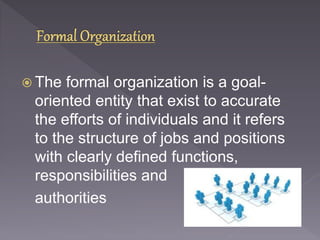
 The formal organization is a goal-oriented 
entity that exist to accurate 
the efforts of individuals and it refers 
to the structure of jobs and positions 
with clearly defined functions, 
responsibilities and 
authorities
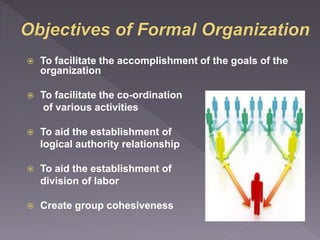
 To facilitate the accomplishment of the goals of the 
organization 
 To facilitate the co-ordination 
of various activities 
 To aid the establishment of 
logical authority relationship 
 To aid the establishment of 
division of labor 
 Create group cohesiveness
1. Well defined rules and 
regulation
2. Arbitrary structure
3. Determined objectives and 
policies
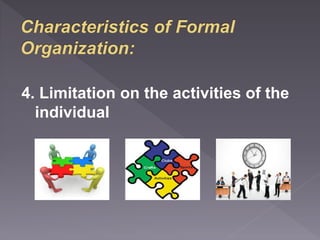
4. Limitation on the activities of the 
individual
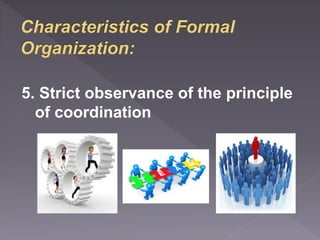
5. Strict observance of the principle 
of coordination
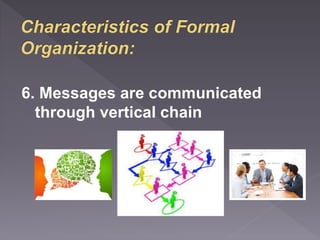
6. Messages are communicated 
through vertical chain
7. Status symbol
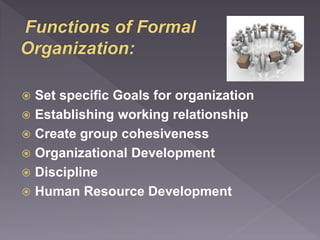
 Set specific Goals for organization 
 Establishing working relationship 
 Create group cohesiveness 
 Organizational Development 
 Discipline 
 Human Resource Development
b) Social Aspects of benefits: a) Financial Aspects of benefits: 
 Security 
 Slow but steady promotion 
 Commissioned ranks open to men and 
women graduates 
 Can't be fired 
 Good retirement benefits 
 Many different branches appeal to 
different interests 
 Social Status 
 See interesting places and people
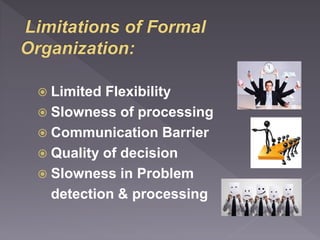
 Limited Flexibility 
 Slowness of processing 
 Communication Barrier 
 Quality of decision 
 Slowness in Problem 
detection & processing
 An Informal organization is an aggregate of 
interpersonal relationships without any conscious 
purpose but which may contribute to joint results. 
Chester Barnard 
 Informal organization is a network of interpersonal 
relationship that arise when people associate with 
one another . 
Keith Davis
 The informal organization is the 
interlocking social structure that governs 
how people work together in practice. It is 
the aggregate of behaviors, interactions, 
norms, personal and professional 
connections through which work gets 
done and relationships are built among 
people who share a common 
organizational affiliation or cluster of 
affiliations.
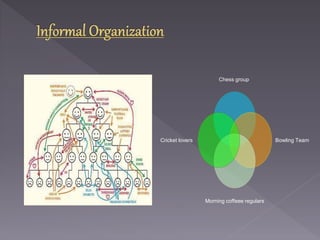
Chess group 
Bowling Team 
Morning coffeee regulars 
Cricket lovers
Informal Leader- 
The leader of an informal 
organization is elected by the 
members of the groups for different 
reasons such as age, seniority, 
technical, competence, work 
location, and responsive 
personality, etc. depending upon 
the work situation. 
Role of Informal Leader: 
a) To help the group reach its goals, and 
b) To maintain and enhance group life.
 Evolving constantly 
 Grass roots 
 Dynamic and responsive 
 Excellent at motivation 
 Requires insider knowledge to be seen 
 Treats people as individuals 
 Flat and fluid 
 Trust and reciprocity 
 Difficult to pin down 
 Essential for situations that change quickly or 
are not yet fully understood
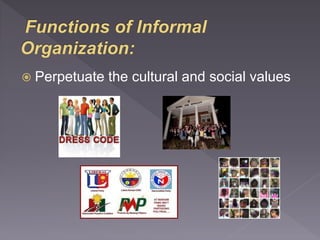
 Perpetuate the cultural and social values
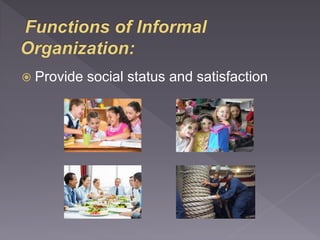
 Provide social status and satisfaction
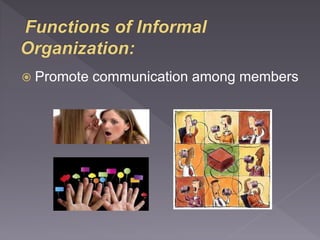
 Promote communication among members
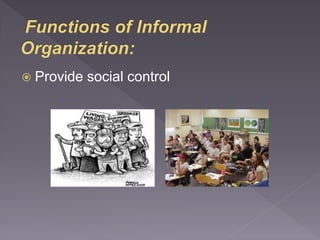
 Provide social control
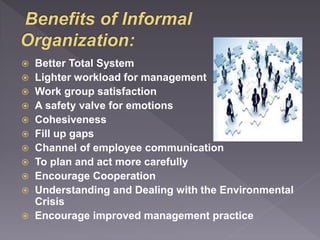
 Better Total System 
 Lighter workload for management 
 Work group satisfaction 
 A safety valve for emotions 
 Cohesiveness 
 Fill up gaps 
 Channel of employee communication 
 To plan and act more carefully 
 Encourage Cooperation 
 Understanding and Dealing with the Environmental 
Crisis 
 Encourage improved management practice
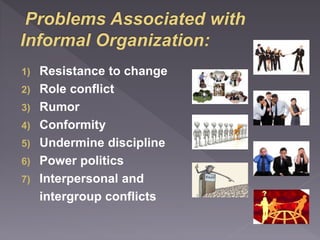
1) Resistance to change 
2) Role conflict 
3) Rumor 
4) Conformity 
5) Undermine discipline 
6) Power politics 
7) Interpersonal and 
intergroup conflicts
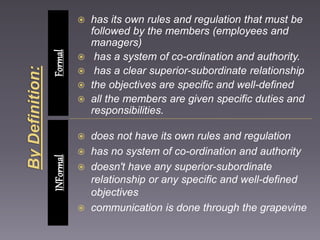
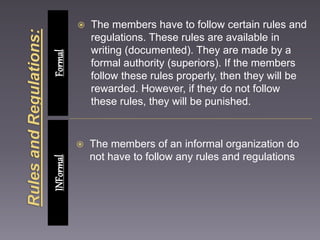
INFormal Formal 
 has its own rules and regulation that must be 
followed by the members (employees and 
managers) 
 has a system of co-ordination and authority. 
 has a clear superior-subordinate relationship 
 the objectives are specific and well-defined 
 all the members are given specific duties and 
responsibilities. 
 does not have its own rules and regulation 
 has no system of co-ordination and authority 
 doesn't have any superior-subordinate 
relationship or any specific and well-defined 
objectives 
 communication is done through the grapevine
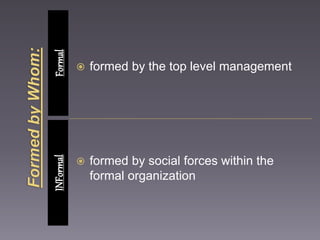
INFormal Formal 
 formed by the top level management 
 formed by social forces within the 
formal organization
 The members have to follow certain rules and 
regulations. These rules are available in 
writing (documented). They are made by a 
formal authority (superiors). If the members 
follow these rules properly, then they will be 
rewarded. However, if they do not follow 
these rules, they will be punished. 
 The members of an informal organization do 
not have to follow any rules and regulations 
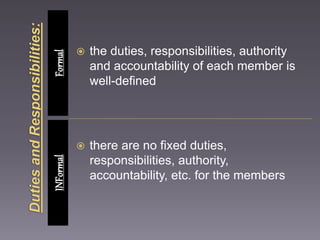
INFormal Formal
 the duties, responsibilities, authority 
and accountability of each member is 
well-defined 
 there are no fixed duties, 
responsibilities, authority, 
accountability, etc. for the members 
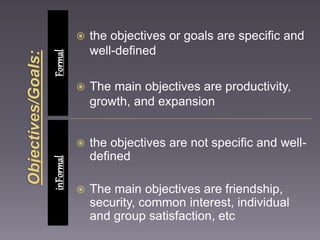
INFormal Formal
 the objectives or goals are specific and 
well-defined 
 The main objectives are productivity, 
growth, and expansion 
 the objectives are not specific and well-defined 
 The main objectives are friendship, 
security, common interest, individual 
and group satisfaction, etc 
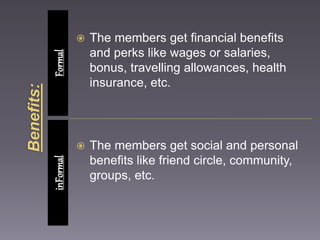
inFormal Formal
 The members get financial benefits 
and perks like wages or salaries, 
bonus, travelling allowances, health 
insurance, etc. 
 The members get social and personal 
benefits like friend circle, community, 
groups, etc. 
inFormal Formal
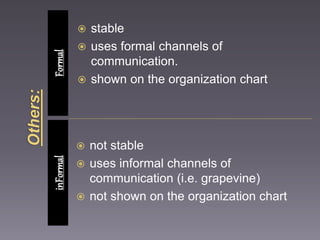
 stable 
 uses formal channels of 
communication. 
 shown on the organization chart 
 not stable 
 uses informal channels of 
communication (i.e. grapevine) 
 not shown on the organization chart 
inFormal Formal

Formal vs informal organization

  • 1.
  • 2.
     The FormalOrganization is a system of well-defined jobs, each bearing a definite measure of authority, responsibility and accountability. Louis Allen  Formal Organization is a system of consciously coordinated activities of two or more persons toward a common objective. Chester Barnard
  • 3.
     The formalorganization is a goal-oriented entity that exist to accurate the efforts of individuals and it refers to the structure of jobs and positions with clearly defined functions, responsibilities and authorities
  • 5.
     To facilitatethe accomplishment of the goals of the organization  To facilitate the co-ordination of various activities  To aid the establishment of logical authority relationship  To aid the establishment of division of labor  Create group cohesiveness
  • 6.
    1. Well definedrules and regulation
  • 7.
  • 8.
  • 9.
    4. Limitation onthe activities of the individual
  • 10.
    5. Strict observanceof the principle of coordination
  • 11.
    6. Messages arecommunicated through vertical chain
  • 12.
  • 13.
     Set specificGoals for organization  Establishing working relationship  Create group cohesiveness  Organizational Development  Discipline  Human Resource Development
  • 14.
    b) Social Aspectsof benefits: a) Financial Aspects of benefits:  Security  Slow but steady promotion  Commissioned ranks open to men and women graduates  Can't be fired  Good retirement benefits  Many different branches appeal to different interests  Social Status  See interesting places and people
  • 15.
     Limited Flexibility  Slowness of processing  Communication Barrier  Quality of decision  Slowness in Problem detection & processing
  • 16.
     An Informalorganization is an aggregate of interpersonal relationships without any conscious purpose but which may contribute to joint results. Chester Barnard  Informal organization is a network of interpersonal relationship that arise when people associate with one another . Keith Davis
  • 17.
     The informalorganization is the interlocking social structure that governs how people work together in practice. It is the aggregate of behaviors, interactions, norms, personal and professional connections through which work gets done and relationships are built among people who share a common organizational affiliation or cluster of affiliations.
  • 18.
    Chess group BowlingTeam Morning coffeee regulars Cricket lovers
  • 19.
    Informal Leader- Theleader of an informal organization is elected by the members of the groups for different reasons such as age, seniority, technical, competence, work location, and responsive personality, etc. depending upon the work situation. Role of Informal Leader: a) To help the group reach its goals, and b) To maintain and enhance group life.
  • 20.
     Evolving constantly  Grass roots  Dynamic and responsive  Excellent at motivation  Requires insider knowledge to be seen  Treats people as individuals  Flat and fluid  Trust and reciprocity  Difficult to pin down  Essential for situations that change quickly or are not yet fully understood
  • 21.
     Perpetuate thecultural and social values
  • 22.
     Provide socialstatus and satisfaction
  • 23.
  • 24.
  • 25.
     Better TotalSystem  Lighter workload for management  Work group satisfaction  A safety valve for emotions  Cohesiveness  Fill up gaps  Channel of employee communication  To plan and act more carefully  Encourage Cooperation  Understanding and Dealing with the Environmental Crisis  Encourage improved management practice
  • 26.
    1) Resistance tochange 2) Role conflict 3) Rumor 4) Conformity 5) Undermine discipline 6) Power politics 7) Interpersonal and intergroup conflicts
  • 27.
    INFormal Formal has its own rules and regulation that must be followed by the members (employees and managers)  has a system of co-ordination and authority.  has a clear superior-subordinate relationship  the objectives are specific and well-defined  all the members are given specific duties and responsibilities.  does not have its own rules and regulation  has no system of co-ordination and authority  doesn't have any superior-subordinate relationship or any specific and well-defined objectives  communication is done through the grapevine
  • 28.
    INFormal Formal formed by the top level management  formed by social forces within the formal organization
  • 29.
     The membershave to follow certain rules and regulations. These rules are available in writing (documented). They are made by a formal authority (superiors). If the members follow these rules properly, then they will be rewarded. However, if they do not follow these rules, they will be punished.  The members of an informal organization do not have to follow any rules and regulations INFormal Formal
  • 30.
     the duties,responsibilities, authority and accountability of each member is well-defined  there are no fixed duties, responsibilities, authority, accountability, etc. for the members INFormal Formal
  • 31.
     the objectivesor goals are specific and well-defined  The main objectives are productivity, growth, and expansion  the objectives are not specific and well-defined  The main objectives are friendship, security, common interest, individual and group satisfaction, etc inFormal Formal
  • 32.
     The membersget financial benefits and perks like wages or salaries, bonus, travelling allowances, health insurance, etc.  The members get social and personal benefits like friend circle, community, groups, etc. inFormal Formal
  • 33.
     stable uses formal channels of communication.  shown on the organization chart  not stable  uses informal channels of communication (i.e. grapevine)  not shown on the organization chart inFormal Formal