DEGRADATIVE PLASMIDS &
SUPERBUG FOR OIL SPILLS
DR. ANU P. ABHIMANNUE
DEPARTMENT OF BIOTECHNOLOGY
ST. MARY’S COLLEGE, THRISSUR
Introduction
DR. ANU P. ABHIMANNUE, ST. MARY'S COLLEGE, THRISSUR. 2
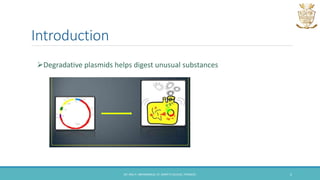
Degradative plasmids helps digest unusual substances
Introduction
Bacterial plasmids carry genes which help the host to degrade recalcitrant
organic compounds
eg: plasmid of pseudomonas putida reported to have genes that enable
degradation of Xylene, octane, naphthalene and camphor
DR. ANU P. ABHIMANNUE, ST. MARY'S COLLEGE, THRISSUR. 3
Degradative pathway
Pathway for degradation of hydrocarbons comprises 2 parts
1. Upper/peripheral pathway: aromatic compounds are converted to catechol
or its derivatives
2. Lower/central pathway: catechol or its derivatives are converted to common
intermediates
DR. ANU P. ABHIMANNUE, ST. MARY'S COLLEGE, THRISSUR. 4
Degradative plasmids - Types
TOL/NAH/SAL plasmids
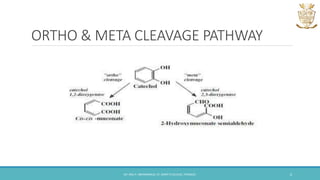
Degrade via meta cleavage pathway
Mainly toluene, naphthalene,
salicylate and biphenyls are degraded
via this pathway
2,4-D plasmids
Degrade via ortho cleavage pathway
Mainly 2,4-D, 3-CBA and MCPA are
degraded via this pathway
DR. ANU P. ABHIMANNUE, ST. MARY'S COLLEGE, THRISSUR. 5
ORTHO & META CLEAVAGE PATHWAY
DR. ANU P. ABHIMANNUE, ST. MARY'S COLLEGE, THRISSUR. 6
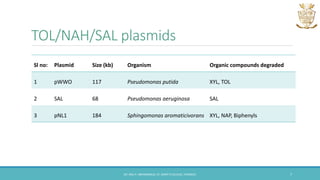
TOL/NAH/SAL plasmids
Sl no: Plasmid Size (kb) Organism Organic compounds degraded
1 pWWO 117 Pseudomonas putida XYL, TOL
2 SAL 68 Pseudomonas aeruginosa SAL
3 pNL1 184 Sphingomonas aromaticivorans XYL, NAP, Biphenyls
DR. ANU P. ABHIMANNUE, ST. MARY'S COLLEGE, THRISSUR. 7
2,4-D plasmids
Sl no: Plasmid Size (kb) Organism Organic compounds degraded
1 pJP4 80 Ralstonia eutrophus 2,4-D, 3-CBA and MCPA
2 pMAB1 90 Alcaligens sp. 2,4-D and MCPA
3 pRC 45 Flavobacterium sp. 2,4-D, 3-CBA and MCPA
DR. ANU P. ABHIMANNUE, ST. MARY'S COLLEGE, THRISSUR. 8
Genetic Manipulation by Transfer of
Plasmids
Degradative plasmids are equipped with genes that synthesize bio-degradative
enzymes.
Hence, genetic manipulations of plasmids leads to new bacterial strains with
better biodegradation potential.
DR. ANU P. ABHIMANNUE, ST. MARY'S COLLEGE, THRISSUR. 9
Super bug for oil spills – P. putida
Pioneering work in genetic manipulation of plasmid was by Chakrabarty and his
co-workers in 1970s.
They developed a new strain of bacterium (Pseudomonas)
They incorporated different plasmids and constructed a new bacterium called
superbug
Superbug could degrade a variety of hydrocarbons.
DR. ANU P. ABHIMANNUE, ST. MARY'S COLLEGE, THRISSUR. 10
Patent
United States granted patent to this superbug in 1981 (as per the directive of
American Supreme Court).
Thus, superbug became the first genetically engineered microorganism to be
patented.
DR. ANU P. ABHIMANNUE, ST. MARY'S COLLEGE, THRISSUR. 11
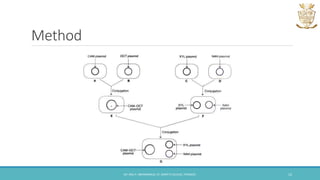
Method
DR. ANU P. ABHIMANNUE, ST. MARY'S COLLEGE, THRISSUR. 12
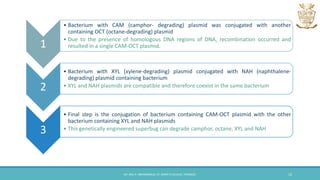
1
• Bacterium with CAM (camphor- degrading) plasmid was conjugated with another
containing OCT (octane-degrading) plasmid
• Due to the presence of homologous DNA regions of DNA, recombination occurred and
resulted in a single CAM-OCT plasmid.
2
• Bacterium with XYL (xylene-degrading) plasmid conjugated with NAH (naphthalene-
degrading) plasmid containing bacterium
• XYL and NAH plasmids are compatible and therefore coexist in the same bacterium
3
• Final step is the conjugation of bacterium containing CAM-OCT plasmid with the other
bacterium containing XYL and NAH plasmids
• This genetically engineered superbug can degrade camphor, octane, XYL and NAH
DR. ANU P. ABHIMANNUE, ST. MARY'S COLLEGE, THRISSUR. 13
Bio-surfactant Producing Genetically
Engireed Microbes (GEM)
 Chakarabarty and his group created a genetically engineered Pseudomonas
aeruginosa
This modified strain produce a glycolipid emulsifier (a bio-surfactant) which can
reduce the surface tension at oil water interface.
The reduced interfacial tension promotes biodegradation of oils.
DR. ANU P. ABHIMANNUE, ST. MARY'S COLLEGE, THRISSUR. 14
Risks associated with GEM
Once introduced to ecosystem, they may disturb ecological balance
GEM could cause harm to the habitat
New strain may turn virulant thereby causing great harm to humankind
Hence, GEM are confined to the laboratories, and being utilized for controlled
processes of biodegradation
DR. ANU P. ABHIMANNUE, ST. MARY'S COLLEGE, THRISSUR. 15
References
https://pt.slideshare.net/15swarka/biology-powerpoint-13029002/2
http://www.biologydiscussion.com/biotechnology/biodegradation/biodegradation-and-
bioremediation-with-diagram/11043
DR. ANU P. ABHIMANNUE, ST. MARY'S COLLEGE, THRISSUR. 16
Thank you
DR. ANU P. ABHIMANNUE, ST. MARY'S COLLEGE, THRISSUR. 17

Degradative plasmids & superbug for oil spills

  • 1.
    DEGRADATIVE PLASMIDS & SUPERBUGFOR OIL SPILLS DR. ANU P. ABHIMANNUE DEPARTMENT OF BIOTECHNOLOGY ST. MARY’S COLLEGE, THRISSUR
  • 2.
    Introduction DR. ANU P.ABHIMANNUE, ST. MARY'S COLLEGE, THRISSUR. 2 Degradative plasmids helps digest unusual substances
  • 3.
    Introduction Bacterial plasmids carrygenes which help the host to degrade recalcitrant organic compounds eg: plasmid of pseudomonas putida reported to have genes that enable degradation of Xylene, octane, naphthalene and camphor DR. ANU P. ABHIMANNUE, ST. MARY'S COLLEGE, THRISSUR. 3
  • 4.
    Degradative pathway Pathway fordegradation of hydrocarbons comprises 2 parts 1. Upper/peripheral pathway: aromatic compounds are converted to catechol or its derivatives 2. Lower/central pathway: catechol or its derivatives are converted to common intermediates DR. ANU P. ABHIMANNUE, ST. MARY'S COLLEGE, THRISSUR. 4
  • 5.
    Degradative plasmids -Types TOL/NAH/SAL plasmids Degrade via meta cleavage pathway Mainly toluene, naphthalene, salicylate and biphenyls are degraded via this pathway 2,4-D plasmids Degrade via ortho cleavage pathway Mainly 2,4-D, 3-CBA and MCPA are degraded via this pathway DR. ANU P. ABHIMANNUE, ST. MARY'S COLLEGE, THRISSUR. 5
  • 6.
    ORTHO & METACLEAVAGE PATHWAY DR. ANU P. ABHIMANNUE, ST. MARY'S COLLEGE, THRISSUR. 6
  • 7.
    TOL/NAH/SAL plasmids Sl no:Plasmid Size (kb) Organism Organic compounds degraded 1 pWWO 117 Pseudomonas putida XYL, TOL 2 SAL 68 Pseudomonas aeruginosa SAL 3 pNL1 184 Sphingomonas aromaticivorans XYL, NAP, Biphenyls DR. ANU P. ABHIMANNUE, ST. MARY'S COLLEGE, THRISSUR. 7
  • 8.
    2,4-D plasmids Sl no:Plasmid Size (kb) Organism Organic compounds degraded 1 pJP4 80 Ralstonia eutrophus 2,4-D, 3-CBA and MCPA 2 pMAB1 90 Alcaligens sp. 2,4-D and MCPA 3 pRC 45 Flavobacterium sp. 2,4-D, 3-CBA and MCPA DR. ANU P. ABHIMANNUE, ST. MARY'S COLLEGE, THRISSUR. 8
  • 9.
    Genetic Manipulation byTransfer of Plasmids Degradative plasmids are equipped with genes that synthesize bio-degradative enzymes. Hence, genetic manipulations of plasmids leads to new bacterial strains with better biodegradation potential. DR. ANU P. ABHIMANNUE, ST. MARY'S COLLEGE, THRISSUR. 9
  • 10.
    Super bug foroil spills – P. putida Pioneering work in genetic manipulation of plasmid was by Chakrabarty and his co-workers in 1970s. They developed a new strain of bacterium (Pseudomonas) They incorporated different plasmids and constructed a new bacterium called superbug Superbug could degrade a variety of hydrocarbons. DR. ANU P. ABHIMANNUE, ST. MARY'S COLLEGE, THRISSUR. 10
  • 11.
    Patent United States grantedpatent to this superbug in 1981 (as per the directive of American Supreme Court). Thus, superbug became the first genetically engineered microorganism to be patented. DR. ANU P. ABHIMANNUE, ST. MARY'S COLLEGE, THRISSUR. 11
  • 12.
    Method DR. ANU P.ABHIMANNUE, ST. MARY'S COLLEGE, THRISSUR. 12
  • 13.
    1 • Bacterium withCAM (camphor- degrading) plasmid was conjugated with another containing OCT (octane-degrading) plasmid • Due to the presence of homologous DNA regions of DNA, recombination occurred and resulted in a single CAM-OCT plasmid. 2 • Bacterium with XYL (xylene-degrading) plasmid conjugated with NAH (naphthalene- degrading) plasmid containing bacterium • XYL and NAH plasmids are compatible and therefore coexist in the same bacterium 3 • Final step is the conjugation of bacterium containing CAM-OCT plasmid with the other bacterium containing XYL and NAH plasmids • This genetically engineered superbug can degrade camphor, octane, XYL and NAH DR. ANU P. ABHIMANNUE, ST. MARY'S COLLEGE, THRISSUR. 13
  • 14.
    Bio-surfactant Producing Genetically EngireedMicrobes (GEM)  Chakarabarty and his group created a genetically engineered Pseudomonas aeruginosa This modified strain produce a glycolipid emulsifier (a bio-surfactant) which can reduce the surface tension at oil water interface. The reduced interfacial tension promotes biodegradation of oils. DR. ANU P. ABHIMANNUE, ST. MARY'S COLLEGE, THRISSUR. 14
  • 15.
    Risks associated withGEM Once introduced to ecosystem, they may disturb ecological balance GEM could cause harm to the habitat New strain may turn virulant thereby causing great harm to humankind Hence, GEM are confined to the laboratories, and being utilized for controlled processes of biodegradation DR. ANU P. ABHIMANNUE, ST. MARY'S COLLEGE, THRISSUR. 15
  • 16.
  • 17.
    Thank you DR. ANUP. ABHIMANNUE, ST. MARY'S COLLEGE, THRISSUR. 17