Bioremediation & Microbial Diversity: Applications of Molecular Biological Tools in Studying Novel Physiological Traits Suneel Arjun Chhatre  Aug 11, 2009
Microbes: The Earth’s Engine ~4 Billions years Capable of exploiting a vast range of energy sources and thriving in almost every habitat For 2 billion years microbes were the only form of life (all the biochemistries of life evolved) Basic ecosystem processes; biogeochemical cycles and food chains, vital & elegant relationship between themselves and higher organisms
Microbial Diversity Biodiversity as a source of innovation in biotechnology  International Convention on Biological Diversity defines genetic resources as “ genetic material of actual potential value” Microbial Diversity as major resource for biotechnological products and processes Food Biotechnology Metabolites (amino acids, antibiotics, biopharmaceuticals) Enzymes Environmental Biotechnology Biological Fuels
Why is Microbial Diversity Important? Critical for the sustainability of life on earth, including recycling of elements, maintenance of climate, degradation of wastes Expand the frontiers of knowledge about the limits and strategies of life Largest untapped reservoir of biodiversity Key roles in conservation of higher organisms and in restoration of degraded ecosystems
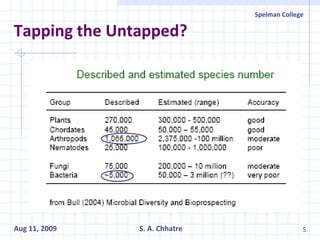
Tapping the Untapped?
Role of Carbon When we study the chemistry of life, carbon is at the center of the action Living things transform carbon-based compounds voraciously, and microbes, as Earth’s most prolific and earliest-evolved life forms, do so most avidly Carbon cycle on Earth is largely dependent on microbiological processes, and biodegradation constitutes one-half of the carbon cycle
The Beginning of Biodegradation As old as life itself Prebiotic soup of organic molecules that served as the precurosr of the molecules, constituted first life (the ancestral cell) They must also have served as the energy sources (self replication requires energy)
Explosion of life must have consumed most of the organic molecules in prebiotic soup during the 1 st  billion years of Earth in the sustainence of first life At that point, the richest source of food for life was other forms of life
This continues today Microbes produce lipases, proteases, cellulases and ligninases that decmpose living organisms or their remains after death Photosynthesis was an important development on the earth’s surface that allowed much greater biomass production and hence generated more molecules to be biodegraded
Importance of Microbial Diversity Microbes harbor the greatest biological diversity and play a more important role in maintaining global processes Microbes have been around since the start of the life at least 3.6 billion years ago (macroscopic ~ 1 billion years) Microbes reproduce, and thus evolve new traits faster than macroscopic organisms
Number of bacteria attached to your body exceeds the entire human population on earth Approximately 5X10 30  prokaryotes reside on earth 500,000 species of insects, termites have 1000 sp of bacteria Total number of bacteria in domestic animals is close to 4X10 24
Identifying Novel Microbial Catalysis by Enrichment Culture & Screening One gram of soil contains 10 9  bacteria, perhaps 10,000 different types Pioneered by Beijerinck & Winogradsky Selective cultivation of one or more bacterial strains obtained from complex mixture such as soil, sludges, water etc. The method relies on using a particular organic compound as the sole carbon source or, less frequently, as the N, S or P source
Case Studies: Hydrocarbon degrading potential of microbes (Oil Spill Remediation) Reductive Dehalogenation (Degradation of Pesticide, Pentachlorophenol) in  Sphingobium cholorophenolicum Sulfur Oxidation Reactions & Acid Tolerance Resposnse in  Halothiobacillus neapoitanus
Bioremediation of Oil Spills EPA (2006): world wide consumption of petroleum was 84,979,000  barrels/day Transportation Oil Spills Disasters Torey Canyon  1967 (38 million gallons)   Exxon Valdez  1989 (10 millions gallons plus) Westchester  2000 (567,000 gallons) Hurricane Katrina  2005   (7 millions)
Two Step Treatment Protocol Containment: Step one is skimming the crude oil from the surface (Sawdust) Mineralization: Step two is biodegradation of crude oil components by using bacterial catabolic properties (Consortium)
Goals Enrichment, Isolation and Characterization of hydrocarbonoclastic microorganisms Designing a consortium based on their catabolic properties and the composition of crude oil Determination of efficacy of consortium for crude oil/hydrocarbon degradation Osmotolerance (genetic manipulation)
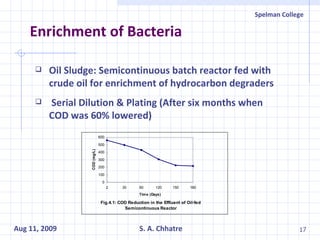
Enrichment of Bacteria Oil Sludge: Semicontinuous batch reactor fed with crude oil for enrichment of hydrocarbon degraders Serial Dilution & Plating (After six months when COD was 60% lowered)
Isolation & Characterization Thirty five isolates Three Tier Screening Primary: based on morphology, growth pattern, incubation time Secondary: Antibiotic Sensitivity Tertiary: based on hydrocarbon degradation potential (catechol, dodecane, tetracosane, eicosane, phenanthrene)
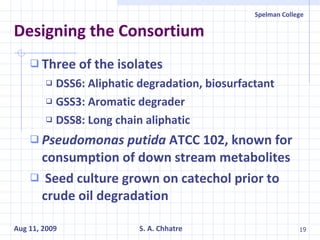
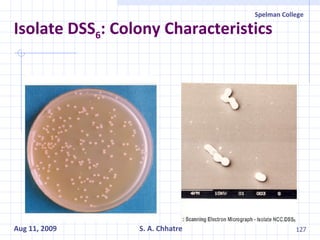
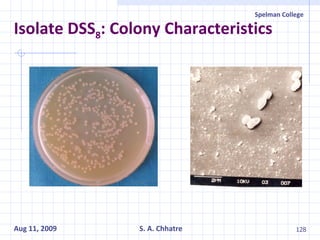
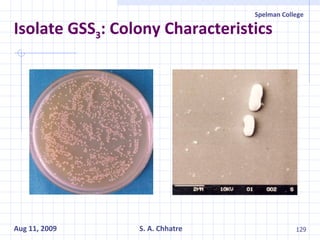
Designing the Consortium Three of the isolates DSS6: Aliphatic degradation, biosurfactant GSS3: Aromatic degrader DSS8: Long chain aliphatic Pseudomonas putida  ATCC 102, known for consumption of down stream metabolites Seed culture grown on catechol prior to crude oil degradation
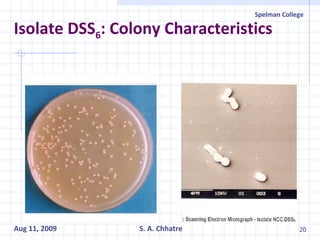
Isolate DSS 6 : Colony Characteristics
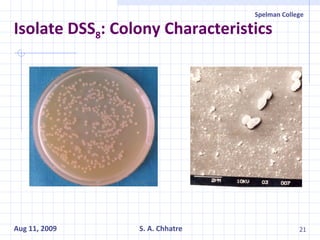
Isolate DSS 8 : Colony Characteristics
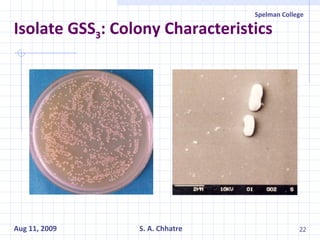
Isolate GSS 3 : Colony Characteristics
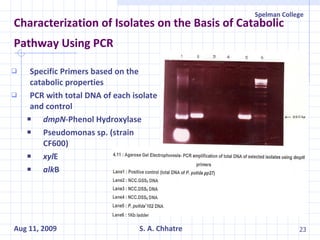
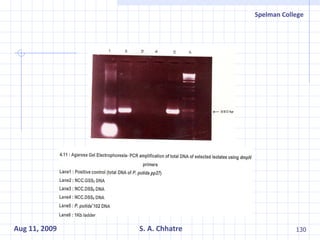
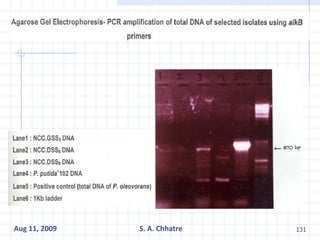
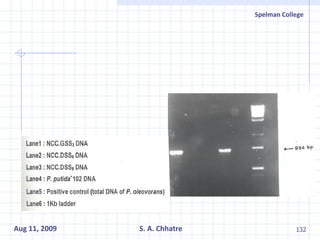
Characterization of Isolates on the Basis of Catabolic Pathway Using PCR   Specific Primers based on the catabolic properties PCR with total DNA of each isolate and control dmpN -Phenol Hydroxylase Pseudomonas sp. (strain CF600) xyl E alk B
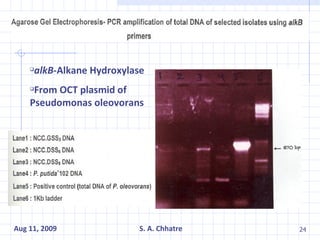
alkB -Alkane Hydroxylase From OCT plasmid of Pseudomonas oleovorans
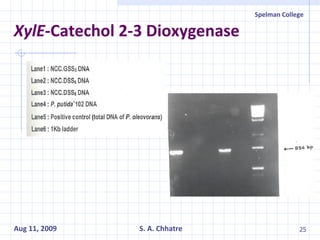
XylE -Catechol 2-3 Dioxygenase
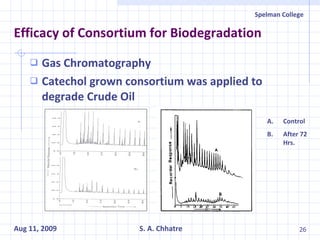
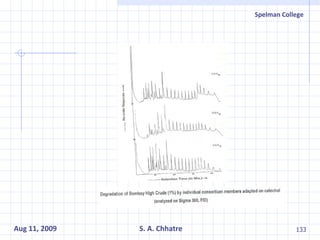
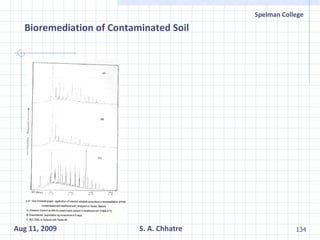
Efficacy of Consortium for Biodegradation Gas Chromatography Catechol grown consortium was applied to degrade Crude Oil Control After 72 Hrs.
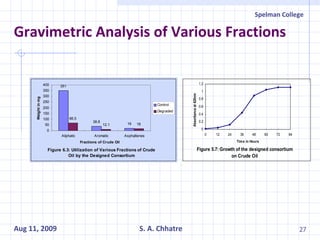
Gravimetric Analysis of Various Fractions
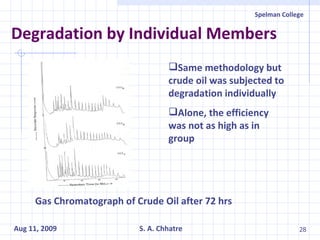
Degradation by Individual Members Same methodology but crude oil was subjected to degradation individually Alone, the efficiency was not as high as in group Gas Chromatograph of Crude Oil after 72 hrs
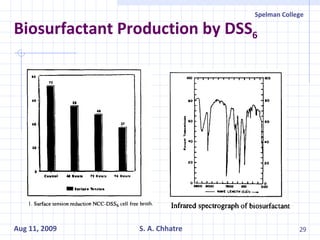
Biosurfactant Production by DSS 6
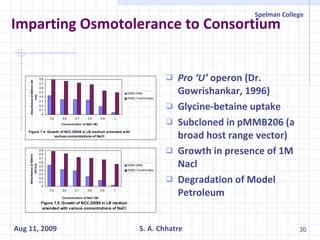
Imparting Osmotolerance to Consortium Pro ‘U’  operon (Dr. Gowrishankar, 1996) Glycine-betaine uptake Subcloned in pMMB206 (a broad host range vector) Growth in presence of 1M Nacl Degradation of Model Petroleum
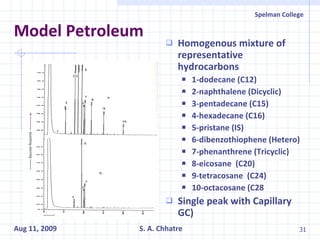
Model Petroleum Homogenous mixture of representative hydrocarbons 1-dodecane (C12) 2-naphthalene (Dicyclic) 3-pentadecane (C15)  4-hexadecane (C16) 5-pristane (IS) 6-dibenzothiophene (Hetero) 7-phenanthrene (Tricyclic) 8-eicosane  (C20) 9-tetracosane  (C24) 10-octacosane  (C28 Single peak with Capillary GC)
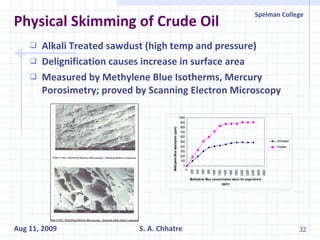
Physical Skimming of Crude Oil Alkali Treated sawdust (high temp and pressure) Delignification causes increase in surface area Measured by Methylene Blue Isotherms, Mercury Porosimetry; proved by Scanning Electron Microscopy
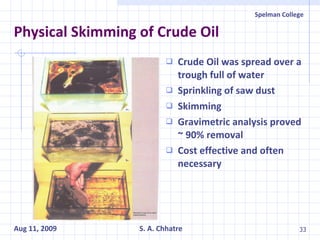
Physical Skimming of Crude Oil Crude Oil was spread over a trough full of water Sprinkling of saw dust Skimming Gravimetric analysis proved ~ 90% removal Cost effective and often necessary
Strategies to Study Evolutionary Origin of TCHQ dehalogenase in  Sphingobium chlorophenolicum
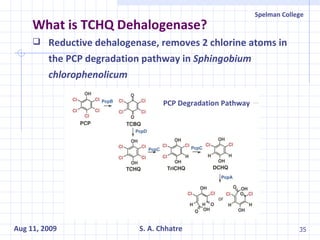
What is TCHQ Dehalogenase? Reductive dehalogenase, removes 2 chlorine atoms in the PCP degradation pathway in  Sphingobium chlorophenolicum PCP Degradation Pathway
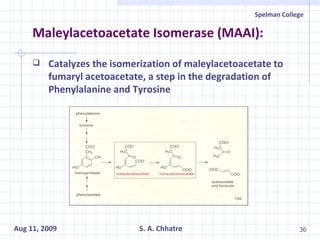
Maleylacetoacetate Isomerase (MAAI):    Catalyzes the isomerization of maleylacetoacetate to fumaryl acetoacetate, a step in the degradation of Phenylalanine and Tyrosine
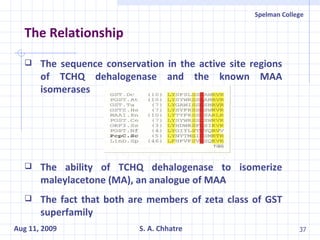
The sequence conservation in the active site regions of TCHQ dehalogenase and the known MAA isomerases The ability of TCHQ dehalogenase to isomerize maleylacetone (MA), an analogue of MAA The fact that both are members of zeta class of GST superfamily The Relationship
Goals Clone, sequence and express the MAA isomerase from  S. chlorophenolicum  and compare it with TCHQ dehalogenase Determine what type of changes have occurred in order to enhance the dehalogenation reaction In vitro  evolution of maai into TCHQ dehalogenase Kinetic studies on dehalogenation
Experimental Approach I Knocking out  maai  gene in  Pseudomonas putida  KT 2440 Making a genomic library of  S. chlorophenolicum  in a BHRV (Broad host range vector) Complementing the knockout mutant with genomic library and selecting on tyrosine Preparation of plasmid from the colonies and sequencing
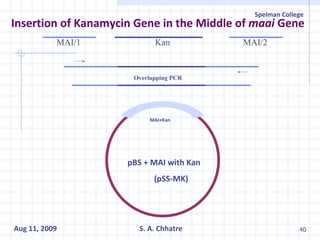
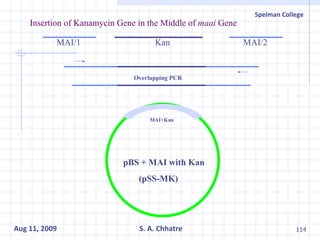
Insertion of Kanamycin Gene in the Middle of  maai  Gene pBS + MAI with Kan (pSS-MK) Kan MAI/2 MAI/1 Overlapping PCR MAI+Kan
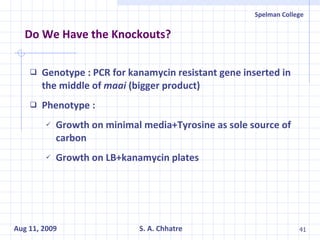
Genotype : PCR for kanamycin resistant gene inserted in the middle of  maai  (bigger product) Phenotype : Growth on minimal media+Tyrosine as sole source of carbon  Growth on LB+kanamycin plates Do We Have the Knockouts?
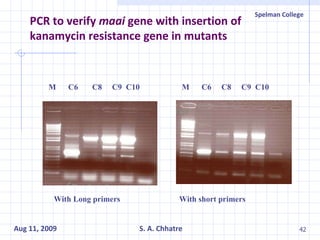
PCR to verify  maai  gene with insertion of kanamycin resistance gene in mutants With Long primers With short primers M  C6  C8  C9  C10 M  C6  C8  C9  C10
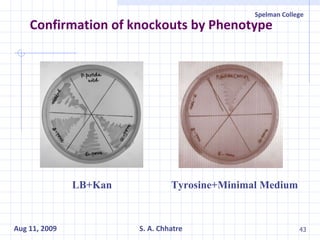
Confirmation of knockouts by Phenotype LB+Kan Tyrosine+Minimal Medium
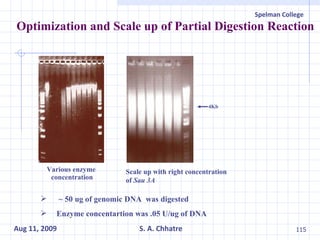
Making a Genomic Library of  S. chlorophenolicum Optimization of partial digestion of genomic DNA with  Sau 3A Scale up the reaction with large quantity of DNA under right conditions Digestion of Vector, dephosphorylation of digested vector Ligation and electroporation
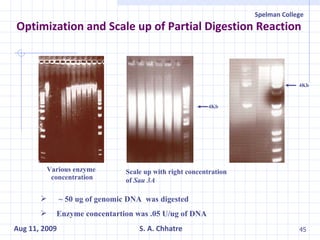
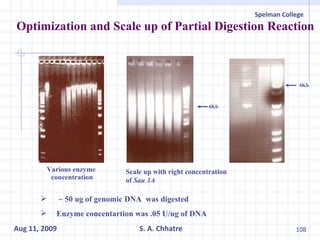
Optimization and Scale up of Partial Digestion Reaction 4Kb ~ 50 ug of genomic DNA  was digested  Enzyme concentartion was .05 U/ug of DNA Various enzyme  concentration Scale up with right concentration of  Sau 3A 4Kb
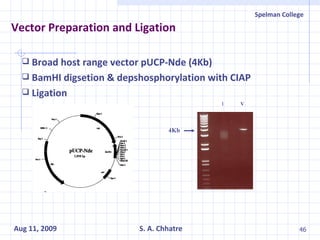
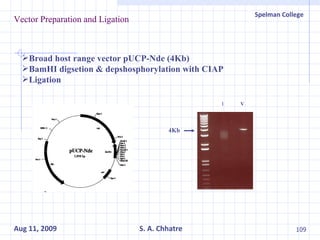
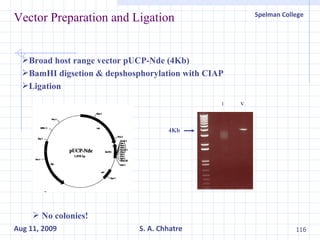
Vector Preparation and Ligation 4Kb  I V Broad host range vector pUCP-Nde (4Kb) BamHI digsetion & depshosphorylation with CIAP Ligation
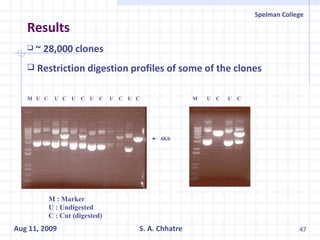
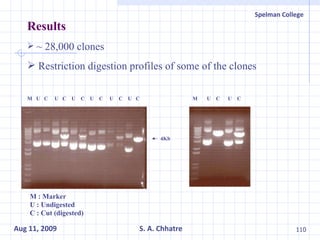
Results ~ 28,000 clones Restriction digestion profiles of some of the clones 4Kb M  U  C  U  C  U  C  U  C  U  C  U  C M  U  C  U  C M : Marker U : Undigested C : Cut (digested)
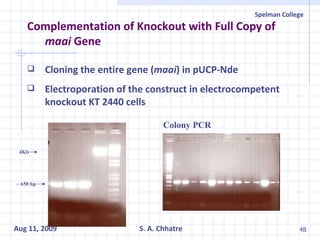
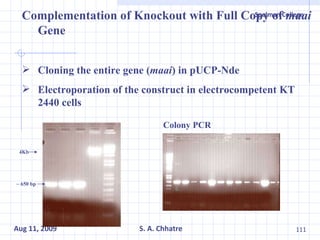
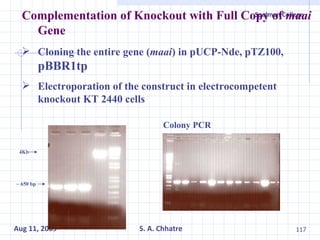
Complementation of Knockout with Full Copy of  maai  Gene Cloning the entire gene ( maai ) in pUCP-Nde Electroporation of the construct in electrocompetent knockout KT 2440 cells 4Kb ~ 650 bp Colony PCR
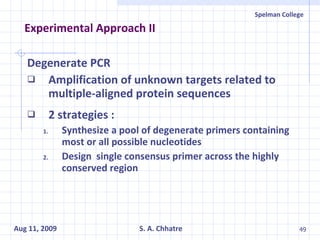
Experimental Approach II Degenerate PCR Amplification of unknown targets related to multiple-aligned protein sequences 2 strategies : Synthesize a pool of degenerate primers containing most or all possible nucleotides Design  single consensus primer across the highly conserved region
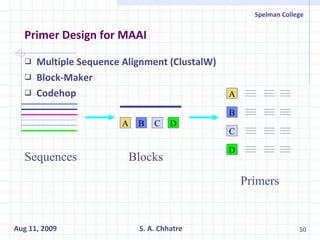
Primer Design for MAAI Multiple Sequence Alignment (ClustalW) Block-Maker Codehop A B C D A B C D Sequences Blocks Primers
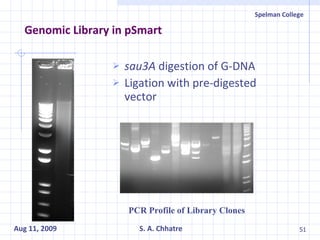
Genomic Library in pSmart sau3A  digestion of G-DNA Ligation with pre-digested vector PCR Profile of Library Clones
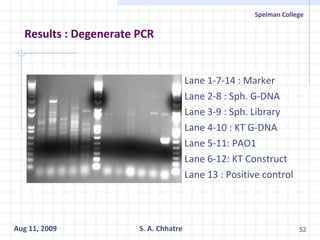
Results : Degenerate PCR Lane 1-7-14 : Marker Lane 2-8 : Sph. G-DNA Lane 3-9 : Sph. Library Lane 4-10 : KT G-DNA Lane 5-11: PAO1 Lane 6-12: KT Construct Lane 13 : Positive control
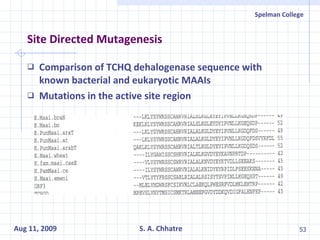
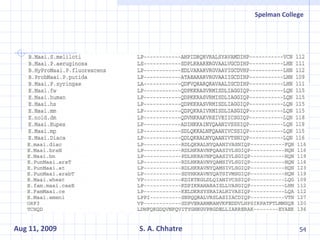
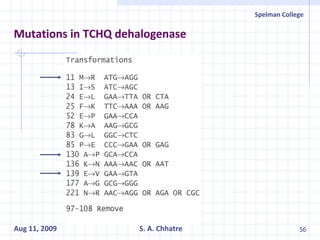
Site Directed Mutagenesis Comparison of TCHQ dehalogenase sequence with known bacterial and eukaryotic MAAIs Mutations in the active site region
 
 
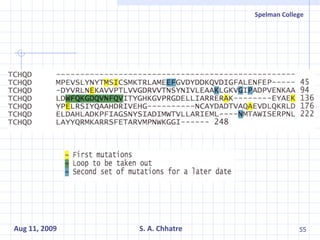
Mutations in TCHQ dehalogenase
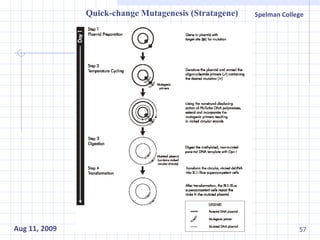
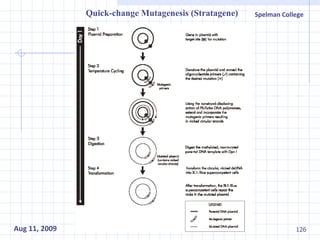
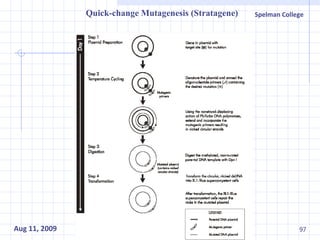
Quick-change Mutagenesis (Stratagene)
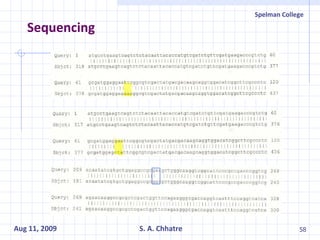
Sequencing
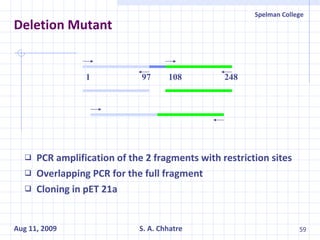
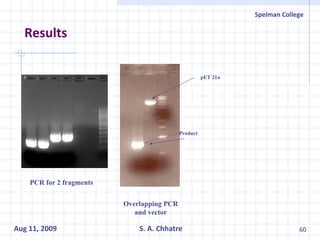
Deletion Mutant PCR amplification of the 2 fragments with restriction sites Overlapping PCR for the full fragment Cloning in pET 21a 1 97 108 248
Results PCR for 2 fragments Overlapping PCR and vector pET 21a Product
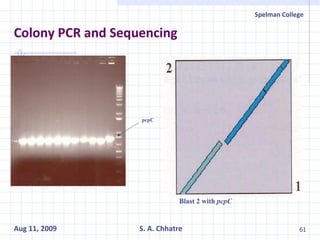
Colony PCR and Sequencing pcpC Blast 2 with  pcpC
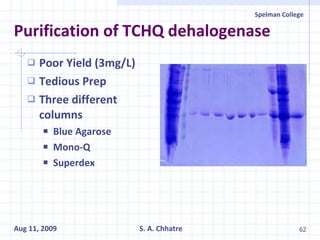
Purification of TCHQ dehalogenase Poor Yield (3mg/L) Tedious Prep Three different columns Blue Agarose Mono-Q Superdex
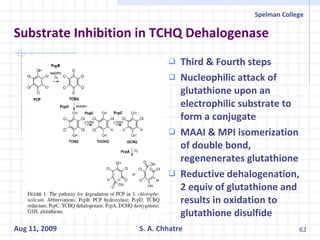
Substrate Inhibition in TCHQ Dehalogenase Third & Fourth steps Nucleophilic attack of glutathione upon an electrophilic substrate to form a conjugate MAAI & MPI isomerization of double bond, regenenerates glutathione Reductive dehalogenation, 2 equiv of glutathione and results in oxidation to glutathione disulfide
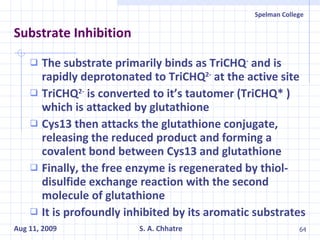
Substrate Inhibition The substrate primarily binds as TriCHQ -  and is rapidly deprotonated to TriCHQ 2-  at the active site TriCHQ 2-  is converted to it’s tautomer (TriCHQ* ) which is attacked by glutathione Cys13 then attacks the glutathione conjugate, releasing the reduced product and forming a covalent bond between Cys13 and glutathione Finally, the free enzyme is regenerated by thiol-disulfide exchange reaction with the second molecule of glutathione It is profoundly inhibited by its aromatic substrates
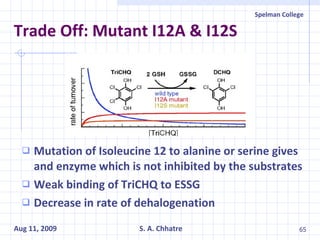
Trade Off: Mutant I12A & I12S Mutation of Isoleucine 12 to alanine or serine gives and enzyme which is not inhibited by the substrates Weak binding of TriCHQ to ESSG Decrease in rate of dehalogenation
pH Dependent Protein Expression in Sulfur Oxidizing Bacteria
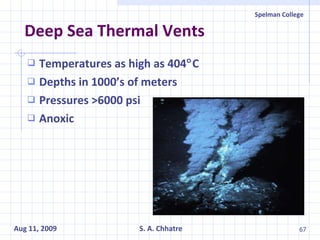
Deep Sea Thermal Vents Temperatures as high as 404  C Depths in 1000’s of meters Pressures >6000 psi Anoxic
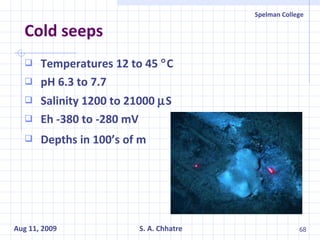
Cold seeps Temperatures 12 to 45   C pH 6.3 to 7.7 Salinity 1200 to 21000   S Eh -380 to -280 mV Depths in 100’s of m
Why study them? Obvious interest in unique microbial physiologies Species thrive in the presence of high levels of toxic compounds  Marine and surface thermal vents long proposed as ‘source of life’ Lateral gene transfer proposed as source for pathogenicity in Proteobacteria Other adaptive responses in Proteobacteria species may also have arisen from horizontal gene transfer Locations range from marine (Mid-Atlantic Ridge) to semi-arid high altitude desert environments (Eddy Co., NM)
Model Organism Halothiobacillus neapolitanus Isolated from a shallow marine vent Also found in cold seeps and municipal sewers Reduced and partially reduced inorganic sulfur compounds as the sole source of energy Mildly halotolerant, mesophile pH range 8.5 to as low as 3.5
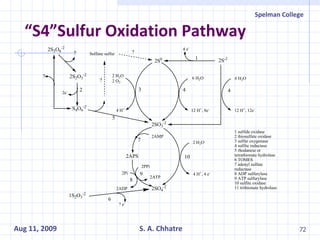
Our reasons to study  H. neapolitanus Wide pH range indicates potential for inducible acid tolerance response (ATR) Chemolithoautotroph Proposed to use the ‘S4’ oxidation pathway Relationship to thermal vent species
“S4”Sulfur Oxidation Pathway
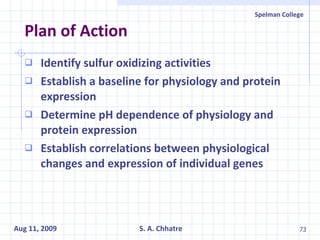
Plan of Action Identify sulfur oxidizing activities Establish a baseline for physiology and protein expression Determine pH dependence of physiology and protein expression Establish correlations between physiological changes and expression of individual genes


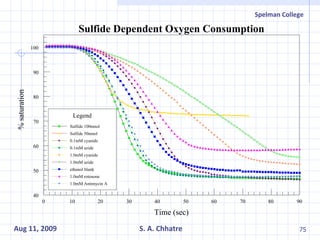
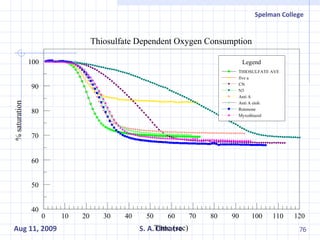
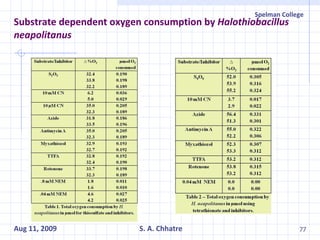
Substrate dependent oxygen consumption by  Halothiobacillus neapolitanus
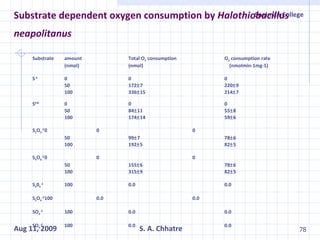
Substrate dependent oxygen consumption by  Halothiobacillus neapolitanus   Substrate amount Total O 2  consumption O 2  consumption rate (nmol) (nmol)   (nmolmin-1mg-1) S -2 0 0 0 50 172  7 220  9 100 336  15 214  7 S 0 * 0 0 0 50 84  11 55  8 100 174  14 59  6 S 2 O 3 -2 0 0 0 50 99  7 78  6 100 192  5 82  5 S 4 O 6 -2 0 0 0 50 155  6 78  6 100 315  9 82  5 S 3 0 6 -2 100 0.0 0.0 S 5 O 6 -2 100 0.0 0.0 SO 3 -2 100 0.0 0.0 SO 4 -2 100 0.0 0.0
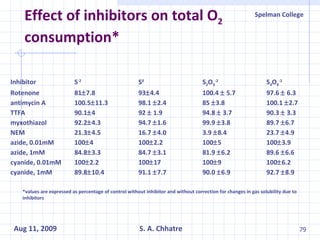
Effect of inhibitors on total O 2  consumption* Inhibitor S -2 S 0 S 2 O 3 -2   S 4 O 6 -2   Rotenone 81  7.8  93  4.4 100.4    5.7 97.6    6.3 antimycin A 100.5  11.3 98.1   2.4 85   3.8 100.1   2.7 TTFA 90.1  4 92    1.9 94.8    3.7 90.3    3.3 myxothiazol 92.2  4.3 94.7   1.6 99.9   3.8 89.7   6.7 NEM  21.3  4.5 16.7   4.0 3.9   8.4 23.7   4.9 azide, 0.01mM 100  4 100  2.2 100  5 100  3.9 azide, 1mM 84.8  3.3 84.7   3.1 81.9   6.2 89.6   6.6 cyanide, 0.01mM 100  2.2 100  17 100  9 100  6.2 cyanide, 1mM 89.8  10.4  91.1   7.7 90.0   6.9 92.7   8.9 *values are expressed as percentage of control without inhibitor and without correction for changes in gas solubility due to inhibitors
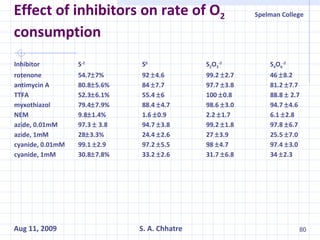
Effect of inhibitors on rate of O 2  consumption Inhibitor S -2 S 0 S 2 O 3 -2   S 4 O 6 -2   rotenone 54.7  7% 92   4.6 99.2   2.7 46   8.2 antimycin A 80.8  5.6% 84   7.7 97.7   3.8 81.2   7.7 TTFA 52.3  6.1% 55.4   6 100   0.8 88.8    2.7 myxothiazol 79.4  7.9% 88.4   4.7 98.6   3.0 94.7   4.6 NEM 9.8  1.4% 1.6   0.9 2.2   1.7 6.1   2.8 azide, 0.01mM 97.3    3.8 94.7   3.8 99.2   1.8 97.8   6.7 azide, 1mM 28  3.3% 24.4   2.6 27   3.9 25.5   7.0 cyanide, 0.01mM 99.1   2.9 97.2   5.5 98   4.7 97.4   3.0 cyanide, 1mM 30.8  7.8%  33.2   2.6 31.7   6.8 34   2.3
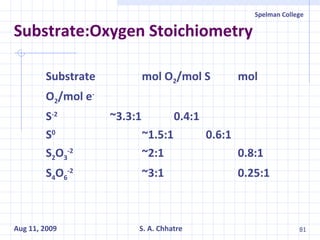
Substrate:Oxygen Stoichiometry Substrate mol O 2 /mol S mol O 2 /mol e - S -2 ~3.3:1 0.4:1 S 0 ~1.5:1 0.6:1 S 2 O 3 -2 ~2:1 0.8:1 S 4 O 6 -2 ~3:1 0.25:1
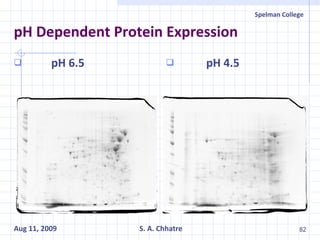
pH Dependent Protein Expression pH 6.5 pH 4.5
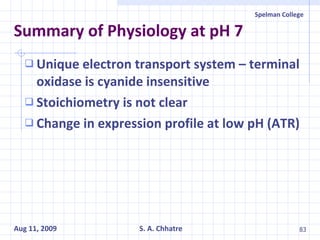
Summary of Physiology at pH 7 Unique electron transport system – terminal oxidase is cyanide insensitive Stoichiometry is not clear Change in expression profile at low pH (ATR)
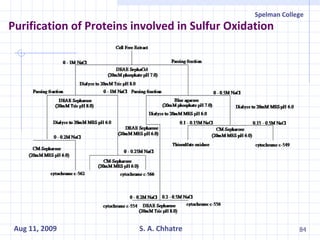
Purification of Proteins involved in Sulfur Oxidation
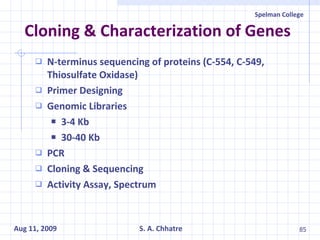
Cloning & Characterization of Genes N-terminus sequencing of proteins (C-554, C-549, Thiosulfate Oxidase) Primer Designing Genomic Libraries 3-4 Kb 30-40 Kb  PCR Cloning & Sequencing Activity Assay, Spectrum
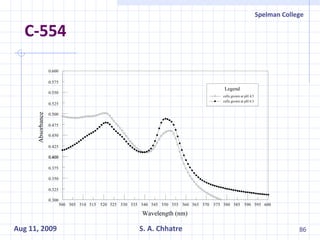
C-554
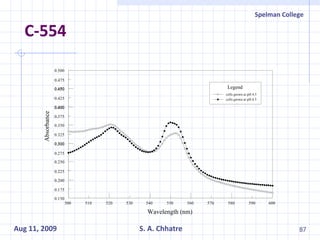
C-554
Future Directions Quenched oxygen consumption assays Measure NAD(P)/NAD(P)H ratios Measure P/O ratios pH dependence Identification of genes and gene products Real time PCR to verify changes in expression ‘ Knock-out’ mutants
Acknowledgements National Environmental Engineering Research Institute (NEERI)/ Indian Institute of Technology, Roorkee, India Department of Biotechnology (DBT) MCDB/Chemistry, University of Colorado at Boulder, CO NIH, NSF, DOE Chemistry, Eastern New Mexico University, Portales, NM NIH NCRR P20-61480
Acknowledgements Students Anton Iliuk Ben Goldbaum Eliseo Castillo John Latham Joaquin DeLeon Nalini Anamula Ramu Kakumanu Neela Gamini Dr. Suneel Chhatre Collaborators Sabine Heinhorst Gordon Cannon NIH NCRR P20-61480 ENMU
Future Directions Purification of MAAI from  Sphingobium Characterization of TCHQ dehalogenase mutants
Acknowledgements Copley Lab Gill lab
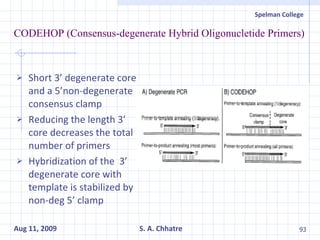
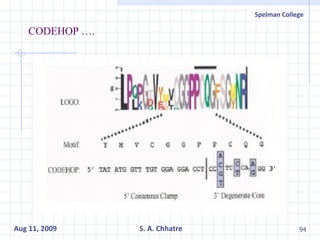
CODEHOP (Consensus-degenerate Hybrid Oligonucletide Primers) Short 3’ degenerate core and a 5’non-degenerate consensus clamp Reducing the length 3’ core decreases the total number of primers Hybridization of the  3’ degenerate core with template is stabilized by non-deg 5’ clamp
CODEHOP ….
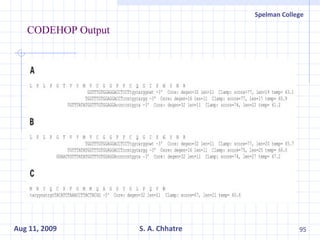
CODEHOP Output
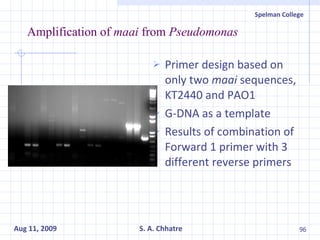
Amplification of  maai  from  Pseudomonas Primer design based on only two  maai  sequences, KT2440 and PAO1 G-DNA as a template Results of combination of Forward 1 primer with 3 different reverse primers
Quick-change Mutagenesis (Stratagene)
Future Directions Genomic Library in pBBR1tp Purification of Homogentisate dioxygenase Characterization of TCHQ dehalogenase mutants
Experimental approach Knocking out  maai  gene in  Pseudomonas putida  KT 2440 Making a genomic library of  S. chlorophenolicum  in a BHRV (Broad host range vector) Complementing the knockout mutant with genomic library and selecting on tyrosine Preparation of plasmid from the colonies and sequencing
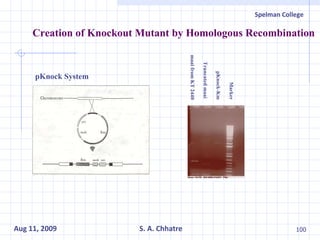
Creation of Knockout Mutant by Homologous Recombination   Marker pKnock-Km Truncated maai  maai from KT 2440 pKnock System
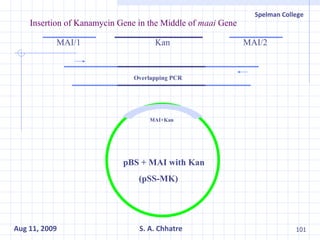
Insertion of Kanamycin Gene in the Middle of  maai  Gene pBS + MAI with Kan (pSS-MK) Kan MAI/2 MAI/1 Overlapping PCR MAI+Kan
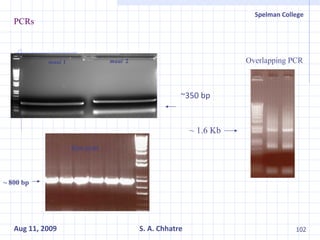
PCRs ~350 bp maai  1 maai   2 Overlapping PCR ~ 1.6 Kb Kan  gene ~ 800 bp
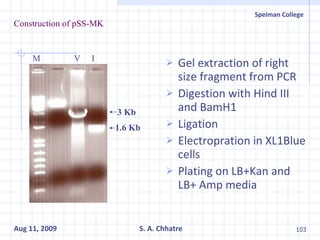
Construction of pSS-MK Gel extraction of right size fragment from PCR Digestion with Hind III and BamH1 Ligation Electropration in XL1Blue cells Plating on LB+Kan and LB+ Amp media M  V  I 3 Kb 1.6 Kb
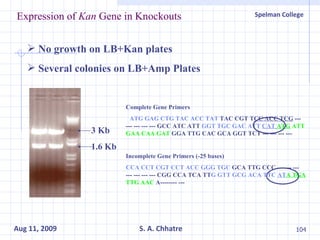
Expression of  Kan  Gene in Knockouts No growth on LB+Kan plates Several colonies on LB+Amp Plates 3 Kb 1.6 Kb Complete Gene Primers   ATG GAG CTG TAC ACC TAT  TAC CGT T CC ACC TCG  --- --- --- --- --- GCC ATC ATT  GGT TGC GAC ATT  CAT   ATG  ATT GAA CAA GAT  GGA TTG CAC GCA GGT TCT --- --- --- ---    Incomplete Gene Primers (-25 bases) CCA CCT CGT CCT ACC GGG TGC  GCA TTG CCC --- --- --- --- --- --- --- CGG CCA TCA TT G GTT GCG ACA TTC  AT A TGA  TTG AAC  A-------- ---
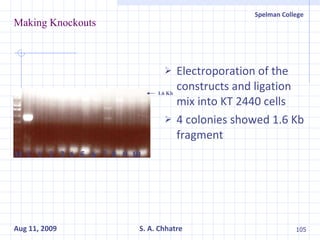
Making Knockouts Electroporation of the constructs and ligation mix into KT 2440 cells 4 colonies showed 1.6 Kb fragment M  C  1  2  3  4  5  6  7  8  9  10 1.6 Kb
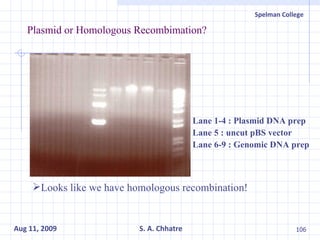
Plasmid or Homologous Recombimation? Lane 1-4 : Plasmid DNA prep Lane 5 : uncut pBS vector Lane 6-9 : Genomic DNA prep Looks like we have homologous recombination!
Making a Genomic Library of  S. chlorophenolicum Optimization of partial digestion of genomic DNA with  Sau 3A Scale up the reaction with large quantity of DNA under right conditions Digestion of Vector, dephosphorylation of digested vector Ligation and electroporation
Optimization and Scale up of Partial Digestion Reaction 4Kb ~ 50 ug of genomic DNA  was digested  Enzyme concentartion was .05 U/ug of DNA Various enzyme  concentration Scale up with right concentration of  Sau 3A 4Kb
Vector Preparation and Ligation 4Kb  I V Broad host range vector pUCP-Nde (4Kb) BamHI digsetion & depshosphorylation with CIAP Ligation
Results ~ 28,000 clones Restriction digestion profiles of some of the clones 4Kb M  U  C  U  C  U  C  U  C  U  C  U  C M  U  C  U  C M : Marker U : Undigested C : Cut (digested)
Complementation of Knockout with Full Copy of  maai  Gene Cloning the entire gene ( maai ) in pUCP-Nde Electroporation of the construct in electrocompetent KT 2440 cells 4Kb ~ 650 bp Colony PCR
Summary Obtain a real knockout (not the contaminant) Ligation reaction Positive control with endogenous promoter
Experimental Approach I Knocking out  maai  gene in  Pseudomonas putida  KT 2440 Making a genomic library of  S. chlorophenolicum  in a BHRV (Broad host range vector) Complementing the knockout mutant with genomic library and selecting on tyrosine Preparation of plasmid from the colonies and sequencing
Insertion of Kanamycin Gene in the Middle of  maai  Gene pBS + MAI with Kan (pSS-MK) Kan MAI/2 MAI/1 Overlapping PCR MAI+Kan
Optimization and Scale up of Partial Digestion Reaction 4Kb ~ 50 ug of genomic DNA  was digested  Enzyme concentartion was .05 U/ug of DNA Various enzyme  concentration Scale up with right concentration of  Sau 3A
Vector Preparation and Ligation 4Kb  I V Broad host range vector pUCP-Nde (4Kb) BamHI digsetion & depshosphorylation with CIAP Ligation No colonies!
Complementation of Knockout with Full Copy of  maai  Gene Cloning the entire gene ( maai ) in pUCP-Nde, pTZ100,  pBBR1tp Electroporation of the construct in electrocompetent knockout KT 2440 cells 4Kb ~ 650 bp Colony PCR
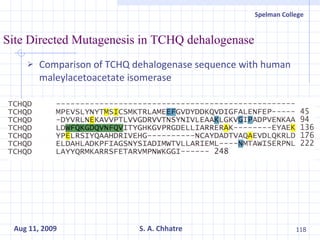
Site Directed Mutagenesis in TCHQ dehalogenase Comparison of TCHQ dehalogenase sequence with human maleylacetoacetate isomerase
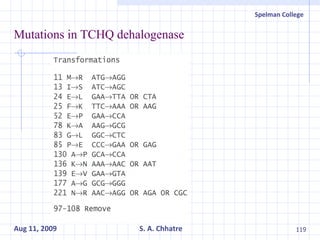
Mutations in TCHQ dehalogenase
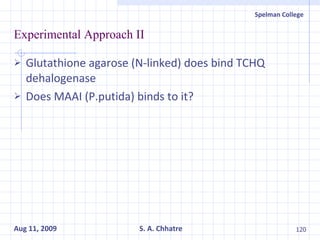
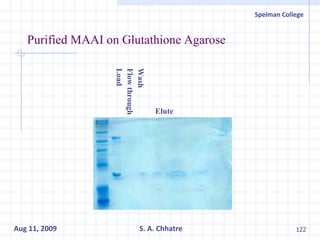
Experimental Approach II Glutathione agarose (N-linked) does bind TCHQ dehalogenase Does MAAI (P.putida) binds to it?
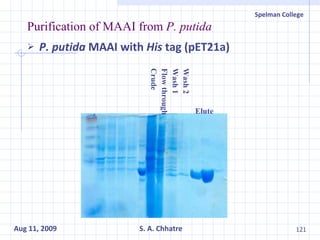
Purification of MAAI from  P. putida P. putida  MAAI with  His  tag (pET21a) Wash 2 Wash 1 Flow through Crude  Elute
Purified MAAI on Glutathione Agarose  Elute Wash  Flow through Load
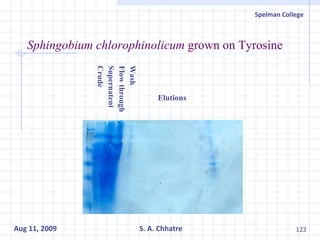
Sphingobium chlorophinolicum  grown on Tyrosine Wash  Flow through Supernatent Crude  Elutions
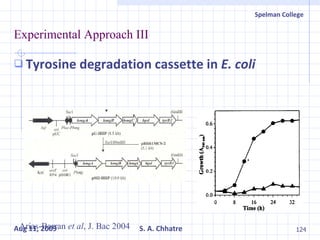
Experimental Approach III Tyrosine degradation cassette in  E. coli   Arias-Barran  et al , J. Bac 2004
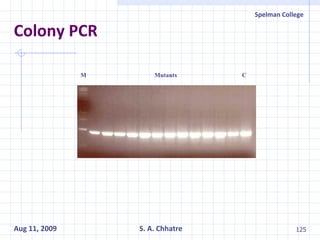
Colony PCR  M  Mutants  C
Quick-change Mutagenesis (Stratagene)
Isolate DSS 6 : Colony Characteristics
Isolate DSS 8 : Colony Characteristics
Isolate GSS 3 : Colony Characteristics


Bioremediation of Contaminated Soil

Microbial Diversity: Tapping the Untapped

  • 1.
    Bioremediation & MicrobialDiversity: Applications of Molecular Biological Tools in Studying Novel Physiological Traits Suneel Arjun Chhatre Aug 11, 2009
  • 2.
    Microbes: The Earth’sEngine ~4 Billions years Capable of exploiting a vast range of energy sources and thriving in almost every habitat For 2 billion years microbes were the only form of life (all the biochemistries of life evolved) Basic ecosystem processes; biogeochemical cycles and food chains, vital & elegant relationship between themselves and higher organisms
  • 3.
    Microbial Diversity Biodiversityas a source of innovation in biotechnology International Convention on Biological Diversity defines genetic resources as “ genetic material of actual potential value” Microbial Diversity as major resource for biotechnological products and processes Food Biotechnology Metabolites (amino acids, antibiotics, biopharmaceuticals) Enzymes Environmental Biotechnology Biological Fuels
  • 4.
    Why is MicrobialDiversity Important? Critical for the sustainability of life on earth, including recycling of elements, maintenance of climate, degradation of wastes Expand the frontiers of knowledge about the limits and strategies of life Largest untapped reservoir of biodiversity Key roles in conservation of higher organisms and in restoration of degraded ecosystems
  • 5.
  • 6.
    Role of CarbonWhen we study the chemistry of life, carbon is at the center of the action Living things transform carbon-based compounds voraciously, and microbes, as Earth’s most prolific and earliest-evolved life forms, do so most avidly Carbon cycle on Earth is largely dependent on microbiological processes, and biodegradation constitutes one-half of the carbon cycle
  • 7.
    The Beginning ofBiodegradation As old as life itself Prebiotic soup of organic molecules that served as the precurosr of the molecules, constituted first life (the ancestral cell) They must also have served as the energy sources (self replication requires energy)
  • 8.
    Explosion of lifemust have consumed most of the organic molecules in prebiotic soup during the 1 st billion years of Earth in the sustainence of first life At that point, the richest source of food for life was other forms of life
  • 9.
    This continues todayMicrobes produce lipases, proteases, cellulases and ligninases that decmpose living organisms or their remains after death Photosynthesis was an important development on the earth’s surface that allowed much greater biomass production and hence generated more molecules to be biodegraded
  • 10.
    Importance of MicrobialDiversity Microbes harbor the greatest biological diversity and play a more important role in maintaining global processes Microbes have been around since the start of the life at least 3.6 billion years ago (macroscopic ~ 1 billion years) Microbes reproduce, and thus evolve new traits faster than macroscopic organisms
  • 11.
    Number of bacteriaattached to your body exceeds the entire human population on earth Approximately 5X10 30 prokaryotes reside on earth 500,000 species of insects, termites have 1000 sp of bacteria Total number of bacteria in domestic animals is close to 4X10 24
  • 12.
    Identifying Novel MicrobialCatalysis by Enrichment Culture & Screening One gram of soil contains 10 9 bacteria, perhaps 10,000 different types Pioneered by Beijerinck & Winogradsky Selective cultivation of one or more bacterial strains obtained from complex mixture such as soil, sludges, water etc. The method relies on using a particular organic compound as the sole carbon source or, less frequently, as the N, S or P source
  • 13.
    Case Studies: Hydrocarbondegrading potential of microbes (Oil Spill Remediation) Reductive Dehalogenation (Degradation of Pesticide, Pentachlorophenol) in Sphingobium cholorophenolicum Sulfur Oxidation Reactions & Acid Tolerance Resposnse in Halothiobacillus neapoitanus
  • 14.
    Bioremediation of OilSpills EPA (2006): world wide consumption of petroleum was 84,979,000 barrels/day Transportation Oil Spills Disasters Torey Canyon 1967 (38 million gallons) Exxon Valdez 1989 (10 millions gallons plus) Westchester 2000 (567,000 gallons) Hurricane Katrina 2005 (7 millions)
  • 15.
    Two Step TreatmentProtocol Containment: Step one is skimming the crude oil from the surface (Sawdust) Mineralization: Step two is biodegradation of crude oil components by using bacterial catabolic properties (Consortium)
  • 16.
    Goals Enrichment, Isolationand Characterization of hydrocarbonoclastic microorganisms Designing a consortium based on their catabolic properties and the composition of crude oil Determination of efficacy of consortium for crude oil/hydrocarbon degradation Osmotolerance (genetic manipulation)
  • 17.
    Enrichment of BacteriaOil Sludge: Semicontinuous batch reactor fed with crude oil for enrichment of hydrocarbon degraders Serial Dilution & Plating (After six months when COD was 60% lowered)
  • 18.
    Isolation & CharacterizationThirty five isolates Three Tier Screening Primary: based on morphology, growth pattern, incubation time Secondary: Antibiotic Sensitivity Tertiary: based on hydrocarbon degradation potential (catechol, dodecane, tetracosane, eicosane, phenanthrene)
  • 19.
    Designing the ConsortiumThree of the isolates DSS6: Aliphatic degradation, biosurfactant GSS3: Aromatic degrader DSS8: Long chain aliphatic Pseudomonas putida ATCC 102, known for consumption of down stream metabolites Seed culture grown on catechol prior to crude oil degradation
  • 20.
    Isolate DSS 6: Colony Characteristics
  • 21.
    Isolate DSS 8: Colony Characteristics
  • 22.
    Isolate GSS 3: Colony Characteristics
  • 23.
    Characterization of Isolateson the Basis of Catabolic Pathway Using PCR Specific Primers based on the catabolic properties PCR with total DNA of each isolate and control dmpN -Phenol Hydroxylase Pseudomonas sp. (strain CF600) xyl E alk B
  • 24.
    alkB -Alkane HydroxylaseFrom OCT plasmid of Pseudomonas oleovorans
  • 25.
    XylE -Catechol 2-3Dioxygenase
  • 26.
    Efficacy of Consortiumfor Biodegradation Gas Chromatography Catechol grown consortium was applied to degrade Crude Oil Control After 72 Hrs.
  • 27.
    Gravimetric Analysis ofVarious Fractions
  • 28.
    Degradation by IndividualMembers Same methodology but crude oil was subjected to degradation individually Alone, the efficiency was not as high as in group Gas Chromatograph of Crude Oil after 72 hrs
  • 29.
  • 30.
    Imparting Osmotolerance toConsortium Pro ‘U’ operon (Dr. Gowrishankar, 1996) Glycine-betaine uptake Subcloned in pMMB206 (a broad host range vector) Growth in presence of 1M Nacl Degradation of Model Petroleum
  • 31.
    Model Petroleum Homogenousmixture of representative hydrocarbons 1-dodecane (C12) 2-naphthalene (Dicyclic) 3-pentadecane (C15) 4-hexadecane (C16) 5-pristane (IS) 6-dibenzothiophene (Hetero) 7-phenanthrene (Tricyclic) 8-eicosane (C20) 9-tetracosane (C24) 10-octacosane (C28 Single peak with Capillary GC)
  • 32.
    Physical Skimming ofCrude Oil Alkali Treated sawdust (high temp and pressure) Delignification causes increase in surface area Measured by Methylene Blue Isotherms, Mercury Porosimetry; proved by Scanning Electron Microscopy
  • 33.
    Physical Skimming ofCrude Oil Crude Oil was spread over a trough full of water Sprinkling of saw dust Skimming Gravimetric analysis proved ~ 90% removal Cost effective and often necessary
  • 34.
    Strategies to StudyEvolutionary Origin of TCHQ dehalogenase in Sphingobium chlorophenolicum
  • 35.
    What is TCHQDehalogenase? Reductive dehalogenase, removes 2 chlorine atoms in the PCP degradation pathway in Sphingobium chlorophenolicum PCP Degradation Pathway
  • 36.
    Maleylacetoacetate Isomerase (MAAI):   Catalyzes the isomerization of maleylacetoacetate to fumaryl acetoacetate, a step in the degradation of Phenylalanine and Tyrosine
  • 37.
    The sequence conservationin the active site regions of TCHQ dehalogenase and the known MAA isomerases The ability of TCHQ dehalogenase to isomerize maleylacetone (MA), an analogue of MAA The fact that both are members of zeta class of GST superfamily The Relationship
  • 38.
    Goals Clone, sequenceand express the MAA isomerase from S. chlorophenolicum and compare it with TCHQ dehalogenase Determine what type of changes have occurred in order to enhance the dehalogenation reaction In vitro evolution of maai into TCHQ dehalogenase Kinetic studies on dehalogenation
  • 39.
    Experimental Approach IKnocking out maai gene in Pseudomonas putida KT 2440 Making a genomic library of S. chlorophenolicum in a BHRV (Broad host range vector) Complementing the knockout mutant with genomic library and selecting on tyrosine Preparation of plasmid from the colonies and sequencing
  • 40.
    Insertion of KanamycinGene in the Middle of maai Gene pBS + MAI with Kan (pSS-MK) Kan MAI/2 MAI/1 Overlapping PCR MAI+Kan
  • 41.
    Genotype : PCRfor kanamycin resistant gene inserted in the middle of maai (bigger product) Phenotype : Growth on minimal media+Tyrosine as sole source of carbon Growth on LB+kanamycin plates Do We Have the Knockouts?
  • 42.
    PCR to verify maai gene with insertion of kanamycin resistance gene in mutants With Long primers With short primers M C6 C8 C9 C10 M C6 C8 C9 C10
  • 43.
    Confirmation of knockoutsby Phenotype LB+Kan Tyrosine+Minimal Medium
  • 44.
    Making a GenomicLibrary of S. chlorophenolicum Optimization of partial digestion of genomic DNA with Sau 3A Scale up the reaction with large quantity of DNA under right conditions Digestion of Vector, dephosphorylation of digested vector Ligation and electroporation
  • 45.
    Optimization and Scaleup of Partial Digestion Reaction 4Kb ~ 50 ug of genomic DNA was digested Enzyme concentartion was .05 U/ug of DNA Various enzyme concentration Scale up with right concentration of Sau 3A 4Kb
  • 46.
    Vector Preparation andLigation 4Kb I V Broad host range vector pUCP-Nde (4Kb) BamHI digsetion & depshosphorylation with CIAP Ligation
  • 47.
    Results ~ 28,000clones Restriction digestion profiles of some of the clones 4Kb M U C U C U C U C U C U C M U C U C M : Marker U : Undigested C : Cut (digested)
  • 48.
    Complementation of Knockoutwith Full Copy of maai Gene Cloning the entire gene ( maai ) in pUCP-Nde Electroporation of the construct in electrocompetent knockout KT 2440 cells 4Kb ~ 650 bp Colony PCR
  • 49.
    Experimental Approach IIDegenerate PCR Amplification of unknown targets related to multiple-aligned protein sequences 2 strategies : Synthesize a pool of degenerate primers containing most or all possible nucleotides Design single consensus primer across the highly conserved region
  • 50.
    Primer Design forMAAI Multiple Sequence Alignment (ClustalW) Block-Maker Codehop A B C D A B C D Sequences Blocks Primers
  • 51.
    Genomic Library inpSmart sau3A digestion of G-DNA Ligation with pre-digested vector PCR Profile of Library Clones
  • 52.
    Results : DegeneratePCR Lane 1-7-14 : Marker Lane 2-8 : Sph. G-DNA Lane 3-9 : Sph. Library Lane 4-10 : KT G-DNA Lane 5-11: PAO1 Lane 6-12: KT Construct Lane 13 : Positive control
  • 53.
    Site Directed MutagenesisComparison of TCHQ dehalogenase sequence with known bacterial and eukaryotic MAAIs Mutations in the active site region
  • 54.
  • 55.
  • 56.
    Mutations in TCHQdehalogenase
  • 57.
  • 58.
  • 59.
    Deletion Mutant PCRamplification of the 2 fragments with restriction sites Overlapping PCR for the full fragment Cloning in pET 21a 1 97 108 248
  • 60.
    Results PCR for2 fragments Overlapping PCR and vector pET 21a Product
  • 61.
    Colony PCR andSequencing pcpC Blast 2 with pcpC
  • 62.
    Purification of TCHQdehalogenase Poor Yield (3mg/L) Tedious Prep Three different columns Blue Agarose Mono-Q Superdex
  • 63.
    Substrate Inhibition inTCHQ Dehalogenase Third & Fourth steps Nucleophilic attack of glutathione upon an electrophilic substrate to form a conjugate MAAI & MPI isomerization of double bond, regenenerates glutathione Reductive dehalogenation, 2 equiv of glutathione and results in oxidation to glutathione disulfide
  • 64.
    Substrate Inhibition Thesubstrate primarily binds as TriCHQ - and is rapidly deprotonated to TriCHQ 2- at the active site TriCHQ 2- is converted to it’s tautomer (TriCHQ* ) which is attacked by glutathione Cys13 then attacks the glutathione conjugate, releasing the reduced product and forming a covalent bond between Cys13 and glutathione Finally, the free enzyme is regenerated by thiol-disulfide exchange reaction with the second molecule of glutathione It is profoundly inhibited by its aromatic substrates
  • 65.
    Trade Off: MutantI12A & I12S Mutation of Isoleucine 12 to alanine or serine gives and enzyme which is not inhibited by the substrates Weak binding of TriCHQ to ESSG Decrease in rate of dehalogenation
  • 66.
    pH Dependent ProteinExpression in Sulfur Oxidizing Bacteria
  • 67.
    Deep Sea ThermalVents Temperatures as high as 404  C Depths in 1000’s of meters Pressures >6000 psi Anoxic
  • 68.
    Cold seeps Temperatures12 to 45  C pH 6.3 to 7.7 Salinity 1200 to 21000  S Eh -380 to -280 mV Depths in 100’s of m
  • 69.
    Why study them?Obvious interest in unique microbial physiologies Species thrive in the presence of high levels of toxic compounds Marine and surface thermal vents long proposed as ‘source of life’ Lateral gene transfer proposed as source for pathogenicity in Proteobacteria Other adaptive responses in Proteobacteria species may also have arisen from horizontal gene transfer Locations range from marine (Mid-Atlantic Ridge) to semi-arid high altitude desert environments (Eddy Co., NM)
  • 70.
    Model Organism Halothiobacillusneapolitanus Isolated from a shallow marine vent Also found in cold seeps and municipal sewers Reduced and partially reduced inorganic sulfur compounds as the sole source of energy Mildly halotolerant, mesophile pH range 8.5 to as low as 3.5
  • 71.
    Our reasons tostudy H. neapolitanus Wide pH range indicates potential for inducible acid tolerance response (ATR) Chemolithoautotroph Proposed to use the ‘S4’ oxidation pathway Relationship to thermal vent species
  • 72.
  • 73.
    Plan of ActionIdentify sulfur oxidizing activities Establish a baseline for physiology and protein expression Determine pH dependence of physiology and protein expression Establish correlations between physiological changes and expression of individual genes
  • 74.
  • 75.
  • 76.
  • 77.
    Substrate dependent oxygenconsumption by Halothiobacillus neapolitanus
  • 78.
    Substrate dependent oxygenconsumption by Halothiobacillus neapolitanus Substrate amount Total O 2 consumption O 2 consumption rate (nmol) (nmol) (nmolmin-1mg-1) S -2 0 0 0 50 172  7 220  9 100 336  15 214  7 S 0 * 0 0 0 50 84  11 55  8 100 174  14 59  6 S 2 O 3 -2 0 0 0 50 99  7 78  6 100 192  5 82  5 S 4 O 6 -2 0 0 0 50 155  6 78  6 100 315  9 82  5 S 3 0 6 -2 100 0.0 0.0 S 5 O 6 -2 100 0.0 0.0 SO 3 -2 100 0.0 0.0 SO 4 -2 100 0.0 0.0
  • 79.
    Effect of inhibitorson total O 2 consumption* Inhibitor S -2 S 0 S 2 O 3 -2 S 4 O 6 -2 Rotenone 81  7.8 93  4.4 100.4  5.7 97.6  6.3 antimycin A 100.5  11.3 98.1  2.4 85  3.8 100.1  2.7 TTFA 90.1  4 92  1.9 94.8  3.7 90.3  3.3 myxothiazol 92.2  4.3 94.7  1.6 99.9  3.8 89.7  6.7 NEM 21.3  4.5 16.7  4.0 3.9  8.4 23.7  4.9 azide, 0.01mM 100  4 100  2.2 100  5 100  3.9 azide, 1mM 84.8  3.3 84.7  3.1 81.9  6.2 89.6  6.6 cyanide, 0.01mM 100  2.2 100  17 100  9 100  6.2 cyanide, 1mM 89.8  10.4 91.1  7.7 90.0  6.9 92.7  8.9 *values are expressed as percentage of control without inhibitor and without correction for changes in gas solubility due to inhibitors
  • 80.
    Effect of inhibitorson rate of O 2 consumption Inhibitor S -2 S 0 S 2 O 3 -2 S 4 O 6 -2 rotenone 54.7  7% 92  4.6 99.2  2.7 46  8.2 antimycin A 80.8  5.6% 84  7.7 97.7  3.8 81.2  7.7 TTFA 52.3  6.1% 55.4  6 100  0.8 88.8  2.7 myxothiazol 79.4  7.9% 88.4  4.7 98.6  3.0 94.7  4.6 NEM 9.8  1.4% 1.6  0.9 2.2  1.7 6.1  2.8 azide, 0.01mM 97.3  3.8 94.7  3.8 99.2  1.8 97.8  6.7 azide, 1mM 28  3.3% 24.4  2.6 27  3.9 25.5  7.0 cyanide, 0.01mM 99.1  2.9 97.2  5.5 98  4.7 97.4  3.0 cyanide, 1mM 30.8  7.8% 33.2  2.6 31.7  6.8 34  2.3
  • 81.
    Substrate:Oxygen Stoichiometry Substratemol O 2 /mol S mol O 2 /mol e - S -2 ~3.3:1 0.4:1 S 0 ~1.5:1 0.6:1 S 2 O 3 -2 ~2:1 0.8:1 S 4 O 6 -2 ~3:1 0.25:1
  • 82.
    pH Dependent ProteinExpression pH 6.5 pH 4.5
  • 83.
    Summary of Physiologyat pH 7 Unique electron transport system – terminal oxidase is cyanide insensitive Stoichiometry is not clear Change in expression profile at low pH (ATR)
  • 84.
    Purification of Proteinsinvolved in Sulfur Oxidation
  • 85.
    Cloning & Characterizationof Genes N-terminus sequencing of proteins (C-554, C-549, Thiosulfate Oxidase) Primer Designing Genomic Libraries 3-4 Kb 30-40 Kb PCR Cloning & Sequencing Activity Assay, Spectrum
  • 86.
  • 87.
  • 88.
    Future Directions Quenchedoxygen consumption assays Measure NAD(P)/NAD(P)H ratios Measure P/O ratios pH dependence Identification of genes and gene products Real time PCR to verify changes in expression ‘ Knock-out’ mutants
  • 89.
    Acknowledgements National EnvironmentalEngineering Research Institute (NEERI)/ Indian Institute of Technology, Roorkee, India Department of Biotechnology (DBT) MCDB/Chemistry, University of Colorado at Boulder, CO NIH, NSF, DOE Chemistry, Eastern New Mexico University, Portales, NM NIH NCRR P20-61480
  • 90.
    Acknowledgements Students AntonIliuk Ben Goldbaum Eliseo Castillo John Latham Joaquin DeLeon Nalini Anamula Ramu Kakumanu Neela Gamini Dr. Suneel Chhatre Collaborators Sabine Heinhorst Gordon Cannon NIH NCRR P20-61480 ENMU
  • 91.
    Future Directions Purificationof MAAI from Sphingobium Characterization of TCHQ dehalogenase mutants
  • 92.
  • 93.
    CODEHOP (Consensus-degenerate HybridOligonucletide Primers) Short 3’ degenerate core and a 5’non-degenerate consensus clamp Reducing the length 3’ core decreases the total number of primers Hybridization of the 3’ degenerate core with template is stabilized by non-deg 5’ clamp
  • 94.
  • 95.
  • 96.
    Amplification of maai from Pseudomonas Primer design based on only two maai sequences, KT2440 and PAO1 G-DNA as a template Results of combination of Forward 1 primer with 3 different reverse primers
  • 97.
  • 98.
    Future Directions GenomicLibrary in pBBR1tp Purification of Homogentisate dioxygenase Characterization of TCHQ dehalogenase mutants
  • 99.
    Experimental approach Knockingout maai gene in Pseudomonas putida KT 2440 Making a genomic library of S. chlorophenolicum in a BHRV (Broad host range vector) Complementing the knockout mutant with genomic library and selecting on tyrosine Preparation of plasmid from the colonies and sequencing
  • 100.
    Creation of KnockoutMutant by Homologous Recombination Marker pKnock-Km Truncated maai maai from KT 2440 pKnock System
  • 101.
    Insertion of KanamycinGene in the Middle of maai Gene pBS + MAI with Kan (pSS-MK) Kan MAI/2 MAI/1 Overlapping PCR MAI+Kan
  • 102.
    PCRs ~350 bpmaai 1 maai 2 Overlapping PCR ~ 1.6 Kb Kan gene ~ 800 bp
  • 103.
    Construction of pSS-MKGel extraction of right size fragment from PCR Digestion with Hind III and BamH1 Ligation Electropration in XL1Blue cells Plating on LB+Kan and LB+ Amp media M V I 3 Kb 1.6 Kb
  • 104.
    Expression of Kan Gene in Knockouts No growth on LB+Kan plates Several colonies on LB+Amp Plates 3 Kb 1.6 Kb Complete Gene Primers   ATG GAG CTG TAC ACC TAT TAC CGT T CC ACC TCG --- --- --- --- --- GCC ATC ATT GGT TGC GAC ATT CAT ATG ATT GAA CAA GAT GGA TTG CAC GCA GGT TCT --- --- --- ---   Incomplete Gene Primers (-25 bases) CCA CCT CGT CCT ACC GGG TGC GCA TTG CCC --- --- --- --- --- --- --- CGG CCA TCA TT G GTT GCG ACA TTC AT A TGA TTG AAC A-------- ---
  • 105.
    Making Knockouts Electroporationof the constructs and ligation mix into KT 2440 cells 4 colonies showed 1.6 Kb fragment M C 1 2 3 4 5 6 7 8 9 10 1.6 Kb
  • 106.
    Plasmid or HomologousRecombimation? Lane 1-4 : Plasmid DNA prep Lane 5 : uncut pBS vector Lane 6-9 : Genomic DNA prep Looks like we have homologous recombination!
  • 107.
    Making a GenomicLibrary of S. chlorophenolicum Optimization of partial digestion of genomic DNA with Sau 3A Scale up the reaction with large quantity of DNA under right conditions Digestion of Vector, dephosphorylation of digested vector Ligation and electroporation
  • 108.
    Optimization and Scaleup of Partial Digestion Reaction 4Kb ~ 50 ug of genomic DNA was digested Enzyme concentartion was .05 U/ug of DNA Various enzyme concentration Scale up with right concentration of Sau 3A 4Kb
  • 109.
    Vector Preparation andLigation 4Kb I V Broad host range vector pUCP-Nde (4Kb) BamHI digsetion & depshosphorylation with CIAP Ligation
  • 110.
    Results ~ 28,000clones Restriction digestion profiles of some of the clones 4Kb M U C U C U C U C U C U C M U C U C M : Marker U : Undigested C : Cut (digested)
  • 111.
    Complementation of Knockoutwith Full Copy of maai Gene Cloning the entire gene ( maai ) in pUCP-Nde Electroporation of the construct in electrocompetent KT 2440 cells 4Kb ~ 650 bp Colony PCR
  • 112.
    Summary Obtain areal knockout (not the contaminant) Ligation reaction Positive control with endogenous promoter
  • 113.
    Experimental Approach IKnocking out maai gene in Pseudomonas putida KT 2440 Making a genomic library of S. chlorophenolicum in a BHRV (Broad host range vector) Complementing the knockout mutant with genomic library and selecting on tyrosine Preparation of plasmid from the colonies and sequencing
  • 114.
    Insertion of KanamycinGene in the Middle of maai Gene pBS + MAI with Kan (pSS-MK) Kan MAI/2 MAI/1 Overlapping PCR MAI+Kan
  • 115.
    Optimization and Scaleup of Partial Digestion Reaction 4Kb ~ 50 ug of genomic DNA was digested Enzyme concentartion was .05 U/ug of DNA Various enzyme concentration Scale up with right concentration of Sau 3A
  • 116.
    Vector Preparation andLigation 4Kb I V Broad host range vector pUCP-Nde (4Kb) BamHI digsetion & depshosphorylation with CIAP Ligation No colonies!
  • 117.
    Complementation of Knockoutwith Full Copy of maai Gene Cloning the entire gene ( maai ) in pUCP-Nde, pTZ100, pBBR1tp Electroporation of the construct in electrocompetent knockout KT 2440 cells 4Kb ~ 650 bp Colony PCR
  • 118.
    Site Directed Mutagenesisin TCHQ dehalogenase Comparison of TCHQ dehalogenase sequence with human maleylacetoacetate isomerase
  • 119.
    Mutations in TCHQdehalogenase
  • 120.
    Experimental Approach IIGlutathione agarose (N-linked) does bind TCHQ dehalogenase Does MAAI (P.putida) binds to it?
  • 121.
    Purification of MAAIfrom P. putida P. putida MAAI with His tag (pET21a) Wash 2 Wash 1 Flow through Crude Elute
  • 122.
    Purified MAAI onGlutathione Agarose Elute Wash Flow through Load
  • 123.
    Sphingobium chlorophinolicum grown on Tyrosine Wash Flow through Supernatent Crude Elutions
  • 124.
    Experimental Approach IIITyrosine degradation cassette in E. coli Arias-Barran et al , J. Bac 2004
  • 125.
    Colony PCR M Mutants C
  • 126.
  • 127.
    Isolate DSS 6: Colony Characteristics
  • 128.
    Isolate DSS 8: Colony Characteristics
  • 129.
    Isolate GSS 3: Colony Characteristics
  • 130.
  • 131.
  • 132.
  • 133.
  • 134.