Biodegradation of pollutants P. DHAMODHARAN
2019502205
DEPARTMENT OF AGRONOMY
BIOREMEDIATION
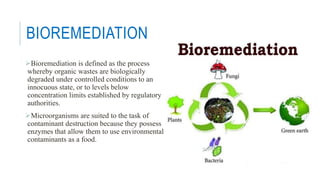
Bioremediation is defined as the process
whereby organic wastes are biologically
degraded under controlled conditions to an
innocuous state, or to levels below
concentration limits established by regulatory
authorities.
Microorganisms are suited to the task of
contaminant destruction because they possess
enzymes that allow them to use environmental
contaminants as a food.
AIM OF BIOREMEDIATION
To encourage them to work by supplying optimum levels of nutrients
and other chemicals essential for their metabolism in order to
degrade/detoxify substances which is hazardous to environment and
living things.
All metabolic reactions are mediated by enzymes.
These belong to the groups of oxidoreductases, hydrolases, lyases,
transferases, isomerases and ligases.
Many enzymes have a remarkably wide degradation capacity due to
their non-specific and specific substrate affinity.
For bioremediation to be effective, microorganisms must
enzymatically attack the pollutants and convert them to harmless
products.
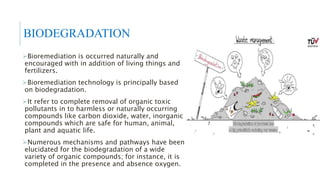
Bioremediation is occurred naturally and
encouraged with in addition of living things and
fertilizers.
Bioremediation technology is principally based
on biodegradation.
It refer to complete removal of organic toxic
pollutants in to harmless or naturally occurring
compounds like carbon dioxide, water, inorganic
compounds which are safe for human, animal,
plant and aquatic life.
Numerous mechanisms and pathways have been
elucidated for the biodegradation of a wide
variety of organic compounds; for instance, it is
completed in the presence and absence oxygen.
BIODEGRADATION
ADVANTAGE OF BIOREMEDIATION
It is a natural process, it takes a little time, as an acceptable waste treatment process
for contaminated material such as soil.
It requires a very less effort and can often be carried out on site, often without
causing a major disruption of normal activities.
It is applied in a cost effective process
It also helps in complete destruction of the pollutants,
It does not use any dangerous chemicals
Simple, less labor intensive and cheap due to their natural role in the environment.
Eco-friendly and sustainable .
 Contaminants are destroyed, not simply transferred to different environmental
media.
 Nonintrusive, potentially allowing for continued site use.
 Relative ease of implementation .
 Effective way of remediating natural ecosystem from a number contaminate and act
as environment friendly options
DISADVANTAGE OF BIOREMEDIATION
It is limited to those compounds that are biodegradable. Not all
compounds are susceptible to rapid and complete degradation.
There are some concerns that the products of biodegradation may be
more persistent or toxic than the parent compound.
Biological processes are often highly specific.
It is difficult to extrapolate from bench and pilot-scale studies to full-
scale field operations.
Research is needed to develop and engineer bioremediation technologies
that are appropriate for sites with complex mixtures of contaminants that
are not evenly dispersed in the environment.
It often takes longer than other treatment options, such as excavation and
removal of soil or incineration.
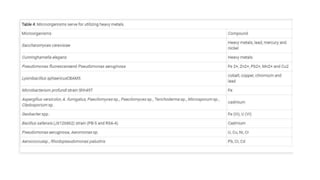
Heavy metals cannot be destroyed biologically (“no degradation”, changes
occur in the nuclear structure of the element), but only transformed from one
oxidation state or organic complex to another.
Besides, bacteria are also efficient in heavy metals bioremediation.
Microorganisms have developed the capabilities to protect themselves from
heavy metal toxicity by various mechanisms, such as adsorption, uptake,
methylation, oxidation and reduction.
Microorganism’s uptake heavy metals actively (bioaccumulation) and/or
passively (adsorption).
Microbial methylation plays an important role in heavy metals
bioremediation, because methylated compounds are frequently volatile.
For example, Mercury, Hg (II) can be biomethylated by a number of different
bacterial species Alcaligenes faecalis, Bacillus pumilus, Bacillus sp., P.
aeruginosa and Brevibacterium iodinium to gaseous methyl mercury
Significance
FACTORS AFFECTING MICROBIAL
BIOREMEDIATION
1. Biological factors
2. Environmental factors
3. Availability of nutrients
4. Temperature
5. Concentration of oxygen
6. Moisture content
7. pH
8. Metal ions
9. Toxic compounds
EFFECTS OF DIFFERENT POLLUTANTS
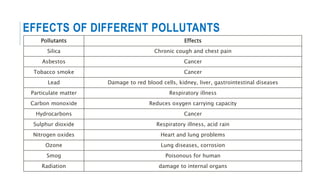
Pollutants Effects
Silica Chronic cough and chest pain
Asbestos Cancer
Tobacco smoke Cancer
Lead Damage to red blood cells, kidney, liver, gastrointestinal diseases
Particulate matter Respiratory illness
Carbon monoxide Reduces oxygen carrying capacity
Hydrocarbons Cancer
Sulphur dioxide Respiratory illness, acid rain
Nitrogen oxides Heart and lung problems
Ozone Lung diseases, corrosion
Smog Poisonous for human
Radiation damage to internal organs
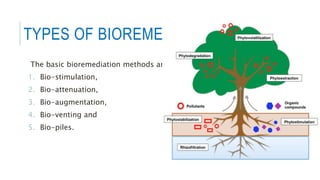
TYPES OF BIOREMEDIATION
The basic bioremediation methods are:
1. Bio-stimulation,
2. Bio-attenuation,
3. Bio-augmentation,
4. Bio-venting and
5. Bio-piles.
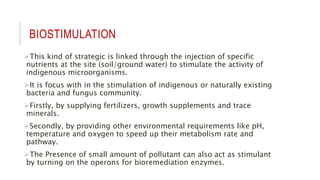
BIOSTIMULATION
This kind of strategic is linked through the injection of specific
nutrients at the site (soil/ground water) to stimulate the activity of
indigenous microorganisms.
It is focus with in the stimulation of indigenous or naturally existing
bacteria and fungus community.
Firstly, by supplying fertilizers, growth supplements and trace
minerals.
Secondly, by providing other environmental requirements like pH,
temperature and oxygen to speed up their metabolism rate and
pathway.
The Presence of small amount of pollutant can also act as stimulant
by turning on the operons for bioremediation enzymes.
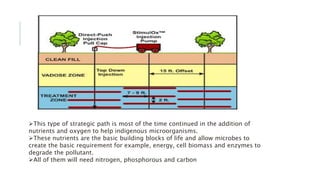
This type of strategic path is most of the time continued in the addition of
nutrients and oxygen to help indigenous microorganisms.
These nutrients are the basic building blocks of life and allow microbes to
create the basic requirement for example, energy, cell biomass and enzymes to
degrade the pollutant.
All of them will need nitrogen, phosphorous and carbon
BIOATTENUATION [NATURAL
ATTENUATION]
It is the eradication of pollutant
concentrations from surrounding.
It is carried out with in biological
processes.
It maybe include (aerobic and anaerobic
biodegradation, plant and animal
uptake), physical phenomena (advection,
dispersion, dilution, diffusion,
volatilization, sorption/desorption), and
chemical reactions (ion exchange,
complexation, abiotic transformation).
FOUR WAYS TO CLEAN UP
1) Tiny bugs or microbes that live in soil and groundwater use some
chemicals for food. When they completely digest the chemicals, they
can change them into water and harmless gases.
2) Chemicals can stick or sorb to soil, which holds them in place. This
does not clean up the chemicals, but it can keep them from polluting
groundwater and leaving the site.
3) As pollution moves through soil and groundwater, it can mix with
clean water. This reduces or dilutes the pollution.
4) Some chemicals, like oil and solvents, can evaporate, which means
they change from liquids to gases within the soil. If these gases escape
to the air at the ground surface, sunlight may destroy them.
If the natural attenuation is not quick enough or complete enough,
bioremediation will be enhanced either by biostimulation or
bioaugmentation.
BIOAUGMENTATION
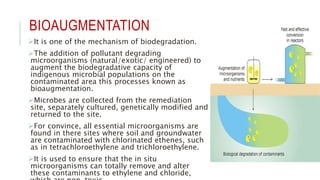
It is one of the mechanism of biodegradation.
The addition of pollutant degrading
microorganisms (natural/exotic/ engineered) to
augment the biodegradative capacity of
indigenous microbial populations on the
contaminated area this processes known as
bioaugmentation.
Microbes are collected from the remediation
site, separately cultured, genetically modified and
returned to the site.
For convince, all essential microorganisms are
found in there sites where soil and groundwater
are contaminated with chlorinated ethenes, such
as in tetrachloroethylene and trichloroethylene.
It is used to ensure that the in situ
microorganisms can totally remove and alter
these contaminants to ethylene and chloride,
GENETICALLY ENGINEERED MICROORGANISMS
(GEMS)
GEMS is a microorganism whose genetic material has been already
changed by applying genetic engineering techniques inspired by
natural otherwise artificial genetic exchange between
microorganisms. (recombinant DNA technology).
Genetic engineering has been improved the utilization and
elimination of hazardous unwanted wastes under laboratory
conditions by creating genetically modified organisms .
Recombinant living organisms able to obtained by recombinant DNA
techniques or by natural genetic material exchange between
organisms.
Essential genes of bacteria are carried on a single chromosome but
genes specifying enzymes required for the catabolism of some of
these unusual substrates may be carried on plasmids.
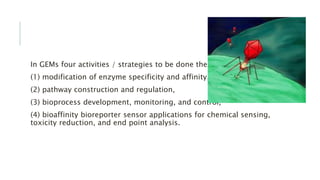
In GEMs four activities / strategies to be done these are:
(1) modification of enzyme specificity and affinity,
(2) pathway construction and regulation,
(3) bioprocess development, monitoring, and control,
(4) bioaffinity bioreporter sensor applications for chemical sensing,
toxicity reduction, and end point analysis.
ADVANTAGE OF GEMS IN BIOREMEDIATION:
speed up the recovery of waste polluted sites,
increase substrate degradation,
displays a high catalytic or utilization capacity with a small amount
of cell mass,
crate safe and purified environmental conditions by decontamination
or neutralizing any harmful substances.
DISADVANTAGE OF GEMS IN
BIOREMEDIATION
In some case the death of cells are happened, having challenge
associated with their release in the surrounding,
delay of growth and substrate degradation,
seasonal variation and
other abiotic factor fluctuation have direct and indirect impact and
relationship on microbial activity
introduced foreign modified strain to the system leads to unreacted
and cause unmeasurable adverse effect on the natural structural and
functional microorganism’s community composition and occurrence.
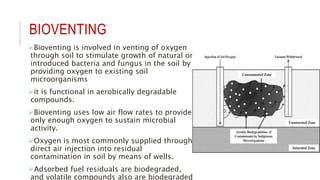
BIOVENTING
Bioventing is involved in venting of oxygen
through soil to stimulate growth of natural or
introduced bacteria and fungus in the soil by
providing oxygen to existing soil
microorganisms
it is functional in aerobically degradable
compounds.
Bioventing uses low air flow rates to provide
only enough oxygen to sustain microbial
activity.
Oxygen is most commonly supplied through
direct air injection into residual
contamination in soil by means of wells.
Adsorbed fuel residuals are biodegraded,
and volatile compounds also are biodegraded
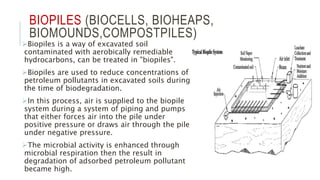
BIOPILES (BIOCELLS, BIOHEAPS,
BIOMOUNDS,COMPOSTPILES)
Biopiles is a way of excavated soil
contaminated with aerobically remediable
hydrocarbons, can be treated in "biopiles".
Biopiles are used to reduce concentrations of
petroleum pollutants in excavated soils during
the time of biodegradation.
In this process, air is supplied to the biopile
system during a system of piping and pumps
that either forces air into the pile under
positive pressure or draws air through the pile
under negative pressure.
The microbial activity is enhanced through
microbial respiration then the result in
degradation of adsorbed petroleum pollutant
became high.
CONCLUSION
Biodegradation is very attractive option to remediating, cleaning,
managing and recovering technique for solving polluted environment
through microbial activity.
The speed of unwanted waste substances degradation is determined
in competition with in biological agents, inadequate supply with
essential nutrient, uncomfortable external abiotic conditions (aeration,
moisture, pH, temperature), and low bioavailability of the pollutant.
As bioremediation can be effective only where environmental
conditions permit microbial growth and activity.
Mainly, the advantages is greater than that of disadvantages which is
evident by the number of sites that choose to use this technology and
its increasing popularity through time.
Generally, different species are explored from different sites and they
are effective in control mechanism.
THANK YOU

Biodegradation of pollutants

  • 1.
    Biodegradation of pollutantsP. DHAMODHARAN 2019502205 DEPARTMENT OF AGRONOMY
  • 2.
    BIOREMEDIATION Bioremediation is definedas the process whereby organic wastes are biologically degraded under controlled conditions to an innocuous state, or to levels below concentration limits established by regulatory authorities. Microorganisms are suited to the task of contaminant destruction because they possess enzymes that allow them to use environmental contaminants as a food.
  • 3.
    AIM OF BIOREMEDIATION Toencourage them to work by supplying optimum levels of nutrients and other chemicals essential for their metabolism in order to degrade/detoxify substances which is hazardous to environment and living things. All metabolic reactions are mediated by enzymes. These belong to the groups of oxidoreductases, hydrolases, lyases, transferases, isomerases and ligases. Many enzymes have a remarkably wide degradation capacity due to their non-specific and specific substrate affinity. For bioremediation to be effective, microorganisms must enzymatically attack the pollutants and convert them to harmless products.
  • 4.
    Bioremediation is occurrednaturally and encouraged with in addition of living things and fertilizers. Bioremediation technology is principally based on biodegradation. It refer to complete removal of organic toxic pollutants in to harmless or naturally occurring compounds like carbon dioxide, water, inorganic compounds which are safe for human, animal, plant and aquatic life. Numerous mechanisms and pathways have been elucidated for the biodegradation of a wide variety of organic compounds; for instance, it is completed in the presence and absence oxygen. BIODEGRADATION
  • 5.
    ADVANTAGE OF BIOREMEDIATION Itis a natural process, it takes a little time, as an acceptable waste treatment process for contaminated material such as soil. It requires a very less effort and can often be carried out on site, often without causing a major disruption of normal activities. It is applied in a cost effective process It also helps in complete destruction of the pollutants, It does not use any dangerous chemicals Simple, less labor intensive and cheap due to their natural role in the environment. Eco-friendly and sustainable .  Contaminants are destroyed, not simply transferred to different environmental media.  Nonintrusive, potentially allowing for continued site use.  Relative ease of implementation .  Effective way of remediating natural ecosystem from a number contaminate and act as environment friendly options
  • 6.
    DISADVANTAGE OF BIOREMEDIATION Itis limited to those compounds that are biodegradable. Not all compounds are susceptible to rapid and complete degradation. There are some concerns that the products of biodegradation may be more persistent or toxic than the parent compound. Biological processes are often highly specific. It is difficult to extrapolate from bench and pilot-scale studies to full- scale field operations. Research is needed to develop and engineer bioremediation technologies that are appropriate for sites with complex mixtures of contaminants that are not evenly dispersed in the environment. It often takes longer than other treatment options, such as excavation and removal of soil or incineration.
  • 7.
    Heavy metals cannotbe destroyed biologically (“no degradation”, changes occur in the nuclear structure of the element), but only transformed from one oxidation state or organic complex to another. Besides, bacteria are also efficient in heavy metals bioremediation. Microorganisms have developed the capabilities to protect themselves from heavy metal toxicity by various mechanisms, such as adsorption, uptake, methylation, oxidation and reduction. Microorganism’s uptake heavy metals actively (bioaccumulation) and/or passively (adsorption). Microbial methylation plays an important role in heavy metals bioremediation, because methylated compounds are frequently volatile. For example, Mercury, Hg (II) can be biomethylated by a number of different bacterial species Alcaligenes faecalis, Bacillus pumilus, Bacillus sp., P. aeruginosa and Brevibacterium iodinium to gaseous methyl mercury Significance
  • 8.
    FACTORS AFFECTING MICROBIAL BIOREMEDIATION 1.Biological factors 2. Environmental factors 3. Availability of nutrients 4. Temperature 5. Concentration of oxygen 6. Moisture content 7. pH 8. Metal ions 9. Toxic compounds
  • 9.
    EFFECTS OF DIFFERENTPOLLUTANTS Pollutants Effects Silica Chronic cough and chest pain Asbestos Cancer Tobacco smoke Cancer Lead Damage to red blood cells, kidney, liver, gastrointestinal diseases Particulate matter Respiratory illness Carbon monoxide Reduces oxygen carrying capacity Hydrocarbons Cancer Sulphur dioxide Respiratory illness, acid rain Nitrogen oxides Heart and lung problems Ozone Lung diseases, corrosion Smog Poisonous for human Radiation damage to internal organs
  • 10.
    TYPES OF BIOREMEDIATION Thebasic bioremediation methods are: 1. Bio-stimulation, 2. Bio-attenuation, 3. Bio-augmentation, 4. Bio-venting and 5. Bio-piles.
  • 11.
    BIOSTIMULATION This kind ofstrategic is linked through the injection of specific nutrients at the site (soil/ground water) to stimulate the activity of indigenous microorganisms. It is focus with in the stimulation of indigenous or naturally existing bacteria and fungus community. Firstly, by supplying fertilizers, growth supplements and trace minerals. Secondly, by providing other environmental requirements like pH, temperature and oxygen to speed up their metabolism rate and pathway. The Presence of small amount of pollutant can also act as stimulant by turning on the operons for bioremediation enzymes.
  • 12.
    This type ofstrategic path is most of the time continued in the addition of nutrients and oxygen to help indigenous microorganisms. These nutrients are the basic building blocks of life and allow microbes to create the basic requirement for example, energy, cell biomass and enzymes to degrade the pollutant. All of them will need nitrogen, phosphorous and carbon
  • 13.
    BIOATTENUATION [NATURAL ATTENUATION] It isthe eradication of pollutant concentrations from surrounding. It is carried out with in biological processes. It maybe include (aerobic and anaerobic biodegradation, plant and animal uptake), physical phenomena (advection, dispersion, dilution, diffusion, volatilization, sorption/desorption), and chemical reactions (ion exchange, complexation, abiotic transformation).
  • 14.
    FOUR WAYS TOCLEAN UP 1) Tiny bugs or microbes that live in soil and groundwater use some chemicals for food. When they completely digest the chemicals, they can change them into water and harmless gases. 2) Chemicals can stick or sorb to soil, which holds them in place. This does not clean up the chemicals, but it can keep them from polluting groundwater and leaving the site. 3) As pollution moves through soil and groundwater, it can mix with clean water. This reduces or dilutes the pollution. 4) Some chemicals, like oil and solvents, can evaporate, which means they change from liquids to gases within the soil. If these gases escape to the air at the ground surface, sunlight may destroy them. If the natural attenuation is not quick enough or complete enough, bioremediation will be enhanced either by biostimulation or bioaugmentation.
  • 15.
    BIOAUGMENTATION It is oneof the mechanism of biodegradation. The addition of pollutant degrading microorganisms (natural/exotic/ engineered) to augment the biodegradative capacity of indigenous microbial populations on the contaminated area this processes known as bioaugmentation. Microbes are collected from the remediation site, separately cultured, genetically modified and returned to the site. For convince, all essential microorganisms are found in there sites where soil and groundwater are contaminated with chlorinated ethenes, such as in tetrachloroethylene and trichloroethylene. It is used to ensure that the in situ microorganisms can totally remove and alter these contaminants to ethylene and chloride,
  • 16.
    GENETICALLY ENGINEERED MICROORGANISMS (GEMS) GEMSis a microorganism whose genetic material has been already changed by applying genetic engineering techniques inspired by natural otherwise artificial genetic exchange between microorganisms. (recombinant DNA technology). Genetic engineering has been improved the utilization and elimination of hazardous unwanted wastes under laboratory conditions by creating genetically modified organisms . Recombinant living organisms able to obtained by recombinant DNA techniques or by natural genetic material exchange between organisms. Essential genes of bacteria are carried on a single chromosome but genes specifying enzymes required for the catabolism of some of these unusual substrates may be carried on plasmids.
  • 17.
    In GEMs fouractivities / strategies to be done these are: (1) modification of enzyme specificity and affinity, (2) pathway construction and regulation, (3) bioprocess development, monitoring, and control, (4) bioaffinity bioreporter sensor applications for chemical sensing, toxicity reduction, and end point analysis.
  • 18.
    ADVANTAGE OF GEMSIN BIOREMEDIATION: speed up the recovery of waste polluted sites, increase substrate degradation, displays a high catalytic or utilization capacity with a small amount of cell mass, crate safe and purified environmental conditions by decontamination or neutralizing any harmful substances.
  • 19.
    DISADVANTAGE OF GEMSIN BIOREMEDIATION In some case the death of cells are happened, having challenge associated with their release in the surrounding, delay of growth and substrate degradation, seasonal variation and other abiotic factor fluctuation have direct and indirect impact and relationship on microbial activity introduced foreign modified strain to the system leads to unreacted and cause unmeasurable adverse effect on the natural structural and functional microorganism’s community composition and occurrence.
  • 20.
    BIOVENTING Bioventing is involvedin venting of oxygen through soil to stimulate growth of natural or introduced bacteria and fungus in the soil by providing oxygen to existing soil microorganisms it is functional in aerobically degradable compounds. Bioventing uses low air flow rates to provide only enough oxygen to sustain microbial activity. Oxygen is most commonly supplied through direct air injection into residual contamination in soil by means of wells. Adsorbed fuel residuals are biodegraded, and volatile compounds also are biodegraded
  • 21.
    BIOPILES (BIOCELLS, BIOHEAPS, BIOMOUNDS,COMPOSTPILES) Biopilesis a way of excavated soil contaminated with aerobically remediable hydrocarbons, can be treated in "biopiles". Biopiles are used to reduce concentrations of petroleum pollutants in excavated soils during the time of biodegradation. In this process, air is supplied to the biopile system during a system of piping and pumps that either forces air into the pile under positive pressure or draws air through the pile under negative pressure. The microbial activity is enhanced through microbial respiration then the result in degradation of adsorbed petroleum pollutant became high.
  • 28.
    CONCLUSION Biodegradation is veryattractive option to remediating, cleaning, managing and recovering technique for solving polluted environment through microbial activity. The speed of unwanted waste substances degradation is determined in competition with in biological agents, inadequate supply with essential nutrient, uncomfortable external abiotic conditions (aeration, moisture, pH, temperature), and low bioavailability of the pollutant. As bioremediation can be effective only where environmental conditions permit microbial growth and activity. Mainly, the advantages is greater than that of disadvantages which is evident by the number of sites that choose to use this technology and its increasing popularity through time. Generally, different species are explored from different sites and they are effective in control mechanism.
  • 29.