Bio- Remediation
for
Sustainable Future
PRESENTED
BY
A.Vimala Rodhe, M.Sc, Ph.D
Department of Microbiology
Silver Jubilee Govt College (A), Kurnool, A.P
Overview..
Cleaning of Oil spills2
Nano Bioremediation4
Trash to Treasure33
Introduction31
 Bioremediation is a waste management
technique that involves the use of organisms to
clean up pollutants from soil, water, and
wastewater.“
 According to the United States EPA,
bioremediation is a "treatment that uses
naturally occurring organisms to break down
hazardous substances into less toxic or non toxic
substances“.
The other names of bioremediation:
Bio - treatment, Bio - reclamation or Bio -
restoration.
INTRODUCTION
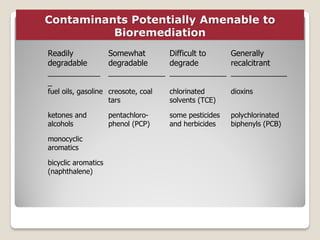
Contaminants Potentially Amenable to
Bioremediation
Readily
degradable
____________
_
Somewhat
degradable
_____________
Difficult to
degrade
_____________
Generally
recalcitrant
_____________
fuel oils, gasoline creosote, coal
tars
chlorinated
solvents (TCE)
dioxins
ketones and
alcohols
pentachloro-
phenol (PCP)
some pesticides
and herbicides
polychlorinated
biphenyls (PCB)
monocyclic
aromatics
bicyclic aromatics
(naphthalene)
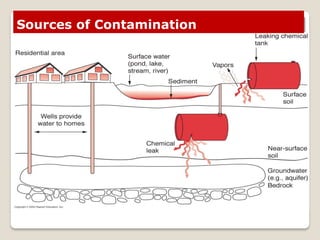
Sources of Contamination
 Soil vapor extraction
 Air sparging
 Bioremediation
 Thermal desorption
 Soil washing
 Chemical dehalogenation
 Soil extraction
 in situ soil flushing
Technologies in use to remove
contaminants
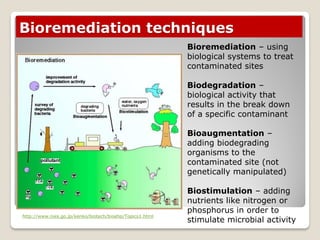
Bioremediation techniques
http://www.nies.go.jp/kenko/biotech/bioehp/Topics1.html
Bioremediation – using
biological systems to treat
contaminated sites
Biodegradation –
biological activity that
results in the break down
of a specific contaminant
Bioaugmentation –
adding biodegrading
organisms to the
contaminated site (not
genetically manipulated)
Biostimulation – adding
nutrients like nitrogen or
phosphorus in order to
stimulate microbial activity
Biostimulation involves the modification of the
environment to stimulate existing microorganisms
capable of bioremediation.
Indigenous populations may not be capable of degrading
the xenobiotics or the wide range of potential substrates
present in complex pollutant mixtures.
Bioaugmentation is the introduction of a group of natural
microbial strains or a genetically engineered variant to
treat contaminated soil or water.
Bioaugmentation vs. biostimulation

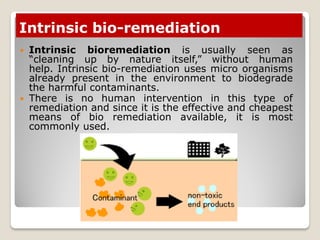
Intrinsic bio-remediation
 Intrinsic bioremediation is usually seen as
“cleaning up by nature itself,” without human
help. Intrinsic bio-remediation uses micro organisms
already present in the environment to biodegrade
the harmful contaminants.
 There is no human intervention in this type of
remediation and since it is the effective and cheapest
means of bio remediation available, it is most
commonly used.
Bio –remediators
 Microorganisms used to perform the function of
bioremediation are known as bio - remediators.
 A recent experiment suggests that the removals of
pollutants such as nitrate, silicate, chromium and
sulphide etc can be removed from tannery wastewater
with the help of marine microalgae.
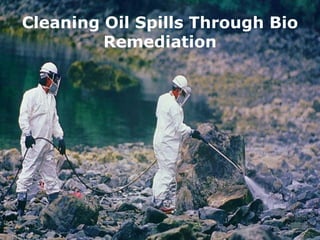
Cleaning Oil Spills Through Bio
Remediation
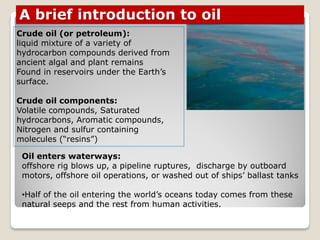
Crude oil (or petroleum):
liquid mixture of a variety of
hydrocarbon compounds derived from
ancient algal and plant remains
Found in reservoirs under the Earth‟s
surface.
Crude oil components:
Volatile compounds, Saturated
hydrocarbons, Aromatic compounds,
Nitrogen and sulfur containing
molecules (“resins”)
A brief introduction to oil
Oil enters waterways:
offshore rig blows up, a pipeline ruptures, discharge by outboard
motors, offshore oil operations, or washed out of ships‟ ballast tanks
•Half of the oil entering the world‟s oceans today comes from these
natural seeps and the rest from human activities.
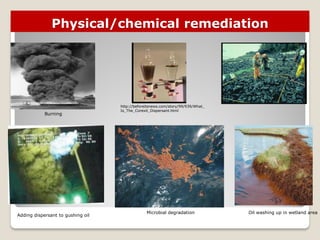
Physical/chemical remediation
http://beforeitsnews.com/story/99/939/What_
Is_The_Corexit_Dispersant.html
Oil washing up in wetland area
Adding dispersant to gushing oil
Burning
Microbial degradation
Fundamentals of cleanup reactions
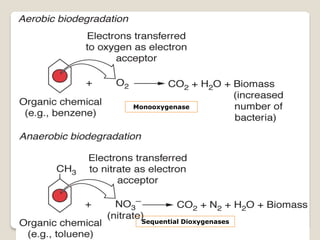
 Aerobic metabolism
◦ Microbes use O2 in their metabolism to degrade
contaminants
 Anaerobic metabolism
◦ Microbes substitute another chemical for O2 to
degrade contaminants
 Nitrate, iron, sulfate, carbon dioxide,
uranium, technicium, perchlorate
Monooxygenase
Sequential Dioxygenases
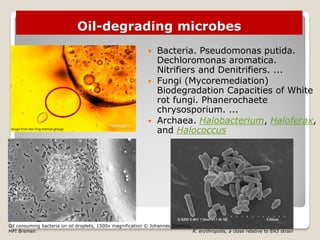
Oil-degrading microbes
 Bacteria. Pseudomonas putida.
Dechloromonas aromatica.
Nitrifiers and Denitrifiers. ...
 Fungi (Mycoremediation)
Biodegradation Capacities of White
rot fungi. Phanerochaete
chrysosporium. ...
 Archaea. Halobacterium, Haloferax,
and HalococcusImage from Hoi-Ying Holman group)
Oil consuming bacteria on oil droplets, 1500x magnification © Johannes Zedelius,
MPI Bremen R. erythropolis, a close relative to EN3 strain
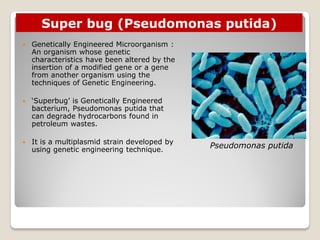
Super bug (Pseudomonas putida)
 Genetically Engineered Microorganism :
An organism whose genetic
characteristics have been altered by the
insertion of a modified gene or a gene
from another organism using the
techniques of Genetic Engineering.
 „Superbug‟ is Genetically Engineered
bacterium, Pseudomonas putida that
can degrade hydrocarbons found in
petroleum wastes.
 It is a multiplasmid strain developed by
using genetic engineering technique.
Pseudomonas putida
Super bug (Pseudomonas putida)
 Super bug is used to treat oil spills as a
measure to control oil pollution.
 Petroleum products contain cycloalkenes
(octane), napthenes, xylene, tolune and
aromatic hydrocarbons.
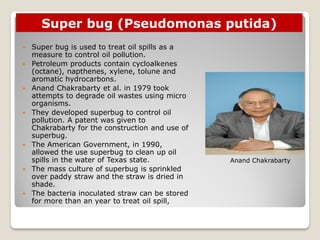
 Anand Chakrabarty et al. in 1979 took
attempts to degrade oil wastes using micro
organisms.
 They developed superbug to control oil
pollution. A patent was given to
Chakrabarty for the construction and use of
superbug.
 The American Government, in 1990,
allowed the use superbug to clean up oil
spills in the water of Texas state.
 The mass culture of superbug is sprinkled
over paddy straw and the straw is dried in
shade.
 The bacteria inoculated straw can be stored
for more than an year to treat oil spill,
Anand Chakrabarty
Trash into Treasure
 Imperial College, London 2013 , Margarita et.
al
Concern :
 Waste management is done by either land fill
/incineration
 Land fill eventually leads to pollution
 Incineration leads to CO2 emission
 Hence focussed on better solution on waste
management
Making bioplastics from engineered E. coli
Genetically Engineered E.Coli can produce
Bioplastic
Experiment :
 Take the trash(paper.plastic,wood etc)
 Add media ,soak it ,use the media by
sedimenting the trash
 Grow engineered bacteria with the waste
 Next day harvest the bacteria
 Treat with chemicals
 E coli is able to make bioplastic in the cell
 That can be later manufactured
 It is now called PHB polyhydroxy buterate
 Currently used in medical applications
 Excited to see in 3D PRINTING IN FUTURE

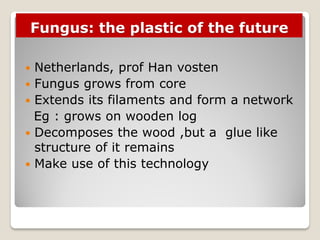
Fungus: the plastic of the future
 Netherlands, prof Han vosten
 Fungus grows from core
 Extends its filaments and form a network
Eg : grows on wooden log
 Decomposes the wood ,but a glue like
structure of it remains
 Make use of this technology
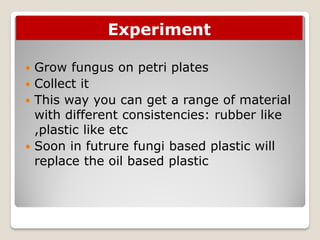
Experiment
 Grow fungus on petri plates
 Collect it
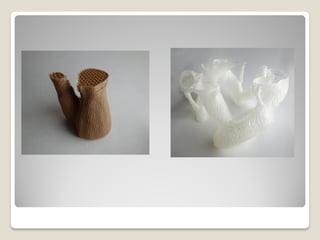
 This way you can get a range of material
with different consistencies: rubber like
,plastic like etc
 Soon in futrure fungi based plastic will
replace the oil based plastic
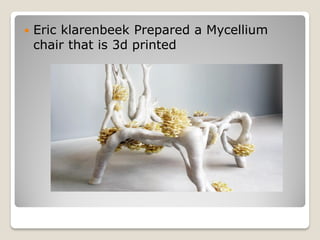
 Eric klarenbeek Prepared a Mycellium
chair that is 3d printed
Experiment
 Take the waste from the land fill
 Treat it
 3d print it
 Any thing you want
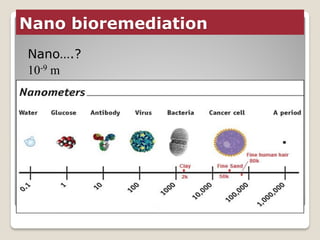
Nano bioremediation
Nano….?
10-9 m
Advantages of nano particles over bulk
• Large surface area – able to absorb large amount
of pollutants
• Faster rate reaction – reduces energy
consumption
• Unique optical, thermal, electrical, physical and
chemical properties
• Diffuse or penetrate into a contamination zone
where bulk particles cannot reach
Nano Bioremediation
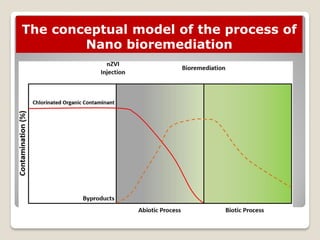
 Nanomaterials initially reduce the
contaminants, to levels that are conducive
to biodegradation and then promote
biodegradation of the contaminants to
reach the risk-based levels.
 Thus, it is an efficient, effective and
sustainable approach to remediate so
many contaminated sites worldwide.
The conceptual model of the process of
Nano bioremediation
Pollutants in ground water system
 Heavy metals
 Organic compounds
 Inorganic compounds
 Complex compounds
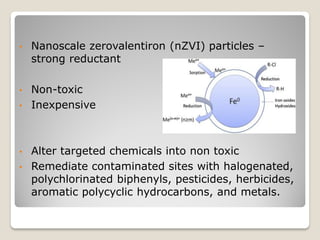
• Nanoscale zerovalentiron (nZVI) particles –
strong reductant
• Non-toxic
• Inexpensive
• Alter targeted chemicals into non toxic
• Remediate contaminated sites with halogenated,
polychlorinated biphenyls, pesticides, herbicides,
aromatic polycyclic hydrocarbons, and metals.
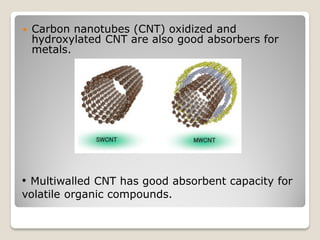
 Carbon nanotubes (CNT) oxidized and
hydroxylated CNT are also good absorbers for
metals.
• Multiwalled CNT has good absorbent capacity for
volatile organic compounds.
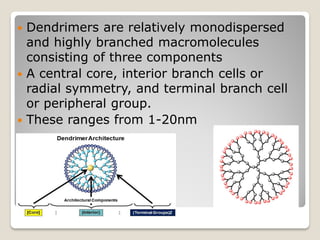
 Dendrimers are relatively monodispersed
and highly branched macromolecules
consisting of three components
 A central core, interior branch cells or
radial symmetry, and terminal branch cell
or peripheral group.
 These ranges from 1-20nm
 Dendritic polymer nanoparticles are soft and use for the
purification of drinking water from organic and inorganic
solutes and free from microbes, toxic metal ions.
 Dendrimers have many void spaces for their interaction of
other substances.
 Polymers like poly(ethylene)glycol modified urethane
acrylate (PMUA), Amphiphilic polyurethane (APU) are used
in the remediation of contaminated sites with poly aromatic
hydrocarbons(PAHs).
Summary
 Many factors control biodegradability of a
contaminant in the environment
 Before attempting to employ bioremediation
technology, one needs to conduct a thorough
characterization of the environment where the
contaminant exists, including the microbiology,
geochemistry, mineralogy, geophysics, and
hydrology of the system
Thank You

Bioremediation

  • 1.
    Bio- Remediation for Sustainable Future PRESENTED BY A.VimalaRodhe, M.Sc, Ph.D Department of Microbiology Silver Jubilee Govt College (A), Kurnool, A.P
  • 2.
    Overview.. Cleaning of Oilspills2 Nano Bioremediation4 Trash to Treasure33 Introduction31
  • 3.
     Bioremediation isa waste management technique that involves the use of organisms to clean up pollutants from soil, water, and wastewater.“  According to the United States EPA, bioremediation is a "treatment that uses naturally occurring organisms to break down hazardous substances into less toxic or non toxic substances“. The other names of bioremediation: Bio - treatment, Bio - reclamation or Bio - restoration. INTRODUCTION
  • 4.
    Contaminants Potentially Amenableto Bioremediation Readily degradable ____________ _ Somewhat degradable _____________ Difficult to degrade _____________ Generally recalcitrant _____________ fuel oils, gasoline creosote, coal tars chlorinated solvents (TCE) dioxins ketones and alcohols pentachloro- phenol (PCP) some pesticides and herbicides polychlorinated biphenyls (PCB) monocyclic aromatics bicyclic aromatics (naphthalene)
  • 5.
  • 6.
     Soil vaporextraction  Air sparging  Bioremediation  Thermal desorption  Soil washing  Chemical dehalogenation  Soil extraction  in situ soil flushing Technologies in use to remove contaminants
  • 7.
    Bioremediation techniques http://www.nies.go.jp/kenko/biotech/bioehp/Topics1.html Bioremediation –using biological systems to treat contaminated sites Biodegradation – biological activity that results in the break down of a specific contaminant Bioaugmentation – adding biodegrading organisms to the contaminated site (not genetically manipulated) Biostimulation – adding nutrients like nitrogen or phosphorus in order to stimulate microbial activity
  • 8.
    Biostimulation involves themodification of the environment to stimulate existing microorganisms capable of bioremediation. Indigenous populations may not be capable of degrading the xenobiotics or the wide range of potential substrates present in complex pollutant mixtures. Bioaugmentation is the introduction of a group of natural microbial strains or a genetically engineered variant to treat contaminated soil or water. Bioaugmentation vs. biostimulation
  • 9.
    Intrinsic bio-remediation  Intrinsicbioremediation is usually seen as “cleaning up by nature itself,” without human help. Intrinsic bio-remediation uses micro organisms already present in the environment to biodegrade the harmful contaminants.  There is no human intervention in this type of remediation and since it is the effective and cheapest means of bio remediation available, it is most commonly used.
  • 10.
    Bio –remediators  Microorganismsused to perform the function of bioremediation are known as bio - remediators.  A recent experiment suggests that the removals of pollutants such as nitrate, silicate, chromium and sulphide etc can be removed from tannery wastewater with the help of marine microalgae.
  • 11.
    Cleaning Oil SpillsThrough Bio Remediation
  • 12.
    Crude oil (orpetroleum): liquid mixture of a variety of hydrocarbon compounds derived from ancient algal and plant remains Found in reservoirs under the Earth‟s surface. Crude oil components: Volatile compounds, Saturated hydrocarbons, Aromatic compounds, Nitrogen and sulfur containing molecules (“resins”) A brief introduction to oil Oil enters waterways: offshore rig blows up, a pipeline ruptures, discharge by outboard motors, offshore oil operations, or washed out of ships‟ ballast tanks •Half of the oil entering the world‟s oceans today comes from these natural seeps and the rest from human activities.
  • 13.
    Physical/chemical remediation http://beforeitsnews.com/story/99/939/What_ Is_The_Corexit_Dispersant.html Oil washingup in wetland area Adding dispersant to gushing oil Burning Microbial degradation
  • 14.
    Fundamentals of cleanupreactions  Aerobic metabolism ◦ Microbes use O2 in their metabolism to degrade contaminants  Anaerobic metabolism ◦ Microbes substitute another chemical for O2 to degrade contaminants  Nitrate, iron, sulfate, carbon dioxide, uranium, technicium, perchlorate
  • 15.
  • 16.
    Oil-degrading microbes  Bacteria.Pseudomonas putida. Dechloromonas aromatica. Nitrifiers and Denitrifiers. ...  Fungi (Mycoremediation) Biodegradation Capacities of White rot fungi. Phanerochaete chrysosporium. ...  Archaea. Halobacterium, Haloferax, and HalococcusImage from Hoi-Ying Holman group) Oil consuming bacteria on oil droplets, 1500x magnification © Johannes Zedelius, MPI Bremen R. erythropolis, a close relative to EN3 strain
  • 17.
    Super bug (Pseudomonasputida)  Genetically Engineered Microorganism : An organism whose genetic characteristics have been altered by the insertion of a modified gene or a gene from another organism using the techniques of Genetic Engineering.  „Superbug‟ is Genetically Engineered bacterium, Pseudomonas putida that can degrade hydrocarbons found in petroleum wastes.  It is a multiplasmid strain developed by using genetic engineering technique. Pseudomonas putida
  • 18.
    Super bug (Pseudomonasputida)  Super bug is used to treat oil spills as a measure to control oil pollution.  Petroleum products contain cycloalkenes (octane), napthenes, xylene, tolune and aromatic hydrocarbons.  Anand Chakrabarty et al. in 1979 took attempts to degrade oil wastes using micro organisms.  They developed superbug to control oil pollution. A patent was given to Chakrabarty for the construction and use of superbug.  The American Government, in 1990, allowed the use superbug to clean up oil spills in the water of Texas state.  The mass culture of superbug is sprinkled over paddy straw and the straw is dried in shade.  The bacteria inoculated straw can be stored for more than an year to treat oil spill, Anand Chakrabarty
  • 19.
    Trash into Treasure Imperial College, London 2013 , Margarita et. al Concern :  Waste management is done by either land fill /incineration  Land fill eventually leads to pollution  Incineration leads to CO2 emission  Hence focussed on better solution on waste management Making bioplastics from engineered E. coli
  • 20.
    Genetically Engineered E.Colican produce Bioplastic Experiment :  Take the trash(paper.plastic,wood etc)  Add media ,soak it ,use the media by sedimenting the trash  Grow engineered bacteria with the waste  Next day harvest the bacteria  Treat with chemicals  E coli is able to make bioplastic in the cell  That can be later manufactured
  • 21.
     It isnow called PHB polyhydroxy buterate  Currently used in medical applications  Excited to see in 3D PRINTING IN FUTURE 
  • 22.
    Fungus: the plasticof the future  Netherlands, prof Han vosten  Fungus grows from core  Extends its filaments and form a network Eg : grows on wooden log  Decomposes the wood ,but a glue like structure of it remains  Make use of this technology
  • 23.
    Experiment  Grow funguson petri plates  Collect it  This way you can get a range of material with different consistencies: rubber like ,plastic like etc  Soon in futrure fungi based plastic will replace the oil based plastic
  • 24.
     Eric klarenbeekPrepared a Mycellium chair that is 3d printed
  • 26.
    Experiment  Take thewaste from the land fill  Treat it  3d print it  Any thing you want
  • 27.
  • 28.
    Advantages of nanoparticles over bulk • Large surface area – able to absorb large amount of pollutants • Faster rate reaction – reduces energy consumption • Unique optical, thermal, electrical, physical and chemical properties • Diffuse or penetrate into a contamination zone where bulk particles cannot reach
  • 29.
    Nano Bioremediation  Nanomaterialsinitially reduce the contaminants, to levels that are conducive to biodegradation and then promote biodegradation of the contaminants to reach the risk-based levels.  Thus, it is an efficient, effective and sustainable approach to remediate so many contaminated sites worldwide.
  • 30.
    The conceptual modelof the process of Nano bioremediation
  • 31.
    Pollutants in groundwater system  Heavy metals  Organic compounds  Inorganic compounds  Complex compounds
  • 32.
    • Nanoscale zerovalentiron(nZVI) particles – strong reductant • Non-toxic • Inexpensive • Alter targeted chemicals into non toxic • Remediate contaminated sites with halogenated, polychlorinated biphenyls, pesticides, herbicides, aromatic polycyclic hydrocarbons, and metals.
  • 33.
     Carbon nanotubes(CNT) oxidized and hydroxylated CNT are also good absorbers for metals. • Multiwalled CNT has good absorbent capacity for volatile organic compounds.
  • 34.
     Dendrimers arerelatively monodispersed and highly branched macromolecules consisting of three components  A central core, interior branch cells or radial symmetry, and terminal branch cell or peripheral group.  These ranges from 1-20nm
  • 35.
     Dendritic polymernanoparticles are soft and use for the purification of drinking water from organic and inorganic solutes and free from microbes, toxic metal ions.  Dendrimers have many void spaces for their interaction of other substances.  Polymers like poly(ethylene)glycol modified urethane acrylate (PMUA), Amphiphilic polyurethane (APU) are used in the remediation of contaminated sites with poly aromatic hydrocarbons(PAHs).
  • 36.
    Summary  Many factorscontrol biodegradability of a contaminant in the environment  Before attempting to employ bioremediation technology, one needs to conduct a thorough characterization of the environment where the contaminant exists, including the microbiology, geochemistry, mineralogy, geophysics, and hydrology of the system
  • 37.