VIVEKANANDHA
ARTS AND SCIENCE COLLEGE FOR WOMEN
Veerachipalayam, sankagiri - 637303 salem Dt,Tamilnadu India
SUBJECT: BIOREMEDIATION
C.NANDHINI,
I-M.SC MICROBIOLOGY,
DEPARTMENT OF MICROBIOLOGY,
VIVEKANANDHA ARTS AND SCIENCE COLLEGE FOR WOMEN,
SANKAGIRI, SALEM, TAMILNADU .
BIODEGRADABLE OF PLASTIC AND SUPERBUG
GUIDED BY;
DR.R.DINESH KUMAR,
ASSISTANT PROFESSOR ,
DEPARTMENT OF MICROBIOLOGY,
VIVEKANANDHA ARTS AND SCIENCE COLLEGE FOR WOMEN,
SANKAGIRI,SALEM,TAMILNADU.
• Introduction
• Bio plastic
• History
• Types of biodegradable plastic
• Mechanism of Biodegradation plastic
• Factor affecting biodegradation
• Agriculture application
• Advantage& Disadvantage
• Superbug
• Construction of Superbug
• Application of Superbug
• Conclusion
INTRODUCTION
 Plastics are polymerized products that have been used extensively and can be
molded into objects. Although nobody can deny the significance of plastic and
its products in our lives.
 Plastic-:
 -hydrophobic
 -resistant to household chemical
 -Cheap
• Take centuries to degrade
• Major cause of pollution
• Non-renewable resources
Why the conventional plastics is non-biodegradable
• The term biodegradable means that a substance is
able to be broken down into simpler substances by
the activities of living organisms
• Because their long polymer molecules are too large
and too tightly bonded together to be broken apart
and assimilated by decomposer organisms
• inhibits the enzymes activity high molecular weighit.
• Three generations of starch-based plastics are
recognized
• The first generation consists of a synthetic
polymer, Starch is only used as a filling material it's
polymeric properties are not made use of.
• An example are "biodegradable" plastic bags.
These bags are not fully biodegradable, though,
since they consist of mainly non-biodegradable
synthetic polymers like polyethylene or
polypropene and only 5-20 percent starch.
• Under special conditions the starch degrades and
the plastic falls apart into small particles, that will
prevail for many years although they are not visible
BIOPLASTIC
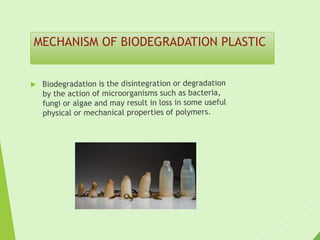
 Biodegradable plastics is plastic that decompose naturally in the
environment.
 This is achieved when microorganism in the environment metabolize and
breakdown the structure of biodegradable plastics.
 The end result is one which is less harmful to the environment then
traditional plastics
 A polymer derived from natural sources, e.g corn or sugars.
HISTORY
 Plastic was first invented in 1862
 1862: The first ever man made plastic was a bio-plastic. It
was made from cellulose nitrate and wascalles Parkesine.
 1924: Henry Ford uses food stock to create a bio-plastic for
 1941: Henry Ford unveils the first bio-plastic car
 1970's: people demanded that research should be done on
creating a non oil based plastic because of the oil crisis
 1990: A British Company called Imperial Chemical
Industries developed a bioplastic, Biopol, that was
biodegradable.
TYPES Of
BIODEGRABLE PLASTIC
• Bio Based Plastics
• These are bio or starch based plastics that are made from
soy, corn, or potatoes, breaking down 60 percent or more,
within 180 days or less.
• In order to do this, bio- based plastics need water, heat,
and aeration.
• Bio-based plastics can take longer to decompose in
landfills because of non-availability of aeration.
• The bio based plastics are non-recyclable. An example of
bio-based plastic is the cellulose fiber plastic, which is
made from reconstituted cellulose, and zein plastic, which
is made from corn protein.
Thermal biodegradable plastic
Oxo-biodegradable plastic
 This type of plastics needs oxygen in order to breakdown.
 Oxo biodegradable plastic is less expensive to produce because it is easy to
make with machinery that currently manufactures conventional plastics
 When aerated it gradually breaks down into biodegradable fragments over a
course of several months to a few years ex.bottles, carryout bags
Hydro-Biodegradable
These plastics break down when exposed to humidity at
a faster rate than oxo- biodegradable plastic. When
combined with moisture, they expand the plastic's
molecular structure and allow the bioactive compounds
to metabolize and neutralize the plastic.
Microbial Biodegradation
Biodegradation of plastics can be achieved by enabling
microorganisms in the environment to metabolize the
molecular structure of plastic films to produce an inert
humus- like material that is less harmful to the
environment. The use of bioactive compounds,
compounded with swelling agents, ensures that the
plastic degrades first into humus, and then into carbon
dioxide or methane and water, when buried.
• From chemical point of view, biological degradation of
polymers occurs either in
• 1)aerobic biodegradation or
• 2)anaerobic biodegradation
• Generally, the mechanism occurs in two steps
• Depolymerization
• Polymer convert to their correspond oligomer or
monomer.
• 1)Physical factors-Hydrolysis, photodegradation
• 2) Microbial enzyme
MECHANISM OF BIODEGRADATION PLASTIC
 This is followed by mineralization in which
monomers and oligomers formed are of sufficiently
smaller in size and are transported to the
cytoplasmic cells o the microorganisms and get
completely mineralized.
CONTINUE...
FACTER AFFECTING BIODEGRADATION
 1) Property of plastic
 2)Envoirnmental condition
 3)Microbes
 Applications of Biodegradable plastics
 Medical
 Surgical Sutures
 Bone-Fixation Devices, thread Artificial Skin, Drug
Delivery System
 Hernia Repair Device
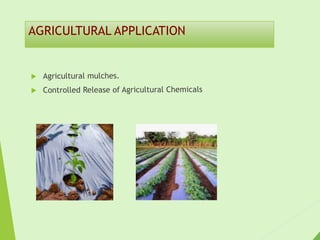
AGRICULTURAL APPLICATION
• Corn and soybeans are popular plants used in the
production of biodegradable plastic.
• These crops require high doses of toxic pesticides that
contribute to pollution and may leech into the soil.
• *Many of the farmed resources that are used to make
biodegradable plastics come from genetically modified
plants.
• There is a risk for cross-contamination associat with
farming genetically modified plants for non-food
purposes
Disadvantage of biodegradable plastic
• Many of the farmed resources that are used to make
biodegradable plastics come from genetically modified
plants.
• There is a risk for cross-contamination associat with
farming genetically modified plants for non-food
purposes
Advantage of biodegradable plastic
Superbug
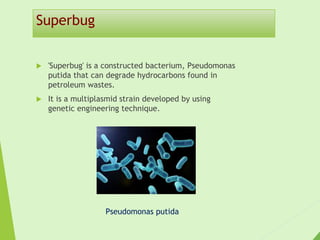
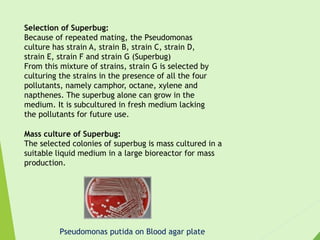
 'Superbug' is a constructed bacterium, Pseudomonas
putida that can degrade hydrocarbons found in
petroleum wastes.
 It is a multiplasmid strain developed by using
genetic engineering technique.
Pseudomonas putida
Continue..
 Super bug was developed by Anand Chakrabarty et al. in
1979.
 It is used to treat oil spills as a measure to control oil
pollution.
 Petroleum products contain cycloalkenes(octane),
napthenes, xylene, tolune and aromatic hydrocarbons.
Since these compounds are not easily biodegradable, oil
wastes become a major pollutant on the soil and water.
 Chakrabarty et al. took attempts to degrade oil wastes
using micro organisms.
 They developed superbug to control oil pollution.
Construction of super bug
 Identification of parent strains
 Conjugative transfer of plasmids
 Selection of superbug
 Mass culture
Identification of parent strains:
Chakrabarty et al. had succeeded in isolating different strains
of Pputida that could degrade camphor, octane, xylene and
napthenes from polluted soils. They found out that each strain
has a special type of plasmid. Thus four types of plasmids are
recognized in the bacterial strains.
 1.plasmid
 2.OCT plasmid
 3.XYL plasmid
 4.NAH plasmid
 The bacterial strain containing CAM plasmid could
degrade camphor compounds.
 Those strain containing OCT plasmid could degrade
octane, hexane and decane.
 The strain containing XYL plasmid could degrade
xylene and toluene.
 And the strain harbouring NAH plasmid could
degrade napthenes.
Conjugative Transfer of plasmids:
Selection of Superbug:
Because of repeated mating, the Pseudomonas
culture has strain A, strain B, strain C, strain D,
strain E, strain F and strain G (Superbug)
From this mixture of strains, strain G is selected by
culturing the strains in the presence of all the four
pollutants, namely camphor, octane, xylene and
napthenes. The superbug alone can grow in the
medium. It is subcultured in fresh medium lacking
the pollutants for future use.
Mass culture of Superbug:
The selected colonies of superbug is mass cultured in a
suitable liquid medium in a large bioreactor for mass
production.
Pseudomonas putida on Blood agar plate
• A patent was given to Chakrabarty regarding the
construction and use of superbug.
• The American Government, in 1990, allowed to use the
superbug to clean up oil spills in the water of Texas state.
• The mass culture of superbug is sprinkled over paddy straw
and the straw is dried in shade
• The bacteria inoculated straw can be stored for more than
an year until we are in need.
• To treat oil spill, the straw is spread over the oil slicks and is
left as such for a week or more.
• During this time, the straw soak up the oil and the bacteria
living on it break the oil into non-polluting materials. As a
result, the oil wastes become harmless to other organisms
living on soil or water polluted with petroleum oil.
APPLICATION OF SUPERBUG
CONCLUSION
 The biodegradable plastic are Eco-friendly and the
main advantage is that they are made by renewable
sources. It is used to overcome the environmental
problem associated with conventional plastic
Thank you

Biodegradable of plastic and superbug...

  • 1.
    VIVEKANANDHA ARTS AND SCIENCECOLLEGE FOR WOMEN Veerachipalayam, sankagiri - 637303 salem Dt,Tamilnadu India SUBJECT: BIOREMEDIATION C.NANDHINI, I-M.SC MICROBIOLOGY, DEPARTMENT OF MICROBIOLOGY, VIVEKANANDHA ARTS AND SCIENCE COLLEGE FOR WOMEN, SANKAGIRI, SALEM, TAMILNADU . BIODEGRADABLE OF PLASTIC AND SUPERBUG GUIDED BY; DR.R.DINESH KUMAR, ASSISTANT PROFESSOR , DEPARTMENT OF MICROBIOLOGY, VIVEKANANDHA ARTS AND SCIENCE COLLEGE FOR WOMEN, SANKAGIRI,SALEM,TAMILNADU.
  • 2.
    • Introduction • Bioplastic • History • Types of biodegradable plastic • Mechanism of Biodegradation plastic • Factor affecting biodegradation • Agriculture application • Advantage& Disadvantage • Superbug • Construction of Superbug • Application of Superbug • Conclusion
  • 3.
    INTRODUCTION  Plastics arepolymerized products that have been used extensively and can be molded into objects. Although nobody can deny the significance of plastic and its products in our lives.  Plastic-:  -hydrophobic  -resistant to household chemical  -Cheap
  • 4.
    • Take centuriesto degrade • Major cause of pollution • Non-renewable resources Why the conventional plastics is non-biodegradable • The term biodegradable means that a substance is able to be broken down into simpler substances by the activities of living organisms • Because their long polymer molecules are too large and too tightly bonded together to be broken apart and assimilated by decomposer organisms • inhibits the enzymes activity high molecular weighit.
  • 5.
    • Three generationsof starch-based plastics are recognized • The first generation consists of a synthetic polymer, Starch is only used as a filling material it's polymeric properties are not made use of. • An example are "biodegradable" plastic bags. These bags are not fully biodegradable, though, since they consist of mainly non-biodegradable synthetic polymers like polyethylene or polypropene and only 5-20 percent starch. • Under special conditions the starch degrades and the plastic falls apart into small particles, that will prevail for many years although they are not visible
  • 6.
    BIOPLASTIC  Biodegradable plasticsis plastic that decompose naturally in the environment.  This is achieved when microorganism in the environment metabolize and breakdown the structure of biodegradable plastics.  The end result is one which is less harmful to the environment then traditional plastics  A polymer derived from natural sources, e.g corn or sugars.
  • 7.
    HISTORY  Plastic wasfirst invented in 1862  1862: The first ever man made plastic was a bio-plastic. It was made from cellulose nitrate and wascalles Parkesine.  1924: Henry Ford uses food stock to create a bio-plastic for  1941: Henry Ford unveils the first bio-plastic car  1970's: people demanded that research should be done on creating a non oil based plastic because of the oil crisis  1990: A British Company called Imperial Chemical Industries developed a bioplastic, Biopol, that was biodegradable.
  • 8.
    TYPES Of BIODEGRABLE PLASTIC •Bio Based Plastics • These are bio or starch based plastics that are made from soy, corn, or potatoes, breaking down 60 percent or more, within 180 days or less. • In order to do this, bio- based plastics need water, heat, and aeration. • Bio-based plastics can take longer to decompose in landfills because of non-availability of aeration. • The bio based plastics are non-recyclable. An example of bio-based plastic is the cellulose fiber plastic, which is made from reconstituted cellulose, and zein plastic, which is made from corn protein.
  • 9.
  • 10.
    Oxo-biodegradable plastic  Thistype of plastics needs oxygen in order to breakdown.  Oxo biodegradable plastic is less expensive to produce because it is easy to make with machinery that currently manufactures conventional plastics  When aerated it gradually breaks down into biodegradable fragments over a course of several months to a few years ex.bottles, carryout bags
  • 11.
    Hydro-Biodegradable These plastics breakdown when exposed to humidity at a faster rate than oxo- biodegradable plastic. When combined with moisture, they expand the plastic's molecular structure and allow the bioactive compounds to metabolize and neutralize the plastic. Microbial Biodegradation Biodegradation of plastics can be achieved by enabling microorganisms in the environment to metabolize the molecular structure of plastic films to produce an inert humus- like material that is less harmful to the environment. The use of bioactive compounds, compounded with swelling agents, ensures that the plastic degrades first into humus, and then into carbon dioxide or methane and water, when buried.
  • 12.
    • From chemicalpoint of view, biological degradation of polymers occurs either in • 1)aerobic biodegradation or • 2)anaerobic biodegradation • Generally, the mechanism occurs in two steps • Depolymerization • Polymer convert to their correspond oligomer or monomer. • 1)Physical factors-Hydrolysis, photodegradation • 2) Microbial enzyme
  • 13.
  • 14.
     This isfollowed by mineralization in which monomers and oligomers formed are of sufficiently smaller in size and are transported to the cytoplasmic cells o the microorganisms and get completely mineralized. CONTINUE...
  • 15.
    FACTER AFFECTING BIODEGRADATION 1) Property of plastic  2)Envoirnmental condition  3)Microbes  Applications of Biodegradable plastics  Medical  Surgical Sutures  Bone-Fixation Devices, thread Artificial Skin, Drug Delivery System  Hernia Repair Device
  • 16.
  • 17.
    • Corn andsoybeans are popular plants used in the production of biodegradable plastic. • These crops require high doses of toxic pesticides that contribute to pollution and may leech into the soil. • *Many of the farmed resources that are used to make biodegradable plastics come from genetically modified plants. • There is a risk for cross-contamination associat with farming genetically modified plants for non-food purposes Disadvantage of biodegradable plastic • Many of the farmed resources that are used to make biodegradable plastics come from genetically modified plants. • There is a risk for cross-contamination associat with farming genetically modified plants for non-food purposes Advantage of biodegradable plastic
  • 18.
    Superbug  'Superbug' isa constructed bacterium, Pseudomonas putida that can degrade hydrocarbons found in petroleum wastes.  It is a multiplasmid strain developed by using genetic engineering technique. Pseudomonas putida
  • 19.
    Continue..  Super bugwas developed by Anand Chakrabarty et al. in 1979.  It is used to treat oil spills as a measure to control oil pollution.  Petroleum products contain cycloalkenes(octane), napthenes, xylene, tolune and aromatic hydrocarbons. Since these compounds are not easily biodegradable, oil wastes become a major pollutant on the soil and water.  Chakrabarty et al. took attempts to degrade oil wastes using micro organisms.  They developed superbug to control oil pollution.
  • 20.
    Construction of superbug  Identification of parent strains  Conjugative transfer of plasmids  Selection of superbug  Mass culture Identification of parent strains: Chakrabarty et al. had succeeded in isolating different strains of Pputida that could degrade camphor, octane, xylene and napthenes from polluted soils. They found out that each strain has a special type of plasmid. Thus four types of plasmids are recognized in the bacterial strains.
  • 21.
     1.plasmid  2.OCTplasmid  3.XYL plasmid  4.NAH plasmid  The bacterial strain containing CAM plasmid could degrade camphor compounds.  Those strain containing OCT plasmid could degrade octane, hexane and decane.  The strain containing XYL plasmid could degrade xylene and toluene.  And the strain harbouring NAH plasmid could degrade napthenes.
  • 22.
  • 23.
    Selection of Superbug: Becauseof repeated mating, the Pseudomonas culture has strain A, strain B, strain C, strain D, strain E, strain F and strain G (Superbug) From this mixture of strains, strain G is selected by culturing the strains in the presence of all the four pollutants, namely camphor, octane, xylene and napthenes. The superbug alone can grow in the medium. It is subcultured in fresh medium lacking the pollutants for future use. Mass culture of Superbug: The selected colonies of superbug is mass cultured in a suitable liquid medium in a large bioreactor for mass production. Pseudomonas putida on Blood agar plate
  • 24.
    • A patentwas given to Chakrabarty regarding the construction and use of superbug. • The American Government, in 1990, allowed to use the superbug to clean up oil spills in the water of Texas state. • The mass culture of superbug is sprinkled over paddy straw and the straw is dried in shade • The bacteria inoculated straw can be stored for more than an year until we are in need. • To treat oil spill, the straw is spread over the oil slicks and is left as such for a week or more. • During this time, the straw soak up the oil and the bacteria living on it break the oil into non-polluting materials. As a result, the oil wastes become harmless to other organisms living on soil or water polluted with petroleum oil. APPLICATION OF SUPERBUG
  • 25.
    CONCLUSION  The biodegradableplastic are Eco-friendly and the main advantage is that they are made by renewable sources. It is used to overcome the environmental problem associated with conventional plastic
  • 26.