Definitions and Concepts
Dr. Basavaraj K. Nanjwade M. Pharm., Ph. D
Department of Pharmaceutics
Faculty of Pharmacy
Omer Al-Mukhtar University
Tobruk, Libya.
E-mail: nanjwadebk@gmail.com
2014/01/25 1
Faculty of Pharmacy, Omer Al-Mukhtar University,
Tobruk, Libya.
2014/01/25 2
Faculty of Pharmacy, Omer Al-Mukhtar University,
Tobruk, Libya.
Definitions
• Biopharmaceutics
• Absorption
• Bioavailability
• Drug disposition
• Drug distribution.
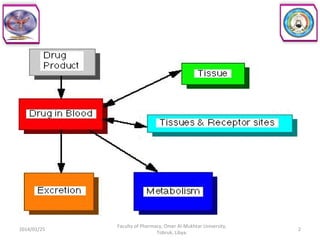
• Elimination
a. Biotransformation(Metabolism)
b. Excretion
2014/01/25 3
Faculty of Pharmacy, Omer Al-Mukhtar University,
Tobruk, Libya.
Definitions
• Pharmacokinetics
• Clinical pharmacokinetics
• Pharmacodynamics
• Equivalence.
• Bioequivalence.
• Pharmaceutical Equivalence.
• Pharmaceutical Alternatives.
• Therapeutic Equivalence.
• Bio-Inequivalence.
• Bioequivalences studies.
2014/01/25
Faculty of Pharmacy, Omer Al-Mukhtar University,
Tobruk, Libya.
4
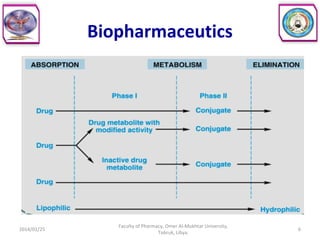
Biopharmaceutics
Biopharmaceutics is defined as the study of
factors influencing the rate and amount of
drug that reaches the systemic circulation and
the use of this information to optimise the
therapeutic efficacy of drug products.
2014/01/25 5
Faculty of Pharmacy, Omer Al-Mukhtar University,
Tobruk, Libya.
Biopharmaceutics
2014/01/25
Faculty of Pharmacy, Omer Al-Mukhtar University,
Tobruk, Libya.
6
Absorption
Definition :
• The process of movement of drug from its site
of administration to the systemic circulation is
called as absorption.
• The process of movement of unchanged drug
from the site of administration to systemic
circulation.
2014/01/25 7
Faculty of Pharmacy, Omer Al-Mukhtar University,
Tobruk, Libya.
Absorption
 There always exist a correlation between the plasma
concentration of a drug & the therapeutic response
& thus, absorption can also be defined as the process
of movement of unchanged drug from the site of
administration to the site of measurement.
i.e., plasma.
2014/01/25 8
Faculty of Pharmacy, Omer Al-Mukhtar University,
Tobruk, Libya.
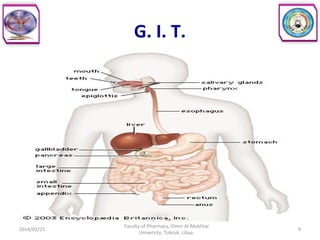
G. I. T.
2014/01/25 9
Faculty of Pharmacy, Omer Al-Mukhtar
University, Tobruk, Libya.
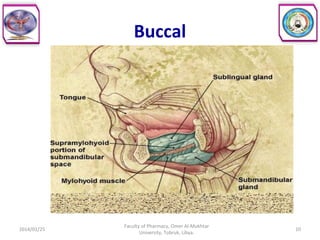
Buccal
2014/01/25 10
Faculty of Pharmacy, Omer Al-Mukhtar
University, Tobruk, Libya.
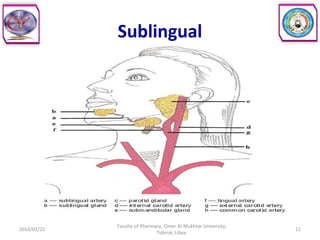
Sublingual
2014/01/25 11
Faculty of Pharmacy, Omer Al-Mukhtar University,
Tobruk, Libya.
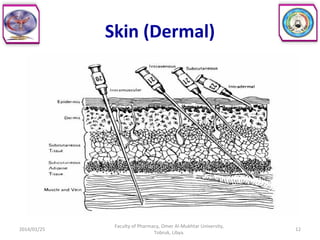
Skin (Dermal)
2014/01/25 12
Faculty of Pharmacy, Omer Al-Mukhtar University,
Tobruk, Libya.
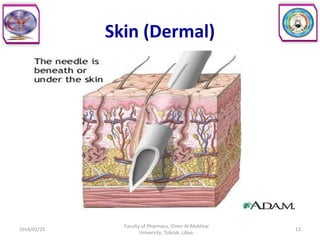
Skin (Dermal)
2014/01/25 13
Faculty of Pharmacy, Omer Al-Mukhtar
University, Tobruk, Libya.
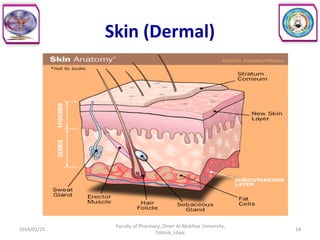
Skin (Dermal)
2014/01/25 14
Faculty of Pharmacy, Omer Al-Mukhtar University,
Tobruk, Libya.
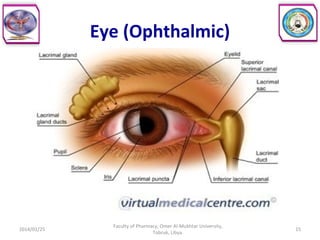
Eye (Ophthalmic)
2014/01/25 15
Faculty of Pharmacy, Omer Al-Mukhtar University,
Tobruk, Libya.
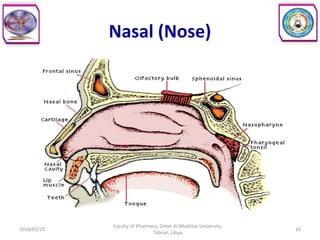
Nasal (Nose)
2014/01/25 16
Faculty of Pharmacy, Omer Al-Mukhtar University,
Tobruk, Libya.
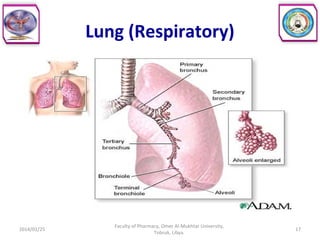
Lung (Respiratory)
2014/01/25 17
Faculty of Pharmacy, Omer Al-Mukhtar University,
Tobruk, Libya.
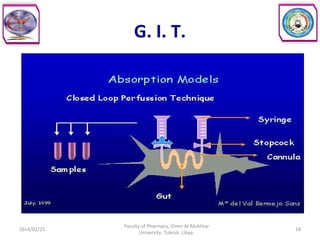
G. I. T.
2014/01/25 18
Faculty of Pharmacy, Omer Al-Mukhtar
University, Tobruk, Libya.
Bioavailability
• Bioavailability is defined as the rate and extent
(amount) of drug absorption.
• The relative amount of an administration dose of a
particular drug that reaches the systemic circulation
intact and the rate at which this occurs is known as
the bioavailability.
• The fraction of an administration dose of the drug
that reaches the systemic circulation in the
unchanged form is known as the bioavailable dose.
2014/01/25 19
Faculty of Pharmacy, Omer Al-Mukhtar
University, Tobruk, Libya.
Absolute Bioavailability
 Absolute Bioavailability :-
If the systemic availability of a drug
administered orally is determined by doing its
comparison with I.V. administration, it is
known as absolute bioavailability.
2014/01/25 20
Faculty of Pharmacy, Omer Al-Mukhtar University,
Tobruk, Libya.
Relative Bioavailability
 Relative Bioavailability :-
If the systemic availability of a drug
administered orally is determined by doing its
comparison with that of an oral standard of
the same drug, it is known as a relative
bioavailability.
2014/01/25 21
Faculty of Pharmacy, Omer Al-Mukhtar University,
Tobruk, Libya.
Drug disposition
• Any alternative in the drug’s bioavailability is
reflected in its pharmacological effects. Other
processes that play a role in the therapeutic
activity of a drug are distribution and
elimination. Together, they are known as drug
disposition.
2014/01/25 22
Faculty of Pharmacy, Omer Al-Mukhtar University,
Tobruk, Libya.
Drug distribution
• The movement of drug between one
compartment and the other (general blood
and the extra-vascular tissues) is referred to
as drug distribution.
2014/01/25 23
Faculty of Pharmacy, Omer Al-Mukhtar University,
Tobruk, Libya.
Elimination
• Elimination is defined as the process that
tends to remove the drug from the body and
terminate its action.
• Biotransformation(Metabolism): Which usually
inactivevates the drug.
• Excretion:Which is responsible for the exit of
drug/metabolites from the body.
2014/01/25 24
Faculty of Pharmacy, Omer Al-Mukhtar University,
Tobruk, Libya.
Biotransformation
(Metabolism)
• Biotransformation(Metabolism):Which usually
inactivates the drug.
2014/01/25 25
Faculty of Pharmacy, Omer Al-Mukhtar University,
Tobruk, Libya.
Excretion
• Which is responsible for the exit of
drug/metabolites from the body.
2014/01/25 26
Faculty of Pharmacy, Omer Al-Mukhtar University,
Tobruk, Libya.
Pharmacokinetics
• Pharmacokinetics is defined as the study of time
course of drug ADME and their relationship with its
therapeutics and toxic effects of the drug.
• Simply speaking, pharmacokinetics is the kinetics of
ADME or KADME.
• Pharmacokinetic is a study of what the body does to
the drug, whereas.
• Pharmacokinetics relates changes in concentration of
drug within the body with time after its
administration, whereas.
2014/01/25 27
Faculty of Pharmacy, Omer Al-Mukhtar University,
Tobruk, Libya.
Clinical pharmacokinetics
• The use of pharmacokinetic principles in
optimising the drug dosage to suit individual
patient needs and achieving maximum
therapeutic utility is called as clinical
pharmacokinetics.
2014/01/25 28
Faculty of Pharmacy, Omer Al-Mukhtar
University, Tobruk, Libya.
Pharmacodynamics
• Pharmacodynamic is a study of what the drug
does to the body.
• Pharmacorelates response to concentration of
drug in the body.
2014/01/25 29
Faculty of Pharmacy, Omer Al-Mukhtar University,
Tobruk, Libya.
Equivalence
• This term compares the drug products to the
characters or functions to the set of
standards.
2014/01/25 30
Faculty of Pharmacy, Omer Al-Mukhtar University,
Tobruk, Libya.
Bioequivalence
• It refers that the drug substance in two or
more identical dosage forms, reaches
systemic circulation at the same rate and to
the same relative extent. i.e. their plasma
concentration time profiles will be identical
without significant statistical differences.
2014/01/25 31
Faculty of Pharmacy, Omer Al-Mukhtar University,
Tobruk, Libya.
Pharmaceutical Equivalence
• Drug products in identical dosage forms that
contains the same active ingredients, use the
same route of administration, and are
identical in strength or concentration, quality,
purity, content uniformity, however they may
differ in containing excipients.
2014/01/25 32
Faculty of Pharmacy, Omer Al-Mukhtar University,
Tobruk, Libya.
Pharmaceutical Alternatives
• Drug products that contain the same
therapeutic moiety but as different salt, ester
or complex. For e. g. tetracycline phosphate or
tetracycline hydrochloride equivalent to 250
mg tetracycline.
2014/01/25 33
Faculty of Pharmacy, Omer Al-Mukhtar University,
Tobruk, Libya.
Therapeutic Equivalence
• It indicate that two or more drug products
that contain same therapeutically active
ingredients, elicit identical pharmacologic
effect and can control the disease to the same
extent.
2014/01/25 34
Faculty of Pharmacy, Omer Al-Mukhtar University,
Tobruk, Libya.
Bio-Inequivalence
• When statistically significant differences are
observed in the bioavailability of two or more
drug products called as bio-inequivalences.
2014/01/25 35
Faculty of Pharmacy, Omer Al-Mukhtar University,
Tobruk, Libya.
Bioequivalences Studies
Bioequivalence studies are performed by
comparing the bioavailability of, to-be-marketed
Generic product with that of the Brand product.
Pharmacokinetic studies are conducted whereby each
of the preparations are administered in a cross-over
study to volunteer subjects, generally healthy
individuals but occasionally in patients.
Serum/Plasma samples are obtained at regular
intervals and assayed for parent drug (or occasionally
metabolite) concentration.
2014/01/25 36
Faculty of Pharmacy, Omer Al-Mukhtar University,
Tobruk, Libya.
Drug Administration and Therapy
1. The Pharmaceutical Phase.
2. The Pharmacokinetic Phase.
3. The Pharmacodynamic Phase.
4. The Therapeutic Phase.
2014/01/25 37
Faculty of Pharmacy, Omer Al-Mukhtar University,
Tobruk, Libya.
The pharmaceutical Phase
• It is concerned with-
a.Physicochemical properties of the drug, and
b.Design and manufacturing of an effective drug
product for administration by a suitable route.
2014/01/25 38
Faculty of Pharmacy, Omer Al-Mukhtar University,
Tobruk, Libya.
The Pharmacokinetic Phase
• It is concerned with the ADME of drugs as
elicited by the plasma drug concentration-
time profile and its relationship with the dose,
dosage form and dosing frequency and route
of administration. In short, it is the sum of all
the processes inflicted by the body on the
drug.
2014/01/25 39
Faculty of Pharmacy, Omer Al-Mukhtar University,
Tobruk, Libya.
The Pharmacodynamic Phase
• It is concerned with the bio-chemical and
physiological effects of the drug and its
mechanism of action. It is characterized by the
concentration of drug at the site of action and
its relation to the magnitude of effects
observed.
2014/01/25 40
Faculty of Pharmacy, Omer Al-Mukhtar University,
Tobruk, Libya.
The Therapeutic Phase
• It is concerned with the translation of
pharmacological effect into clinical benefit.
2014/01/25 41
Faculty of Pharmacy, Omer Al-Mukhtar University,
Tobruk, Libya.
Concept of Bioavailability
• Be completely released from the dosage form.
• Be fully dissolved in the gastrointestinal fluids.
• Be stable in solution in the gastrointestinal
fluids.
• Pass through the gastrointestinal barrier into
the mesenteric circulation without being
metabolized.
• Pass through the liver into the systemic
circulation unchanged form.
2014/01/25
Faculty of Pharmacy, Omer Al-Mukhtar University,
Tobruk, Libya.
42
Concept of Biopharmaceutics
• In the same type of dosage form by different routes of
administration, e.g. an aqueous solution of a given drug
administered by the oral and intramuscular routes.
• By the same routes of administration but different types
of dosage form, e.g. a tablet, a hard gelatin capsule and
an aqueous suspension administered by the peroral
route.
• In the same type of dosage form by the same route of
administration but with different formulations of the
dosage form, e.g. different formulations of an oral
aqueous suspension.
2014/01/25
Faculty of Pharmacy, Omer Al-Mukhtar University,
Tobruk, Libya.
43
Poor biopharmaceutical properties
• Poor and variable bioavailability.
• Difficulties in toxicological evaluation.
• Difficulties with bioequivalence of
formulations.
• Multi-daily dosing.
• The requirement for a non-conventional
delivery system.
• Long and costly development times.
2014/01/25
Faculty of Pharmacy, Omer Al-Mukhtar University,
Tobruk, Libya.
44
References
1. “Biopharmaceutics & pharmacokinetics”, D.M.
Brahmankar & Sunil B. Jaiswal, Vallabh prakashan.
2. “Text book of Biopharmaceutics &pharmacokinetics”,
Dr. Shobharani R. Hiramath.
3. “Applied Biopharmaceutics & pharmacokinetics”,
Leon Shargel & Andrew B.C.
4. www.google.com
2014/01/25 45
Faculty of Pharmacy, Omer Al-Mukhtar University,
Tobruk, Libya.
2014/01/25
Faculty of Pharmacy, Omer Al-Mukhtar University,
Tobruk, Libya.
46
E-mail: nanjwadebk@gmail.com

Definitions and concepts

  • 1.
    Definitions and Concepts Dr.Basavaraj K. Nanjwade M. Pharm., Ph. D Department of Pharmaceutics Faculty of Pharmacy Omer Al-Mukhtar University Tobruk, Libya. E-mail: nanjwadebk@gmail.com 2014/01/25 1 Faculty of Pharmacy, Omer Al-Mukhtar University, Tobruk, Libya.
  • 2.
    2014/01/25 2 Faculty ofPharmacy, Omer Al-Mukhtar University, Tobruk, Libya.
  • 3.
    Definitions • Biopharmaceutics • Absorption •Bioavailability • Drug disposition • Drug distribution. • Elimination a. Biotransformation(Metabolism) b. Excretion 2014/01/25 3 Faculty of Pharmacy, Omer Al-Mukhtar University, Tobruk, Libya.
  • 4.
    Definitions • Pharmacokinetics • Clinicalpharmacokinetics • Pharmacodynamics • Equivalence. • Bioequivalence. • Pharmaceutical Equivalence. • Pharmaceutical Alternatives. • Therapeutic Equivalence. • Bio-Inequivalence. • Bioequivalences studies. 2014/01/25 Faculty of Pharmacy, Omer Al-Mukhtar University, Tobruk, Libya. 4
  • 5.
    Biopharmaceutics Biopharmaceutics is definedas the study of factors influencing the rate and amount of drug that reaches the systemic circulation and the use of this information to optimise the therapeutic efficacy of drug products. 2014/01/25 5 Faculty of Pharmacy, Omer Al-Mukhtar University, Tobruk, Libya.
  • 6.
    Biopharmaceutics 2014/01/25 Faculty of Pharmacy,Omer Al-Mukhtar University, Tobruk, Libya. 6
  • 7.
    Absorption Definition : • Theprocess of movement of drug from its site of administration to the systemic circulation is called as absorption. • The process of movement of unchanged drug from the site of administration to systemic circulation. 2014/01/25 7 Faculty of Pharmacy, Omer Al-Mukhtar University, Tobruk, Libya.
  • 8.
    Absorption  There alwaysexist a correlation between the plasma concentration of a drug & the therapeutic response & thus, absorption can also be defined as the process of movement of unchanged drug from the site of administration to the site of measurement. i.e., plasma. 2014/01/25 8 Faculty of Pharmacy, Omer Al-Mukhtar University, Tobruk, Libya.
  • 9.
    G. I. T. 2014/01/259 Faculty of Pharmacy, Omer Al-Mukhtar University, Tobruk, Libya.
  • 10.
    Buccal 2014/01/25 10 Faculty ofPharmacy, Omer Al-Mukhtar University, Tobruk, Libya.
  • 11.
    Sublingual 2014/01/25 11 Faculty ofPharmacy, Omer Al-Mukhtar University, Tobruk, Libya.
  • 12.
    Skin (Dermal) 2014/01/25 12 Facultyof Pharmacy, Omer Al-Mukhtar University, Tobruk, Libya.
  • 13.
    Skin (Dermal) 2014/01/25 13 Facultyof Pharmacy, Omer Al-Mukhtar University, Tobruk, Libya.
  • 14.
    Skin (Dermal) 2014/01/25 14 Facultyof Pharmacy, Omer Al-Mukhtar University, Tobruk, Libya.
  • 15.
    Eye (Ophthalmic) 2014/01/25 15 Facultyof Pharmacy, Omer Al-Mukhtar University, Tobruk, Libya.
  • 16.
    Nasal (Nose) 2014/01/25 16 Facultyof Pharmacy, Omer Al-Mukhtar University, Tobruk, Libya.
  • 17.
    Lung (Respiratory) 2014/01/25 17 Facultyof Pharmacy, Omer Al-Mukhtar University, Tobruk, Libya.
  • 18.
    G. I. T. 2014/01/2518 Faculty of Pharmacy, Omer Al-Mukhtar University, Tobruk, Libya.
  • 19.
    Bioavailability • Bioavailability isdefined as the rate and extent (amount) of drug absorption. • The relative amount of an administration dose of a particular drug that reaches the systemic circulation intact and the rate at which this occurs is known as the bioavailability. • The fraction of an administration dose of the drug that reaches the systemic circulation in the unchanged form is known as the bioavailable dose. 2014/01/25 19 Faculty of Pharmacy, Omer Al-Mukhtar University, Tobruk, Libya.
  • 20.
    Absolute Bioavailability  AbsoluteBioavailability :- If the systemic availability of a drug administered orally is determined by doing its comparison with I.V. administration, it is known as absolute bioavailability. 2014/01/25 20 Faculty of Pharmacy, Omer Al-Mukhtar University, Tobruk, Libya.
  • 21.
    Relative Bioavailability  RelativeBioavailability :- If the systemic availability of a drug administered orally is determined by doing its comparison with that of an oral standard of the same drug, it is known as a relative bioavailability. 2014/01/25 21 Faculty of Pharmacy, Omer Al-Mukhtar University, Tobruk, Libya.
  • 22.
    Drug disposition • Anyalternative in the drug’s bioavailability is reflected in its pharmacological effects. Other processes that play a role in the therapeutic activity of a drug are distribution and elimination. Together, they are known as drug disposition. 2014/01/25 22 Faculty of Pharmacy, Omer Al-Mukhtar University, Tobruk, Libya.
  • 23.
    Drug distribution • Themovement of drug between one compartment and the other (general blood and the extra-vascular tissues) is referred to as drug distribution. 2014/01/25 23 Faculty of Pharmacy, Omer Al-Mukhtar University, Tobruk, Libya.
  • 24.
    Elimination • Elimination isdefined as the process that tends to remove the drug from the body and terminate its action. • Biotransformation(Metabolism): Which usually inactivevates the drug. • Excretion:Which is responsible for the exit of drug/metabolites from the body. 2014/01/25 24 Faculty of Pharmacy, Omer Al-Mukhtar University, Tobruk, Libya.
  • 25.
    Biotransformation (Metabolism) • Biotransformation(Metabolism):Which usually inactivatesthe drug. 2014/01/25 25 Faculty of Pharmacy, Omer Al-Mukhtar University, Tobruk, Libya.
  • 26.
    Excretion • Which isresponsible for the exit of drug/metabolites from the body. 2014/01/25 26 Faculty of Pharmacy, Omer Al-Mukhtar University, Tobruk, Libya.
  • 27.
    Pharmacokinetics • Pharmacokinetics isdefined as the study of time course of drug ADME and their relationship with its therapeutics and toxic effects of the drug. • Simply speaking, pharmacokinetics is the kinetics of ADME or KADME. • Pharmacokinetic is a study of what the body does to the drug, whereas. • Pharmacokinetics relates changes in concentration of drug within the body with time after its administration, whereas. 2014/01/25 27 Faculty of Pharmacy, Omer Al-Mukhtar University, Tobruk, Libya.
  • 28.
    Clinical pharmacokinetics • Theuse of pharmacokinetic principles in optimising the drug dosage to suit individual patient needs and achieving maximum therapeutic utility is called as clinical pharmacokinetics. 2014/01/25 28 Faculty of Pharmacy, Omer Al-Mukhtar University, Tobruk, Libya.
  • 29.
    Pharmacodynamics • Pharmacodynamic isa study of what the drug does to the body. • Pharmacorelates response to concentration of drug in the body. 2014/01/25 29 Faculty of Pharmacy, Omer Al-Mukhtar University, Tobruk, Libya.
  • 30.
    Equivalence • This termcompares the drug products to the characters or functions to the set of standards. 2014/01/25 30 Faculty of Pharmacy, Omer Al-Mukhtar University, Tobruk, Libya.
  • 31.
    Bioequivalence • It refersthat the drug substance in two or more identical dosage forms, reaches systemic circulation at the same rate and to the same relative extent. i.e. their plasma concentration time profiles will be identical without significant statistical differences. 2014/01/25 31 Faculty of Pharmacy, Omer Al-Mukhtar University, Tobruk, Libya.
  • 32.
    Pharmaceutical Equivalence • Drugproducts in identical dosage forms that contains the same active ingredients, use the same route of administration, and are identical in strength or concentration, quality, purity, content uniformity, however they may differ in containing excipients. 2014/01/25 32 Faculty of Pharmacy, Omer Al-Mukhtar University, Tobruk, Libya.
  • 33.
    Pharmaceutical Alternatives • Drugproducts that contain the same therapeutic moiety but as different salt, ester or complex. For e. g. tetracycline phosphate or tetracycline hydrochloride equivalent to 250 mg tetracycline. 2014/01/25 33 Faculty of Pharmacy, Omer Al-Mukhtar University, Tobruk, Libya.
  • 34.
    Therapeutic Equivalence • Itindicate that two or more drug products that contain same therapeutically active ingredients, elicit identical pharmacologic effect and can control the disease to the same extent. 2014/01/25 34 Faculty of Pharmacy, Omer Al-Mukhtar University, Tobruk, Libya.
  • 35.
    Bio-Inequivalence • When statisticallysignificant differences are observed in the bioavailability of two or more drug products called as bio-inequivalences. 2014/01/25 35 Faculty of Pharmacy, Omer Al-Mukhtar University, Tobruk, Libya.
  • 36.
    Bioequivalences Studies Bioequivalence studiesare performed by comparing the bioavailability of, to-be-marketed Generic product with that of the Brand product. Pharmacokinetic studies are conducted whereby each of the preparations are administered in a cross-over study to volunteer subjects, generally healthy individuals but occasionally in patients. Serum/Plasma samples are obtained at regular intervals and assayed for parent drug (or occasionally metabolite) concentration. 2014/01/25 36 Faculty of Pharmacy, Omer Al-Mukhtar University, Tobruk, Libya.
  • 37.
    Drug Administration andTherapy 1. The Pharmaceutical Phase. 2. The Pharmacokinetic Phase. 3. The Pharmacodynamic Phase. 4. The Therapeutic Phase. 2014/01/25 37 Faculty of Pharmacy, Omer Al-Mukhtar University, Tobruk, Libya.
  • 38.
    The pharmaceutical Phase •It is concerned with- a.Physicochemical properties of the drug, and b.Design and manufacturing of an effective drug product for administration by a suitable route. 2014/01/25 38 Faculty of Pharmacy, Omer Al-Mukhtar University, Tobruk, Libya.
  • 39.
    The Pharmacokinetic Phase •It is concerned with the ADME of drugs as elicited by the plasma drug concentration- time profile and its relationship with the dose, dosage form and dosing frequency and route of administration. In short, it is the sum of all the processes inflicted by the body on the drug. 2014/01/25 39 Faculty of Pharmacy, Omer Al-Mukhtar University, Tobruk, Libya.
  • 40.
    The Pharmacodynamic Phase •It is concerned with the bio-chemical and physiological effects of the drug and its mechanism of action. It is characterized by the concentration of drug at the site of action and its relation to the magnitude of effects observed. 2014/01/25 40 Faculty of Pharmacy, Omer Al-Mukhtar University, Tobruk, Libya.
  • 41.
    The Therapeutic Phase •It is concerned with the translation of pharmacological effect into clinical benefit. 2014/01/25 41 Faculty of Pharmacy, Omer Al-Mukhtar University, Tobruk, Libya.
  • 42.
    Concept of Bioavailability •Be completely released from the dosage form. • Be fully dissolved in the gastrointestinal fluids. • Be stable in solution in the gastrointestinal fluids. • Pass through the gastrointestinal barrier into the mesenteric circulation without being metabolized. • Pass through the liver into the systemic circulation unchanged form. 2014/01/25 Faculty of Pharmacy, Omer Al-Mukhtar University, Tobruk, Libya. 42
  • 43.
    Concept of Biopharmaceutics •In the same type of dosage form by different routes of administration, e.g. an aqueous solution of a given drug administered by the oral and intramuscular routes. • By the same routes of administration but different types of dosage form, e.g. a tablet, a hard gelatin capsule and an aqueous suspension administered by the peroral route. • In the same type of dosage form by the same route of administration but with different formulations of the dosage form, e.g. different formulations of an oral aqueous suspension. 2014/01/25 Faculty of Pharmacy, Omer Al-Mukhtar University, Tobruk, Libya. 43
  • 44.
    Poor biopharmaceutical properties •Poor and variable bioavailability. • Difficulties in toxicological evaluation. • Difficulties with bioequivalence of formulations. • Multi-daily dosing. • The requirement for a non-conventional delivery system. • Long and costly development times. 2014/01/25 Faculty of Pharmacy, Omer Al-Mukhtar University, Tobruk, Libya. 44
  • 45.
    References 1. “Biopharmaceutics &pharmacokinetics”, D.M. Brahmankar & Sunil B. Jaiswal, Vallabh prakashan. 2. “Text book of Biopharmaceutics &pharmacokinetics”, Dr. Shobharani R. Hiramath. 3. “Applied Biopharmaceutics & pharmacokinetics”, Leon Shargel & Andrew B.C. 4. www.google.com 2014/01/25 45 Faculty of Pharmacy, Omer Al-Mukhtar University, Tobruk, Libya.
  • 46.
    2014/01/25 Faculty of Pharmacy,Omer Al-Mukhtar University, Tobruk, Libya. 46 E-mail: nanjwadebk@gmail.com