Presented By
Miss. Safalata S.
Sakla
Department of
Pharmaceutics
RAJARSHI SHAHU COLLEGE OF PHARMACY, BULDHANA
Guided By
Asst. Prof,
Dr. Darshan R. Telange
RSCP, Buldana
Pharmacokinetics and Multi-compartment Modeling
 CONTENTS
• Pharmacokinetics
• Types of pharmacokinetic model
• Compartment models
• Types of compartment model
• Classification
• Multi-compartment model
• Two compartment model
• Models of two compartment modelling
• Parameters
• Michaelis Menten equation
• References
2
 Pharmacokinetics
pharmacon - drug; kinesis – motion/change of rate
Pharmacokinetics is defined as kinetics of absorption, distribution, metabolism
and excretion (ADME) of drugs and their corresponding responses.
Types of Pharmacokinetic Model
• Compartment Model
• Non-compartment Model
• Physiological Model
3
 Compartment Models
Most common and most desirable route of drug administration is orally,
by mouth, using tablets, capsules or oral solutions.
Compartment models are classical pharmacokinetics model that stimulate
the kinetic processes of drug absorption, distribution and elimination with
little physiologic detail.
• Physiological system is described by decomposition into number of
interacting substances called compartment.
• Mass of well mixed, homogenous material.
• Behaves uniformly.
• Exchange material.
4
 Types of Compartment Model
• Open model
• Closed model
• Open model : The administered drug dose is eliminated from the
body by an excretory mechanism.
• Closed model : The drug dose is not eliminated from body.
5
Highly
perfused
group
Poorly
perfused
tissue
group
Fat tissue
group
Negligible
perfused
tissue
group
Fig. Classification of human body into compartments 6
 Multi-compartment models
Multi-compartment models were developed to explain this observation
that after rapid IV injection the plasma level time curve does not decline
linearly as a single, first order rate process.
They were developed to explain and predict plasma and tissue
concentration for the behaviour of these drugs.
For multi-compartment models, the drugs in the tissue that have the
highest blood perfusion and equilibrates rapidly with the drug.
For example, lipid soluble drug tends to accumulate in fat tissues.
7
Kinetics analysis of a multi-compartment model assumes that all transfer
rate process for the passage of drug into or out of individual compartment
are first order processes.
On the basis of this assumptions, the plasma level-time curve for the drug
that follows a multi-compartment model is best described by the
summation of series of exponential terms, each corresponding to first
order rate process associated with given compartment.
Because of these distribution factors, drugs will generally concentrate
unevenly in tissues and different groups of tissues will accumulate the
drug at different rates.
8
Tissue Percent body
weight
Percent cardiac
output
Blood flow
(ml/100g tissue /
min)
Adernals 0.02 1 550
Kidneys 0.4 24 450
Thyroid 0.04 2 400
Liver
hepatic
portal
2.0 5
20
20
75
Fat 15.0 2 1
Portal-drained
viscera
2.0 20 75
Heart(basal) 0.4 4 70
Brain 2.0 15 55
skin 7.0 5 5
Muscle(basal) 40.0 15 3
Connective tissue 7.0 1 1
9
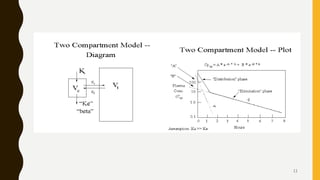
 Two Compartment Open Model
The two compartment open model treats the body as two compartment. Input
and output are from the central compartment mixing occurs between two
compartments.
Many drugs given in single IV bolus dose demonstrate a plasma level-time
curve that does not decline as single exponential (first-order) process.
The plasma level-time curve for drug that follows a two- compartment model
shows that the plasma drug concentration declines bi-exponentially as the sum
of two first order processes-distribution and elimination.
The drug of two-compartment model does not equilibrate rapidly throughout
the body, as is assumed for one-compartment model.
10
11
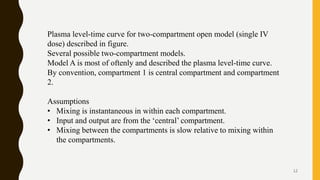
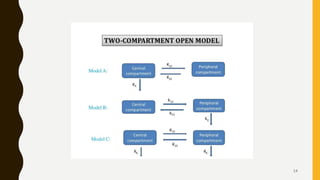
Plasma level-time curve for two-compartment open model (single IV
dose) described in figure.
Several possible two-compartment models.
Model A is most of oftenly and described the plasma level-time curve.
By convention, compartment 1 is central compartment and compartment
2.
Assumptions
• Mixing is instantaneous in within each compartment.
• Input and output are from the ‘central’ compartment.
• Mixing between the compartments is slow relative to mixing within
the compartments.
12
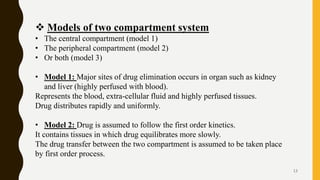
 Models of two compartment system
• The central compartment (model 1)
• The peripheral compartment (model 2)
• Or both (model 3)
• Model 1: Major sites of drug elimination occurs in organ such as kidney
and liver (highly perfused with blood).
Represents the blood, extra-cellular fluid and highly perfused tissues.
Drug distributes rapidly and uniformly.
• Model 2: Drug is assumed to follow the first order kinetics.
It contains tissues in which drug equilibrates more slowly.
The drug transfer between the two compartment is assumed to be taken place
by first order process.
13
14
 Parameters
of two
compartmen
t model
Apparent volume of distribution
Elimination rate constant
Biological half-life
Drug clearance
15
• Apparent volume of distribution
Relates plasma concentration to the amount of drug in the body.
Drugs with large extravascular distribution, apparent volume of
distribution is generally large.
Also for drugs having high peripheral tissue binding volume of distribution
is large.
For polar drugs apparent volume of distribution is small.
16
• Significance of volume of distribution
• Volume of distribution is affected by changes in the overall elimination
rate and by the change in the total body clearance of drugs.
• It is useful in calculation of clearance.
• Changes in disease state may not results in different pharmacokinetic
parameters.
• Change in pk parameters should not lead to physiologic changes.
17
• Elimination rate constant
Elimination rate constant of central compartment and tissue compartment.
Because of redistribution of drug out of tissue compartment, b smaller than
k.
Three rate constants are associated with two compartment model
k21= Ab + Ba /B+A
k10= ab /k21
k12= a+b-k21-k10
• Biological half-life
Biological half-life can be determined from the rate constant
t1/2=0.693/b
• Drug clearance
Clearance is the volume of plasma that is cleared of drug per unit time.
Cl = Vd /b 18
 Non-linear pharmacokinetic
It is dose dependent pharmacokinetics.
Non linear pharmacokinetic models imply that some aspect of
pharmacokinetic behaviour of drugs is saturable.
• Causes of non-linearity
Saturation of enzymes in process of drug ADME.
Pathologic alteration on drug ADME.
• Example
Amino glycoside may cause renal nephrotoxicity, thereby altering renal drug
excretion.
Obstruction of the bile duct to the formation of gallstone will alter biliary
drug excretion.
19
 Michaelis Menten equation
Non-linear pharmacokinetics can be best descried by Michaelis Menten
equation.
-dc/dt = Vmax.C / km + C
where, dc/dt = rate of decline in drug conc. with time
Vmax = therotical maximum rate of process
km = Michaelis constant
Three possible conditions
• When km=C,
-dc/dt = Vmax/2
• When km>>C,
-dc/dt = Vmax.C/km
• When km<<C,
-dc/dt = Vmax
20
21
 References
 “Multicompartmental models : Intravenous Bolus
Administration”, Applied Biopharmaceutics and
Pharmacokinetics, Leon Shargel, Susanna Wu-Pong, Andrew
B.C. Yu, page no 73-105, fifth edition, 2005
 “Compartmental and Noncompartmental Pharmacokinetics”,
Biopharmaceutics and Clinical Pharmacokinetics, Milo Gibaldi,
fourth edition, 2014
 “Nonlinear Pharmacokinetics”, Applied Biopharmaceutics and
Pharmacokinetics, Leon Shargel, Susanna Wu-Pong, Andrew
B.C. Yu, page no 219-248, fifth edition, 2005
Thank you!
22

Multi compartment models

  • 1.
    Presented By Miss. SafalataS. Sakla Department of Pharmaceutics RAJARSHI SHAHU COLLEGE OF PHARMACY, BULDHANA Guided By Asst. Prof, Dr. Darshan R. Telange RSCP, Buldana Pharmacokinetics and Multi-compartment Modeling
  • 2.
     CONTENTS • Pharmacokinetics •Types of pharmacokinetic model • Compartment models • Types of compartment model • Classification • Multi-compartment model • Two compartment model • Models of two compartment modelling • Parameters • Michaelis Menten equation • References 2
  • 3.
     Pharmacokinetics pharmacon -drug; kinesis – motion/change of rate Pharmacokinetics is defined as kinetics of absorption, distribution, metabolism and excretion (ADME) of drugs and their corresponding responses. Types of Pharmacokinetic Model • Compartment Model • Non-compartment Model • Physiological Model 3
  • 4.
     Compartment Models Mostcommon and most desirable route of drug administration is orally, by mouth, using tablets, capsules or oral solutions. Compartment models are classical pharmacokinetics model that stimulate the kinetic processes of drug absorption, distribution and elimination with little physiologic detail. • Physiological system is described by decomposition into number of interacting substances called compartment. • Mass of well mixed, homogenous material. • Behaves uniformly. • Exchange material. 4
  • 5.
     Types ofCompartment Model • Open model • Closed model • Open model : The administered drug dose is eliminated from the body by an excretory mechanism. • Closed model : The drug dose is not eliminated from body. 5
  • 6.
  • 7.
     Multi-compartment models Multi-compartmentmodels were developed to explain this observation that after rapid IV injection the plasma level time curve does not decline linearly as a single, first order rate process. They were developed to explain and predict plasma and tissue concentration for the behaviour of these drugs. For multi-compartment models, the drugs in the tissue that have the highest blood perfusion and equilibrates rapidly with the drug. For example, lipid soluble drug tends to accumulate in fat tissues. 7
  • 8.
    Kinetics analysis ofa multi-compartment model assumes that all transfer rate process for the passage of drug into or out of individual compartment are first order processes. On the basis of this assumptions, the plasma level-time curve for the drug that follows a multi-compartment model is best described by the summation of series of exponential terms, each corresponding to first order rate process associated with given compartment. Because of these distribution factors, drugs will generally concentrate unevenly in tissues and different groups of tissues will accumulate the drug at different rates. 8
  • 9.
    Tissue Percent body weight Percentcardiac output Blood flow (ml/100g tissue / min) Adernals 0.02 1 550 Kidneys 0.4 24 450 Thyroid 0.04 2 400 Liver hepatic portal 2.0 5 20 20 75 Fat 15.0 2 1 Portal-drained viscera 2.0 20 75 Heart(basal) 0.4 4 70 Brain 2.0 15 55 skin 7.0 5 5 Muscle(basal) 40.0 15 3 Connective tissue 7.0 1 1 9
  • 10.
     Two CompartmentOpen Model The two compartment open model treats the body as two compartment. Input and output are from the central compartment mixing occurs between two compartments. Many drugs given in single IV bolus dose demonstrate a plasma level-time curve that does not decline as single exponential (first-order) process. The plasma level-time curve for drug that follows a two- compartment model shows that the plasma drug concentration declines bi-exponentially as the sum of two first order processes-distribution and elimination. The drug of two-compartment model does not equilibrate rapidly throughout the body, as is assumed for one-compartment model. 10
  • 11.
  • 12.
    Plasma level-time curvefor two-compartment open model (single IV dose) described in figure. Several possible two-compartment models. Model A is most of oftenly and described the plasma level-time curve. By convention, compartment 1 is central compartment and compartment 2. Assumptions • Mixing is instantaneous in within each compartment. • Input and output are from the ‘central’ compartment. • Mixing between the compartments is slow relative to mixing within the compartments. 12
  • 13.
     Models oftwo compartment system • The central compartment (model 1) • The peripheral compartment (model 2) • Or both (model 3) • Model 1: Major sites of drug elimination occurs in organ such as kidney and liver (highly perfused with blood). Represents the blood, extra-cellular fluid and highly perfused tissues. Drug distributes rapidly and uniformly. • Model 2: Drug is assumed to follow the first order kinetics. It contains tissues in which drug equilibrates more slowly. The drug transfer between the two compartment is assumed to be taken place by first order process. 13
  • 14.
  • 15.
     Parameters of two compartmen tmodel Apparent volume of distribution Elimination rate constant Biological half-life Drug clearance 15
  • 16.
    • Apparent volumeof distribution Relates plasma concentration to the amount of drug in the body. Drugs with large extravascular distribution, apparent volume of distribution is generally large. Also for drugs having high peripheral tissue binding volume of distribution is large. For polar drugs apparent volume of distribution is small. 16
  • 17.
    • Significance ofvolume of distribution • Volume of distribution is affected by changes in the overall elimination rate and by the change in the total body clearance of drugs. • It is useful in calculation of clearance. • Changes in disease state may not results in different pharmacokinetic parameters. • Change in pk parameters should not lead to physiologic changes. 17
  • 18.
    • Elimination rateconstant Elimination rate constant of central compartment and tissue compartment. Because of redistribution of drug out of tissue compartment, b smaller than k. Three rate constants are associated with two compartment model k21= Ab + Ba /B+A k10= ab /k21 k12= a+b-k21-k10 • Biological half-life Biological half-life can be determined from the rate constant t1/2=0.693/b • Drug clearance Clearance is the volume of plasma that is cleared of drug per unit time. Cl = Vd /b 18
  • 19.
     Non-linear pharmacokinetic Itis dose dependent pharmacokinetics. Non linear pharmacokinetic models imply that some aspect of pharmacokinetic behaviour of drugs is saturable. • Causes of non-linearity Saturation of enzymes in process of drug ADME. Pathologic alteration on drug ADME. • Example Amino glycoside may cause renal nephrotoxicity, thereby altering renal drug excretion. Obstruction of the bile duct to the formation of gallstone will alter biliary drug excretion. 19
  • 20.
     Michaelis Mentenequation Non-linear pharmacokinetics can be best descried by Michaelis Menten equation. -dc/dt = Vmax.C / km + C where, dc/dt = rate of decline in drug conc. with time Vmax = therotical maximum rate of process km = Michaelis constant Three possible conditions • When km=C, -dc/dt = Vmax/2 • When km>>C, -dc/dt = Vmax.C/km • When km<<C, -dc/dt = Vmax 20
  • 21.
    21  References  “Multicompartmentalmodels : Intravenous Bolus Administration”, Applied Biopharmaceutics and Pharmacokinetics, Leon Shargel, Susanna Wu-Pong, Andrew B.C. Yu, page no 73-105, fifth edition, 2005  “Compartmental and Noncompartmental Pharmacokinetics”, Biopharmaceutics and Clinical Pharmacokinetics, Milo Gibaldi, fourth edition, 2014  “Nonlinear Pharmacokinetics”, Applied Biopharmaceutics and Pharmacokinetics, Leon Shargel, Susanna Wu-Pong, Andrew B.C. Yu, page no 219-248, fifth edition, 2005
  • 22.