COMPARTMENT
MODELING
BINU ANAND
FIRST YEAR M.PHARM
NAZARETH COLLEGE OF PHARMACY
1
2
• Drug movement within the body is a complex process. The
major objective is therefore to develop a generalized and
simple approach to describe, analyse and interpret the data
obtained during in vivo drug disposition studies
PHARMACOKINETIC MODELS
QUALITIES OF A PHARMACOKINETIC
MODEL
• Validity: It should have practical applicability and should
be valuable in describing events chosen accurately with
high precision.
• Prediction ability: These models predict the qualitative
and quantitative changes in the parameters that are rate
constants and half lives of the drugs.
• Consistency of results: Reproducibility is an important
quality of a mathematical model.
3
APPLICATIONS OF PHARMACOKINETIC
MODELS
• Characterizing the behavior of drugs in patients.
• Calculating the optimum dosage regimens for individual
patients.
• Evaluating the bioequivalence between different
formulations of same drug.
• Determining the influence of altered physiology or
disease state on drug ADME. 4
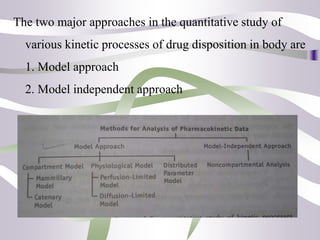
The two major approaches in the quantitative study of
various kinetic processes of drug disposition in body are
1. Model approach
2. Model independent approach
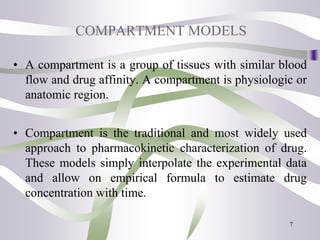
Types of pharmacokinetic models
1. Compartment models ; are also called empirical
models.
2. Physiological models ; are realistic models.
3. Distributed parameter models ; are also
realistic models.
6
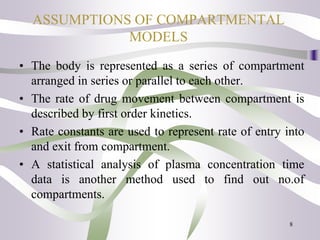
COMPARTMENT MODELS
• A compartment is a group of tissues with similar blood
flow and drug affinity. A compartment is physiologic or
anatomic region.
• Compartment is the traditional and most widely used
approach to pharmacokinetic characterization of drug.
These models simply interpolate the experimental data
and allow on empirical formula to estimate drug
concentration with time.
7
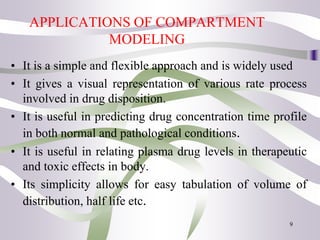
ASSUMPTIONS OF COMPARTMENTAL
MODELS
• The body is represented as a series of compartment
arranged in series or parallel to each other.
• The rate of drug movement between compartment is
described by first order kinetics.
• Rate constants are used to represent rate of entry into
and exit from compartment.
• A statistical analysis of plasma concentration time
data is another method used to find out no.of
compartments.
8
APPLICATIONS OF COMPARTMENT
MODELING
• It is a simple and flexible approach and is widely used
• It gives a visual representation of various rate process
involved in drug disposition.
• It is useful in predicting drug concentration time profile
in both normal and pathological conditions.
• It is useful in relating plasma drug levels in therapeutic
and toxic effects in body.
• Its simplicity allows for easy tabulation of volume of
distribution, half life etc.
9
TYPES OF COMPARTMENT MODELS
Based on whether the compartment is arranged in parallel
or series. The compartmental models are classified into
four types, they are;
1. Mammillary model
2. Catenary model
3. Open model
4. Closed model
10
11
MAMMILLARY MODEL-
• The mammilary model is the most common compartment
model used in pharmacokinetics.
• It consists of one or more peripheral compartments
connected to the central compartment in a manner similar to
connection of satellites to a planet .
• They are joined parallel to the central compartment.
• The central compartment comprises of plasma and highly
perfused tissues such as lungs, liver, kidney etc. which
rapidly equilibrate with drugs.
12
The peripheral compartments or tissue compartments
are those with low vascularity and poor perfusion.
Distribution of drugs to those compartments is through
blood.
Movement of drug can be defined by first-order
kinetics.
13
CATENARY MODEL
•The compartments are joined to one another in a series like
compartments of a train.
•It is rarely used because it is not observed that anatomicaly or
physiologically various organs are directly linked to the blood
compartment.
CONCLUSION
14
•In pharmacokinetic studies, compartment models have
been termed as “DETERMINISTIC”.
•The simplicity and flexibility of the compartment model is
the principle reason for its wide application.
•Because of its simplicity they often serves as a “FIRST
MODEL ” that requires refinement.
•In spite of such an advantage it generally regarded as
somewhat empirical and lacking physiologic relevance
REFERENCE
• Biopharmaceutics and pharmacokinetics, D.M.
Brahmankar and Sunil.B.Jaiswal, 1st edition.
• Applied biopharmaceutics andpharmacokinetics, Leon
Shargel and Andrew.Y.U, 4TH edition.
• Biopharmaceutics and pharmacokinetics,
Venkateswarulu
15
THANK YOU
16

Compartment modeling ppt

  • 1.
    COMPARTMENT MODELING BINU ANAND FIRST YEARM.PHARM NAZARETH COLLEGE OF PHARMACY 1
  • 2.
    2 • Drug movementwithin the body is a complex process. The major objective is therefore to develop a generalized and simple approach to describe, analyse and interpret the data obtained during in vivo drug disposition studies PHARMACOKINETIC MODELS
  • 3.
    QUALITIES OF APHARMACOKINETIC MODEL • Validity: It should have practical applicability and should be valuable in describing events chosen accurately with high precision. • Prediction ability: These models predict the qualitative and quantitative changes in the parameters that are rate constants and half lives of the drugs. • Consistency of results: Reproducibility is an important quality of a mathematical model. 3
  • 4.
    APPLICATIONS OF PHARMACOKINETIC MODELS •Characterizing the behavior of drugs in patients. • Calculating the optimum dosage regimens for individual patients. • Evaluating the bioequivalence between different formulations of same drug. • Determining the influence of altered physiology or disease state on drug ADME. 4
  • 5.
    The two majorapproaches in the quantitative study of various kinetic processes of drug disposition in body are 1. Model approach 2. Model independent approach
  • 6.
    Types of pharmacokineticmodels 1. Compartment models ; are also called empirical models. 2. Physiological models ; are realistic models. 3. Distributed parameter models ; are also realistic models. 6
  • 7.
    COMPARTMENT MODELS • Acompartment is a group of tissues with similar blood flow and drug affinity. A compartment is physiologic or anatomic region. • Compartment is the traditional and most widely used approach to pharmacokinetic characterization of drug. These models simply interpolate the experimental data and allow on empirical formula to estimate drug concentration with time. 7
  • 8.
    ASSUMPTIONS OF COMPARTMENTAL MODELS •The body is represented as a series of compartment arranged in series or parallel to each other. • The rate of drug movement between compartment is described by first order kinetics. • Rate constants are used to represent rate of entry into and exit from compartment. • A statistical analysis of plasma concentration time data is another method used to find out no.of compartments. 8
  • 9.
    APPLICATIONS OF COMPARTMENT MODELING •It is a simple and flexible approach and is widely used • It gives a visual representation of various rate process involved in drug disposition. • It is useful in predicting drug concentration time profile in both normal and pathological conditions. • It is useful in relating plasma drug levels in therapeutic and toxic effects in body. • Its simplicity allows for easy tabulation of volume of distribution, half life etc. 9
  • 10.
    TYPES OF COMPARTMENTMODELS Based on whether the compartment is arranged in parallel or series. The compartmental models are classified into four types, they are; 1. Mammillary model 2. Catenary model 3. Open model 4. Closed model 10
  • 11.
    11 MAMMILLARY MODEL- • Themammilary model is the most common compartment model used in pharmacokinetics. • It consists of one or more peripheral compartments connected to the central compartment in a manner similar to connection of satellites to a planet . • They are joined parallel to the central compartment. • The central compartment comprises of plasma and highly perfused tissues such as lungs, liver, kidney etc. which rapidly equilibrate with drugs.
  • 12.
    12 The peripheral compartmentsor tissue compartments are those with low vascularity and poor perfusion. Distribution of drugs to those compartments is through blood. Movement of drug can be defined by first-order kinetics.
  • 13.
    13 CATENARY MODEL •The compartmentsare joined to one another in a series like compartments of a train. •It is rarely used because it is not observed that anatomicaly or physiologically various organs are directly linked to the blood compartment.
  • 14.
    CONCLUSION 14 •In pharmacokinetic studies,compartment models have been termed as “DETERMINISTIC”. •The simplicity and flexibility of the compartment model is the principle reason for its wide application. •Because of its simplicity they often serves as a “FIRST MODEL ” that requires refinement. •In spite of such an advantage it generally regarded as somewhat empirical and lacking physiologic relevance
  • 15.
    REFERENCE • Biopharmaceutics andpharmacokinetics, D.M. Brahmankar and Sunil.B.Jaiswal, 1st edition. • Applied biopharmaceutics andpharmacokinetics, Leon Shargel and Andrew.Y.U, 4TH edition. • Biopharmaceutics and pharmacokinetics, Venkateswarulu 15
  • 16.