Pharmacokinetic
Name: Sanjog Bam
Introduction
• It is the quantitative, time dependent changes
of both the plasma drug concentration and the
total amount of drug in the body following the
drug administration by various route.
• It describes the study of absorption,
distribution, metabolism & excretion of drugs
and their relation to pharmacological response.
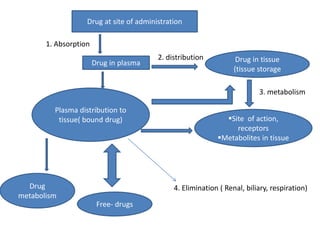
Drug at site of administration
Drug in plasma Drug in tissue
(tissue storage
Plasma distribution to
tissue( bound drug) Site of action,
receptors
Metabolites in tissue
1. Absorption
2. distribution
3. metabolism
4. Elimination ( Renal, biliary, respiration)
Free- drugs
Drug
metabolism
Absorption of drugs
• Transfer of drug from the site of administration to the
blood circulation.
• Absorption is complete in case of IV administration and
may be partial in other routes.
• Drugs are absorbed from GIT by:
– Passive diffusion
– Active diffusion
• Most drugs are either weak acids or weak base which on
ionization produce certain charged forms.
• unlike charged, uncharged drugs can readily penetrates
membrane in GI.
• So the concentration of charged and uncharged forms
determines the effective concentration of the permeable
form of each drugs.
• Highly lipid soluble drugs rapidly penetrates membrane and
often enters tissues at a rate determined by blood flow.
• Factors influencing absorption are:
Vascularity of absorption site.
Surface area available for absorption.
Contact time at the absorption site.
• Acidic drugs(aspirin) are less ionized at gastric
pH hence absorbed more but the basic
drug(atropine) are largely ionized and are
absorbed when reach in the intestine.
• Acidic drugs are ionized more in the alkaline
urine, so are excreted faster.
• Similarly , basic drugs are excreted faster if
urine is acidified.
Bioavailability
• It is used to describe the fraction of an administered dose of
unchanged drug that reaches the systemic circulation.
• It is one of principle pharmacokinetics properties of drugs.
• In I.V, bioavailability is 100%
• When medication is administered via other route other than
IV, then fraction of drugs are only absorbed to systemic
circulation(its bioavailability decreases) due to first pass
metabolism and incomplete absorption.
• Essential tools in pharmacokinetics, as bioavailability must be
considered when calculating dosages for non-intravenous
routes of administration.
ABSOLUTE BIOAVAILABILITY
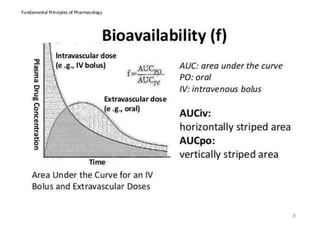
• It compares the bioavailability of the active drug in
systemic circulation following the non-intravenous
administration , with bioavailability of the same
drug following intravenous administration.
• Its is the fraction of the drugs absorbed through
the non-intravenous administration compared with
the corresponding intravenous administration of
the same drug.
• Drug given by the I.V route will have an absolute
bioavailability(F) of 1,while drugs given via other
routes usually have F < 1.
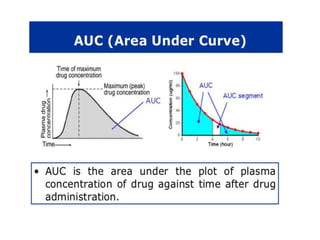
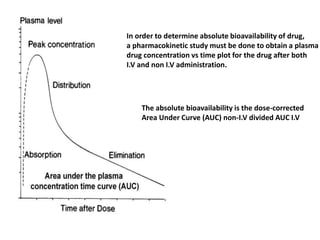
In order to determine absolute bioavailability of drug,
a pharmacokinetic study must be done to obtain a plasma
drug concentration vs time plot for the drug after both
I.V and non I.V administration.
The absolute bioavailability is the dose-corrected
Area Under Curve (AUC) non-I.V divided AUC I.V
Relative bioavailability
• This measures the bioavailability (estimated as AUC) of
a certain drug when compared with another
formulation of the same drug, usually an established
standard, or through administration via a different
route.
• When the standard consists of intravenously
administered drug, then it becomes absolute
bioavailability.
• Relative bioavailability is extremely sensitive to drug
formulation.
• Relative bioavailability is one of the measures used to
assess bioequivalence between two drug products, as
it is the test/reference ratio of AUC.
Factors influencing bioavailability
• Physical properties of drugs.
• Drug formulation
• If drug is administered in fed or fasting state
• Gastric emptying rate
• Circadian difference
• Enzymes induction/inhibition by other drugs/foods.
• Interaction with other drugs( antacid, alcohol, nicotine)
• Interaction with other foods(eg: grapefruits juice, pomello,
cranberry juice)
• Transporters: substrate of an efflux transporter(eg: P-
glycoprotein)
• Health of GI tract
• Enzyme induction/inhibition by other
drugs/foods:
– Enzymes induction( increases rate of metabolism) eg:
phenytoin (antiepileptic) induces CYP1A2, CYP2C9,
CYP2C19 and CYP3A4
– Enzyme inhibition(decreases rate of metabolism) eg
grapefruit juice inhibits CYP3A, higher nifedipine
concentration
• Individual variation in metabolic differences
1. Age:In general, drugs metabolized more slowly in
fetal, neonatal, and geriatric populations
2. Phenotypic differences, enterohepatic circulation,
diet, gender.
• Disease state: insufficiency, poor renal function.
• Each of these factors mention before may vary from
patient to patient(inter individual variation),and in
same patient over time (intra individual variation)
• In oral route, absorption of solid drug dosage requires
disintegration of solid drugs into fine active drug
particles in gastric lumen; released active drugs gets
dissolved in aqueous GI contents(dissolution) and
treated via gastric secretion and motility.
• Difference in bioavailability may arise due to variation
in disintegration and dissolution.
• Reduction in particles size(microfined) can enhance
absorption with half decrease tablet size.
• There is no need to reduce the particle size of freely
water soluble drugs, eg: paracetamol
Distribution
• Once drug gets into circulation, then it tends to
distribute all over tissue via concentration gradient.
• The extent of distribution of drugs depends upon:
– Lipid solubility
– Its ionization at the physiological
– Affinity of binding to plasma protein and tissue protein
– Presence of tissue specific transporter.
– Difference in regional blood flow.
• Movements of drugs proceeds until an equilibrium is
established between unbound drug in plasma and
tissue fluid (intersitial fluid).
• Subsequently, there is a parallel decline in both due to
elimination.
Volume of distribution
• It is a hypothetical volume( body as the single homogeneous
compartment ) into which drug is disseminated.
• V= dose administered i.v / plasma concentration
• As the drug is not equally distributed into total of body water, it is
just an apparent volume of distribution which can be defined as the
volume that would accommodate all the drug in the body, assuming
the concentration throughout being same as in plasma.
• Pathological states , eg. CHF, uraemia , cirrhosis of liver etc can
alter the V of many drugs by altering distribution of body water,
permeability of membranes, binding proteins or by accumulation of
metabolites that displace the drug from binding sites.
• Lipid insoluble drugs donot enter cells: V approx
ECF eg: streptomycin, gentamicin 0.25L/kg
• Binding and sequestration also interfere ; drugs
extensively bound to plasma proteins are largely
restricted to the vascular compartment and low
value eg: declofenac and warfarin (99% bound)
V=0.15L/kg.
• Drug sequestrated in other tissue may have, V
comes much more than total body water or even
body mass, eg: digoxin 6L/kg, propranolol 4L/kg,
morphine 3.5 L/kg, because most drug is present
in other tissues, and plasma concentration is low.
• Therefore, in case of poisoning, drugs with larger
volumes of distribution are not easily removed
by hemodialysis.
• Factors governing volume of distribution:
– Lipid: water partition coefficient of the drug.
– Degree of plasma protein binding
– Affinity for different tissues
– Fat: lean body mass ratio
– Diseases condition.
• Binding of drugs to plasma proteins(usually
albumin ) have lower volume of distribution,
longer duration of action.
• Drugs binding to albumin: barbiturates, NSAIDS,
penicillins, tetracyclines etc
• Drugs binding to α-acid glycoprotein: blockers,
Lignocaine, imipramine, prazosin etc
Redistribution
• Highly lipid soluble drugs get initially distributed to
organs with high blood flow: i.e brain, heart, kidney etc
• Later less vascular but more bulky tissue take up the
drugs, resulting fall in plasma concentration of drug
and the drug is withdrawn from the sites.
• If the site of action of drugs is in highly perfused tissue
then, redistribution results the termination of drug
action.
• Greater the lipid solubility of drug, faster is its
redistribution.
• Eg: anaesthetic action of thiopentone sod.injection is
terminated in few minutes due to redistribution
Drugs may accumulate in specific organs and get
bound to specific tissue constituents:
Specific tissue drugs
Bone and teeth Tetracyclines, heavy metals
thyroid iodine
Brain Chlorpropamide
Acetazolamide
isoniazide
Liver Chloroquine
Tetracycline
Digoxin
Kidney Chloroquine
Emetine
Skeletal muscles digoxin
Heart Emetine etc
Drug metabolism(bio-transformation)
• It is the metabolism of drugs, their biochemical
modification or degradation usually through specialized
enzymatic systems.
• This is a form of xenobiotic metabolism
• Often converts lipophilic chemical compounds into more
readily excreted polar products.
• Biotransformation rate is an important determinant of the
duration and intensity of pharmacological action of
drugs.
• Metabolism can result in toxication or detoxication- the
activation or deactivation of the chemical.
• While both occurs, the major metabolites of most drugs
are detoxication products.
Reactions of drug metabolism
• Phase I reactions( non-synthetic reaction):
– During theses reactions, polar bodies are either
introduced or unmasked, which results in more polar
metabolites of the original chemicals
– In the case of pharmaceutical drugs, phase I reactions
can lead either to activation or inactivation of the
drugs by:
a. oxidation using cytochrome P450
b. Reduction
c. Hydrolysis
d. Cyclization
e. Decyclization
Phase II reactions:
• Usually known as conjugation reactions( eg: with glucuronic
acid, sulfonates, glutathione or amino acids).
• Are usually detoxication in nature, and involve the
interactions of polar functional group of phase I
metabolism.
a. glucuronide conjugation
b. Acetylation
c. Methylation
d. sulphate conjugation
e. Glycine conjugation
f. Glutathione conjugation
 Sites of metabolism:
liver, lungs, GI tract , skin
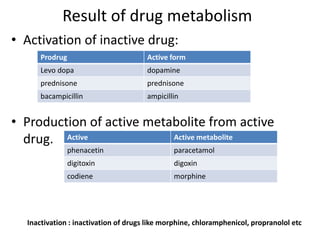
Result of drug metabolism
• Activation of inactive drug:
• Production of active metabolite from active
drug.
Prodrug Active form
Levo dopa dopamine
prednisone prednisone
bacampicillin ampicillin
Active Active metabolite
phenacetin paracetamol
digitoxin digoxin
codiene morphine
Inactivation : inactivation of drugs like morphine, chloramphenicol, propranolol etc
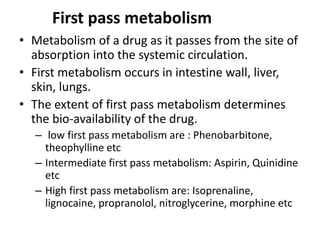
First pass metabolism
• Metabolism of a drug as it passes from the site of
absorption into the systemic circulation.
• First metabolism occurs in intestine wall, liver,
skin, lungs.
• The extent of first pass metabolism determines
the bio-availability of the drug.
– low first pass metabolism are : Phenobarbitone,
theophylline etc
– Intermediate first pass metabolism: Aspirin, Quinidine
etc
– High first pass metabolism are: Isoprenaline,
lignocaine, propranolol, nitroglycerine, morphine etc
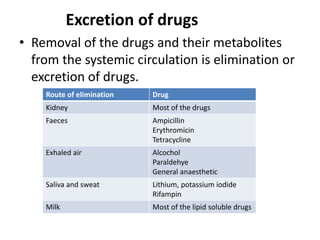
Excretion of drugs
• Removal of the drugs and their metabolites
from the systemic circulation is elimination or
excretion of drugs.
Route of elimination Drug
Kidney Most of the drugs
Faeces Ampicillin
Erythromicin
Tetracycline
Exhaled air Alcochol
Paraldehye
General anaesthetic
Saliva and sweat Lithium, potassium iodide
Rifampin
Milk Most of the lipid soluble drugs
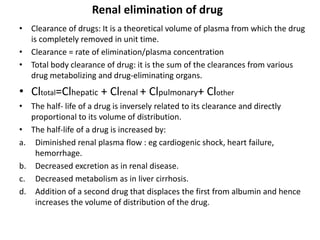
Renal elimination of drug
• Clearance of drugs: It is a theoretical volume of plasma from which the drug
is completely removed in unit time.
• Clearance = rate of elimination/plasma concentration
• Total body clearance of drug: it is the sum of the clearances from various
drug metabolizing and drug-eliminating organs.
• Cltotal=Clhepatic + Clrenal + Clpulmonary+ Clother
• The half- life of a drug is inversely related to its clearance and directly
proportional to its volume of distribution.
• The half-life of a drug is increased by:
a. Diminished renal plasma flow : eg cardiogenic shock, heart failure,
hemorrhage.
b. Decreased excretion as in renal disease.
c. Decreased metabolism as in liver cirrhosis.
d. Addition of a second drug that displaces the first from albumin and hence
increases the volume of distribution of the drug.
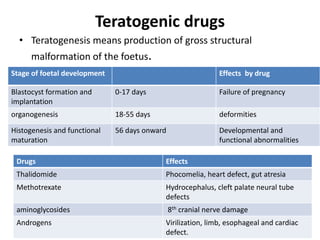
Teratogenic drugs
• Teratogenesis means production of gross structural
malformation of the foetus.
Stage of foetal development Effects by drug
Blastocyst formation and
implantation
0-17 days Failure of pregnancy
organogenesis 18-55 days deformities
Histogenesis and functional
maturation
56 days onward Developmental and
functional abnormalities
Drugs Effects
Thalidomide Phocomelia, heart defect, gut atresia
Methotrexate Hydrocephalus, cleft palate neural tube
defects
aminoglycosides 8th cranial nerve damage
Androgens Virilization, limb, esophageal and cardiac
defect.
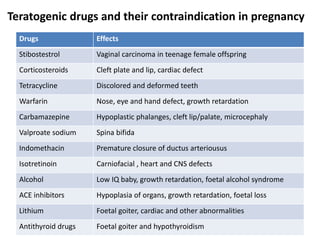
Teratogenic drugs and their contraindication in pregnancy
Drugs Effects
Stibostestrol Vaginal carcinoma in teenage female offspring
Corticosteroids Cleft plate and lip, cardiac defect
Tetracycline Discolored and deformed teeth
Warfarin Nose, eye and hand defect, growth retardation
Carbamazepine Hypoplastic phalanges, cleft lip/palate, microcephaly
Valproate sodium Spina bifida
Indomethacin Premature closure of ductus arteriousus
Isotretinoin Carniofacial , heart and CNS defects
Alcohol Low IQ baby, growth retardation, foetal alcohol syndrome
ACE inhibitors Hypoplasia of organs, growth retardation, foetal loss
Lithium Foetal goiter, cardiac and other abnormalities
Antithyroid drugs Foetal goiter and hypothyroidism
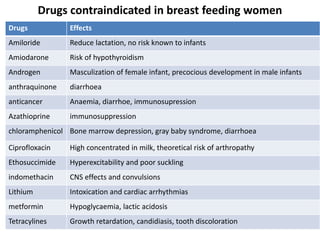
Drugs contraindicated in breast feeding women
Drugs Effects
Amiloride Reduce lactation, no risk known to infants
Amiodarone Risk of hypothyroidism
Androgen Masculization of female infant, precocious development in male infants
anthraquinone diarrhoea
anticancer Anaemia, diarrhoe, immunosupression
Azathioprine immunosuppression
chloramphenicol Bone marrow depression, gray baby syndrome, diarrhoea
Ciprofloxacin High concentrated in milk, theoretical risk of arthropathy
Ethosuccimide Hyperexcitability and poor suckling
indomethacin CNS effects and convulsions
Lithium Intoxication and cardiac arrhythmias
metformin Hypoglycaemia, lactic acidosis
Tetracylines Growth retardation, candidiasis, tooth discoloration
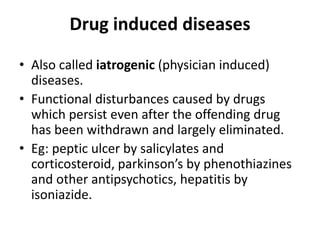
Drug induced diseases
• Also called iatrogenic (physician induced)
diseases.
• Functional disturbances caused by drugs
which persist even after the offending drug
has been withdrawn and largely eliminated.
• Eg: peptic ulcer by salicylates and
corticosteroid, parkinson’s by phenothiazines
and other antipsychotics, hepatitis by
isoniazide.

PHARMACOKINETIC

  • 1.
  • 2.
    Introduction • It isthe quantitative, time dependent changes of both the plasma drug concentration and the total amount of drug in the body following the drug administration by various route. • It describes the study of absorption, distribution, metabolism & excretion of drugs and their relation to pharmacological response.
  • 3.
    Drug at siteof administration Drug in plasma Drug in tissue (tissue storage Plasma distribution to tissue( bound drug) Site of action, receptors Metabolites in tissue 1. Absorption 2. distribution 3. metabolism 4. Elimination ( Renal, biliary, respiration) Free- drugs Drug metabolism
  • 4.
    Absorption of drugs •Transfer of drug from the site of administration to the blood circulation. • Absorption is complete in case of IV administration and may be partial in other routes. • Drugs are absorbed from GIT by: – Passive diffusion – Active diffusion • Most drugs are either weak acids or weak base which on ionization produce certain charged forms. • unlike charged, uncharged drugs can readily penetrates membrane in GI. • So the concentration of charged and uncharged forms determines the effective concentration of the permeable form of each drugs. • Highly lipid soluble drugs rapidly penetrates membrane and often enters tissues at a rate determined by blood flow.
  • 5.
    • Factors influencingabsorption are: Vascularity of absorption site. Surface area available for absorption. Contact time at the absorption site. • Acidic drugs(aspirin) are less ionized at gastric pH hence absorbed more but the basic drug(atropine) are largely ionized and are absorbed when reach in the intestine. • Acidic drugs are ionized more in the alkaline urine, so are excreted faster. • Similarly , basic drugs are excreted faster if urine is acidified.
  • 6.
    Bioavailability • It isused to describe the fraction of an administered dose of unchanged drug that reaches the systemic circulation. • It is one of principle pharmacokinetics properties of drugs. • In I.V, bioavailability is 100% • When medication is administered via other route other than IV, then fraction of drugs are only absorbed to systemic circulation(its bioavailability decreases) due to first pass metabolism and incomplete absorption. • Essential tools in pharmacokinetics, as bioavailability must be considered when calculating dosages for non-intravenous routes of administration.
  • 7.
    ABSOLUTE BIOAVAILABILITY • Itcompares the bioavailability of the active drug in systemic circulation following the non-intravenous administration , with bioavailability of the same drug following intravenous administration. • Its is the fraction of the drugs absorbed through the non-intravenous administration compared with the corresponding intravenous administration of the same drug. • Drug given by the I.V route will have an absolute bioavailability(F) of 1,while drugs given via other routes usually have F < 1.
  • 9.
    In order todetermine absolute bioavailability of drug, a pharmacokinetic study must be done to obtain a plasma drug concentration vs time plot for the drug after both I.V and non I.V administration. The absolute bioavailability is the dose-corrected Area Under Curve (AUC) non-I.V divided AUC I.V
  • 11.
    Relative bioavailability • Thismeasures the bioavailability (estimated as AUC) of a certain drug when compared with another formulation of the same drug, usually an established standard, or through administration via a different route. • When the standard consists of intravenously administered drug, then it becomes absolute bioavailability. • Relative bioavailability is extremely sensitive to drug formulation. • Relative bioavailability is one of the measures used to assess bioequivalence between two drug products, as it is the test/reference ratio of AUC.
  • 12.
    Factors influencing bioavailability •Physical properties of drugs. • Drug formulation • If drug is administered in fed or fasting state • Gastric emptying rate • Circadian difference • Enzymes induction/inhibition by other drugs/foods. • Interaction with other drugs( antacid, alcohol, nicotine) • Interaction with other foods(eg: grapefruits juice, pomello, cranberry juice) • Transporters: substrate of an efflux transporter(eg: P- glycoprotein) • Health of GI tract
  • 13.
    • Enzyme induction/inhibitionby other drugs/foods: – Enzymes induction( increases rate of metabolism) eg: phenytoin (antiepileptic) induces CYP1A2, CYP2C9, CYP2C19 and CYP3A4 – Enzyme inhibition(decreases rate of metabolism) eg grapefruit juice inhibits CYP3A, higher nifedipine concentration • Individual variation in metabolic differences 1. Age:In general, drugs metabolized more slowly in fetal, neonatal, and geriatric populations 2. Phenotypic differences, enterohepatic circulation, diet, gender. • Disease state: insufficiency, poor renal function.
  • 14.
    • Each ofthese factors mention before may vary from patient to patient(inter individual variation),and in same patient over time (intra individual variation) • In oral route, absorption of solid drug dosage requires disintegration of solid drugs into fine active drug particles in gastric lumen; released active drugs gets dissolved in aqueous GI contents(dissolution) and treated via gastric secretion and motility. • Difference in bioavailability may arise due to variation in disintegration and dissolution. • Reduction in particles size(microfined) can enhance absorption with half decrease tablet size. • There is no need to reduce the particle size of freely water soluble drugs, eg: paracetamol
  • 15.
    Distribution • Once druggets into circulation, then it tends to distribute all over tissue via concentration gradient. • The extent of distribution of drugs depends upon: – Lipid solubility – Its ionization at the physiological – Affinity of binding to plasma protein and tissue protein – Presence of tissue specific transporter. – Difference in regional blood flow. • Movements of drugs proceeds until an equilibrium is established between unbound drug in plasma and tissue fluid (intersitial fluid). • Subsequently, there is a parallel decline in both due to elimination.
  • 16.
    Volume of distribution •It is a hypothetical volume( body as the single homogeneous compartment ) into which drug is disseminated. • V= dose administered i.v / plasma concentration • As the drug is not equally distributed into total of body water, it is just an apparent volume of distribution which can be defined as the volume that would accommodate all the drug in the body, assuming the concentration throughout being same as in plasma. • Pathological states , eg. CHF, uraemia , cirrhosis of liver etc can alter the V of many drugs by altering distribution of body water, permeability of membranes, binding proteins or by accumulation of metabolites that displace the drug from binding sites.
  • 17.
    • Lipid insolubledrugs donot enter cells: V approx ECF eg: streptomycin, gentamicin 0.25L/kg • Binding and sequestration also interfere ; drugs extensively bound to plasma proteins are largely restricted to the vascular compartment and low value eg: declofenac and warfarin (99% bound) V=0.15L/kg. • Drug sequestrated in other tissue may have, V comes much more than total body water or even body mass, eg: digoxin 6L/kg, propranolol 4L/kg, morphine 3.5 L/kg, because most drug is present in other tissues, and plasma concentration is low. • Therefore, in case of poisoning, drugs with larger volumes of distribution are not easily removed by hemodialysis.
  • 18.
    • Factors governingvolume of distribution: – Lipid: water partition coefficient of the drug. – Degree of plasma protein binding – Affinity for different tissues – Fat: lean body mass ratio – Diseases condition. • Binding of drugs to plasma proteins(usually albumin ) have lower volume of distribution, longer duration of action. • Drugs binding to albumin: barbiturates, NSAIDS, penicillins, tetracyclines etc • Drugs binding to α-acid glycoprotein: blockers, Lignocaine, imipramine, prazosin etc
  • 19.
    Redistribution • Highly lipidsoluble drugs get initially distributed to organs with high blood flow: i.e brain, heart, kidney etc • Later less vascular but more bulky tissue take up the drugs, resulting fall in plasma concentration of drug and the drug is withdrawn from the sites. • If the site of action of drugs is in highly perfused tissue then, redistribution results the termination of drug action. • Greater the lipid solubility of drug, faster is its redistribution. • Eg: anaesthetic action of thiopentone sod.injection is terminated in few minutes due to redistribution
  • 20.
    Drugs may accumulatein specific organs and get bound to specific tissue constituents: Specific tissue drugs Bone and teeth Tetracyclines, heavy metals thyroid iodine Brain Chlorpropamide Acetazolamide isoniazide Liver Chloroquine Tetracycline Digoxin Kidney Chloroquine Emetine Skeletal muscles digoxin Heart Emetine etc
  • 21.
    Drug metabolism(bio-transformation) • Itis the metabolism of drugs, their biochemical modification or degradation usually through specialized enzymatic systems. • This is a form of xenobiotic metabolism • Often converts lipophilic chemical compounds into more readily excreted polar products. • Biotransformation rate is an important determinant of the duration and intensity of pharmacological action of drugs. • Metabolism can result in toxication or detoxication- the activation or deactivation of the chemical. • While both occurs, the major metabolites of most drugs are detoxication products.
  • 22.
    Reactions of drugmetabolism • Phase I reactions( non-synthetic reaction): – During theses reactions, polar bodies are either introduced or unmasked, which results in more polar metabolites of the original chemicals – In the case of pharmaceutical drugs, phase I reactions can lead either to activation or inactivation of the drugs by: a. oxidation using cytochrome P450 b. Reduction c. Hydrolysis d. Cyclization e. Decyclization
  • 23.
    Phase II reactions: •Usually known as conjugation reactions( eg: with glucuronic acid, sulfonates, glutathione or amino acids). • Are usually detoxication in nature, and involve the interactions of polar functional group of phase I metabolism. a. glucuronide conjugation b. Acetylation c. Methylation d. sulphate conjugation e. Glycine conjugation f. Glutathione conjugation  Sites of metabolism: liver, lungs, GI tract , skin
  • 24.
    Result of drugmetabolism • Activation of inactive drug: • Production of active metabolite from active drug. Prodrug Active form Levo dopa dopamine prednisone prednisone bacampicillin ampicillin Active Active metabolite phenacetin paracetamol digitoxin digoxin codiene morphine Inactivation : inactivation of drugs like morphine, chloramphenicol, propranolol etc
  • 25.
    First pass metabolism •Metabolism of a drug as it passes from the site of absorption into the systemic circulation. • First metabolism occurs in intestine wall, liver, skin, lungs. • The extent of first pass metabolism determines the bio-availability of the drug. – low first pass metabolism are : Phenobarbitone, theophylline etc – Intermediate first pass metabolism: Aspirin, Quinidine etc – High first pass metabolism are: Isoprenaline, lignocaine, propranolol, nitroglycerine, morphine etc
  • 26.
    Excretion of drugs •Removal of the drugs and their metabolites from the systemic circulation is elimination or excretion of drugs. Route of elimination Drug Kidney Most of the drugs Faeces Ampicillin Erythromicin Tetracycline Exhaled air Alcochol Paraldehye General anaesthetic Saliva and sweat Lithium, potassium iodide Rifampin Milk Most of the lipid soluble drugs
  • 27.
    Renal elimination ofdrug • Clearance of drugs: It is a theoretical volume of plasma from which the drug is completely removed in unit time. • Clearance = rate of elimination/plasma concentration • Total body clearance of drug: it is the sum of the clearances from various drug metabolizing and drug-eliminating organs. • Cltotal=Clhepatic + Clrenal + Clpulmonary+ Clother • The half- life of a drug is inversely related to its clearance and directly proportional to its volume of distribution. • The half-life of a drug is increased by: a. Diminished renal plasma flow : eg cardiogenic shock, heart failure, hemorrhage. b. Decreased excretion as in renal disease. c. Decreased metabolism as in liver cirrhosis. d. Addition of a second drug that displaces the first from albumin and hence increases the volume of distribution of the drug.
  • 28.
    Teratogenic drugs • Teratogenesismeans production of gross structural malformation of the foetus. Stage of foetal development Effects by drug Blastocyst formation and implantation 0-17 days Failure of pregnancy organogenesis 18-55 days deformities Histogenesis and functional maturation 56 days onward Developmental and functional abnormalities Drugs Effects Thalidomide Phocomelia, heart defect, gut atresia Methotrexate Hydrocephalus, cleft palate neural tube defects aminoglycosides 8th cranial nerve damage Androgens Virilization, limb, esophageal and cardiac defect.
  • 29.
    Teratogenic drugs andtheir contraindication in pregnancy Drugs Effects Stibostestrol Vaginal carcinoma in teenage female offspring Corticosteroids Cleft plate and lip, cardiac defect Tetracycline Discolored and deformed teeth Warfarin Nose, eye and hand defect, growth retardation Carbamazepine Hypoplastic phalanges, cleft lip/palate, microcephaly Valproate sodium Spina bifida Indomethacin Premature closure of ductus arteriousus Isotretinoin Carniofacial , heart and CNS defects Alcohol Low IQ baby, growth retardation, foetal alcohol syndrome ACE inhibitors Hypoplasia of organs, growth retardation, foetal loss Lithium Foetal goiter, cardiac and other abnormalities Antithyroid drugs Foetal goiter and hypothyroidism
  • 30.
    Drugs contraindicated inbreast feeding women Drugs Effects Amiloride Reduce lactation, no risk known to infants Amiodarone Risk of hypothyroidism Androgen Masculization of female infant, precocious development in male infants anthraquinone diarrhoea anticancer Anaemia, diarrhoe, immunosupression Azathioprine immunosuppression chloramphenicol Bone marrow depression, gray baby syndrome, diarrhoea Ciprofloxacin High concentrated in milk, theoretical risk of arthropathy Ethosuccimide Hyperexcitability and poor suckling indomethacin CNS effects and convulsions Lithium Intoxication and cardiac arrhythmias metformin Hypoglycaemia, lactic acidosis Tetracylines Growth retardation, candidiasis, tooth discoloration
  • 31.
    Drug induced diseases •Also called iatrogenic (physician induced) diseases. • Functional disturbances caused by drugs which persist even after the offending drug has been withdrawn and largely eliminated. • Eg: peptic ulcer by salicylates and corticosteroid, parkinson’s by phenothiazines and other antipsychotics, hepatitis by isoniazide.