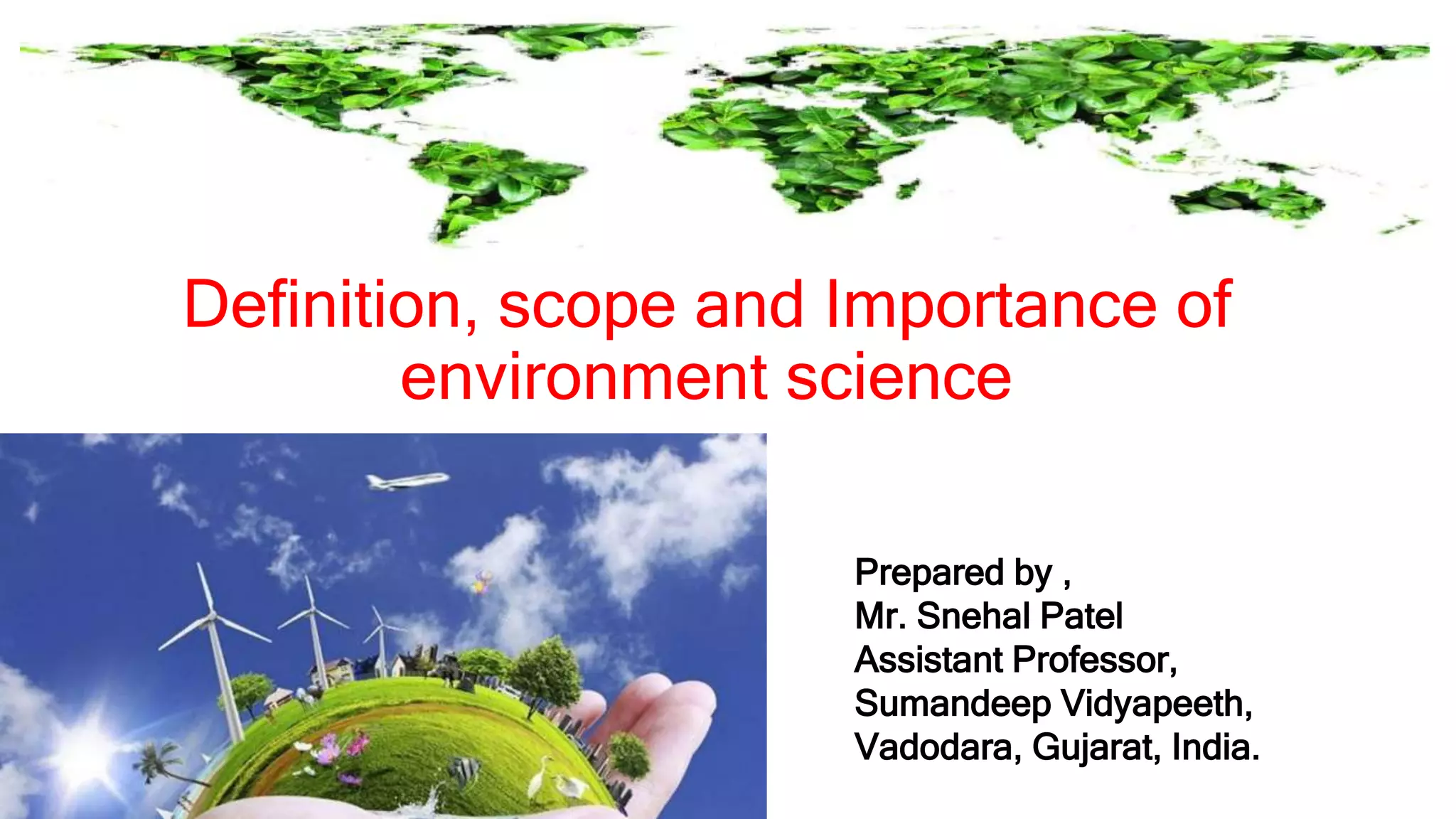
Definition, scope and Importance of environment science
Environmental science is a multidisciplinary field that combines various sciences to protect the environment. It studies both the biotic environment of living things like plants and animals, as well as the abiotic physical and chemical surroundings. The scope of environmental science is wide, as it examines how human activities impact natural resources in forests, rivers, cities, and more. Protecting the environment is important because natural resources are limited and human population growth is increasing resource usage and pollution, threatening human health and life itself if left unchecked. Individual action is needed alongside government efforts to preserve environmental resources for the future.
Definition, scope and Importance of environment science
1.
Definition, scope andImportance of
environment science
Prepared by ,
Mr. Snehal Patel
Assistant Professor,
Sumandeep Vidyapeeth,
Vadodara, Gujarat, India.
2.
Definition of EnvironmentalScience
• The word environment is derived from French word “ environ” which
means surrounding or enveloping.
• Environmental science is a multidisciplinary science which combines
physics, chemistry, biology, medical, health science, life science,
agricultural science, forestry, public health engineering and so on.
• The main objective of environmental science is to protect the
environment.
3.
Definition of Environment
•All the factors such as physical, geographical, chemical, biological,
and ecological which affects human life and its existance on this
planet are called environment.
• The environment includes earth, lakes, forests, farms, vegetation
and other biological life such as animals, plants, bacteria and micro-
organisms etc.
• All the components of the environment are basically divided into two
categories.
1. Biotic environment
2. Abiotic environment
4.
Biotic and Abioticenvironment
• Biotic environment includes all living organisms and biological life
such as animals, birds, forests, reptiles, insects, bacteria and micro-
organisms like algae, fungus etc.
• Abiotic environment includes all non-living components such as
land, mountains, rivers, air, water, temperature, humidity, water
vapour, sand, dust, clouds etc.
5.
Scope of EnvironmentalScience
• Our surrounding includes forest, rivers, mountains, desert, or a
combination of these elements.
• Most of us live in landscapes that have been heavily modified by the
human beings in villages, towns and cities.
• But even those of us who live in cities get our food supply from
surrounding villages.
• We use water to drink and other day to day activities, we breath air,
we use resources from which food is made.
• Our dependence on nature is so great that we cannot continue to live
without protecting the earths environmental resources.
6.
Importance of Environment
•Environment is not a single subject. It is an integration of several subjects
that includes both science and social science. To understand all the different
aspects of our environment we need to understand biology, chemistry,
physics, geography, resources management, economics and population
issue. Thus the scope of environmental studies is extremely wide and covers
some aspects of nearly every major discipline.
• We will in a world in which natural resources are limited. Water, air, soil,
minerals, oils, the product we get from the forests, grasslands, oceans, and
from agriculture and from livestock are all the part of our life support
system. Without them life it self will be impossible.
7.
Importance of Environment
•As we keep on increasing in number the quantity of resources each of us
uses also increases. The earth cannot be expected to sustain this expanding
level of utilization of resources. Added to this is misuse of resources. We
waste or pollute large amount of natures clean water; we create more and
more amount of plastic that we discard after the single use. We waste large
amount of food, which is discarded as garbage.
• Air pollution leads to respiratory diseases. Water pollution leads to
gastrointestinal (GIT) disorder. And many pollutants are known to cause
cancer.
• Improving this situation will only happen if each of use begins to take actions
in our daily lives that will help preserve our environmental resources. We
cannot expect government alone to manage the safe guarding of our
environment nor can we expect other people to prevent environmental
damage. We need to do it ourselves.


![Environmental science[3]](https://cdn.slidesharecdn.com/ss_thumbnails/environmentalscience3-140929233918-phpapp02-thumbnail.jpg?width=640&height=640&fit=bounds)


![Pollution.ppt [Autosaved].ppt yogesh kumbhar](https://cdn.slidesharecdn.com/ss_thumbnails/pollution-251205194856-d30cfee8-thumbnail.jpg?width=640&height=640&fit=bounds)


