Interfacial Phenomena
Prepared by ,
Mr. Snehal Patel
Assistant Professor,
Sumandeep Vidyapeeth,
Vadodara, Gujarat, India.
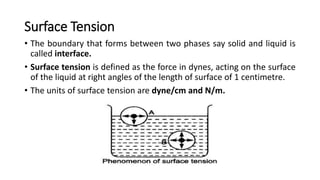
Surface Tension
• The boundary that forms between two phases say solid and liquid is
called interface.
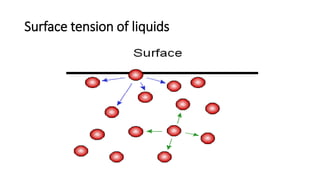
• Surface tension is defined as the force in dynes, acting on the surface
of the liquid at right angles of the length of surface of 1 centimetre.
• The units of surface tension are dyne/cm and N/m.
The phenomenon of surface tension is
responsible for following processes.
• Formation of spherical globules in emulsion.
• Formation of nearly spherical shape of falling water droplets.
• Formation of spherical shape of mercury particles on a flat surface.
• Rise of liquid in a capillary tube.
• Formation of hemispherical surface i.e lower meniscus, when water is
filled in glass tube.
Surface tension of liquids
Dertermination of surface and interfacial tension
• Different methods used for the determination of surface and
interfacial tension are
1. Capillary rise
2. Tensiometer
3. Bubble pressure
4. Drop weight (drop count)
Capillary rise method
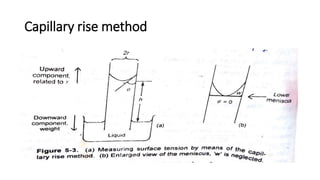
• When a capillary tube is placed in the liquid contained a beaker, the
liquid rises up in the tube to a certain distance. This is because the
adhesive forces between the liquid molecules and glass are stronger
than the cohesive forces between the liquid molecules.
• The rise in the tube continue until the upward movement is just
balanced by the downward force of gravity due to the weight of the
liquid.
• The phenomenon of capillary rise is observed in several instances in
nature.
1. Underground water rising on to the surface.
2. Oil rising through wick in a lamp.
3. To certain extent, water rising from the soil to the branches above
the ground in the plants.
Capillary rise method
The derivation for the determination of surface
tension by capillary rise is as follows.
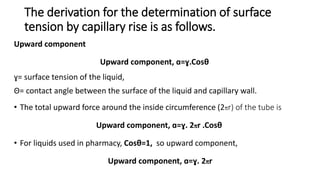
Upward component
Upward component, ɑ=ɣ.Cosθ
ɣ= surface tension of the liquid,
Θ= contact angle between the surface of the liquid and capillary wall.
• The total upward force around the inside circumference (2πr) of the tube is
Upward component, ɑ=ɣ. 2πr .Cosθ
• For liquids used in pharmacy, Cosθ=1, so upward component,
Upward component, ɑ=ɣ. 2πr
Downward component
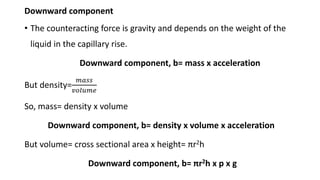
• The counteracting force is gravity and depends on the weight of the
liquid in the capillary rise.
Downward component, b= mass x acceleration
But density=
𝑚𝑎𝑠𝑠
𝑣𝑜𝑙𝑢𝑚𝑒
So, mass= density x volume
Downward component, b= density x volume x acceleration
But volume= cross sectional area x height= πr2h
Downward component, b= πr2h x p x g
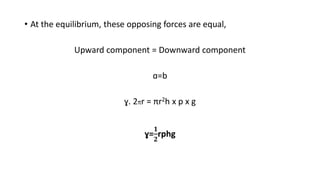
• At the equilibrium, these opposing forces are equal,
Upward component = Downward component
ɑ=b
ɣ. 2πr = πr2h x p x g
ɣ=
𝟏
𝟐
rphg
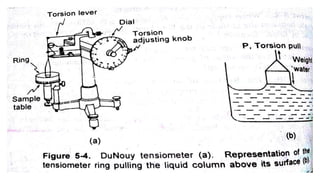
Tensiometer (DuNouy Ring method)
• DuNouy tensiometer is widely used to measure surface and interfacial
tensions.
• This method is convenient for rapid determination, especially when
the quantity of liquid available is small.
• It works on the principle of force required to detach the platinium-
iridium ring immersed at the interface or surface. The force is equal to
the surface and interfacial tension.
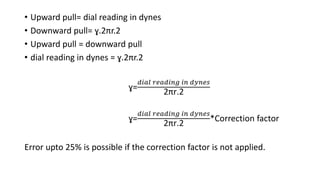
• Upward pull= dial reading in dynes
• Downward pull= ɣ.2πr.2
• Upward pull = downward pull
• dial reading in dynes = ɣ.2πr.2
ɣ=
𝑑𝑖𝑎𝑙 𝑟𝑒𝑎𝑑𝑖𝑛𝑔 𝑖𝑛 𝑑𝑦𝑛𝑒𝑠
2πr.2
ɣ=
𝑑𝑖𝑎𝑙 𝑟𝑒𝑎𝑑𝑖𝑛𝑔 𝑖𝑛 𝑑𝑦𝑛𝑒𝑠
2πr.2
*Correction factor
Error upto 25% is possible if the correction factor is not applied.
Surface free energy
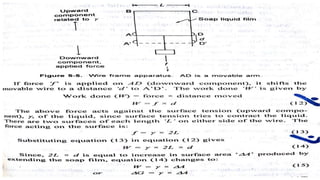
• Surface free energy is defined as the work required to increase the
area of the liquid by 1 sq cm.
• ABCD is a rectangular wire as shown in figure.
• The side of AD=L and is movable.
• A drop of soap solution is placed on the frame, so that it forms film
within the frame.
• When force is applied downwards, the film gets stretched as the
movable bar AD goes down until the film breaks.
Spreading Coefficient
• When a drop of oleic acid is placed on the surface of water, it will
spread as a film.
• If the spreading is spontaneous the surface free energy of the system
is reduced.
• The spreading of liquids can be analysed by considering the cohesion
and adhesive forces operating between the molecules.
Work of Cohesion
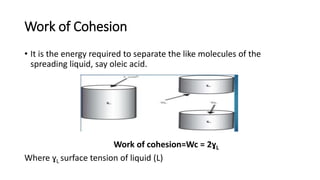
• It is the energy required to separate the like molecules of the
spreading liquid, say oleic acid.
Work of cohesion=Wc = 2ɣL
Where ɣL surface tension of liquid (L)
Work of Adhesion
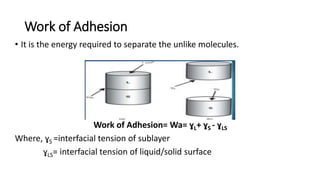
• It is the energy required to separate the unlike molecules.
Work of Adhesion= Wa= ɣL+ ɣS - ɣLS
Where, ɣS =interfacial tension of sublayer
ɣLS= interfacial tension of liquid/solid surface
• When the spreading of oleic acid occurs, when the adhesive force are
stronger than the cohesive forces . The spreading coefficient is
obtained by the following equation:
S=Wa-Wc = ( ɣL+ ɣS -ɣLS)-2ɣL
S= ɣs - ɣL - ɣLS
S= ɣs – (ɣL + ɣLS)
• If ɣs >(ɣL + ɣLS), than S is positive indicating spreading
• If ɣs <(ɣL + ɣLS), than S is negative indicating no spreading
Wetting Phenomena
• In industry, large quantities of powders such as talc and charcoal are
added to water. These powders do not get wetted properly in spite of
their higher densities than water, instead these float on the surface.
• Wetting is the adsorption process in which an intimate contact of
the solids with liquid phase is achieved.
Wetting Phenomena
This process is important in many ways in pharmacy.
• Initimate contact of solids or liquids in an initial step towards the
preparation of suspension and emulsion.
• In case of granulation prior to tabletting, the powder are mixed with the
liquid binding agents. The success of this process in part depends on the
wetting and spreading of the liquid over the solid.
• Film coating requires the wetting and spreading of liquids (containing the
coating material ) over the tablet surface.
• Dissolution of the tablet or a capsule necessitates the penetration of the
liquid into the pores of the dosage form.
Wetting Phenomena
• Surfactants are used to aid wetting of powders, because they are
capable of:
1. Lowering the interfacial tension.
2. Lowering of the contact angle between the solids and liquids.
3. Displacing the air and permit the intimate contact.
• Contact angle is used as an indicator to evaluate the efficiency of
wetting agent.
Wetting Phenomena
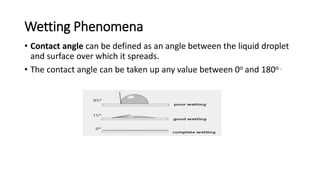
• Contact angle can be defined as an angle between the liquid droplet
and surface over which it spreads.
• The contact angle can be taken up any value between 0o and 180o .

Interfacial phenomena

  • 1.
    Interfacial Phenomena Prepared by, Mr. Snehal Patel Assistant Professor, Sumandeep Vidyapeeth, Vadodara, Gujarat, India.
  • 2.
    Surface Tension • Theboundary that forms between two phases say solid and liquid is called interface. • Surface tension is defined as the force in dynes, acting on the surface of the liquid at right angles of the length of surface of 1 centimetre. • The units of surface tension are dyne/cm and N/m.
  • 3.
    The phenomenon ofsurface tension is responsible for following processes. • Formation of spherical globules in emulsion. • Formation of nearly spherical shape of falling water droplets. • Formation of spherical shape of mercury particles on a flat surface. • Rise of liquid in a capillary tube. • Formation of hemispherical surface i.e lower meniscus, when water is filled in glass tube.
  • 4.
  • 5.
    Dertermination of surfaceand interfacial tension • Different methods used for the determination of surface and interfacial tension are 1. Capillary rise 2. Tensiometer 3. Bubble pressure 4. Drop weight (drop count)
  • 6.
    Capillary rise method •When a capillary tube is placed in the liquid contained a beaker, the liquid rises up in the tube to a certain distance. This is because the adhesive forces between the liquid molecules and glass are stronger than the cohesive forces between the liquid molecules. • The rise in the tube continue until the upward movement is just balanced by the downward force of gravity due to the weight of the liquid.
  • 7.
    • The phenomenonof capillary rise is observed in several instances in nature. 1. Underground water rising on to the surface. 2. Oil rising through wick in a lamp. 3. To certain extent, water rising from the soil to the branches above the ground in the plants.
  • 8.
  • 9.
    The derivation forthe determination of surface tension by capillary rise is as follows. Upward component Upward component, ɑ=ɣ.Cosθ ɣ= surface tension of the liquid, Θ= contact angle between the surface of the liquid and capillary wall. • The total upward force around the inside circumference (2πr) of the tube is Upward component, ɑ=ɣ. 2πr .Cosθ • For liquids used in pharmacy, Cosθ=1, so upward component, Upward component, ɑ=ɣ. 2πr
  • 10.
    Downward component • Thecounteracting force is gravity and depends on the weight of the liquid in the capillary rise. Downward component, b= mass x acceleration But density= 𝑚𝑎𝑠𝑠 𝑣𝑜𝑙𝑢𝑚𝑒 So, mass= density x volume Downward component, b= density x volume x acceleration But volume= cross sectional area x height= πr2h Downward component, b= πr2h x p x g
  • 11.
    • At theequilibrium, these opposing forces are equal, Upward component = Downward component ɑ=b ɣ. 2πr = πr2h x p x g ɣ= 𝟏 𝟐 rphg
  • 12.
    Tensiometer (DuNouy Ringmethod) • DuNouy tensiometer is widely used to measure surface and interfacial tensions. • This method is convenient for rapid determination, especially when the quantity of liquid available is small. • It works on the principle of force required to detach the platinium- iridium ring immersed at the interface or surface. The force is equal to the surface and interfacial tension.
  • 14.
    • Upward pull=dial reading in dynes • Downward pull= ɣ.2πr.2 • Upward pull = downward pull • dial reading in dynes = ɣ.2πr.2 ɣ= 𝑑𝑖𝑎𝑙 𝑟𝑒𝑎𝑑𝑖𝑛𝑔 𝑖𝑛 𝑑𝑦𝑛𝑒𝑠 2πr.2 ɣ= 𝑑𝑖𝑎𝑙 𝑟𝑒𝑎𝑑𝑖𝑛𝑔 𝑖𝑛 𝑑𝑦𝑛𝑒𝑠 2πr.2 *Correction factor Error upto 25% is possible if the correction factor is not applied.
  • 15.
    Surface free energy •Surface free energy is defined as the work required to increase the area of the liquid by 1 sq cm. • ABCD is a rectangular wire as shown in figure. • The side of AD=L and is movable. • A drop of soap solution is placed on the frame, so that it forms film within the frame. • When force is applied downwards, the film gets stretched as the movable bar AD goes down until the film breaks.
  • 17.
    Spreading Coefficient • Whena drop of oleic acid is placed on the surface of water, it will spread as a film. • If the spreading is spontaneous the surface free energy of the system is reduced. • The spreading of liquids can be analysed by considering the cohesion and adhesive forces operating between the molecules.
  • 18.
    Work of Cohesion •It is the energy required to separate the like molecules of the spreading liquid, say oleic acid. Work of cohesion=Wc = 2ɣL Where ɣL surface tension of liquid (L)
  • 19.
    Work of Adhesion •It is the energy required to separate the unlike molecules. Work of Adhesion= Wa= ɣL+ ɣS - ɣLS Where, ɣS =interfacial tension of sublayer ɣLS= interfacial tension of liquid/solid surface
  • 20.
    • When thespreading of oleic acid occurs, when the adhesive force are stronger than the cohesive forces . The spreading coefficient is obtained by the following equation: S=Wa-Wc = ( ɣL+ ɣS -ɣLS)-2ɣL S= ɣs - ɣL - ɣLS S= ɣs – (ɣL + ɣLS) • If ɣs >(ɣL + ɣLS), than S is positive indicating spreading • If ɣs <(ɣL + ɣLS), than S is negative indicating no spreading
  • 21.
    Wetting Phenomena • Inindustry, large quantities of powders such as talc and charcoal are added to water. These powders do not get wetted properly in spite of their higher densities than water, instead these float on the surface. • Wetting is the adsorption process in which an intimate contact of the solids with liquid phase is achieved.
  • 22.
    Wetting Phenomena This processis important in many ways in pharmacy. • Initimate contact of solids or liquids in an initial step towards the preparation of suspension and emulsion. • In case of granulation prior to tabletting, the powder are mixed with the liquid binding agents. The success of this process in part depends on the wetting and spreading of the liquid over the solid. • Film coating requires the wetting and spreading of liquids (containing the coating material ) over the tablet surface. • Dissolution of the tablet or a capsule necessitates the penetration of the liquid into the pores of the dosage form.
  • 23.
    Wetting Phenomena • Surfactantsare used to aid wetting of powders, because they are capable of: 1. Lowering the interfacial tension. 2. Lowering of the contact angle between the solids and liquids. 3. Displacing the air and permit the intimate contact. • Contact angle is used as an indicator to evaluate the efficiency of wetting agent.
  • 24.
    Wetting Phenomena • Contactangle can be defined as an angle between the liquid droplet and surface over which it spreads. • The contact angle can be taken up any value between 0o and 180o .