UNIT-I
Multidisciplinary Nature of
Environmental Studies
 Environment - is derived from an old French word
‘ENVIRONNER’ which means ENCIRCLE.
In real world everything that affects an organism
during its life time is collectively known as its
Environment.
Environmental study: Involves the study and
understanding that even a single phenomenon can
affect the environment in a variety of ways with varying
degrees of complexity.
 Environmental science - the study of how various species
interact with one another and with the non-living
environment (matter & energy).
 It is the study of interaction of the biotic component
(plants, animals and micro-organisms) among themselves
and together with the abiotic components (temperature,
rainfall, relative humidity, soil, air, fire, and atmosphere).
 The complex set of physical, geographic, biological, social,
cultural and political conditions that surround an individual
or organism and that ultimately determines its form and
nature of its survival.
Definitions
Environmental Science
An interdisciplinary branch of science that
investigates questions related to the human
population, resources, and damages caused by
pollution and disturbance.
Environmental science is integrative and
involves complex biology, chemistry, politics,
sociology, geology, agriculture, economics.
Why it is necessary to learn about the
state of environment?
 To conserve biodiversity, to lead more sustainable lifestyles
and to use resources more equitably.
 Biodiversity: The part of nature which includes the variety
and richness of all plant and animal species at different
scales in space i.e. Local, regional, country wise and global,
and various types of ecosystems - both terrestrial and aquatic
- within a defined area.
 Sustainable development: Implies the use of resources in a
managed way as to provide resources for future generations.
Objective of This Course
• Develop a concern for our environment.
• Begin to act at your own level to protect
the environment where we live in.
Multidisciplinary Nature of Environmental Studies
ES requires skills that encompass a range of disciplines
including chemistry, biology, earth sciences, atmospheric
science, statistics, mathematics, and geography.
Scope and Importance
• Resources: renewable (forest and water) and non-
renewable (minerals and oil).
• Due to the increase in population these resources are
getting depleted gradually.
• Need to understand about our natural assets and
sustainably utilize the resources.
• Scope of environmental studies is very wide and
nearly covers some aspects of every major discipline
(biology, chemistry, physics, geography, resource
management, economy, etc.).
Scope of Environmental Studies
• Ecosystem structure and function
• Natural resource conservation
• Environmental pollution control
• Environmental management
• Environmental impact assessment
• Research and development
• Social development
• Forest management
• Environmental consulting firms
Importance of Environmental Studies
• Environmental Studies is useful in checking environmental
pollution.
• It helps in maintaining ecological balance.
• It helps to gain skills to assess the environmental impact of
human activities.
• It gives us basic knowledge of environment and associated
problems.
• It helps to achieve sustainable development .
• It helps to educate people regarding their duties towards the
protection of environment.
Factors Affecting Environmental Problems
• Rapid population growth
• Degradation of parts of earth’s life support
systems.
• Poverty
• Wide-spread use of fossil fuels (coal and oil).
• Rapid and indiscriminate use of resources with
too little emphasis on pollution prevention and
waste reduction.
Major Environmental Problems
•Air Pollution
•Water Pollution
•Biodiversity Degradation
•Waste generation
•Food Supply Problems
Steps for environmental protection
1. To reduce world consumption of fossil fuels
2. To reduce and clean up all sorts of pollution
with future goal of zero pollution
3.Emphasis on clean, alternative energy sources
that have low carbon emissions
4. Sustainable use of water, land, and other
scarce resources
5. Preservation of existing endangered species
6. Protection of biodiversity
Challenges in agriculture
• Technology expanded food production
– Leading to increased population and consumption
• One of humanity’s greatest achievements, but it comes
at an enormous environmental cost
• Nearly half of the land surface is used for agriculture
• Chemical fertilizers and pesticides poison and change
natural systems
• Erosion, climate change and poor management destroy
millions of acres each year
Challenges in pollution
• Waste products and artificial chemicals
– Used in farms, industries, and households
– Contaminate land, water and air
– Kill millions of people
• Humans are affecting the Earth’s climate
– Melting glaciers
– Rising sea levels
– Impacted wildlife, forests, health and crops
– Changed rainfall and increased storms
Since the Industrial Revolution, atmospheric CO2 concentrations
have risen by 39%, to the highest level in 800,000 years.
Challenges in biodiversity
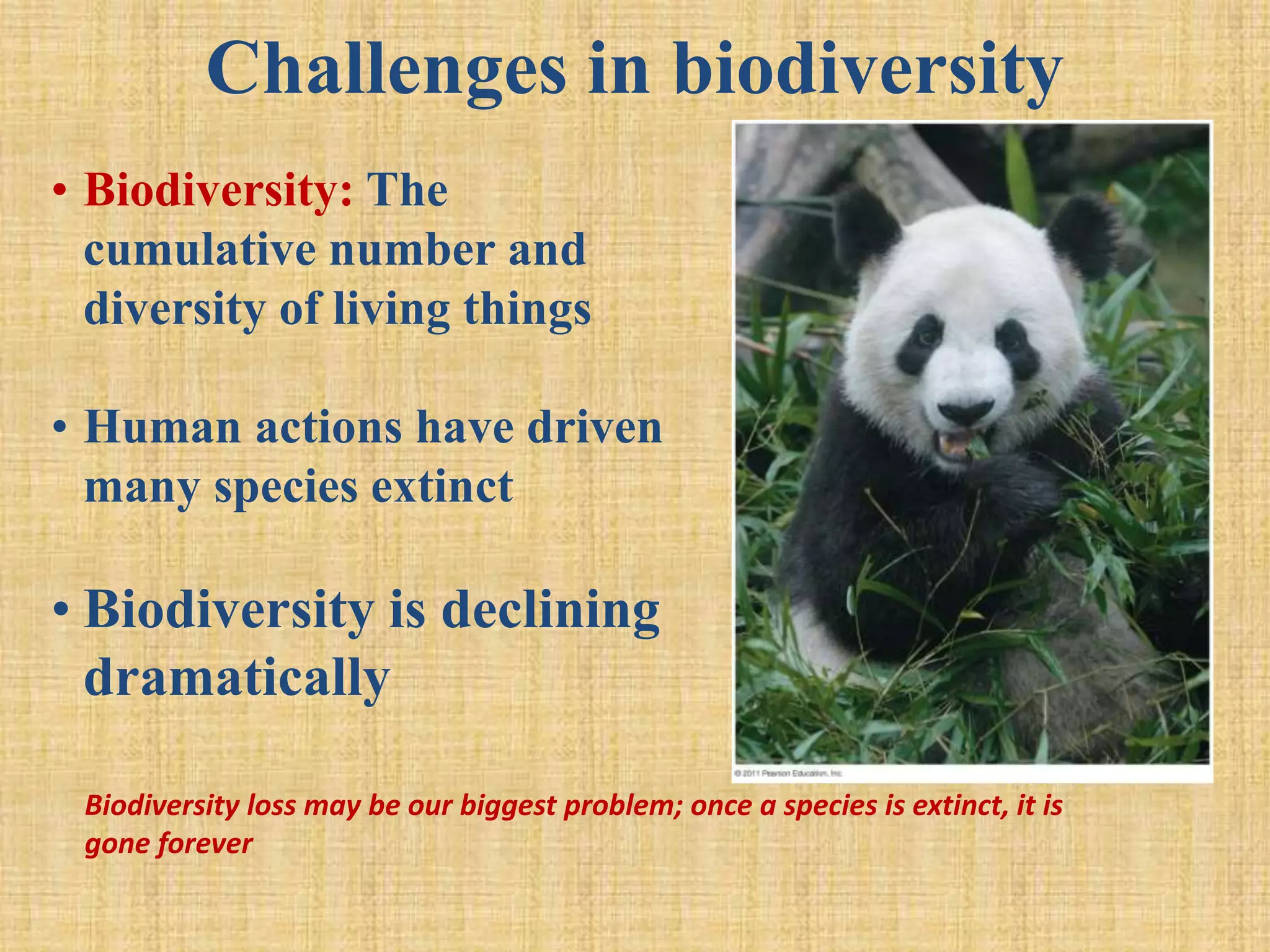
• Biodiversity: The
cumulative number and
diversity of living things
• Human actions have driven
many species extinct
• Biodiversity is declining
dramatically
Biodiversity loss may be our biggest problem; once a species is extinct, it is
gone forever
Challenges in Energy Sector
• The lives we live today are due to fossil fuels
– Machines
– Chemicals
– Transportation
– Products
• Fossil fuels are a one-time bonanza
– Supplies will certainly decline
We have used up ½ of the world’s oil supplies; how
will we handle this imminent fossil fuel shortage?
Sustainable solutions around
• Renewable energy
• Organic agriculture
• Legislation and technology to reduce pollution
• Protect species and their habitat
• Recycling and reducing waste
• Decrease greenhouse gas emissions
We must develop solutions that
protect both our quality of life and
the environment
Sustainable development
• Development: purposeful changes to improve
the quality of life
• Sustainable development:
• Involves environmental protection, economic
well-being and social equity.
• the use of resources to satisfy current needs
without compromising future availability of
resources
Can we develop in a sustainable way?
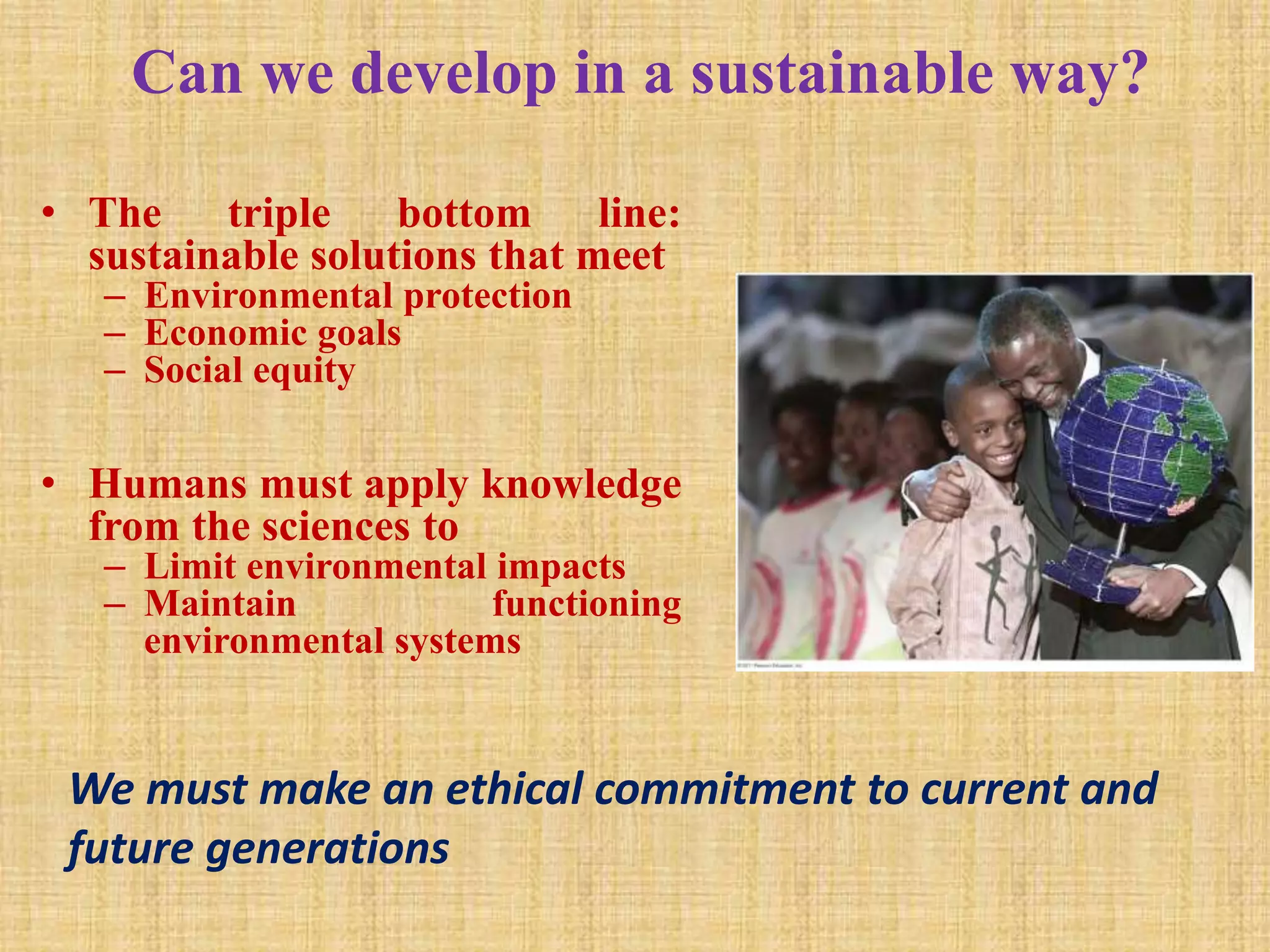
• The triple bottom line:
sustainable solutions that meet
– Environmental protection
– Economic goals
– Social equity
• Humans must apply knowledge
from the sciences to
– Limit environmental impacts
– Maintain functioning
environmental systems
We must make an ethical commitment to current and
future generations
Take home lesson
• Environmental science helps us understand our
relationship with the environment
• It helps us find balanced solutions to
environmental challenges
• Solving environmental problems can move us
towards health, longevity, peace and prosperity
• Sustainable development is what we are
looking for.

1,2 U1, L1.pptx

  • 1.
  • 2.
    Environmental Studies  Environment- is derived from an old French word ‘ENVIRONNER’ which means ENCIRCLE. In real world everything that affects an organism during its life time is collectively known as its Environment. Environmental study: Involves the study and understanding that even a single phenomenon can affect the environment in a variety of ways with varying degrees of complexity.
  • 3.
     Environmental science- the study of how various species interact with one another and with the non-living environment (matter & energy).  It is the study of interaction of the biotic component (plants, animals and micro-organisms) among themselves and together with the abiotic components (temperature, rainfall, relative humidity, soil, air, fire, and atmosphere).  The complex set of physical, geographic, biological, social, cultural and political conditions that surround an individual or organism and that ultimately determines its form and nature of its survival. Definitions
  • 4.
    Environmental Science An interdisciplinarybranch of science that investigates questions related to the human population, resources, and damages caused by pollution and disturbance. Environmental science is integrative and involves complex biology, chemistry, politics, sociology, geology, agriculture, economics.
  • 5.
    Why it isnecessary to learn about the state of environment?  To conserve biodiversity, to lead more sustainable lifestyles and to use resources more equitably.  Biodiversity: The part of nature which includes the variety and richness of all plant and animal species at different scales in space i.e. Local, regional, country wise and global, and various types of ecosystems - both terrestrial and aquatic - within a defined area.  Sustainable development: Implies the use of resources in a managed way as to provide resources for future generations.
  • 6.
    Objective of ThisCourse • Develop a concern for our environment. • Begin to act at your own level to protect the environment where we live in.
  • 7.
    Multidisciplinary Nature ofEnvironmental Studies ES requires skills that encompass a range of disciplines including chemistry, biology, earth sciences, atmospheric science, statistics, mathematics, and geography.
  • 8.
    Scope and Importance •Resources: renewable (forest and water) and non- renewable (minerals and oil). • Due to the increase in population these resources are getting depleted gradually. • Need to understand about our natural assets and sustainably utilize the resources. • Scope of environmental studies is very wide and nearly covers some aspects of every major discipline (biology, chemistry, physics, geography, resource management, economy, etc.).
  • 9.
    Scope of EnvironmentalStudies • Ecosystem structure and function • Natural resource conservation • Environmental pollution control • Environmental management • Environmental impact assessment • Research and development • Social development • Forest management • Environmental consulting firms
  • 10.
    Importance of EnvironmentalStudies • Environmental Studies is useful in checking environmental pollution. • It helps in maintaining ecological balance. • It helps to gain skills to assess the environmental impact of human activities. • It gives us basic knowledge of environment and associated problems. • It helps to achieve sustainable development . • It helps to educate people regarding their duties towards the protection of environment.
  • 11.
    Factors Affecting EnvironmentalProblems • Rapid population growth • Degradation of parts of earth’s life support systems. • Poverty • Wide-spread use of fossil fuels (coal and oil). • Rapid and indiscriminate use of resources with too little emphasis on pollution prevention and waste reduction.
  • 12.
    Major Environmental Problems •AirPollution •Water Pollution •Biodiversity Degradation •Waste generation •Food Supply Problems
  • 13.
    Steps for environmentalprotection 1. To reduce world consumption of fossil fuels 2. To reduce and clean up all sorts of pollution with future goal of zero pollution 3.Emphasis on clean, alternative energy sources that have low carbon emissions 4. Sustainable use of water, land, and other scarce resources 5. Preservation of existing endangered species 6. Protection of biodiversity
  • 14.
    Challenges in agriculture •Technology expanded food production – Leading to increased population and consumption • One of humanity’s greatest achievements, but it comes at an enormous environmental cost • Nearly half of the land surface is used for agriculture • Chemical fertilizers and pesticides poison and change natural systems • Erosion, climate change and poor management destroy millions of acres each year
  • 15.
    Challenges in pollution •Waste products and artificial chemicals – Used in farms, industries, and households – Contaminate land, water and air – Kill millions of people • Humans are affecting the Earth’s climate – Melting glaciers – Rising sea levels – Impacted wildlife, forests, health and crops – Changed rainfall and increased storms Since the Industrial Revolution, atmospheric CO2 concentrations have risen by 39%, to the highest level in 800,000 years.
  • 16.
    Challenges in biodiversity •Biodiversity: The cumulative number and diversity of living things • Human actions have driven many species extinct • Biodiversity is declining dramatically Biodiversity loss may be our biggest problem; once a species is extinct, it is gone forever
  • 17.
    Challenges in EnergySector • The lives we live today are due to fossil fuels – Machines – Chemicals – Transportation – Products • Fossil fuels are a one-time bonanza – Supplies will certainly decline We have used up ½ of the world’s oil supplies; how will we handle this imminent fossil fuel shortage?
  • 18.
    Sustainable solutions around •Renewable energy • Organic agriculture • Legislation and technology to reduce pollution • Protect species and their habitat • Recycling and reducing waste • Decrease greenhouse gas emissions We must develop solutions that protect both our quality of life and the environment
  • 19.
    Sustainable development • Development:purposeful changes to improve the quality of life • Sustainable development: • Involves environmental protection, economic well-being and social equity. • the use of resources to satisfy current needs without compromising future availability of resources
  • 20.
    Can we developin a sustainable way? • The triple bottom line: sustainable solutions that meet – Environmental protection – Economic goals – Social equity • Humans must apply knowledge from the sciences to – Limit environmental impacts – Maintain functioning environmental systems We must make an ethical commitment to current and future generations
  • 21.
    Take home lesson •Environmental science helps us understand our relationship with the environment • It helps us find balanced solutions to environmental challenges • Solving environmental problems can move us towards health, longevity, peace and prosperity • Sustainable development is what we are looking for.