Environmental Science (MCI-101)
Dr. Harmeet Singh
Professor , M&PE Department
GNDEC, Ludhiana
Course Outcomes
Course Outcomes (CO) Students will be able to
1. Identify environmental variables and interpret results.
2. Evaluate local, regional and global environmental topics related to
resource use and management.
3. Interpret the results of scientific studies of environmental problems.
4. Propose solutions to environmental problems related to resource
use and management.
5. Infer threats to global biodiversity, their implications and potential
solutions.
6. Adapt sustainability as practice in life, society and industry.
Detailed Contents
Part-A
• Natural Resources: 3 hours
Renewable and non-renewable resources: Natural resources and associated problems:
Forest resources: Use and over-exploitation, deforestation, case studies, Timber
extraction, mining, dams and their effects on forests and tribal people,
• Water resources: 5 hours
Use and over-utilization of surface and ground water, floods, drought, conflicts over
water, dam’s benefits and problems, Food Resources: World food problems, changes
caused by agriculture and over grazing, effects of modern agriculture, fertilizers-
pesticides problems, water logging, salinity, case studies, Energy Resources: Growing
energy needs, renewable and non-renewable energy sources, use of alternate energy
sources, case studies, Land Resources: Land as a resource, land degradation, man
induces landslides, soil erosion, and desertification.
• Eco Systems: 4 hours
Concept of an ecosystem, Structure and function of an ecosystem, Producers,
consumers, decomposers, Energy flow in the ecosystems, Ecological succession, Food
chains, food webs and ecological pyramids, Introduction, types, characteristic features,
structure and function of the following ecosystems: Forest ecosystem, Grass land
ecosystem, Desert ecosystem, Aquatic ecosystems (ponds, streams, lakes, rivers, oceans,
estuaries).
Detailed Contents
Part- B
• Biodiversity and Conservation: 4 hours
Introduction-Definition: genetics, species and ecosystem diversity, Biogeographically classification of
India, Value of biodiversity: consumptive use, productive use, social, ethical, aesthetic and option values,
Biodiversity at global, national and local level, India as a mega diversity nation, Hot-spots of
biodiversity, Threats to biodiversity: habitats loss, poaching of wild 34 life, man wildlife conflicts,
Endangered and endemic spaces of India, Conservation of biodiversity: in-situ and ex-situ conservation
of biodiversity.
• Environmental Pollution: 3 hours
Definition, causes, effects and control measures of: Air pollution, Water pollution, Soil pollution, Marine
pollution, Noise pollution, Thermal pollution, nuclear hazards. Causes, effects and control measures of
urban and industrial wastes, Role of an individual in prevention of pollution, Pollution case studies.
• Social issues and the Environment: 4 hours
Form unsustainable to sustainable development, Water conservation, rain water harvesting, water shed
management, Resettlement and rehabilitation of people; its problems and concerns, case studies,
Environmental ethics: issues and possible solutions, Climate change, global warming, acid rain, ozone
layer depletion, nuclear accidents and holocaust, case studies, Environment protection Act, Air
(prevention and control of pollution) Act, Water (prevention and control of pollution) Act, Wildlife
protection act, Forest conservation act
• Human population and the environment: 3 hours
Population growth and variation among nations, Population explosion- family welfare program,
Environment and human health, Human rights, Value education, HIV / AIDS, Women and child welfare
Books
Text Books:
1. Textbook of Environmental studies, Erach Bharucha, UGC
2. Fundamental concepts in Environmental Studies, D D Mishra, S
Chand & Co Ltd
3. Essentials of Environment Science by Joseph.
4. Perspectives in Environmental Studies by Kaushik, A.
Reference Books:
1. Environment Biology by Agarwal, K. C., Nidi Publ. Ltd. Bikaner.
2. Principle of Environment Science by Cunninghan, W.P.
3. Elements of Environment Science & Engineering by Meenakshi.
4. Elements of Environment Engineering by Duggal.
Environment
• Environmental studies deals with every issue that affects an
organism (an individual animal, plant, or single-celled life form).
• The word ‘Environment’ is derived from the French word
‘Environner’which means to encircle, around or surround.
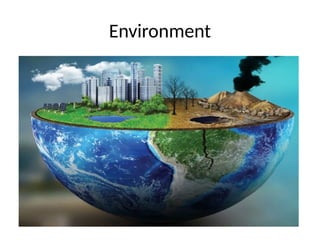
• Environment is the sum total of land, water, air, interrelationships
among themselves and also with the human beings and other living
organisms.
• It is essentially a multidisciplinary approach that brings about an
appreciation of our natural world and human impacts on its integrity.
• It is an applied science as its seeks practical answers to making
human civilization sustainable on the earth’s finite resources.
• Its components include biology, geology, chemistry, physics,
engineering, sociology, health, anthropology (study of humanity),
economics, statistics, computers and philosophy.
Environment
Environmental Science
• As given by Environment Protection Act 1986, Environment is the
sum total of land, water, air, interrelationships among themselves
and also with the human beings and other living organisms.
• Environmental Science deals with the study of processes in soil,
water, air and organisms which lead to pollution or environmental
damages and the scientific basis for the establishment of a
standard which can be considered acceptably clean, safe and
healthy for human beings and natural ecosystems.
• The Environment is about the surrounding external conditions
influencing development or growth of people, animal or plants;
living or working conditions etc.
DEFINITIONS OF ENVIRONMENT
1. According to Boring, ‘A person’s environment consists of
the sum total of the stimulation (activities) which he
receives from his conception until his death.’ Indicating
that environment comprises various types of forces such as
physical, intellectual, mental, economical, political,
cultural, social, moral and emotional.
2. Douglas and Holland defined that ‘The term environment
is used to describe, in aggregate, all the external forces,
influences and conditions, which affect the life, nature,
behaviour and the growth, development and maturity of
living organisms’.
Environment
• Environment is not a single subject. It is an
integration of several subjects that include both
Science and Social Studies.
• To understand all the different aspects of our
environment we need to understand biology,
chemistry, physics, geography, resource management,
economics and population issues.
• Thus the scope of environmental studies is
extremely wide and covers some aspects of nearly
every major discipline.
ENVIRONMENT STUDIES: IMPORTANCE
• Environment Issues are being of Global: global
warming and ozone depletion, acid rain,
marine pollution and biodiversity
• Development and Environment: ignorance of
the environmental impact
• Explosive Increase in Pollution
• Need for an Alternative Solution
• Need for Wise Planning of Development
Natural Resources
• Our environment provides us with a variety of goods
and services necessary for our day to day lives.
• These natural resources include, air, water, soil,
minerals, along with the climate and solar energy,
which form the non-living or ‘abiotic’ part of nature.
The ‘biotic’ or living parts of nature consists of plants
and animals, including microbes.
• Plants and animals can only survive as communities of
different organisms, all closely linked to each in their
own habitat, and requiring specific abiotic conditions.
SCOPE OF ENVIRONMENT
• Atmosphere: protective thick layer of gases
around the earth
• Hydrosphere: all types of water resources
• Lithosphere: outer mantle of the solid earth
• Biosphere: living organisms and their
interactions with environment
Scope- Importance
• Conservation of natural resources
• Ecological aspects
• Pollution of the surrounding natural resources
• Controlling the pollution
• Social issues connected to it
• Impacts of human population on the
environment
Earth’s Resources:Atmosphere
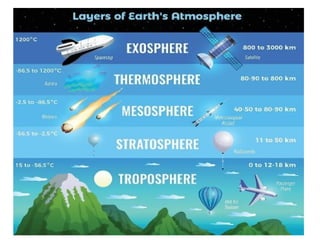
• Atmosphere is a protective layer of gases that shelters all life on Earth,
keeping temperatures within a relatively small range and blocking out
harmful rays of sunlight.
• The atmosphere forms a protective shell over the earth.
• The lowest layer, the troposphere, the only part warm enough for us to
survive in, is only 12 kilometers thick.
• The stratosphere is 50 kilometers thick and contains a layer of
sulphates and is an atmospheric layer composed
of stratified temperature layers, with the warm layers of air high in the
sky and the cool layers of air in the low sky, close to the planetary
surface of the Earth. It also contains a layer of ozone, which absorbs
ultra-violet light known to cause cancer and without which, no life could
exist on earth.
Atmosphere
• Oxygen for human respiration (metabolic
requirements).
• Oxygen for wild fauna in natural ecosystems
and domestic animals used by man as food.
• Oxygen as a part of carbon dioxide, used for
the growth of plants (in turn are used by man).
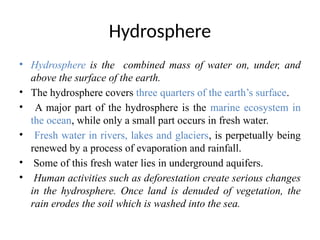
Hydrosphere
• Hydrosphere is the combined mass of water on, under, and
above the surface of the earth.
• The hydrosphere covers three quarters of the earth’s surface.
• A major part of the hydrosphere is the marine ecosystem in
the ocean, while only a small part occurs in fresh water.
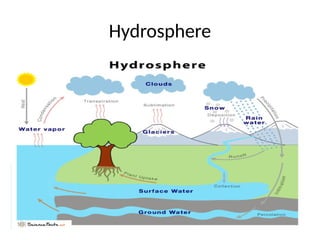
• Fresh water in rivers, lakes and glaciers, is perpetually being
renewed by a process of evaporation and rainfall.
• Some of this fresh water lies in underground aquifers.
• Human activities such as deforestation create serious changes
in the hydrosphere. Once land is denuded of vegetation, the
rain erodes the soil which is washed into the sea.
Hydrosphere
Hydrosphere
• Clean water for drinking (a metabolic requirement for living
processes).
• Water for washing and cooking.
• Water used in agriculture and industry.
• Food resources from the sea, including fish, crustacean
(shrimps, prawns, crabs, lobsters and crayfish), sea weed,
etc.
• Food from fresh water sources, including fish, crustacean and
aquatic plants.
• Water flowing down from mountain ranges harnessed to
generate electricity in hydroelectric projects.
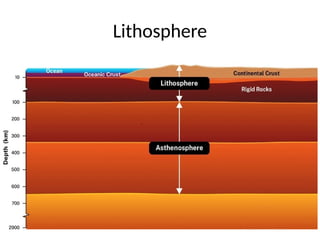
Lithosphere
• The outermost layer of the Earth that consists of the crust and the
uppermost mantle.
• The lithosphere began as a hot ball of matter which formed the
earth about 4.6 billion years ago.
• About 3.2 billion years ago, the earth cooled down considerably
and a very special event took place - life began on our planet.
• The crust of the earth is 6 or 7 kilometers thick and lies under the
continents.
• Of the 92 elements in the lithosphere only eight are common
constituents of crustal rocks. Of these constituents, 47% is
oxygen, 28% is silicon, 8% is aluminium, 5% is iron, while
sodium, magnesium, potassium and calcium constitute 4% each.
Lithosphere
Lithosphere
• Soil, the basis for agriculture to provide us with food.
• Stone, sand and gravel, used for construction.
• Micronutrients in soil, essential for plant growth.
• Microscopic flora, small soil fauna and fungi in soil, important
living organisms of the lithosphere, which break down plant
litter as well as animal wastes to provide nutrients for plants.
• A large number of minerals on which our industries are based.
• Oil, coal and gas, extracted from underground sources. It
provides power for vehicles, agricultural machinery, industry,
and for our homes.
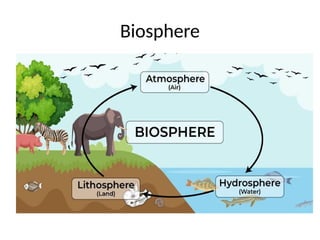
Biosphere
• The biosphere is the region of the Earth where life exists,
including the soil, water, and air.
• This is the relatively thin layer on the earth in which life
can exist.
• Within it the air, water, rocks and soil and the living
creatures, form structural and functional ecological units,
which together can be considered as one giant global
living system, that of our Earth itself.
• Within this framework, those characterized by broadly
similar geography and climate, as well as communities of
plant and animal life can be divided for convenience into
different biogeographically realms (Kingdom).
Biosphere
Biosphere
• Food, from crops and domestic animals,
providing human metabolic requirements.
• Food, for all forms of life which live as
interdependent species in a community and form
food chains in nature on which man is dependent.
• Energy needs: Biomass fuel wood collected from
forests and plantations, along with other forms of
organic matter, used as a source of energy.
• Timber and other construction materials.
RENEWABLE AND NON-RENEWABLE
RESOURCES
• Renewable resources are natural resources that can be
replenished naturally over time and are not depleted when
used.
• Some examples of renewable resources include sunlight,
water, wind, and trees.
• We can use these resources to generate power, heat our
homes, and provide us with food and building supplies.
• One of the most significant benefits of renewable resources
is their sustainability, as they can be used repeatedly
without running out.
• Additionally, renewable resources don’t produce pollution,
making them a cleaner alternative to non-renewable
resources.
Renewable energy resources
• However, renewable resources do have their
challenges. If we don’t manage some
renewable resources, like trees and fish,
carefully, they may become overused.
Additionally, renewable energy sources
like wind and solar power aren’t always
reliable, making them difficult to rely on as the
only source of energy.
Non-Renewable Natural Resources
• Non-renewable resources are natural resources that cannot be
replenished in a short amount of time and are finite.
• Examples of non-renewable resources include metals, rocks,
minerals, and fossil fuels.
• We use these resources to generate electricity and power our
vehicles, but they pollute the air and cause environmental
problems.
• Non-renewable resources are limited, and their availability
will eventually run out. As they become scarce, they will also
become more expensive, making them difficult for people to
access.
RENEWABLE AND NON-RENEWABLE
RESOURCES
• Ecosystems act as resource producers and processors.
• Solar energy is the main driving force of ecological systems,
providing energy for the growth of plants in forests, grasslands and
aquatic ecosystems.
• A forest recycles its plant material slowly by continuously
returning its dead material, leaves, branches, etc. to the soil.
• Grasslands recycle material much faster than forests as the grass
dries up after the rains are over every year.
• All the aquatic ecosystems are also solar energy dependent and
have cycles of growth when plant life spreads and aquatic animals
breed.
• The sun also drives the water cycle.
Renewable Resources
• Fresh water (even after being used) is evaporated by the
sun’s energy, forms water vapour and is reformed in clouds
by condensation and falls to earth as rain.
• However, water sources can be overused or wasted to such
an extent that they locally run dry. Water sources can be so
heavily polluted by sewage and toxic substances that it
becomes impossible to use the water.
• Forests, once destroyed take thousands of years to re-grow
into fully developed natural ecosystems with their full
complement of species. Forests thus can be said to behave
like non-renewable resources if overused.
Renewable Resources
• Though water and biological living resources
are considered renewable.
• They are in fact renewable only within certain
limits.
• They are linked to natural cycles such as the
water cycle.
Renewable Resources
• Fish are today being over-harvested until the catch
has become a fraction of the original resource and the
fish are incapable of breeding successfully to
replenish the population.
• The output of agricultural land if mismanaged drops
drastically.
• When the population of a species of plant or animal
is reduced by human activities, until it cannot
reproduce fast enough to maintain a viable number,
the species becomes extinct.
Forest Resources
• Our homes, furniture and paper are made from wood
from the forest. We use many medicines that are based
on forest produce. And we depend on the oxygen that
plants give out and the removal of carbon dioxide we
breathe out from the air.
• Forests once extended over large tracts of our country.
People have used forests in our country for thousands
of years.
• As agriculture spread the forests were left in patches
which were controlled mostly by tribal people. They
hunted animals and gathered plants and lived entirely
on forest resources.
Forest Resources
• Deforestation became a major concern in British
times when a large amount of timber was extracted
for building their ships. This led the British to
develop scientific forestry in India.
• They however alienated local people by creating
Reserved and Protected Forests which curtailed
access to the resources. This led to a loss of stake in
the conservation of the forests which led to a gradual
degradation and fragmentation of forests across the
length and breadth of the country.
Forest Functions
• Watershed protection:
Reduce the rate of surface run-off of water.
Prevent flash floods and soil erosion.
Produces prolonged gradual run-off and thus prevent effects of drought.
• Atmospheric regulation:
Absorption of solar heat during evapo-transpiration.
Maintaining carbon dioxide levels for plant growth.
Maintaining the local climatic conditions.
• Erosion control:
Holding soil (by preventing rain from directly washing soil away).
• Land bank:
Maintenance of soil nutrients and structure
Forest Functions
• Local use - Consumption of forest produce by local people who collect
it for subsistence – (Consumptive use)
Food - gathering plants, fishing, hunting from the forest.
Fodder - for cattle.
Fuel wood and charcoal- for cooking, heating.
Poles/wood - building homes especially in rural and wilderness areas.
Timber – household articles and construction.
Fiber - weaving of baskets, ropes, nets, string, etc.
Sericulture – for silk.
Apiculture - bees for honey, forest bees also pollinate crops.
Medicinal plants - traditionally used medicines, investigating them as
potential source for new modern drugs.
Forest Functions
• Market use - (Productive use)
Most of the products from the forests used for
consumptive purposes are also sold as a source of income
for supporting the livelihoods of forest dwelling people.
Minor forest produce - (non-wood products): Fuel wood,
fruit, gum, fiber, etc. which are collected and sold in local
markets as a source of income for forest dwellers.
Major timber extraction - construction, industrial uses,
paper pulp, etc. Timber extraction is done in India by the
Forest Department, but illegal logging continues in many
of the forests of India and the world.
Deforestation
• One of India’s serious environmental problems
is forest degradation due to timber extraction
and our dependence on fuel wood.
• A large number of poor rural people are still
highly dependent on wood to cook their meals
and heat their homes.
• We have not been able to plant enough trees to
support the need for timber and fuel wood.
Deforestation
• Timber extraction, mining and dams are invariably
parts of the needs of a developing country.
• If timber is overharvested the ecological functions
of the forest are lost.
• Unfortunately forests are located in areas where
there are rich mineral resources.
• Forests also cover the steep embankments of river
valleys, which are ideally suited to develop hydel
and irrigation projects.
Deforestation
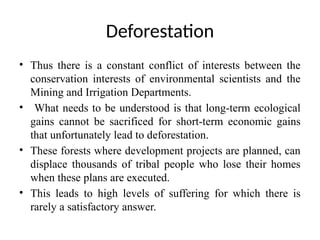
• Thus there is a constant conflict of interests between the
conservation interests of environmental scientists and the
Mining and Irrigation Departments.
• What needs to be understood is that long-term ecological
gains cannot be sacrificed for short-term economic gains
that unfortunately lead to deforestation.
• These forests where development projects are planned, can
displace thousands of tribal people who lose their homes
when these plans are executed.
• This leads to high levels of suffering for which there is
rarely a satisfactory answer.
Joint Forest Management(JFM)
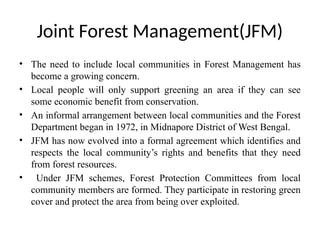
• The need to include local communities in Forest Management has
become a growing concern.
• Local people will only support greening an area if they can see
some economic benefit from conservation.
• An informal arrangement between local communities and the Forest
Department began in 1972, in Midnapore District of West Bengal.
• JFM has now evolved into a formal agreement which identifies and
respects the local community’s rights and benefits that they need
from forest resources.
• Under JFM schemes, Forest Protection Committees from local
community members are formed. They participate in restoring green
cover and protect the area from being over exploited.
Joint Forest Management(JFM)
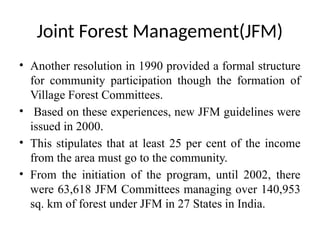
• Another resolution in 1990 provided a formal structure
for community participation though the formation of
Village Forest Committees.
• Based on these experiences, new JFM guidelines were
issued in 2000.
• This stipulates that at least 25 per cent of the income
from the area must go to the community.
• From the initiation of the program, until 2002, there
were 63,618 JFM Committees managing over 140,953
sq. km of forest under JFM in 27 States in India.
Forests in India
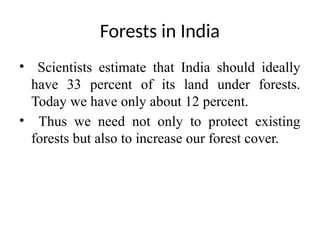
• Scientists estimate that India should ideally
have 33 percent of its land under forests.
Today we have only about 12 percent.
• Thus we need not only to protect existing
forests but also to increase our forest cover.

1. Environmental Science Introduction.pptx

  • 1.
    Environmental Science (MCI-101) Dr.Harmeet Singh Professor , M&PE Department GNDEC, Ludhiana
  • 2.
    Course Outcomes Course Outcomes(CO) Students will be able to 1. Identify environmental variables and interpret results. 2. Evaluate local, regional and global environmental topics related to resource use and management. 3. Interpret the results of scientific studies of environmental problems. 4. Propose solutions to environmental problems related to resource use and management. 5. Infer threats to global biodiversity, their implications and potential solutions. 6. Adapt sustainability as practice in life, society and industry.
  • 3.
    Detailed Contents Part-A • NaturalResources: 3 hours Renewable and non-renewable resources: Natural resources and associated problems: Forest resources: Use and over-exploitation, deforestation, case studies, Timber extraction, mining, dams and their effects on forests and tribal people, • Water resources: 5 hours Use and over-utilization of surface and ground water, floods, drought, conflicts over water, dam’s benefits and problems, Food Resources: World food problems, changes caused by agriculture and over grazing, effects of modern agriculture, fertilizers- pesticides problems, water logging, salinity, case studies, Energy Resources: Growing energy needs, renewable and non-renewable energy sources, use of alternate energy sources, case studies, Land Resources: Land as a resource, land degradation, man induces landslides, soil erosion, and desertification. • Eco Systems: 4 hours Concept of an ecosystem, Structure and function of an ecosystem, Producers, consumers, decomposers, Energy flow in the ecosystems, Ecological succession, Food chains, food webs and ecological pyramids, Introduction, types, characteristic features, structure and function of the following ecosystems: Forest ecosystem, Grass land ecosystem, Desert ecosystem, Aquatic ecosystems (ponds, streams, lakes, rivers, oceans, estuaries).
  • 4.
    Detailed Contents Part- B •Biodiversity and Conservation: 4 hours Introduction-Definition: genetics, species and ecosystem diversity, Biogeographically classification of India, Value of biodiversity: consumptive use, productive use, social, ethical, aesthetic and option values, Biodiversity at global, national and local level, India as a mega diversity nation, Hot-spots of biodiversity, Threats to biodiversity: habitats loss, poaching of wild 34 life, man wildlife conflicts, Endangered and endemic spaces of India, Conservation of biodiversity: in-situ and ex-situ conservation of biodiversity. • Environmental Pollution: 3 hours Definition, causes, effects and control measures of: Air pollution, Water pollution, Soil pollution, Marine pollution, Noise pollution, Thermal pollution, nuclear hazards. Causes, effects and control measures of urban and industrial wastes, Role of an individual in prevention of pollution, Pollution case studies. • Social issues and the Environment: 4 hours Form unsustainable to sustainable development, Water conservation, rain water harvesting, water shed management, Resettlement and rehabilitation of people; its problems and concerns, case studies, Environmental ethics: issues and possible solutions, Climate change, global warming, acid rain, ozone layer depletion, nuclear accidents and holocaust, case studies, Environment protection Act, Air (prevention and control of pollution) Act, Water (prevention and control of pollution) Act, Wildlife protection act, Forest conservation act • Human population and the environment: 3 hours Population growth and variation among nations, Population explosion- family welfare program, Environment and human health, Human rights, Value education, HIV / AIDS, Women and child welfare
  • 5.
    Books Text Books: 1. Textbookof Environmental studies, Erach Bharucha, UGC 2. Fundamental concepts in Environmental Studies, D D Mishra, S Chand & Co Ltd 3. Essentials of Environment Science by Joseph. 4. Perspectives in Environmental Studies by Kaushik, A. Reference Books: 1. Environment Biology by Agarwal, K. C., Nidi Publ. Ltd. Bikaner. 2. Principle of Environment Science by Cunninghan, W.P. 3. Elements of Environment Science & Engineering by Meenakshi. 4. Elements of Environment Engineering by Duggal.
  • 6.
    Environment • Environmental studiesdeals with every issue that affects an organism (an individual animal, plant, or single-celled life form). • The word ‘Environment’ is derived from the French word ‘Environner’which means to encircle, around or surround. • Environment is the sum total of land, water, air, interrelationships among themselves and also with the human beings and other living organisms. • It is essentially a multidisciplinary approach that brings about an appreciation of our natural world and human impacts on its integrity. • It is an applied science as its seeks practical answers to making human civilization sustainable on the earth’s finite resources. • Its components include biology, geology, chemistry, physics, engineering, sociology, health, anthropology (study of humanity), economics, statistics, computers and philosophy.
  • 7.
  • 8.
    Environmental Science • Asgiven by Environment Protection Act 1986, Environment is the sum total of land, water, air, interrelationships among themselves and also with the human beings and other living organisms. • Environmental Science deals with the study of processes in soil, water, air and organisms which lead to pollution or environmental damages and the scientific basis for the establishment of a standard which can be considered acceptably clean, safe and healthy for human beings and natural ecosystems. • The Environment is about the surrounding external conditions influencing development or growth of people, animal or plants; living or working conditions etc.
  • 9.
    DEFINITIONS OF ENVIRONMENT 1.According to Boring, ‘A person’s environment consists of the sum total of the stimulation (activities) which he receives from his conception until his death.’ Indicating that environment comprises various types of forces such as physical, intellectual, mental, economical, political, cultural, social, moral and emotional. 2. Douglas and Holland defined that ‘The term environment is used to describe, in aggregate, all the external forces, influences and conditions, which affect the life, nature, behaviour and the growth, development and maturity of living organisms’.
  • 10.
    Environment • Environment isnot a single subject. It is an integration of several subjects that include both Science and Social Studies. • To understand all the different aspects of our environment we need to understand biology, chemistry, physics, geography, resource management, economics and population issues. • Thus the scope of environmental studies is extremely wide and covers some aspects of nearly every major discipline.
  • 11.
    ENVIRONMENT STUDIES: IMPORTANCE •Environment Issues are being of Global: global warming and ozone depletion, acid rain, marine pollution and biodiversity • Development and Environment: ignorance of the environmental impact • Explosive Increase in Pollution • Need for an Alternative Solution • Need for Wise Planning of Development
  • 12.
    Natural Resources • Ourenvironment provides us with a variety of goods and services necessary for our day to day lives. • These natural resources include, air, water, soil, minerals, along with the climate and solar energy, which form the non-living or ‘abiotic’ part of nature. The ‘biotic’ or living parts of nature consists of plants and animals, including microbes. • Plants and animals can only survive as communities of different organisms, all closely linked to each in their own habitat, and requiring specific abiotic conditions.
  • 13.
    SCOPE OF ENVIRONMENT •Atmosphere: protective thick layer of gases around the earth • Hydrosphere: all types of water resources • Lithosphere: outer mantle of the solid earth • Biosphere: living organisms and their interactions with environment
  • 14.
    Scope- Importance • Conservationof natural resources • Ecological aspects • Pollution of the surrounding natural resources • Controlling the pollution • Social issues connected to it • Impacts of human population on the environment
  • 15.
    Earth’s Resources:Atmosphere • Atmosphereis a protective layer of gases that shelters all life on Earth, keeping temperatures within a relatively small range and blocking out harmful rays of sunlight. • The atmosphere forms a protective shell over the earth. • The lowest layer, the troposphere, the only part warm enough for us to survive in, is only 12 kilometers thick. • The stratosphere is 50 kilometers thick and contains a layer of sulphates and is an atmospheric layer composed of stratified temperature layers, with the warm layers of air high in the sky and the cool layers of air in the low sky, close to the planetary surface of the Earth. It also contains a layer of ozone, which absorbs ultra-violet light known to cause cancer and without which, no life could exist on earth.
  • 17.
    Atmosphere • Oxygen forhuman respiration (metabolic requirements). • Oxygen for wild fauna in natural ecosystems and domestic animals used by man as food. • Oxygen as a part of carbon dioxide, used for the growth of plants (in turn are used by man).
  • 18.
    Hydrosphere • Hydrosphere isthe combined mass of water on, under, and above the surface of the earth. • The hydrosphere covers three quarters of the earth’s surface. • A major part of the hydrosphere is the marine ecosystem in the ocean, while only a small part occurs in fresh water. • Fresh water in rivers, lakes and glaciers, is perpetually being renewed by a process of evaporation and rainfall. • Some of this fresh water lies in underground aquifers. • Human activities such as deforestation create serious changes in the hydrosphere. Once land is denuded of vegetation, the rain erodes the soil which is washed into the sea.
  • 19.
  • 20.
    Hydrosphere • Clean waterfor drinking (a metabolic requirement for living processes). • Water for washing and cooking. • Water used in agriculture and industry. • Food resources from the sea, including fish, crustacean (shrimps, prawns, crabs, lobsters and crayfish), sea weed, etc. • Food from fresh water sources, including fish, crustacean and aquatic plants. • Water flowing down from mountain ranges harnessed to generate electricity in hydroelectric projects.
  • 21.
    Lithosphere • The outermostlayer of the Earth that consists of the crust and the uppermost mantle. • The lithosphere began as a hot ball of matter which formed the earth about 4.6 billion years ago. • About 3.2 billion years ago, the earth cooled down considerably and a very special event took place - life began on our planet. • The crust of the earth is 6 or 7 kilometers thick and lies under the continents. • Of the 92 elements in the lithosphere only eight are common constituents of crustal rocks. Of these constituents, 47% is oxygen, 28% is silicon, 8% is aluminium, 5% is iron, while sodium, magnesium, potassium and calcium constitute 4% each.
  • 22.
  • 23.
    Lithosphere • Soil, thebasis for agriculture to provide us with food. • Stone, sand and gravel, used for construction. • Micronutrients in soil, essential for plant growth. • Microscopic flora, small soil fauna and fungi in soil, important living organisms of the lithosphere, which break down plant litter as well as animal wastes to provide nutrients for plants. • A large number of minerals on which our industries are based. • Oil, coal and gas, extracted from underground sources. It provides power for vehicles, agricultural machinery, industry, and for our homes.
  • 24.
    Biosphere • The biosphereis the region of the Earth where life exists, including the soil, water, and air. • This is the relatively thin layer on the earth in which life can exist. • Within it the air, water, rocks and soil and the living creatures, form structural and functional ecological units, which together can be considered as one giant global living system, that of our Earth itself. • Within this framework, those characterized by broadly similar geography and climate, as well as communities of plant and animal life can be divided for convenience into different biogeographically realms (Kingdom).
  • 25.
  • 26.
    Biosphere • Food, fromcrops and domestic animals, providing human metabolic requirements. • Food, for all forms of life which live as interdependent species in a community and form food chains in nature on which man is dependent. • Energy needs: Biomass fuel wood collected from forests and plantations, along with other forms of organic matter, used as a source of energy. • Timber and other construction materials.
  • 27.
    RENEWABLE AND NON-RENEWABLE RESOURCES •Renewable resources are natural resources that can be replenished naturally over time and are not depleted when used. • Some examples of renewable resources include sunlight, water, wind, and trees. • We can use these resources to generate power, heat our homes, and provide us with food and building supplies. • One of the most significant benefits of renewable resources is their sustainability, as they can be used repeatedly without running out. • Additionally, renewable resources don’t produce pollution, making them a cleaner alternative to non-renewable resources.
  • 28.
    Renewable energy resources •However, renewable resources do have their challenges. If we don’t manage some renewable resources, like trees and fish, carefully, they may become overused. Additionally, renewable energy sources like wind and solar power aren’t always reliable, making them difficult to rely on as the only source of energy.
  • 29.
    Non-Renewable Natural Resources •Non-renewable resources are natural resources that cannot be replenished in a short amount of time and are finite. • Examples of non-renewable resources include metals, rocks, minerals, and fossil fuels. • We use these resources to generate electricity and power our vehicles, but they pollute the air and cause environmental problems. • Non-renewable resources are limited, and their availability will eventually run out. As they become scarce, they will also become more expensive, making them difficult for people to access.
  • 30.
    RENEWABLE AND NON-RENEWABLE RESOURCES •Ecosystems act as resource producers and processors. • Solar energy is the main driving force of ecological systems, providing energy for the growth of plants in forests, grasslands and aquatic ecosystems. • A forest recycles its plant material slowly by continuously returning its dead material, leaves, branches, etc. to the soil. • Grasslands recycle material much faster than forests as the grass dries up after the rains are over every year. • All the aquatic ecosystems are also solar energy dependent and have cycles of growth when plant life spreads and aquatic animals breed. • The sun also drives the water cycle.
  • 31.
    Renewable Resources • Freshwater (even after being used) is evaporated by the sun’s energy, forms water vapour and is reformed in clouds by condensation and falls to earth as rain. • However, water sources can be overused or wasted to such an extent that they locally run dry. Water sources can be so heavily polluted by sewage and toxic substances that it becomes impossible to use the water. • Forests, once destroyed take thousands of years to re-grow into fully developed natural ecosystems with their full complement of species. Forests thus can be said to behave like non-renewable resources if overused.
  • 32.
    Renewable Resources • Thoughwater and biological living resources are considered renewable. • They are in fact renewable only within certain limits. • They are linked to natural cycles such as the water cycle.
  • 33.
    Renewable Resources • Fishare today being over-harvested until the catch has become a fraction of the original resource and the fish are incapable of breeding successfully to replenish the population. • The output of agricultural land if mismanaged drops drastically. • When the population of a species of plant or animal is reduced by human activities, until it cannot reproduce fast enough to maintain a viable number, the species becomes extinct.
  • 34.
    Forest Resources • Ourhomes, furniture and paper are made from wood from the forest. We use many medicines that are based on forest produce. And we depend on the oxygen that plants give out and the removal of carbon dioxide we breathe out from the air. • Forests once extended over large tracts of our country. People have used forests in our country for thousands of years. • As agriculture spread the forests were left in patches which were controlled mostly by tribal people. They hunted animals and gathered plants and lived entirely on forest resources.
  • 35.
    Forest Resources • Deforestationbecame a major concern in British times when a large amount of timber was extracted for building their ships. This led the British to develop scientific forestry in India. • They however alienated local people by creating Reserved and Protected Forests which curtailed access to the resources. This led to a loss of stake in the conservation of the forests which led to a gradual degradation and fragmentation of forests across the length and breadth of the country.
  • 36.
    Forest Functions • Watershedprotection: Reduce the rate of surface run-off of water. Prevent flash floods and soil erosion. Produces prolonged gradual run-off and thus prevent effects of drought. • Atmospheric regulation: Absorption of solar heat during evapo-transpiration. Maintaining carbon dioxide levels for plant growth. Maintaining the local climatic conditions. • Erosion control: Holding soil (by preventing rain from directly washing soil away). • Land bank: Maintenance of soil nutrients and structure
  • 37.
    Forest Functions • Localuse - Consumption of forest produce by local people who collect it for subsistence – (Consumptive use) Food - gathering plants, fishing, hunting from the forest. Fodder - for cattle. Fuel wood and charcoal- for cooking, heating. Poles/wood - building homes especially in rural and wilderness areas. Timber – household articles and construction. Fiber - weaving of baskets, ropes, nets, string, etc. Sericulture – for silk. Apiculture - bees for honey, forest bees also pollinate crops. Medicinal plants - traditionally used medicines, investigating them as potential source for new modern drugs.
  • 38.
    Forest Functions • Marketuse - (Productive use) Most of the products from the forests used for consumptive purposes are also sold as a source of income for supporting the livelihoods of forest dwelling people. Minor forest produce - (non-wood products): Fuel wood, fruit, gum, fiber, etc. which are collected and sold in local markets as a source of income for forest dwellers. Major timber extraction - construction, industrial uses, paper pulp, etc. Timber extraction is done in India by the Forest Department, but illegal logging continues in many of the forests of India and the world.
  • 39.
    Deforestation • One ofIndia’s serious environmental problems is forest degradation due to timber extraction and our dependence on fuel wood. • A large number of poor rural people are still highly dependent on wood to cook their meals and heat their homes. • We have not been able to plant enough trees to support the need for timber and fuel wood.
  • 40.
    Deforestation • Timber extraction,mining and dams are invariably parts of the needs of a developing country. • If timber is overharvested the ecological functions of the forest are lost. • Unfortunately forests are located in areas where there are rich mineral resources. • Forests also cover the steep embankments of river valleys, which are ideally suited to develop hydel and irrigation projects.
  • 41.
    Deforestation • Thus thereis a constant conflict of interests between the conservation interests of environmental scientists and the Mining and Irrigation Departments. • What needs to be understood is that long-term ecological gains cannot be sacrificed for short-term economic gains that unfortunately lead to deforestation. • These forests where development projects are planned, can displace thousands of tribal people who lose their homes when these plans are executed. • This leads to high levels of suffering for which there is rarely a satisfactory answer.
  • 42.
    Joint Forest Management(JFM) •The need to include local communities in Forest Management has become a growing concern. • Local people will only support greening an area if they can see some economic benefit from conservation. • An informal arrangement between local communities and the Forest Department began in 1972, in Midnapore District of West Bengal. • JFM has now evolved into a formal agreement which identifies and respects the local community’s rights and benefits that they need from forest resources. • Under JFM schemes, Forest Protection Committees from local community members are formed. They participate in restoring green cover and protect the area from being over exploited.
  • 43.
    Joint Forest Management(JFM) •Another resolution in 1990 provided a formal structure for community participation though the formation of Village Forest Committees. • Based on these experiences, new JFM guidelines were issued in 2000. • This stipulates that at least 25 per cent of the income from the area must go to the community. • From the initiation of the program, until 2002, there were 63,618 JFM Committees managing over 140,953 sq. km of forest under JFM in 27 States in India.
  • 44.
    Forests in India •Scientists estimate that India should ideally have 33 percent of its land under forests. Today we have only about 12 percent. • Thus we need not only to protect existing forests but also to increase our forest cover.