ENVIRONMENTAL STUDIES
UNIT-I
THE MULTIDISCIPLINARY
NATURE OF
ENVIRONMENTAL STUDIES
DEFINITION, SCOPE AND INPORTANCE
 Environment is the physical and biotic habitat
that surrounds us.
 Environmental literacy is the capability for a
contextual and detailed understanding of
environmental problem in order to enable
analysis, synthesis, evaluation and ultimately
sound and informed decision making at a
citizen’s level.
 ES deals with every issue that effects a living
organism.
 Its components include
biology,geology,chemistry,physics,engineering,s
ociology,health,anthropology,economics,statisti
cs,computers and philosophy.
SCOPE
 Study the natural history: a forest, a river, a
mountain, a desert or a combination of these
elements.
 Our dependence on nature:Protect earth’s
environmental resources.
 Respect for nature and all living creatures is
not new to India.
Application of technological innovations
 Growing more food by using fertilizers and
pesticides.
 Developing better strains of domestic animals
and crops
 Irrigating farmland through mega-dams and
developing industry.
 Non-renewable resources such as minerals and oil
are those which will be exhausted in the future if
we continue to extract these without a thought for
subsequent generations.
 Renewable resources such as timber and water can
be regenerated by natural processes such as
regrowth or rainfall.
 Natural resouces can be compared with money in a
bank. Sustainable development.
RESOURCE
 What is the value of the resource and where does it
originate?
 Who uses it most intensively and how?
 How is it being overused or misused?
 Who is responsible for its improper use-the resource
collector, the middle man, the end-user?
 How can we help to conserve it and prevent its
unsustainable use?
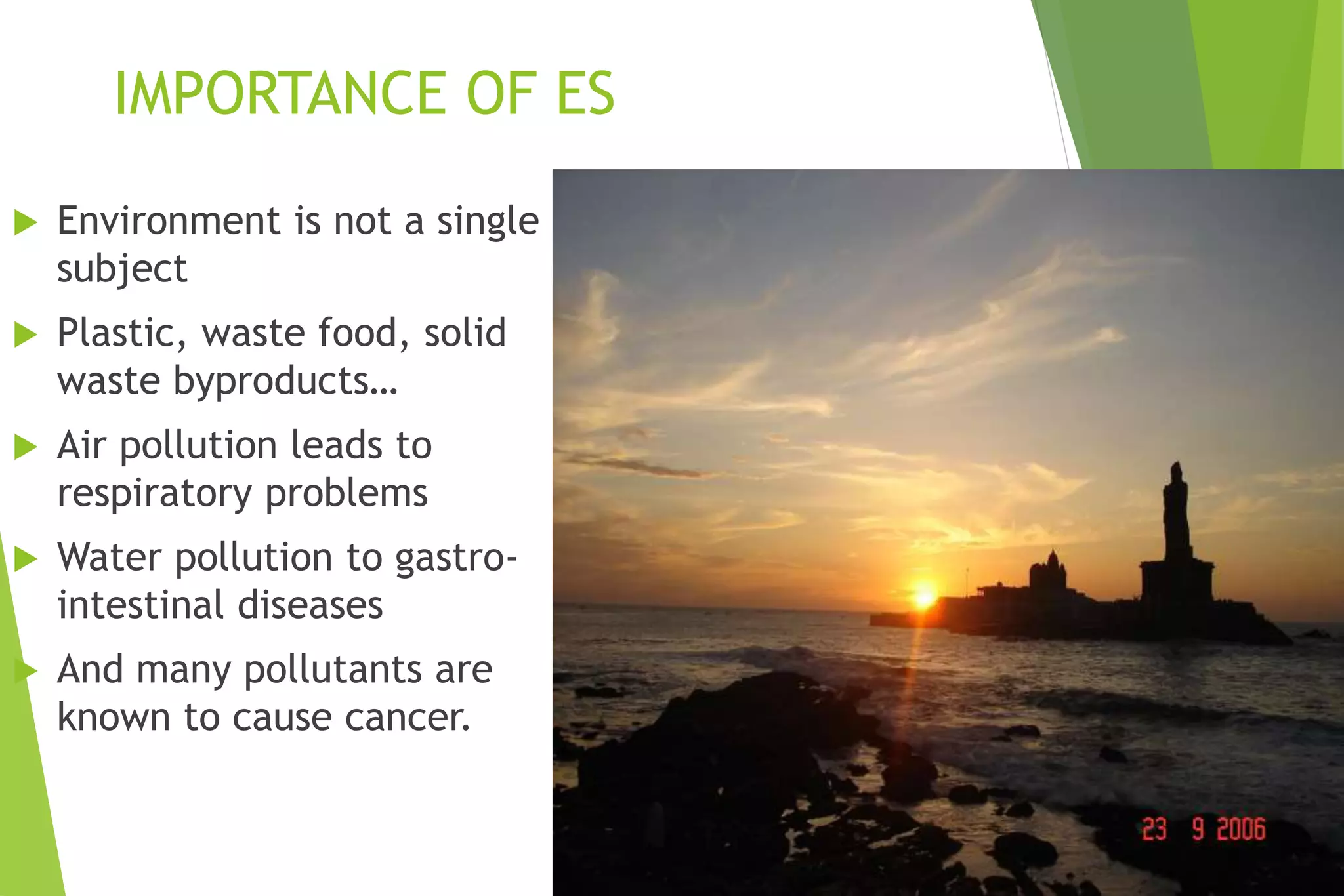
IMPORTANCE OF ES
 Environment is not a single
subject
 Plastic, waste food, solid
waste byproducts…
 Air pollution leads to
respiratory problems
 Water pollution to gastro-
intestinal diseases
 And many pollutants are
known to cause cancer.
Productive value of nature
 Advances in fields like Biotechnology.
 New medicines developed.
 Flowering plants and insects: Protect them
 Once a species is lost, man cannot bring it back.
 For crops to be successful, the flowers of fruit trees and
vegetables must be pollinated by insects, bats and birds.
Aesthetic/Recreational value of nature
 This is created by developing national parks and wildlife
sanctuaries in relatively undisturbed areas.
 In an urban setting, green spaces and gardens are vital to
the psychological and physical health of city dwellers.
The option value of nature
 Utilizing goods and services furnished by nature
vs. adverse impact on nature’s integrity.
 We can use its resources sustainable and reduce
our impact on the environment.
 Or destroy its integrity.
NEED FOR PUBLIC AWARENESS
 We feel that everything must be done by Govt.
 Everything is possible through public awareness.
 News papers, TV, Radio must take responsibility.
Suggested further activities for concerned students:
 Join a group to study nature such as WWF-I(World wide Fund for nature –India)
or BNHS(The Bombay Natural History Society)
 Begin reading news paper articles and periodicals like Down to earth, WWF-I
News letter,Sanctuary magazine etc.
 Join local movements : saving trees in ur area.
 RRR: Reduce, Reuse, Recycle.
 Visit a National Park or Sanctuary….
Institutions in Environment
 There are two type of institutions in
environment, they are
 Government Organizations
 Non-Government Organizations
Government Organizations
 The Government organizations are as follows,
 BSI (www.envfor.nic.in)
 ZSI (www.zsi.gov.in)
BSI-Botanical Survey of India
 Established in 1890 at the Royal Botanic
Gardens, Calcutta.
 In 1952, plans were made to recognize the BSI
and formulate its objectives.
 The BSI currently has nine regional centers.
ZSI-Zoological Survey of India
 Established in 1916.
 It’s mandate was to do a symmetric survey
of fauna in India.
 Its origins were collections based at the
Indian Museum at Calcutta, which was
established in 1875.
 It has done an enormous amount of work on
taxonomy and ecology.
 It currently operates from 16 regional
centers.
Non-Government Organizations
 The following are the NGO’s
 BNHS (www.bnhs.org)
 WWF-I (www.wwfindia.org)
 CSE (www.cseindia.org)
 CPR-EEC (www.cpreec.org)
 CEE (www.ceeindia.org)
 BVIEER (http://environment.bharatividyapeeth.edu)
 UKSN (www.usnpss.org)
 Kalpavriksh (www.kalpavriksh.org)
 SACON (www.sacon.org)
 WII (www.wii.gov.in)
 MCBT (www.madrascrocodilebank.org)
BNHS-Bombay Natural History
Society, Mumbai
 Begin as a small society of six members in
1883.
 Its influence is on wild life policy building,
research, popular publications.
 Publishes a popular magazine called
Hornbill and also an internationally well-
known journal on Natural History.
 Helped the government to frame wild life
related laws and taken up battles such as
‘save the silent valley campaign’.
WWF-I World Wide Fund for
Natural India, New Delhi
 Initiated in 1969 in Mumbai, after the head
quarters is shifted to New Delhi.
 Attention on wild life education and awareness.
 It runs several programs, including the Natural
Clubs of India program from school children.
CSE-Center for Science and
Environment, New Delhi
 The activities including organizing campaigns, holding
workshops and conferences, and producing environment
related publications.
 Publication material is in the form of books, posters,
video films and also conducts work shops and seminars on
bio-diversity related issues.
CPR-EEC CPR Environmental
Education Center, Chennai
 Setup in 1988.
 Conducts a variety of programs to spread
environmental awareness and create an
interest in conservation among the general
public.
 To promote conservation of nature and
natural resources.
 Its programs include components on wild
life an biodiversity issues.
 Produces large number of publications.
CEE-Center for Environmental
Education, Ahemadabad
 Initiated in 1989.
 Wide range of programs on the environment
and produces a variety of educational material.
 CEE’s Training in Environment Education
program has trained many environmental
educators.
BVIEER-Bharati Vidyapeet
Institute of Environmental
Education and Research, Pune
 Part of Bharati Vidyapeet deemed
university.
 The institute has a PhD, master’s and
Bachelor’s Program in Environmental
Sciences.
 It also offers an innovative diploma in
Environment education for in-service
teachers.
 Biodiversity conservation is a major focus of
its research initiatives.
UKSN-Uttarkhand Seva Nidhi,
Almora
 This organization is a Nodal agency that
supports NGOs in need of funds for their
environment related activities.
 Its main target is sustainable resource use at
the village level through training school
children.
 Its environment education program covers
about 500 schools
Kalpavriksh, Pune
 This NGO, initially Delhi based, is now working from
Pune.
 Works on a variety of fronts; education and awareness;
investigation and research; direct action and lobbying;
and litigation with regard to environment and
development issues.
 Responsible for developing India’s National Biodiversity
strategy and Action plan in 2003.
Salim Ali center for Ornithology
and Natural History (SACON),
Coimbatore
 Intially conceived as being a wing of the BNHS,
it later evolved into an independent
organization based at Coimbatore in 1990.
 It has instituted a variety of field programs that
have added to the country’s information on our
threatened biodiversity.
WII- Wildlife Institute of
India, Dehradun
 Established in 1982.
 This institute is established as a major training
for forest officials and for research in wild life
management.
 Its most significant publication has been
planning a Wild Life Protected Area Network for
India.
MCBT-Madras Crocodile Bank
Trust, Chennai
 The first Crocodile conservation breeding
center in Asia, was founded in 1976 to
conserve Indian Crocodiles an establish
program for the conservation an
propagation of other species.
 MCBT has an ongoing Environmental
Education Program for the villages and
schools that include nature camps,
training workshops for teachers.
People in Environment
 The following are the well-known names in the last
century include environmentalists, administrators,
legal experts, educationalists, and journalists.
 Indira Gandhi
 S.P.Gadgil
 M.S.Swaminathan
 Madhav Gadgil
 M.C.Mehta
 Anil Agarwal
 Medha Patkar
 Sunderlal Bahuguna
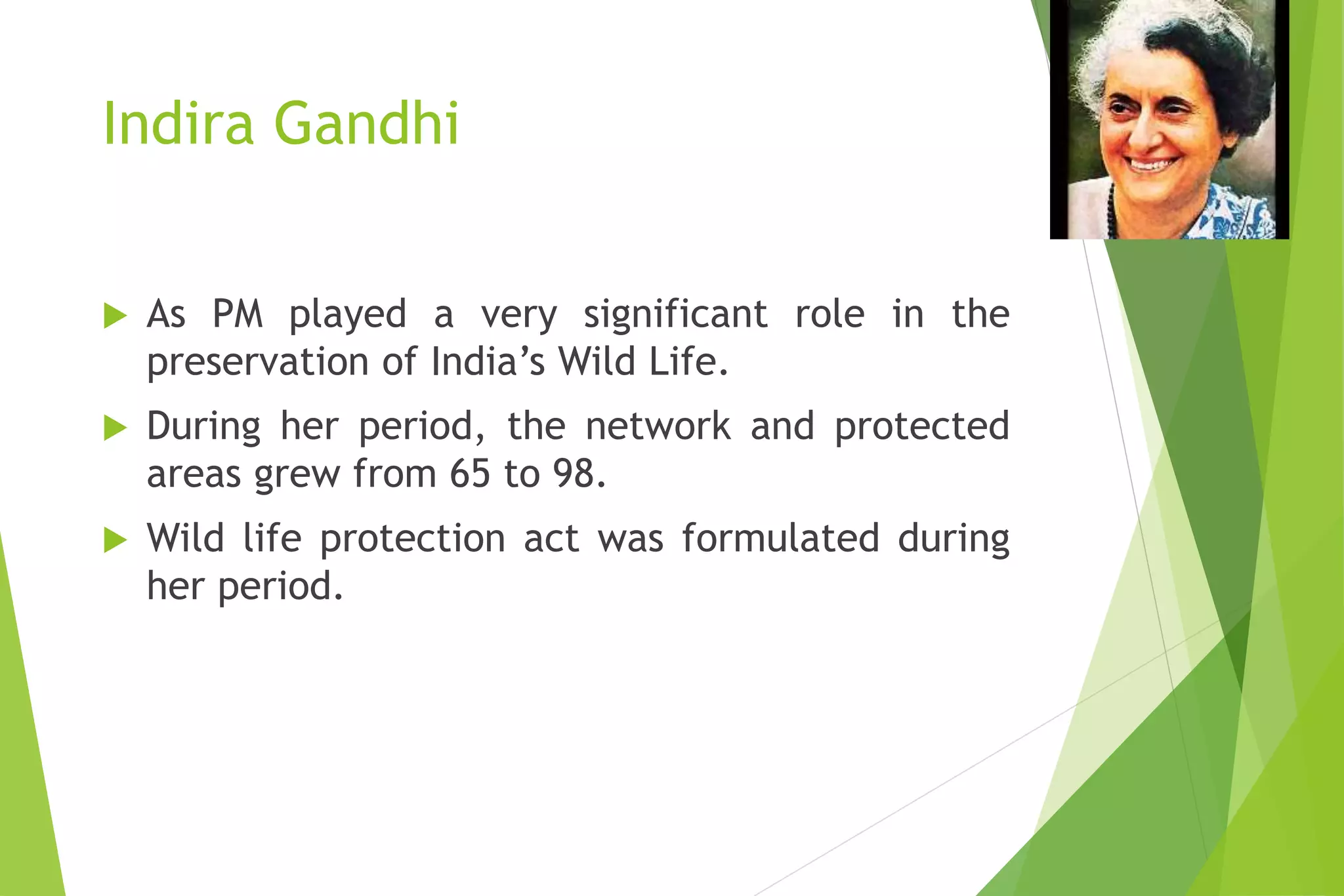
Indira Gandhi
 As PM played a very significant role in the
preservation of India’s Wild Life.
 During her period, the network and protected
areas grew from 65 to 98.
 Wild life protection act was formulated during
her period.
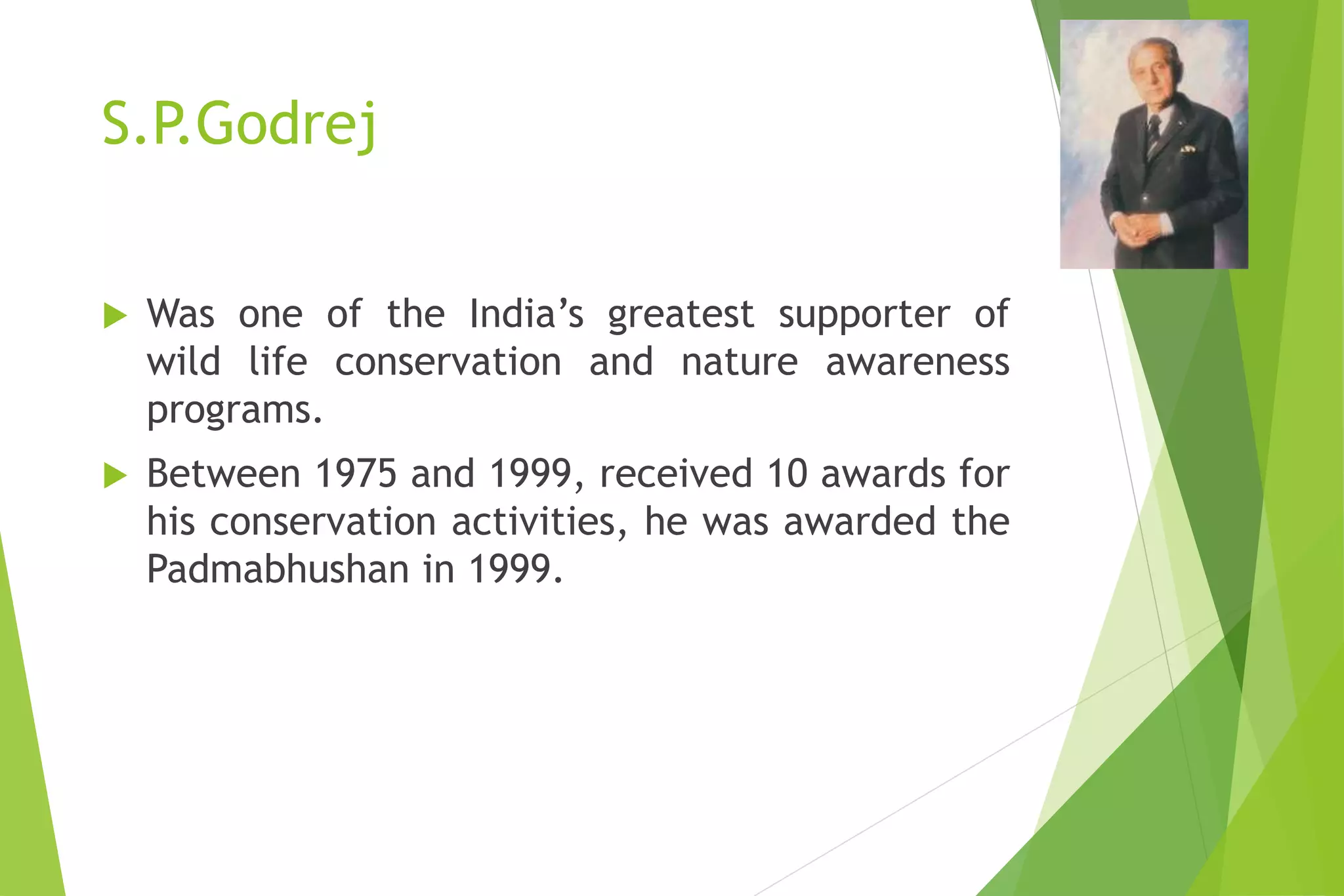
S.P.Godrej
 Was one of the India’s greatest supporter of
wild life conservation and nature awareness
programs.
 Between 1975 and 1999, received 10 awards for
his conservation activities, he was awarded the
Padmabhushan in 1999.
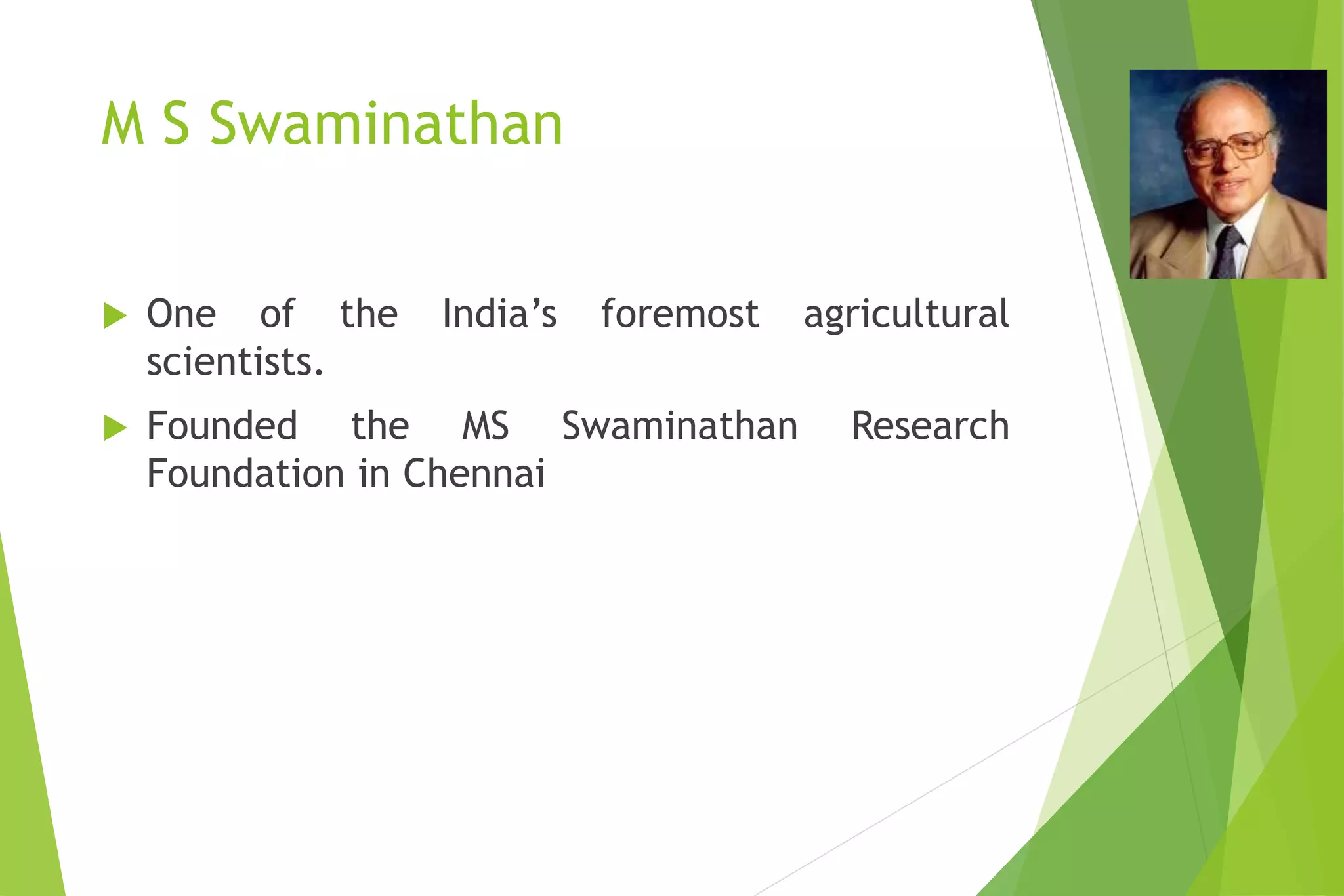
M S Swaminathan
 One of the India’s foremost agricultural
scientists.
 Founded the MS Swaminathan Research
Foundation in Chennai
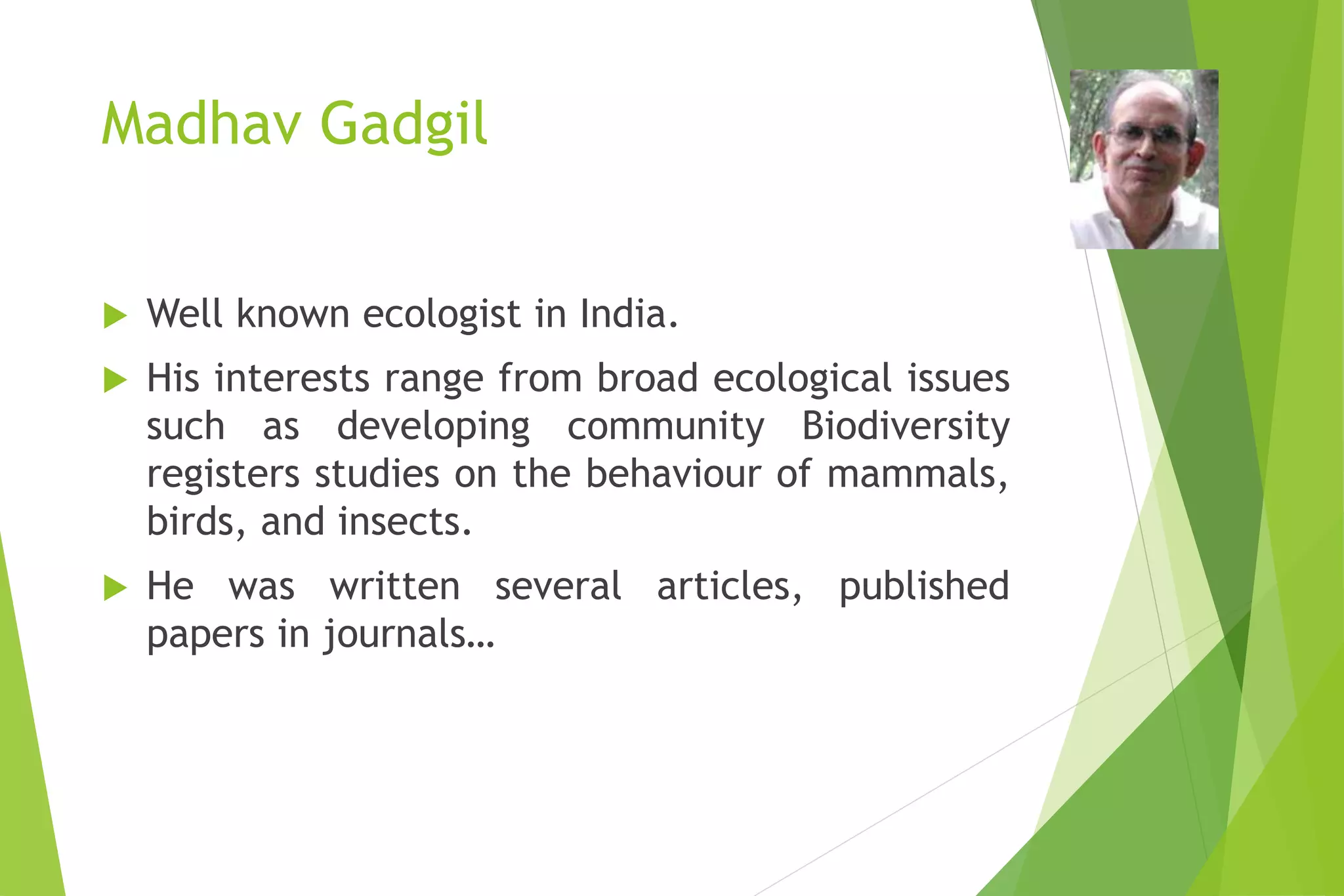
Madhav Gadgil
 Well known ecologist in India.
 His interests range from broad ecological issues
such as developing community Biodiversity
registers studies on the behaviour of mammals,
birds, and insects.
 He was written several articles, published
papers in journals…
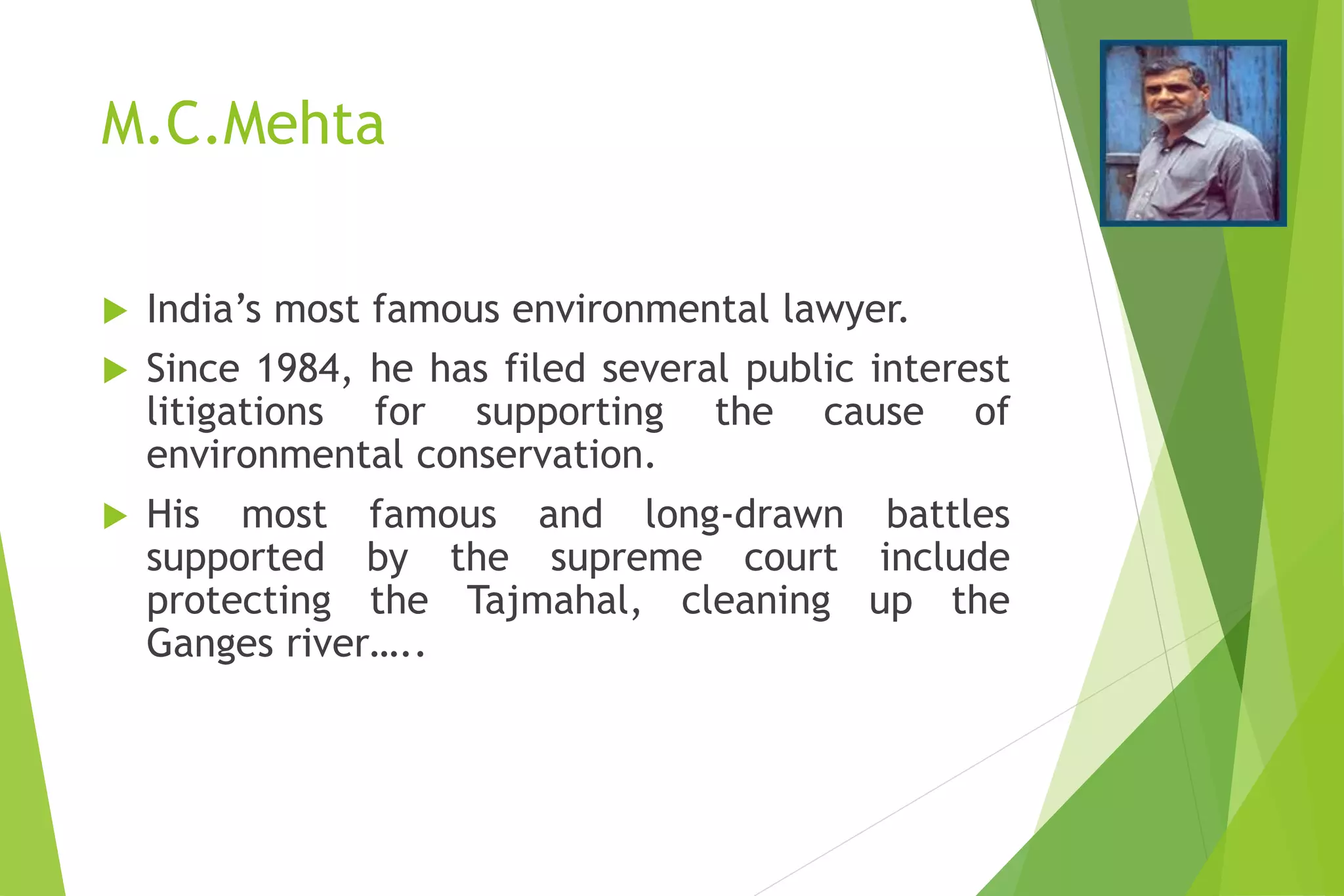
M.C.Mehta
 India’s most famous environmental lawyer.
 Since 1984, he has filed several public interest
litigations for supporting the cause of
environmental conservation.
 His most famous and long-drawn battles
supported by the supreme court include
protecting the Tajmahal, cleaning up the
Ganges river…..
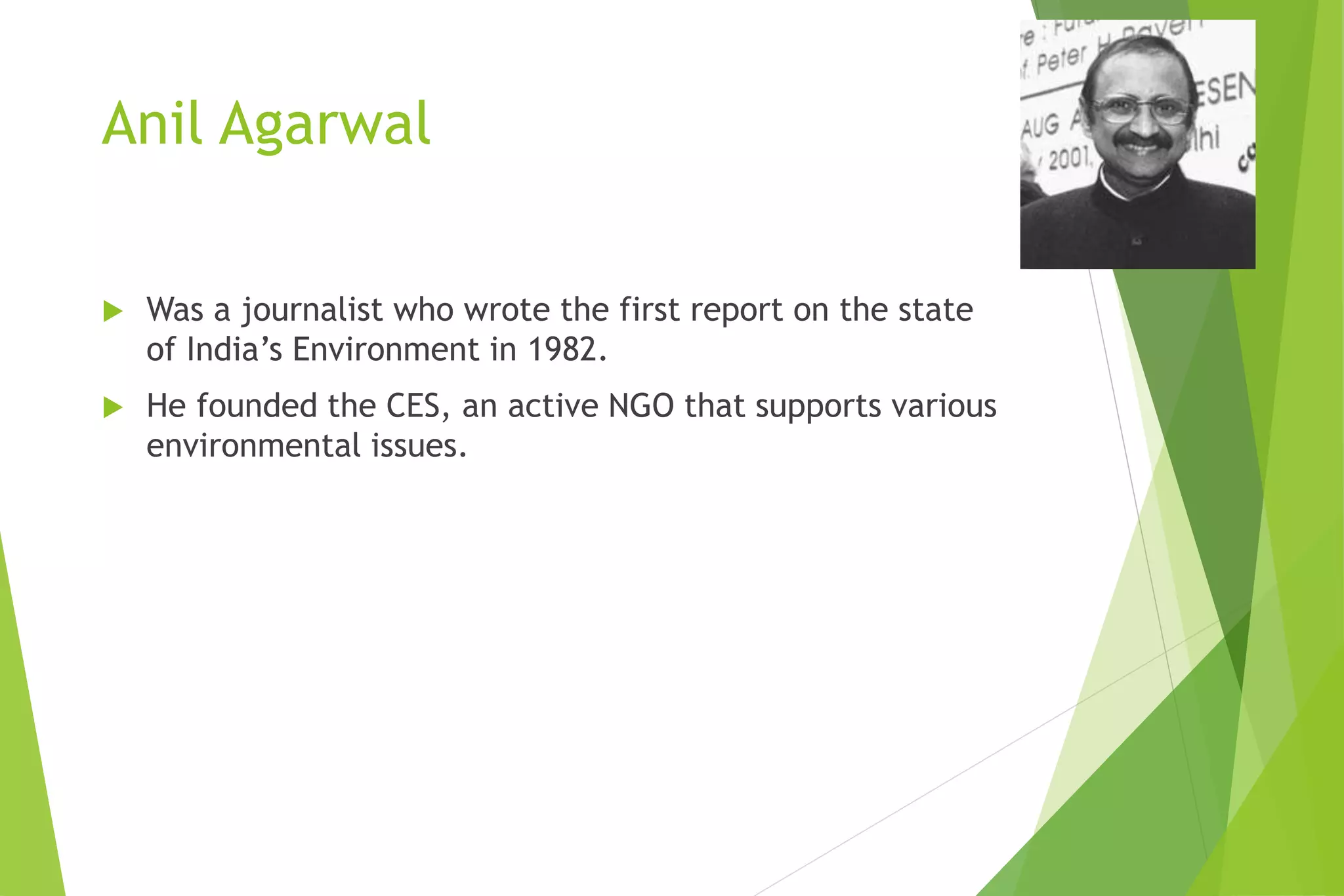
Anil Agarwal
 Was a journalist who wrote the first report on the state
of India’s Environment in 1982.
 He founded the CES, an active NGO that supports various
environmental issues.
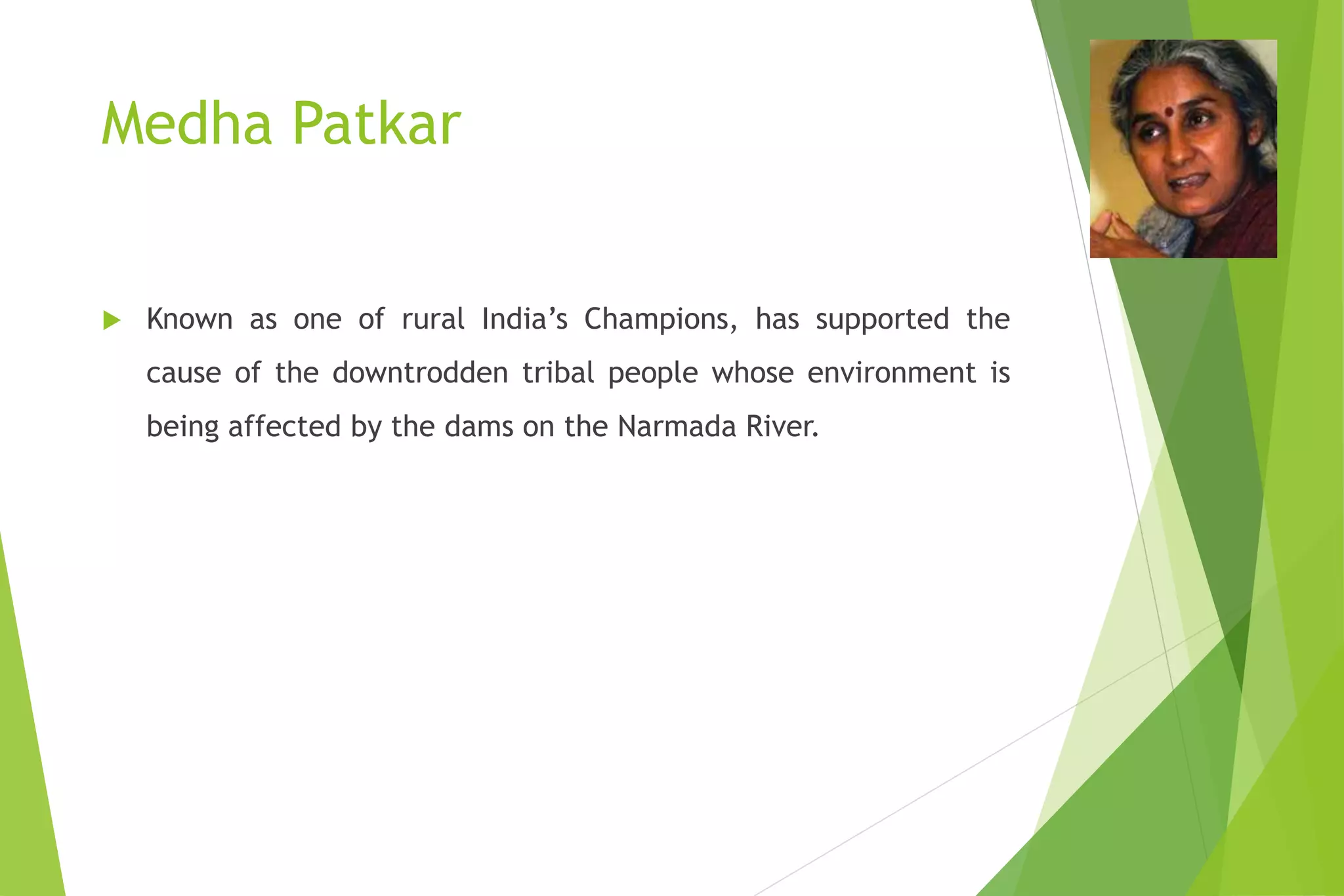
Medha Patkar
 Known as one of rural India’s Champions, has supported the
cause of the downtrodden tribal people whose environment is
being affected by the dams on the Narmada River.
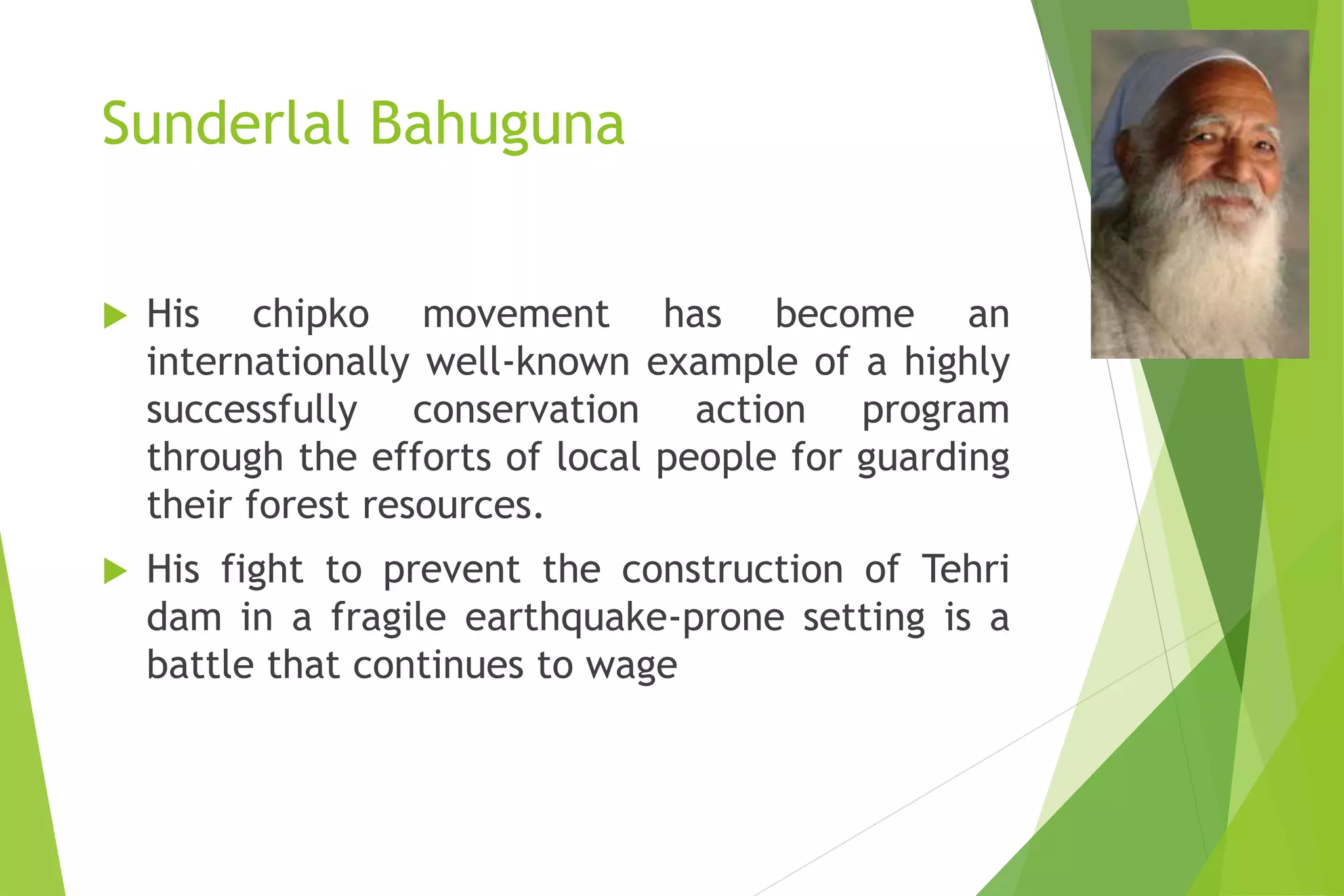
Sunderlal Bahuguna
 His chipko movement has become an
internationally well-known example of a highly
successfully conservation action program
through the efforts of local people for guarding
their forest resources.
 His fight to prevent the construction of Tehri
dam in a fragile earthquake-prone setting is a
battle that continues to wage
International Environmental
Thinkers
 Charles Darwin(wrote Origin of Species)
 Ralph Emerson (spoke of the dangers of commerce to our
environment in 1840s)
 Henry Thoreau (wrote that the wilderness should be
preserved in 1860s)
 John Muir (saved the great ancient sequoia trees in
California’s forests; he formed Sierra club in 1890s)
 Aldo Leopold (designed the early policies on wilderness
conservation and wildlife management in 1920s)
 Rachel Carson (wrote Silent Spring;several articles on
effects of pesticides on nature and mankind)
 EO Wilson (entomologist and wrote Diversity of Life in
1993)

Unit 1 introduction to environmental studies

  • 1.
  • 2.
    DEFINITION, SCOPE ANDINPORTANCE  Environment is the physical and biotic habitat that surrounds us.  Environmental literacy is the capability for a contextual and detailed understanding of environmental problem in order to enable analysis, synthesis, evaluation and ultimately sound and informed decision making at a citizen’s level.
  • 3.
     ES dealswith every issue that effects a living organism.  Its components include biology,geology,chemistry,physics,engineering,s ociology,health,anthropology,economics,statisti cs,computers and philosophy.
  • 4.
    SCOPE  Study thenatural history: a forest, a river, a mountain, a desert or a combination of these elements.  Our dependence on nature:Protect earth’s environmental resources.  Respect for nature and all living creatures is not new to India.
  • 5.
    Application of technologicalinnovations  Growing more food by using fertilizers and pesticides.  Developing better strains of domestic animals and crops  Irrigating farmland through mega-dams and developing industry.
  • 6.
     Non-renewable resourcessuch as minerals and oil are those which will be exhausted in the future if we continue to extract these without a thought for subsequent generations.  Renewable resources such as timber and water can be regenerated by natural processes such as regrowth or rainfall.  Natural resouces can be compared with money in a bank. Sustainable development.
  • 7.
    RESOURCE  What isthe value of the resource and where does it originate?  Who uses it most intensively and how?  How is it being overused or misused?  Who is responsible for its improper use-the resource collector, the middle man, the end-user?  How can we help to conserve it and prevent its unsustainable use?
  • 8.
    IMPORTANCE OF ES Environment is not a single subject  Plastic, waste food, solid waste byproducts…  Air pollution leads to respiratory problems  Water pollution to gastro- intestinal diseases  And many pollutants are known to cause cancer.
  • 9.
    Productive value ofnature  Advances in fields like Biotechnology.  New medicines developed.  Flowering plants and insects: Protect them  Once a species is lost, man cannot bring it back.  For crops to be successful, the flowers of fruit trees and vegetables must be pollinated by insects, bats and birds.
  • 10.
    Aesthetic/Recreational value ofnature  This is created by developing national parks and wildlife sanctuaries in relatively undisturbed areas.  In an urban setting, green spaces and gardens are vital to the psychological and physical health of city dwellers.
  • 11.
    The option valueof nature  Utilizing goods and services furnished by nature vs. adverse impact on nature’s integrity.  We can use its resources sustainable and reduce our impact on the environment.  Or destroy its integrity.
  • 12.
    NEED FOR PUBLICAWARENESS  We feel that everything must be done by Govt.  Everything is possible through public awareness.  News papers, TV, Radio must take responsibility.
  • 13.
    Suggested further activitiesfor concerned students:  Join a group to study nature such as WWF-I(World wide Fund for nature –India) or BNHS(The Bombay Natural History Society)  Begin reading news paper articles and periodicals like Down to earth, WWF-I News letter,Sanctuary magazine etc.  Join local movements : saving trees in ur area.  RRR: Reduce, Reuse, Recycle.  Visit a National Park or Sanctuary….
  • 14.
    Institutions in Environment There are two type of institutions in environment, they are  Government Organizations  Non-Government Organizations
  • 15.
    Government Organizations  TheGovernment organizations are as follows,  BSI (www.envfor.nic.in)  ZSI (www.zsi.gov.in)
  • 16.
    BSI-Botanical Survey ofIndia  Established in 1890 at the Royal Botanic Gardens, Calcutta.  In 1952, plans were made to recognize the BSI and formulate its objectives.  The BSI currently has nine regional centers.
  • 17.
    ZSI-Zoological Survey ofIndia  Established in 1916.  It’s mandate was to do a symmetric survey of fauna in India.  Its origins were collections based at the Indian Museum at Calcutta, which was established in 1875.  It has done an enormous amount of work on taxonomy and ecology.  It currently operates from 16 regional centers.
  • 18.
    Non-Government Organizations  Thefollowing are the NGO’s  BNHS (www.bnhs.org)  WWF-I (www.wwfindia.org)  CSE (www.cseindia.org)  CPR-EEC (www.cpreec.org)  CEE (www.ceeindia.org)  BVIEER (http://environment.bharatividyapeeth.edu)  UKSN (www.usnpss.org)  Kalpavriksh (www.kalpavriksh.org)  SACON (www.sacon.org)  WII (www.wii.gov.in)  MCBT (www.madrascrocodilebank.org)
  • 19.
    BNHS-Bombay Natural History Society,Mumbai  Begin as a small society of six members in 1883.  Its influence is on wild life policy building, research, popular publications.  Publishes a popular magazine called Hornbill and also an internationally well- known journal on Natural History.  Helped the government to frame wild life related laws and taken up battles such as ‘save the silent valley campaign’.
  • 20.
    WWF-I World WideFund for Natural India, New Delhi  Initiated in 1969 in Mumbai, after the head quarters is shifted to New Delhi.  Attention on wild life education and awareness.  It runs several programs, including the Natural Clubs of India program from school children.
  • 21.
    CSE-Center for Scienceand Environment, New Delhi  The activities including organizing campaigns, holding workshops and conferences, and producing environment related publications.  Publication material is in the form of books, posters, video films and also conducts work shops and seminars on bio-diversity related issues.
  • 22.
    CPR-EEC CPR Environmental EducationCenter, Chennai  Setup in 1988.  Conducts a variety of programs to spread environmental awareness and create an interest in conservation among the general public.  To promote conservation of nature and natural resources.  Its programs include components on wild life an biodiversity issues.  Produces large number of publications.
  • 23.
    CEE-Center for Environmental Education,Ahemadabad  Initiated in 1989.  Wide range of programs on the environment and produces a variety of educational material.  CEE’s Training in Environment Education program has trained many environmental educators.
  • 24.
    BVIEER-Bharati Vidyapeet Institute ofEnvironmental Education and Research, Pune  Part of Bharati Vidyapeet deemed university.  The institute has a PhD, master’s and Bachelor’s Program in Environmental Sciences.  It also offers an innovative diploma in Environment education for in-service teachers.  Biodiversity conservation is a major focus of its research initiatives.
  • 25.
    UKSN-Uttarkhand Seva Nidhi, Almora This organization is a Nodal agency that supports NGOs in need of funds for their environment related activities.  Its main target is sustainable resource use at the village level through training school children.  Its environment education program covers about 500 schools
  • 26.
    Kalpavriksh, Pune  ThisNGO, initially Delhi based, is now working from Pune.  Works on a variety of fronts; education and awareness; investigation and research; direct action and lobbying; and litigation with regard to environment and development issues.  Responsible for developing India’s National Biodiversity strategy and Action plan in 2003.
  • 27.
    Salim Ali centerfor Ornithology and Natural History (SACON), Coimbatore  Intially conceived as being a wing of the BNHS, it later evolved into an independent organization based at Coimbatore in 1990.  It has instituted a variety of field programs that have added to the country’s information on our threatened biodiversity.
  • 28.
    WII- Wildlife Instituteof India, Dehradun  Established in 1982.  This institute is established as a major training for forest officials and for research in wild life management.  Its most significant publication has been planning a Wild Life Protected Area Network for India.
  • 29.
    MCBT-Madras Crocodile Bank Trust,Chennai  The first Crocodile conservation breeding center in Asia, was founded in 1976 to conserve Indian Crocodiles an establish program for the conservation an propagation of other species.  MCBT has an ongoing Environmental Education Program for the villages and schools that include nature camps, training workshops for teachers.
  • 30.
    People in Environment The following are the well-known names in the last century include environmentalists, administrators, legal experts, educationalists, and journalists.  Indira Gandhi  S.P.Gadgil  M.S.Swaminathan  Madhav Gadgil  M.C.Mehta  Anil Agarwal  Medha Patkar  Sunderlal Bahuguna
  • 31.
    Indira Gandhi  AsPM played a very significant role in the preservation of India’s Wild Life.  During her period, the network and protected areas grew from 65 to 98.  Wild life protection act was formulated during her period.
  • 32.
    S.P.Godrej  Was oneof the India’s greatest supporter of wild life conservation and nature awareness programs.  Between 1975 and 1999, received 10 awards for his conservation activities, he was awarded the Padmabhushan in 1999.
  • 33.
    M S Swaminathan One of the India’s foremost agricultural scientists.  Founded the MS Swaminathan Research Foundation in Chennai
  • 34.
    Madhav Gadgil  Wellknown ecologist in India.  His interests range from broad ecological issues such as developing community Biodiversity registers studies on the behaviour of mammals, birds, and insects.  He was written several articles, published papers in journals…
  • 35.
    M.C.Mehta  India’s mostfamous environmental lawyer.  Since 1984, he has filed several public interest litigations for supporting the cause of environmental conservation.  His most famous and long-drawn battles supported by the supreme court include protecting the Tajmahal, cleaning up the Ganges river…..
  • 36.
    Anil Agarwal  Wasa journalist who wrote the first report on the state of India’s Environment in 1982.  He founded the CES, an active NGO that supports various environmental issues.
  • 37.
    Medha Patkar  Knownas one of rural India’s Champions, has supported the cause of the downtrodden tribal people whose environment is being affected by the dams on the Narmada River.
  • 38.
    Sunderlal Bahuguna  Hischipko movement has become an internationally well-known example of a highly successfully conservation action program through the efforts of local people for guarding their forest resources.  His fight to prevent the construction of Tehri dam in a fragile earthquake-prone setting is a battle that continues to wage
  • 39.
    International Environmental Thinkers  CharlesDarwin(wrote Origin of Species)  Ralph Emerson (spoke of the dangers of commerce to our environment in 1840s)  Henry Thoreau (wrote that the wilderness should be preserved in 1860s)  John Muir (saved the great ancient sequoia trees in California’s forests; he formed Sierra club in 1890s)  Aldo Leopold (designed the early policies on wilderness conservation and wildlife management in 1920s)  Rachel Carson (wrote Silent Spring;several articles on effects of pesticides on nature and mankind)  EO Wilson (entomologist and wrote Diversity of Life in 1993)

Editor's Notes