DEFIBRILLATOR
PRINCY FRANCIS M
IInd Yr MSc (N)
JMCON
DEFINITION
Defibrillation is a process in which an electronic device sends an electric
shock to the heart to stop an extremely rapid, irregular heartbeat, and restore
the normal heart rhythm.
Defibrillator is a device that deliver a therapeutic dose of electrical
energy to the affected heart to force the heart to produce more normal
cardiac rhythm.
DEFINITION
Cardioversion is a synchronized administration of shock
during the R waves or QRS complex of a cardiac cycle.
In defibrillation, electrode paddles are used to direct an
electric current through the patient’s heart, causes the
myocardium to depolarize, which in turn encourages the SA
node to resume control of the heart’s electrical activity.
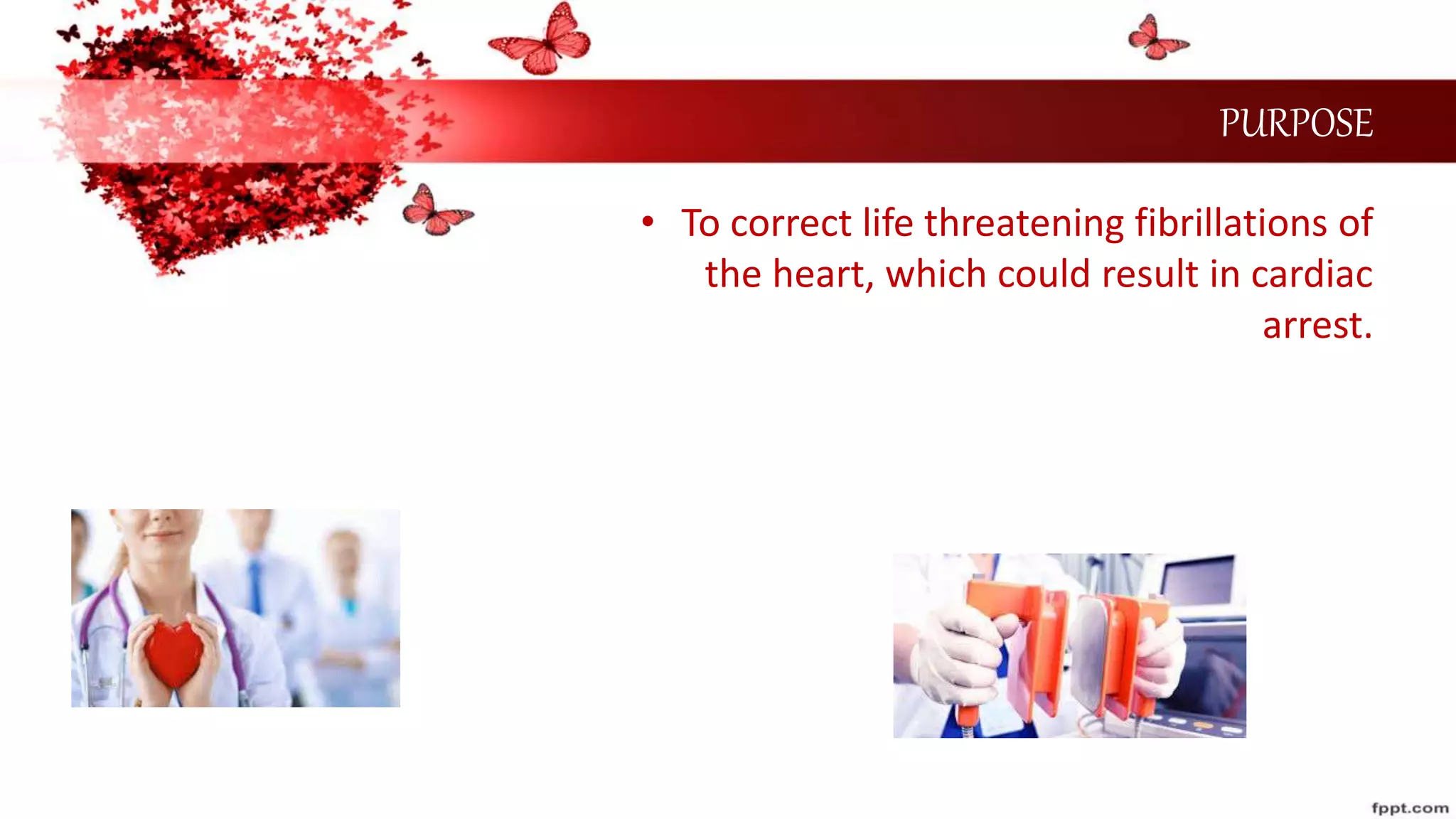
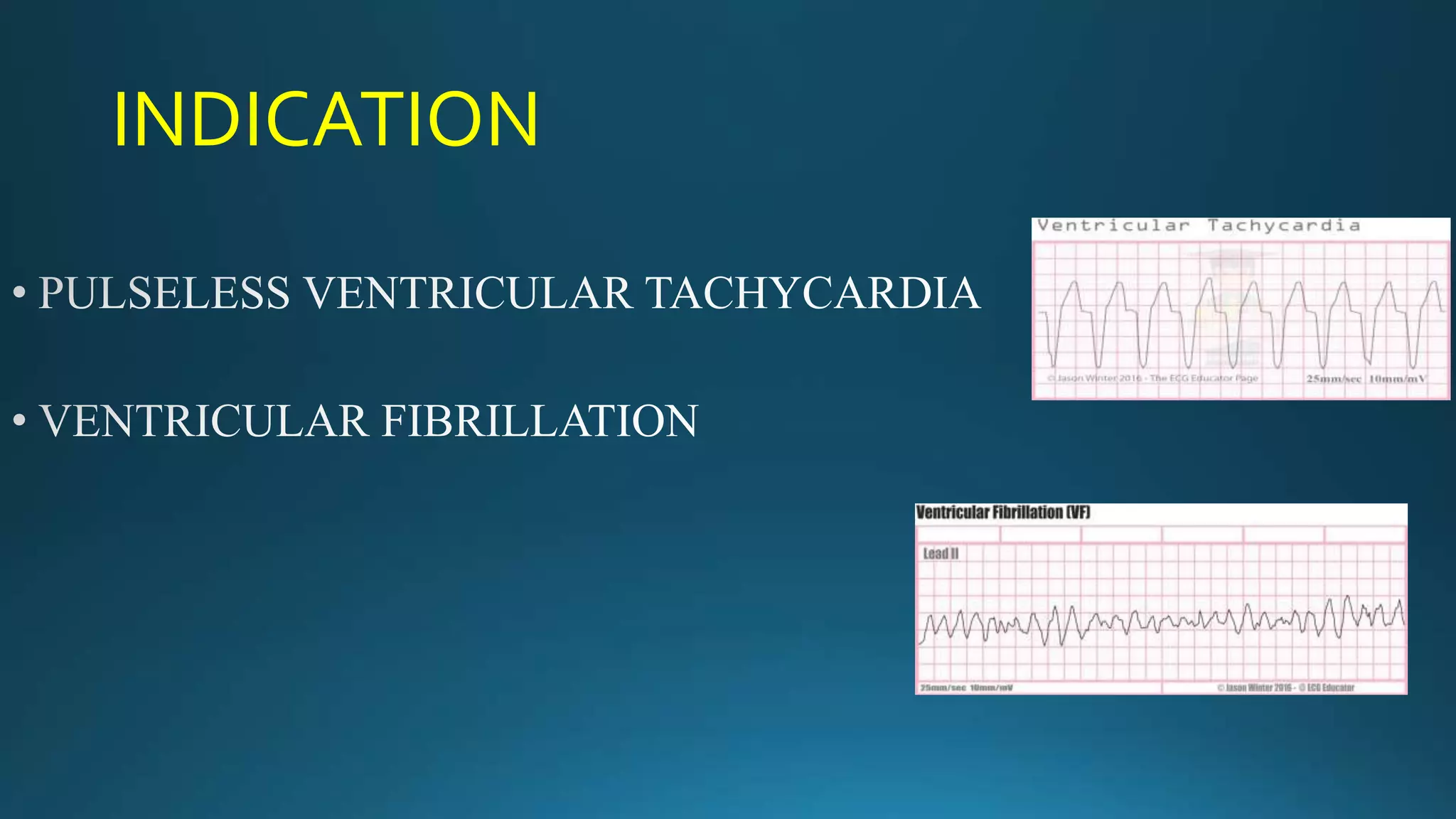
PURPOSE
• To correct life threatening fibrillations of
the heart, which could result in cardiac
arrest.
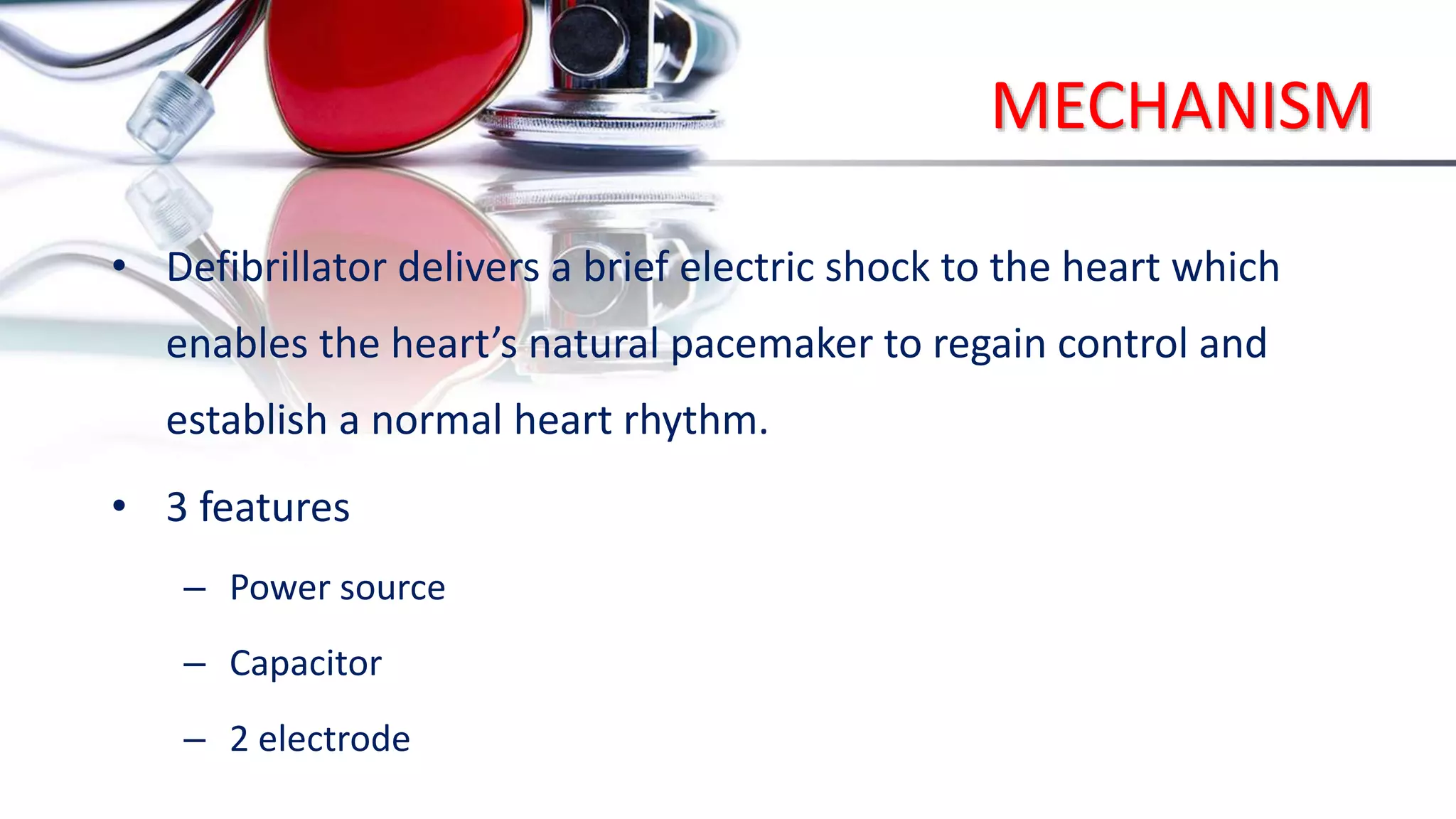
INDICATION
CONTRAINDICATION
• Patient who are conscious or have a pulse
• Non shockable rhythm – asystole, pulseless
electrical activity
• Multifocal atrial tachycardia
• Dysrhythmia due to enhanced automaticity
such as digitalis toxicity.
MECHANISM
• Defibrillator delivers a brief electric shock to the heart which
enables the heart’s natural pacemaker to regain control and
establish a normal heart rhythm.
• 3 features
– Power source
– Capacitor
– 2 electrode
FACTORS AFFECTING DEFIBRILLATION
 Transthoracic impendence
 Electrode to skin contact
 Electrode size
 Phase
 Body size
 Electrode position
•
•
•
DEFIBRILLATOR ELECTRODES
• Metal Disc 5 x 10 cm
Types
a. Spoon shaped electrode
b. Paddle type electrode
c. Pad type electrode
TYPEOF
DEFIBRILLATORS
 MANUAL EXTERNAL DEFIBRILLATOR
 MANUAL INTERNAL DEFIBRILLATOR
 AUTOMATED EXTERNAL DEFIBRILLATOR
 WEARABLE CARDIOVERTER
DEFIBRILLATOR
 IMPLANATBLE CARDIOVERTER-
DEFIBRILLATOR
MANUAL EXTERNAL DEFIBRILLATOR
 First diagnose the cardiac rhythm and then manually determine the
voltage and timing for the electrical shock
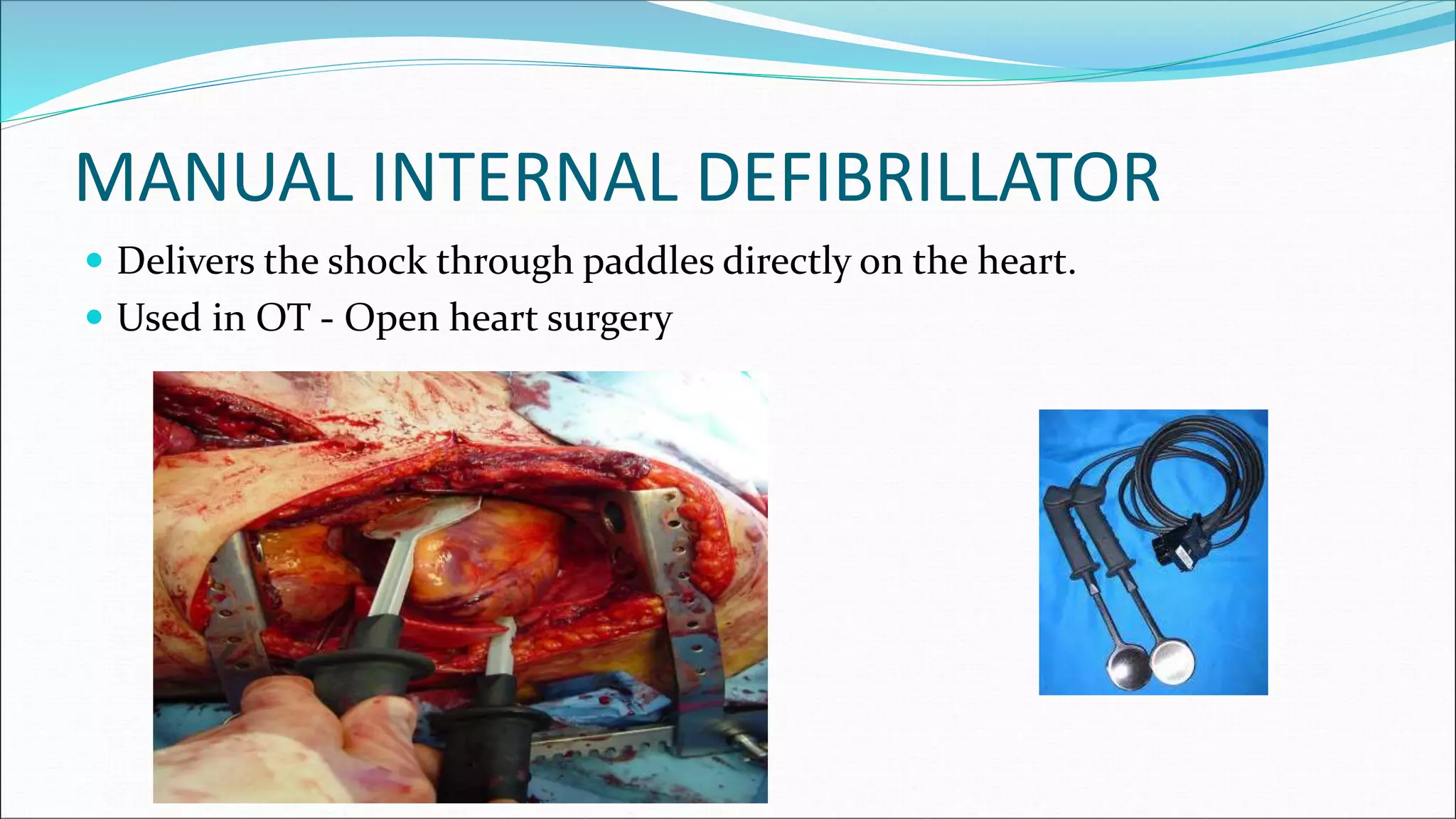
MANUAL INTERNAL DEFIBRILLATOR
 Delivers the shock through paddles directly on the heart.
 Used in OT - Open heart surgery
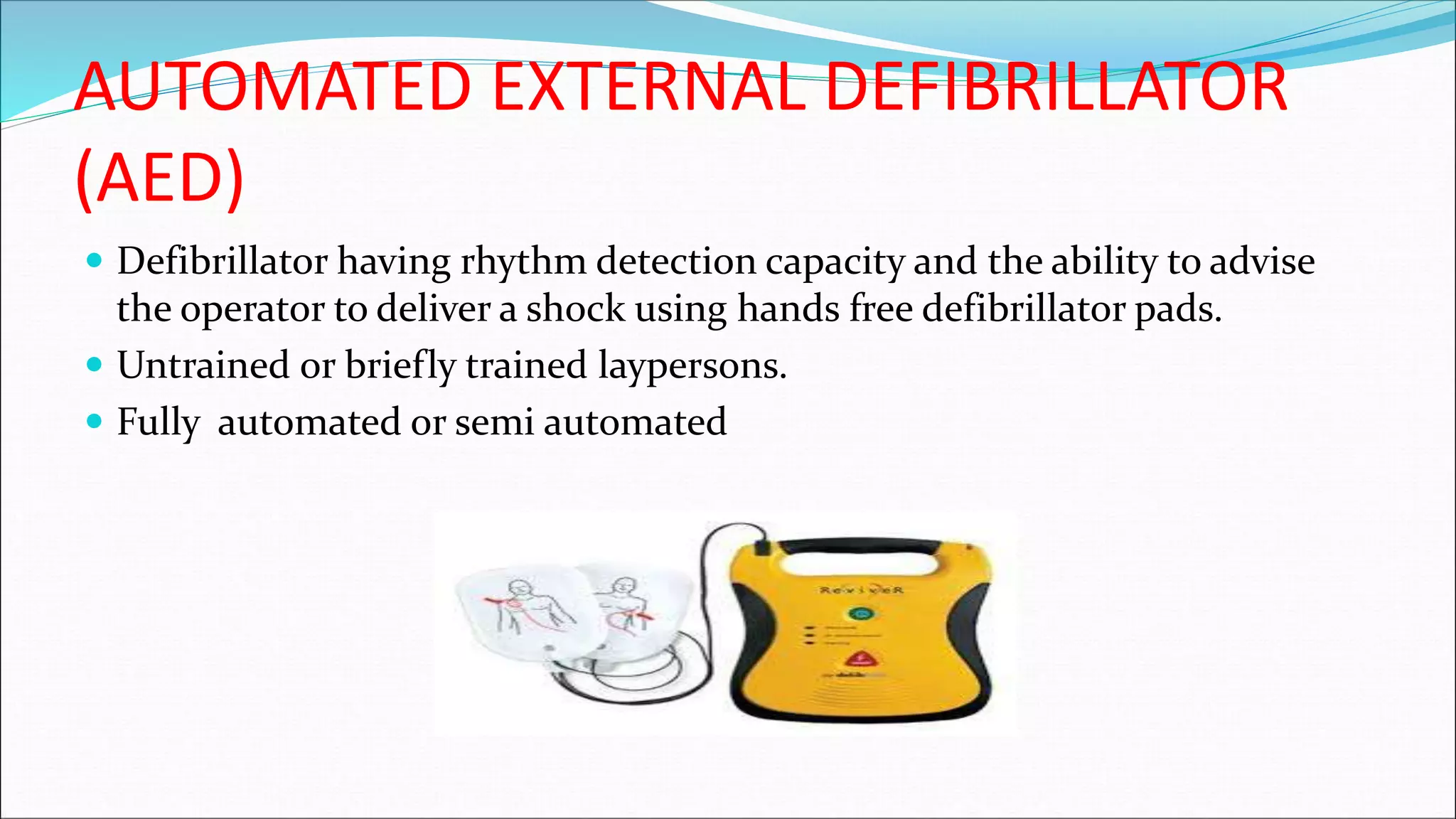
AUTOMATED EXTERNAL DEFIBRILLATOR
(AED)
 Defibrillator having rhythm detection capacity and the ability to advise
the operator to deliver a shock using hands free defibrillator pads.
 Untrained or briefly trained laypersons.
 Fully automated or semi automated
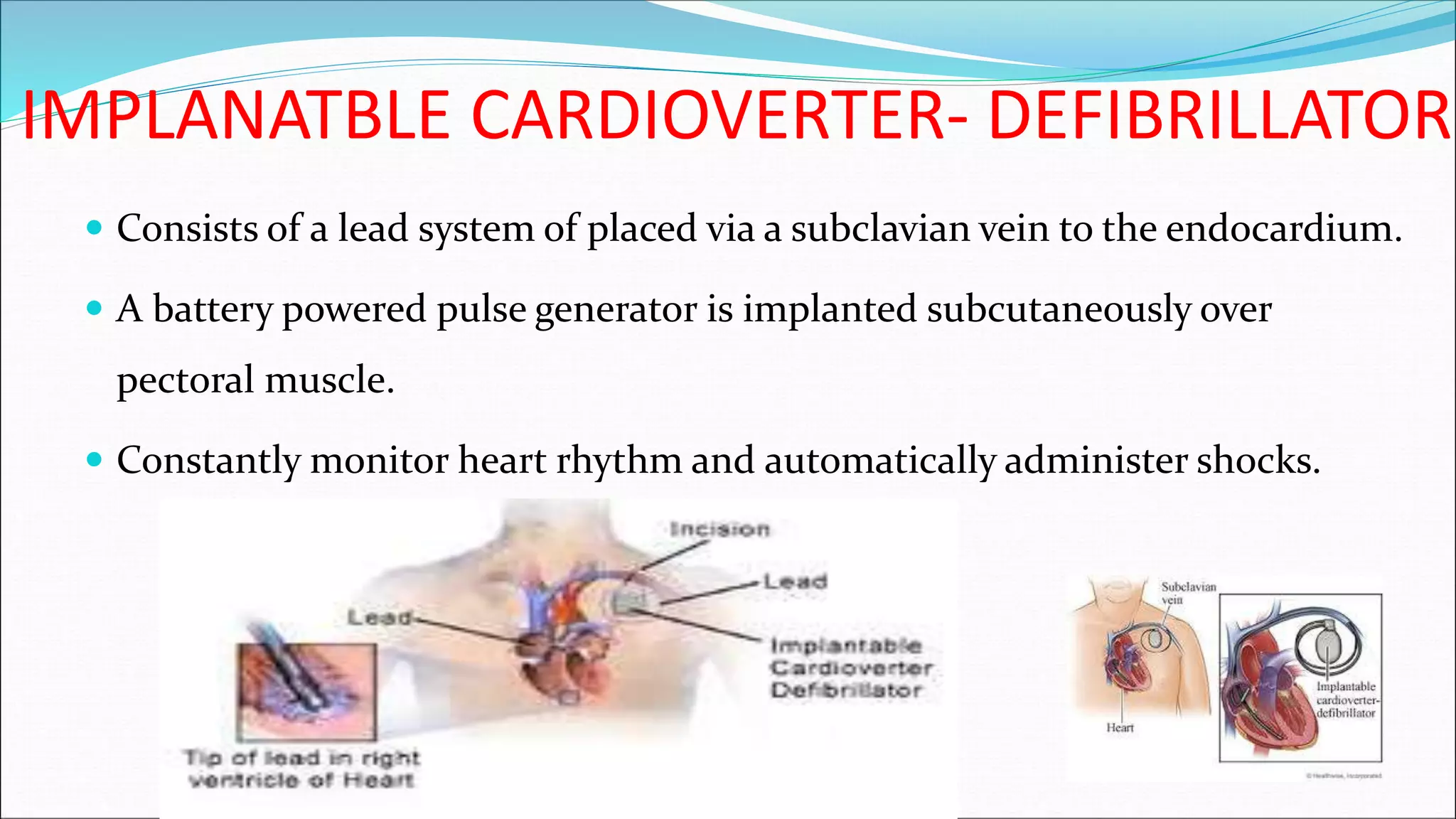
IMPLANATBLE CARDIOVERTER- DEFIBRILLATOR
 Consists of a lead system of placed via a subclavian vein to the endocardium.
 A battery powered pulse generator is implanted subcutaneously over
pectoral muscle.
 Constantly monitor heart rhythm and automatically administer shocks.
Wearable cardioverter defibrillator
 Portable external defibrillator that can worn by at risk patient.
 Monitor 24 hrs a day and can automatically deliver a biphasic shock.
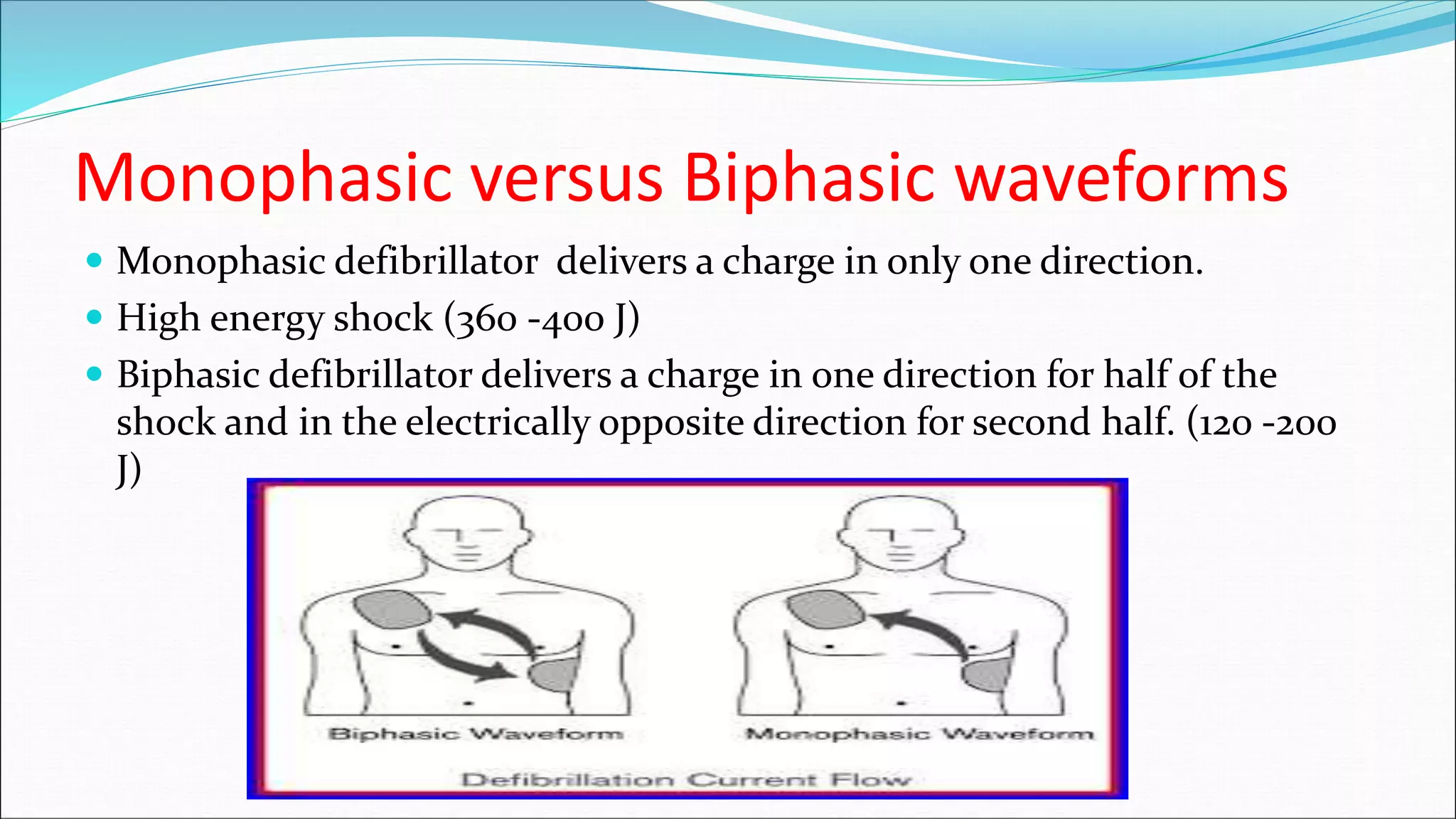
Monophasic versus Biphasic waveforms
 Monophasic defibrillator delivers a charge in only one direction.
 High energy shock (360 -400 J)
 Biphasic defibrillator delivers a charge in one direction for half of the
shock and in the electrically opposite direction for second half. (120 -200
J)
EQUIPMENT'S
 Defibrillator with paddle or adhesive patches
 Conductive gel
 ECG monitor with recorder
 Oxygen supply
 Intubation kit
 Multipara monitor – BP, Pulse, Spo2
 Intravenous access
 Suction device
 Code cart with ACLS medication
oThe designated person select the appropriate energy
on the defibrillator. 150-200 J for biphasic
defibrillators and 150-360 J for monophasic
defibrillators.
oPress ‘charge’ button to charge the capacitor
oWhile the defibrillator is charging, warn all rescuers
other than the individual performing the chest
compressions to ‘stand clear’ and remove any oxygen
delivery device as appropriate.
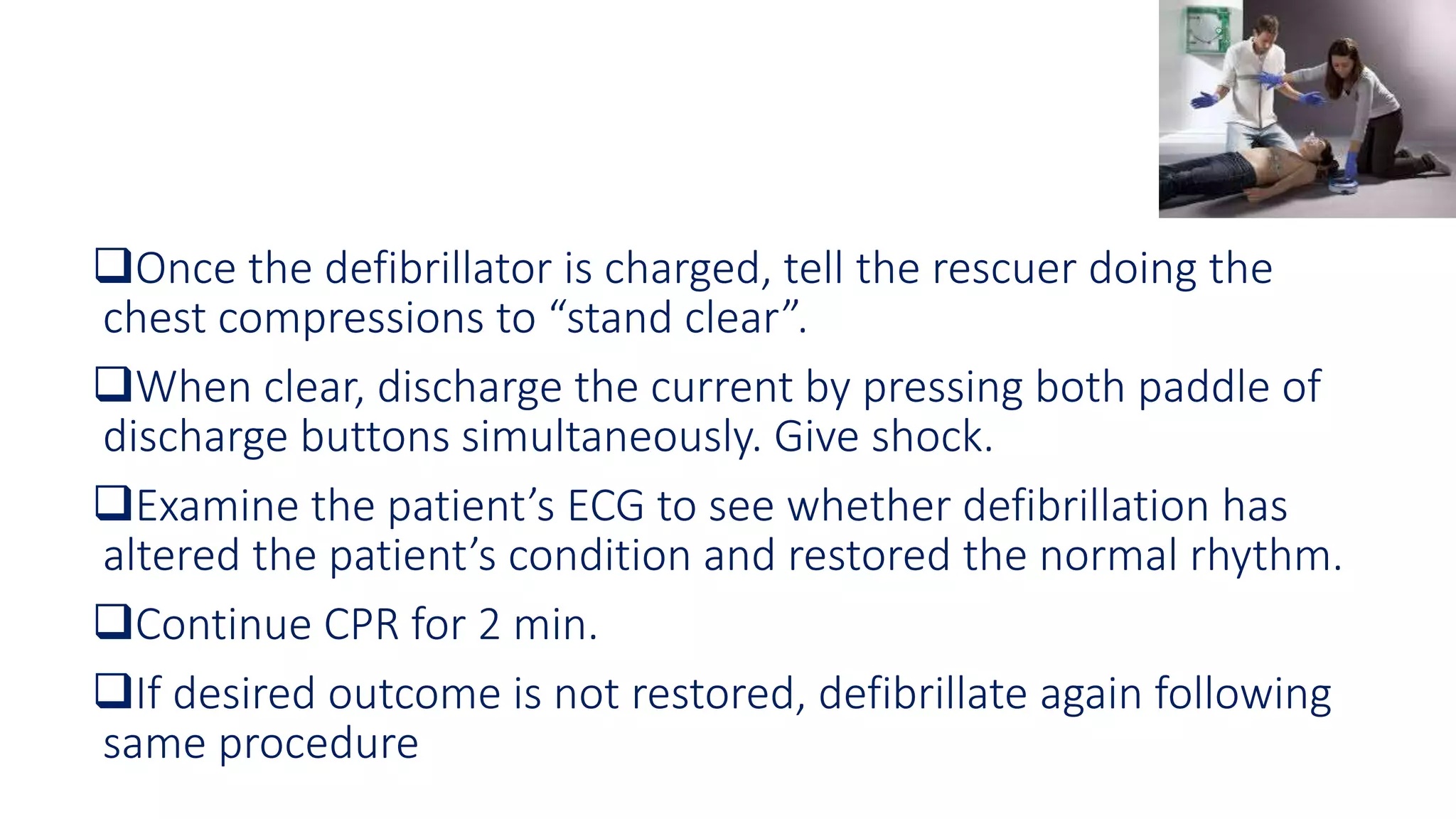
Once the defibrillator is charged, tell the rescuer doing the
chest compressions to “stand clear”.
When clear, discharge the current by pressing both paddle of
discharge buttons simultaneously. Give shock.
Examine the patient’s ECG to see whether defibrillation has
altered the patient’s condition and restored the normal rhythm.
Continue CPR for 2 min.
If desired outcome is not restored, defibrillate again following
same procedure
• Perform the 3 counter shocks in rapid succession.
• If the patient still has no pulse after 3 initial
defibrillations,
• Resume CPR
• Give supplemental oxygen
Begin administering epinephrine and switch to non
shockable algorithm.
If further defibrillation is unnecessary, discharge the
machine by turning off.
Once machine is discharged, clean the paddles / making
sure to remove conductive jelly.
Any jelly remains the paddle will corrode the metal
paddles.
Assess patient level of status.
Obtain baseline data/ ABG levels and 12 lead ECG
Provide supplemental oxygen, ventilation
Document the procedure.
AUTOMATED EXTERNAL
DEFIBRILLATOR
PATIENT PREPARATION
Assess the patient to determine if he lacks a pulse
Call for help
Perform resuscitation until the defibrillation and other
emergency equipment arrive.
As soon as the AED arrives, expose the patient’s chest.
PROCEDURE
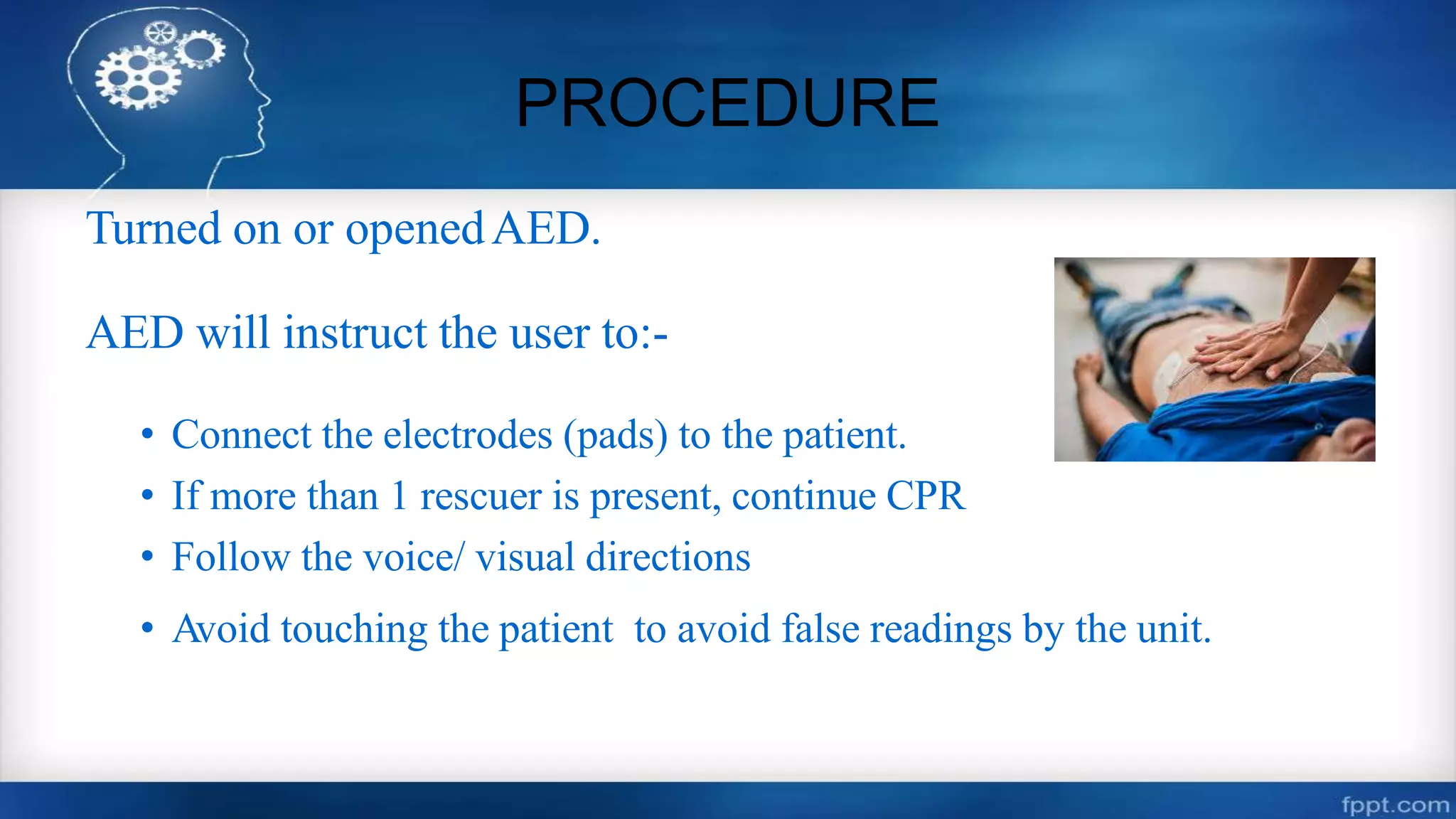
Turned on or openedAED.
AED will instruct the user to:-
• Connect the electrodes (pads) to the patient.
• If more than 1 rescuer is present, continue CPR
• Follow the voice/ visual directions
• Avoid touching the patient to avoid false readings by the unit.
• TheAED examine the electrical output from the heart and
determine the patient is in a shock able rhythm or not
• When device determined that shock is warranted, it will charge
its internal capacitor in preparation to deliver the shock
• When charged, the device instructs the us ensure no one is
touching the victim or trolley and callout ‘stand clear’
• Then to press a red button to deliver the shock
• Continue as directed by voice/ visual prompts.
CARDIOVERSION
• Cardioversion is an elective or emergency procedure in which an
electric current is programmed for synchronized to occur with the
R wave.
Indications
• Atrial or ventricular tachyarrhythmias
• Arrhythmias not respond to drug therapy
TYPES OF CARDIOVERSION
• CHEMICAL CARDIOVERSION
Antiarryhtmic medication
• ELECTRICAL CARDIOVERSION
Electrical energy synchronized with QRS
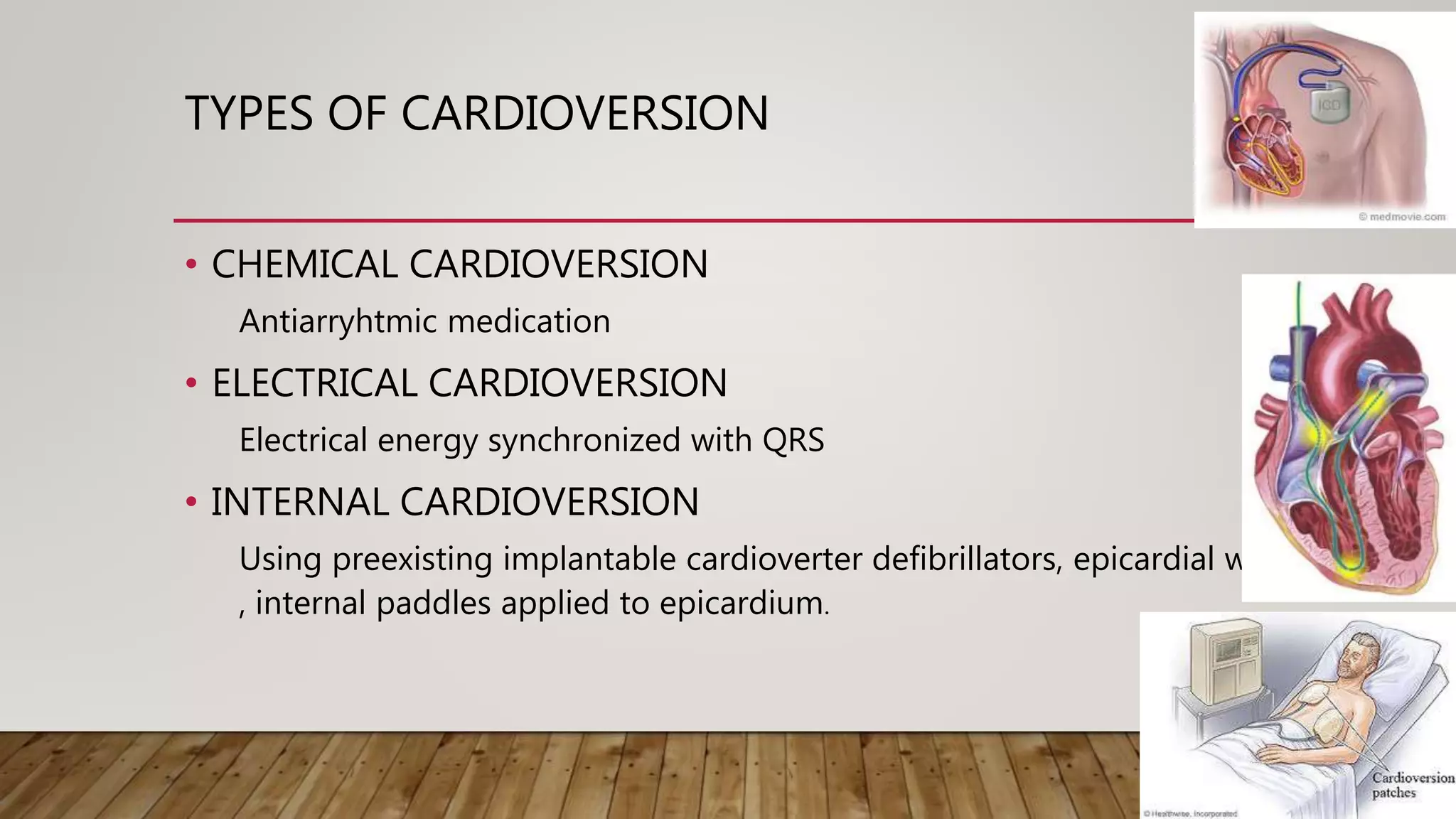
• INTERNAL CARDIOVERSION
Using preexisting implantable cardioverter defibrillators, epicardial wires
, internal paddles applied to epicardium.
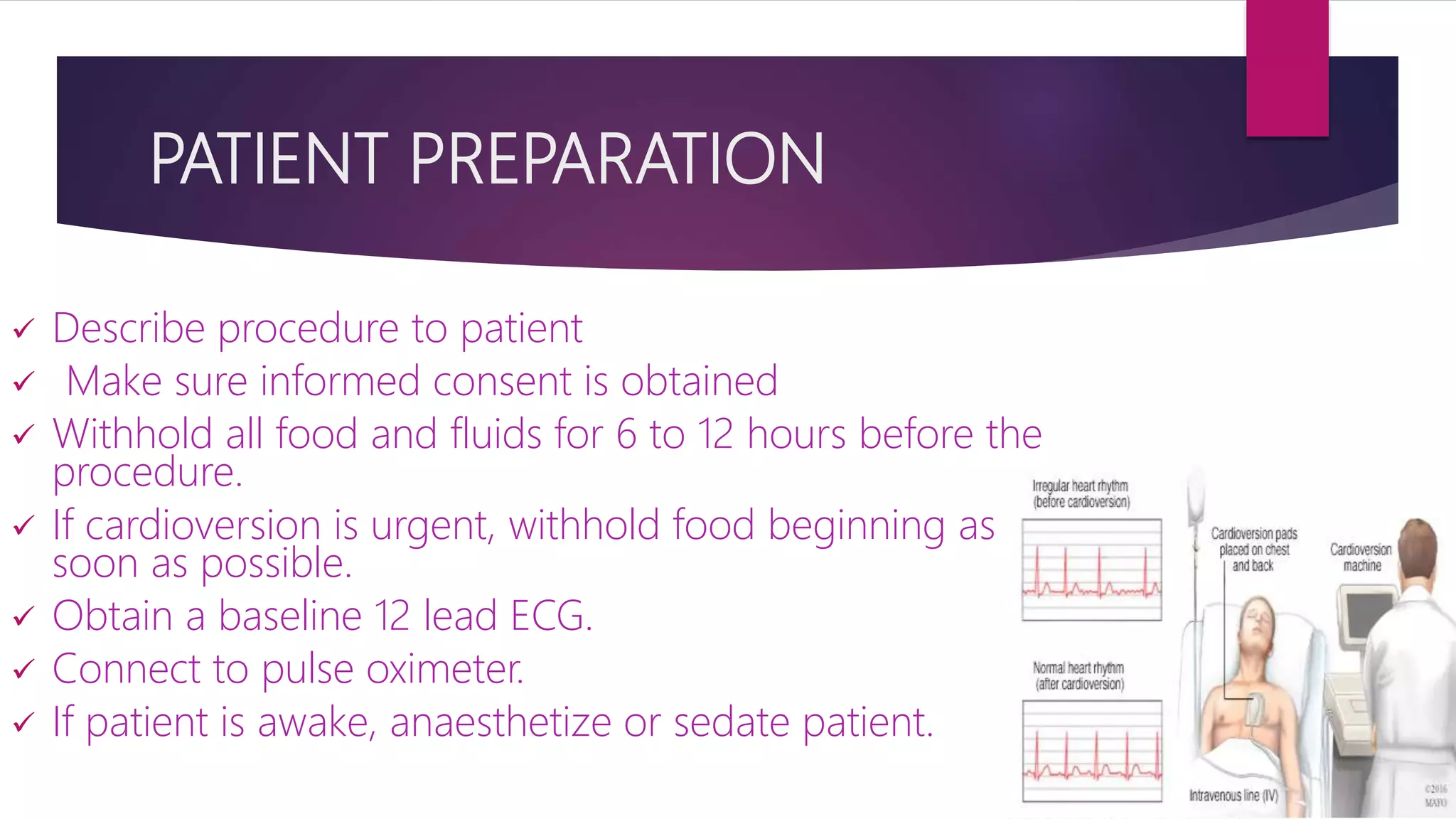
PATIENT PREPARATION
 Describe procedure to patient
 Make sure informed consent is obtained
 Withhold all food and fluids for 6 to 12 hours before the
procedure.
 If cardioversion is urgent, withhold food beginning as
soon as possible.
 Obtain a baseline 12 lead ECG.
 Connect to pulse oximeter.
 If patient is awake, anaesthetize or sedate patient.
PROCEDURE
1. Prepare patient and equipments. Ensure the patient
has adequate monitoring and that there is
resuscitation.
2. Check the patient rhythm.
3. Turn on defibrillator
4. Select the ordered energy level usually between 50
to 100 joules.
5. Activate synchronized mode.
6. Check the machine is sensing the QRS complex and
R wave correctly
CONT….
• Place the paddles on the chest
• Charge the paddles
• Check that no one is contact with patient or trolley and call
out “stand clear”.
• Discharge the shock
• If cardioversion is unsuccessful , repeat the procedure 3 or
4 times.
• If normal rhythm is restored, continue monitoring the
patient and provide supplemental ventilation.
• If cardiac rhythm changes to VF , switch off the mode from
synchronized to defibrillate.
• Document the procedure.
COMPLICATIONS
• Skin burns from the defibrillator paddles are the most
common complication of defibrillation.
• Other risks include injury to the heart muscle, abnormal
heart rhythms, and blood clots.
• Myocardial necrosis and myocardial dysfunction
• Pulmonary edema
NURSING MANAGEMENT
• Monitor cardiovascular status.
• Monitor respiratory status
• Monitor neurologic status
• Initiate IV antiarrhythmic therapy
• Monitor for burns
• Documentation
• Patient/ family education
Defibrillator

Defibrillator

  • 2.
  • 3.
    DEFINITION Defibrillation is aprocess in which an electronic device sends an electric shock to the heart to stop an extremely rapid, irregular heartbeat, and restore the normal heart rhythm. Defibrillator is a device that deliver a therapeutic dose of electrical energy to the affected heart to force the heart to produce more normal cardiac rhythm.
  • 4.
    DEFINITION Cardioversion is asynchronized administration of shock during the R waves or QRS complex of a cardiac cycle. In defibrillation, electrode paddles are used to direct an electric current through the patient’s heart, causes the myocardium to depolarize, which in turn encourages the SA node to resume control of the heart’s electrical activity.
  • 5.
    PURPOSE • To correctlife threatening fibrillations of the heart, which could result in cardiac arrest.
  • 6.
  • 7.
    CONTRAINDICATION • Patient whoare conscious or have a pulse • Non shockable rhythm – asystole, pulseless electrical activity • Multifocal atrial tachycardia • Dysrhythmia due to enhanced automaticity such as digitalis toxicity.
  • 8.
    MECHANISM • Defibrillator deliversa brief electric shock to the heart which enables the heart’s natural pacemaker to regain control and establish a normal heart rhythm. • 3 features – Power source – Capacitor – 2 electrode
  • 9.
    FACTORS AFFECTING DEFIBRILLATION Transthoracic impendence  Electrode to skin contact  Electrode size  Phase  Body size  Electrode position
  • 10.
  • 11.
    DEFIBRILLATOR ELECTRODES • MetalDisc 5 x 10 cm Types a. Spoon shaped electrode b. Paddle type electrode c. Pad type electrode
  • 12.
    TYPEOF DEFIBRILLATORS  MANUAL EXTERNALDEFIBRILLATOR  MANUAL INTERNAL DEFIBRILLATOR  AUTOMATED EXTERNAL DEFIBRILLATOR  WEARABLE CARDIOVERTER DEFIBRILLATOR  IMPLANATBLE CARDIOVERTER- DEFIBRILLATOR
  • 13.
    MANUAL EXTERNAL DEFIBRILLATOR First diagnose the cardiac rhythm and then manually determine the voltage and timing for the electrical shock
  • 14.
    MANUAL INTERNAL DEFIBRILLATOR Delivers the shock through paddles directly on the heart.  Used in OT - Open heart surgery
  • 15.
    AUTOMATED EXTERNAL DEFIBRILLATOR (AED) Defibrillator having rhythm detection capacity and the ability to advise the operator to deliver a shock using hands free defibrillator pads.  Untrained or briefly trained laypersons.  Fully automated or semi automated
  • 16.
    IMPLANATBLE CARDIOVERTER- DEFIBRILLATOR Consists of a lead system of placed via a subclavian vein to the endocardium.  A battery powered pulse generator is implanted subcutaneously over pectoral muscle.  Constantly monitor heart rhythm and automatically administer shocks.
  • 17.
    Wearable cardioverter defibrillator Portable external defibrillator that can worn by at risk patient.  Monitor 24 hrs a day and can automatically deliver a biphasic shock.
  • 18.
    Monophasic versus Biphasicwaveforms  Monophasic defibrillator delivers a charge in only one direction.  High energy shock (360 -400 J)  Biphasic defibrillator delivers a charge in one direction for half of the shock and in the electrically opposite direction for second half. (120 -200 J)
  • 20.
    EQUIPMENT'S  Defibrillator withpaddle or adhesive patches  Conductive gel  ECG monitor with recorder  Oxygen supply  Intubation kit  Multipara monitor – BP, Pulse, Spo2  Intravenous access  Suction device  Code cart with ACLS medication
  • 22.
    oThe designated personselect the appropriate energy on the defibrillator. 150-200 J for biphasic defibrillators and 150-360 J for monophasic defibrillators. oPress ‘charge’ button to charge the capacitor oWhile the defibrillator is charging, warn all rescuers other than the individual performing the chest compressions to ‘stand clear’ and remove any oxygen delivery device as appropriate.
  • 23.
    Once the defibrillatoris charged, tell the rescuer doing the chest compressions to “stand clear”. When clear, discharge the current by pressing both paddle of discharge buttons simultaneously. Give shock. Examine the patient’s ECG to see whether defibrillation has altered the patient’s condition and restored the normal rhythm. Continue CPR for 2 min. If desired outcome is not restored, defibrillate again following same procedure
  • 24.
    • Perform the3 counter shocks in rapid succession. • If the patient still has no pulse after 3 initial defibrillations, • Resume CPR • Give supplemental oxygen
  • 25.
    Begin administering epinephrineand switch to non shockable algorithm. If further defibrillation is unnecessary, discharge the machine by turning off. Once machine is discharged, clean the paddles / making sure to remove conductive jelly. Any jelly remains the paddle will corrode the metal paddles. Assess patient level of status. Obtain baseline data/ ABG levels and 12 lead ECG Provide supplemental oxygen, ventilation Document the procedure.
  • 26.
    AUTOMATED EXTERNAL DEFIBRILLATOR PATIENT PREPARATION Assessthe patient to determine if he lacks a pulse Call for help Perform resuscitation until the defibrillation and other emergency equipment arrive. As soon as the AED arrives, expose the patient’s chest.
  • 27.
    PROCEDURE Turned on oropenedAED. AED will instruct the user to:- • Connect the electrodes (pads) to the patient. • If more than 1 rescuer is present, continue CPR • Follow the voice/ visual directions • Avoid touching the patient to avoid false readings by the unit.
  • 28.
    • TheAED examinethe electrical output from the heart and determine the patient is in a shock able rhythm or not • When device determined that shock is warranted, it will charge its internal capacitor in preparation to deliver the shock • When charged, the device instructs the us ensure no one is touching the victim or trolley and callout ‘stand clear’ • Then to press a red button to deliver the shock • Continue as directed by voice/ visual prompts.
  • 29.
    CARDIOVERSION • Cardioversion isan elective or emergency procedure in which an electric current is programmed for synchronized to occur with the R wave. Indications • Atrial or ventricular tachyarrhythmias • Arrhythmias not respond to drug therapy
  • 30.
    TYPES OF CARDIOVERSION •CHEMICAL CARDIOVERSION Antiarryhtmic medication • ELECTRICAL CARDIOVERSION Electrical energy synchronized with QRS • INTERNAL CARDIOVERSION Using preexisting implantable cardioverter defibrillators, epicardial wires , internal paddles applied to epicardium.
  • 31.
    PATIENT PREPARATION  Describeprocedure to patient  Make sure informed consent is obtained  Withhold all food and fluids for 6 to 12 hours before the procedure.  If cardioversion is urgent, withhold food beginning as soon as possible.  Obtain a baseline 12 lead ECG.  Connect to pulse oximeter.  If patient is awake, anaesthetize or sedate patient.
  • 32.
    PROCEDURE 1. Prepare patientand equipments. Ensure the patient has adequate monitoring and that there is resuscitation. 2. Check the patient rhythm. 3. Turn on defibrillator 4. Select the ordered energy level usually between 50 to 100 joules. 5. Activate synchronized mode. 6. Check the machine is sensing the QRS complex and R wave correctly
  • 33.
    CONT…. • Place thepaddles on the chest • Charge the paddles • Check that no one is contact with patient or trolley and call out “stand clear”. • Discharge the shock • If cardioversion is unsuccessful , repeat the procedure 3 or 4 times. • If normal rhythm is restored, continue monitoring the patient and provide supplemental ventilation. • If cardiac rhythm changes to VF , switch off the mode from synchronized to defibrillate. • Document the procedure.
  • 34.
    COMPLICATIONS • Skin burnsfrom the defibrillator paddles are the most common complication of defibrillation. • Other risks include injury to the heart muscle, abnormal heart rhythms, and blood clots. • Myocardial necrosis and myocardial dysfunction • Pulmonary edema
  • 35.
    NURSING MANAGEMENT • Monitorcardiovascular status. • Monitor respiratory status • Monitor neurologic status • Initiate IV antiarrhythmic therapy • Monitor for burns • Documentation • Patient/ family education