3 Julai 2018
BLOK PEMBELAJARAN SUMBER PELAJAR,
KAMPUS KESIHATAN, USM
ELECTRICAL THERAPYELECTRICAL THERAPY
ININ
BASIC LIFE SUPPORTBASIC LIFE SUPPORT
• Electrical therapy was an electrical
stimulation by placing a lead wires
and electrodes on the skin over
the target areas of the body
• When the device activated, a
signal is transmitted down the
lead to the electrode and cause
depolarization of sensory nerves
to increase muscle strength of
atrophied muscles
1. AED
2. Defibrillation
3. Synchronized Cardioversion
4. Cardiac monitor
5. Transcutaneous Pacing
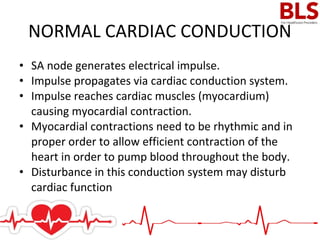
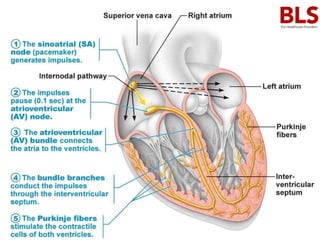
• SA node generates electrical impulse.
• Impulse propagates via cardiac conduction system.
• Impulse reaches cardiac muscles (myocardium)
causing myocardial contraction.
• Myocardial contractions need to be rhythmic and in
proper order to allow efficient contraction of the
heart in order to pump blood throughout the body.
• Disturbance in this conduction system may disturb
cardiac function
NORMAL CARDIAC CONDUCTION
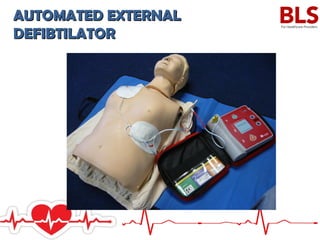
AUTOMATED EXTERNALAUTOMATED EXTERNAL
DEFIBTILATORDEFIBTILATOR
AUTOMATED EXTERNALAUTOMATED EXTERNAL
DEFIBTILATORDEFIBTILATOR
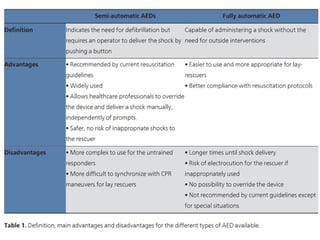
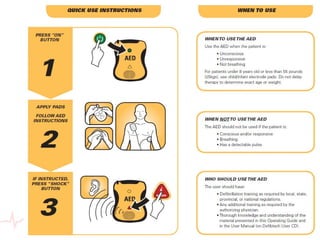
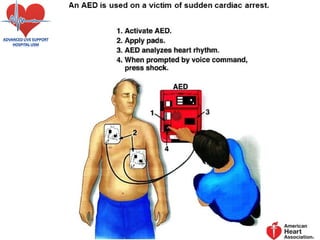
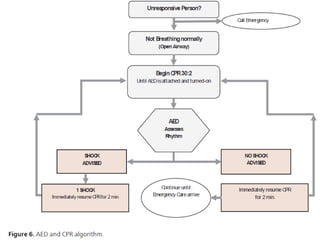
• is a portable & computerized device that incorporates
heart rhythm then send an electric shock to the heart
to try to restore a normal rhythm.
• AEDs are used to treat sudden cardiac arrest (SCA).
• Used voice / visual prompts to guide lay rescuers to
safely defibrillate victims of cardiac arrest D/T VF or
pulseless VT
• 2 types :
Semi automatic :
Fully automatic
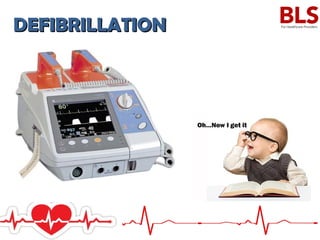
DEFIBRILLATIONDEFIBRILLATION
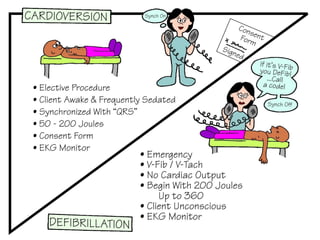
• Defibrillation is a common treatment for life-
threatening cardiac arrhythmias, ventricular
fibrillation, and pulseless ventricular
tachycardia.
• Defibrillation consists of delivering a therapeutic
dose of electrical energy to the affected heart
with a device called a defibrillator
http://www.livestrong.com/article
• Defibrillator is the device used to deliver
that shock and it can be manual or
automatic.
• 2 Types
• Impedance based defibrillators
• Current based defibrillator
CONT..CONT..
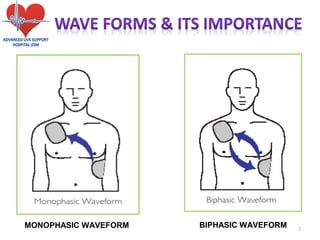
* Biphasic:
120-200J
* Monophasic:
360J
17
MONOPHASIC WAVEFORM BIPHASIC WAVEFORM
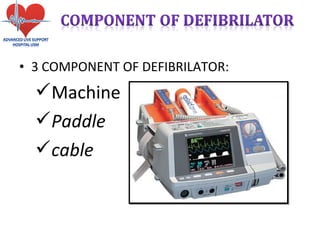
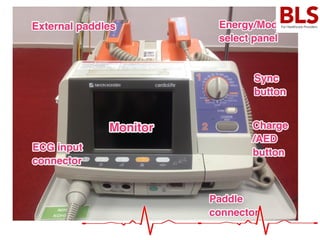
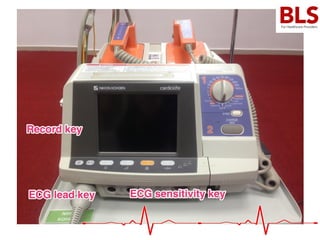
• 3 COMPONENT OF DEFIBRILATOR:
Machine
Paddle
cable
SYNCHRONIZEDSYNCHRONIZED
CARDIOVERSIONCARDIOVERSION
SYNCHRONIZED CARDIOVERSIONSYNCHRONIZED CARDIOVERSION
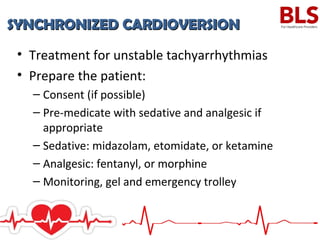
• Treatment for unstable tachyarrhythmias
• Prepare the patient:
– Consent (if possible)
– Pre-medicate with sedative and analgesic if
appropriate
– Sedative: midazolam, etomidate, or ketamine
– Analgesic: fentanyl, or morphine
– Monitoring, gel and emergency trolley
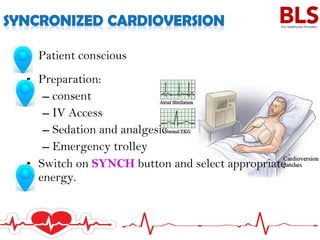
• Patient conscious
• Preparation:
– consent
– IV Access
– Sedation and analgesic
– Emergency trolley
• Switch on SYNCH button and select appropriate
energy.
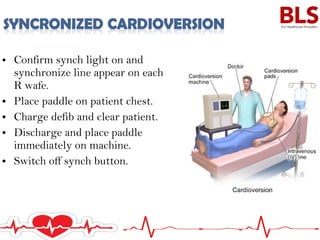
• Confirm synch light on and
synchronize line appear on each
R wafe.
• Place paddle on patient chest.
• Charge defib and clear patient.
• Discharge and place paddle
immediately on machine.
• Switch off synch button.
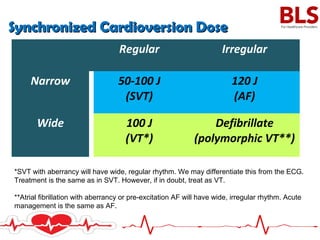
Synchronized Cardioversion DoseSynchronized Cardioversion Dose
Regular Irregular
Narrow 50-100 J
(SVT)
120 J
(AF)
Wide 100 J
(VT*)
Defibrillate
(polymorphic VT**)
*SVT with aberrancy will have wide, regular rhythm. We may differentiate this from the ECG.
Treatment is the same as in SVT. However, if in doubt, treat as VT.
**Atrial fibrillation with aberrancy or pre-excitation AF will have wide, irregular rhythm. Acute
management is the same as AF.
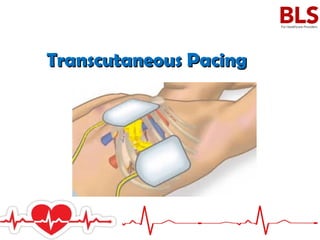
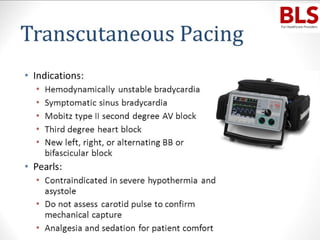
Transcutaneous PacingTranscutaneous Pacing
• Treatment for symptomatic bradyarrhytmia if
not responding to atropine
• Other treatment available:
–IV adrenaline infusion 1-10mcg/min
–IV Dopamine infusion 2-10mcg/kg/min
• Preferably in AMI with bradycardia to avoid
stress effect from adrenalin, dopamine
• LOCATION OF 4 PADDLES;
Antero-lateral position
Antero-posterior position
Anterior-left infra-scapular position
Anterior – right infra-scapular position
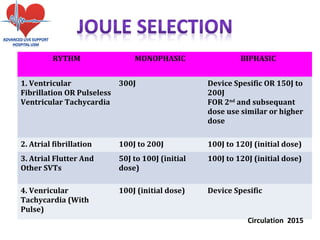
RYTHM MONOPHASIC BIPHASIC
1. Ventricular
Fibrillation OR Pulseless
Ventricular Tachycardia
300J Device Spesific OR 150J to
200J
FOR 2nd
and subsequant
dose use similar or higher
dose
2. Atrial fibrillation 100J to 200J 100J to 120J (initial dose)
3. Atrial Flutter And
Other SVTs
50J to 100J (initial
dose)
100J to 120J (initial dose)
4. Venricular
Tachycardia (With
Pulse)
100J (initial dose) Device Spesific
Circulation 2015
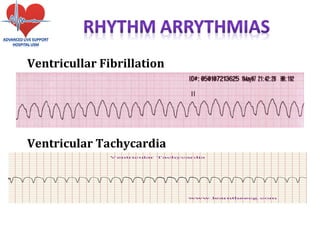
Ventricullar Fibrillation
Ventricular Tachycardia
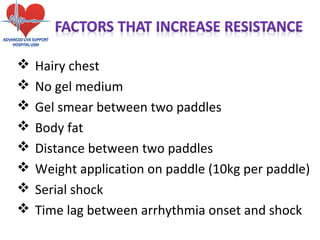
 Hairy chest
 No gel medium
 Gel smear between two paddles
 Body fat
 Distance between two paddles
 Weight application on paddle (10kg per paddle)
 Serial shock
 Time lag between arrhythmia onset and shock
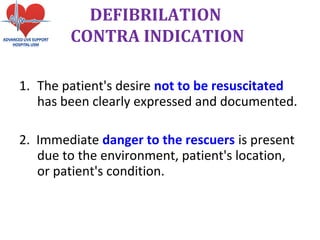
1. The patient's desire not to be resuscitated
has been clearly expressed and documented.
2. Immediate danger to the rescuers is present
due to the environment, patient's location,
or patient's condition.
DEFIBRILATION
CONTRA INDICATION
1. Skin Burns
Burns on the paddle placement areas are the
most common side effect of external
defibrillators.
2. Unintentional Shock
People touching a person being defibrillated
may receive a shock themselves. This may be
painful - according to the American Heart
Association.
SIDE EFFECT OF DEFIBRILATOR
1. Oxygen & Fire Risk
Burns on the paddle placement areas are the
most common side effect of external
defibrillators.
2. Technique
Avoid - charging / placing the paddle
- direct contact with victim
- allowing oxygen flow onto victim’s
PRECAUTIONS
Check paddle or electrode position
Check that there is adequate skin contact
Consider changing the defibrillator pads
FAILURE OF DEFIBRILLATION
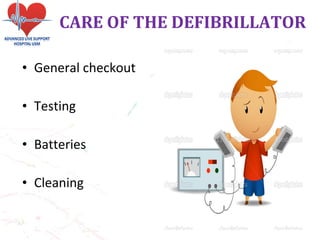
• General checkout
• Testing
• Batteries
• Cleaning
CARE OF THE DEFIBRILLATOR
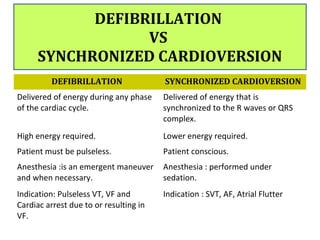
DEFIBRILLATION
VS
SYNCHRONIZED CARDIOVERSION
DEFIBRILLATION SYNCHRONIZED CARDIOVERSION
Delivered of energy during any phase
of the cardiac cycle.
Delivered of energy that is
synchronized to the R waves or QRS
complex.
High energy required. Lower energy required.
Patient must be pulseless. Patient conscious.
Anesthesia :is an emergent maneuver
and when necessary.
Anesthesia : performed under
sedation.
Indication: Pulseless VT, VF and
Cardiac arrest due to or resulting in
VF.
Indication : SVT, AF, Atrial Flutter
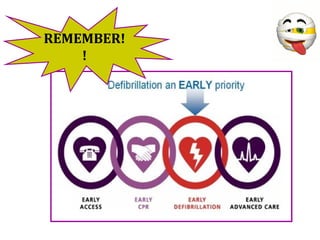
REMEMBER!
!
2 critical questions about
CPR+ defibrillation
• ? CPR should be provided before
defibrillation is attempted
• Number of shocks to be delivered in a
sequence before the rescuer resumes
CPR
Electrical therapy  in bls 2018

Electrical therapy in bls 2018

  • 1.
    3 Julai 2018 BLOKPEMBELAJARAN SUMBER PELAJAR, KAMPUS KESIHATAN, USM ELECTRICAL THERAPYELECTRICAL THERAPY ININ BASIC LIFE SUPPORTBASIC LIFE SUPPORT
  • 3.
    • Electrical therapywas an electrical stimulation by placing a lead wires and electrodes on the skin over the target areas of the body • When the device activated, a signal is transmitted down the lead to the electrode and cause depolarization of sensory nerves to increase muscle strength of atrophied muscles
  • 4.
    1. AED 2. Defibrillation 3.Synchronized Cardioversion 4. Cardiac monitor 5. Transcutaneous Pacing
  • 5.
    • SA nodegenerates electrical impulse. • Impulse propagates via cardiac conduction system. • Impulse reaches cardiac muscles (myocardium) causing myocardial contraction. • Myocardial contractions need to be rhythmic and in proper order to allow efficient contraction of the heart in order to pump blood throughout the body. • Disturbance in this conduction system may disturb cardiac function NORMAL CARDIAC CONDUCTION
  • 7.
  • 8.
    AUTOMATED EXTERNALAUTOMATED EXTERNAL DEFIBTILATORDEFIBTILATOR •is a portable & computerized device that incorporates heart rhythm then send an electric shock to the heart to try to restore a normal rhythm. • AEDs are used to treat sudden cardiac arrest (SCA). • Used voice / visual prompts to guide lay rescuers to safely defibrillate victims of cardiac arrest D/T VF or pulseless VT • 2 types : Semi automatic : Fully automatic
  • 13.
  • 14.
    • Defibrillation isa common treatment for life- threatening cardiac arrhythmias, ventricular fibrillation, and pulseless ventricular tachycardia. • Defibrillation consists of delivering a therapeutic dose of electrical energy to the affected heart with a device called a defibrillator http://www.livestrong.com/article
  • 15.
    • Defibrillator isthe device used to deliver that shock and it can be manual or automatic. • 2 Types • Impedance based defibrillators • Current based defibrillator
  • 16.
  • 17.
  • 18.
    • 3 COMPONENTOF DEFIBRILATOR: Machine Paddle cable
  • 21.
  • 22.
    SYNCHRONIZED CARDIOVERSIONSYNCHRONIZED CARDIOVERSION •Treatment for unstable tachyarrhythmias • Prepare the patient: – Consent (if possible) – Pre-medicate with sedative and analgesic if appropriate – Sedative: midazolam, etomidate, or ketamine – Analgesic: fentanyl, or morphine – Monitoring, gel and emergency trolley
  • 23.
    • Patient conscious •Preparation: – consent – IV Access – Sedation and analgesic – Emergency trolley • Switch on SYNCH button and select appropriate energy.
  • 24.
    • Confirm synchlight on and synchronize line appear on each R wafe. • Place paddle on patient chest. • Charge defib and clear patient. • Discharge and place paddle immediately on machine. • Switch off synch button.
  • 25.
    Synchronized Cardioversion DoseSynchronizedCardioversion Dose Regular Irregular Narrow 50-100 J (SVT) 120 J (AF) Wide 100 J (VT*) Defibrillate (polymorphic VT**) *SVT with aberrancy will have wide, regular rhythm. We may differentiate this from the ECG. Treatment is the same as in SVT. However, if in doubt, treat as VT. **Atrial fibrillation with aberrancy or pre-excitation AF will have wide, irregular rhythm. Acute management is the same as AF.
  • 26.
  • 28.
    Transcutaneous PacingTranscutaneous Pacing •Treatment for symptomatic bradyarrhytmia if not responding to atropine • Other treatment available: –IV adrenaline infusion 1-10mcg/min –IV Dopamine infusion 2-10mcg/kg/min • Preferably in AMI with bradycardia to avoid stress effect from adrenalin, dopamine
  • 30.
    • LOCATION OF4 PADDLES; Antero-lateral position Antero-posterior position Anterior-left infra-scapular position Anterior – right infra-scapular position
  • 31.
    RYTHM MONOPHASIC BIPHASIC 1.Ventricular Fibrillation OR Pulseless Ventricular Tachycardia 300J Device Spesific OR 150J to 200J FOR 2nd and subsequant dose use similar or higher dose 2. Atrial fibrillation 100J to 200J 100J to 120J (initial dose) 3. Atrial Flutter And Other SVTs 50J to 100J (initial dose) 100J to 120J (initial dose) 4. Venricular Tachycardia (With Pulse) 100J (initial dose) Device Spesific Circulation 2015
  • 32.
  • 33.
     Hairy chest No gel medium  Gel smear between two paddles  Body fat  Distance between two paddles  Weight application on paddle (10kg per paddle)  Serial shock  Time lag between arrhythmia onset and shock
  • 34.
    1. The patient'sdesire not to be resuscitated has been clearly expressed and documented. 2. Immediate danger to the rescuers is present due to the environment, patient's location, or patient's condition. DEFIBRILATION CONTRA INDICATION
  • 35.
    1. Skin Burns Burnson the paddle placement areas are the most common side effect of external defibrillators. 2. Unintentional Shock People touching a person being defibrillated may receive a shock themselves. This may be painful - according to the American Heart Association. SIDE EFFECT OF DEFIBRILATOR
  • 36.
    1. Oxygen &Fire Risk Burns on the paddle placement areas are the most common side effect of external defibrillators. 2. Technique Avoid - charging / placing the paddle - direct contact with victim - allowing oxygen flow onto victim’s PRECAUTIONS
  • 37.
    Check paddle orelectrode position Check that there is adequate skin contact Consider changing the defibrillator pads FAILURE OF DEFIBRILLATION
  • 38.
    • General checkout •Testing • Batteries • Cleaning CARE OF THE DEFIBRILLATOR
  • 42.
    DEFIBRILLATION VS SYNCHRONIZED CARDIOVERSION DEFIBRILLATION SYNCHRONIZEDCARDIOVERSION Delivered of energy during any phase of the cardiac cycle. Delivered of energy that is synchronized to the R waves or QRS complex. High energy required. Lower energy required. Patient must be pulseless. Patient conscious. Anesthesia :is an emergent maneuver and when necessary. Anesthesia : performed under sedation. Indication: Pulseless VT, VF and Cardiac arrest due to or resulting in VF. Indication : SVT, AF, Atrial Flutter
  • 43.
  • 44.
    2 critical questionsabout CPR+ defibrillation • ? CPR should be provided before defibrillation is attempted • Number of shocks to be delivered in a sequence before the rescuer resumes CPR