DEFIBRILLATION
D. SAI KUMAR
16.10.2014
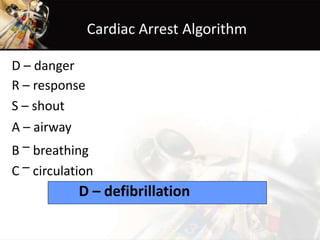
Cardiac Arrest Algorithm
D – danger
R – response
S – shout
A
B
C
–
–
–
airway
breathing
circulation
D – defibrillation
DEFIBRILLATION
• Defibrillation is a process in which an
electronic device sends an electric shock
to the heart to stop an extremely rapid,
irregular heartbeat, and restore the normal
heart rhythm.
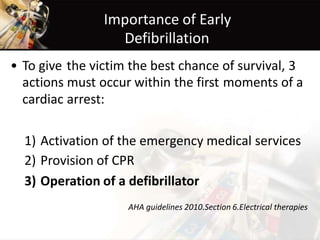
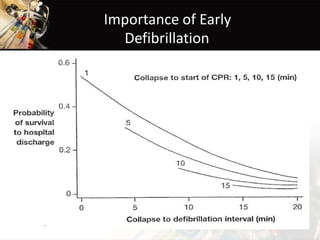
Importance of Early
Defibrillation
• To give
actions
cardiac
the victim the best chance
must occur within the first
arrest:
of survival, 3
moments of a
1)
2)
3)
Activation of the emergency medical services
Provision of CPR
Operation of a defibrillator
AHA guidelines 2010.Section 6.Electrical therapies
Importance of Early
Defibrillation
• Claude Beck (1894-1971) was a pioneer of heart
surgery,. He also developed ways to revive heart
attack victims, including the defibrillator and CPR
• In 1947, Beck successfully defibrillated his first
patient, a 14-year-old boy whose heart went into
fibrillation after an operation.
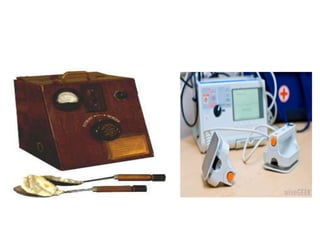
• The defibrillator used on this patient was made
by James Rand, a friend of Beck. It had silver
paddles (the size of large tablespoons) that were
used in open-chest situations..
• Nine years later (1956) Paul Zoll used a more
powerful unit to perform the first closed-chest
defibrillation.
• In Belfast , ambulance-transported physicians
first achieved pre-hospital defibrillation in
1966. Defibrillation by EMT’s (emergency
medical technicians), without the presence of
physicians, was first performed in Oregon , in
1969.
• The electrical shock, by depolarizing all
excitable myocardium and possibly by
prolonging refractoriness, interrupts
reentrant circuits and establishes electrical
homogeneity, which terminates reentry
• Produces electrical silence or ASYSTOLE
• This allows pacemaking cells in heart to
recover
• Defibrillation is non synchronised delivery of
energy during any phase of cardiac cycle
• Cardioversion is the delivery of energy
synchronised with the large R waves of QRS
complex
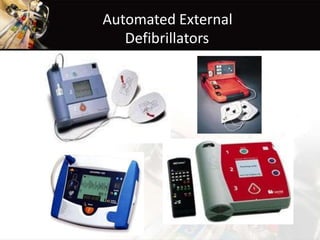
Automated External
Defibrillators
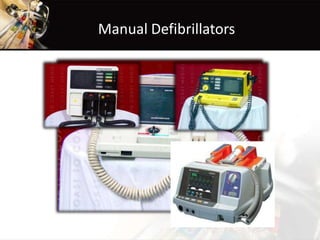
Manual Defibrillators
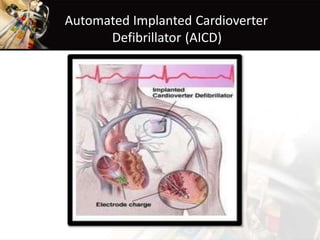
Automated Implanted Cardioverter
Defibrillator (AICD)
INDICATIONS
• As a rule, any tachycardia that produces
hypotension, congestive heart failure, mental
status changes, or angina and does not
respond promptly to medical management
should be terminated electrically.
• Very rapid ventricular rates in patients with
atrial fibrillation and Wolff-Parkinson-White
syndrome are often best treated by electrical
cardioversion
ENERGY REQUIREMENTS
• Selection of appropriate current will reduce
the need for multiple shocks and limit the
myocardial damage per shock
• The energy set too low will leave the heart in
ventricular fibrillation and a shock with the
energy set too high may leave the heart in
asystole or AV block
• The realtionship between bodysize and energy
requirements for defibrillation has been under
debate
• By the help of prospective out of hospital
studies, the first shock energy for defibrillation
was set at 200J in the mid 1980s
Defibrillation waveforms
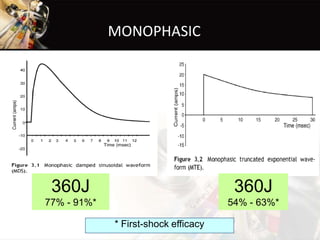
• Two broad categories : monophasic and biphasic
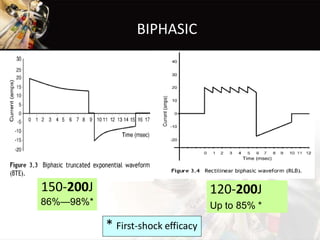
• Biphasic waveforms deliver current that flows in
positive direction for a specified duration then
reverses and flows in a negative direction for the
remaining milliseconds of the electrical discharge
• Biphasic waveforms are more superior than
monophasic …. Still under investigation and
debate
MONOPHASIC
* First-shock efficacy
360J
54% - 63%*
360J
77% - 91%*
BIPHASIC
Up to 85% *
* First-shock efficacy
120-200J150-200J
86%—98%*
• Research has shown that repititive lower
energy biphasic waveforms shocks (<200J)
have equivalent or higher success for
immediate termination of VF compared with
monphasic waveform shocks that escalate the
energy (200,300,400J) with successive shocks
Pads ,Paddles, and Positions
• Often neglected topic
• Should be placed in a position which
maximises current flow through myocardium
• Even with proper placement of paddles only
4% to 25% of deliverd current actually passes
through heart
• Recommended placement is termed either
sternal- apex or anterior apex
• The sternal or anterior electrode is placed to
the right of the upper part of the sternum
below the clavicle
• The apex electrode is placed to the left of the
nipple with the center of the electrode in the
midaxillary line
• Alteranative method is to place one paddle
anteriorly over the left apex and the other
posteriorly behind the heart in left
infrascapular location
• Avoid placement directly over any implanted
pacemaker or defibrillator
Syncronised cardioversion
• Synchronisation prevents the unwanted
induction of VF because it ensures that a
shock hits during the absolute refractory
period of the cardiac cycle
• Recommended in hemodynamically stable,
widecomplex tachycardia requiring
cardioversion, supraventricular tachycardia,
atrial fibrillation and atrial flutter
Synchronised Cardioversion
•
•
Not effective in junctional tachycardia
multifocal atrial tachycardia
or
Problems with synchronization
• Time delay
• Some times shock not delivered
IMPORTANT POINTS DURING
DEFIBRILLATION
Important Points During
Defibrillation
•
•
•
•
Hairy chest
Wet chest
Breasts
Patches
Wrenn, K. The hazards of defibrillation through nitroglycerin
patches. Ann Emerg Med 1990; 19(11): 1327-8
AICD / pacemaker•
Important Points During
Defibrillation
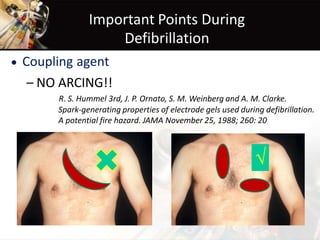
Coupling agent•
– NO ARCING!!
R. S. Hummel 3rd, J. P. Ornato, S. M. Weinberg and A. M. Clarke.
Spark-generating properties of electrode gels used during defibrillation.
A potential fire hazard. JAMA November 25, 1988; 260: 20
√
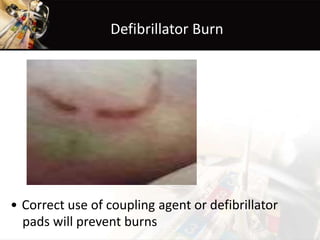
Defibrillator Burn
• Correct use of coupling agent or defibrillator
pads will prevent burns
Important Points During
Defibrillation
• Paddle force
– 8kg in adult, 5kg in 1-8 year old
using adult paddles
children when
• Paddle size
– Minimum 150cm2, diameter 8-12cm
Important Points During
Defibrillation
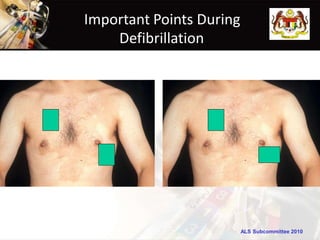
• Paddle position
1.
2.
3.
4.
Sternal - apical
Biaxillary
Right or left upper back – apical
Antero-posterior especially in atrial
arrhythmias
4 positions are equally effective in shock• All
success Deakin CD, Sado DM, Petley GW, Clewlow F. Is the orientation
of the apical defibrillation paddle of importance during manual
external defibrillation? Resuscitation 2003;56:15—8
Important Points During
Defibrillation
ALS Subcommittee 2010
Important Points During
Defibrillation
• Fire
May be ignited by sparks from poorly applied
defibrillator paddles in the presence of an
oxygen-enriched atmosphere
Miller, P. H. Potential fire hazard in defibrillation. JAMA 1972;221(2): 192. Early report of fire hazard
during defibrillation
Fires from Defibrillation during Oxygen Administration. Hazard. Health Devices Jul
1994;23(7):307-8
Robertshaw, H. and G. McAnulty. Ambient oxygen concentrations during simulated cardiopulmonary
resuscitation. Anaesthesia
1998;53(7): 634-7
Theodorou et al. Fire Attributable to a Defibrillation Attempt in a Neonate. Pediatrics 2003;112:677-679
Important Points During
Defibrillation
• One I clear, Two you clear, Three
clear
everybody
• Look back at monitor before shocking
• Paddles MUST be horizontal at all times!
How to defibrillate ?
stop look go
1.
2.
3.
4.
5.
6.
7.
8.
9.
Attach electrodes to patient’s chest
Turn defibrillator on – select leads
Analyse the rhythm ?shockable
Apply coupling agent or
Select energy level
Apply paddles to chest
Charge the paddles
The “Clear” chant
Check monitor again
pads to patient’s chest
10.Discharge shock and return paddles to machine
If Flatline…
• Always double check that it IS a flatline
–
–
–
Check other leads
Check attachment of leads
Increase the size of rhythm to rule out fine
ventricular fibrillation
ALS Subcommittee 2010
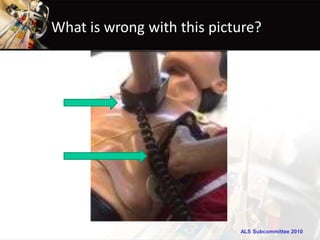
What is wrong with this picture?
ALS Subcommittee 2010
References
1. American Heart Association CPR
2010
Guidelines Nov
2. European Resuscitation Council Guidelines for
Resuscitation 2010
3. Braunwald’s textbook of cardiology 9th
edition

Defibrilllation

  • 1.
  • 2.
    Cardiac Arrest Algorithm D– danger R – response S – shout A B C – – – airway breathing circulation D – defibrillation
  • 3.
    DEFIBRILLATION • Defibrillation isa process in which an electronic device sends an electric shock to the heart to stop an extremely rapid, irregular heartbeat, and restore the normal heart rhythm.
  • 4.
    Importance of Early Defibrillation •To give actions cardiac the victim the best chance must occur within the first arrest: of survival, 3 moments of a 1) 2) 3) Activation of the emergency medical services Provision of CPR Operation of a defibrillator AHA guidelines 2010.Section 6.Electrical therapies
  • 5.
  • 6.
    • Claude Beck(1894-1971) was a pioneer of heart surgery,. He also developed ways to revive heart attack victims, including the defibrillator and CPR • In 1947, Beck successfully defibrillated his first patient, a 14-year-old boy whose heart went into fibrillation after an operation. • The defibrillator used on this patient was made by James Rand, a friend of Beck. It had silver paddles (the size of large tablespoons) that were used in open-chest situations..
  • 7.
    • Nine yearslater (1956) Paul Zoll used a more powerful unit to perform the first closed-chest defibrillation. • In Belfast , ambulance-transported physicians first achieved pre-hospital defibrillation in 1966. Defibrillation by EMT’s (emergency medical technicians), without the presence of physicians, was first performed in Oregon , in 1969.
  • 9.
    • The electricalshock, by depolarizing all excitable myocardium and possibly by prolonging refractoriness, interrupts reentrant circuits and establishes electrical homogeneity, which terminates reentry • Produces electrical silence or ASYSTOLE • This allows pacemaking cells in heart to recover
  • 10.
    • Defibrillation isnon synchronised delivery of energy during any phase of cardiac cycle • Cardioversion is the delivery of energy synchronised with the large R waves of QRS complex
  • 11.
  • 12.
  • 13.
  • 14.
    INDICATIONS • As arule, any tachycardia that produces hypotension, congestive heart failure, mental status changes, or angina and does not respond promptly to medical management should be terminated electrically. • Very rapid ventricular rates in patients with atrial fibrillation and Wolff-Parkinson-White syndrome are often best treated by electrical cardioversion
  • 15.
    ENERGY REQUIREMENTS • Selectionof appropriate current will reduce the need for multiple shocks and limit the myocardial damage per shock • The energy set too low will leave the heart in ventricular fibrillation and a shock with the energy set too high may leave the heart in asystole or AV block
  • 16.
    • The realtionshipbetween bodysize and energy requirements for defibrillation has been under debate • By the help of prospective out of hospital studies, the first shock energy for defibrillation was set at 200J in the mid 1980s
  • 17.
    Defibrillation waveforms • Twobroad categories : monophasic and biphasic • Biphasic waveforms deliver current that flows in positive direction for a specified duration then reverses and flows in a negative direction for the remaining milliseconds of the electrical discharge • Biphasic waveforms are more superior than monophasic …. Still under investigation and debate
  • 18.
  • 19.
    BIPHASIC Up to 85%* * First-shock efficacy 120-200J150-200J 86%—98%*
  • 20.
    • Research hasshown that repititive lower energy biphasic waveforms shocks (<200J) have equivalent or higher success for immediate termination of VF compared with monphasic waveform shocks that escalate the energy (200,300,400J) with successive shocks
  • 21.
    Pads ,Paddles, andPositions • Often neglected topic • Should be placed in a position which maximises current flow through myocardium • Even with proper placement of paddles only 4% to 25% of deliverd current actually passes through heart
  • 22.
    • Recommended placementis termed either sternal- apex or anterior apex • The sternal or anterior electrode is placed to the right of the upper part of the sternum below the clavicle • The apex electrode is placed to the left of the nipple with the center of the electrode in the midaxillary line
  • 23.
    • Alteranative methodis to place one paddle anteriorly over the left apex and the other posteriorly behind the heart in left infrascapular location • Avoid placement directly over any implanted pacemaker or defibrillator
  • 24.
    Syncronised cardioversion • Synchronisationprevents the unwanted induction of VF because it ensures that a shock hits during the absolute refractory period of the cardiac cycle • Recommended in hemodynamically stable, widecomplex tachycardia requiring cardioversion, supraventricular tachycardia, atrial fibrillation and atrial flutter
  • 25.
    Synchronised Cardioversion • • Not effectivein junctional tachycardia multifocal atrial tachycardia or Problems with synchronization • Time delay • Some times shock not delivered
  • 26.
  • 27.
    Important Points During Defibrillation • • • • Hairychest Wet chest Breasts Patches Wrenn, K. The hazards of defibrillation through nitroglycerin patches. Ann Emerg Med 1990; 19(11): 1327-8 AICD / pacemaker•

  • 28.
    Important Points During Defibrillation Couplingagent• – NO ARCING!! R. S. Hummel 3rd, J. P. Ornato, S. M. Weinberg and A. M. Clarke. Spark-generating properties of electrode gels used during defibrillation. A potential fire hazard. JAMA November 25, 1988; 260: 20 √
  • 29.
    Defibrillator Burn • Correctuse of coupling agent or defibrillator pads will prevent burns
  • 30.
    Important Points During Defibrillation •Paddle force – 8kg in adult, 5kg in 1-8 year old using adult paddles children when • Paddle size – Minimum 150cm2, diameter 8-12cm
  • 31.
    Important Points During Defibrillation •Paddle position 1. 2. 3. 4. Sternal - apical Biaxillary Right or left upper back – apical Antero-posterior especially in atrial arrhythmias 4 positions are equally effective in shock• All success Deakin CD, Sado DM, Petley GW, Clewlow F. Is the orientation of the apical defibrillation paddle of importance during manual external defibrillation? Resuscitation 2003;56:15—8
  • 32.
  • 33.
    Important Points During Defibrillation •Fire May be ignited by sparks from poorly applied defibrillator paddles in the presence of an oxygen-enriched atmosphere Miller, P. H. Potential fire hazard in defibrillation. JAMA 1972;221(2): 192. Early report of fire hazard during defibrillation Fires from Defibrillation during Oxygen Administration. Hazard. Health Devices Jul 1994;23(7):307-8 Robertshaw, H. and G. McAnulty. Ambient oxygen concentrations during simulated cardiopulmonary resuscitation. Anaesthesia 1998;53(7): 634-7 Theodorou et al. Fire Attributable to a Defibrillation Attempt in a Neonate. Pediatrics 2003;112:677-679
  • 34.
    Important Points During Defibrillation •One I clear, Two you clear, Three clear everybody • Look back at monitor before shocking • Paddles MUST be horizontal at all times!
  • 35.
    How to defibrillate? stop look go 1. 2. 3. 4. 5. 6. 7. 8. 9. Attach electrodes to patient’s chest Turn defibrillator on – select leads Analyse the rhythm ?shockable Apply coupling agent or Select energy level Apply paddles to chest Charge the paddles The “Clear” chant Check monitor again pads to patient’s chest 10.Discharge shock and return paddles to machine
  • 36.
    If Flatline… • Alwaysdouble check that it IS a flatline – – – Check other leads Check attachment of leads Increase the size of rhythm to rule out fine ventricular fibrillation ALS Subcommittee 2010
  • 37.
    What is wrongwith this picture? ALS Subcommittee 2010
  • 40.
    References 1. American HeartAssociation CPR 2010 Guidelines Nov 2. European Resuscitation Council Guidelines for Resuscitation 2010 3. Braunwald’s textbook of cardiology 9th edition