Definition of Cardioversion
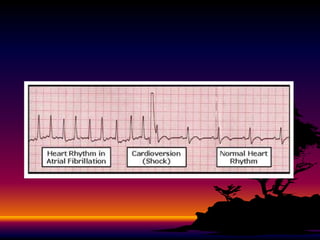
Cardioversion is a method to restore
a rapid heart beat back to normal
.
Cardioversion is used in
persons who have heart rhythm
problems (arrhythmias), which can
cause the heart to beat too fast
.
Most elective or non-emergency
Cardioversions are performed :
• To treat atrial fibrillation or atrial flutter to
regain heart rhythm.
• To treat disturbances originating in the
upper
Chambers (atria) of the heart.
Cardioversion
Cardioversion
Cardioversion is used in emergency
situations to correct a rapid abnormal
rhythm associated with faintness,
low blood pressure, chest pain,
difficulty breathing, or loss of
consciousness.
Types Of Cardioversion
Cardioversion can be "chemical" or
"electrical".
• Chemical cardioversion: refers to the
use of antiarrhythmia medications
to restore the heart's normal rhythm.
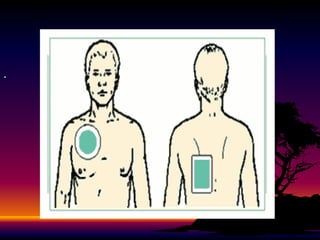
Electrical cardioversion : (also known
as " direct-current" or DC cardioversion);
is a procedure whereby a synchronized
electrical shock is delivered through the chest
wall to the heart through special electrodes
or paddles that are applied to the skin
of the chest and back.
Types Of Cardioversion
.
The goals of the electrical
cardioversion
• Is to disrupt the abnormal electrical
circuit(s) in the heart.
• To restore a normal heart beat .
Pharmacologic Cardioversion
Cardioversion can be done using drugs
that are taken by mouth or given through
an intravenous line (IV)
.
It can take several minutes to days for a
successful cardioversion
.
• If pharmacological cardioversion is done in
a hospital, your heart rate will be regularly
checked .
• Cardioversion using drugs can be done
outside the hospital, but this requires close
follow-up with a cardiologist.
Pharmacologic Cardioversion
Blood thining medicines may be given
with electrical cardioversion to prevent
clots from moving to the heart
.
Complications
Possible complications of cardioversion
are uncommon but may include
:
• Worsening of the arrhythmias.
• Blood clots that can cause a stroke or other
organ damage, bruising, burning or pain
where the paddles were used.
• Allergic reactions from medicines used in
pharmacologic cardioversion .
Equipment
• Defibrillator with a synchronising button.
• Emergency trolley with emergency drugs;
( lignocaine, atropine, and adrenaline ).
• Oxygen mask, intubation equipment,
airway .
• Monitor and continuous recording facilities.
Preparing for a
Cardioversion
 Do not eat or drink for at least eight hours
prior to the procedure.
 Take your regularly scheduled
medications the morning of the procedure
unless your medical practitioner has told
you otherwise .
 Bring a list of all your medications with
you.
Do not apply any lotions or ointments to
chest or back as this may interfere with the
adhesiveness of the shocking pads.
Do not drive yourself home after receiving
sedation anesthesia.
Preparing for a
Cardioversion
Do not operate a car, heavy
machinery, or make any important
decisions.
Stop digoxin before 48 hours prior the
procedure.
Apply ointment to the area to reduce the
discomfort.
Preparing for a
Cardioversion
Outcome
The procedure will be terminated either by
a successful reversion to sinus rhythm or
when the medical officer determines that
cardioversion will not revert the rhythm.
Defibrillation
Is a medical technique used to counter the
onset of ventricular fibrillation
nommoc a ,
fo esuac
cardiac arrest
sseleslup dna ,
ventricular tachycardia
,
In simple terms, the process uses an electric
shock to stop the heart arrhythmias, in the
hope that the heart will restart with rhythmic
contractions
.
History Of Defibrillation
Defibrillation was invented in
1899
by Prevost
and Batelli, two Italian physiologists. They
discovered that electric shocks could convert
ventricular fibrillation to sinus rhythm in dogs
.
The first case of a human life saved by
defibrillation was reported by Beck in
1947
.
The Purpose Of
Defibrillation
Is to apply a controlled electrical
shock to the heart, which leads to
depolarization of the entire electrical
conductive system of the heart
.
Types of Defibrillators
Internal Defibrillators
The device may be implanted directly in the
user of the device
.
So it is known as an Impalantable
cardioverter-defibrillator or (much less
frequently) an internal cardiac defibrillator
(ICD
(
.
This type of defibrillator is designed to
provide immediate defibrillation to high-risk
patients .
Implantable Cardioversion
Defibrillation
An implantable cardioverter-defibrillator (often
called an ICD) is a device that briefly passes an
electric current through the heart. It is
"implanted," or put in your body surgically. It
includes a pulse generator and one or more
leads. The pulse generator constantly watches
your heartbeat.
Automated
External defibrillator
(AEDs)
External defibrillators are typically used in
hospitals or ambulances, but are
increasingly common outside the
medical areas
.
As automated external defibrillators
become safer and cheaper
.
Types of Defibrillators
Methods Of Defibrillation
The shock is generally conducted through
the heart by two electrodes, in the form
of two hand-held paddles or adhesive
patches depending on the variety of the
defibrillator
.
Methods Of Defibrillation
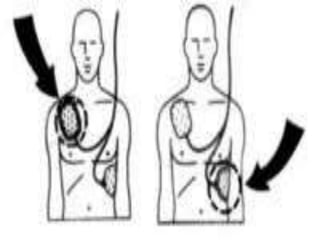
• One electrode is placed on the right
side of the front of the chest just below
the clavicle.
• The other electrode is placed on the left
side of the chest just below the pectoral
muscle of breast.
Open-chest defibrillators also exist, which
have electrodes in the form of two cup-
shaped paddles that surround the sides
of the heart and shock it directly
.
Open-chest defibrillators generally
require less energy to operate due to
direct contact with the heart
.
Methods Of Defibrillation
The number of attempts is in practice
limited to a series of three or four
attempts at increasing energies
.
The likelihood of restoring normal heart
rhythm is much less in successive
attempts
.
Methods Of Defibrillation
Differences Between
Cardioversion & Defibrillation
 One major difference between cardioversion
and defibrillation with the timing of the delivery
of electrical current .
 Another major difference concerns the
circumstance defibrillation usually performed
as an emergency treatment .
 Cardioversion is usually, but not always a
planned procedure .
Procedure
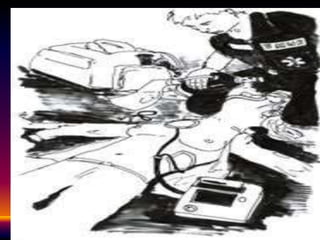
The most well-known type of electrode is the
traditional metal paddle with an
insulated handle
.
This type must be held in place on the
patient's skin while a shock or a series of
shocks is delivered
.
Procedure
Steps
• Place paddles so that they do not
touch pts clothing or bed linens or
not near direct oxygen supply.
• Ensure monitor is attached to pat.
• Do not charge the machine untill
ready to shock.
Procedure
• Exert 25 pound pressure on the
paddle.
• Ensure you and every body is free
of the pat.Inspect skin for burns.
• Record the delivered energy.
Treatment
Shock may be delivered, but it is not
regarded as the treatment of choice
.
Antiarrhthmic medications such as
amiodarone, cordorone, lidocaine
,
magnesium, or pronestly are given if
ventricular dysrhythmia persists
.
Treatment
The probability of a successful conversion is
very small according to the current
guidelines, in this situation, continued CPR in
order to improve the oxygenation of the heart
for a few minutes is preferred before
defibrillation is attempted
.
.
Warning
As the nurse applies the shock this is just
a warning to everyone around to stay
away from the patient for risk of
electrical shock
.
defibrillation-amp-cardioversion good.ppt

defibrillation-amp-cardioversion good.ppt

  • 2.
    Definition of Cardioversion Cardioversionis a method to restore a rapid heart beat back to normal . Cardioversion is used in persons who have heart rhythm problems (arrhythmias), which can cause the heart to beat too fast .
  • 4.
    Most elective ornon-emergency Cardioversions are performed : • To treat atrial fibrillation or atrial flutter to regain heart rhythm. • To treat disturbances originating in the upper Chambers (atria) of the heart. Cardioversion
  • 5.
    Cardioversion Cardioversion is usedin emergency situations to correct a rapid abnormal rhythm associated with faintness, low blood pressure, chest pain, difficulty breathing, or loss of consciousness.
  • 6.
    Types Of Cardioversion Cardioversioncan be "chemical" or "electrical". • Chemical cardioversion: refers to the use of antiarrhythmia medications to restore the heart's normal rhythm.
  • 7.
    Electrical cardioversion :(also known as " direct-current" or DC cardioversion); is a procedure whereby a synchronized electrical shock is delivered through the chest wall to the heart through special electrodes or paddles that are applied to the skin of the chest and back. Types Of Cardioversion
  • 8.
  • 9.
    The goals ofthe electrical cardioversion • Is to disrupt the abnormal electrical circuit(s) in the heart. • To restore a normal heart beat .
  • 10.
    Pharmacologic Cardioversion Cardioversion canbe done using drugs that are taken by mouth or given through an intravenous line (IV) . It can take several minutes to days for a successful cardioversion .
  • 11.
    • If pharmacologicalcardioversion is done in a hospital, your heart rate will be regularly checked . • Cardioversion using drugs can be done outside the hospital, but this requires close follow-up with a cardiologist. Pharmacologic Cardioversion
  • 12.
    Pharmacologic Cardioversion Blood thiningmedicines may be given with electrical cardioversion to prevent clots from moving to the heart .
  • 13.
    Complications Possible complications ofcardioversion are uncommon but may include : • Worsening of the arrhythmias. • Blood clots that can cause a stroke or other organ damage, bruising, burning or pain where the paddles were used. • Allergic reactions from medicines used in pharmacologic cardioversion .
  • 14.
    Equipment • Defibrillator witha synchronising button. • Emergency trolley with emergency drugs; ( lignocaine, atropine, and adrenaline ). • Oxygen mask, intubation equipment, airway . • Monitor and continuous recording facilities.
  • 15.
    Preparing for a Cardioversion Do not eat or drink for at least eight hours prior to the procedure.  Take your regularly scheduled medications the morning of the procedure unless your medical practitioner has told you otherwise .  Bring a list of all your medications with you.
  • 16.
    Do not applyany lotions or ointments to chest or back as this may interfere with the adhesiveness of the shocking pads. Do not drive yourself home after receiving sedation anesthesia. Preparing for a Cardioversion
  • 17.
    Do not operatea car, heavy machinery, or make any important decisions. Stop digoxin before 48 hours prior the procedure. Apply ointment to the area to reduce the discomfort. Preparing for a Cardioversion
  • 18.
    Outcome The procedure willbe terminated either by a successful reversion to sinus rhythm or when the medical officer determines that cardioversion will not revert the rhythm.
  • 19.
    Defibrillation Is a medicaltechnique used to counter the onset of ventricular fibrillation nommoc a , fo esuac cardiac arrest sseleslup dna , ventricular tachycardia , In simple terms, the process uses an electric shock to stop the heart arrhythmias, in the hope that the heart will restart with rhythmic contractions .
  • 20.
    History Of Defibrillation Defibrillationwas invented in 1899 by Prevost and Batelli, two Italian physiologists. They discovered that electric shocks could convert ventricular fibrillation to sinus rhythm in dogs . The first case of a human life saved by defibrillation was reported by Beck in 1947 .
  • 21.
    The Purpose Of Defibrillation Isto apply a controlled electrical shock to the heart, which leads to depolarization of the entire electrical conductive system of the heart .
  • 22.
    Types of Defibrillators InternalDefibrillators The device may be implanted directly in the user of the device . So it is known as an Impalantable cardioverter-defibrillator or (much less frequently) an internal cardiac defibrillator (ICD ( . This type of defibrillator is designed to provide immediate defibrillation to high-risk patients .
  • 23.
    Implantable Cardioversion Defibrillation An implantablecardioverter-defibrillator (often called an ICD) is a device that briefly passes an electric current through the heart. It is "implanted," or put in your body surgically. It includes a pulse generator and one or more leads. The pulse generator constantly watches your heartbeat.
  • 24.
    Automated External defibrillator (AEDs) External defibrillatorsare typically used in hospitals or ambulances, but are increasingly common outside the medical areas . As automated external defibrillators become safer and cheaper . Types of Defibrillators
  • 25.
    Methods Of Defibrillation Theshock is generally conducted through the heart by two electrodes, in the form of two hand-held paddles or adhesive patches depending on the variety of the defibrillator .
  • 26.
    Methods Of Defibrillation •One electrode is placed on the right side of the front of the chest just below the clavicle. • The other electrode is placed on the left side of the chest just below the pectoral muscle of breast.
  • 28.
    Open-chest defibrillators alsoexist, which have electrodes in the form of two cup- shaped paddles that surround the sides of the heart and shock it directly . Open-chest defibrillators generally require less energy to operate due to direct contact with the heart . Methods Of Defibrillation
  • 29.
    The number ofattempts is in practice limited to a series of three or four attempts at increasing energies . The likelihood of restoring normal heart rhythm is much less in successive attempts . Methods Of Defibrillation
  • 32.
    Differences Between Cardioversion &Defibrillation  One major difference between cardioversion and defibrillation with the timing of the delivery of electrical current .  Another major difference concerns the circumstance defibrillation usually performed as an emergency treatment .  Cardioversion is usually, but not always a planned procedure .
  • 33.
    Procedure The most well-knowntype of electrode is the traditional metal paddle with an insulated handle . This type must be held in place on the patient's skin while a shock or a series of shocks is delivered .
  • 34.
    Procedure Steps • Place paddlesso that they do not touch pts clothing or bed linens or not near direct oxygen supply. • Ensure monitor is attached to pat. • Do not charge the machine untill ready to shock.
  • 35.
    Procedure • Exert 25pound pressure on the paddle. • Ensure you and every body is free of the pat.Inspect skin for burns. • Record the delivered energy.
  • 37.
    Treatment Shock may bedelivered, but it is not regarded as the treatment of choice . Antiarrhthmic medications such as amiodarone, cordorone, lidocaine , magnesium, or pronestly are given if ventricular dysrhythmia persists .
  • 38.
    Treatment The probability ofa successful conversion is very small according to the current guidelines, in this situation, continued CPR in order to improve the oxygenation of the heart for a few minutes is preferred before defibrillation is attempted . .
  • 39.
    Warning As the nurseapplies the shock this is just a warning to everyone around to stay away from the patient for risk of electrical shock .