Management


 Chapter – 6 Decision Making
Introduction
Aim
   To Acquaint The
    Students With Steps
    Involved In Decision
    Making Process &
    Factors Influencing
    Decision Making
Group Members
   Fawad Hussain
   Rao Qaiser
   Rizwan Shaukat
   Naveed ur Rehman
Sequence
   Introduction
   Part – 1    Fundamentals of Decision Making : Fawad Hussain
   Part – 2    Managerial Decision Making:          Rao Qaiser
   Part – 3    Rational Decision Making :           Rao Qaiser
   Part – 3    Effective Decision Making :   Naveed ur Rehman
   Part – 4    Groups and Decision Making :     Rizwan Shaukat
   Conclusion
   Questions
Part – 1
What is Decision Making


   It is the process of recognizing a
    problem, generating an weighing
    alternatives, coming to a decision,
    taking action , and assessing the
    results
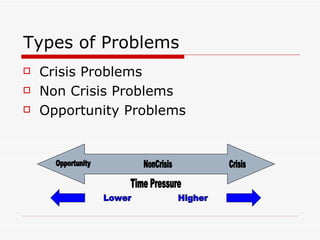
Types of Problems
   Crisis Problems
   Non Crisis Problems
   Opportunity Problems
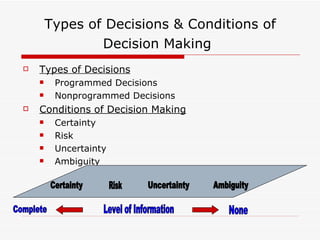
Types of Decisions & Conditions of
                Decision Making
   Types of Decisions
        Programmed Decisions
        Nonprogrammed Decisions
   Conditions of Decision Making
        Certainty
        Risk
        Uncertainty
        Ambiguity
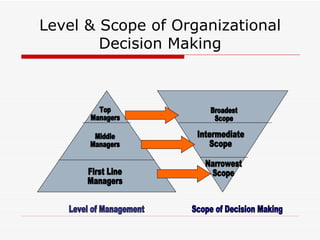
Level & Scope of Organizational
        Decision Making
Part – 2
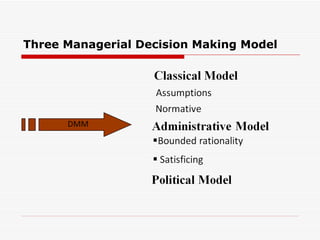
Three Managerial Decision Making Model
Part – 3
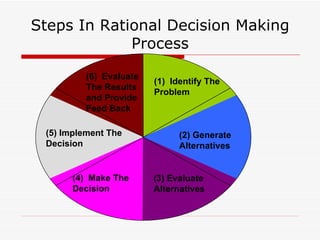
Steps In Rational Decision Making
             Process

          (6) Evaluate
                         (1) Identify The
          The Results
                         Problem
          and Provide
          Feed Back

 (5) Implement The             (2) Generate
 Decision                      Alternatives


      (4) Make The       (3) Evaluate
      Decision           Alternatives
Part – 4
MORE EFFECTIVE DECISION
             MAKING
   Barriers to effective decision making.

   Behavioral tools for effective decision
    making.

   Quantitative tools for effective decision
    making.
BARRIER TO EFFECTIVE
          DECISION MAKING


   Barriers are the imperfect or incomplete
    information, inaccurate identification of
    problems or alternatives, biases and over
    commitment or under commitment
   IMPERFECT OR INCOMPLETE INFORMATION.
    Imperfect or incomplete information is to
    withholding information or misinforming others.

   INACCURATE IDENTIFICATION OF PROBLEM OR
    ALTERNATIVES.
    It means When we ask wrong question we can't
    get the right answer.
   BIASES.
    In decision making bias refers to situations in
    which decision- making short cuts are
    inappropriately applied.


   OVER COMMITMENT OR UNDER COMMITMENT.
    It means exhibiting no rational escalation of
    commitment.
BEHAVIORAL TOOLS FOR EFFECTIVE
          DECISION MAKING

   Behavioral tools are the ways in which a person
    behaves in a situation.
    these tools are:-
       Decision timing.
       Realistic decision constraints.
       Critical thinking.
       Experience and expertise.
       Intuition .
BEHAVIORAL TOOLS
   Decision Timing.
    It is the time when the decision is to be made by comparing the
    benefits and the risks.

   Realistic Decision Constraints.
    By understanding constraints one can more realistically select an
    appropriate and acceptable solution.

   Critical Thinking Skills.
    To improve decision making is to develop critical thinking which
    help us think clearly, logically and analytically about the
    problems we face.
BEHAVIORAL TOOLS

   Experience and Expertise
    With decision making experience comes the ability to make
    decisions faster managers also need to develop their expertise
    in decision making so that they can recognize the key elements
    in each problem

   Intuition
    It is the ability to understand something immediately without
    the need for conscious reasoning. We should be intuitive in
    decision making.
QUANTITATIVE TOOLS FOR EFFECTIVE
            DECISION MAKING
   Quantitative tools are especially valuable when
    planning production, analyzing inventory levels and
    considering major budget expenditure.

    These tools are :-
      Payoff matrix

      Decision tree

      Simulation model
QUANTITATIVE TOOLS
   PAYOF MATRIX
    A tool that compare probable outcome of two or more
    alternatives.

   DECISION TREE
    An analytical tool that graphically portrays the logical
    series of actions and decisions in a problem situation.

   SIMULATION MODEL
    A mathematical representation of problems that reflect
    the relationship between the elements and it is used to
    project that result of certain actions under various
    circumstances.
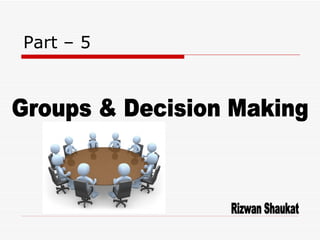
Part – 5
GROUPS AND DECISION MAKING
   Decision making is often an individual activity but there are many times when groups
    become involved in the process.

   Employee Participation in Decision Making
     Manager have a great deal of latitude when deciding to handle decision making alone
    or to involve others in the process.

   Group Decision – Making Formats
        Interacting Group.

        Nominal Groups.

        Delphi Groups.

   Impact of group Decision Making
     Group decision making has both benefits and limitation as compared with individual
    decision making.

   Benefits of Groups Decision
     When attacking a problem, group members are able to contribute more knowledge and
    information than individuals.
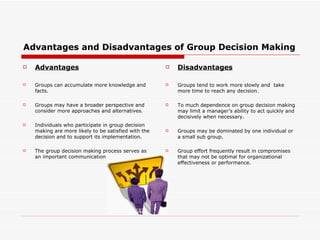
Advantages and Disadvantages of Group Decision Making

   Advantages                                           Disadvantages

   Groups can accumulate more knowledge and             Groups tend to work more slowly and take
    facts.                                                more time to reach any decision.

   Groups may have a broader perspective and            To much dependence on group decision making
    consider more approaches and alternatives.            may limit a manager’s ability to act quickly and
                                                          decisively when necessary.
   Individuals who participate in group decision
    making are more likely to be satisfied with the      Groups may be dominated by one individual or
    decision and to support its implementation.           a small sub group.

   The group decision making process serves as          Group effort frequently result in compromises
    an important communication devices.                   that may not be optimal for organizational
                                                          effectiveness or performance.
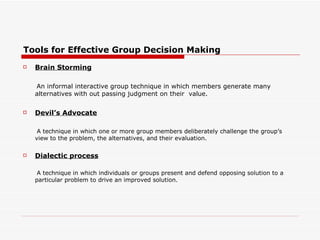
Tools for Effective Group Decision Making
   Brain Storming

    An informal interactive group technique in which members generate many
    alternatives with out passing judgment on their value.

   Devil’s Advocate

     A technique in which one or more group members deliberately challenge the group’s
    view to the problem, the alternatives, and their evaluation.

   Dialectic process

     A technique in which individuals or groups present and defend opposing solution to a
    particular problem to drive an improved solution.
Decision making   management chapter 6

Decision making management chapter 6

  • 1.
    Management Chapter –6 Decision Making
  • 2.
  • 3.
    Aim  To Acquaint The Students With Steps Involved In Decision Making Process & Factors Influencing Decision Making
  • 4.
    Group Members  Fawad Hussain  Rao Qaiser  Rizwan Shaukat  Naveed ur Rehman
  • 5.
    Sequence  Introduction  Part – 1 Fundamentals of Decision Making : Fawad Hussain  Part – 2 Managerial Decision Making: Rao Qaiser  Part – 3 Rational Decision Making : Rao Qaiser  Part – 3 Effective Decision Making : Naveed ur Rehman  Part – 4 Groups and Decision Making : Rizwan Shaukat  Conclusion  Questions
  • 6.
  • 7.
    What is DecisionMaking  It is the process of recognizing a problem, generating an weighing alternatives, coming to a decision, taking action , and assessing the results
  • 8.
    Types of Problems  Crisis Problems  Non Crisis Problems  Opportunity Problems
  • 9.
    Types of Decisions& Conditions of Decision Making  Types of Decisions  Programmed Decisions  Nonprogrammed Decisions  Conditions of Decision Making  Certainty  Risk  Uncertainty  Ambiguity
  • 10.
    Level & Scopeof Organizational Decision Making
  • 11.
  • 12.
  • 13.
  • 14.
    Steps In RationalDecision Making Process (6) Evaluate (1) Identify The The Results Problem and Provide Feed Back (5) Implement The (2) Generate Decision Alternatives (4) Make The (3) Evaluate Decision Alternatives
  • 15.
  • 16.
    MORE EFFECTIVE DECISION MAKING  Barriers to effective decision making.  Behavioral tools for effective decision making.  Quantitative tools for effective decision making.
  • 17.
    BARRIER TO EFFECTIVE DECISION MAKING  Barriers are the imperfect or incomplete information, inaccurate identification of problems or alternatives, biases and over commitment or under commitment
  • 18.
    IMPERFECT OR INCOMPLETE INFORMATION. Imperfect or incomplete information is to withholding information or misinforming others.  INACCURATE IDENTIFICATION OF PROBLEM OR ALTERNATIVES. It means When we ask wrong question we can't get the right answer.
  • 19.
    BIASES. In decision making bias refers to situations in which decision- making short cuts are inappropriately applied.  OVER COMMITMENT OR UNDER COMMITMENT. It means exhibiting no rational escalation of commitment.
  • 20.
    BEHAVIORAL TOOLS FOREFFECTIVE DECISION MAKING  Behavioral tools are the ways in which a person behaves in a situation. these tools are:-  Decision timing.  Realistic decision constraints.  Critical thinking.  Experience and expertise.  Intuition .
  • 21.
    BEHAVIORAL TOOLS  Decision Timing. It is the time when the decision is to be made by comparing the benefits and the risks.  Realistic Decision Constraints. By understanding constraints one can more realistically select an appropriate and acceptable solution.  Critical Thinking Skills. To improve decision making is to develop critical thinking which help us think clearly, logically and analytically about the problems we face.
  • 22.
    BEHAVIORAL TOOLS  Experience and Expertise With decision making experience comes the ability to make decisions faster managers also need to develop their expertise in decision making so that they can recognize the key elements in each problem  Intuition It is the ability to understand something immediately without the need for conscious reasoning. We should be intuitive in decision making.
  • 23.
    QUANTITATIVE TOOLS FOREFFECTIVE DECISION MAKING  Quantitative tools are especially valuable when planning production, analyzing inventory levels and considering major budget expenditure. These tools are :-  Payoff matrix  Decision tree  Simulation model
  • 24.
    QUANTITATIVE TOOLS  PAYOF MATRIX A tool that compare probable outcome of two or more alternatives.  DECISION TREE An analytical tool that graphically portrays the logical series of actions and decisions in a problem situation.  SIMULATION MODEL A mathematical representation of problems that reflect the relationship between the elements and it is used to project that result of certain actions under various circumstances.
  • 25.
  • 26.
    GROUPS AND DECISIONMAKING  Decision making is often an individual activity but there are many times when groups become involved in the process.  Employee Participation in Decision Making Manager have a great deal of latitude when deciding to handle decision making alone or to involve others in the process.  Group Decision – Making Formats  Interacting Group.  Nominal Groups.  Delphi Groups.  Impact of group Decision Making Group decision making has both benefits and limitation as compared with individual decision making.  Benefits of Groups Decision When attacking a problem, group members are able to contribute more knowledge and information than individuals.
  • 27.
    Advantages and Disadvantagesof Group Decision Making  Advantages  Disadvantages  Groups can accumulate more knowledge and  Groups tend to work more slowly and take facts. more time to reach any decision.  Groups may have a broader perspective and  To much dependence on group decision making consider more approaches and alternatives. may limit a manager’s ability to act quickly and decisively when necessary.  Individuals who participate in group decision making are more likely to be satisfied with the  Groups may be dominated by one individual or decision and to support its implementation. a small sub group.  The group decision making process serves as  Group effort frequently result in compromises an important communication devices. that may not be optimal for organizational effectiveness or performance.
  • 28.
    Tools for EffectiveGroup Decision Making  Brain Storming An informal interactive group technique in which members generate many alternatives with out passing judgment on their value.  Devil’s Advocate A technique in which one or more group members deliberately challenge the group’s view to the problem, the alternatives, and their evaluation.  Dialectic process A technique in which individuals or groups present and defend opposing solution to a particular problem to drive an improved solution.