Slide content created by Joseph B. Mosca, Monmouth University.
Copyright © Houghton Mifflin Company. All rights reserved.
9
Ready Notes
Managing Decision
Making and Problem
Solving
For in-class note taking, choose Handouts
or Notes Pages from the print options, with
three slides per page.
SEYAM RAYHAN SHARKAR
Copyright © Houghton Mifflin Company. All rights reserved. 1 - 2
Copyright © Houghton Mifflin Company. All rights reserved. 9 - 3
The Nature of Decision Making
Decision making:
– The act of choosing one
alternative from among a
set of alternatives.
Decision-making process:
– Recognizing and defining
the nature of a decision
situation, identifying
alternatives, choosing the
“best” alternative, and
putting it into practice.
Copyright © Houghton Mifflin Company. All rights reserved. 9 - 4
Types of Decisions
Programmed decision:
– A decision that is fairly
structured or recurs with
some frequency (or both).
Non-programmed decision:
– A decision that is relatively
unstructured and occurs
much less often than a
PROGRAMMED DECISION.
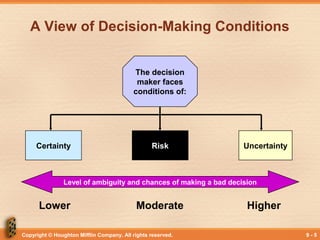
Copyright © Houghton Mifflin Company. All rights reserved. 9 - 5
A View of Decision-Making Conditions
Certainty Risk Uncertainty
Level of ambiguity and chances of making a bad decision
Lower Moderate Higher
The decision
maker faces
conditions of:
Copyright © Houghton Mifflin Company. All rights reserved. 9 - 6
Decision-Making Conditions
State of certainty:
– A condition in which the
decision maker knows with
reasonable certainty what
the alternatives are and
what conditions are
associated with each
alternative.
State of risk:
– A condition in which the
availability of each
alternative and its potential
payoffs and costs are all
associated with probability
estimates.
Copyright © Houghton Mifflin Company. All rights reserved. 9 - 7
State of Uncertainty
• A condition in which
the decision maker
does not know all
the alternatives, the
risks associated with
each, or the likely
consequences of
each alternative.
Copyright © Houghton Mifflin Company. All rights reserved. 9 - 8
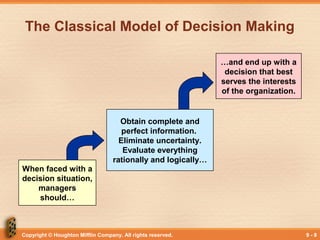
Obtain complete and
perfect information.
Eliminate uncertainty.
Evaluate everything
rationally and logically…
The Classical Model of Decision Making
When faced with a
decision situation,
managers
should…
…and end up with a
decision that best
serves the interests
of the organization.
Copyright © Houghton Mifflin Company. All rights reserved. 9 - 9
Rational Perspectives on Decision Making
Classical model:
– A prescriptive approach to
decision making that tells
managers how they should
make decisions. It
assumes that managers
are logical and rational and
that they make decisions
that are in the best
interests of the
organization.
Copyright © Houghton Mifflin Company. All rights reserved. 9 - 10
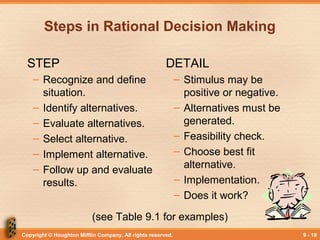
Steps in Rational Decision Making
STEP
– Recognize and define
situation.
– Identify alternatives.
– Evaluate alternatives.
– Select alternative.
– Implement alternative.
– Follow up and evaluate
results.
DETAIL
– Stimulus may be
positive or negative.
– Alternatives must be
generated.
– Feasibility check.
– Choose best fit
alternative.
– Implementation.
– Does it work?
(see Table 9.1 for examples)
Copyright © Houghton Mifflin Company. All rights reserved. 9 - 11
Copyright © Houghton Mifflin Company. All rights reserved. 9 - 12
Identifying Alternatives
• When the decision situation has been
recognized and defined, the second
step is to identify alternative courses.
• The third step in the decision-making
process is evaluating each alternative.
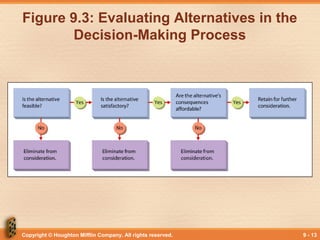
• See next slide Figure 9.3 for an
illustration of a decision tree.
Copyright © Houghton Mifflin Company. All rights reserved. 9 - 13
Figure 9.3: Evaluating Alternatives in the
Decision-Making Process
Copyright © Houghton Mifflin Company. All rights reserved. 9 - 14
Behavioral Aspects of Decision Making
The Administrative Model:
– A decision making model showing
that managers:
1. Have incomplete and imperfect
information.
2. Are constrained by bounded
rationality.
3. Tend to satisfice when making
decisions.
Copyright © Houghton Mifflin Company. All rights reserved. 9 - 15
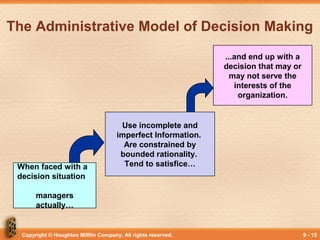
...and end up with a
decision that may or
may not serve the
interests of the
organization.
The Administrative Model of Decision Making
Use incomplete and
imperfect Information.
Are constrained by
bounded rationality.
Tend to satisfice…When faced with a
decision situation
managers
actually…
Copyright © Houghton Mifflin Company. All rights reserved. 9 - 16
Bounded Rationality
• A concept suggesting that decision
makers are limited by their values and
unconscious:
A. Values.
B. Unconscious reflexes.
C. Skills.
D. Habits.
Copyright © Houghton Mifflin Company. All rights reserved. 9 - 17
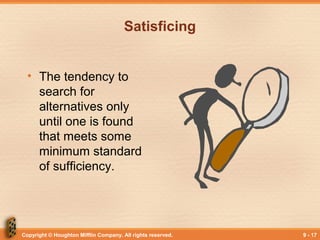
Satisficing
• The tendency to
search for
alternatives only
until one is found
that meets some
minimum standard
of sufficiency.
Copyright © Houghton Mifflin Company. All rights reserved. 9 - 18
Political Forces in Decision Making
Coalition:
– An informal alliance of
groups formed to
achieve a common
goal.
Copyright © Houghton Mifflin Company. All rights reserved. 9 - 19
Intuition and Escalation of Commitment
Intuition:
– An innate belief about
something without
conscious
consideration.
Escalation of
commitment:
– A decision maker’s
staying with a decision
even when it appears
to be wrong.
Copyright © Houghton Mifflin Company. All rights reserved. 9 - 20
Risk Propensity and Decision Making
Risk propensity:
– The extent to which a
decision maker is
willing to gamble when
making a decision.
Copyright © Houghton Mifflin Company. All rights reserved. 9 - 21
Group and Team Decision Making in
Organizations
Forms of Group and Team Decision
Making:
– Interacting group or team:
• A decision making group or team in which
members openly discuss, argue about, and
agree on the best alternative.
– Delphi group:
• A form of group decision making in which a
group solicits input from a panel of experts who
contribute individually; their opinions are
combined and, in effect, averaged.
Copyright © Houghton Mifflin Company. All rights reserved. 9 - 22
Nominal Groups
• Unlike the Delphi method where group
members do not see one another, this
group is brought together.
• A structured technique used most often
to generate:
– Creativity.
– Innovative alternatives.
– Ideas.
Copyright © Houghton Mifflin Company. All rights reserved. 9 - 23
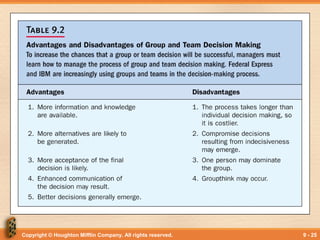
Advantages and Disadvantages of Group and
Team Decision Making
ADVANTAGES
– More information
and knowledge
available.
– More alternatives
generated.
– More acceptance.
– Enhanced
communication.
– Better discussions.
DISADVANTAGES
– The process takes
longer.
– Compromised
decisions result from
indecisiveness.
– One person may
dominate.
– Groupthink may
occur.
Copyright © Houghton Mifflin Company. All rights reserved. 9 - 24
Groupthink
• A situation that
occurs when a
group or team’s
desire for
consensus and
cohesiveness
overwhelms the goal
of reaching the best
possible decision.
Copyright © Houghton Mifflin Company. All rights reserved. 9 - 25

Managing decision making and problem solving

  • 1.
    Slide content createdby Joseph B. Mosca, Monmouth University. Copyright © Houghton Mifflin Company. All rights reserved. 9 Ready Notes Managing Decision Making and Problem Solving For in-class note taking, choose Handouts or Notes Pages from the print options, with three slides per page.
  • 2.
    SEYAM RAYHAN SHARKAR Copyright© Houghton Mifflin Company. All rights reserved. 1 - 2
  • 3.
    Copyright © HoughtonMifflin Company. All rights reserved. 9 - 3 The Nature of Decision Making Decision making: – The act of choosing one alternative from among a set of alternatives. Decision-making process: – Recognizing and defining the nature of a decision situation, identifying alternatives, choosing the “best” alternative, and putting it into practice.
  • 4.
    Copyright © HoughtonMifflin Company. All rights reserved. 9 - 4 Types of Decisions Programmed decision: – A decision that is fairly structured or recurs with some frequency (or both). Non-programmed decision: – A decision that is relatively unstructured and occurs much less often than a PROGRAMMED DECISION.
  • 5.
    Copyright © HoughtonMifflin Company. All rights reserved. 9 - 5 A View of Decision-Making Conditions Certainty Risk Uncertainty Level of ambiguity and chances of making a bad decision Lower Moderate Higher The decision maker faces conditions of:
  • 6.
    Copyright © HoughtonMifflin Company. All rights reserved. 9 - 6 Decision-Making Conditions State of certainty: – A condition in which the decision maker knows with reasonable certainty what the alternatives are and what conditions are associated with each alternative. State of risk: – A condition in which the availability of each alternative and its potential payoffs and costs are all associated with probability estimates.
  • 7.
    Copyright © HoughtonMifflin Company. All rights reserved. 9 - 7 State of Uncertainty • A condition in which the decision maker does not know all the alternatives, the risks associated with each, or the likely consequences of each alternative.
  • 8.
    Copyright © HoughtonMifflin Company. All rights reserved. 9 - 8 Obtain complete and perfect information. Eliminate uncertainty. Evaluate everything rationally and logically… The Classical Model of Decision Making When faced with a decision situation, managers should… …and end up with a decision that best serves the interests of the organization.
  • 9.
    Copyright © HoughtonMifflin Company. All rights reserved. 9 - 9 Rational Perspectives on Decision Making Classical model: – A prescriptive approach to decision making that tells managers how they should make decisions. It assumes that managers are logical and rational and that they make decisions that are in the best interests of the organization.
  • 10.
    Copyright © HoughtonMifflin Company. All rights reserved. 9 - 10 Steps in Rational Decision Making STEP – Recognize and define situation. – Identify alternatives. – Evaluate alternatives. – Select alternative. – Implement alternative. – Follow up and evaluate results. DETAIL – Stimulus may be positive or negative. – Alternatives must be generated. – Feasibility check. – Choose best fit alternative. – Implementation. – Does it work? (see Table 9.1 for examples)
  • 11.
    Copyright © HoughtonMifflin Company. All rights reserved. 9 - 11
  • 12.
    Copyright © HoughtonMifflin Company. All rights reserved. 9 - 12 Identifying Alternatives • When the decision situation has been recognized and defined, the second step is to identify alternative courses. • The third step in the decision-making process is evaluating each alternative. • See next slide Figure 9.3 for an illustration of a decision tree.
  • 13.
    Copyright © HoughtonMifflin Company. All rights reserved. 9 - 13 Figure 9.3: Evaluating Alternatives in the Decision-Making Process
  • 14.
    Copyright © HoughtonMifflin Company. All rights reserved. 9 - 14 Behavioral Aspects of Decision Making The Administrative Model: – A decision making model showing that managers: 1. Have incomplete and imperfect information. 2. Are constrained by bounded rationality. 3. Tend to satisfice when making decisions.
  • 15.
    Copyright © HoughtonMifflin Company. All rights reserved. 9 - 15 ...and end up with a decision that may or may not serve the interests of the organization. The Administrative Model of Decision Making Use incomplete and imperfect Information. Are constrained by bounded rationality. Tend to satisfice…When faced with a decision situation managers actually…
  • 16.
    Copyright © HoughtonMifflin Company. All rights reserved. 9 - 16 Bounded Rationality • A concept suggesting that decision makers are limited by their values and unconscious: A. Values. B. Unconscious reflexes. C. Skills. D. Habits.
  • 17.
    Copyright © HoughtonMifflin Company. All rights reserved. 9 - 17 Satisficing • The tendency to search for alternatives only until one is found that meets some minimum standard of sufficiency.
  • 18.
    Copyright © HoughtonMifflin Company. All rights reserved. 9 - 18 Political Forces in Decision Making Coalition: – An informal alliance of groups formed to achieve a common goal.
  • 19.
    Copyright © HoughtonMifflin Company. All rights reserved. 9 - 19 Intuition and Escalation of Commitment Intuition: – An innate belief about something without conscious consideration. Escalation of commitment: – A decision maker’s staying with a decision even when it appears to be wrong.
  • 20.
    Copyright © HoughtonMifflin Company. All rights reserved. 9 - 20 Risk Propensity and Decision Making Risk propensity: – The extent to which a decision maker is willing to gamble when making a decision.
  • 21.
    Copyright © HoughtonMifflin Company. All rights reserved. 9 - 21 Group and Team Decision Making in Organizations Forms of Group and Team Decision Making: – Interacting group or team: • A decision making group or team in which members openly discuss, argue about, and agree on the best alternative. – Delphi group: • A form of group decision making in which a group solicits input from a panel of experts who contribute individually; their opinions are combined and, in effect, averaged.
  • 22.
    Copyright © HoughtonMifflin Company. All rights reserved. 9 - 22 Nominal Groups • Unlike the Delphi method where group members do not see one another, this group is brought together. • A structured technique used most often to generate: – Creativity. – Innovative alternatives. – Ideas.
  • 23.
    Copyright © HoughtonMifflin Company. All rights reserved. 9 - 23 Advantages and Disadvantages of Group and Team Decision Making ADVANTAGES – More information and knowledge available. – More alternatives generated. – More acceptance. – Enhanced communication. – Better discussions. DISADVANTAGES – The process takes longer. – Compromised decisions result from indecisiveness. – One person may dominate. – Groupthink may occur.
  • 24.
    Copyright © HoughtonMifflin Company. All rights reserved. 9 - 24 Groupthink • A situation that occurs when a group or team’s desire for consensus and cohesiveness overwhelms the goal of reaching the best possible decision.
  • 25.
    Copyright © HoughtonMifflin Company. All rights reserved. 9 - 25