.
Present by-
Pranab sarkar
4th sem
MEANING OF PLANING
 Planning is a projected course of
action and through planning we can
achieve goal
 Planning is deciding in advance what
to do, how to do it, when to do it and
who to do it.
NATURE OF PLANNING
 Planning is a goal oriented.
 Pervasiveness of planning.
 Planning should be efficient.
 Planning should help in economy.
 Planning helps in coordination.
 Planning helps in flexibility.
 Planning is a primary function
 Planning is all-pervasive
 Planning is a continuous process
 Planning is forward-looking
 Planning involves choice
 Planning is directed toward efficiency
IMPORTANCE OF
PLANNING
 Planning helps to set the objectives.
 Planning helps to avoid the
uncertainty and change.
 Planning helps in coordination.
 Planning helps to make the control
effective.
 Planning helps to run the organization
effectively.
Importance of planning
 Focuses attention on objectives and
result
 Reduces uncertainty and risk
 Provides sense of direction
 Encourages innovation and creativity
 Helps in co-ordination
 Guides decision-making
 Provide efficiency in operation
ADVANTAGE OF PLANNING
 Planning helps in future change.
 Planning helps to set up the standard
for organization.
 Planning says the proper utilization of
resources.
 Planning helps to win over competitors
and rivals.
DISADVANTAGE OF PLANNING
 Planning is costly.
 Planning delays action.
 Planning encourage the risk of
uncertainty.
 Planning cannot change the
organizational rules.
PLANNING PROCESS
 Analyze the external environment.
 Analyze the internal environment.
 Determining your mission and
objective.
 Forecasting.
 Determining your alternative course of
action.
 Selecting the best performing and
review.
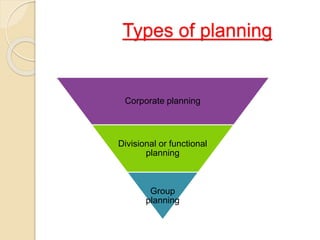
Types of planning
Corporate planning
Divisional or functional
planning
Group
planning
Group or sectional planning
Group or sectional planning refers to planning
for specific groups or section within a
department or division .
group or sectional planning are formulated
mainly at the opreting level of management .
They have to approved by higher authorities.
Departmental or Divisional
Planning
Such planning includes the plans
formulated for various departments or
division of an enterprise. it determines
the scope and activities of a particular
department.
Departmental or divisional plans
are formulated at the middle level of
management and approved by the top
management.
corporate planning
Planning for the company as a whole is
known as corporate planning. It lays
down objectives, strategies, and
policies for the entire organization.
corporate planning is done at the
top level of management.

7.planning

  • 1.
  • 2.
    MEANING OF PLANING Planning is a projected course of action and through planning we can achieve goal  Planning is deciding in advance what to do, how to do it, when to do it and who to do it.
  • 3.
    NATURE OF PLANNING Planning is a goal oriented.  Pervasiveness of planning.  Planning should be efficient.  Planning should help in economy.  Planning helps in coordination.  Planning helps in flexibility.  Planning is a primary function  Planning is all-pervasive  Planning is a continuous process  Planning is forward-looking  Planning involves choice  Planning is directed toward efficiency
  • 4.
    IMPORTANCE OF PLANNING  Planninghelps to set the objectives.  Planning helps to avoid the uncertainty and change.  Planning helps in coordination.  Planning helps to make the control effective.  Planning helps to run the organization effectively.
  • 5.
    Importance of planning Focuses attention on objectives and result  Reduces uncertainty and risk  Provides sense of direction  Encourages innovation and creativity  Helps in co-ordination  Guides decision-making  Provide efficiency in operation
  • 6.
    ADVANTAGE OF PLANNING Planning helps in future change.  Planning helps to set up the standard for organization.  Planning says the proper utilization of resources.  Planning helps to win over competitors and rivals.
  • 7.
    DISADVANTAGE OF PLANNING Planning is costly.  Planning delays action.  Planning encourage the risk of uncertainty.  Planning cannot change the organizational rules.
  • 8.
    PLANNING PROCESS  Analyzethe external environment.  Analyze the internal environment.  Determining your mission and objective.  Forecasting.  Determining your alternative course of action.  Selecting the best performing and review.
  • 9.
    Types of planning Corporateplanning Divisional or functional planning Group planning
  • 10.
    Group or sectionalplanning Group or sectional planning refers to planning for specific groups or section within a department or division . group or sectional planning are formulated mainly at the opreting level of management . They have to approved by higher authorities.
  • 11.
    Departmental or Divisional Planning Suchplanning includes the plans formulated for various departments or division of an enterprise. it determines the scope and activities of a particular department. Departmental or divisional plans are formulated at the middle level of management and approved by the top management.
  • 12.
    corporate planning Planning forthe company as a whole is known as corporate planning. It lays down objectives, strategies, and policies for the entire organization. corporate planning is done at the top level of management.