I.D.E.A.L. Decision Making
Melissa Rodgers
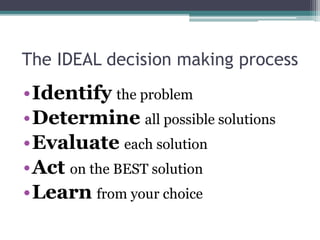
The IDEAL decision making process
•Identify the problem
•Determine all possible solutions
•Evaluate each solution
•Act on the BEST solution
•Learn from your choice
IDENTIFY:
• Figure out what the problem is
Determine:
• Make a list of all the ways you could solve this
problem.
• Even if the solutions are not right or far fetched
Evaluate:
• Think about the pros and cons of each solution
you came up with.
• What is the good thing about handling the
situation one way and what is the a bad thing
Act
• From your list of solutions with their pros and
cons, decide what is the BEST course of action
Learn
• After you act, reflect on if you made the best
choice and what you could do different next
time.
Example:
• You and a friend are at your house and there are
no parents home. Your friend really wants you
to drive around town in your parent’s car. You
have just started drivers education and you do
not have your drivers license yet. Using the
IDEAL process what do you do?
Example:
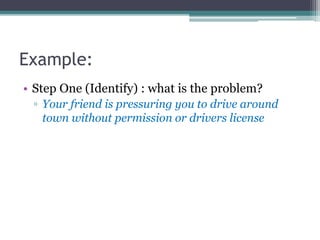
• Step One (Identify) : what is the problem?
▫ Your friend is pressuring you to drive around
town without permission or drivers license
Example:
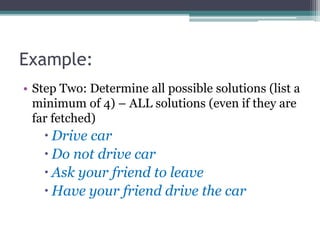
• Step Two: Determine all possible solutions (list a
minimum of 4) – ALL solutions (even if they are
far fetched)
 Drive car
 Do not drive car
 Ask your friend to leave
 Have your friend drive the car
Example
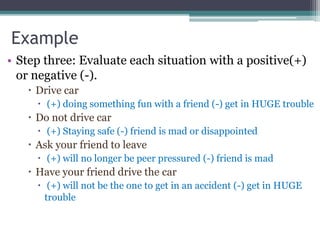
• Step three: Evaluate each situation with a positive(+)
or negative (-).
 Drive car
 (+) doing something fun with a friend (-) get in HUGE trouble
 Do not drive car
 (+) Staying safe (-) friend is mad or disappointed
 Ask your friend to leave
 (+) will no longer be peer pressured (-) friend is mad
 Have your friend drive the car
 (+) will not be the one to get in an accident (-) get in HUGE
trouble
Example
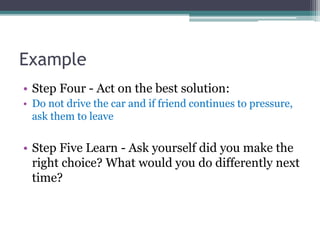
• Step Four - Act on the best solution:
• Do not drive the car and if friend continues to pressure,
ask them to leave
• Step Five Learn - Ask yourself did you make the
right choice? What would you do differently next
time?

IDEAL

  • 1.
  • 2.
    The IDEAL decisionmaking process •Identify the problem •Determine all possible solutions •Evaluate each solution •Act on the BEST solution •Learn from your choice
  • 3.
    IDENTIFY: • Figure outwhat the problem is
  • 4.
    Determine: • Make alist of all the ways you could solve this problem. • Even if the solutions are not right or far fetched
  • 5.
    Evaluate: • Think aboutthe pros and cons of each solution you came up with. • What is the good thing about handling the situation one way and what is the a bad thing
  • 6.
    Act • From yourlist of solutions with their pros and cons, decide what is the BEST course of action
  • 7.
    Learn • After youact, reflect on if you made the best choice and what you could do different next time.
  • 8.
    Example: • You anda friend are at your house and there are no parents home. Your friend really wants you to drive around town in your parent’s car. You have just started drivers education and you do not have your drivers license yet. Using the IDEAL process what do you do?
  • 9.
    Example: • Step One(Identify) : what is the problem? ▫ Your friend is pressuring you to drive around town without permission or drivers license
  • 10.
    Example: • Step Two:Determine all possible solutions (list a minimum of 4) – ALL solutions (even if they are far fetched)  Drive car  Do not drive car  Ask your friend to leave  Have your friend drive the car
  • 11.
    Example • Step three:Evaluate each situation with a positive(+) or negative (-).  Drive car  (+) doing something fun with a friend (-) get in HUGE trouble  Do not drive car  (+) Staying safe (-) friend is mad or disappointed  Ask your friend to leave  (+) will no longer be peer pressured (-) friend is mad  Have your friend drive the car  (+) will not be the one to get in an accident (-) get in HUGE trouble
  • 12.
    Example • Step Four- Act on the best solution: • Do not drive the car and if friend continues to pressure, ask them to leave • Step Five Learn - Ask yourself did you make the right choice? What would you do differently next time?