ninth edition
STEPHEN P. ROBBINS
PowerPoint Presentation by Charlie Cook
The University of West Alabama
MARY COULTER
Decision-Making:
The Essence of
the Manager’s Job
6–2
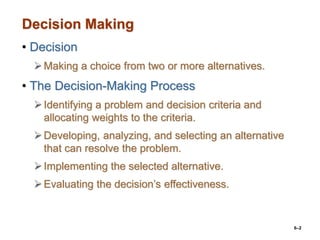
Decision Making
• Decision
Making a choice from two or more alternatives.
• The Decision-Making Process
Identifying a problem and decision criteria and
allocating weights to the criteria.
Developing, analyzing, and selecting an alternative
that can resolve the problem.
Implementing the selected alternative.
Evaluating the decision’s effectiveness.
6–3
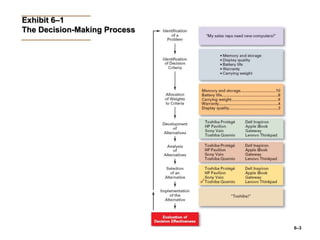
Exhibit 6–1
The Decision-Making Process
6–4
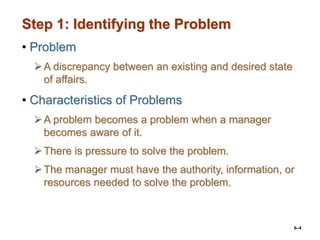
Step 1: Identifying the Problem
• Problem
A discrepancy between an existing and desired state
of affairs.
• Characteristics of Problems
A problem becomes a problem when a manager
becomes aware of it.
There is pressure to solve the problem.
The manager must have the authority, information, or
resources needed to solve the problem.
6–5
Step 2: Identifying Decision Criteria
• Decision criteria are factors that are important
(relevant) to resolving the problem.
Costs that will be incurred (investments required)
Risks likely to be encountered (chance of failure)
Outcomes that are desired (growth of the firm)
Step 3: Allocating Weights to the Criteria
• Decision criteria are not of equal importance:
Assigning a weight to each item places the items in
the correct priority order of their importance in the
decision making process.
6–6
Step 4: Developing Alternatives
• Identifying viable alternatives
Alternatives are listed (without evaluation) that can
resolve the problem.
Step 5: Analyzing Alternatives
• Appraising each alternative’s strengths and
weaknesses
An alternative’s appraisal is based on its ability to
resolve the issues identified in steps 2 and 3.
6–7
Step 6: Selecting an Alternative
• Choosing the best alternative
The alternative with the highest total weight is
chosen.
Step 7: Implementing the Alternative
• Putting the chosen alternative into action.
Conveying the decision to and gaining commitment
from those who will carry out the decision.
6–8
Step 8: Evaluating the Decision’s
Effectiveness
• The soundness of the decision is judged by its
outcomes.
How effectively was the problem resolved by
outcomes resulting from the chosen alternatives?
If the problem was not resolved, what went wrong?
6–9
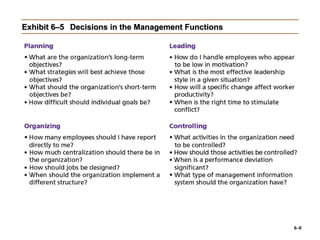
Exhibit 6–5 Decisions in the Management Functions
6–10
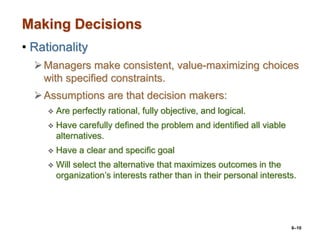
Making Decisions
• Rationality
Managers make consistent, value-maximizing choices
with specified constraints.
Assumptions are that decision makers:
 Are perfectly rational, fully objective, and logical.
 Have carefully defined the problem and identified all viable
alternatives.
 Have a clear and specific goal
 Will select the alternative that maximizes outcomes in the
organization’s interests rather than in their personal interests.
6–11
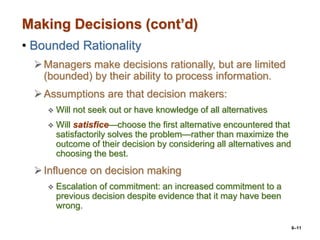
Making Decisions (cont’d)
• Bounded Rationality
Managers make decisions rationally, but are limited
(bounded) by their ability to process information.
Assumptions are that decision makers:
 Will not seek out or have knowledge of all alternatives
 Will satisfice—choose the first alternative encountered that
satisfactorily solves the problem—rather than maximize the
outcome of their decision by considering all alternatives and
choosing the best.
Influence on decision making
 Escalation of commitment: an increased commitment to a
previous decision despite evidence that it may have been
wrong.
6–12
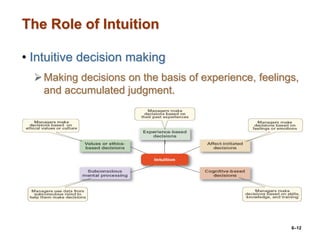
The Role of Intuition
• Intuitive decision making
Making decisions on the basis of experience, feelings,
and accumulated judgment.
6–13
Types of Problems and Decisions
• Structured Problems
Involve goals that clear.
Are familiar (have occurred before).
Are easily and completely defined—information about
the problem is available and complete.
• Programmed Decision
A repetitive decision that can be handled by a routine
approach.
6–14
Types of Programmed Decisions
• Policy
A general guideline for making a decision about a
structured problem.
• Procedure
A series of interrelated steps that a manager can use
to respond (applying a policy) to a structured problem.
• Rule
An explicit statement that limits what a manager or
employee can or cannot do.
6–15
Policy, Procedure, and Rule Examples
• Policy
Accept all customer-returned merchandise.
• Procedure
Follow all steps for completing merchandise return
documentation.
• Rules
Managers must approve all refunds over $50.00.
No credit purchases are refunded for cash.
6–16
Problems and Decisions (cont’d)
• Unstructured Problems
Problems that are new or unusual and for which
information is ambiguous or incomplete.
Problems that will require custom-made solutions.
• Nonprogrammed Decisions
Decisions that are unique and nonrecurring.
Decisions that generate unique responses.
6–17
Decision-Making Conditions
• Certainty
A situation in which a manager can make an accurate
decision because the outcome of every alternative
choice is known.
• Risk
A situation in which the manager is able to estimate
the likelihood (probability) of outcomes that result
from the choice of particular alternatives.
6–18
Decision-Making Conditions
• Uncertainty
Limited information prevents estimation of outcome
probabilities for alternatives associated with the
problem and may force managers to rely on intuition,
hunches, and “gut feelings”.
6–19
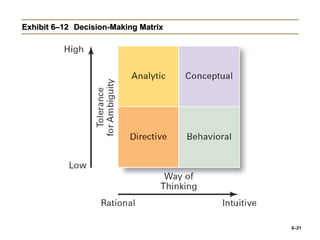
Decision-Making Styles
• Dimensions of Decision-Making Styles
Ways of thinking
 Rational, orderly, and consistent
 Intuitive, creative, and unique
Tolerance for ambiguity
 Low tolerance: require consistency and order
 High tolerance: multiple thoughts simultaneously
6–20
Decision-Making Styles (cont’d)
• Types of Decision Makers
Directive
 Use minimal information and consider few alternatives.
Analytic
 Make careful decisions in unique situations.
Conceptual
 Maintain a broad outlook and consider many alternatives in
making decisions.
Behavioral
 Avoid conflict by working well with others and being receptive
to suggestions.
6–21
Exhibit 6–12 Decision-Making Matrix
6–22
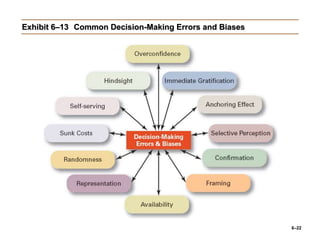
Exhibit 6–13 Common Decision-Making Errors and Biases
6–23
Decision Making for Today’s World
• Guidelines for making effective decisions:
Understand cultural differences.
Know when it’s time to call it quits.
Use an effective decision-making process.
• Habits of highly reliable organizations (HROs)
Are not tricked by their success.
Defer to the experts on the front line.
Let unexpected circumstances provide the solution.
Embrace complexity.
Anticipate, but also anticipate their limits.
6–24
Characteristics of an Effective Decision-
Making Process
• It focuses on what is important.
• It is logical and consistent.
• It acknowledges both subjective and objective thinking
and blends analytical with intuitive thinking.
• It requires only as much information and analysis as is
necessary to resolve a particular dilemma.
• It encourages and guides the gathering of relevant
information and informed opinion.
• It is straightforward, reliable, easy to use, and flexible.

1607065595-decision-making-process.ppt

  • 1.
    ninth edition STEPHEN P.ROBBINS PowerPoint Presentation by Charlie Cook The University of West Alabama MARY COULTER Decision-Making: The Essence of the Manager’s Job
  • 2.
    6–2 Decision Making • Decision Makinga choice from two or more alternatives. • The Decision-Making Process Identifying a problem and decision criteria and allocating weights to the criteria. Developing, analyzing, and selecting an alternative that can resolve the problem. Implementing the selected alternative. Evaluating the decision’s effectiveness.
  • 3.
  • 4.
    6–4 Step 1: Identifyingthe Problem • Problem A discrepancy between an existing and desired state of affairs. • Characteristics of Problems A problem becomes a problem when a manager becomes aware of it. There is pressure to solve the problem. The manager must have the authority, information, or resources needed to solve the problem.
  • 5.
    6–5 Step 2: IdentifyingDecision Criteria • Decision criteria are factors that are important (relevant) to resolving the problem. Costs that will be incurred (investments required) Risks likely to be encountered (chance of failure) Outcomes that are desired (growth of the firm) Step 3: Allocating Weights to the Criteria • Decision criteria are not of equal importance: Assigning a weight to each item places the items in the correct priority order of their importance in the decision making process.
  • 6.
    6–6 Step 4: DevelopingAlternatives • Identifying viable alternatives Alternatives are listed (without evaluation) that can resolve the problem. Step 5: Analyzing Alternatives • Appraising each alternative’s strengths and weaknesses An alternative’s appraisal is based on its ability to resolve the issues identified in steps 2 and 3.
  • 7.
    6–7 Step 6: Selectingan Alternative • Choosing the best alternative The alternative with the highest total weight is chosen. Step 7: Implementing the Alternative • Putting the chosen alternative into action. Conveying the decision to and gaining commitment from those who will carry out the decision.
  • 8.
    6–8 Step 8: Evaluatingthe Decision’s Effectiveness • The soundness of the decision is judged by its outcomes. How effectively was the problem resolved by outcomes resulting from the chosen alternatives? If the problem was not resolved, what went wrong?
  • 9.
    6–9 Exhibit 6–5 Decisionsin the Management Functions
  • 10.
    6–10 Making Decisions • Rationality Managersmake consistent, value-maximizing choices with specified constraints. Assumptions are that decision makers:  Are perfectly rational, fully objective, and logical.  Have carefully defined the problem and identified all viable alternatives.  Have a clear and specific goal  Will select the alternative that maximizes outcomes in the organization’s interests rather than in their personal interests.
  • 11.
    6–11 Making Decisions (cont’d) •Bounded Rationality Managers make decisions rationally, but are limited (bounded) by their ability to process information. Assumptions are that decision makers:  Will not seek out or have knowledge of all alternatives  Will satisfice—choose the first alternative encountered that satisfactorily solves the problem—rather than maximize the outcome of their decision by considering all alternatives and choosing the best. Influence on decision making  Escalation of commitment: an increased commitment to a previous decision despite evidence that it may have been wrong.
  • 12.
    6–12 The Role ofIntuition • Intuitive decision making Making decisions on the basis of experience, feelings, and accumulated judgment.
  • 13.
    6–13 Types of Problemsand Decisions • Structured Problems Involve goals that clear. Are familiar (have occurred before). Are easily and completely defined—information about the problem is available and complete. • Programmed Decision A repetitive decision that can be handled by a routine approach.
  • 14.
    6–14 Types of ProgrammedDecisions • Policy A general guideline for making a decision about a structured problem. • Procedure A series of interrelated steps that a manager can use to respond (applying a policy) to a structured problem. • Rule An explicit statement that limits what a manager or employee can or cannot do.
  • 15.
    6–15 Policy, Procedure, andRule Examples • Policy Accept all customer-returned merchandise. • Procedure Follow all steps for completing merchandise return documentation. • Rules Managers must approve all refunds over $50.00. No credit purchases are refunded for cash.
  • 16.
    6–16 Problems and Decisions(cont’d) • Unstructured Problems Problems that are new or unusual and for which information is ambiguous or incomplete. Problems that will require custom-made solutions. • Nonprogrammed Decisions Decisions that are unique and nonrecurring. Decisions that generate unique responses.
  • 17.
    6–17 Decision-Making Conditions • Certainty Asituation in which a manager can make an accurate decision because the outcome of every alternative choice is known. • Risk A situation in which the manager is able to estimate the likelihood (probability) of outcomes that result from the choice of particular alternatives.
  • 18.
    6–18 Decision-Making Conditions • Uncertainty Limitedinformation prevents estimation of outcome probabilities for alternatives associated with the problem and may force managers to rely on intuition, hunches, and “gut feelings”.
  • 19.
    6–19 Decision-Making Styles • Dimensionsof Decision-Making Styles Ways of thinking  Rational, orderly, and consistent  Intuitive, creative, and unique Tolerance for ambiguity  Low tolerance: require consistency and order  High tolerance: multiple thoughts simultaneously
  • 20.
    6–20 Decision-Making Styles (cont’d) •Types of Decision Makers Directive  Use minimal information and consider few alternatives. Analytic  Make careful decisions in unique situations. Conceptual  Maintain a broad outlook and consider many alternatives in making decisions. Behavioral  Avoid conflict by working well with others and being receptive to suggestions.
  • 21.
  • 22.
    6–22 Exhibit 6–13 CommonDecision-Making Errors and Biases
  • 23.
    6–23 Decision Making forToday’s World • Guidelines for making effective decisions: Understand cultural differences. Know when it’s time to call it quits. Use an effective decision-making process. • Habits of highly reliable organizations (HROs) Are not tricked by their success. Defer to the experts on the front line. Let unexpected circumstances provide the solution. Embrace complexity. Anticipate, but also anticipate their limits.
  • 24.
    6–24 Characteristics of anEffective Decision- Making Process • It focuses on what is important. • It is logical and consistent. • It acknowledges both subjective and objective thinking and blends analytical with intuitive thinking. • It requires only as much information and analysis as is necessary to resolve a particular dilemma. • It encourages and guides the gathering of relevant information and informed opinion. • It is straightforward, reliable, easy to use, and flexible.