
University of Education
Introduction to business
Topic: Decision Making
Group Members
• Muhammad Azan Ahmad
• Ahmad Hassan
• Mughira Asghar
• Hamid Raza
• Hamza Shafqat
• Kabeer Hayyat
Outline
• Decision Making.
• Decision Making in Business.
• Role of Managers in Decision Making.
• Business Environment.
• Problem solving styles.
• Types of Decisions.
• Steps involved in Decision Making Process.
1. Step 1 2. Step 2 3. Step 3
4. Step 4 5. Step 5
What is decision Making?
• Decision Making is define as the act or process of deciding, determination,
, by making a judgment.
• Decision-making is the process of identifying and choosing alternatives based on
the values, preferences and beliefs of the decision-maker.
• A decision is one when there are different things you can do and you pick one of
them. You make lots of decisions everyday!
Decision Making in Business
• Decision-making is a vital part of any business and a key function of its
success.
• It is the selection of a course of action amongst different alternatives.
• It is the process that begins with identification of the problem and ends
with evaluation of implemented solutions.
Role of managers in Decision Making
• Managers deal with multiple problems posing threats and offering
opportunities.
• They can be problem avoiders, problem solvers, or problem seekers.
• They make decisions under conditions of certainty, risk, and uncertainty.
• They display systematic and intuitive problem solving styles.
• They solve problems with programmed and non programmed decisions.
Problem Solving
Problem solving is the process of identifying and taking action to solve problems.
Information Competency
It is the ability to gather and use information to solve problems.
Performance Threat
A situation where something is wrong or likely to be wrong.
Performance Opportunity
A situation that offers the possibility of a better future, if the right steps are taken.
Decision Environments
There are three environments, managers can face:
Risk Environment: It lacks complete information but offers probabilities
of the likely outcomes for possible action alternatives.
Certain Environment: It offers complete information on possible action
alternatives and their consequences.
Uncertain Environment: It lacks so much information that it is difficult
to assign probabilities to the likely outcomes of alternatives.
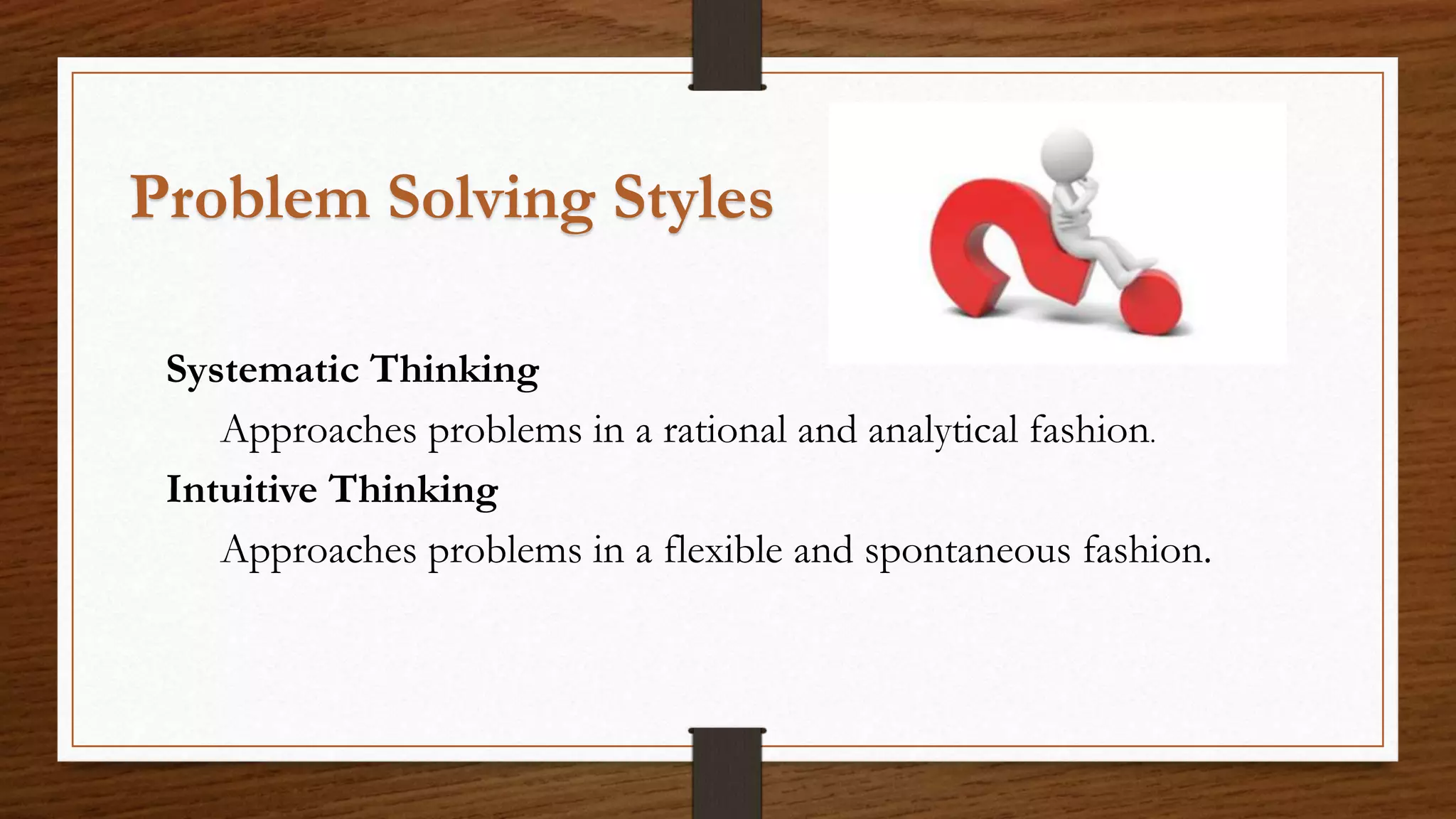
Problem Solving Styles
Systematic Thinking
Approaches problems in a rational and analytical fashion.
Intuitive Thinking
Approaches problems in a flexible and spontaneous fashion.
Types of Decisions
• There are two types of Decisions:
• Programmed Decisions.
• Non-Programmed Decisions.
Types of Decision
Programmed
Decision
Non-
Programmed
Decision
Programmed Decisions
• A routine decision that can be handled by established business rules or
procedures. These types of decisions are often called for at certain points in
a standard process, and are decided based on recognized and easily
identifiable factors. Programmed decisions typically do not require much
consideration or discussion, and can generally be automated to ensure
consistency and save time for decision-makers.
Non-Programmed Decisions
• Non-programmed decisions relate to difficult situations for which there is no
easy solution. These decisions are unique. They are often ill-structured, one-
shot decisions. Traditionally they have been handled by techniques such as
judgment, intuition, and creativity.
Steps involved in Decision Making Process
There are five steps involved in Decision Making Process:
• Step 1: Identify and define the problem.
• Step 2: Generate and evaluate alternative courses
of action.
• Step 3: Decide on a preferred course of action.
• Step 4: Implement the decision.
• Step 5: Evaluate results.
Define the problem
Evaluate alternatives
Select the best course of action
Implement the problem
Evaluate results
Step 1: Identify and define the problem
The first step in the decision making process is to identify and define the
problem.
A problem can be regarded as a difference between the actual situation and the
desired situation. This means that in order to identify a problem the team must
know where it is meant to be and have a clear understanding of where it
currently is in relation to the perceived problem.
Step 2: Generate and evaluate alternative courses of action
Postpone the selection of one solution until several alternatives have been
proposed. Having a standard with which to compare the characteristics of the
final solution is not the same as defining the desired result. A standard allows us
to evaluate the different intended results offered by alternatives. When you try
to build toward desired results, it’s very difficult to collect good information
about the process.
Step 3: Decide on a preferred course of action
Managers use Experience, Experimentation and Research analysis to select best
course of actions.
Two Different Outcomes
• Optimizing Decision
chooses the alternative giving the absolute best solution to a problem.
• Satisfying Decision
chooses the first satisfactory alternative that presents itself.
Step 4 :Implement the Decision.
The forth step in the decision-making process is to implement the decision. To
implement your decision you must act on it, keep yourself on track, and
determine how well you’ve done.
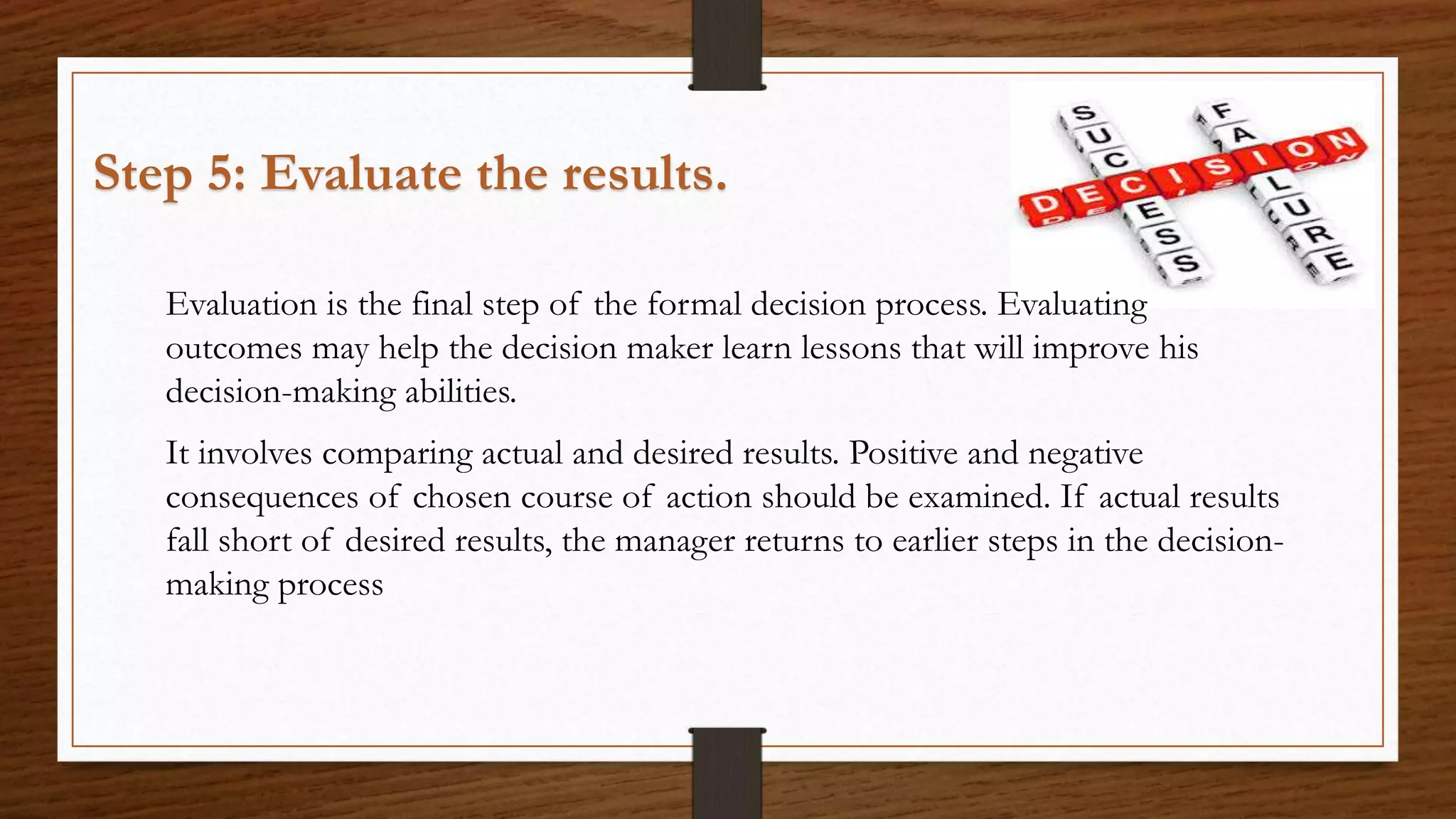
Step 5: Evaluate the results.
Evaluation is the final step of the formal decision process. Evaluating
outcomes may help the decision maker learn lessons that will improve his
decision-making abilities.
It involves comparing actual and desired results. Positive and negative
consequences of chosen course of action should be examined. If actual results
fall short of desired results, the manager returns to earlier steps in the decision-
making process
• Criteria for Implementing the Decision
It is more likely that the people who have participated in decision
making process they would help in its implementation.
• Criteria for Evaluating the Decision
Results must be evaluated against objectives set at the beginning of
the process.
• Creativity
Creativity is the ability and power to develop new ideas.
• Innovation
Innovation is define as the use of new ideas.
• Brainstorming
It focuses on group thinking. The purpose of this approach is
to improve problem solving by finding new and unusual solutions.
Decision Making In Business

Decision Making In Business

  • 2.
    University of Education Introductionto business Topic: Decision Making
  • 3.
    Group Members • MuhammadAzan Ahmad • Ahmad Hassan • Mughira Asghar • Hamid Raza • Hamza Shafqat • Kabeer Hayyat
  • 4.
    Outline • Decision Making. •Decision Making in Business. • Role of Managers in Decision Making. • Business Environment. • Problem solving styles. • Types of Decisions. • Steps involved in Decision Making Process. 1. Step 1 2. Step 2 3. Step 3 4. Step 4 5. Step 5
  • 5.
    What is decisionMaking? • Decision Making is define as the act or process of deciding, determination, , by making a judgment. • Decision-making is the process of identifying and choosing alternatives based on the values, preferences and beliefs of the decision-maker. • A decision is one when there are different things you can do and you pick one of them. You make lots of decisions everyday!
  • 6.
    Decision Making inBusiness • Decision-making is a vital part of any business and a key function of its success. • It is the selection of a course of action amongst different alternatives. • It is the process that begins with identification of the problem and ends with evaluation of implemented solutions.
  • 7.
    Role of managersin Decision Making • Managers deal with multiple problems posing threats and offering opportunities. • They can be problem avoiders, problem solvers, or problem seekers. • They make decisions under conditions of certainty, risk, and uncertainty. • They display systematic and intuitive problem solving styles. • They solve problems with programmed and non programmed decisions.
  • 8.
    Problem Solving Problem solvingis the process of identifying and taking action to solve problems. Information Competency It is the ability to gather and use information to solve problems. Performance Threat A situation where something is wrong or likely to be wrong. Performance Opportunity A situation that offers the possibility of a better future, if the right steps are taken.
  • 9.
    Decision Environments There arethree environments, managers can face: Risk Environment: It lacks complete information but offers probabilities of the likely outcomes for possible action alternatives. Certain Environment: It offers complete information on possible action alternatives and their consequences. Uncertain Environment: It lacks so much information that it is difficult to assign probabilities to the likely outcomes of alternatives.
  • 10.
    Problem Solving Styles SystematicThinking Approaches problems in a rational and analytical fashion. Intuitive Thinking Approaches problems in a flexible and spontaneous fashion.
  • 11.
    Types of Decisions •There are two types of Decisions: • Programmed Decisions. • Non-Programmed Decisions. Types of Decision Programmed Decision Non- Programmed Decision
  • 12.
    Programmed Decisions • Aroutine decision that can be handled by established business rules or procedures. These types of decisions are often called for at certain points in a standard process, and are decided based on recognized and easily identifiable factors. Programmed decisions typically do not require much consideration or discussion, and can generally be automated to ensure consistency and save time for decision-makers.
  • 13.
    Non-Programmed Decisions • Non-programmeddecisions relate to difficult situations for which there is no easy solution. These decisions are unique. They are often ill-structured, one- shot decisions. Traditionally they have been handled by techniques such as judgment, intuition, and creativity.
  • 14.
    Steps involved inDecision Making Process There are five steps involved in Decision Making Process: • Step 1: Identify and define the problem. • Step 2: Generate and evaluate alternative courses of action. • Step 3: Decide on a preferred course of action. • Step 4: Implement the decision. • Step 5: Evaluate results. Define the problem Evaluate alternatives Select the best course of action Implement the problem Evaluate results
  • 15.
    Step 1: Identifyand define the problem The first step in the decision making process is to identify and define the problem. A problem can be regarded as a difference between the actual situation and the desired situation. This means that in order to identify a problem the team must know where it is meant to be and have a clear understanding of where it currently is in relation to the perceived problem.
  • 16.
    Step 2: Generateand evaluate alternative courses of action Postpone the selection of one solution until several alternatives have been proposed. Having a standard with which to compare the characteristics of the final solution is not the same as defining the desired result. A standard allows us to evaluate the different intended results offered by alternatives. When you try to build toward desired results, it’s very difficult to collect good information about the process.
  • 17.
    Step 3: Decideon a preferred course of action Managers use Experience, Experimentation and Research analysis to select best course of actions. Two Different Outcomes • Optimizing Decision chooses the alternative giving the absolute best solution to a problem. • Satisfying Decision chooses the first satisfactory alternative that presents itself.
  • 18.
    Step 4 :Implementthe Decision. The forth step in the decision-making process is to implement the decision. To implement your decision you must act on it, keep yourself on track, and determine how well you’ve done.
  • 19.
    Step 5: Evaluatethe results. Evaluation is the final step of the formal decision process. Evaluating outcomes may help the decision maker learn lessons that will improve his decision-making abilities. It involves comparing actual and desired results. Positive and negative consequences of chosen course of action should be examined. If actual results fall short of desired results, the manager returns to earlier steps in the decision- making process
  • 20.
    • Criteria forImplementing the Decision It is more likely that the people who have participated in decision making process they would help in its implementation. • Criteria for Evaluating the Decision Results must be evaluated against objectives set at the beginning of the process.
  • 21.
    • Creativity Creativity isthe ability and power to develop new ideas. • Innovation Innovation is define as the use of new ideas. • Brainstorming It focuses on group thinking. The purpose of this approach is to improve problem solving by finding new and unusual solutions.