
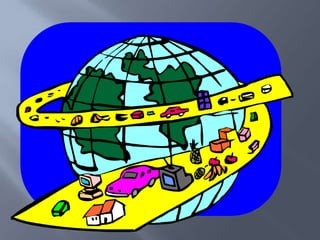

International business is the process of
focusing on the resources of the globe
and objectives of the organization on
global business opportunities and
threats , in order to produce , buy , sell
or exchange of goods/services world
wide
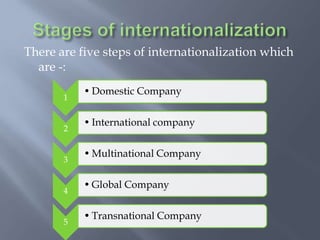
There are five steps of internationalization which
are -:
1
• Domestic Company
2
• International company
3
• Multinational Company
4
• Global Company
5
• Transnational Company
Domestic company limits its operations , mission
,vision to the national political boundaries. The
company focuses its view on the domestic
market opportunities, supplier , financial
companies ,customers etc.
Domestic company never thinks of growing
globally.
These company follows ethnocentric approach.
 International Companies focus on Domestic
practices, but extends the wings to foreign
country.
 These companies extend the domestic product
,price promotion and other business practices
to the foreign markets.
 These companies adopt ethnocentric approach.
 MNC formulate different strategies for
different market.
 Stage of multinational company is also referred
to as multidomestic.
 The orientation shifts from ethnocentric to
polycentric.
 They operate like a domestic company of the
country concerned in each of their market.
 Global company either produces in one
country and market globally or produces
globally and market domestically.
 Transnational company
produces, markets, invests and operates across
the world
 It is an integrated global enterprise that links
global resources with global market at profits.
 Transnational company adopt geocentric
approach.
Douglas Wind and Pelmutter advocated four
approaches 0f I. B .
They are -:
 Ethnocentric
 Polycentric
 Regiocentric
 Geocentric
 Under this approach, the domestic companies
view foreign markets as an extension to
domestic market.
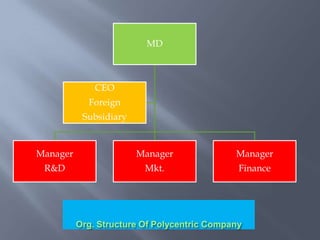
Company establishes a foreign subsidiary
company and decentralizes all the operations
and delegates decision making and policy
making authority to its executives.
C.E.O. reports directly to the M.D. of the
company.
MD
Manager
R&D
Manager
Mkt.
Manager
Finance
CEO
Foreign
Subsidiary
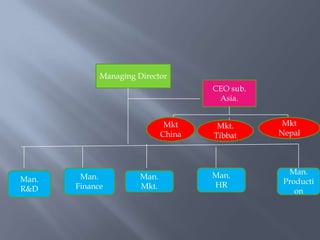
The company after operating successfully in a
foreign country, thinks of operating to the
neighboring countries of the host country. At
this stage, the foreign subsidiary consider the
regional environment (e.g .Asian env. Like
laws culture, policies etc.)for formulating
policies and strategies.
Managing Director
CEO sub.
Asia.
Mkt
China
Mkt.
Tibbat
Mkt
Nepal
Man.
Mkt.
Man.
R&D
Man.
Finance
Man.
HR
Man.
Producti
on
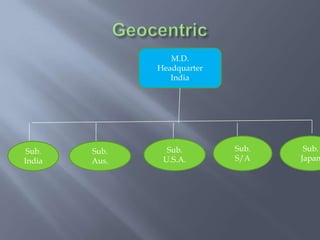
Under this approach the entire world is just like a
single country for the company. They select the
employees from the entire globe and operate
with a no. of subsidiary.
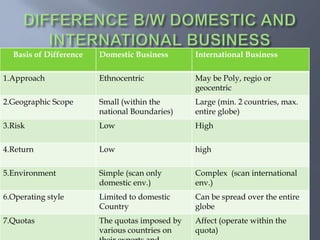
Basis of Difference Domestic Business International Business
1.Approach Ethnocentric May be Poly, regio or
geocentric
2.Geographic Scope Small (within the
national Boundaries)
Large (min. 2 countries, max.
entire globe)
3.Risk Low High
4.Return Low high
5.Environment Simple (scan only
domestic env.)
Complex (scan international
env.)
6.Operating style Limited to domestic
Country
Can be spread over the entire
globe
7.Quotas The quotas imposed by
various countries on
Affect (operate within the
quota)
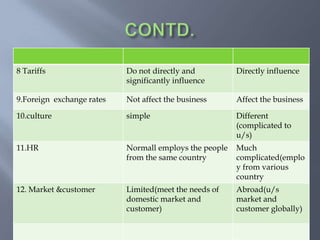
8 Tariffs Do not directly and
significantly influence
Directly influence
9.Foreign exchange rates Not affect the business Affect the business
10.culture simple Different
(complicated to
u/s)
11.HR Normall employs the people
from the same country
Much
complicated(emplo
y from various
country
12. Market &customer Limited(meet the needs of
domestic market and
customer)
Abroad(u/s
market and
customer globally)
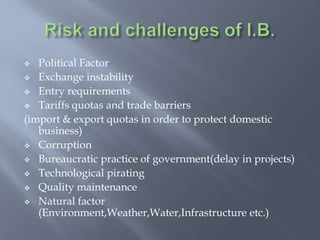
 Political Factor
 Exchange instability
 Entry requirements
 Tariffs quotas and trade barriers
(import & export quotas in order to protect domestic
business)
 Corruption
 Bureaucratic practice of government(delay in projects)
 Technological pirating
 Quality maintenance
 Natural factor
(Environment,Weather,Water,Infrastructure etc.)
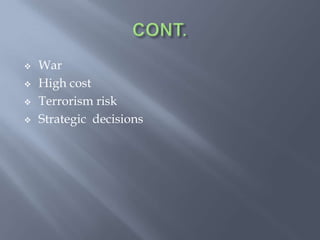
 War
 High cost
 Terrorism risk
 Strategic decisions
 We shall discuss the competitive advantages of I.B.
 High living standards
 Increased socio economic welfare
 Wider market
 Reduced effects of business cycle
 Reduced risks
 Large scale economies
 Potential untapped market
 Provides the opportunity for and challenge to
domestic
 Division of labor and specialization
 Economic growth of the world
 Optimum and proper utilization of world
resources
 Cultural transformation
 To achieve high rate of profits
 Expanding the production
 Severe competition in the home country
 Limited home market
 Availability of technology and skilled human
resource
 High cost of transportation
 Nearness to raw material
 Liberalization and globalization
 To increase market share
 To achieve higher rate of economic
development
 Tariffs and import quotas
The medieval proverb says “A merchant has no nation”
It means that a businessman can view the entire
world as one country for the operations.
Erasing national and political boundaries for the
purpose of business may be termed as
globalization. It implies integration of economy of
the country with the rest of the world economy
and opening up of the economy for FDI by
liberalizing the rules and regulations and by
creating favorable socio-economic political climate
for global business.
Charles U.L. Hill defines Globalization as
“The shift towards a more integrated and
interdependent world economy. Globalization has
two main components – the globalization of market
and the globalization of production.”
 Operating and planning to expand business
throughout the world
 Erasing the diff. b/w domestic market and
foreign market.
 Buying and selling goods & services from/to
any country in the world
 Establishing manufacturing and distribution
facilities in any part of the world
 Product planning & deveolpment are based on
market consideration of the entire world
 Sourcing of factors of production and inputs
from the entire globe
 Global orientation in strategies, organizational
structure, organizational culture and
managerial expertise
 Setting the mind and attitude to view the entire
globe as a single market.
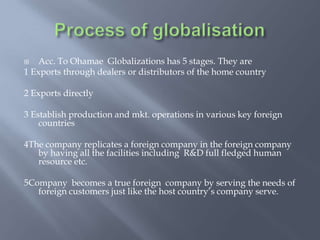
 Acc. To Ohamae Globalizations has 5 stages. They are
1 Exports through dealers or distributors of the home country
2 Exports directly
3 Establish production and mkt. operations in various key foreign
countries
4The company replicates a foreign company in the foreign company
by having all the facilities including R&D full fledged human
resource etc.
5Company becomes a true foreign company by serving the needs of
foreign customers just like the host country’s company serve.
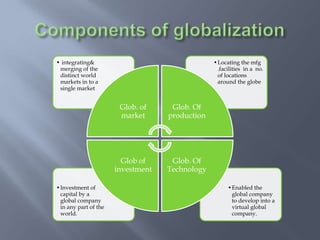
•Enabled the
global company
to develop into a
virtual global
company.
•Investment of
capital by a
global company
in any part of the
world.
•Locating the mfg
.facilities in a no.
of locations
around the globe
• integrating&
merging of the
distinct world
markets in to a
single market
Glob. of
market
Glob. Of
production
Glob. Of
Technology
Glob of
investment
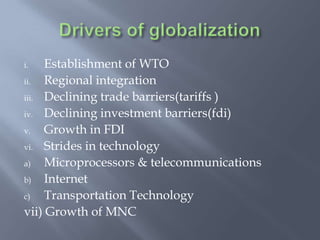
i. Establishment of WTO
ii. Regional integration
iii. Declining trade barriers(tariffs )
iv. Declining investment barriers(fdi)
v. Growth in FDI
vi. Strides in technology
a) Microprocessors & telecommunications
b) Internet
c) Transportation Technology
vii) Growth of MNC
1) EU
2) NAFTA(North American Free Trade
Agreement)
3) SAARC(South Asian Association for Region
Cooperation)
4) ASEAN Etc.
 Free flow of capital
 Free flow of technology
 Increase in industrialization
 Global Production
 Balanced development of world economy
 Increase in production and consumption
 Lower price with high Quality
 Cultural exchange & demand for a variety of
product
 Increase in Employment and income
 Higher standards of living
 Balanced human development
 Increase in welfare and prosperity
 Kills domestic business
 Exploits human Resources
 Violation of labor and environmental laws
 Leads to unemployment
 Decline in demand for domestic product
 Decline in income
 Widening gap b/w the rich & the poor
 Transfer of natural resources
 National sovereignity at stake
M.D.
Headquarter
India
Sub.
India
Sub.
Aus.
Sub.
U.S.A.
Sub.
S/A
Sub.
Japan
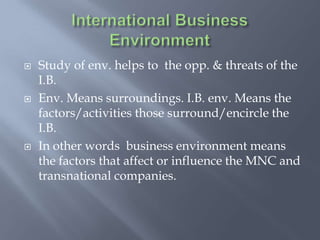
 Study of env. helps to the opp. & threats of the
I.B.
 Env. Means surroundings. I.B. env. Means the
factors/activities those surround/encircle the
I.B.
 In other words business environment means
the factors that affect or influence the MNC and
transnational companies.
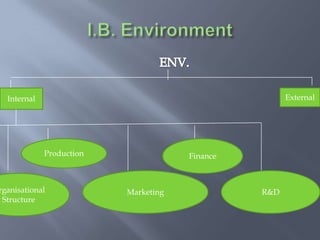
Internal External
rganisational
Structure
Production
Marketing
Finance
R&D
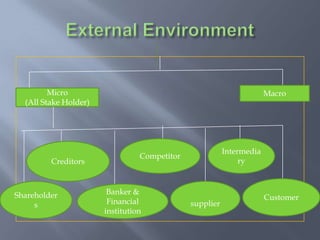
Micro
(All Stake Holder)
Macro
Shareholder
s
Creditors
Banker &
Financial
institution
Competitor
supplier
Intermedia
ry
Customer
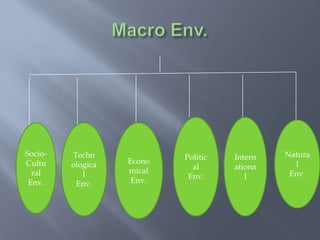
Socio-
Cultu
ral
Env.
Techn
ologica
l
Env.
Econo
mical
Env.
Politic
al
Env.
Intern
ationa
l
Natura
l
Env.
Culture is a set of traditional beliefs and values
which are transmitted and shared in a given
society.
It includes -
 Attitude of people to work
 Attitude to wealth
 Family
 Marriage
 Religion
 Education etc.
Technology is application of knowledge-
“A systematic application of scientific or other
organised knowledge to particular task”
Acc. To J.K. Galbraith
o Many inventions and discoveries do not
remain property for long period.
o Level of tech. is not same in all countries
o I.T. redefined business
The economic env. of various countries mostly
and directly influences .I.B. the change was
revolutionary after 1990
Economic system-
1. Capitalistic –Customer choice for
product/services. Decide what will be
produced by whom? (customer allocate
resources)
Ex. U.S.A. , Japan , U.K.
2 Communism -
State owns all the factor of production and
distribution. It is also called Marxism.
Ex China, Poland , Russia , Most of the east
European countries
3. Mixed Economy-
Major factor of production and distribution are
owned , managed and controlled by state.
Ex. India
 Low income countries
 Lower middle countries
 Upper middle Countries
 Higher income countries
IB by Amaresh Tyagi

IB by Amaresh Tyagi

  • 1.
    International business isthe process of focusing on the resources of the globe and objectives of the organization on global business opportunities and threats , in order to produce , buy , sell or exchange of goods/services world wide
  • 3.
    There are fivesteps of internationalization which are -: 1 • Domestic Company 2 • International company 3 • Multinational Company 4 • Global Company 5 • Transnational Company
  • 4.
    Domestic company limitsits operations , mission ,vision to the national political boundaries. The company focuses its view on the domestic market opportunities, supplier , financial companies ,customers etc. Domestic company never thinks of growing globally. These company follows ethnocentric approach.
  • 5.
     International Companiesfocus on Domestic practices, but extends the wings to foreign country.  These companies extend the domestic product ,price promotion and other business practices to the foreign markets.  These companies adopt ethnocentric approach.
  • 6.
     MNC formulatedifferent strategies for different market.  Stage of multinational company is also referred to as multidomestic.  The orientation shifts from ethnocentric to polycentric.  They operate like a domestic company of the country concerned in each of their market.
  • 7.
     Global companyeither produces in one country and market globally or produces globally and market domestically.
  • 8.
     Transnational company produces,markets, invests and operates across the world  It is an integrated global enterprise that links global resources with global market at profits.  Transnational company adopt geocentric approach.
  • 10.
    Douglas Wind andPelmutter advocated four approaches 0f I. B . They are -:  Ethnocentric  Polycentric  Regiocentric  Geocentric
  • 11.
     Under thisapproach, the domestic companies view foreign markets as an extension to domestic market.
  • 12.
    Company establishes aforeign subsidiary company and decentralizes all the operations and delegates decision making and policy making authority to its executives. C.E.O. reports directly to the M.D. of the company.
  • 13.
  • 14.
    The company afteroperating successfully in a foreign country, thinks of operating to the neighboring countries of the host country. At this stage, the foreign subsidiary consider the regional environment (e.g .Asian env. Like laws culture, policies etc.)for formulating policies and strategies.
  • 15.
  • 16.
    Under this approachthe entire world is just like a single country for the company. They select the employees from the entire globe and operate with a no. of subsidiary.
  • 17.
    Basis of DifferenceDomestic Business International Business 1.Approach Ethnocentric May be Poly, regio or geocentric 2.Geographic Scope Small (within the national Boundaries) Large (min. 2 countries, max. entire globe) 3.Risk Low High 4.Return Low high 5.Environment Simple (scan only domestic env.) Complex (scan international env.) 6.Operating style Limited to domestic Country Can be spread over the entire globe 7.Quotas The quotas imposed by various countries on Affect (operate within the quota)
  • 18.
    8 Tariffs Donot directly and significantly influence Directly influence 9.Foreign exchange rates Not affect the business Affect the business 10.culture simple Different (complicated to u/s) 11.HR Normall employs the people from the same country Much complicated(emplo y from various country 12. Market &customer Limited(meet the needs of domestic market and customer) Abroad(u/s market and customer globally)
  • 19.
     Political Factor Exchange instability  Entry requirements  Tariffs quotas and trade barriers (import & export quotas in order to protect domestic business)  Corruption  Bureaucratic practice of government(delay in projects)  Technological pirating  Quality maintenance  Natural factor (Environment,Weather,Water,Infrastructure etc.)
  • 20.
     War  Highcost  Terrorism risk  Strategic decisions
  • 21.
     We shalldiscuss the competitive advantages of I.B.  High living standards  Increased socio economic welfare  Wider market  Reduced effects of business cycle  Reduced risks  Large scale economies  Potential untapped market  Provides the opportunity for and challenge to domestic
  • 22.
     Division oflabor and specialization  Economic growth of the world  Optimum and proper utilization of world resources  Cultural transformation
  • 23.
     To achievehigh rate of profits  Expanding the production  Severe competition in the home country  Limited home market  Availability of technology and skilled human resource  High cost of transportation  Nearness to raw material
  • 24.
     Liberalization andglobalization  To increase market share  To achieve higher rate of economic development  Tariffs and import quotas
  • 25.
    The medieval proverbsays “A merchant has no nation” It means that a businessman can view the entire world as one country for the operations. Erasing national and political boundaries for the purpose of business may be termed as globalization. It implies integration of economy of the country with the rest of the world economy and opening up of the economy for FDI by liberalizing the rules and regulations and by creating favorable socio-economic political climate for global business.
  • 26.
    Charles U.L. Hilldefines Globalization as “The shift towards a more integrated and interdependent world economy. Globalization has two main components – the globalization of market and the globalization of production.”
  • 27.
     Operating andplanning to expand business throughout the world  Erasing the diff. b/w domestic market and foreign market.  Buying and selling goods & services from/to any country in the world  Establishing manufacturing and distribution facilities in any part of the world  Product planning & deveolpment are based on market consideration of the entire world
  • 28.
     Sourcing offactors of production and inputs from the entire globe  Global orientation in strategies, organizational structure, organizational culture and managerial expertise  Setting the mind and attitude to view the entire globe as a single market.
  • 29.
     Acc. ToOhamae Globalizations has 5 stages. They are 1 Exports through dealers or distributors of the home country 2 Exports directly 3 Establish production and mkt. operations in various key foreign countries 4The company replicates a foreign company in the foreign company by having all the facilities including R&D full fledged human resource etc. 5Company becomes a true foreign company by serving the needs of foreign customers just like the host country’s company serve.
  • 30.
    •Enabled the global company todevelop into a virtual global company. •Investment of capital by a global company in any part of the world. •Locating the mfg .facilities in a no. of locations around the globe • integrating& merging of the distinct world markets in to a single market Glob. of market Glob. Of production Glob. Of Technology Glob of investment
  • 31.
    i. Establishment ofWTO ii. Regional integration iii. Declining trade barriers(tariffs ) iv. Declining investment barriers(fdi) v. Growth in FDI vi. Strides in technology a) Microprocessors & telecommunications b) Internet c) Transportation Technology vii) Growth of MNC
  • 32.
    1) EU 2) NAFTA(NorthAmerican Free Trade Agreement) 3) SAARC(South Asian Association for Region Cooperation) 4) ASEAN Etc.
  • 33.
     Free flowof capital  Free flow of technology  Increase in industrialization  Global Production  Balanced development of world economy  Increase in production and consumption  Lower price with high Quality  Cultural exchange & demand for a variety of product
  • 34.
     Increase inEmployment and income  Higher standards of living  Balanced human development  Increase in welfare and prosperity
  • 35.
     Kills domesticbusiness  Exploits human Resources  Violation of labor and environmental laws  Leads to unemployment  Decline in demand for domestic product  Decline in income  Widening gap b/w the rich & the poor  Transfer of natural resources  National sovereignity at stake
  • 36.
  • 37.
     Study ofenv. helps to the opp. & threats of the I.B.  Env. Means surroundings. I.B. env. Means the factors/activities those surround/encircle the I.B.  In other words business environment means the factors that affect or influence the MNC and transnational companies.
  • 38.
  • 39.
    Micro (All Stake Holder) Macro Shareholder s Creditors Banker& Financial institution Competitor supplier Intermedia ry Customer
  • 40.
  • 41.
    Culture is aset of traditional beliefs and values which are transmitted and shared in a given society. It includes -  Attitude of people to work  Attitude to wealth  Family  Marriage  Religion  Education etc.
  • 42.
    Technology is applicationof knowledge- “A systematic application of scientific or other organised knowledge to particular task” Acc. To J.K. Galbraith o Many inventions and discoveries do not remain property for long period. o Level of tech. is not same in all countries o I.T. redefined business
  • 43.
    The economic env.of various countries mostly and directly influences .I.B. the change was revolutionary after 1990 Economic system- 1. Capitalistic –Customer choice for product/services. Decide what will be produced by whom? (customer allocate resources) Ex. U.S.A. , Japan , U.K.
  • 44.
    2 Communism - Stateowns all the factor of production and distribution. It is also called Marxism. Ex China, Poland , Russia , Most of the east European countries 3. Mixed Economy- Major factor of production and distribution are owned , managed and controlled by state. Ex. India
  • 45.
     Low incomecountries  Lower middle countries  Upper middle Countries  Higher income countries