Operation research GAURAV SONKAR
OPERATIONRESEARCHofAn operation may be defined as the set of acts required for the achievements of a desired outcomes.
DEFNITIONS OF O.R.OPERATION RESEARCH IS SYSTEMATIC, METHOD ORIENTED STUDY OF THE BASIC STRUCTURE, CHARACTERISTICS, FUNCTION & RELATIONSHIP OF AN ORGANISATION TO PROIDE THE EXECUTIVE WITH A SOUND, SCIENTIFIC AND QUANITATIVE BASIS FOR THE DECESION MAKING.                                                                                          ------------------------------BY E.L.ARNOFF & M.J.NETZORGIO.R. IS AN AID FOR THE EXECUTIVE IN MAKING HIS DECISIONS BY PROVIDING HIM WITH THE NEEDED QUANTITATIVE INFORMATION BASED ON THE SCIENTIFIC METHOD OF ANALYSIS ---------------BY C. KITTELO.R. IS THE APPLICATION OF SCIENTIFIC METHODS TO THE PROBLEM ARISING FROM OPERATIONS INVOLVING INTEGRATED SYSTEMS OF MEN, MACHINE AND MATERIALS. IT NORMALLY UTILIZES THE KNOWLEDGE AND SKILLS OF INTERDISCIPLINARY RESEARCH TEAM TO PROVIDE THE MANAGERS OF SUCH SYSTEMS WITH OPTIMUM OPERATING SOLUTIONS. --------------------BY FABRYCKY & TORGERSEN
CHARACTERISTICS OF OR:ITS SYSTEM ORIENTED
USE OF INTERDISCIPLINARY TEAM
APPLICATION OF SCIENTIFIC METHODS
UNCOVERING OF NEW PROBLEMS
IMPROVE THE QUALITY OF DECESIONS
USE OF COMPUTERS
QUANTITATIVE SOLUTION
HUMAN FACTORSSCOPE OF OPERATION RESEARCH:I. ALLOCATION AND DISTRIBUTION:Optimal allocation of limited resources such as men, machine, and material.Location and size of warehouses, distribution centre, retail depot etc.Distribution policy.II. PRODUCTION AND FACILITY PLANNING:Selection, location and design of production plant.Project scheduling & allocation of resources.Forecasting.Maintenance policy.Scheduling & sequencing.
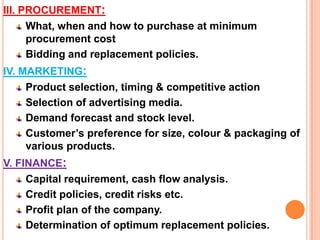
III. PROCUREMENT: What, when and how to purchase at minimum procurement costBidding and replacement policies.IV. MARKETING:Product selection, timing & competitive actionSelection of advertising media.Demand forecast and stock level.Customerโ€™s preference for size, colour & packaging of various products.ย V. FINANCE:Capital requirement, cash flow analysis.Credit policies, credit risks etc.Profit plan of the company.Determination of optimum replacement policies.
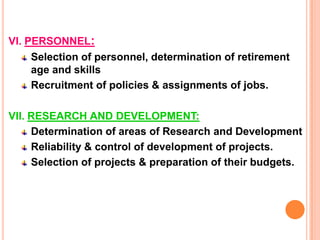
VI. PERSONNEL:Selection of personnel, determination of retirement age and skillsRecruitment of policies & assignments of jobs.ย VII. RESEARCH AND DEVELOPMENT:Determination of areas of Research and DevelopmentReliability & control of development of projects.Selection of projects & preparation of their budgets.
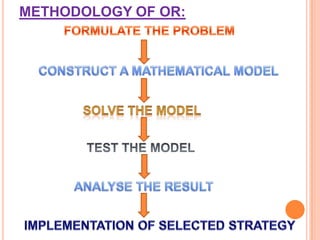
METHODOLOGY OF OR:FORMULATE THE PROBLEMCONSTRUCT A MATHEMATICAL MODELSOLVE THE MODELTEST THE MODELANALYSE THE RESULTIMPLEMENTATION OF SELECTED STRATEGY
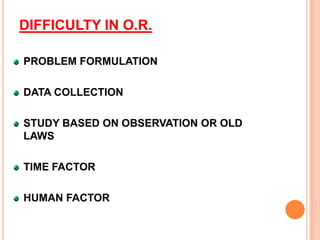
DIFFICULTY IN O.R.PROBLEM FORMULATIONDATA COLLECTIONSTUDY BASED ON OBSERVATION OR OLD LAWSTIME FACTORHUMAN FACTOR
DECESION THEORY:    DECESION THEORY PROVIDES A RATIONAL APPROACH IN DEALING PROBLEMS CONFRONTED WITH THE PARTIAL , IMPERFECT OR UNCERTAIN FUTURE CONDITION
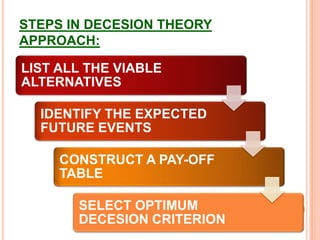
STEPS IN DECESION THEORY APPROACH:
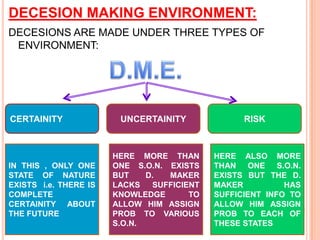
DECESION MAKING ENVIRONMENT:DECESIONS ARE MADE UNDER THREE TYPES OF ENVIRONMENT:D.M.E.CERTAINITYUNCERTAINITYRISKIN THIS , ONLY ONE STATE OF NATURE EXISTS  i.e. THERE IS COMPLETE CERTAINITY ABOUT THE FUTUREHERE MORE THAN ONE S.O.N. EXISTS BUT D. MAKER LACKS SUFFICIENT KNOWLEDGE TO ALLOW HIM ASSIGN PROB TO VARIOUS S.O.N.HERE ALSO MORE THAN ONE S.O.N. EXISTS BUT THE D. MAKER HAS SUFFICIENT INFO TO ALLOW HIM ASSIGN PROB TO EACH OF THESE STATES
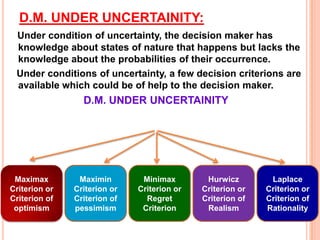
D.M. UNDER UNCERTAINITY:Under condition of uncertainty, the decision maker has knowledge about states of nature that happens but lacks the knowledge about the probabilities of their occurrence.    Under conditions of uncertainty, a few decision criterions are available which could be of help to the decision maker.D.M. UNDER UNCERTAINITYMaximax Criterion or Criterion of optimismMaximin Criterion or Criterion of pessimismMinimax Criterion or Regret CriterionHurwicz Criterion or Criterion of RealismLaplace Criterion or Criterion of Rationality
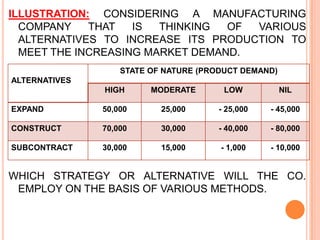
ILLUSTRATION:CONSIDERING A MANUFACTURING COMPANY THAT IS THINKING OF VARIOUS ALTERNATIVES TO INCREASE ITS PRODUCTION TO MEET THE INCREASING MARKET DEMAND.WHICH STRATEGY OR ALTERNATIVE WILL THE CO. EMPLOY ON THE BASIS OF VARIOUS METHODS.
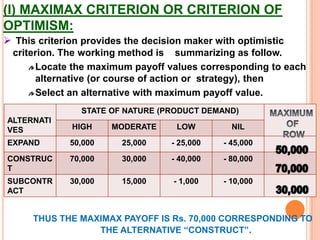
(I) MAXIMAX CRITERION OR CRITERION OF OPTIMISM:This criterion provides the decision maker with optimistic criterion. The working method is    summarizing as follow.Locate the maximum payoff values corresponding to each alternative (or course of action or  strategy), thenSelect an alternative with maximum payoff value.THUS THE MAXIMAX PAYOFF IS Rs. 70,000 CORRESPONDING TO THE ALTERNATIVE โ€œCONSTRUCTโ€.MAXIMUM OF ROW50,00070,00030,000
(II) MAXIMIN CRITERION OR CRITERION OF PESSIMISM:This criterion provides the decision maker with pessimistic criterion. The working method is summarizing as follow.Locate the minimum payoff values corresponding to each alternative (or course of action or strategy), then Select an alternative with maximum payoff value.THUS THE MINIMAX PAYOFF IS Rs. โ€“ 10,000 CORRESPONDING TO THE ALTERNATIVE  - โ€œSUBCONTRACTโ€MINIMUM OF ROW-45,000-80,000-10,000
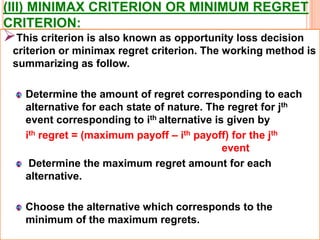
(III) MINIMAX CRITERION OR MINIMUM REGRET CRITERION: This criterion is also known as opportunity loss decision criterion or minimax regret criterion. The working method is summarizing as follow.Determine the amount of regret corresponding to each alternative for each state of nature. The regret for jthevent corresponding to ithalternative is given byith regret = (maximum payoff โ€“ ith payoff) for the jth         event Determine the maximum regret amount for each alternative.ย Choose the alternative which corresponds to the minimum of the maximum regrets.ย 
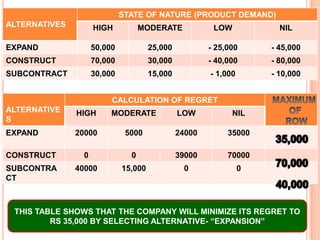
MAXIMUM OF ROW35,00070,00040,000THIS TABLE SHOWS THAT THE COMPANY WILL MINIMIZE ITS REGRET TO RS 35,000 BY SELECTING ALTERNATIVE- โ€œEXPANSIONโ€
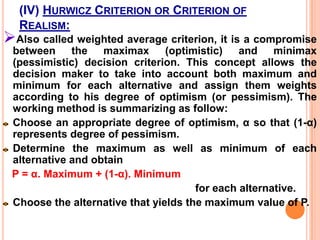
(IV) Hurwicz Criterion or Criterion of Realism:Also called weighted average criterion, it is a compromise between the maximax (optimistic) and minimax (pessimistic) decision criterion. This concept allows the decision maker to take into account both maximum and minimum for each alternative and assign them weights according to his degree of optimism (or pessimism). The working method is summarizing as follow:Choose an appropriate degree of optimism, ฮฑ so that (1-ฮฑ) represents degree of pessimism.Determine the maximum as well as minimum of each alternative and obtainP = ฮฑ. Maximum + (1-ฮฑ). Minimum							for each alternative.Choose the alternative that yields the maximum value of P.ย 
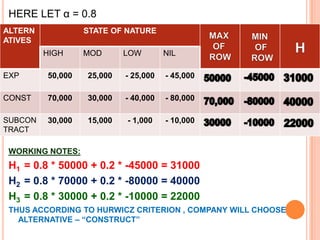
HERE LET ฮฑ = 0.8WORKING NOTES:H1  = 0.8 * 50000 + 0.2 * -45000 = 31000H2  = 0.8 * 70000 + 0.2 * -80000 = 40000H3  = 0.8 * 30000 + 0.2 * -10000 = 22000THUS ACCORDING TO HURWICZ CRITERION , COMPANY WILL CHOOSE ALTERNATIVE โ€“ โ€œCONSTRUCTโ€MAXOF ROWMIN OF ROWH-450003100050000-800004000070,000-100003000022000
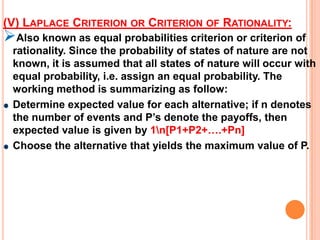
(V) Laplace Criterion or Criterion of Rationality: Also known as equal probabilities criterion or criterion of rationality. Since the probability of states of nature are not known, it is assumed that all states of nature will occur with equal probability, i.e. assign an equal probability. The working method is summarizing as follow:Determine expected value for each alternative; if n denotes the number of events and Pโ€™s denote the payoffs, then expected value is given by 1\n[P1+P2+โ€ฆ.+Pn]Choose the alternative that yields the maximum value of P.
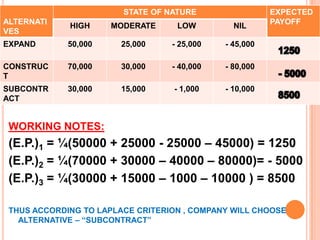
1250WORKING NOTES:(E.P.)1 = ยผ(50000 + 25000 - 25000 โ€“ 45000) = 1250(E.P.)2 = ยผ(70000 + 30000 โ€“ 40000 โ€“ 80000)= - 5000(E.P.)3 = ยผ(30000 + 15000 โ€“ 1000 โ€“ 10000 ) = 8500THUS ACCORDING TO LAPLACE CRITERION , COMPANY WILL CHOOSE ALTERNATIVE โ€“ โ€œSUBCONTRACTโ€- 50008500
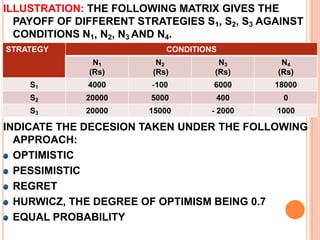
ILLUSTRATION: THE FOLLOWING MATRIX GIVES THE PAYOFF OF DIFFERENT STRATEGIES S1, S2, S3 AGAINST CONDITIONS N1, N2, N3 AND N4.INDICATE THE DECESION TAKEN UNDER THE FOLLOWING APPROACH:OPTIMISTICPESSIMISTICREGRETHURWICZ, THE DEGREE OF OPTIMISM BEING 0.7EQUAL PROBABILITY
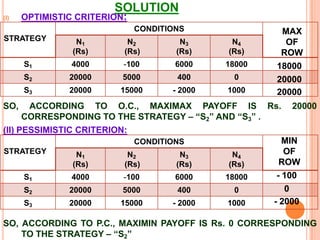
SOLUTIONOPTIMISTIC CRITERION:SO, ACCORDING TO O.C., MAXIMAX PAYOFF IS Rs. 20000 CORRESPONDING TO THE STRATEGY โ€“ โ€œS2โ€ AND โ€œS3โ€ .(II) PESSIMISTIC CRITERION:SO, ACCORDING TO P.C., MAXIMIN PAYOFF IS Rs. 0 CORRESPONDING TO THE STRATEGY โ€“ โ€œS2โ€MAX OF ROW180002000020000MINOF ROW- 1000- 2000
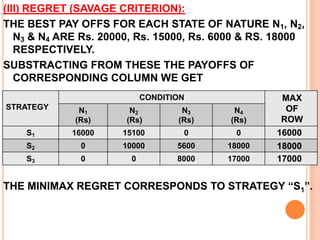
(III) REGRET (SAVAGE CRITERION): THE BEST PAY OFFS FOR EACH STATE OF NATURE N1, N2, N3 & N4 ARE Rs. 20000, Rs. 15000, Rs. 6000 & RS. 18000 RESPECTIVELY.SUBSTRACTING FROM THESE THE PAYOFFS OF CORRESPONDING COLUMN WE GETTHE MINIMAX REGRET CORRESPONDS TO STRATEGY โ€œS1โ€.MAX OF ROW160001800017000
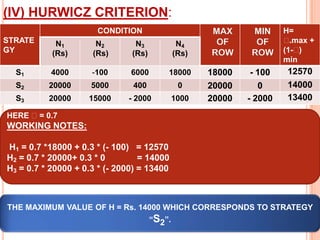
(IV) HURWICZ CRITERION:MAX OF ROWMINOF ROW1257018000- 100140002000001340020000- 2000HERE ๏„ƒ = 0.7 WORKING NOTES: H1 = 0.7 *18000 + 0.3 * (- 100)   = 12570H2 = 0.7 * 20000+ 0.3 * 0             = 14000H3 = 0.7 * 20000 + 0.3 * (- 2000) = 13400THE MAXIMUM VALUE OF H = Rs. 14000 WHICH CORRESPONDS TO STRATEGY โ€œS2โ€.
(V) EQUAL PROBABILITY CRITERION:WORKING NOTES:(E.P.)1 = ยผ(4000  - 100 + 6000 + 18000)      = 6975.(E.P.)2 = ยผ(20000 + 5000 + 400 + 0 )           = 6350.(E.P.)3 = ยผ(20000 + 15000 โ€“ 2000 + 1000 ) = 8500.THE MAXIMUM PAYOFF IS Rs. 8500 WHICH CORRESPONDS TO THE STRATEGY โ€“ โ€œS3โ€.EXPECTED PAYOFF697563508500
DECESION MAKING UNDER RISK:Here more than one state of nature exists and the decision maker has sufficient information to assign probabilities to each of these states. These probabilities could be obtained from the past records or simply the subjective judgment of the decision maker. Under conditions of risk, knowing the probability distribution of the state of nature, the best decision is to select the course of action which has the largest expected pay off value.
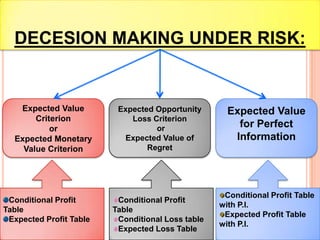
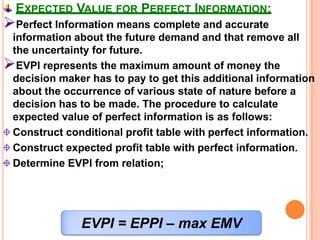
DECESION MAKING UNDER RISK:Expected Value Criterion or Expected Monetary Value CriterionExpected Opportunity Loss Criterion or Expected Value of Regret Expected Value for Perfect InformationConditional Profit      	 TableExpected Profit TableConditional Profit   TableConditional Loss tableExpected Loss Table       Conditional Profit Table with P.I.Expected Profit Table with P.I.
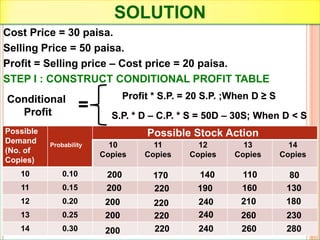
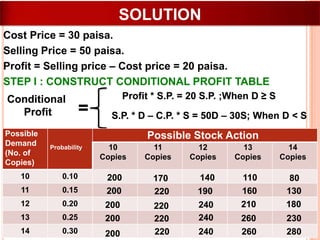
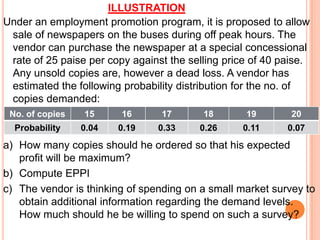
ILLUSTRATIONA newspaper boy has the following probabilities of selling a magazine:		No. of copies sold             Probability 			10			     	0.10			11				0.15			12				0.20			13				0.25			14				0.30Cost of the copy is 30 paisa and sale price is 50 paisa. He cannot return the unsold copies. How many should he order?
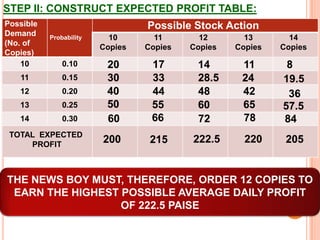
 Expected Value Criterion:The expected monetary value for a given course of action is the weighted sum of possible payoffs for each alternative. It is obtained by summing the payoffs for each course of action multiplied by the probabilities associated with state of nature. It consists of following steps:Construct a payoff table listing the alternative decisions and the various state of nature. Enter the conditional profit for each decision event combination along with the associated probabilities. (Construct Conditional profit table).ย Calculate the EMV for each decision alternative by multiplying the conditional profits by assigned    probabilities and adding the resulting conditional values. (Construct expected profit table).Select the alternative that yields the highest EMV.
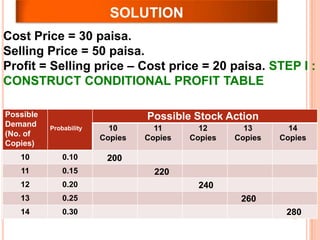
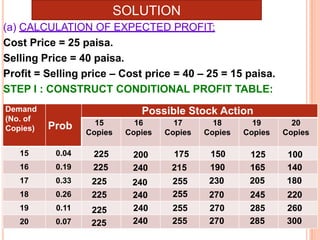
SOLUTIONCost Price = 30 paisa.Selling Price = 50 paisa.Profit = Selling price โ€“ Cost price = 20 paisa.STEP I : CONSTRUCT CONDITIONAL PROFIT TABLEProfit * S.P. = 20 S.P. ;When D โ‰ฅ SConditional Profit=S.P. * D โ€“ C.P. * S = 50D โ€“ 30S; When D < S11020014080170200160130190220180210240200220240260200230220280220240260200
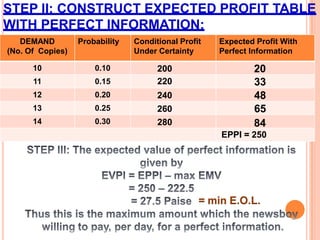
STEP II: CONSTRUCT EXPECTED PROFIT TABLE:172014118303328.52419.540444842365065556057.57866607284TOTAL  EXPECTED PROFIT222.5220200205215THE NEWS BOY MUST, THEREFORE, ORDER 12 COPIES TO EARN THE HIGHEST POSSIBLE AVERAGE DAILY PROFIT OF 222.5 PAISE
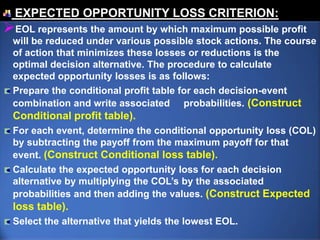
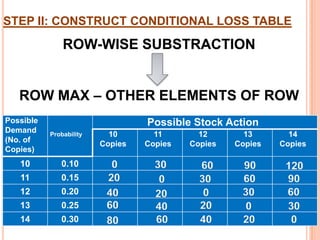
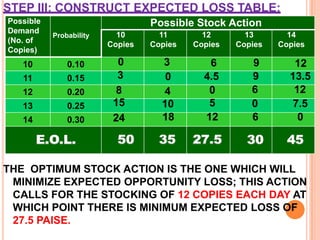
 EXPECTED OPPORTUNITY LOSS CRITERION:EOL represents the amount by which maximum possible profit will be reduced under various possible stock actions. The course of action that minimizes these losses or reductions is the optimal decision alternative. The procedure to calculate expected opportunity losses is as follows: Prepare the conditional profit table for each decision-event combination and write associated     probabilities. (Construct Conditional profit table).ย For each event, determine the conditional opportunity loss (COL) by subtracting the payoff from the maximum payoff for that event. (Construct Conditional loss table).Calculate the expected opportunity loss for each decision alternative by multiplying the COLโ€™s by the associated probabilities and then adding the values. (Construct Expected  loss table).Select the alternative that yields the lowest EOL.
SOLUTIONCost Price = 30 paisa.Selling Price = 50 paisa.Profit = Selling price โ€“ Cost price = 20 paisa.STEP I : CONSTRUCT CONDITIONAL PROFIT TABLEProfit * S.P. = 20 S.P. ;When D โ‰ฅ SConditional Profit=S.P. * D โ€“ C.P. * S = 50D โ€“ 30S; When D < S11020014080170200160130190220180210240200220240260200230220280220240260200
STEP II: CONSTRUCT CONDITIONAL LOSS TABLEROW-WISE SUBSTRACTIONROW MAX โ€“ OTHER ELEMENTS OF ROW0309060120206090300603004020602003040060402080

decision making criterion

  • 1.
  • 2.
    OPERATIONRESEARCHofAn operation maybe defined as the set of acts required for the achievements of a desired outcomes.
  • 3.
    DEFNITIONS OF O.R.OPERATIONRESEARCH IS SYSTEMATIC, METHOD ORIENTED STUDY OF THE BASIC STRUCTURE, CHARACTERISTICS, FUNCTION & RELATIONSHIP OF AN ORGANISATION TO PROIDE THE EXECUTIVE WITH A SOUND, SCIENTIFIC AND QUANITATIVE BASIS FOR THE DECESION MAKING. ------------------------------BY E.L.ARNOFF & M.J.NETZORGIO.R. IS AN AID FOR THE EXECUTIVE IN MAKING HIS DECISIONS BY PROVIDING HIM WITH THE NEEDED QUANTITATIVE INFORMATION BASED ON THE SCIENTIFIC METHOD OF ANALYSIS ---------------BY C. KITTELO.R. IS THE APPLICATION OF SCIENTIFIC METHODS TO THE PROBLEM ARISING FROM OPERATIONS INVOLVING INTEGRATED SYSTEMS OF MEN, MACHINE AND MATERIALS. IT NORMALLY UTILIZES THE KNOWLEDGE AND SKILLS OF INTERDISCIPLINARY RESEARCH TEAM TO PROVIDE THE MANAGERS OF SUCH SYSTEMS WITH OPTIMUM OPERATING SOLUTIONS. --------------------BY FABRYCKY & TORGERSEN
  • 4.
  • 5.
  • 6.
  • 7.
  • 8.
  • 9.
  • 10.
  • 11.
    HUMAN FACTORSSCOPE OFOPERATION RESEARCH:I. ALLOCATION AND DISTRIBUTION:Optimal allocation of limited resources such as men, machine, and material.Location and size of warehouses, distribution centre, retail depot etc.Distribution policy.II. PRODUCTION AND FACILITY PLANNING:Selection, location and design of production plant.Project scheduling & allocation of resources.Forecasting.Maintenance policy.Scheduling & sequencing.
  • 12.
    III. PROCUREMENT: What,when and how to purchase at minimum procurement costBidding and replacement policies.IV. MARKETING:Product selection, timing & competitive actionSelection of advertising media.Demand forecast and stock level.Customerโ€™s preference for size, colour & packaging of various products.ย V. FINANCE:Capital requirement, cash flow analysis.Credit policies, credit risks etc.Profit plan of the company.Determination of optimum replacement policies.
  • 13.
    VI. PERSONNEL:Selection ofpersonnel, determination of retirement age and skillsRecruitment of policies & assignments of jobs.ย VII. RESEARCH AND DEVELOPMENT:Determination of areas of Research and DevelopmentReliability & control of development of projects.Selection of projects & preparation of their budgets.
  • 14.
    METHODOLOGY OF OR:FORMULATETHE PROBLEMCONSTRUCT A MATHEMATICAL MODELSOLVE THE MODELTEST THE MODELANALYSE THE RESULTIMPLEMENTATION OF SELECTED STRATEGY
  • 15.
    DIFFICULTY IN O.R.PROBLEMFORMULATIONDATA COLLECTIONSTUDY BASED ON OBSERVATION OR OLD LAWSTIME FACTORHUMAN FACTOR
  • 16.
    DECESION THEORY: DECESION THEORY PROVIDES A RATIONAL APPROACH IN DEALING PROBLEMS CONFRONTED WITH THE PARTIAL , IMPERFECT OR UNCERTAIN FUTURE CONDITION
  • 17.
    STEPS IN DECESIONTHEORY APPROACH:
  • 18.
    DECESION MAKING ENVIRONMENT:DECESIONSARE MADE UNDER THREE TYPES OF ENVIRONMENT:D.M.E.CERTAINITYUNCERTAINITYRISKIN THIS , ONLY ONE STATE OF NATURE EXISTS i.e. THERE IS COMPLETE CERTAINITY ABOUT THE FUTUREHERE MORE THAN ONE S.O.N. EXISTS BUT D. MAKER LACKS SUFFICIENT KNOWLEDGE TO ALLOW HIM ASSIGN PROB TO VARIOUS S.O.N.HERE ALSO MORE THAN ONE S.O.N. EXISTS BUT THE D. MAKER HAS SUFFICIENT INFO TO ALLOW HIM ASSIGN PROB TO EACH OF THESE STATES
  • 19.
    D.M. UNDER UNCERTAINITY:Undercondition of uncertainty, the decision maker has knowledge about states of nature that happens but lacks the knowledge about the probabilities of their occurrence. Under conditions of uncertainty, a few decision criterions are available which could be of help to the decision maker.D.M. UNDER UNCERTAINITYMaximax Criterion or Criterion of optimismMaximin Criterion or Criterion of pessimismMinimax Criterion or Regret CriterionHurwicz Criterion or Criterion of RealismLaplace Criterion or Criterion of Rationality
  • 20.
    ILLUSTRATION:CONSIDERING A MANUFACTURINGCOMPANY THAT IS THINKING OF VARIOUS ALTERNATIVES TO INCREASE ITS PRODUCTION TO MEET THE INCREASING MARKET DEMAND.WHICH STRATEGY OR ALTERNATIVE WILL THE CO. EMPLOY ON THE BASIS OF VARIOUS METHODS.
  • 21.
    (I) MAXIMAX CRITERIONOR CRITERION OF OPTIMISM:This criterion provides the decision maker with optimistic criterion. The working method is summarizing as follow.Locate the maximum payoff values corresponding to each alternative (or course of action or strategy), thenSelect an alternative with maximum payoff value.THUS THE MAXIMAX PAYOFF IS Rs. 70,000 CORRESPONDING TO THE ALTERNATIVE โ€œCONSTRUCTโ€.MAXIMUM OF ROW50,00070,00030,000
  • 22.
    (II) MAXIMIN CRITERIONOR CRITERION OF PESSIMISM:This criterion provides the decision maker with pessimistic criterion. The working method is summarizing as follow.Locate the minimum payoff values corresponding to each alternative (or course of action or strategy), then Select an alternative with maximum payoff value.THUS THE MINIMAX PAYOFF IS Rs. โ€“ 10,000 CORRESPONDING TO THE ALTERNATIVE - โ€œSUBCONTRACTโ€MINIMUM OF ROW-45,000-80,000-10,000
  • 23.
    (III) MINIMAX CRITERIONOR MINIMUM REGRET CRITERION: This criterion is also known as opportunity loss decision criterion or minimax regret criterion. The working method is summarizing as follow.Determine the amount of regret corresponding to each alternative for each state of nature. The regret for jthevent corresponding to ithalternative is given byith regret = (maximum payoff โ€“ ith payoff) for the jth event Determine the maximum regret amount for each alternative.ย Choose the alternative which corresponds to the minimum of the maximum regrets.ย 
  • 24.
    MAXIMUM OF ROW35,00070,00040,000THISTABLE SHOWS THAT THE COMPANY WILL MINIMIZE ITS REGRET TO RS 35,000 BY SELECTING ALTERNATIVE- โ€œEXPANSIONโ€
  • 25.
    (IV) Hurwicz Criterionor Criterion of Realism:Also called weighted average criterion, it is a compromise between the maximax (optimistic) and minimax (pessimistic) decision criterion. This concept allows the decision maker to take into account both maximum and minimum for each alternative and assign them weights according to his degree of optimism (or pessimism). The working method is summarizing as follow:Choose an appropriate degree of optimism, ฮฑ so that (1-ฮฑ) represents degree of pessimism.Determine the maximum as well as minimum of each alternative and obtainP = ฮฑ. Maximum + (1-ฮฑ). Minimum for each alternative.Choose the alternative that yields the maximum value of P.ย 
  • 26.
    HERE LET ฮฑ= 0.8WORKING NOTES:H1 = 0.8 * 50000 + 0.2 * -45000 = 31000H2 = 0.8 * 70000 + 0.2 * -80000 = 40000H3 = 0.8 * 30000 + 0.2 * -10000 = 22000THUS ACCORDING TO HURWICZ CRITERION , COMPANY WILL CHOOSE ALTERNATIVE โ€“ โ€œCONSTRUCTโ€MAXOF ROWMIN OF ROWH-450003100050000-800004000070,000-100003000022000
  • 27.
    (V) Laplace Criterionor Criterion of Rationality: Also known as equal probabilities criterion or criterion of rationality. Since the probability of states of nature are not known, it is assumed that all states of nature will occur with equal probability, i.e. assign an equal probability. The working method is summarizing as follow:Determine expected value for each alternative; if n denotes the number of events and Pโ€™s denote the payoffs, then expected value is given by 1\n[P1+P2+โ€ฆ.+Pn]Choose the alternative that yields the maximum value of P.
  • 28.
    1250WORKING NOTES:(E.P.)1 =ยผ(50000 + 25000 - 25000 โ€“ 45000) = 1250(E.P.)2 = ยผ(70000 + 30000 โ€“ 40000 โ€“ 80000)= - 5000(E.P.)3 = ยผ(30000 + 15000 โ€“ 1000 โ€“ 10000 ) = 8500THUS ACCORDING TO LAPLACE CRITERION , COMPANY WILL CHOOSE ALTERNATIVE โ€“ โ€œSUBCONTRACTโ€- 50008500
  • 29.
    ILLUSTRATION: THE FOLLOWINGMATRIX GIVES THE PAYOFF OF DIFFERENT STRATEGIES S1, S2, S3 AGAINST CONDITIONS N1, N2, N3 AND N4.INDICATE THE DECESION TAKEN UNDER THE FOLLOWING APPROACH:OPTIMISTICPESSIMISTICREGRETHURWICZ, THE DEGREE OF OPTIMISM BEING 0.7EQUAL PROBABILITY
  • 30.
    SOLUTIONOPTIMISTIC CRITERION:SO, ACCORDINGTO O.C., MAXIMAX PAYOFF IS Rs. 20000 CORRESPONDING TO THE STRATEGY โ€“ โ€œS2โ€ AND โ€œS3โ€ .(II) PESSIMISTIC CRITERION:SO, ACCORDING TO P.C., MAXIMIN PAYOFF IS Rs. 0 CORRESPONDING TO THE STRATEGY โ€“ โ€œS2โ€MAX OF ROW180002000020000MINOF ROW- 1000- 2000
  • 31.
    (III) REGRET (SAVAGECRITERION): THE BEST PAY OFFS FOR EACH STATE OF NATURE N1, N2, N3 & N4 ARE Rs. 20000, Rs. 15000, Rs. 6000 & RS. 18000 RESPECTIVELY.SUBSTRACTING FROM THESE THE PAYOFFS OF CORRESPONDING COLUMN WE GETTHE MINIMAX REGRET CORRESPONDS TO STRATEGY โ€œS1โ€.MAX OF ROW160001800017000
  • 32.
    (IV) HURWICZ CRITERION:MAXOF ROWMINOF ROW1257018000- 100140002000001340020000- 2000HERE ๏„ƒ = 0.7 WORKING NOTES: H1 = 0.7 *18000 + 0.3 * (- 100) = 12570H2 = 0.7 * 20000+ 0.3 * 0 = 14000H3 = 0.7 * 20000 + 0.3 * (- 2000) = 13400THE MAXIMUM VALUE OF H = Rs. 14000 WHICH CORRESPONDS TO STRATEGY โ€œS2โ€.
  • 33.
    (V) EQUAL PROBABILITYCRITERION:WORKING NOTES:(E.P.)1 = ยผ(4000 - 100 + 6000 + 18000) = 6975.(E.P.)2 = ยผ(20000 + 5000 + 400 + 0 ) = 6350.(E.P.)3 = ยผ(20000 + 15000 โ€“ 2000 + 1000 ) = 8500.THE MAXIMUM PAYOFF IS Rs. 8500 WHICH CORRESPONDS TO THE STRATEGY โ€“ โ€œS3โ€.EXPECTED PAYOFF697563508500
  • 34.
    DECESION MAKING UNDERRISK:Here more than one state of nature exists and the decision maker has sufficient information to assign probabilities to each of these states. These probabilities could be obtained from the past records or simply the subjective judgment of the decision maker. Under conditions of risk, knowing the probability distribution of the state of nature, the best decision is to select the course of action which has the largest expected pay off value.
  • 35.
    DECESION MAKING UNDERRISK:Expected Value Criterion or Expected Monetary Value CriterionExpected Opportunity Loss Criterion or Expected Value of Regret Expected Value for Perfect InformationConditional Profit TableExpected Profit TableConditional Profit TableConditional Loss tableExpected Loss Table Conditional Profit Table with P.I.Expected Profit Table with P.I.
  • 36.
    ILLUSTRATIONA newspaper boyhas the following probabilities of selling a magazine: No. of copies sold Probability 10 0.10 11 0.15 12 0.20 13 0.25 14 0.30Cost of the copy is 30 paisa and sale price is 50 paisa. He cannot return the unsold copies. How many should he order?
  • 37.
    Expected ValueCriterion:The expected monetary value for a given course of action is the weighted sum of possible payoffs for each alternative. It is obtained by summing the payoffs for each course of action multiplied by the probabilities associated with state of nature. It consists of following steps:Construct a payoff table listing the alternative decisions and the various state of nature. Enter the conditional profit for each decision event combination along with the associated probabilities. (Construct Conditional profit table).ย Calculate the EMV for each decision alternative by multiplying the conditional profits by assigned probabilities and adding the resulting conditional values. (Construct expected profit table).Select the alternative that yields the highest EMV.
  • 38.
    SOLUTIONCost Price =30 paisa.Selling Price = 50 paisa.Profit = Selling price โ€“ Cost price = 20 paisa.STEP I : CONSTRUCT CONDITIONAL PROFIT TABLEProfit * S.P. = 20 S.P. ;When D โ‰ฅ SConditional Profit=S.P. * D โ€“ C.P. * S = 50D โ€“ 30S; When D < S11020014080170200160130190220180210240200220240260200230220280220240260200
  • 39.
    STEP II: CONSTRUCTEXPECTED PROFIT TABLE:172014118303328.52419.540444842365065556057.57866607284TOTAL EXPECTED PROFIT222.5220200205215THE NEWS BOY MUST, THEREFORE, ORDER 12 COPIES TO EARN THE HIGHEST POSSIBLE AVERAGE DAILY PROFIT OF 222.5 PAISE
  • 40.
    EXPECTED OPPORTUNITYLOSS CRITERION:EOL represents the amount by which maximum possible profit will be reduced under various possible stock actions. The course of action that minimizes these losses or reductions is the optimal decision alternative. The procedure to calculate expected opportunity losses is as follows: Prepare the conditional profit table for each decision-event combination and write associated probabilities. (Construct Conditional profit table).ย For each event, determine the conditional opportunity loss (COL) by subtracting the payoff from the maximum payoff for that event. (Construct Conditional loss table).Calculate the expected opportunity loss for each decision alternative by multiplying the COLโ€™s by the associated probabilities and then adding the values. (Construct Expected loss table).Select the alternative that yields the lowest EOL.
  • 41.
    SOLUTIONCost Price =30 paisa.Selling Price = 50 paisa.Profit = Selling price โ€“ Cost price = 20 paisa.STEP I : CONSTRUCT CONDITIONAL PROFIT TABLEProfit * S.P. = 20 S.P. ;When D โ‰ฅ SConditional Profit=S.P. * D โ€“ C.P. * S = 50D โ€“ 30S; When D < S11020014080170200160130190220180210240200220240260200230220280220240260200
  • 42.
    STEP II: CONSTRUCTCONDITIONAL LOSS TABLEROW-WISE SUBSTRACTIONROW MAX โ€“ OTHER ELEMENTS OF ROW0309060120206090300603004020602003040060402080