UNIT-4

DECISION-MAKING PROCESS
Meaning and Definition
In all the org.s whether small/big, decisions are
made.
- Through decisions gap b/w the existing situation
and desired situation is reduced.
= process of selecting a course of action to achieve
a desired result.
- Done after consultations, after seeing the pros and
cons.
- Purpose is to direct human behaviour towards a
future goal, i.e., desired goal/result.
George R Terry:
“Decision-Making is the selection based on
certain criteria from two/more alternatives.”
Marry Nites:
“Decision-Making takes place in adopting the
objectives and choosing the means and again
when a change in the situation creates a
necessary for adjustments.”
Heinz Weihrich and Harold Koontz:
“decision-Making is defined as the selection of a
course of action among alternatives; it is the care
of planning.”
Nature/Characteristics of
Decision-Making
1.

2.
3.
4.

5.
6.
7.
8.

It is the choice of the best among alternatives after evaluation
through critical appraisal.
End process preceded by deliberation and reasoning.
A mental process becz the final selection is made after thoughtful
consideration.
Involves rationality becz through decisions an endeavour is made
to better one’s happiness.
Aimed at achieving the objectives of the org.
It may be also a negative and may just be a decision not to decide.
It involves a certain commitment which may be for short run or
long run depending upon the type of decision.
Decision relates to the means to the end.
Importance of Decision-Making
 Decision-making plays an important role in the mgmt
of a org.
 Managers perform all their functions and activities
through decision-making.
 Making right decision in right times values much to the
org.
 Helps the mgmt to procure necessary data and
information.
 Helps to initiate and complete the action of all the
activities of the mgmt in the right time.
 It also helps in the formation of strategies and
implement them.
Principles of Decision-Making
1. Pl of Problem-Orientation
2. Pl of Exception: any decision which can be made
by the subordinate shd be left for him to make
(ex: decisions relating to operational details).
The manager shd make only policy decisions.
3. Pl of Alternatives: only realistic or feasible
alternatives shd be analyzed fully.
4. Pl of Limiting Factors: recognizing and
overcoming the factors that stand critical in the
way of a goal, the best alternative course of
action can be selected.
5. Pl of Bounded or Limited Rationality: a managers must
settle for bounded or limited rationality. They shd pick
up a course of action that is satisfactory or good
enough under the existing circumstances.
6. Pl of Commitment: from both manager himself and
subordinates to implement the decisions.
7. Pl of Participation: manager shd understand that the
participation of subordinates in decision-making
process not only improves their quality but also
inculcates in them a sense of commitment and support
for such decisions.
Process of Decision-Making
1.
2.
3.
4.
5.
6.

Identifying and describing the problem
Collection of Data= available facts and figures.
Formulation of a Model: objective and alternatives are developed.
Model becomes an analytical aid for making decision under
different situations.
Evaluation: after formulation of model we must evaluate it to see
how far the model represents conditions of the real
world/situation.
Framing/ Selecting a Decision: after the possible outcomes of the
course of action we select a particular course of action to cope
with a particular problem. It called taking/making a decision.
Follow-up/implementation of the Decision: plan follow-up
strategies and actions, anticipate reactions.
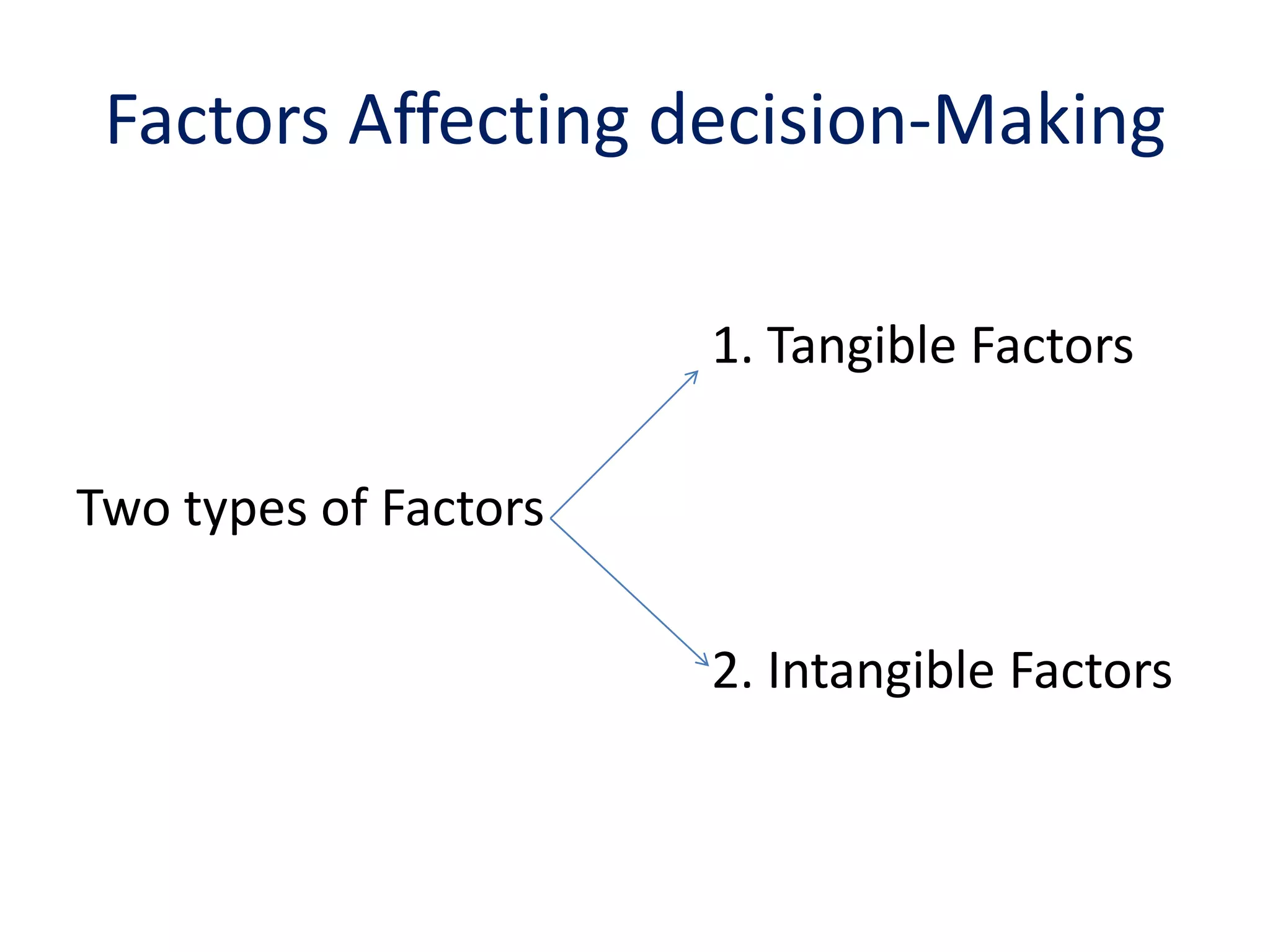
Factors Affecting decision-Making
1. Tangible Factors
Two types of Factors
2. Intangible Factors
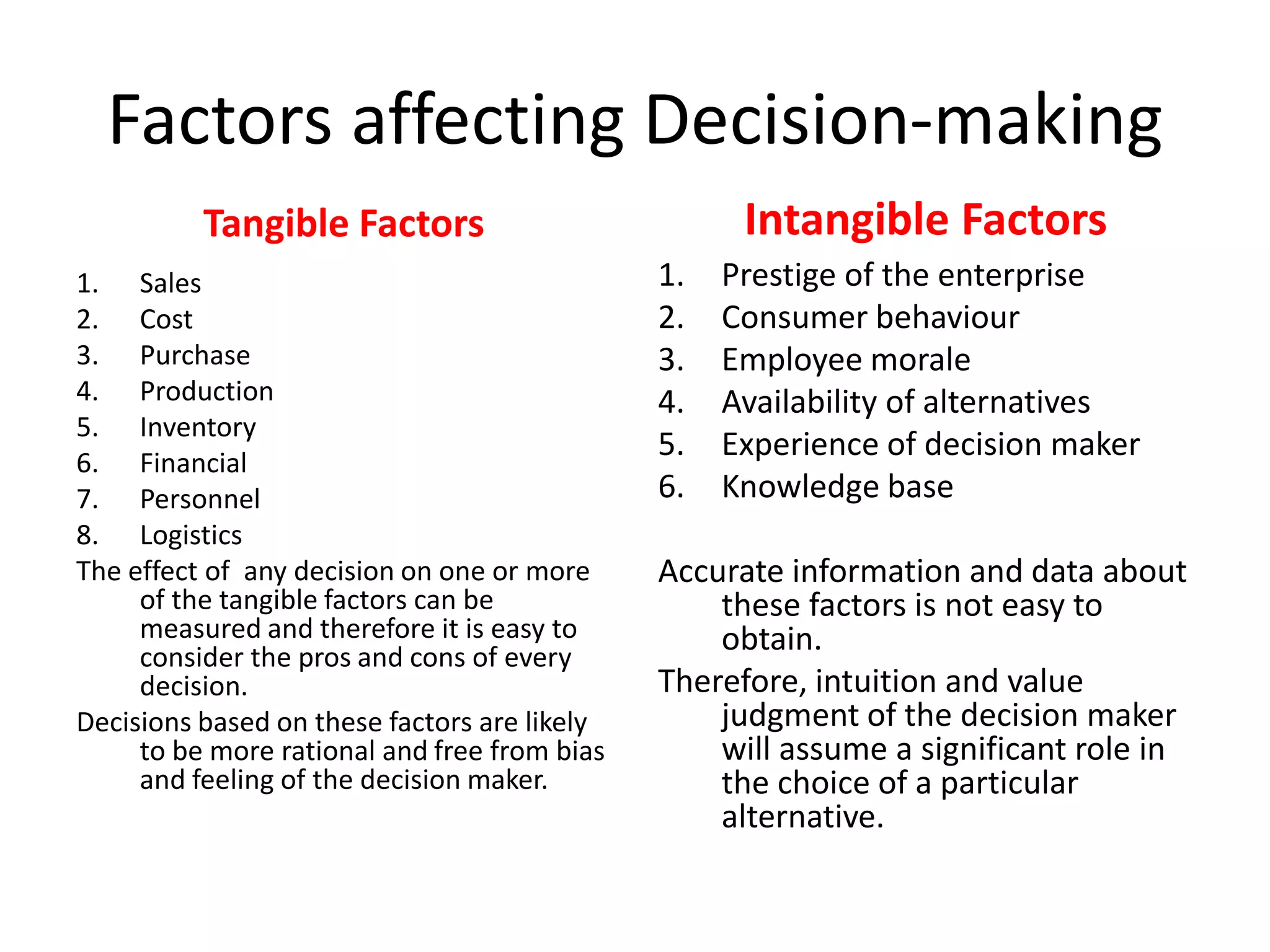
Factors affecting Decision-making
Intangible Factors

Tangible Factors
1. Sales
2. Cost
3. Purchase
4. Production
5. Inventory
6. Financial
7. Personnel
8. Logistics
The effect of any decision on one or more
of the tangible factors can be
measured and therefore it is easy to
consider the pros and cons of every
decision.
Decisions based on these factors are likely
to be more rational and free from bias
and feeling of the decision maker.

1.
2.
3.
4.
5.
6.

Prestige of the enterprise
Consumer behaviour
Employee morale
Availability of alternatives
Experience of decision maker
Knowledge base

Accurate information and data about
these factors is not easy to
obtain.
Therefore, intuition and value
judgment of the decision maker
will assume a significant role in
the choice of a particular
alternative.
Tools and Techniques of
Decision-Making
1.
2.
3.
4.

Marginal Analysis: used to find out how much extra output will
result if one variable(raw mtrl, machine, worker, etc) is added.
Useful for evaluating alternatives.
Financial analysis: used to estimate the profitability of an
investment, to calculate the payback period and to analyze cash
outflows and inflows.
Break-Even Analysis: (total revenue = total cost, and profit is nil).
Enables the decision-maker to evaluate the available alternatives
based on price, fixed cost and variable cost per unit.
Ratio analysis: an a/c tool for interpreting a/cng info. Useful to
find out the relationship b/w two variables., to interpret financial
statements to determine the strengths and weaknesses of a firm,
historical performance and current financial condition.
5. Operation Research = research of operations.
-involves the practical application of quantitative methods in
the process of decision-making.
a)

b)

Game theory: Game refers to a situation in which two or more
players are competing. It involves players (decision makers) who
have different goals or objectives and whose fates are
intertwined. Game theory refers to a body of kn which is
concerned with the study of decision-making in situations where
two or more rational opponents are involved under conditions of
competition and conflicting interests.
Simulation: a numerical solution method that seeks optimal
alternatives (strategies) through a trial and error process. Used
when uncertainty is involved in decision-making. It involves
building a model that represents a real or an existing system
c). Queuing Model: a mathematical technique for
balancing
services provided and waiting
lines. Waiting lines
occur
whenever the
demand for the service exceeds the service
facilities.
- it helps to optimize customer service
on
the
basis of quantitative criteria.

d). Transportation Models: it involves the
problem of
determining the minimum cost for allocating a product
several supply sources to several destinations.

from

e). Decision tree Analysis: a graphical representation of the
decision process indicating decision alternatives,
states of
nature, probabilities attached to the states to
the states of
nature and conditional benefits and losses.
Types of Decisions
1.

Programmed and Non-Programmed Decisions:
a). Programmed Decisions: normally repetitive, taken within
the broad policy structure. Have short-run impact and are taken
by lower level managers, ex, granting leave to an employee,
purchase of mtl in normal routine.
b). Non-programmed Decisions: non-repetitive in nature. Their
need arises becz of some specific circumstances. Ex. opening of
new branch, introducing a new product, etc.
- they involve judgment, intuition, creativity, etc.
- these decisions are taken by top mgmt.
2. Major and Minor decisions
3. Routine and Strategic Decisions
4. Policy and operative decisions
5)
6)
7)
8)
9)
10)

Organizational and Personal decisions.
Individual and Group Decisions
Long-term and short-term decisions
Departmental decisions
Non-economic decisions: relate to values, moral behaviour, etc.
Crisis and research Decisions: Crisis decisions are those which are
made to meet unanticipated situations. Mostly made immediately
under pressure of the circumstances.
Research Decisions are made after thorough analysis without any pressure.

11) Initiative and forced Decisions
12) Problem and opportunity Decisions: pblm decisions= resolving
pblm situations which have arisen as anticipated or not…,
opportunity decisions= pertain to taking advantage of an
opportunity…sometimes involves risk.
Essentials for effective
Decision-Making
1.
2.
3.
4.
5.
6.

Accuracy
Environment for decision
Timely decision
Communication of decision
Participative decision-making
Implementation of decision
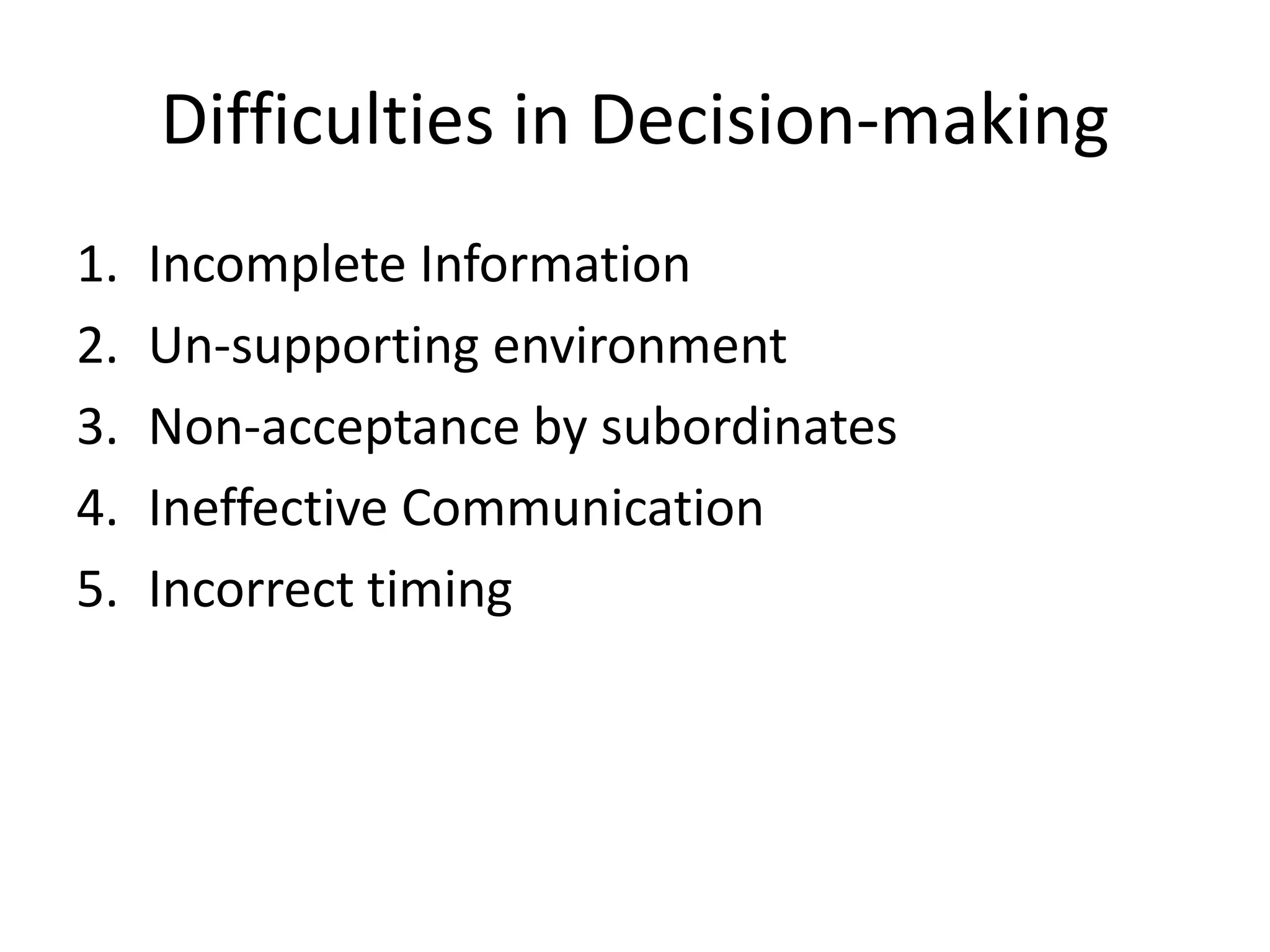
Difficulties in Decision-making
1.
2.
3.
4.
5.

Incomplete Information
Un-supporting environment
Non-acceptance by subordinates
Ineffective Communication
Incorrect timing

Decision making

  • 1.
  • 2.
    Meaning and Definition Inall the org.s whether small/big, decisions are made. - Through decisions gap b/w the existing situation and desired situation is reduced. = process of selecting a course of action to achieve a desired result. - Done after consultations, after seeing the pros and cons. - Purpose is to direct human behaviour towards a future goal, i.e., desired goal/result.
  • 3.
    George R Terry: “Decision-Makingis the selection based on certain criteria from two/more alternatives.” Marry Nites: “Decision-Making takes place in adopting the objectives and choosing the means and again when a change in the situation creates a necessary for adjustments.” Heinz Weihrich and Harold Koontz: “decision-Making is defined as the selection of a course of action among alternatives; it is the care of planning.”
  • 4.
    Nature/Characteristics of Decision-Making 1. 2. 3. 4. 5. 6. 7. 8. It isthe choice of the best among alternatives after evaluation through critical appraisal. End process preceded by deliberation and reasoning. A mental process becz the final selection is made after thoughtful consideration. Involves rationality becz through decisions an endeavour is made to better one’s happiness. Aimed at achieving the objectives of the org. It may be also a negative and may just be a decision not to decide. It involves a certain commitment which may be for short run or long run depending upon the type of decision. Decision relates to the means to the end.
  • 5.
    Importance of Decision-Making Decision-making plays an important role in the mgmt of a org.  Managers perform all their functions and activities through decision-making.  Making right decision in right times values much to the org.  Helps the mgmt to procure necessary data and information.  Helps to initiate and complete the action of all the activities of the mgmt in the right time.  It also helps in the formation of strategies and implement them.
  • 6.
    Principles of Decision-Making 1.Pl of Problem-Orientation 2. Pl of Exception: any decision which can be made by the subordinate shd be left for him to make (ex: decisions relating to operational details). The manager shd make only policy decisions. 3. Pl of Alternatives: only realistic or feasible alternatives shd be analyzed fully. 4. Pl of Limiting Factors: recognizing and overcoming the factors that stand critical in the way of a goal, the best alternative course of action can be selected.
  • 7.
    5. Pl ofBounded or Limited Rationality: a managers must settle for bounded or limited rationality. They shd pick up a course of action that is satisfactory or good enough under the existing circumstances. 6. Pl of Commitment: from both manager himself and subordinates to implement the decisions. 7. Pl of Participation: manager shd understand that the participation of subordinates in decision-making process not only improves their quality but also inculcates in them a sense of commitment and support for such decisions.
  • 8.
    Process of Decision-Making 1. 2. 3. 4. 5. 6. Identifyingand describing the problem Collection of Data= available facts and figures. Formulation of a Model: objective and alternatives are developed. Model becomes an analytical aid for making decision under different situations. Evaluation: after formulation of model we must evaluate it to see how far the model represents conditions of the real world/situation. Framing/ Selecting a Decision: after the possible outcomes of the course of action we select a particular course of action to cope with a particular problem. It called taking/making a decision. Follow-up/implementation of the Decision: plan follow-up strategies and actions, anticipate reactions.
  • 9.
    Factors Affecting decision-Making 1.Tangible Factors Two types of Factors 2. Intangible Factors
  • 10.
    Factors affecting Decision-making IntangibleFactors Tangible Factors 1. Sales 2. Cost 3. Purchase 4. Production 5. Inventory 6. Financial 7. Personnel 8. Logistics The effect of any decision on one or more of the tangible factors can be measured and therefore it is easy to consider the pros and cons of every decision. Decisions based on these factors are likely to be more rational and free from bias and feeling of the decision maker. 1. 2. 3. 4. 5. 6. Prestige of the enterprise Consumer behaviour Employee morale Availability of alternatives Experience of decision maker Knowledge base Accurate information and data about these factors is not easy to obtain. Therefore, intuition and value judgment of the decision maker will assume a significant role in the choice of a particular alternative.
  • 11.
    Tools and Techniquesof Decision-Making 1. 2. 3. 4. Marginal Analysis: used to find out how much extra output will result if one variable(raw mtrl, machine, worker, etc) is added. Useful for evaluating alternatives. Financial analysis: used to estimate the profitability of an investment, to calculate the payback period and to analyze cash outflows and inflows. Break-Even Analysis: (total revenue = total cost, and profit is nil). Enables the decision-maker to evaluate the available alternatives based on price, fixed cost and variable cost per unit. Ratio analysis: an a/c tool for interpreting a/cng info. Useful to find out the relationship b/w two variables., to interpret financial statements to determine the strengths and weaknesses of a firm, historical performance and current financial condition.
  • 12.
    5. Operation Research= research of operations. -involves the practical application of quantitative methods in the process of decision-making. a) b) Game theory: Game refers to a situation in which two or more players are competing. It involves players (decision makers) who have different goals or objectives and whose fates are intertwined. Game theory refers to a body of kn which is concerned with the study of decision-making in situations where two or more rational opponents are involved under conditions of competition and conflicting interests. Simulation: a numerical solution method that seeks optimal alternatives (strategies) through a trial and error process. Used when uncertainty is involved in decision-making. It involves building a model that represents a real or an existing system
  • 13.
    c). Queuing Model:a mathematical technique for balancing services provided and waiting lines. Waiting lines occur whenever the demand for the service exceeds the service facilities. - it helps to optimize customer service on the basis of quantitative criteria. d). Transportation Models: it involves the problem of determining the minimum cost for allocating a product several supply sources to several destinations. from e). Decision tree Analysis: a graphical representation of the decision process indicating decision alternatives, states of nature, probabilities attached to the states to the states of nature and conditional benefits and losses.
  • 14.
    Types of Decisions 1. Programmedand Non-Programmed Decisions: a). Programmed Decisions: normally repetitive, taken within the broad policy structure. Have short-run impact and are taken by lower level managers, ex, granting leave to an employee, purchase of mtl in normal routine. b). Non-programmed Decisions: non-repetitive in nature. Their need arises becz of some specific circumstances. Ex. opening of new branch, introducing a new product, etc. - they involve judgment, intuition, creativity, etc. - these decisions are taken by top mgmt. 2. Major and Minor decisions 3. Routine and Strategic Decisions 4. Policy and operative decisions
  • 15.
    5) 6) 7) 8) 9) 10) Organizational and Personaldecisions. Individual and Group Decisions Long-term and short-term decisions Departmental decisions Non-economic decisions: relate to values, moral behaviour, etc. Crisis and research Decisions: Crisis decisions are those which are made to meet unanticipated situations. Mostly made immediately under pressure of the circumstances. Research Decisions are made after thorough analysis without any pressure. 11) Initiative and forced Decisions 12) Problem and opportunity Decisions: pblm decisions= resolving pblm situations which have arisen as anticipated or not…, opportunity decisions= pertain to taking advantage of an opportunity…sometimes involves risk.
  • 16.
    Essentials for effective Decision-Making 1. 2. 3. 4. 5. 6. Accuracy Environmentfor decision Timely decision Communication of decision Participative decision-making Implementation of decision
  • 17.
    Difficulties in Decision-making 1. 2. 3. 4. 5. IncompleteInformation Un-supporting environment Non-acceptance by subordinates Ineffective Communication Incorrect timing