

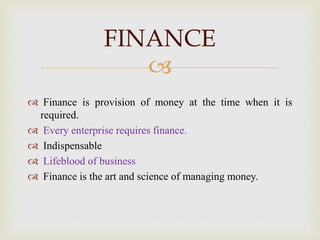
 Finance is provision of money at the time when it is
required.
 Every enterprise requires finance.
 Indispensable
 Lifeblood of business
 Finance is the art and science of managing money.
FINANCE

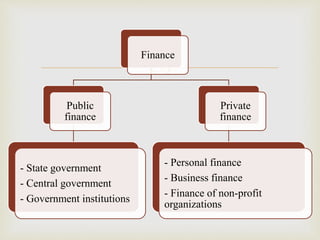
Finance
Public
finance
- State government
- Central government
- Government institutions
Private
finance
- Personal finance
- Business finance
- Finance of non-profit
organizations

 Financial management is an applied branch of
management that looks after the finance function of a
business.
 “Financial management is the operational activity of the
business that is responsible for obtaining and effectively
utilizing the funds necessary for efficient operations”.
Financial management

Financial management deals with how the
corporation obtains the funds and how it uses
them”-- Hoagland
Financial Management
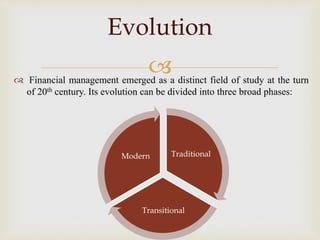
 Financial management emerged as a distinct field of study at the turn
of 20th century. Its evolution can be divided into three broad phases:
Evolution
Traditional
Transitional
Modern

Traditional phase lasted for about four decades. Following were its
important features:
1) The focus of financial management was mainly on certain
episodic events like formation, issuance of capital, major
expansion, merger, reorganization and liquidation in the
lifecycle of the firm.
2) The approach placed great emphasis on long term problems.
3) Financial management was not considered to be a managerial
function.
Traditional Phase

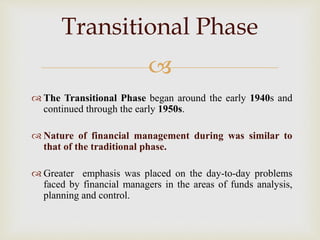
 The Transitional Phase began around the early 1940s and
continued through the early 1950s.
 Nature of financial management during was similar to
that of the traditional phase.
 Greater emphasis was placed on the day-to-day problems
faced by financial managers in the areas of funds analysis,
planning and control.
Transitional Phase

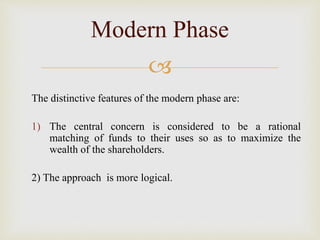
The distinctive features of the modern phase are:
1) The central concern is considered to be a rational
matching of funds to their uses so as to maximize the
wealth of the shareholders.
2) The approach is more logical.
Modern Phase

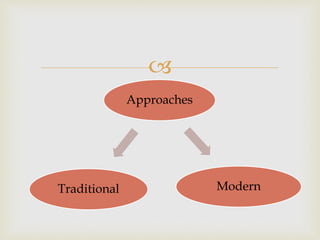
Approaches
Traditional Modern

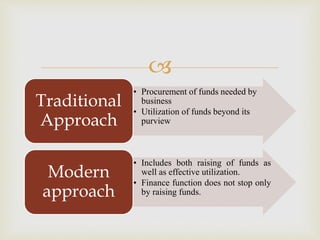
• Procurement of funds needed by
business
• Utilization of funds beyond its
purview
Traditional
Approach
• Includes both raising of funds as
well as effective utilization.
• Finance function does not stop only
by raising funds.
Modern
approach


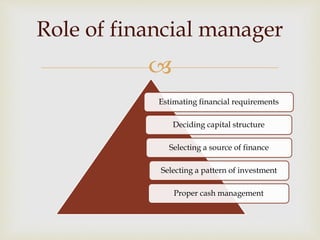
Estimating financial requirements
Deciding capital structure
Selecting a source of finance
Selecting a pattern of investment
Proper cash management
Role of financial manager

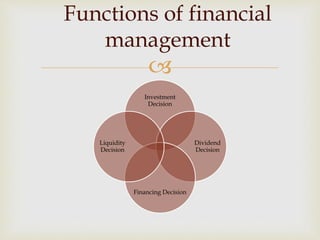
Investment
Decision
Dividend
Decision
Financing Decision
Liquidity
Decision
Functions of financial
management

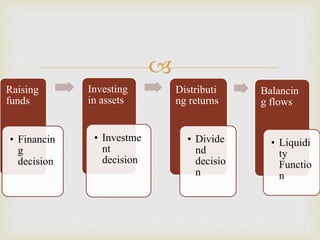
Raising
funds
• Financin
g
decision
Investing
in assets
• Investme
nt
decision
Distributi
ng returns
• Divide
nd
decisio
n
Balancin
g flows
• Liquidi
ty
Functio
n

 Investment decisions involve capital expenditure; known
as capital budgeting decisions.
 Risk arises due to uncertain returns.
 So, evaluate proposals in terms of both expected returns
and risks.
Investment Decision

 Decide from where, when and how to acquire funds to
meet needs.
 Determine appropriate proportion of debt and equity.
Financing decisions

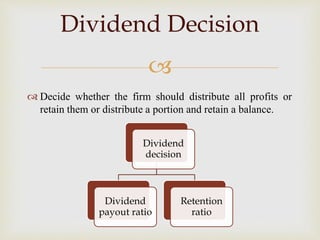
 Decide whether the firm should distribute all profits or
retain them or distribute a portion and retain a balance.
Dividend Decision
Dividend
decision
Dividend
payout ratio
Retention
ratio

 Investment in current assets affects the firm’s liquidity
and profitability.
 Current assets to be managed effectively.
Liquidity Decision

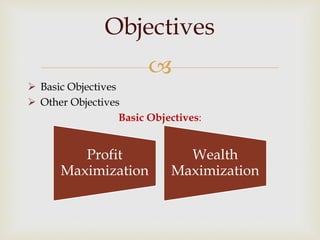
 Basic Objectives
 Other Objectives
Basic Objectives:
Objectives
Profit
Maximization
Wealth
Maximization

 Profit maximization implies that a firm either produces
maximum output for a given amount of input.
 Uses minimum input for producing a given output.
 Profit earning is the main aim of every business activity.
Profit Maximization

Profit Maximization
Cover its costs and provide funds for growth.
Profit is the measure of efficiency
Help an organization to face market fluctuation.
Considered as the most appropriate measure of a firm’s
performance.
Profits provide protection against risks.

 Profit is a barometer through which the performance of a business
unit can be determined.
 Profit ensures maximum welfare of all the stakeholders.
 Profit maximization increases the confidence of management for
modernization, expansion and diversification.
 Profit maximization attracts the investors to invest.
 Profits indicate efficient utilization of funds.
 Profits ensure survival during adverse business conditions.
Points in favor of Profit
maximization

 It may encourage corrupt and unethical practices.
 It ignores time value of money.
 It does not take into account the element of risk.
 It attracts cut throat competition.
 Huge amount of profit may attract Government
intervention.
 Huge profits may invite problems from workers who may
demand increased wages and salaries.
 Customers may feel exploited.
 The term profit is vague and it cannot be defined precisely.
Points Against Profit
maximization

 The goal of the management should be such all the stakeholders
are benefited.
 A financial action that has a positive NPV creates wealth for
shareholders and, therefore, is desirable.
 The wealth will be maximized if NPV criteria is followed in
making financial decisions.
 NPV is the difference between the present value of its benefits
and present value of its costs. If
 Pv(benefits)>Pv(costs)=Positive
 Pv(benefits)<Pv(costs)=Negative
Wealth Maximization

 It considers the concept of time value of money.
 It takes care of the interests of all the stakeholders.
 It considers the impact of risk factor.
 It implies long run survival and growth of the firm.
 It leads to maximizing stockholders’ utility or value
maximization of equity shareholders through increase in
stock price per share.
Points in Favor of Wealth
Maximization

It may not be socially desirable.
Because of divorce between ownership and
management, the latter may be more interested in
maximizing managerial utility than shareholders
wealth.
Point Against Wealth
Maximization

Concept, evolution, functions, objectives, scope

  • 1.
  • 2.
      Finance isprovision of money at the time when it is required.  Every enterprise requires finance.  Indispensable  Lifeblood of business  Finance is the art and science of managing money. FINANCE
  • 3.
     Finance Public finance - State government -Central government - Government institutions Private finance - Personal finance - Business finance - Finance of non-profit organizations
  • 4.
      Financial managementis an applied branch of management that looks after the finance function of a business.  “Financial management is the operational activity of the business that is responsible for obtaining and effectively utilizing the funds necessary for efficient operations”. Financial management
  • 5.
     Financial management dealswith how the corporation obtains the funds and how it uses them”-- Hoagland Financial Management
  • 6.
     Financial managementemerged as a distinct field of study at the turn of 20th century. Its evolution can be divided into three broad phases: Evolution Traditional Transitional Modern
  • 7.
     Traditional phase lastedfor about four decades. Following were its important features: 1) The focus of financial management was mainly on certain episodic events like formation, issuance of capital, major expansion, merger, reorganization and liquidation in the lifecycle of the firm. 2) The approach placed great emphasis on long term problems. 3) Financial management was not considered to be a managerial function. Traditional Phase
  • 8.
      The TransitionalPhase began around the early 1940s and continued through the early 1950s.  Nature of financial management during was similar to that of the traditional phase.  Greater emphasis was placed on the day-to-day problems faced by financial managers in the areas of funds analysis, planning and control. Transitional Phase
  • 9.
     The distinctive featuresof the modern phase are: 1) The central concern is considered to be a rational matching of funds to their uses so as to maximize the wealth of the shareholders. 2) The approach is more logical. Modern Phase
  • 10.
  • 11.
     • Procurement offunds needed by business • Utilization of funds beyond its purview Traditional Approach • Includes both raising of funds as well as effective utilization. • Finance function does not stop only by raising funds. Modern approach
  • 12.
  • 13.
     Estimating financial requirements Decidingcapital structure Selecting a source of finance Selecting a pattern of investment Proper cash management Role of financial manager
  • 14.
  • 15.
     Raising funds • Financin g decision Investing in assets •Investme nt decision Distributi ng returns • Divide nd decisio n Balancin g flows • Liquidi ty Functio n
  • 16.
      Investment decisionsinvolve capital expenditure; known as capital budgeting decisions.  Risk arises due to uncertain returns.  So, evaluate proposals in terms of both expected returns and risks. Investment Decision
  • 17.
      Decide fromwhere, when and how to acquire funds to meet needs.  Determine appropriate proportion of debt and equity. Financing decisions
  • 18.
      Decide whetherthe firm should distribute all profits or retain them or distribute a portion and retain a balance. Dividend Decision Dividend decision Dividend payout ratio Retention ratio
  • 19.
      Investment incurrent assets affects the firm’s liquidity and profitability.  Current assets to be managed effectively. Liquidity Decision
  • 20.
      Basic Objectives Other Objectives Basic Objectives: Objectives Profit Maximization Wealth Maximization
  • 21.
      Profit maximizationimplies that a firm either produces maximum output for a given amount of input.  Uses minimum input for producing a given output.  Profit earning is the main aim of every business activity. Profit Maximization
  • 22.
     Profit Maximization Cover itscosts and provide funds for growth. Profit is the measure of efficiency Help an organization to face market fluctuation. Considered as the most appropriate measure of a firm’s performance. Profits provide protection against risks.
  • 23.
      Profit isa barometer through which the performance of a business unit can be determined.  Profit ensures maximum welfare of all the stakeholders.  Profit maximization increases the confidence of management for modernization, expansion and diversification.  Profit maximization attracts the investors to invest.  Profits indicate efficient utilization of funds.  Profits ensure survival during adverse business conditions. Points in favor of Profit maximization
  • 24.
      It mayencourage corrupt and unethical practices.  It ignores time value of money.  It does not take into account the element of risk.  It attracts cut throat competition.  Huge amount of profit may attract Government intervention.  Huge profits may invite problems from workers who may demand increased wages and salaries.  Customers may feel exploited.  The term profit is vague and it cannot be defined precisely. Points Against Profit maximization
  • 25.
      The goalof the management should be such all the stakeholders are benefited.  A financial action that has a positive NPV creates wealth for shareholders and, therefore, is desirable.  The wealth will be maximized if NPV criteria is followed in making financial decisions.  NPV is the difference between the present value of its benefits and present value of its costs. If  Pv(benefits)>Pv(costs)=Positive  Pv(benefits)<Pv(costs)=Negative Wealth Maximization
  • 26.
      It considersthe concept of time value of money.  It takes care of the interests of all the stakeholders.  It considers the impact of risk factor.  It implies long run survival and growth of the firm.  It leads to maximizing stockholders’ utility or value maximization of equity shareholders through increase in stock price per share. Points in Favor of Wealth Maximization
  • 27.
     It may notbe socially desirable. Because of divorce between ownership and management, the latter may be more interested in maximizing managerial utility than shareholders wealth. Point Against Wealth Maximization