INTRODUCTION TO MANAGEMENT SCIENCE Lecture Note one Fahmy Radhi
Management Science   Management Science is a scientific approaches to problem solving and decision making Management Science encompass a logical approach to problem solving Management Science can be used in a variety of organization to solve many different types of problems
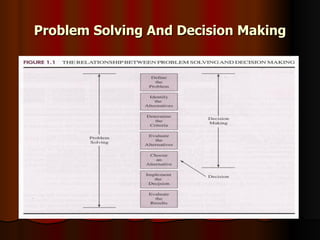
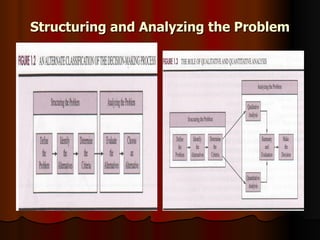
Problem Solving Problem Solving is defined as the process of identifying a difference between the actual and desired state of affairs The problem Solving process: Identify and define the problem Determine the set of alternative solutions Determine the criterion used to evaluate the alternatives Evaluate Alternatives Choose an alternative Implement the selective alternative Evaluate the result
Decision Making Decision Making is the term generally associated with the first five steps of the problem solving process The first step of decision making is to identify and defines the problem Decision making ends with the choosing of the an alternative, which is the act of making the decision
Problem Solving And Decision Making
Structuring and Analyzing the Problem
Quantitative Analysis Model Development Data Preparation Model Solution Implementation and Report
Model Development Models are representation of real object or situation that can be presented in various forms Model Classification: Iconic models are physical replicas of real objects. E.g. The model airplane and toy truck Analog models are physical in form but do not have the same physical appearance as the object being modeled. E.g. The speedometer represent the speed of automobile  Mathematical Models are representations of problem by a system of symbol and mathematical relationship or expression. E.g. P = 10x
Data Preparation The preparation of the date required by the model Data refer to the values of uncontrollable input to models If data required are few, the analysis will combine model development and data preparation into one step by inserted as the equation
Model Solution Model Solution attempt to identify the values of the decision variables that provide the best output as the optimal solution for the model  One procedure that might be used in the model solution step involves a trial-and-error approach
Conclusion and Report Making concluding remarks based on model solution Preparing the managerial report based on the conclusion The report is one of the inputs for the manager considering before making a final decision
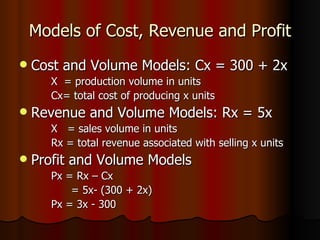
Models of Cost, Revenue and Profit Cost and Volume Models: Cx = 300 + 2x X  = production volume in units Cx= total cost of producing x units Revenue and Volume Models: Rx = 5x X  = sales volume in units Rx = total revenue associated with selling x units Profit and Volume Models Px = Rx – Cx = 5x- (300 + 2x) Px = 3x - 300
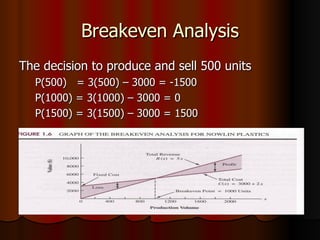
Breakeven Analysis The decision to produce and sell 500 units P(500)  = 3(500) – 3000 = -1500 P(1000) = 3(1000) – 3000 = 0 P(1500) = 3(1500) – 3000 = 1500
Management Science Techniques Linier Programming Transportation and Assignment models Project Scheduling: PERT/CPM Inventory Models Waiting line or Queuing Models Decision Analysis Goal Programming Analytic Hierarchy Process Simulation Forecasting Markov Process Models Dynamic Programming
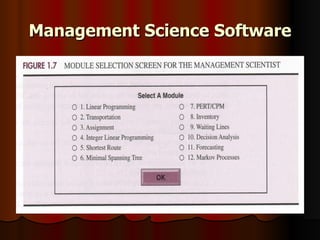
Management Science Software

11-Management Science

  • 1.
    INTRODUCTION TO MANAGEMENTSCIENCE Lecture Note one Fahmy Radhi
  • 2.
    Management Science Management Science is a scientific approaches to problem solving and decision making Management Science encompass a logical approach to problem solving Management Science can be used in a variety of organization to solve many different types of problems
  • 3.
    Problem Solving ProblemSolving is defined as the process of identifying a difference between the actual and desired state of affairs The problem Solving process: Identify and define the problem Determine the set of alternative solutions Determine the criterion used to evaluate the alternatives Evaluate Alternatives Choose an alternative Implement the selective alternative Evaluate the result
  • 4.
    Decision Making DecisionMaking is the term generally associated with the first five steps of the problem solving process The first step of decision making is to identify and defines the problem Decision making ends with the choosing of the an alternative, which is the act of making the decision
  • 5.
    Problem Solving AndDecision Making
  • 6.
  • 7.
    Quantitative Analysis ModelDevelopment Data Preparation Model Solution Implementation and Report
  • 8.
    Model Development Modelsare representation of real object or situation that can be presented in various forms Model Classification: Iconic models are physical replicas of real objects. E.g. The model airplane and toy truck Analog models are physical in form but do not have the same physical appearance as the object being modeled. E.g. The speedometer represent the speed of automobile Mathematical Models are representations of problem by a system of symbol and mathematical relationship or expression. E.g. P = 10x
  • 9.
    Data Preparation Thepreparation of the date required by the model Data refer to the values of uncontrollable input to models If data required are few, the analysis will combine model development and data preparation into one step by inserted as the equation
  • 10.
    Model Solution ModelSolution attempt to identify the values of the decision variables that provide the best output as the optimal solution for the model One procedure that might be used in the model solution step involves a trial-and-error approach
  • 11.
    Conclusion and ReportMaking concluding remarks based on model solution Preparing the managerial report based on the conclusion The report is one of the inputs for the manager considering before making a final decision
  • 12.
    Models of Cost,Revenue and Profit Cost and Volume Models: Cx = 300 + 2x X = production volume in units Cx= total cost of producing x units Revenue and Volume Models: Rx = 5x X = sales volume in units Rx = total revenue associated with selling x units Profit and Volume Models Px = Rx – Cx = 5x- (300 + 2x) Px = 3x - 300
  • 13.
    Breakeven Analysis Thedecision to produce and sell 500 units P(500) = 3(500) – 3000 = -1500 P(1000) = 3(1000) – 3000 = 0 P(1500) = 3(1500) – 3000 = 1500
  • 14.
    Management Science TechniquesLinier Programming Transportation and Assignment models Project Scheduling: PERT/CPM Inventory Models Waiting line or Queuing Models Decision Analysis Goal Programming Analytic Hierarchy Process Simulation Forecasting Markov Process Models Dynamic Programming
  • 15.