Revathy Rajasekaran
Co-ordinator, EDC
V.V.VanniaperumalCollege forWomen
Virudhunagar
 Project formulation is the systematic
developments of project ideas for eventual
objective of arriving at an investment
decision.
 Project formulation involves step by step
investigation and development of project
idea.
 It helps in taking decisions of accepting or
rejecting an idea.
 Project formulation process involves involves
experts from various fields
 Industrial economist
 Market analyst
 Technologist/Engineer
 Mechanical & Industrial Engineer
 Civil Engineer
 Management accounting expert
 Well formulated project is passport for
obtaining required assistance from financial
institution.
 A well formulated project is the best way of
selling a project idea.
 It is also a great assistance for obtaining
necessary government clearance and
sanctions without difficulties
 Selection of appropriate technology –
Modern technology in developed country
may not be suitable for adopting in
developing country. Due to limited market for
the products and limited availability of capital
and skilled labour.
 Hence the entrepreneur has to examine the
project idea thoroughly in regard design,
production & marketing
 Influence of external Economics- No project
can function independently in economy.
 It depend on other industries for raw
material, power tools, spare parts, technical,
financial and managerial service,
communication &Transport facility.
 Dearth of technical qualified personnel-
lack of skilled personnel for coping with
modern technology.
 Resource mobilization-The capital required
is difficult to generate.
 Knowledge about government regulations-
an entrepreneur has to undergo numerous
government regulations.
 The ‘Guidelines for Industries’ published by
ministry of industrial development provides
information about industrial policy, licencing
procedure, import –export control orders.
 Gives information about the future prospects
of industry
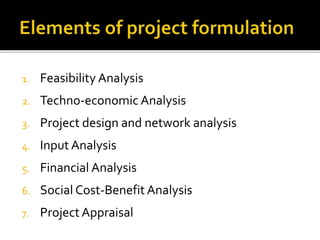
1. Feasibility Analysis
2. Techno-economic Analysis
3. Project design and network analysis
4. Input Analysis
5. Financial Analysis
6. Social Cost-Benefit Analysis
7. Project Appraisal
 It is the process of evaluating the future of a
project idea within the limitations.
 It determines the desirability of investing in
future development of project idea.
 3 possibility are:
 Feasible(Positive)- proceed to invest resource
 Not feasible- no investment is made
 Data not adequate for arriving decision then
additional information must be collected to
take decision
 Project are analysed from angles of technical,
marketing, financial etc.
 There are 3 stages in feasibility study namely
 Prefeasibility study
 Feasibility study
 Project report
 The objective of prefeasibility study are
 The investment decision can be taken on
information on prefeasibility study.
 Futher detailed analysis can be done or not.
 Need for in-depth study on critical aspects of
projects.
 The information collected at this stage
include market & plant capacity, material
input, location, technology, manpower,
financial analysis
 It is the detailed analysis on different aspects
relating project like economic, technical,
managerial, organizational, commercial and
financial.
 The feasibility study is an iterative process
covering alternative solution for production,
location, technology etc.
 If there is any non-viable project the
parameters should be adjusted to make it
viable.
 It is concerned with identification of project
demand potential and selection of
technology for the project.
 There are 2 parts namely
 Determination of project demand potential
 Selection of optimal project strategy.
 Estimation of the demand potential of the
project is done by demand forecasting.
 This is done in 3 stages viz. 1.Situation
analysis 2.Data collection & compilation,3.
interpretation & presentation.
 Situation analysis involves identifying the
dimension of demand forecasting.
 Future trend is projected by collecting &
compiling past, present & future market data.
 The data collected is compiled and presented
in a table and interpretation is done to
estimate the future demand.
 There are infinite series of strategy to achieve
the project objectives.
 One single optimal strategy which attains the
objective with minimum cost & time is
selected from the list of strategy.
 The techno economic report contains the
details of the selected strategy with which
the further project development is done
 It is the heart of the project. It defines the
individual activity comprising a project and
interrelationship between these activities.
 The activity & its relationship is shown in
network diagram.
 It shows the detailed work plan & time profile
 The network analysis is done to identify the
optimal course of action to execute it within
the minimum time within the resources.
 Input Analysis is mainly concerned with
identification, quantification and evaluation
of project inputs.
 This include identify the nature of resource,
estimate the magnitude of the required
resource, evaluate the possibility of
uninterrupted supply.
 Resource are needed in 3 stages
 Preinvestment stage, Construction stage &
normalisation stage
 Pre investment stage- resource for
investigation of various aspects of project
idea. Less resource is needed.
 Construction stage- non-recurring resource
to develop the project structure. Maximum
resources is needed
 Normalization stage- raw material & other
consumables on recurring basis
 Input requirements includes the cost
estimate of the resource
 Financial analysis is done to know the
financial feasibility of the project.
 It involves estimation of the project cost &
revenue and funds required for project.
 It analyse if the project generates the
revenue.
 The information obtained is to do
commercial profitability analysis, break even
analysis & ratio analysis.
 Cost benefit analysis estimates the social cost
and social benefits . It analyze the social
profitability of the project.
 It evaluates the impact of the project of the
society.
 The details gathered from feasibility studies
are presented in tables reports and
statements are consolidated into one master
report called project report or feasibility
report.
 It contains background information of
industry to which project belong and the
company.
 It provides information for project evaluation
appraisal before the funding agencies finance
 Project formulation is investigation process
before investment decision.
 It helps to accept or reject project.
 Detailed project report is a post investment
decision.
 It is the detailed specifications of design,
engineering drawings, site, process design
and time schedule for implementation. It is
the work plan for project
 The project profile consist of
 Economic size
 Status of industry or scope
 Raw material availability
 Cost of production
 Capital cost
 Utility requirements
 Infrastructure facility
 Profitability
 Government policy
 The criteria of project selection includes
 Investment size
 Location
 Technology
 Equipment
 Marketing
 Power &Water
 Others Performance
 Working capital requirements
 Labour component
 Economic viability

Project formulation (1)

  • 1.
  • 2.
     Project formulationis the systematic developments of project ideas for eventual objective of arriving at an investment decision.  Project formulation involves step by step investigation and development of project idea.  It helps in taking decisions of accepting or rejecting an idea.
  • 3.
     Project formulationprocess involves involves experts from various fields  Industrial economist  Market analyst  Technologist/Engineer  Mechanical & Industrial Engineer  Civil Engineer  Management accounting expert
  • 4.
     Well formulatedproject is passport for obtaining required assistance from financial institution.  A well formulated project is the best way of selling a project idea.  It is also a great assistance for obtaining necessary government clearance and sanctions without difficulties
  • 5.
     Selection ofappropriate technology – Modern technology in developed country may not be suitable for adopting in developing country. Due to limited market for the products and limited availability of capital and skilled labour.  Hence the entrepreneur has to examine the project idea thoroughly in regard design, production & marketing
  • 6.
     Influence ofexternal Economics- No project can function independently in economy.  It depend on other industries for raw material, power tools, spare parts, technical, financial and managerial service, communication &Transport facility.  Dearth of technical qualified personnel- lack of skilled personnel for coping with modern technology.
  • 7.
     Resource mobilization-Thecapital required is difficult to generate.  Knowledge about government regulations- an entrepreneur has to undergo numerous government regulations.  The ‘Guidelines for Industries’ published by ministry of industrial development provides information about industrial policy, licencing procedure, import –export control orders.  Gives information about the future prospects of industry
  • 8.
    1. Feasibility Analysis 2.Techno-economic Analysis 3. Project design and network analysis 4. Input Analysis 5. Financial Analysis 6. Social Cost-Benefit Analysis 7. Project Appraisal
  • 9.
     It isthe process of evaluating the future of a project idea within the limitations.  It determines the desirability of investing in future development of project idea.  3 possibility are:  Feasible(Positive)- proceed to invest resource  Not feasible- no investment is made  Data not adequate for arriving decision then additional information must be collected to take decision
  • 10.
     Project areanalysed from angles of technical, marketing, financial etc.  There are 3 stages in feasibility study namely  Prefeasibility study  Feasibility study  Project report
  • 11.
     The objectiveof prefeasibility study are  The investment decision can be taken on information on prefeasibility study.  Futher detailed analysis can be done or not.  Need for in-depth study on critical aspects of projects.  The information collected at this stage include market & plant capacity, material input, location, technology, manpower, financial analysis
  • 12.
     It isthe detailed analysis on different aspects relating project like economic, technical, managerial, organizational, commercial and financial.  The feasibility study is an iterative process covering alternative solution for production, location, technology etc.  If there is any non-viable project the parameters should be adjusted to make it viable.
  • 13.
     It isconcerned with identification of project demand potential and selection of technology for the project.  There are 2 parts namely  Determination of project demand potential  Selection of optimal project strategy.
  • 14.
     Estimation ofthe demand potential of the project is done by demand forecasting.  This is done in 3 stages viz. 1.Situation analysis 2.Data collection & compilation,3. interpretation & presentation.  Situation analysis involves identifying the dimension of demand forecasting.  Future trend is projected by collecting & compiling past, present & future market data.  The data collected is compiled and presented in a table and interpretation is done to estimate the future demand.
  • 15.
     There areinfinite series of strategy to achieve the project objectives.  One single optimal strategy which attains the objective with minimum cost & time is selected from the list of strategy.  The techno economic report contains the details of the selected strategy with which the further project development is done
  • 16.
     It isthe heart of the project. It defines the individual activity comprising a project and interrelationship between these activities.  The activity & its relationship is shown in network diagram.  It shows the detailed work plan & time profile  The network analysis is done to identify the optimal course of action to execute it within the minimum time within the resources.
  • 17.
     Input Analysisis mainly concerned with identification, quantification and evaluation of project inputs.  This include identify the nature of resource, estimate the magnitude of the required resource, evaluate the possibility of uninterrupted supply.  Resource are needed in 3 stages  Preinvestment stage, Construction stage & normalisation stage
  • 18.
     Pre investmentstage- resource for investigation of various aspects of project idea. Less resource is needed.  Construction stage- non-recurring resource to develop the project structure. Maximum resources is needed  Normalization stage- raw material & other consumables on recurring basis  Input requirements includes the cost estimate of the resource
  • 19.
     Financial analysisis done to know the financial feasibility of the project.  It involves estimation of the project cost & revenue and funds required for project.  It analyse if the project generates the revenue.  The information obtained is to do commercial profitability analysis, break even analysis & ratio analysis.
  • 20.
     Cost benefitanalysis estimates the social cost and social benefits . It analyze the social profitability of the project.  It evaluates the impact of the project of the society.
  • 21.
     The detailsgathered from feasibility studies are presented in tables reports and statements are consolidated into one master report called project report or feasibility report.  It contains background information of industry to which project belong and the company.  It provides information for project evaluation appraisal before the funding agencies finance
  • 22.
     Project formulationis investigation process before investment decision.  It helps to accept or reject project.  Detailed project report is a post investment decision.  It is the detailed specifications of design, engineering drawings, site, process design and time schedule for implementation. It is the work plan for project
  • 23.
     The projectprofile consist of  Economic size  Status of industry or scope  Raw material availability  Cost of production  Capital cost  Utility requirements  Infrastructure facility  Profitability  Government policy
  • 24.
     The criteriaof project selection includes  Investment size  Location  Technology  Equipment  Marketing
  • 25.
     Power &Water Others Performance  Working capital requirements  Labour component  Economic viability