1
March 9, 2023
Prepared by: mohammedkhaliffarah@gmail.com
Decision—a choice among two or more alternatives
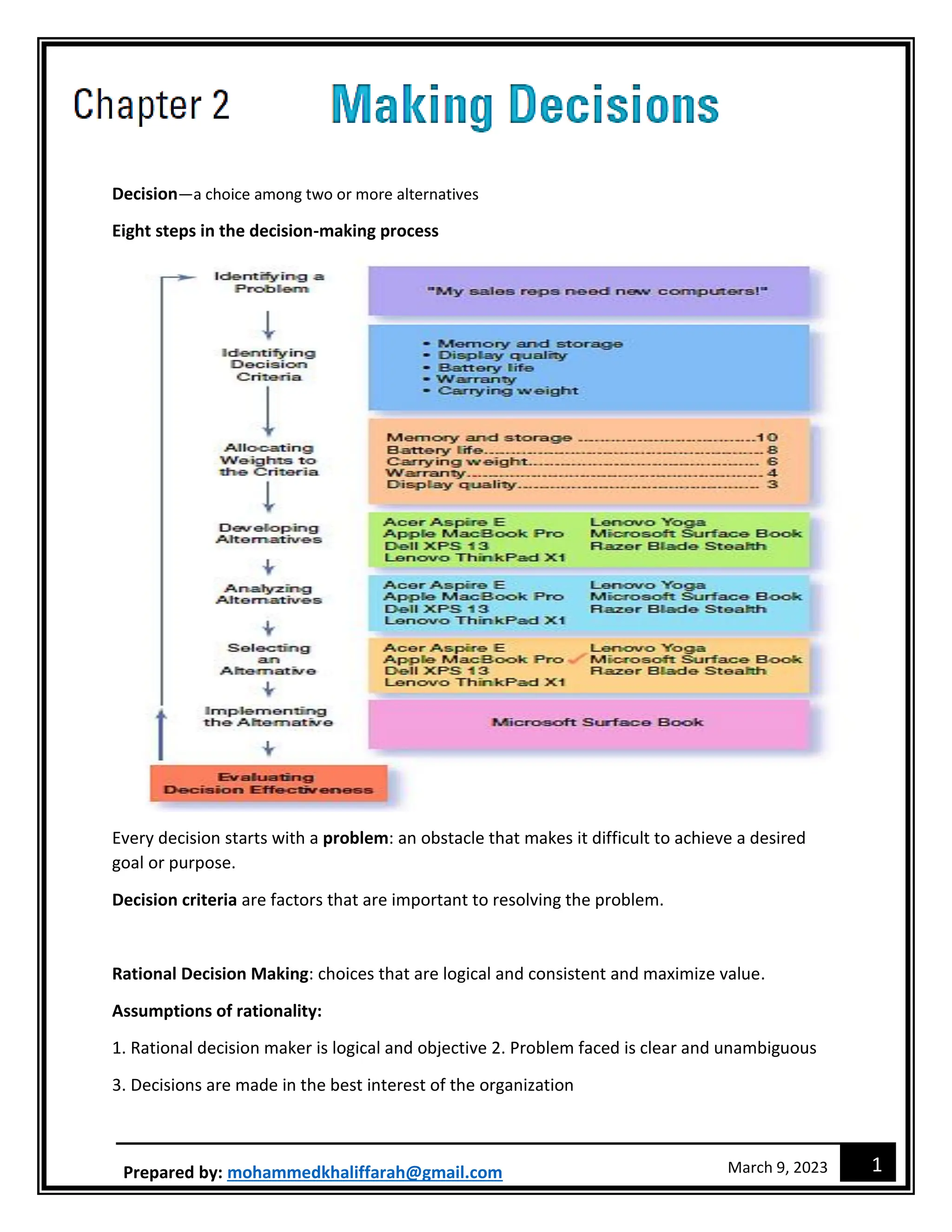
Eight steps in the decision-making process
Every decision starts with a problem: an obstacle that makes it difficult to achieve a desired
goal or purpose.
Decision criteria are factors that are important to resolving the problem.
Rational Decision Making: choices that are logical and consistent and maximize value.
Assumptions of rationality:
1. Rational decision maker is logical and objective 2. Problem faced is clear and unambiguous
3. Decisions are made in the best interest of the organization
2
March 9, 2023
Prepared by: mohammedkhaliffarah@gmail.com
Bounded rationality: decision making that’s rational, but limited by an individual’s ability to
process information
Satisfice: accepting solutions that are “good enough”
Intuitive Decision Making: making decisions on the basis of experience, feelings, and
accumulated judgment.
Evidence-based management (E B Mgt): the systematic use of the best available evidence to
improve management practice.
Crowdsourcing: a decision-making approach where you solicit ideas and input from a network
of people outside of the traditional set of decision makers.
Types of Decisions:
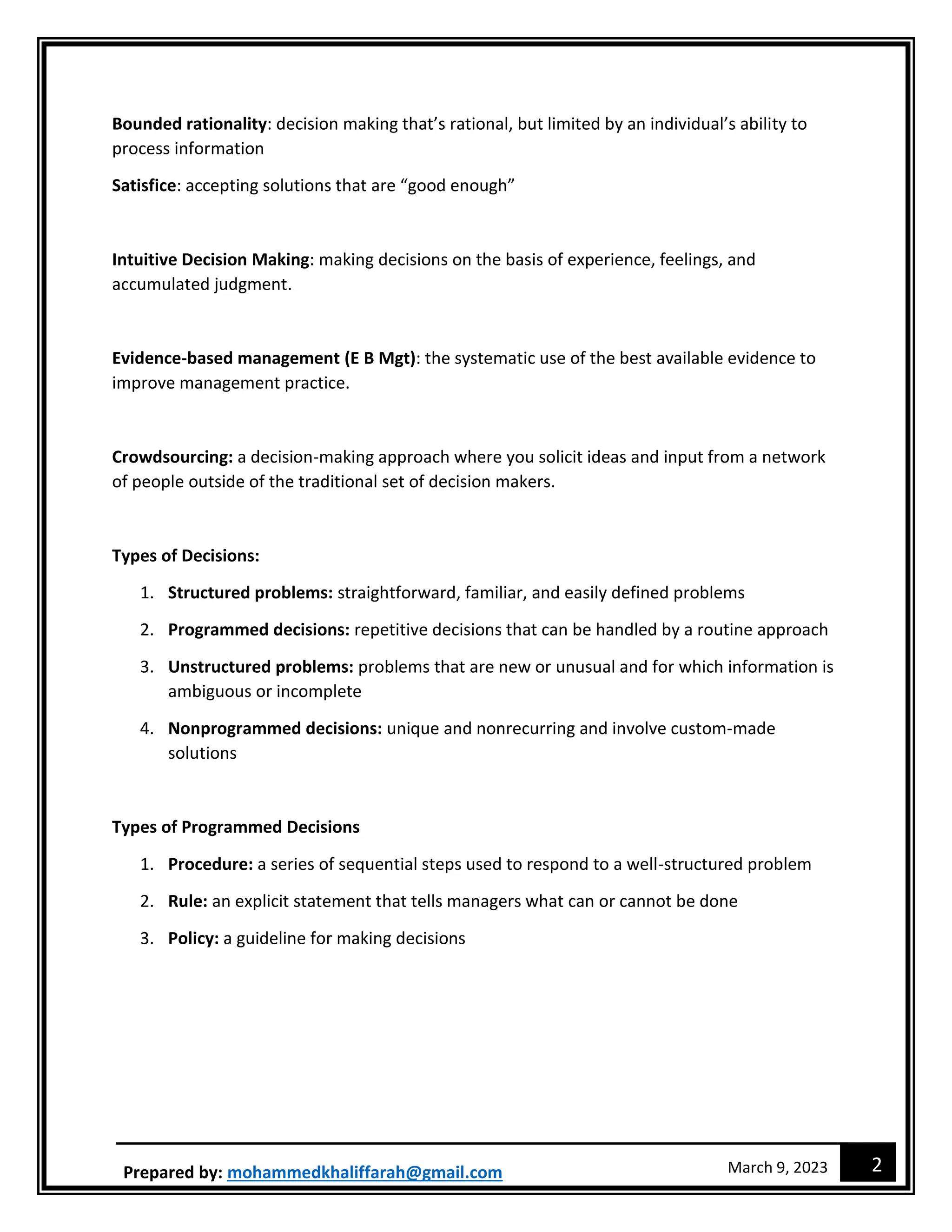
1. Structured problems: straightforward, familiar, and easily defined problems
2. Programmed decisions: repetitive decisions that can be handled by a routine approach
3. Unstructured problems: problems that are new or unusual and for which information is
ambiguous or incomplete
4. Nonprogrammed decisions: unique and nonrecurring and involve custom-made
solutions
Types of Programmed Decisions
1. Procedure: a series of sequential steps used to respond to a well-structured problem
2. Rule: an explicit statement that tells managers what can or cannot be done
3. Policy: a guideline for making decisions
3
March 9, 2023
Prepared by: mohammedkhaliffarah@gmail.com
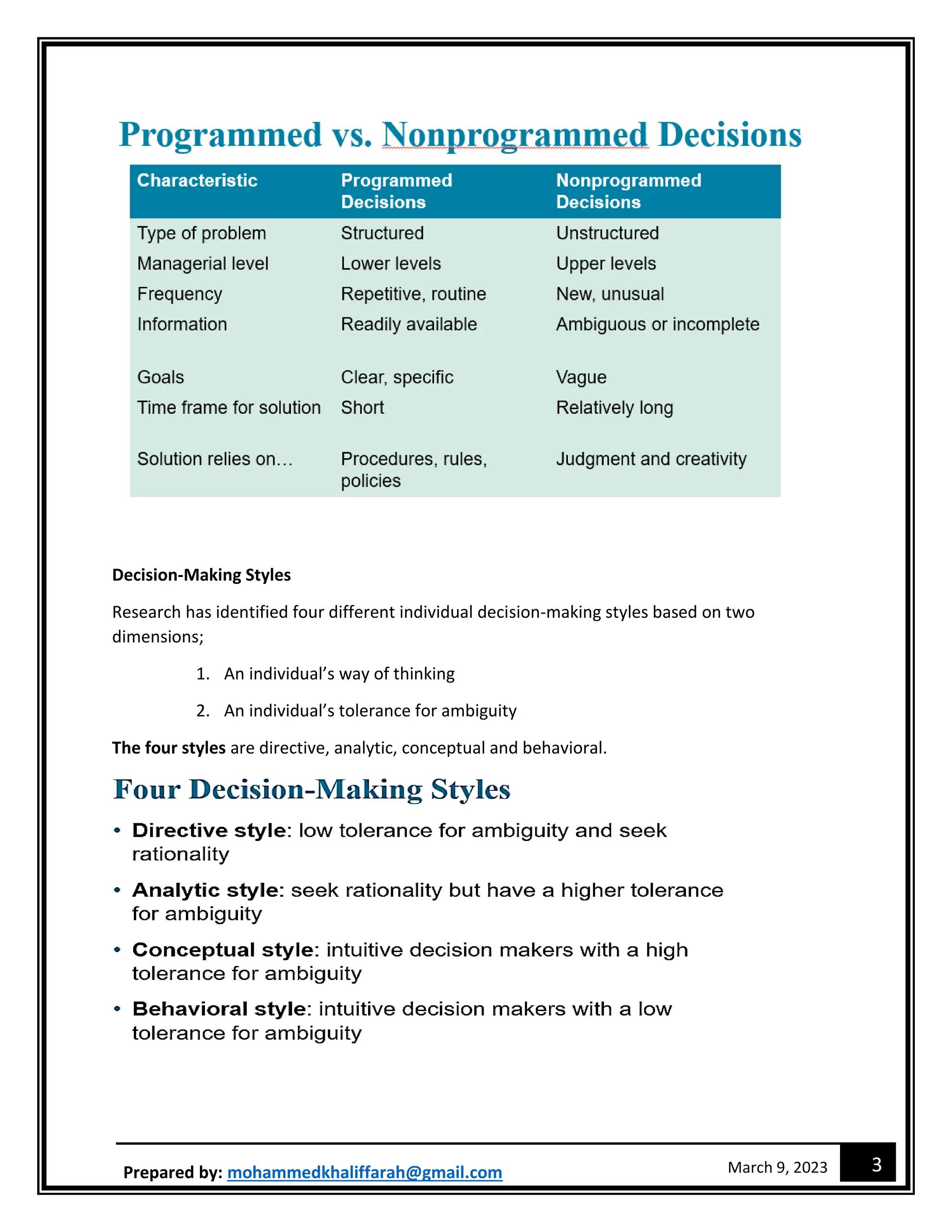
Decision-Making Styles
Research has identified four different individual decision-making styles based on two
dimensions;
1. An individual’s way of thinking
2. An individual’s tolerance for ambiguity
The four styles are directive, analytic, conceptual and behavioral.
4
March 9, 2023
Prepared by: mohammedkhaliffarah@gmail.com
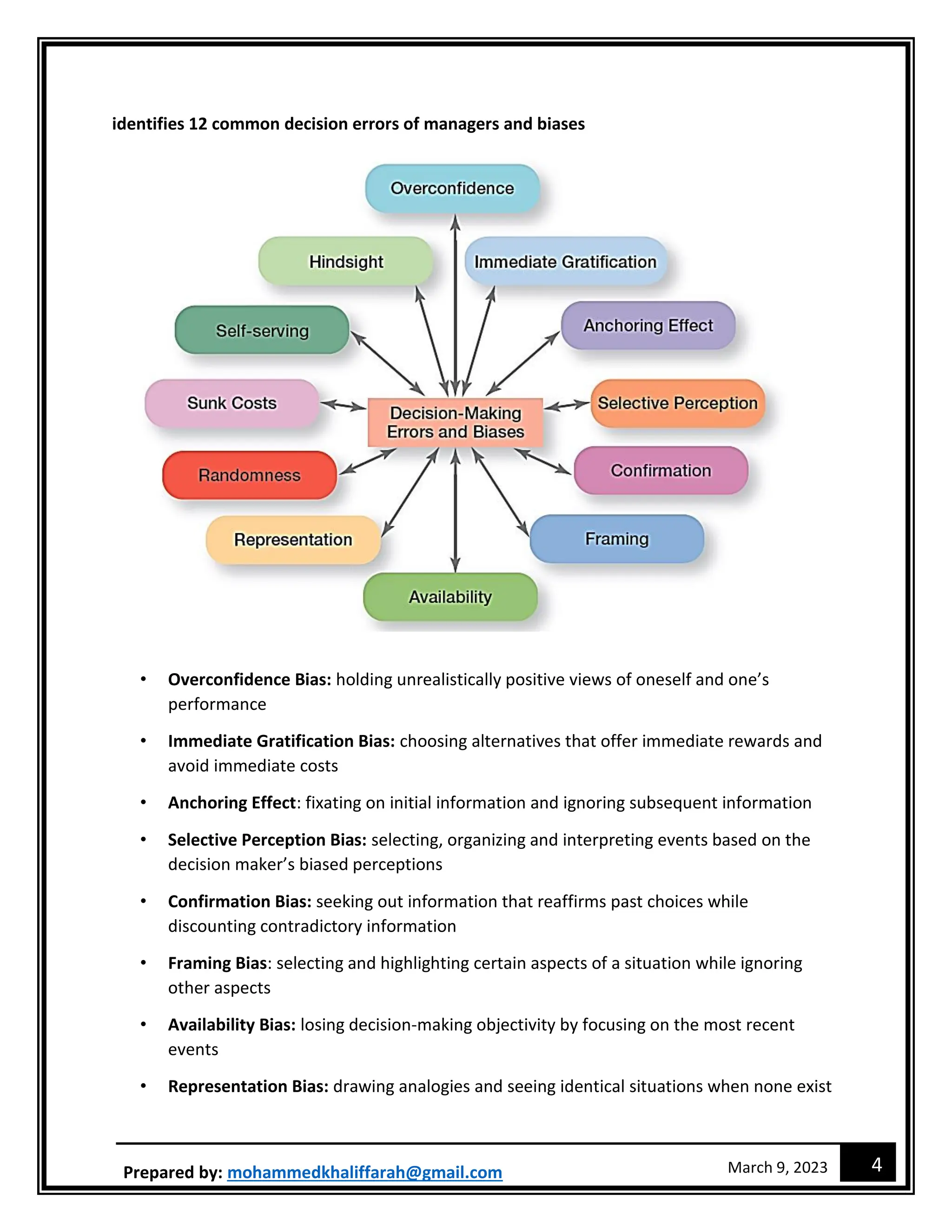
identifies 12 common decision errors of managers and biases
• Overconfidence Bias: holding unrealistically positive views of oneself and one’s
performance
• Immediate Gratification Bias: choosing alternatives that offer immediate rewards and
avoid immediate costs
• Anchoring Effect: fixating on initial information and ignoring subsequent information
• Selective Perception Bias: selecting, organizing and interpreting events based on the
decision maker’s biased perceptions
• Confirmation Bias: seeking out information that reaffirms past choices while
discounting contradictory information
• Framing Bias: selecting and highlighting certain aspects of a situation while ignoring
other aspects
• Availability Bias: losing decision-making objectivity by focusing on the most recent
events
• Representation Bias: drawing analogies and seeing identical situations when none exist
5
March 9, 2023
Prepared by: mohammedkhaliffarah@gmail.com
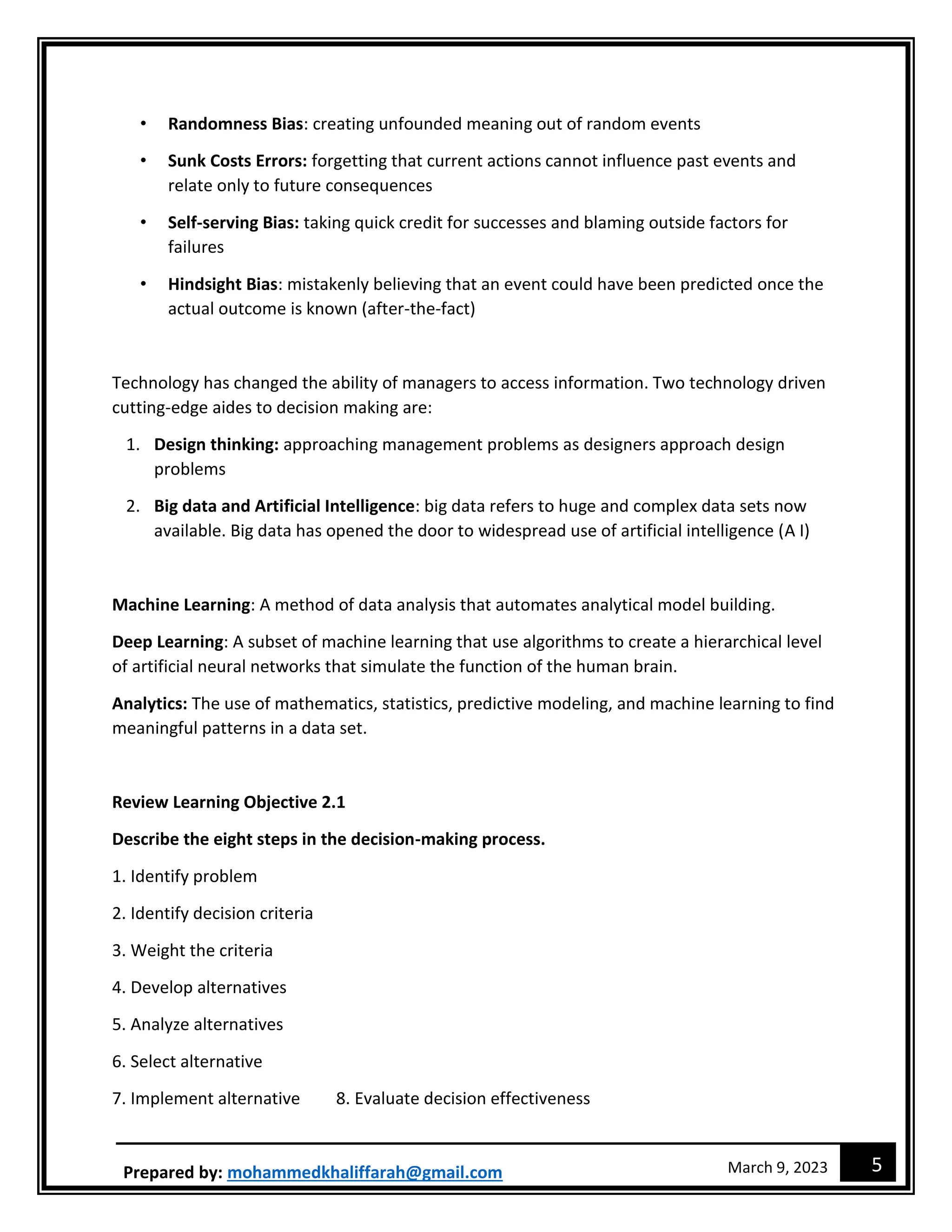
• Randomness Bias: creating unfounded meaning out of random events
• Sunk Costs Errors: forgetting that current actions cannot influence past events and
relate only to future consequences
• Self-serving Bias: taking quick credit for successes and blaming outside factors for
failures
• Hindsight Bias: mistakenly believing that an event could have been predicted once the
actual outcome is known (after-the-fact)
Technology has changed the ability of managers to access information. Two technology driven
cutting-edge aides to decision making are:
1. Design thinking: approaching management problems as designers approach design
problems
2. Big data and Artificial Intelligence: big data refers to huge and complex data sets now
available. Big data has opened the door to widespread use of artificial intelligence (A I)
Machine Learning: A method of data analysis that automates analytical model building.
Deep Learning: A subset of machine learning that use algorithms to create a hierarchical level
of artificial neural networks that simulate the function of the human brain.
Analytics: The use of mathematics, statistics, predictive modeling, and machine learning to find
meaningful patterns in a data set.
Review Learning Objective 2.1
Describe the eight steps in the decision-making process.
1. Identify problem
2. Identify decision criteria
3. Weight the criteria
4. Develop alternatives
5. Analyze alternatives
6. Select alternative
7. Implement alternative 8. Evaluate decision effectiveness
6
March 9, 2023
Prepared by: mohammedkhaliffarah@gmail.com
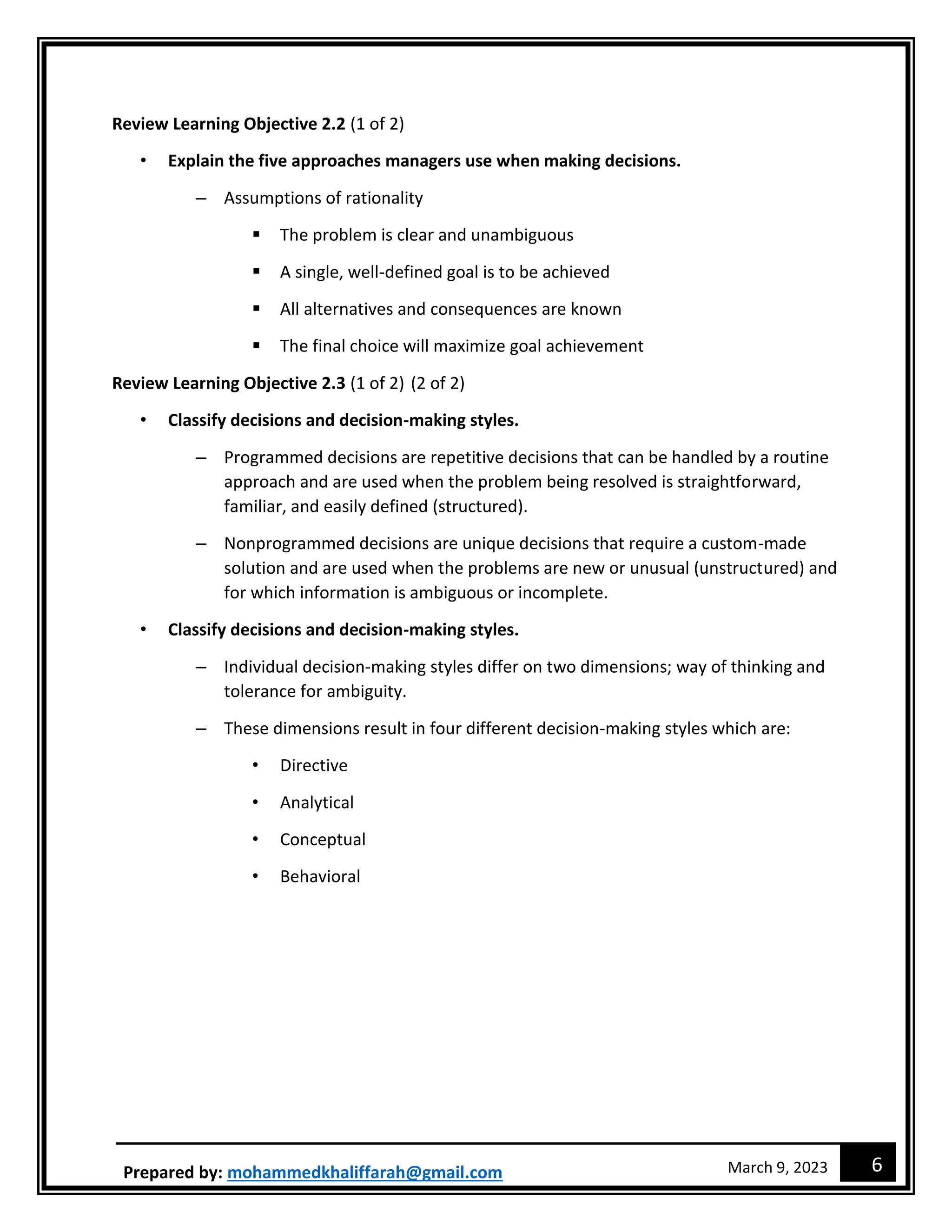
Review Learning Objective 2.2 (1 of 2)
• Explain the five approaches managers use when making decisions.
– Assumptions of rationality
 The problem is clear and unambiguous
 A single, well-defined goal is to be achieved
 All alternatives and consequences are known
 The final choice will maximize goal achievement
Review Learning Objective 2.3 (1 of 2) (2 of 2)
• Classify decisions and decision-making styles.
– Programmed decisions are repetitive decisions that can be handled by a routine
approach and are used when the problem being resolved is straightforward,
familiar, and easily defined (structured).
– Nonprogrammed decisions are unique decisions that require a custom-made
solution and are used when the problems are new or unusual (unstructured) and
for which information is ambiguous or incomplete.
• Classify decisions and decision-making styles.
– Individual decision-making styles differ on two dimensions; way of thinking and
tolerance for ambiguity.
– These dimensions result in four different decision-making styles which are:
• Directive
• Analytical
• Conceptual
• Behavioral
7
March 9, 2023
Prepared by: mohammedkhaliffarah@gmail.com
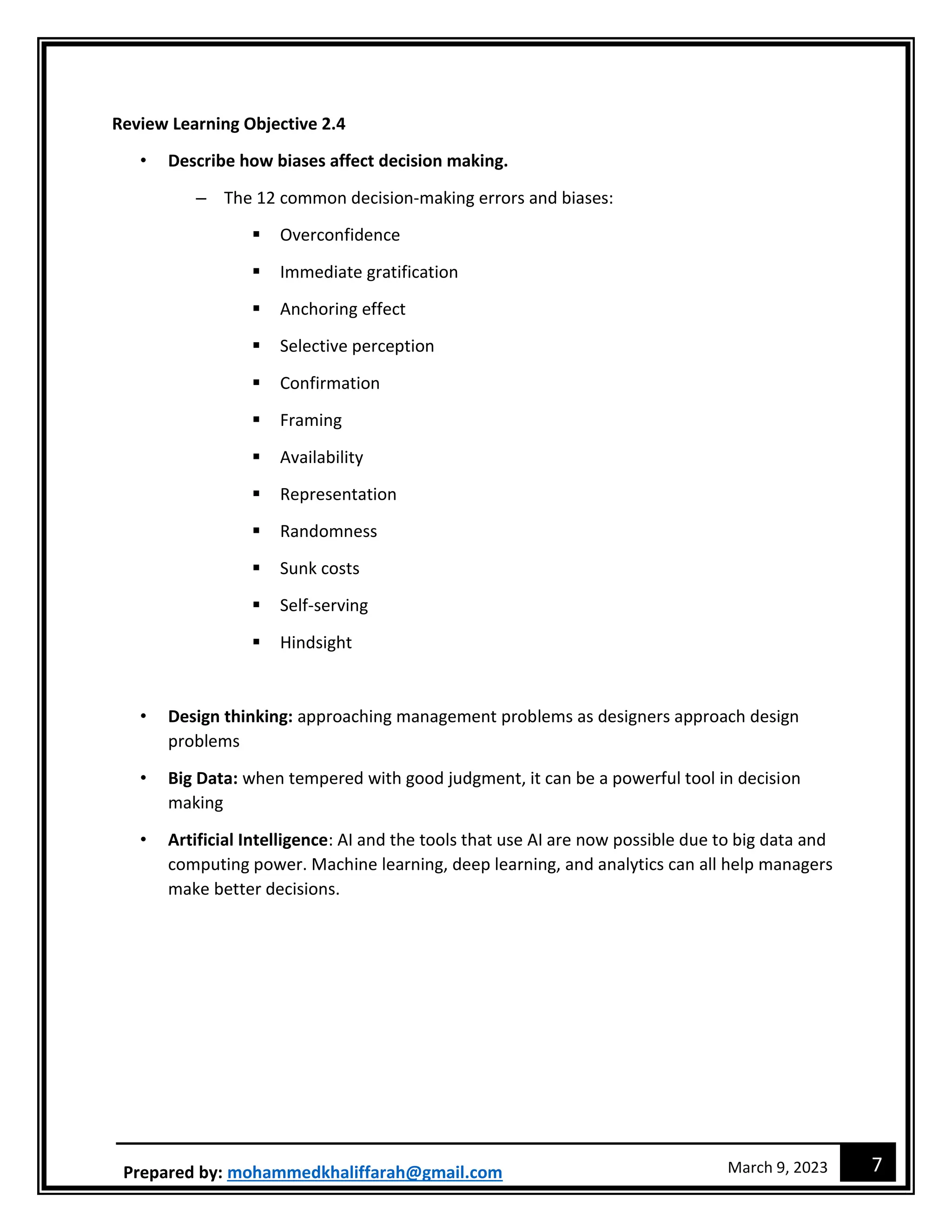
Review Learning Objective 2.4
• Describe how biases affect decision making.
– The 12 common decision-making errors and biases:
 Overconfidence
 Immediate gratification
 Anchoring effect
 Selective perception
 Confirmation
 Framing
 Availability
 Representation
 Randomness
 Sunk costs
 Self-serving
 Hindsight
• Design thinking: approaching management problems as designers approach design
problems
• Big Data: when tempered with good judgment, it can be a powerful tool in decision
making
• Artificial Intelligence: AI and the tools that use AI are now possible due to big data and
computing power. Machine learning, deep learning, and analytics can all help managers
make better decisions.

Ch2 POM.pdf chapter summary for principal of management

  • 1.
    1 March 9, 2023 Preparedby: mohammedkhaliffarah@gmail.com Decision—a choice among two or more alternatives Eight steps in the decision-making process Every decision starts with a problem: an obstacle that makes it difficult to achieve a desired goal or purpose. Decision criteria are factors that are important to resolving the problem. Rational Decision Making: choices that are logical and consistent and maximize value. Assumptions of rationality: 1. Rational decision maker is logical and objective 2. Problem faced is clear and unambiguous 3. Decisions are made in the best interest of the organization
  • 2.
    2 March 9, 2023 Preparedby: mohammedkhaliffarah@gmail.com Bounded rationality: decision making that’s rational, but limited by an individual’s ability to process information Satisfice: accepting solutions that are “good enough” Intuitive Decision Making: making decisions on the basis of experience, feelings, and accumulated judgment. Evidence-based management (E B Mgt): the systematic use of the best available evidence to improve management practice. Crowdsourcing: a decision-making approach where you solicit ideas and input from a network of people outside of the traditional set of decision makers. Types of Decisions: 1. Structured problems: straightforward, familiar, and easily defined problems 2. Programmed decisions: repetitive decisions that can be handled by a routine approach 3. Unstructured problems: problems that are new or unusual and for which information is ambiguous or incomplete 4. Nonprogrammed decisions: unique and nonrecurring and involve custom-made solutions Types of Programmed Decisions 1. Procedure: a series of sequential steps used to respond to a well-structured problem 2. Rule: an explicit statement that tells managers what can or cannot be done 3. Policy: a guideline for making decisions
  • 3.
    3 March 9, 2023 Preparedby: mohammedkhaliffarah@gmail.com Decision-Making Styles Research has identified four different individual decision-making styles based on two dimensions; 1. An individual’s way of thinking 2. An individual’s tolerance for ambiguity The four styles are directive, analytic, conceptual and behavioral.
  • 4.
    4 March 9, 2023 Preparedby: mohammedkhaliffarah@gmail.com identifies 12 common decision errors of managers and biases • Overconfidence Bias: holding unrealistically positive views of oneself and one’s performance • Immediate Gratification Bias: choosing alternatives that offer immediate rewards and avoid immediate costs • Anchoring Effect: fixating on initial information and ignoring subsequent information • Selective Perception Bias: selecting, organizing and interpreting events based on the decision maker’s biased perceptions • Confirmation Bias: seeking out information that reaffirms past choices while discounting contradictory information • Framing Bias: selecting and highlighting certain aspects of a situation while ignoring other aspects • Availability Bias: losing decision-making objectivity by focusing on the most recent events • Representation Bias: drawing analogies and seeing identical situations when none exist
  • 5.
    5 March 9, 2023 Preparedby: mohammedkhaliffarah@gmail.com • Randomness Bias: creating unfounded meaning out of random events • Sunk Costs Errors: forgetting that current actions cannot influence past events and relate only to future consequences • Self-serving Bias: taking quick credit for successes and blaming outside factors for failures • Hindsight Bias: mistakenly believing that an event could have been predicted once the actual outcome is known (after-the-fact) Technology has changed the ability of managers to access information. Two technology driven cutting-edge aides to decision making are: 1. Design thinking: approaching management problems as designers approach design problems 2. Big data and Artificial Intelligence: big data refers to huge and complex data sets now available. Big data has opened the door to widespread use of artificial intelligence (A I) Machine Learning: A method of data analysis that automates analytical model building. Deep Learning: A subset of machine learning that use algorithms to create a hierarchical level of artificial neural networks that simulate the function of the human brain. Analytics: The use of mathematics, statistics, predictive modeling, and machine learning to find meaningful patterns in a data set. Review Learning Objective 2.1 Describe the eight steps in the decision-making process. 1. Identify problem 2. Identify decision criteria 3. Weight the criteria 4. Develop alternatives 5. Analyze alternatives 6. Select alternative 7. Implement alternative 8. Evaluate decision effectiveness
  • 6.
    6 March 9, 2023 Preparedby: mohammedkhaliffarah@gmail.com Review Learning Objective 2.2 (1 of 2) • Explain the five approaches managers use when making decisions. – Assumptions of rationality  The problem is clear and unambiguous  A single, well-defined goal is to be achieved  All alternatives and consequences are known  The final choice will maximize goal achievement Review Learning Objective 2.3 (1 of 2) (2 of 2) • Classify decisions and decision-making styles. – Programmed decisions are repetitive decisions that can be handled by a routine approach and are used when the problem being resolved is straightforward, familiar, and easily defined (structured). – Nonprogrammed decisions are unique decisions that require a custom-made solution and are used when the problems are new or unusual (unstructured) and for which information is ambiguous or incomplete. • Classify decisions and decision-making styles. – Individual decision-making styles differ on two dimensions; way of thinking and tolerance for ambiguity. – These dimensions result in four different decision-making styles which are: • Directive • Analytical • Conceptual • Behavioral
  • 7.
    7 March 9, 2023 Preparedby: mohammedkhaliffarah@gmail.com Review Learning Objective 2.4 • Describe how biases affect decision making. – The 12 common decision-making errors and biases:  Overconfidence  Immediate gratification  Anchoring effect  Selective perception  Confirmation  Framing  Availability  Representation  Randomness  Sunk costs  Self-serving  Hindsight • Design thinking: approaching management problems as designers approach design problems • Big Data: when tempered with good judgment, it can be a powerful tool in decision making • Artificial Intelligence: AI and the tools that use AI are now possible due to big data and computing power. Machine learning, deep learning, and analytics can all help managers make better decisions.