PRINCIPLES OF
MANAGEMENT
Decision Making
Lecture 5
Learning Objectives
■ Describe the eight steps in the decision-making
process.
– Develop your skill at being creative.
■ Explain the four ways managers make decisions.
■ Classify decisions and decision-making conditions.
■ Describe how biases affect decision making.
– Know how to recognize when you’re using decision-
making errors and biases and what to do about it.
■ Identify effective decision-making techniques.
What is a Decision?
Decision—a choice among two or more alternatives
but this is very simplistic view.
What is a Decision?
Decision-Making Process (Exibhit 2-1)
1. Identifying a problem and
2. decision criteria and
3. allocating weights to the criteria.
4. Developing,
5. analyzing, and
6. selecting an alternative that can resolve the problem.
7. Implementing the selected alternative.
8. Evaluating the decision’s effectiveness.
Decision-Making Process
Step 1: Identify a Problem
Problem: an obstacle that makes it difficult to
achieve a desired goal or purpose.
Every decision starts with a problem, a discrepancy
between an existing and a desired condition.
Example: Amanda is a sales manager whose reps/
agents need new laptops.
Step 2: Identify the Decision
Criteria
■ Decision criteria are factors that are important to
resolving the problem.
■ Example: Amanda decides that memory and
storage capabilities, display quality, battery life,
warranty, and carrying weight are the relevant
criteria in her decision
Step 3: Allocate Weights to the
Criteria
■ If the relevant criteria aren’t equally important, the
decision maker must weight the items in order to
give them the correct priority in the decision.
■ Example: The weighted criteria for Amanda’s
computer purchase are shown in Exhibit 2-2.
Step 4: Develop Alternatives
■ List viable alternatives that could solve the
problem.
■ Example: Amanda identifies eight laptops as
possible choices (shown in Exhibit 2-3).
■ Decision maker needs to be creative, and the
alternatives are only listed— not evaluated
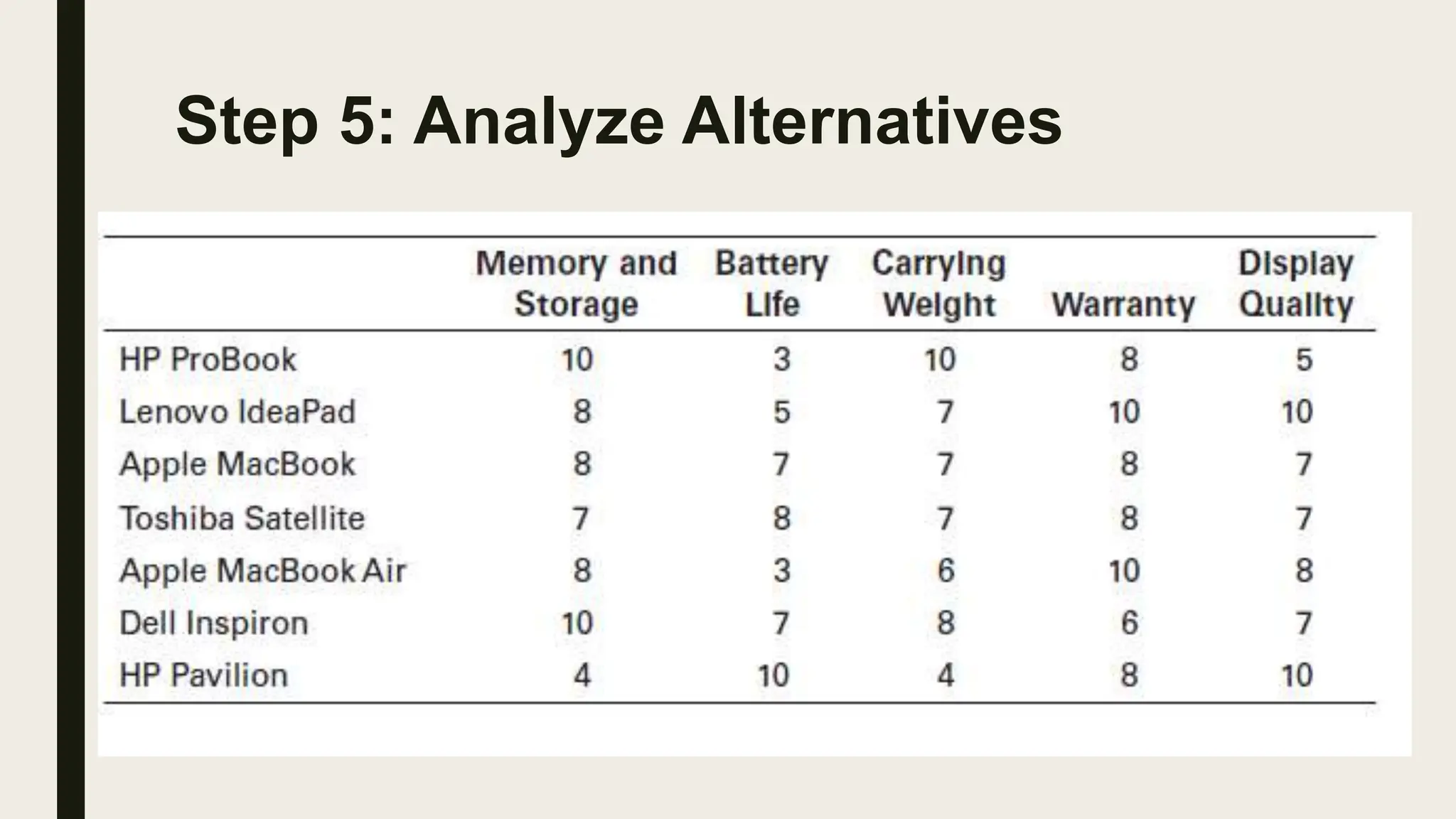
Step 5: Analyze Alternatives
Step 6: Select an Alternative
■ Choose the alternative that generates the highest
total in Step 5.
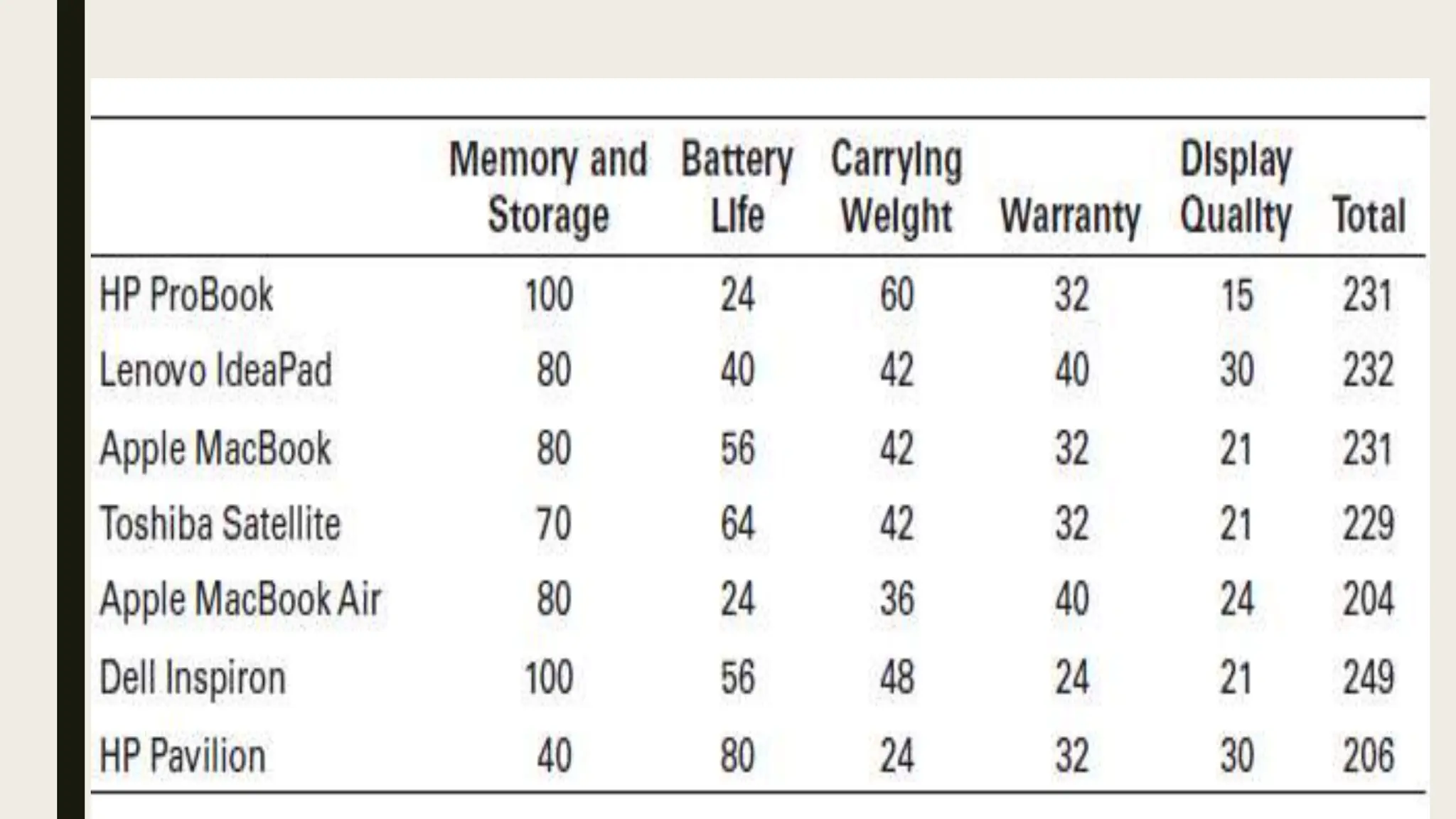
■ In our example (Exhibit 2-4), Amanda would
choose the Dell Inspiron because it scored higher
than all other alternatives (249 total).
Step 7: Implement the Alternative
■ Put the chosen alternative into action.
■ By Conveying the decision to those affected and
get their commitment to it.
■ We know that if the people who must implement a
decision participate in the process, they’re more
likely to support it.
Step 7: Implement the Alternative
■ Another thing managers may need to do during
implementation is reassess the environment for
any changes, especially if it’s a long- term
decision.
Step 8: Evaluate Decision
Effectiveness
■ Evaluate the result or outcome of the decision to
see if the problem was resolved.
If it wasn’t resolved, what went wrong?
■ Was the problem incorrectly defined? Were errors
made when evaluating alternatives? Was the right
alternative selected but poorly implemented? The
answers might lead you to redo an earlier step or
might even require starting the whole process
over.
APPROACHES to decision making
Rationality
Rational Decision-Making: choices that are logical and
consistent and maximize value.
Rationality
Assumptions of rationality:
■ Rational decision maker is logical and objective
■ Problem faced is clear and unambiguous. Decision
maker would have clear, specific goal and be aware of
all alternatives and consequences.
■ The alternative that maximizes achieving this goal will be
selected
■ Decisions are made in the best interest of the
organization
Bounded Rationality
■ Managers make decisions rationally, but are limited
(bounded) by their ability to process information.
Assumptions are that decision makers:
– Because they can’t possibly analyze all information
on all alternatives
– Will satisfice rather than maximize
– Accept solution that are good enough
– Being rational within the limits.
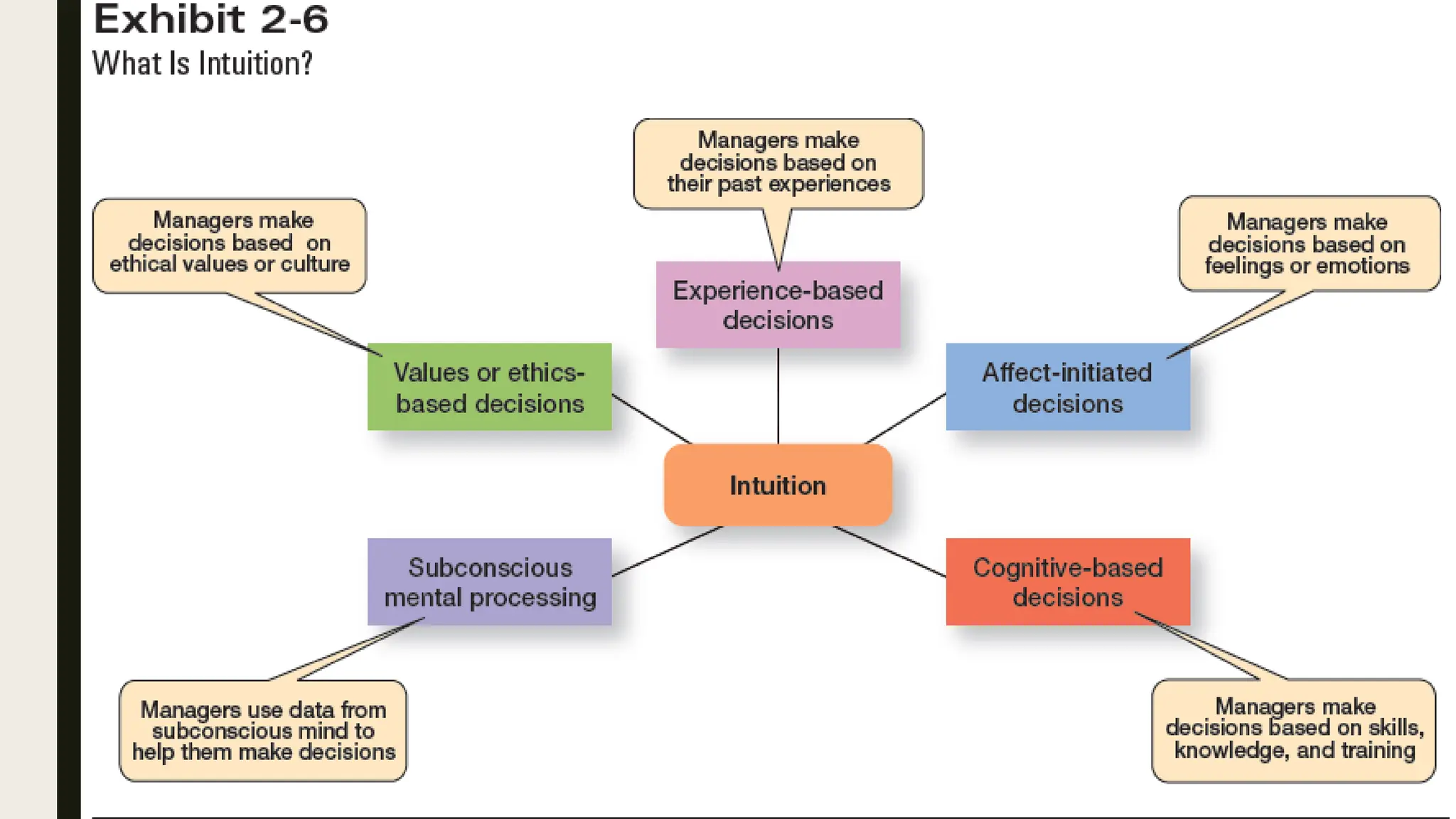
Intuition
■ Intuitive decision-making: making decisions on the
basis of experience, feelings, and accumulated
judgment.
Evidence-Based Management
■ Evidence-based management (EBMgt): the
systematic use of the best available evidence to
improve management practice.
■ Any decision-making process is likely to be
enhanced through the use of relevant and reliable
evidence
TYPES of decisions and decision-
making
conditions
Problems and Decisions
Structured Problems
– Involve goals that clear.
– Are familiar (have occurred before).
– Are easily and completely defined—information about
the problem is available and complete.
■ Programmed Decision
– A repetitive decision that can be handled by a routine
approach.
– E.g., registration process at MAO college.
Types of Programmed Decisions
A Procedure
■ A series of interrelated steps that a manager can use to
respond (applying a policy) to a structured problem.
■ E.g., Follow all steps for completing merchandise return
documentation.
■ Purchasing procedures.
■ Follow the steps for reviewing marks.
■ Recruitment procedures.
■ Registration procedures.
Types of Programmed Decisions
A Rule
■ An explicit statement that limits what a manager or
employee can or cannot do in carrying out the steps
involved in a procedure.
Examples:
■ Managers must approve all refunds over $50.00.
Types of Programmed Decisions
A Policy
■ A general guideline for making a decision about a
structured problem. (system)
■ Students have the right to review his final mark.
■ The recruitment must start from job vacancy
announcement.
UNSTRUCTURED PROBLEMS AND
NONPROGRAMMED DECISIONS
UNSTRUCTURED PROBLEMS
■ Problems that are new or unusual and for which
information is ambiguous or incomplete.
■ Problems that will require custom-made solutions.
UNSTRUCTURED PROBLEMS AND
NONPROGRAMMED DECISIONS
Non-programmed Decisions
■ Decisions that are unique and nonrecurring/
infrequent.
■ Decisions that generate unique responses.
■ E.g., making a decision regarding opening a
second branch in a new geographical area.
■ few decisions in the real world are either fully
programmed or non-programmed
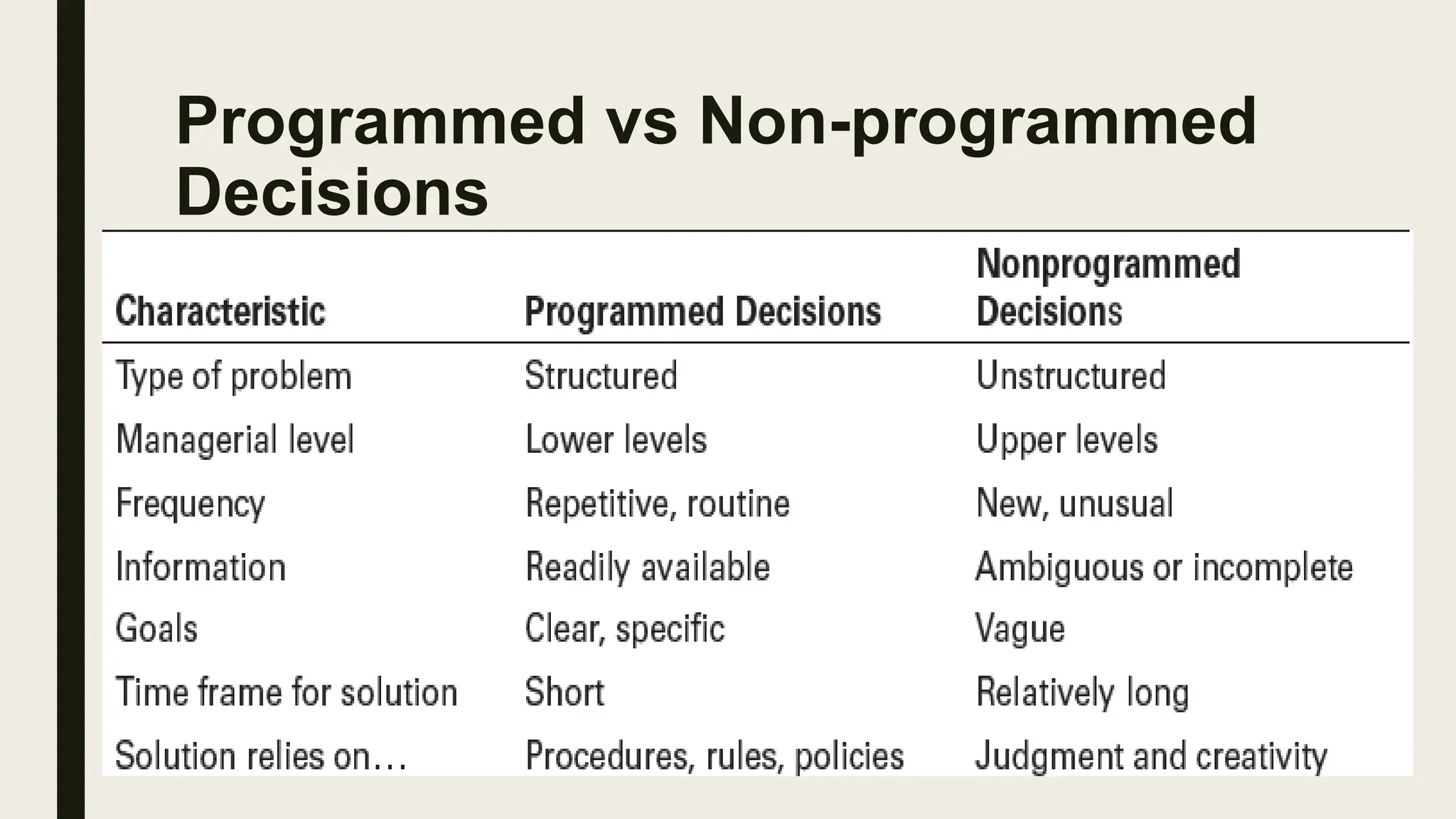
Programmed vs Non-programmed
Decisions
Decision-Making Conditions
■ Certainty: a situation in which a manager can
make accurate decisions because all outcomes
are known. E.g., putting a deposit in a bank, the
annual return on it is known.
■ Risk: a situation in which the decision maker is
able to estimate the likelihood of certain outcomes
■ Uncertainty: a situation in which a decision
maker has neither certainty nor reasonable
probability estimates available
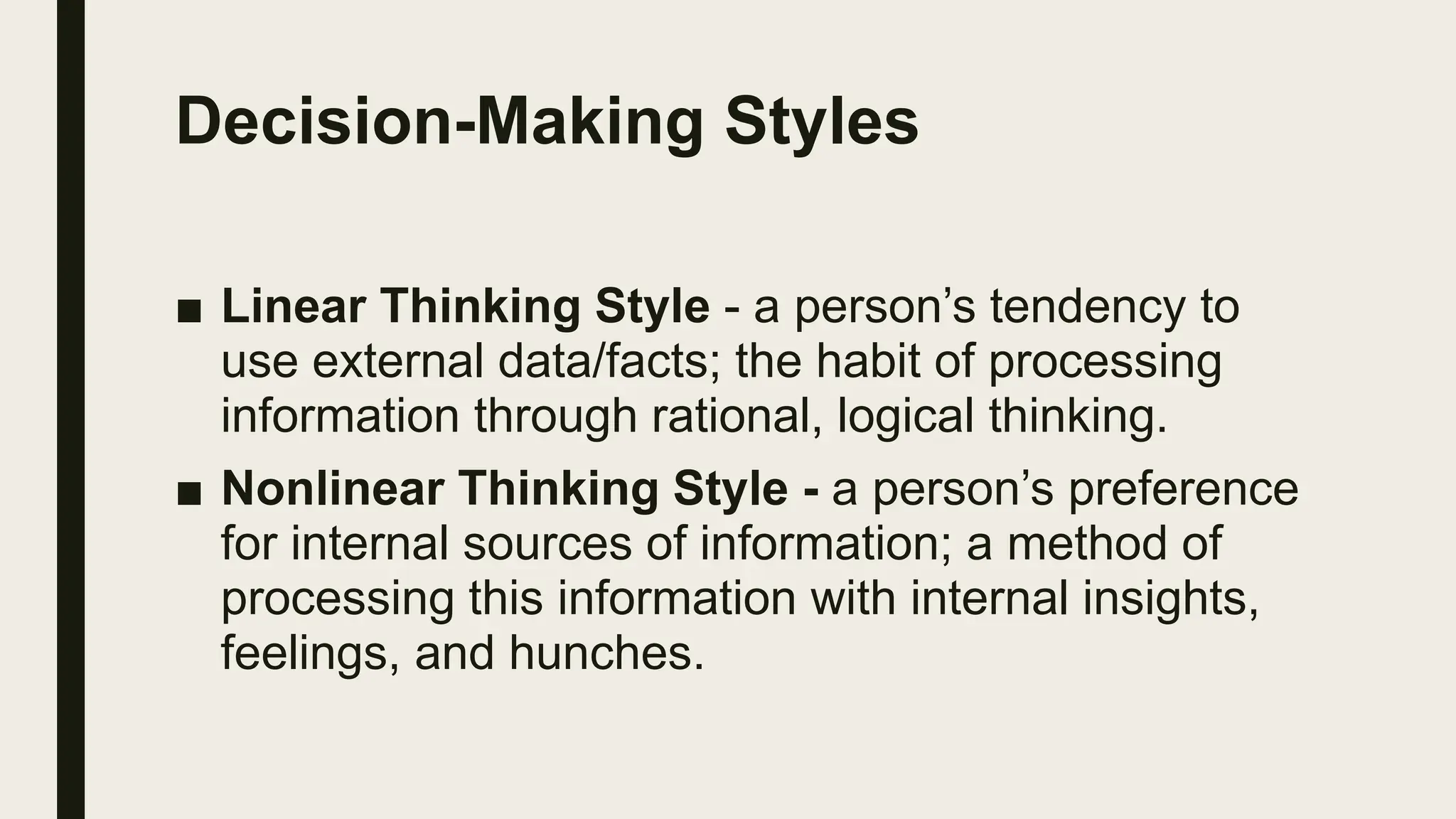
Decision-Making Styles
■ Linear Thinking Style - a person’s tendency to
use external data/facts; the habit of processing
information through rational, logical thinking.
■ Nonlinear Thinking Style - a person’s preference
for internal sources of information; a method of
processing this information with internal insights,
feelings, and hunches.
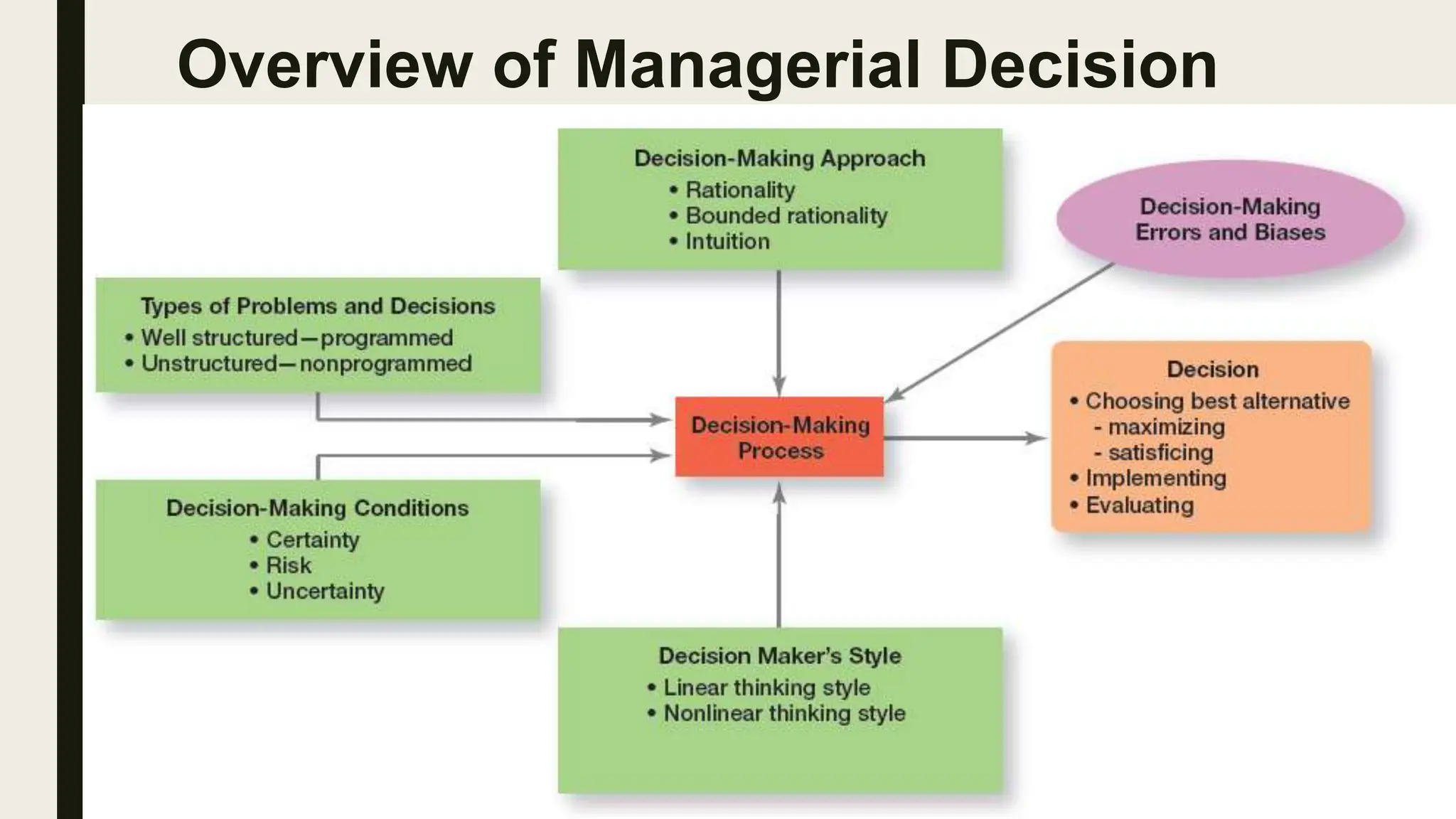
Overview of Managerial Decision
Making
Guidelines for Making Effective
Decisions
■ Understand cultural differences
■ Create standards for good decision making
■ Know when it’s time to call it quits
■ Use an effective decision-making process
■ Develop your ability to think clearly
Characteristics of an Effective Decision-
Making Process
■ Focuses on what’s important
■ Is logical and consistent
■ Acknowledges subjective and analytical thinking,
blends analytical with intuitive thinking
■ Requires only as much information as is needed to
resolve particular dilemma
■ Encourages the gathering of relevant information
■ Is straightforward, reliable, easy-to-use, flexible
Design Thinking and Decision
Making
■ Design thinking: approaching management
problems as designers approach design problems
Big Data and Decision-Making
■ Big data: the vast amount of quantifiable data that
can be analyzed by highly sophisticated data
processing
■ Can be a powerful tool in decision making, but
collecting and analyzing data for data’s sake is
wasted effort

Principle of management decision makings

  • 1.
  • 2.
    Learning Objectives ■ Describethe eight steps in the decision-making process. – Develop your skill at being creative. ■ Explain the four ways managers make decisions. ■ Classify decisions and decision-making conditions. ■ Describe how biases affect decision making. – Know how to recognize when you’re using decision- making errors and biases and what to do about it. ■ Identify effective decision-making techniques.
  • 3.
    What is aDecision? Decision—a choice among two or more alternatives but this is very simplistic view.
  • 4.
    What is aDecision? Decision-Making Process (Exibhit 2-1) 1. Identifying a problem and 2. decision criteria and 3. allocating weights to the criteria. 4. Developing, 5. analyzing, and 6. selecting an alternative that can resolve the problem. 7. Implementing the selected alternative. 8. Evaluating the decision’s effectiveness.
  • 5.
    Decision-Making Process Step 1:Identify a Problem Problem: an obstacle that makes it difficult to achieve a desired goal or purpose. Every decision starts with a problem, a discrepancy between an existing and a desired condition. Example: Amanda is a sales manager whose reps/ agents need new laptops.
  • 6.
    Step 2: Identifythe Decision Criteria ■ Decision criteria are factors that are important to resolving the problem. ■ Example: Amanda decides that memory and storage capabilities, display quality, battery life, warranty, and carrying weight are the relevant criteria in her decision
  • 7.
    Step 3: AllocateWeights to the Criteria ■ If the relevant criteria aren’t equally important, the decision maker must weight the items in order to give them the correct priority in the decision. ■ Example: The weighted criteria for Amanda’s computer purchase are shown in Exhibit 2-2.
  • 8.
    Step 4: DevelopAlternatives ■ List viable alternatives that could solve the problem. ■ Example: Amanda identifies eight laptops as possible choices (shown in Exhibit 2-3). ■ Decision maker needs to be creative, and the alternatives are only listed— not evaluated
  • 9.
    Step 5: AnalyzeAlternatives
  • 10.
    Step 6: Selectan Alternative ■ Choose the alternative that generates the highest total in Step 5. ■ In our example (Exhibit 2-4), Amanda would choose the Dell Inspiron because it scored higher than all other alternatives (249 total).
  • 12.
    Step 7: Implementthe Alternative ■ Put the chosen alternative into action. ■ By Conveying the decision to those affected and get their commitment to it. ■ We know that if the people who must implement a decision participate in the process, they’re more likely to support it.
  • 13.
    Step 7: Implementthe Alternative ■ Another thing managers may need to do during implementation is reassess the environment for any changes, especially if it’s a long- term decision.
  • 14.
    Step 8: EvaluateDecision Effectiveness ■ Evaluate the result or outcome of the decision to see if the problem was resolved. If it wasn’t resolved, what went wrong? ■ Was the problem incorrectly defined? Were errors made when evaluating alternatives? Was the right alternative selected but poorly implemented? The answers might lead you to redo an earlier step or might even require starting the whole process over.
  • 15.
    APPROACHES to decisionmaking Rationality Rational Decision-Making: choices that are logical and consistent and maximize value.
  • 16.
    Rationality Assumptions of rationality: ■Rational decision maker is logical and objective ■ Problem faced is clear and unambiguous. Decision maker would have clear, specific goal and be aware of all alternatives and consequences. ■ The alternative that maximizes achieving this goal will be selected ■ Decisions are made in the best interest of the organization
  • 17.
    Bounded Rationality ■ Managersmake decisions rationally, but are limited (bounded) by their ability to process information. Assumptions are that decision makers: – Because they can’t possibly analyze all information on all alternatives – Will satisfice rather than maximize – Accept solution that are good enough – Being rational within the limits.
  • 18.
    Intuition ■ Intuitive decision-making:making decisions on the basis of experience, feelings, and accumulated judgment.
  • 20.
    Evidence-Based Management ■ Evidence-basedmanagement (EBMgt): the systematic use of the best available evidence to improve management practice. ■ Any decision-making process is likely to be enhanced through the use of relevant and reliable evidence
  • 21.
    TYPES of decisionsand decision- making conditions Problems and Decisions Structured Problems – Involve goals that clear. – Are familiar (have occurred before). – Are easily and completely defined—information about the problem is available and complete. ■ Programmed Decision – A repetitive decision that can be handled by a routine approach. – E.g., registration process at MAO college.
  • 22.
    Types of ProgrammedDecisions A Procedure ■ A series of interrelated steps that a manager can use to respond (applying a policy) to a structured problem. ■ E.g., Follow all steps for completing merchandise return documentation. ■ Purchasing procedures. ■ Follow the steps for reviewing marks. ■ Recruitment procedures. ■ Registration procedures.
  • 23.
    Types of ProgrammedDecisions A Rule ■ An explicit statement that limits what a manager or employee can or cannot do in carrying out the steps involved in a procedure. Examples: ■ Managers must approve all refunds over $50.00.
  • 24.
    Types of ProgrammedDecisions A Policy ■ A general guideline for making a decision about a structured problem. (system) ■ Students have the right to review his final mark. ■ The recruitment must start from job vacancy announcement.
  • 25.
    UNSTRUCTURED PROBLEMS AND NONPROGRAMMEDDECISIONS UNSTRUCTURED PROBLEMS ■ Problems that are new or unusual and for which information is ambiguous or incomplete. ■ Problems that will require custom-made solutions.
  • 26.
    UNSTRUCTURED PROBLEMS AND NONPROGRAMMEDDECISIONS Non-programmed Decisions ■ Decisions that are unique and nonrecurring/ infrequent. ■ Decisions that generate unique responses. ■ E.g., making a decision regarding opening a second branch in a new geographical area. ■ few decisions in the real world are either fully programmed or non-programmed
  • 27.
  • 28.
    Decision-Making Conditions ■ Certainty:a situation in which a manager can make accurate decisions because all outcomes are known. E.g., putting a deposit in a bank, the annual return on it is known. ■ Risk: a situation in which the decision maker is able to estimate the likelihood of certain outcomes ■ Uncertainty: a situation in which a decision maker has neither certainty nor reasonable probability estimates available
  • 29.
    Decision-Making Styles ■ LinearThinking Style - a person’s tendency to use external data/facts; the habit of processing information through rational, logical thinking. ■ Nonlinear Thinking Style - a person’s preference for internal sources of information; a method of processing this information with internal insights, feelings, and hunches.
  • 30.
    Overview of ManagerialDecision Making
  • 31.
    Guidelines for MakingEffective Decisions ■ Understand cultural differences ■ Create standards for good decision making ■ Know when it’s time to call it quits ■ Use an effective decision-making process ■ Develop your ability to think clearly
  • 32.
    Characteristics of anEffective Decision- Making Process ■ Focuses on what’s important ■ Is logical and consistent ■ Acknowledges subjective and analytical thinking, blends analytical with intuitive thinking ■ Requires only as much information as is needed to resolve particular dilemma ■ Encourages the gathering of relevant information ■ Is straightforward, reliable, easy-to-use, flexible
  • 33.
    Design Thinking andDecision Making ■ Design thinking: approaching management problems as designers approach design problems
  • 34.
    Big Data andDecision-Making ■ Big data: the vast amount of quantifiable data that can be analyzed by highly sophisticated data processing ■ Can be a powerful tool in decision making, but collecting and analyzing data for data’s sake is wasted effort

Editor's Notes

  • #5 Managers at all levels and in all areas of organizations make decisions. That is, they make choices. Although decision-making is typically described as choosing among alternatives, this view is too simplistic. Why? Because decision-making is (and should be) a process, not just a simple act of choosing among alternatives.