Organizational Change
Change
Change
Change is an inevitable aspect of life.
Organizations need capacity to adapt quickly.
People are focus of most serious challenges.
Large scale changes often incur significant problems
and challenges.
 Changes can be brought about by managers, non
managers, employees or an outside consultants




Organizational Change
 Organizational change is a structured approach in an
organization for ensuring that changes are smoothly
and successfully implemented to achieve lasting
benefits. In the modern business environment,
organizations face rapid change like never before.
Change management
Change management
 Change
management is
an
approach
to
transitioning individuals, teams, and organizations to
a desired future state. In some project management
contexts, change management refers to a project
management process wherein changes to a project
are formally introduced and approved.
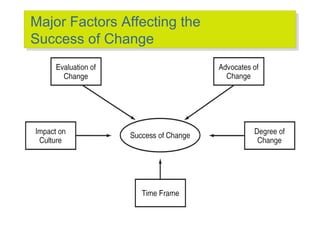
Major Factors Affecting the
Success of Change
Success of Change
Advocates of Change
Advocates of Change


Person leading change program is often most
important force for change.
Internal or external OD practitioners may be
brought in to assist.
Degree of Change
Degree of Change


Is change minor or major?
The greater the degree of change, the more
difficult it is to implement and vice versa.
Time Frame
Time Frame


Greater chance of success if change is gradual
and in longer time frame.
Some organizations only chance for survival
depends on radical change introduced swiftly.
Impact on Culture
Impact on Culture


The greater the impact on existing culture, the
greater the resistance and difficulty to implement
change.
Evaluation on Culture


Standards of performance developed to measure
change and impact on organization.
Changes on Organizational Level






Policies.
Procedures.
Organization structures.
Manufacturing processes.
Work flows.
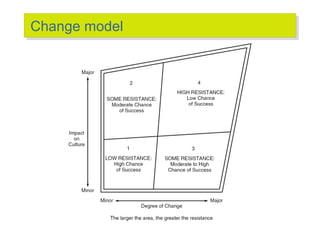
Change model
Change model
Quadrant 1
Quadrant 1
 Minor change, minor impact on culture.
 Resistance will be at lowest level and success will be
most probable.
Quadrant 2
Quadrant 2
 Minor change, major impact on culture.
 Some resistance can be expected.
Quadrant 3
Quadrant 3
 Major change, minor impact on culture.
 Some resistance is likely.
 Good management can probably overcome it.
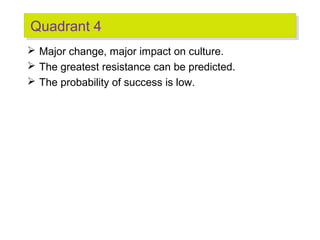
Quadrant 4
Quadrant 4
 Major change, major impact on culture.
 The greatest resistance can be predicted.
 The probability of success is low.
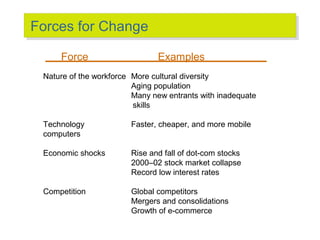
Forces for Change
Forces for Change
Force

Examples

Nature of the workforce More cultural diversity
Aging population
Many new entrants with inadequate
skills
Technology
computers

Faster, cheaper, and more mobile

Economic shocks

Rise and fall of dot-com stocks
2000–02 stock market collapse
Record low interest rates

Competition

Global competitors
Mergers and consolidations
Growth of e-commerce
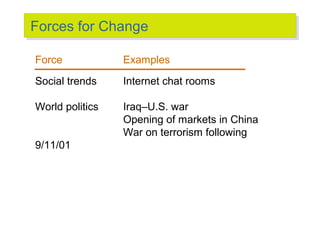
Forces for Change
Forces for Change
Force

Examples

Social trends

Internet chat rooms

World politics

Iraq–U.S. war
Opening of markets in China
War on terrorism following

9/11/01
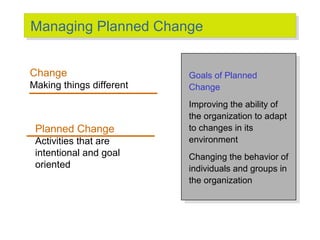
Managing Planned Change
Change
Making things different

Planned Change
Activities that are
intentional and goal
oriented

Goals of Planned
Goals of Planned
Change
Change
Improving the ability of
the organization to adapt
to changes in its
to changes in its
environment
environment
Changing the behavior of
individuals and groups in
the organization
the organization
Restraining Forces Blocking
Implementation of Change










Uncertainty regarding change.
Fear of unknown.
Disruption of routine.
Loss of benefits.
Threat to security.
Threat to position power.
Redistribution of power.
Disturb existing social networks.
Conformity to norms and culture.
Change agent
Change agent
 persons who act as catalysts and assume the
responsibility for managing change are called change
agents.
Factors that help change agent
Some of the things which will help him are:
 A real need in the client system to change.
 Genuine support from management.
 Setting a personal example: listening, supporting behavior.
 A sound background in the behavioral sciences.
 A working knowledge of systems theory.
 A belief in man as a rational, self-educating being fully
capable of learning better ways to do things.
Resistance to change
Definitions of resistance to change
 “Resistance to change is an incomplete to change”.
Bridges
 “Resistance is a valuable passion, which can be
channeled more constructively”.
Weisbord
 “Resistance is the obstacle in the organization's
structure”.
Kotter
 “Resistance is protection ,energy and paradox”.
Maurer
 Resistance to change is normal and even beneficial.
It must be expected and acknowledged, and people's
concerns must be listened to and responded to.
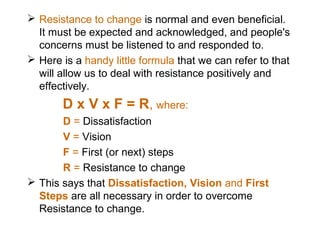
 Here is a handy little formula that we can refer to that
will allow us to deal with resistance positively and
effectively.

D x V x F = R, where:
D = Dissatisfaction
V = Vision
F = First (or next) steps
R = Resistance to change
 This says that Dissatisfaction, Vision and First
Steps are all necessary in order to overcome
Resistance to change.
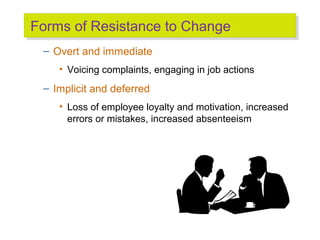
Forms of Resistance to Change
– Overt and immediate
• Voicing complaints, engaging in job actions

– Implicit and deferred
• Loss of employee loyalty and motivation, increased
errors or mistakes, increased absenteeism
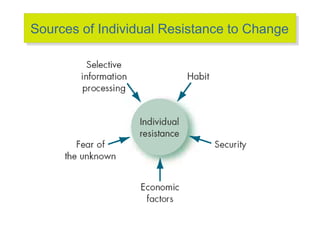
Sources of Individual Resistance to Change
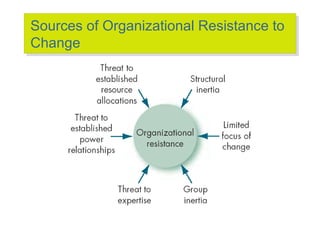
Sources of Organizational Resistance to
Change
Change
Life Cycle of Resistance to Change
The response to change tends to move through a
life cycle of 5 phases:

 Phase 1.
•

Only few people who see need for
change.

•

Resistance appears massive.
Phase 2.
Phase 2.
•

Forces for and against change become
identifiable.

•

Change more thoroughly understood.

•

Novelty of change tends to disappear.
Phase 3.
Phase 3.
•

Direct conflict and showdown between
forces.

•

This phase probably means life or death
to change.
Phase 4.
Phase 4.
•

Remaining resistance seen as stubborn.

•

Possibility that resisters will mobilize
support to shift balance of power.
Phase 5.
Phase 5.
•

Resisters to change are as few and as
alienated as were advocates in first
phase.
Overcoming Resistance to Change
Tactics for dealing with resistance
to change:
to change:
•• Education and communication
Education and communication
•• Participation
Participation
•• Facilitation and support
Facilitation and support
•• Negotiation
Negotiation
•• Manipulation and cooptation
Manipulation and cooptation
•• Selecting people who accept change
Selecting people who accept change
•• Coercion
Coercion
Strategies to Lessen Resistance to
change
change






Education and communication.
Create a vision.
Participation and involvement of members.
Facilitation and support.
Negotiation and agreement.
References
References





www.wikipedia.com
www.Chron.com
www.Business dictionery.com
Change management
- Radha R Sharma
Questions ?
Questions ?
Thank You
Thank You

Change management

  • 1.
  • 2.
    Change Change Change is aninevitable aspect of life. Organizations need capacity to adapt quickly. People are focus of most serious challenges. Large scale changes often incur significant problems and challenges.  Changes can be brought about by managers, non managers, employees or an outside consultants    
  • 3.
    Organizational Change Organizational Change Organizational change is a structured approach in an organization for ensuring that changes are smoothly and successfully implemented to achieve lasting benefits. In the modern business environment, organizations face rapid change like never before.
  • 4.
    Change management Change management Change management is an approach to transitioning individuals, teams, and organizations to a desired future state. In some project management contexts, change management refers to a project management process wherein changes to a project are formally introduced and approved.
  • 5.
    Major Factors Affectingthe Major Factors Affecting the Success of Change Success of Change
  • 6.
    Advocates of Change Advocatesof Change  Person leading change program is often most important force for change. Internal or external OD practitioners may be brought in to assist.
  • 7.
    Degree of Change Degreeof Change  Is change minor or major? The greater the degree of change, the more difficult it is to implement and vice versa.
  • 8.
    Time Frame Time Frame  Greaterchance of success if change is gradual and in longer time frame. Some organizations only chance for survival depends on radical change introduced swiftly.
  • 9.
    Impact on Culture Impacton Culture  The greater the impact on existing culture, the greater the resistance and difficulty to implement change.
  • 10.
    Evaluation on Culture Evaluationon Culture  Standards of performance developed to measure change and impact on organization.
  • 11.
    Changes on OrganizationalLevel Changes on Organizational Level      Policies. Procedures. Organization structures. Manufacturing processes. Work flows.
  • 12.
  • 13.
    Quadrant 1 Quadrant 1 Minor change, minor impact on culture.  Resistance will be at lowest level and success will be most probable.
  • 14.
    Quadrant 2 Quadrant 2 Minor change, major impact on culture.  Some resistance can be expected.
  • 15.
    Quadrant 3 Quadrant 3 Major change, minor impact on culture.  Some resistance is likely.  Good management can probably overcome it.
  • 16.
    Quadrant 4 Quadrant 4 Major change, major impact on culture.  The greatest resistance can be predicted.  The probability of success is low.
  • 17.
    Forces for Change Forcesfor Change Force Examples Nature of the workforce More cultural diversity Aging population Many new entrants with inadequate skills Technology computers Faster, cheaper, and more mobile Economic shocks Rise and fall of dot-com stocks 2000–02 stock market collapse Record low interest rates Competition Global competitors Mergers and consolidations Growth of e-commerce
  • 18.
    Forces for Change Forcesfor Change Force Examples Social trends Internet chat rooms World politics Iraq–U.S. war Opening of markets in China War on terrorism following 9/11/01
  • 19.
    Managing Planned Change ManagingPlanned Change Change Making things different Planned Change Activities that are intentional and goal oriented Goals of Planned Goals of Planned Change Change Improving the ability of Improving the ability of the organization to adapt the organization to adapt to changes in its to changes in its environment environment Changing the behavior of Changing the behavior of individuals and groups in individuals and groups in the organization the organization
  • 20.
    Restraining Forces Blocking RestrainingForces Blocking Implementation of Change Implementation of Change          Uncertainty regarding change. Fear of unknown. Disruption of routine. Loss of benefits. Threat to security. Threat to position power. Redistribution of power. Disturb existing social networks. Conformity to norms and culture.
  • 21.
    Change agent Change agent persons who act as catalysts and assume the responsibility for managing change are called change agents.
  • 22.
    Factors that helpchange agent Factors that help change agent Some of the things which will help him are:  A real need in the client system to change.  Genuine support from management.  Setting a personal example: listening, supporting behavior.  A sound background in the behavioral sciences.  A working knowledge of systems theory.  A belief in man as a rational, self-educating being fully capable of learning better ways to do things.
  • 23.
  • 24.
    Definitions of resistanceto change Definitions of resistance to change  “Resistance to change is an incomplete to change”. Bridges  “Resistance is a valuable passion, which can be channeled more constructively”. Weisbord  “Resistance is the obstacle in the organization's structure”. Kotter  “Resistance is protection ,energy and paradox”. Maurer
  • 25.
     Resistance tochange is normal and even beneficial. It must be expected and acknowledged, and people's concerns must be listened to and responded to.  Here is a handy little formula that we can refer to that will allow us to deal with resistance positively and effectively. D x V x F = R, where: D = Dissatisfaction V = Vision F = First (or next) steps R = Resistance to change  This says that Dissatisfaction, Vision and First Steps are all necessary in order to overcome Resistance to change.
  • 26.
    Forms of Resistanceto Change Forms of Resistance to Change – Overt and immediate • Voicing complaints, engaging in job actions – Implicit and deferred • Loss of employee loyalty and motivation, increased errors or mistakes, increased absenteeism
  • 27.
    Sources of IndividualResistance to Change Sources of Individual Resistance to Change
  • 28.
    Sources of OrganizationalResistance to Sources of Organizational Resistance to Change Change
  • 29.
    Life Cycle ofResistance to Change Life Cycle of Resistance to Change The response to change tends to move through a life cycle of 5 phases:  Phase 1. • Only few people who see need for change. • Resistance appears massive.
  • 30.
    Phase 2. Phase 2. • Forcesfor and against change become identifiable. • Change more thoroughly understood. • Novelty of change tends to disappear.
  • 31.
    Phase 3. Phase 3. • Directconflict and showdown between forces. • This phase probably means life or death to change.
  • 32.
    Phase 4. Phase 4. • Remainingresistance seen as stubborn. • Possibility that resisters will mobilize support to shift balance of power.
  • 33.
    Phase 5. Phase 5. • Resistersto change are as few and as alienated as were advocates in first phase.
  • 34.
    Overcoming Resistance toChange Overcoming Resistance to Change Tactics for dealing with resistance Tactics for dealing with resistance to change: to change: •• Education and communication Education and communication •• Participation Participation •• Facilitation and support Facilitation and support •• Negotiation Negotiation •• Manipulation and cooptation Manipulation and cooptation •• Selecting people who accept change Selecting people who accept change •• Coercion Coercion
  • 35.
    Strategies to LessenResistance to Strategies to Lessen Resistance to change change      Education and communication. Create a vision. Participation and involvement of members. Facilitation and support. Negotiation and agreement.
  • 36.
  • 37.
  • 38.