DE-ESCALATION
TECHNIQUE
Dr Tuti Iryani Mohd Daud
Senior Lecturer & Psychiatrist,
National University of Malaysia Medical Centre.
De-escalation technique by Tuti Mohd Daud is
licensed under a Creative Commons Attribution-
NonCommercial 4.0 International License.
RECAP
BY THE END OF THIS LECTURE,
YOU WILL BE ABLE TO:
Define de-escalation technique
Describe how de-escalation is carried out
Photo by Jessica Flavin
https://commons.wikimedia.org/wiki/File:Anger_Controlls_Him.jpg
Escalation
De-escalation
What is ‘de-
escalation
technique’?
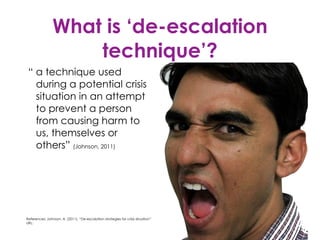
“a technique used during
a potential crisis
situation in an attempt
to prevent a person
from causing harm to
us, themselves or others”
(Johnson, 2011)

Reference: Johnson, A. (2011). “De-escalation strategies for crisis situation”
Retrieved from https://www.yumpu.com/en/document/view/21766178/de-
escalation-strategies-for-crisis-situations/3
OBJECTIVES
• ensure the safety of the patient, staff, and
others in the area
• help the patient manage his emotions and
distress and maintain or regain control of his
behaviour
• avoid the use of restraint when at all possible
• avoid coercive interventions that escalate
agitation
(Richmond et al, 2012)
Reference:
Richmond et al, J.S. (2012). “Verbal De-escalation of the
Agitated Patient: Consensus Statement of the American
Association for Emergency Psychiatry Project BETA De-
escalation Workgroup”, Western Journal of Emergency
Medicine, XIII (1), 17-25.
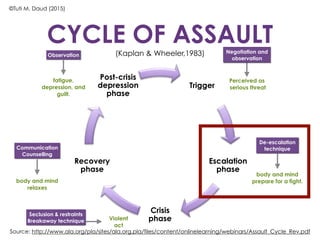
Trigger
Escalation
phase
Crisis
phase
Recovery
phase
Post-crisis
depression
phase
CYCLE OF ASSAULT
(Kaplan & Wheeler,1983)
Perceived as
serious threat
body and mind
prepare for a fight
Violent
act
body and mind
relaxes
fatigue,
depression, and
guilt.
Source: Wolf,K & Knight,M. The Assault Cycle and Verbal Diffusion Handout.
Retrieved from http://www.ala.org/pla/sites/ala.org.pla/files/content/onlinelearning/webinars/Assault_Cycle_Rev.pdf
De-escalation
technique
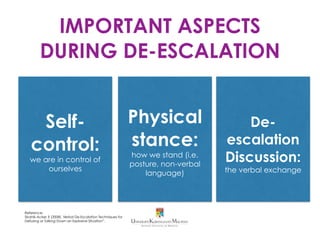
IMPORTANT ASPECTS
DURING DE-ESCALATION
Self-
control:
we are in control of
ourselves
Physical
stance:
how we stand
(i.e. posture, non-verbal
language)
De-
escalation
Discussion:
the verbal exchange
Reference:
Skolnik-Acker, E. Verbal De-Escalation Techniques for
Defusing or Talking Down an Explosive Situation”. Retrieved
from http://www.naswma.org/?page=520.
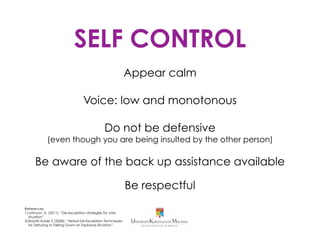
SELF CONTROL
Appear calm
Voice: low and monotonous
Do not be defensive
(even though you are being insulted by the other person)
Be aware of the back up assistance available
Be respectful
References:
1. Johnson, A. (2011). “De-escalation strategies for crisis
situation” Retrieved from https://www.yumpu.com/en/
document/view/21766178/de-escalation-strategies-for-
crisis-situations/3
2. Skolnik-Acker, E. Verbal De-Escalation Techniques for
Defusing or Talking Down an Explosive Situation”.
Retrieved from http://www.naswma.org/?page=520.
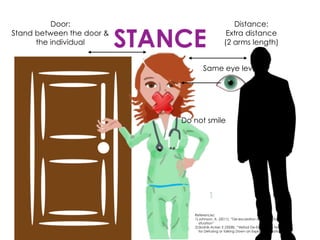
STANCE
Same eye level
Distance:
Extra distance
(2 arms length)
Door:
Stand between the door &
the individual
Do not smile
References:
1. Johnson, A. (2011). “De-escalation strategies for crisis
situation” Retrieved from https://www.yumpu.com/en/
document/view/21766178/de-escalation-strategies-for-
crisis-situations/3
2. Skolnik-Acker, E. Verbal De-Escalation Techniques for
Defusing or Talking Down an Explosive Situation”.
Retrieved from http://www.naswma.org/?page=520.
De-escalation
discussion
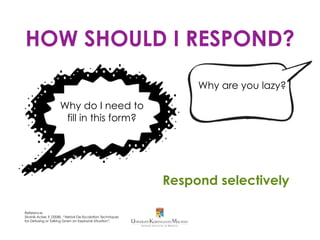
HOW SHOULD I RESPOND?
Why do I need to
fill in this form?
Why are you lazy?
Reference:
Skolnik-Acker, E. Verbal De-Escalation Techniques for
Defusing or Talking Down an Explosive Situation”. Retrieved
from http://www.naswma.org/?page=520.
HOW SHOULD I RESPOND?
Why do I need to
fill in this form?
Why are you lazy?
Reference:
Skolnik-Acker, E. Verbal De-Escalation Techniques for
Defusing or Talking Down an Explosive Situation”. Retrieved
from http://www.naswma.org/?page=520.
Respond
selectively
COMMUNICATION
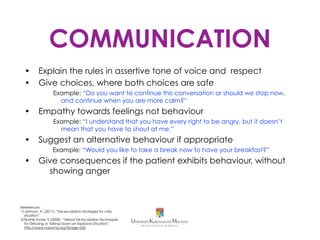
• Explain the rules in assertive tone of voice and respect
• Give choices, where both choices are safe
Example: “Would you like to continue our discussion calmly or would you prefer
to stop now and talk tomorrow when things can be more relaxed?” (Skolnik-
Acker, E.)
• Empathy towards feelings not behaviour
Example: “I understand that you have every right to feel angry, but it is not okay
for you to treat myself or others this way.” (Skolnik-Acker, E.)
• Suggest an alternative behaviour if appropriate
Example:“Would you like to take a break and have a cup of water?”(Skolnik-Acker,
E.)
• Give consequences if the patient exhibits inappropriate
behaviour, without showing anger
References:
1. Johnson, A. (2011). “De-escalation strategies for crisis
situation” Retrieved from https://www.yumpu.com/en/
document/view/21766178/de-escalation-strategies-for-
crisis-situations/3
2. Skolnik-Acker, E. Verbal De-Escalation Techniques for
Defusing or Talking Down an Explosive Situation”.
Retrieved from http://www.naswma.org/?page=520.
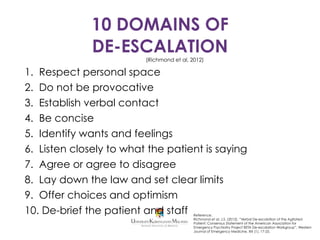
10 DOMAINS OF DE-ESCALATION
(Richmond et al, 2012)
1. Respect personal space
2. Do not be provocative
3. Establish verbal contact
4. Be concise
5. Identify wants and feelings
6. Listen closely to what the patient is saying
7. Agree or agree to disagree
8. Lay down the law and set clear limits
9. Offer choices and optimism
10. De-brief the patient and staff Reference:
Richmond et al, J.S. (2012). “Verbal De-escalation of the Agitated
Patient: Consensus Statement of the American Association for
Emergency Psychiatry Project BETA De-escalation Workgroup”, Western
Journal of Emergency Medicine, XIII (1), 17-25. Retrieved from https://
escholarship.org/uc/item/55g994m6
If you think your de-escalation
technique is not successful…
stop
leave and
ask for help!
Photo: http://s-machine.deviantart.com/art/My-Super-Hero-280690085
Photo by Jessica Flavin
https://commons.wikimedia.org/wiki/File:Anger_Controlls_Him.jpg
SUMMARY
• To reduce the anger so that discussion is
possible
• De-escalation technique consists of three
aspects: self-control, stance and de-escalation
discussion
• If you think de-escalation technique is not
working, leave and ask for help!
De-escalation technique by Tuti Mohd Daud is
licensed under a Creative Commons Attribution-
NonCommercial 4.0 International License.

De-escalation technique

  • 1.
    DE-ESCALATION TECHNIQUE Dr Tuti IryaniMohd Daud Senior Lecturer & Psychiatrist, National University of Malaysia Medical Centre. De-escalation technique by Tuti Mohd Daud is licensed under a Creative Commons Attribution- NonCommercial 4.0 International License.
  • 2.
  • 3.
    BY THE ENDOF THIS LECTURE, YOU WILL BE ABLE TO: Define de-escalation technique Describe how de-escalation is carried out
  • 4.
    Photo by JessicaFlavin https://commons.wikimedia.org/wiki/File:Anger_Controlls_Him.jpg
  • 6.
  • 7.
    What is ‘de- escalation technique’? “atechnique used during a potential crisis situation in an attempt to prevent a person from causing harm to us, themselves or others” (Johnson, 2011)
 Reference: Johnson, A. (2011). “De-escalation strategies for crisis situation” Retrieved from https://www.yumpu.com/en/document/view/21766178/de- escalation-strategies-for-crisis-situations/3
  • 8.
    OBJECTIVES • ensure thesafety of the patient, staff, and others in the area • help the patient manage his emotions and distress and maintain or regain control of his behaviour • avoid the use of restraint when at all possible • avoid coercive interventions that escalate agitation (Richmond et al, 2012) Reference: Richmond et al, J.S. (2012). “Verbal De-escalation of the Agitated Patient: Consensus Statement of the American Association for Emergency Psychiatry Project BETA De- escalation Workgroup”, Western Journal of Emergency Medicine, XIII (1), 17-25.
  • 9.
    Trigger Escalation phase Crisis phase Recovery phase Post-crisis depression phase CYCLE OF ASSAULT (Kaplan& Wheeler,1983) Perceived as serious threat body and mind prepare for a fight Violent act body and mind relaxes fatigue, depression, and guilt. Source: Wolf,K & Knight,M. The Assault Cycle and Verbal Diffusion Handout. Retrieved from http://www.ala.org/pla/sites/ala.org.pla/files/content/onlinelearning/webinars/Assault_Cycle_Rev.pdf De-escalation technique
  • 10.
    IMPORTANT ASPECTS DURING DE-ESCALATION Self- control: weare in control of ourselves Physical stance: how we stand (i.e. posture, non-verbal language) De- escalation Discussion: the verbal exchange Reference: Skolnik-Acker, E. Verbal De-Escalation Techniques for Defusing or Talking Down an Explosive Situation”. Retrieved from http://www.naswma.org/?page=520.
  • 11.
    SELF CONTROL Appear calm Voice:low and monotonous Do not be defensive (even though you are being insulted by the other person) Be aware of the back up assistance available Be respectful References: 1. Johnson, A. (2011). “De-escalation strategies for crisis situation” Retrieved from https://www.yumpu.com/en/ document/view/21766178/de-escalation-strategies-for- crisis-situations/3 2. Skolnik-Acker, E. Verbal De-Escalation Techniques for Defusing or Talking Down an Explosive Situation”. Retrieved from http://www.naswma.org/?page=520.
  • 12.
    STANCE Same eye level Distance: Extradistance (2 arms length) Door: Stand between the door & the individual Do not smile References: 1. Johnson, A. (2011). “De-escalation strategies for crisis situation” Retrieved from https://www.yumpu.com/en/ document/view/21766178/de-escalation-strategies-for- crisis-situations/3 2. Skolnik-Acker, E. Verbal De-Escalation Techniques for Defusing or Talking Down an Explosive Situation”. Retrieved from http://www.naswma.org/?page=520.
  • 13.
  • 14.
    HOW SHOULD IRESPOND? Why do I need to fill in this form? Why are you lazy? Reference: Skolnik-Acker, E. Verbal De-Escalation Techniques for Defusing or Talking Down an Explosive Situation”. Retrieved from http://www.naswma.org/?page=520.
  • 16.
    HOW SHOULD IRESPOND? Why do I need to fill in this form? Why are you lazy? Reference: Skolnik-Acker, E. Verbal De-Escalation Techniques for Defusing or Talking Down an Explosive Situation”. Retrieved from http://www.naswma.org/?page=520. Respond selectively
  • 17.
    COMMUNICATION • Explain therules in assertive tone of voice and respect • Give choices, where both choices are safe Example: “Would you like to continue our discussion calmly or would you prefer to stop now and talk tomorrow when things can be more relaxed?” (Skolnik- Acker, E.) • Empathy towards feelings not behaviour Example: “I understand that you have every right to feel angry, but it is not okay for you to treat myself or others this way.” (Skolnik-Acker, E.) • Suggest an alternative behaviour if appropriate Example:“Would you like to take a break and have a cup of water?”(Skolnik-Acker, E.) • Give consequences if the patient exhibits inappropriate behaviour, without showing anger References: 1. Johnson, A. (2011). “De-escalation strategies for crisis situation” Retrieved from https://www.yumpu.com/en/ document/view/21766178/de-escalation-strategies-for- crisis-situations/3 2. Skolnik-Acker, E. Verbal De-Escalation Techniques for Defusing or Talking Down an Explosive Situation”. Retrieved from http://www.naswma.org/?page=520.
  • 18.
    10 DOMAINS OFDE-ESCALATION (Richmond et al, 2012) 1. Respect personal space 2. Do not be provocative 3. Establish verbal contact 4. Be concise 5. Identify wants and feelings 6. Listen closely to what the patient is saying 7. Agree or agree to disagree 8. Lay down the law and set clear limits 9. Offer choices and optimism 10. De-brief the patient and staff Reference: Richmond et al, J.S. (2012). “Verbal De-escalation of the Agitated Patient: Consensus Statement of the American Association for Emergency Psychiatry Project BETA De-escalation Workgroup”, Western Journal of Emergency Medicine, XIII (1), 17-25. Retrieved from https:// escholarship.org/uc/item/55g994m6
  • 19.
    If you thinkyour de-escalation technique is not successful… stop leave and ask for help!
  • 20.
  • 21.
    Photo by JessicaFlavin https://commons.wikimedia.org/wiki/File:Anger_Controlls_Him.jpg
  • 22.
    SUMMARY • To reducethe anger so that discussion is possible • De-escalation technique consists of three aspects: self-control, stance and de-escalation discussion • If you think de-escalation technique is not working, leave and ask for help!
  • 23.
    De-escalation technique byTuti Mohd Daud is licensed under a Creative Commons Attribution- NonCommercial 4.0 International License.