Casa del NiñoSchools System, Inc.
Psychological
First Aid Matters
Presenter: Benito L. Casas
Agenda 1. What is Psychological First Aid?
- humane, supportive response to a fellow human being who
is suffering and who may
need support
Sphere (2011) and IASC (2007)
1.1Crisis Events
Affects People
-their experience with previous distressing
events;
-the nature and severity of the event(s) they
experience;
-their personal and family history of mental
health problems;
-the support they have in their life from
others;
-their age (for example, children of different
age groups react differently).
-their cultural background and traditions;
PFA involves in
the following
themes:
-providing practical care and support, which
does not intrude;
- assessing needs and concerns;
- helping people to address basic needs (for
example, food and water, information);
- listening to people, but not pressuring them
to talk;
- comforting people and helping them to feel
calm;
- helping people connect to information,
services and social supports;
- protecting people from further harm.
PFA is not:
- it is not something only professional can do
- it is not professional counselling
- it is not a Psychological debriefing
- it is not asking someone to analyze what
happened to them or to put time and events
in order
- it is nt about pressuring people to tell you
their feelings and reactions to an event.
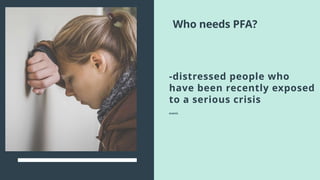
Who needs PFA?
-distressed people who
have been recently exposed
to a serious crisis
event.
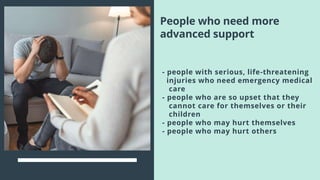
People who need more
advanced support
- people with serious, life-threatening
injuries who need emergency medical
care
- people who are so upset that they
cannot care for themselves or their
children
- people who may hurt themselves
- people who may hurt others
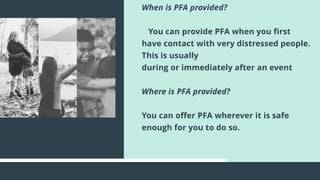
When is PFA provided?
You can provide PFA when you first
have contact with very distressed people.
This is usually
during or immediately after an event
Where is PFA provided?
You can offer PFA wherever it is safe
enough for you to do so.
Agenda 2: How to Help Responsively
Helping
responsibly
involves four
(4) main points:
Be aware of other emergency response measures.
Adapt what you do to take account of the
person’s culture.
Respect safety, dignity and rights
Look after yourself
1. Respect safety, dignity and
rights
Respect people's ........
- Avoid putting people at further risk of harm as a result of
your actions.
- Make sure, to the best of your ability, that the adults and children you
help are safe and protect them from physical or psychological harm.
SAFETY
DIGNITY
Treat people with respect and according to
their cultural andsocial norms.
RIGHTS
- Make sure people can access help fairly and
without discrimination.
- Help people to claim their rights and access
available support.
- Act only in the best interest of any person
you encounter.
DO's
Be honest and trustworthy
Respect people's right to make
own decision
Make it clear that even they refuse
help now they can still access help
in the future.
Respect privacy and keep person's
story confedential.
Behave appropriately by
considering the person's culture,
age and gender.
DON'Ts
Don't exploit your relationship as
helper.
Don't ask person for any favor for
helping them.
Don't make false promises or give
false information.
Don't exagerate your skill.
Don't share person's story with
others
Don't pressure people to tell you
their story.
Don't force help on people.
Don't judge person for their action
or feeling.
2. ADAPT WHAT YOU DO TO TAKE
ACCOUNT OF THE PERSON’S CULTURE.
Consider the
following as
you prepare
to offer PFA in
different
cultures:
Gender, Age and Power
Language
Dress
Touching and behaviour
Beliefs and religion
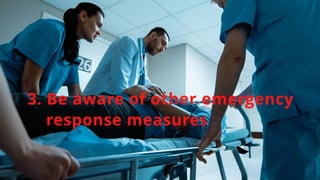
3. Be aware of other emergency
response measures
Whenever
possible in
responding
to a
crisis
situation:
follow the direction of relevant
authorities managing the crisis;
learn what emergency responses are
being organized and what
resources are available to help people, if any;
know your role and the limits of your
role.
don’t get in the way of search-and-
rescue or emergency medical
personnel; and
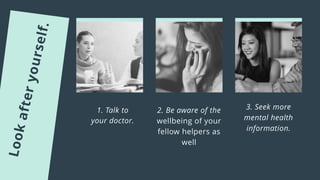
4. Look after yourself.
2. Be aware of the
wellbeing of your
fellow helpers as
well
3. Seek more
mental health
information.
1. Talk to
your doctor.
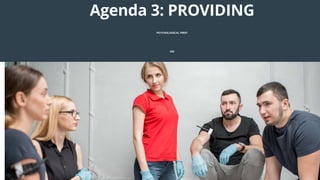
Agenda 3: PROVIDING
PSYCHOLOGICAL FIRST
AID
3.1 Good communication with people in
distress
Being calm and showing
understanding can help people
in distress feel more safe and
secure
Do not talk too much, allow
silence
Do not pressure anyone to tell
you what they have been
through
Be aware of your words and
body language
Find a quiet place and minimize outside distraction.
Keep the person's story confidential, if this is appropriate.
Stay near the person but keep anappropriate distance
Be patient and calm.
Let them know you are listening;
Provide factual information.
Give information in a way the person can understand –
keep it simple.
Acknowledge the person’s strengths and how they have
helped themselves.
Don’t pressure someone to tell their story.
Don’t interrupt or rush someone’s story
Don’t touch the person if you’re not sure it is appropriate to do so.
Don’t judge what they have or haven’t done
Don’t make up things you don’t know.
Don’t use terms that are too technical
Don’t talk about people in negative terms
Don’t take away the person’s strength and sense of being
able to care for themselves.
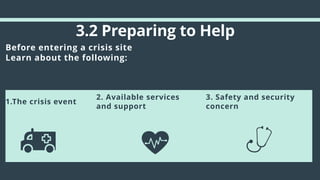
3.2 Preparing to Help
Before entering a crisis site
Learn about the following:
2. Available services
and support
3. Safety and security
concern
1.The crisis event
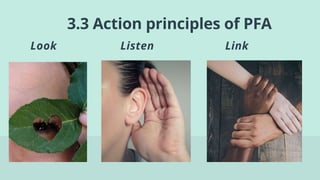
3.3 Action principles of PFA
Look Listen Link
Look!
Safety
People with obviuos urgent basic needs
People with distress serioue reaction
be calm,
be safe,
and
think
before you
act!
Distress
responses
to crisis:
Physical symptoms
crying, sadness, depressed mood,
grief
anxiety, fear
being “on guard” or “jumpy”
insomnia, nightmares
worry that something really bad is
going to happen
guilt, shame
irritability, anger
Distress
responses
to crisis:
appearing withdrawn or very stil
confused, emotionally numb, or
feeling unreal or in a daze
not responding to others
disorientation
not being able to care for
themselves or their children
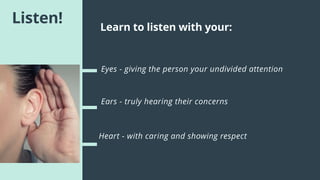
Listen!
Eyes - giving the person your undivided attention
Ears - truly hearing their concerns
Heart - with caring and showing respect
Learn to listen with your:
Distress
responses
to crisis:
• Approach people who may need support:
• Approach people respectfully and according to their culture.
• Introduce yourself by name and organization.
• Ask if you can provide help.
• Try to keep the person safe.
• Help the person feel comfortable
• If possible, find a safe and quiet place to talk.
Distress
responses
to crisis:
2. Ask about people’s needs and concerns:
Although some needs may be obvious, such as a
blanket or covering for someone whose clothing is
torn, always ask what people need and what their
concerns are.
Find out what is most important to them at this
moment, and help them work out what their
priorities are.
Distress
responses
to crisis:
3. Help people to keep calm
• Keep your tone of voice calm and soft
• If culturally appropriate, try to maintain some eye contact
with the person as you talk with them.
• Remind the person that you are there to help them. Remind
them that they are safe, if it is true.
• If someone feels unreal or disconnected from their
surroundings, help them to make contact with their current
environment and themselves.
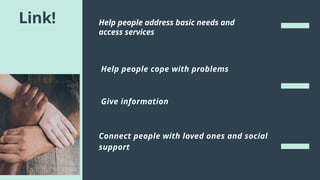
Link!
Help people cope with problems
Give information
Connect people with loved ones and social
support
Help people address basic needs and
access services
Distress
responses
to crisis:
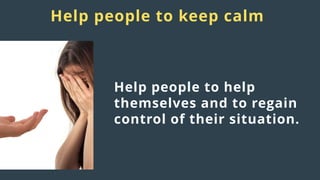
Help people to keep calm
Help people to help
themselves and to regain
control of their situation.
Distress
responses
to crisis:
1. Help people address basic needs and access services
• Immediately after a crisis event, try to help the person in
distress to meet the basic needs they request, such as food,
water, shelter and sanitation.
• Learn what specific needs people have – such as health care,
clothing or items for feeding small children (cups and bottles)
– and try to link them to the help available.
• Make sure vulnerable or marginalized people are not
overlooked
• follow up with people if you promise to do so
Distress
responses
to crisis:
2. Help people cope with problem
• help people identify supports in their life, such as friends or
family, who can help them in the current situation;
• give practical suggestions for people to meet their own needs
• ask the person to consider how they coped with difficult
situations in the past, and affirm their ability to cope with the
current situation;
• ask the person what helps them to feel better. Encourage
them to use positive coping strategies and avoid negative
coping strategies
Distress
responses
to crisis:
Encourage positive coping strategies.
• Get enough rest.
• Eat as regularly as possible and drink water.
• Talk and spend time with family and friends.
• Discuss problems with someone you trust.
• ask the person to consider how they coped with difficult
situations in the past, and affirm their ability to cope with the
current situation;
• Do activities that help you relax (walk, sing, pray, play with children).
• Do physical exercise
• Find safe ways to help others in the crisis and get involved in
community activities.
Distress
responses
to crisis:
Discourage negative coping strategies.
• Don’t take drugs, smoke or drink alcohol.
• Don’t sleep all day.
• Don’t work all the time without any rest or relaxation
• Don’t isolate yourself from friends and loved ones.
• Don’t neglect basic personal hygiene.
• Don’t be violent.
Distress
responses
to crisis:
3. Give information
• explain the source of the information you are providing and
how reliable it is;
• only say what you know
• keep messages simple and accurate, and repeat the message
to be sure people hear and understand the information;
• it may be useful to give information to groups of affected
people, so that everyone hears the same message;
• let people know if you will keep them updated on new
developments, including where and when.
• let people know if you will keep them updated.
Distress
responses
to crisis:
4. Connect with loved ones and social support
• Help keep families together, and keep children with their
parents and loved ones.
• Help people to contact friends and relatives so they can get
support; for example, provide a way for them to call loved ones.
• support from religious leaders might be helpful for them
• Help bring affected people together to help each other
Distress
responses
to crisis:
People who likely need special
attention in a crisis situation.
• Children, including adolescents
• People with health conditions or
disabilities.
• People at risk of discrimination or violence.
CARING FOR YOURSELF
AND YOUR COLLEAGUES
Getting ready to help
Managing Stress: Healthy Work Habits
Rest and reflection
Ending your
Help.
When and how you stop providing help will
depend on the context of the crisis, your role
and situation, and the needs of the people
you are helping.
If appropriate, explain to the person that you
are leaving, and if someone else will be
helping them from that point on, try and
introduce them to that person.
No matter what your experience has been
with
the person, you can say goodbye in a positive
way by wishing them well.
Psychological First Aid Matters

Psychological First Aid Matters

  • 1.
    Casa del NiñoSchoolsSystem, Inc. Psychological First Aid Matters Presenter: Benito L. Casas
  • 2.
    Agenda 1. Whatis Psychological First Aid? - humane, supportive response to a fellow human being who is suffering and who may need support Sphere (2011) and IASC (2007)
  • 3.
    1.1Crisis Events Affects People -theirexperience with previous distressing events; -the nature and severity of the event(s) they experience; -their personal and family history of mental health problems; -the support they have in their life from others; -their age (for example, children of different age groups react differently). -their cultural background and traditions;
  • 4.
    PFA involves in thefollowing themes: -providing practical care and support, which does not intrude; - assessing needs and concerns; - helping people to address basic needs (for example, food and water, information); - listening to people, but not pressuring them to talk; - comforting people and helping them to feel calm; - helping people connect to information, services and social supports; - protecting people from further harm.
  • 5.
    PFA is not: -it is not something only professional can do - it is not professional counselling - it is not a Psychological debriefing - it is not asking someone to analyze what happened to them or to put time and events in order - it is nt about pressuring people to tell you their feelings and reactions to an event.
  • 6.
    Who needs PFA? -distressedpeople who have been recently exposed to a serious crisis event.
  • 7.
    People who needmore advanced support - people with serious, life-threatening injuries who need emergency medical care - people who are so upset that they cannot care for themselves or their children - people who may hurt themselves - people who may hurt others
  • 8.
    When is PFAprovided? You can provide PFA when you first have contact with very distressed people. This is usually during or immediately after an event Where is PFA provided? You can offer PFA wherever it is safe enough for you to do so.
  • 9.
    Agenda 2: Howto Help Responsively
  • 10.
    Helping responsibly involves four (4) mainpoints: Be aware of other emergency response measures. Adapt what you do to take account of the person’s culture. Respect safety, dignity and rights Look after yourself
  • 11.
    1. Respect safety,dignity and rights
  • 12.
    Respect people's ........ -Avoid putting people at further risk of harm as a result of your actions. - Make sure, to the best of your ability, that the adults and children you help are safe and protect them from physical or psychological harm. SAFETY
  • 13.
    DIGNITY Treat people withrespect and according to their cultural andsocial norms. RIGHTS - Make sure people can access help fairly and without discrimination. - Help people to claim their rights and access available support. - Act only in the best interest of any person you encounter.
  • 14.
    DO's Be honest andtrustworthy Respect people's right to make own decision Make it clear that even they refuse help now they can still access help in the future. Respect privacy and keep person's story confedential. Behave appropriately by considering the person's culture, age and gender.
  • 15.
    DON'Ts Don't exploit yourrelationship as helper. Don't ask person for any favor for helping them. Don't make false promises or give false information. Don't exagerate your skill. Don't share person's story with others Don't pressure people to tell you their story. Don't force help on people. Don't judge person for their action or feeling.
  • 16.
    2. ADAPT WHATYOU DO TO TAKE ACCOUNT OF THE PERSON’S CULTURE.
  • 17.
    Consider the following as youprepare to offer PFA in different cultures: Gender, Age and Power Language Dress Touching and behaviour Beliefs and religion
  • 18.
    3. Be awareof other emergency response measures
  • 19.
    Whenever possible in responding to a crisis situation: followthe direction of relevant authorities managing the crisis; learn what emergency responses are being organized and what resources are available to help people, if any; know your role and the limits of your role. don’t get in the way of search-and- rescue or emergency medical personnel; and
  • 20.
    4. Look afteryourself.
  • 21.
    2. Be awareof the wellbeing of your fellow helpers as well 3. Seek more mental health information. 1. Talk to your doctor.
  • 22.
  • 23.
    3.1 Good communicationwith people in distress Being calm and showing understanding can help people in distress feel more safe and secure Do not talk too much, allow silence Do not pressure anyone to tell you what they have been through Be aware of your words and body language
  • 24.
    Find a quietplace and minimize outside distraction. Keep the person's story confidential, if this is appropriate. Stay near the person but keep anappropriate distance Be patient and calm. Let them know you are listening; Provide factual information. Give information in a way the person can understand – keep it simple. Acknowledge the person’s strengths and how they have helped themselves.
  • 25.
    Don’t pressure someoneto tell their story. Don’t interrupt or rush someone’s story Don’t touch the person if you’re not sure it is appropriate to do so. Don’t judge what they have or haven’t done Don’t make up things you don’t know. Don’t use terms that are too technical Don’t talk about people in negative terms Don’t take away the person’s strength and sense of being able to care for themselves.
  • 26.
    3.2 Preparing toHelp Before entering a crisis site Learn about the following: 2. Available services and support 3. Safety and security concern 1.The crisis event
  • 27.
    3.3 Action principlesof PFA Look Listen Link
  • 28.
    Look! Safety People with obviuosurgent basic needs People with distress serioue reaction be calm, be safe, and think before you act!
  • 29.
    Distress responses to crisis: Physical symptoms crying,sadness, depressed mood, grief anxiety, fear being “on guard” or “jumpy” insomnia, nightmares worry that something really bad is going to happen guilt, shame irritability, anger
  • 30.
    Distress responses to crisis: appearing withdrawnor very stil confused, emotionally numb, or feeling unreal or in a daze not responding to others disorientation not being able to care for themselves or their children
  • 31.
    Listen! Eyes - givingthe person your undivided attention Ears - truly hearing their concerns Heart - with caring and showing respect Learn to listen with your:
  • 32.
    Distress responses to crisis: • Approachpeople who may need support: • Approach people respectfully and according to their culture. • Introduce yourself by name and organization. • Ask if you can provide help. • Try to keep the person safe. • Help the person feel comfortable • If possible, find a safe and quiet place to talk.
  • 33.
    Distress responses to crisis: 2. Askabout people’s needs and concerns: Although some needs may be obvious, such as a blanket or covering for someone whose clothing is torn, always ask what people need and what their concerns are. Find out what is most important to them at this moment, and help them work out what their priorities are.
  • 34.
    Distress responses to crisis: 3. Helppeople to keep calm • Keep your tone of voice calm and soft • If culturally appropriate, try to maintain some eye contact with the person as you talk with them. • Remind the person that you are there to help them. Remind them that they are safe, if it is true. • If someone feels unreal or disconnected from their surroundings, help them to make contact with their current environment and themselves.
  • 35.
    Link! Help people copewith problems Give information Connect people with loved ones and social support Help people address basic needs and access services
  • 36.
    Distress responses to crisis: Help peopleto keep calm Help people to help themselves and to regain control of their situation.
  • 37.
    Distress responses to crisis: 1. Helppeople address basic needs and access services • Immediately after a crisis event, try to help the person in distress to meet the basic needs they request, such as food, water, shelter and sanitation. • Learn what specific needs people have – such as health care, clothing or items for feeding small children (cups and bottles) – and try to link them to the help available. • Make sure vulnerable or marginalized people are not overlooked • follow up with people if you promise to do so
  • 38.
    Distress responses to crisis: 2. Helppeople cope with problem • help people identify supports in their life, such as friends or family, who can help them in the current situation; • give practical suggestions for people to meet their own needs • ask the person to consider how they coped with difficult situations in the past, and affirm their ability to cope with the current situation; • ask the person what helps them to feel better. Encourage them to use positive coping strategies and avoid negative coping strategies
  • 39.
    Distress responses to crisis: Encourage positivecoping strategies. • Get enough rest. • Eat as regularly as possible and drink water. • Talk and spend time with family and friends. • Discuss problems with someone you trust. • ask the person to consider how they coped with difficult situations in the past, and affirm their ability to cope with the current situation; • Do activities that help you relax (walk, sing, pray, play with children). • Do physical exercise • Find safe ways to help others in the crisis and get involved in community activities.
  • 40.
    Distress responses to crisis: Discourage negativecoping strategies. • Don’t take drugs, smoke or drink alcohol. • Don’t sleep all day. • Don’t work all the time without any rest or relaxation • Don’t isolate yourself from friends and loved ones. • Don’t neglect basic personal hygiene. • Don’t be violent.
  • 41.
    Distress responses to crisis: 3. Giveinformation • explain the source of the information you are providing and how reliable it is; • only say what you know • keep messages simple and accurate, and repeat the message to be sure people hear and understand the information; • it may be useful to give information to groups of affected people, so that everyone hears the same message; • let people know if you will keep them updated on new developments, including where and when. • let people know if you will keep them updated.
  • 42.
    Distress responses to crisis: 4. Connectwith loved ones and social support • Help keep families together, and keep children with their parents and loved ones. • Help people to contact friends and relatives so they can get support; for example, provide a way for them to call loved ones. • support from religious leaders might be helpful for them • Help bring affected people together to help each other
  • 43.
    Distress responses to crisis: People wholikely need special attention in a crisis situation. • Children, including adolescents • People with health conditions or disabilities. • People at risk of discrimination or violence.
  • 44.
    CARING FOR YOURSELF ANDYOUR COLLEAGUES Getting ready to help Managing Stress: Healthy Work Habits Rest and reflection
  • 45.
    Ending your Help. When andhow you stop providing help will depend on the context of the crisis, your role and situation, and the needs of the people you are helping. If appropriate, explain to the person that you are leaving, and if someone else will be helping them from that point on, try and introduce them to that person. No matter what your experience has been with the person, you can say goodbye in a positive way by wishing them well.