AUTHORS:
• SORAYA VEGA MARTÍNEZ
• GERMÁN BOLA SAIZ
VERBAL DE-
ESCALATION
TOOL FOR THE
CONFLICT MANAGEMENT
Bilbao, February 27th 2024
"Use of strategies aimed at achieving quick
tranquility of the person, facilitating the transition
from a potentially threatening stimulus to a more
harmless one."
It is based on the use of language along with other
communication techniques to mitigate, redirect or
de-escalate a conflictive situation..
VERBAL DE-ESCALATION

Emotional cognitive process

“Situations in which two or more people come into
opposition or disagreement because their positions,
interests, needs, desires or values ​
​
are incompatible or
are perceived as such.”
CONFLICT
CONFLICTO
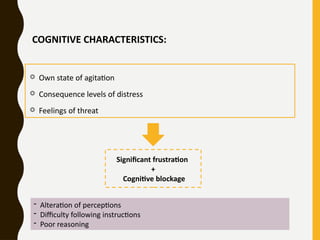
COGNITIVE CHARACTERISTICS:
 Own state of agitation
 Consequence levels of distress
 Feelings of threat
Significant frustration
+
Cognitive blockage
- Alteration of perceptions
- Difficulty following instructions
- Poor reasoning
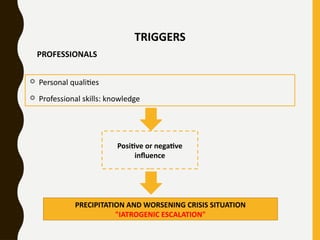
TRIGGERS
TRIGGERS
PROFESSIONALS
 Personal qualities
 Professional skills: knowledge
Positive or negative
influence
PRECIPITATION AND WORSENING CRISIS SITUATION
"IATROGENIC ESCALATION"
TRIGGERS
PROFESSIONALS
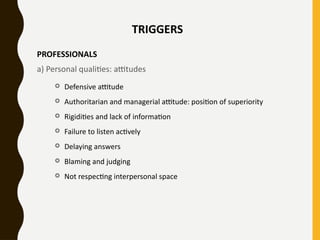
a) Personal qualities: attitudes
 Defensive attitude
 Authoritarian and managerial attitude: position of superiority
 Rigidities and lack of information
 Failure to listen actively
 Delaying answers
 Blaming and judging
 Not respecting interpersonal space
TRIGGERS
PROFESSIONALS
a) Personal qualities: skills
 Early detection capability
 Communication skills
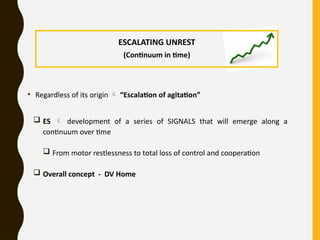
• Regardless of its origin  “Escalation of agitation”
 ES  development of a series of SIGNALS that will emerge along a
continuum over time
 From motor restlessness to total loss of control and cooperation
 Overall concept - DV Home
ESCALATING UNREST
(Continuum in time)
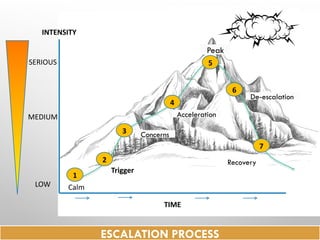
SERIOUS
TIME
MEDIUM
INTENSITY
LOW Calm
Trigger
1
2
3
4
5
6
7
ESCALADA DE AGITACIÓN
Peak
De-escalation
Recovery
Acceleration
Concerns
ESCALATION PROCESS
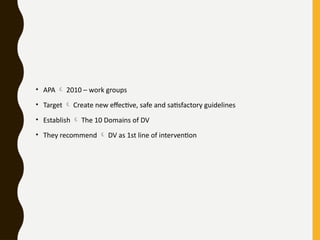
• APA  2010 – work groups
• Target  Create new effective, safe and satisfactory guidelines
• Establish  The 10 Domains of DV
• They recommend  DV as 1st line of intervention
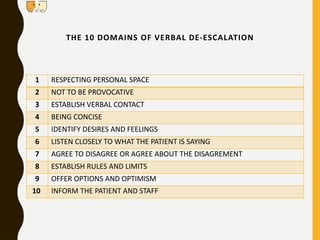
THE 10 DOMAINS OF VERBAL DE-ESCALATION
1 RESPECTING PERSONAL SPACE
2 NOT TO BE PROVOCATIVE
3 ESTABLISH VERBAL CONTACT
4 BEING CONCISE
5 IDENTIFY DESIRES AND FEELINGS
6 LISTEN CLOSELY TO WHAT THE PATIENT IS SAYING
7 AGREE TO DISAGREE OR AGREE ABOUT THE DISAGREMENT
8 ESTABLISH RULES AND LIMITS
9 OFFER OPTIONS AND OPTIMISM
10 INFORM THE PATIENT AND STAFF
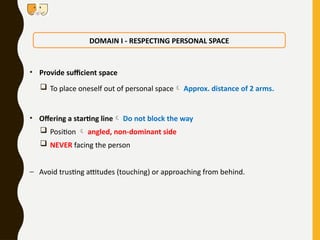
• Provide sufficient space
 To place oneself out of personal space Approx. distance of 2 arms.
• Offering a starting line Do not block the way
 Position  angled, non-dominant side
 NEVER facing the person
– Avoid trusting attitudes (touching) or approaching from behind.
DOMAIN I - RESPECTING PERSONAL SPACE
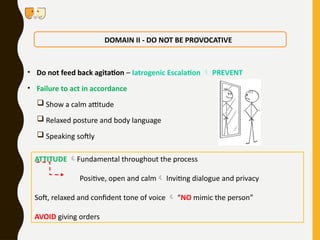
• Do not feed back agitation – Iatrogenic Escalation  PREVENT
• Failure to act in accordance
 Show a calm attitude
 Relaxed posture and body language
 Speaking softly
DOMAIN II - DO NOT BE PROVOCATIVE
ATTITUDE Fundamental throughout the process
Positive, open and calm Inviting dialogue and privacy
Soft, relaxed and confident tone of voice  “NO mimic the person”
AVOID giving orders
DOMAIN II - DO NOT BE PROVOCATIVE
o Expresión facial
o La mirada  Mantener mirada sin resultar invasivos. Paciente dentro del campo visual
- La mirada excesiva y directa – amenazante e invasivo
- La evitación – signo debilidad y miedo
o Postura corporal:
- Hands visible and open
- Knees slightly bent
- Arms uncrossed
- Non-threatening and non-defensive gestures – avoiding sudden and spontaneous
gestures
• Non-Verbal Communication  up to 60-70% of information transmitted is non-verbal
As the look, posture, gestures…
• Before verbal contact:

Get as much information as possible about the person
• Situation analysis

What is happening, who is involved, and what are the possible reactions?

Removal of dangerous objects
DOMAIN III - ESTABLISHING VERBAL CONTACT
• START verbal contact  ONE person ONLY

ERROR: Multiple people interacting

Person who knows the patient best or with > DV experience/training

Introduce yourself: name, profession…

Express our intentions
DOMAIN III - ESTABLISHING VERBAL CONTACT
Show our concern and intentions
“I'm here to help you, not to harm you, I'm not here to tell you what to do, but to help
you regain control.
to tell you what to do, but to help you regain control."
• AP (Alt. Psico-motor)  difficulty in information processing
• Be concise simple and neutral vocabulary (little emotional impact)

No technicalities: short, clear and simple messages

REPEAT – Essential in the de-escalation process

Information contribution

Set boundaries

Provide options

Suggest alternatives
DOMAIN IV - BE CONCISE
GIVE TIME
(Process and answer)
FUNCTIONAL
SILENCE
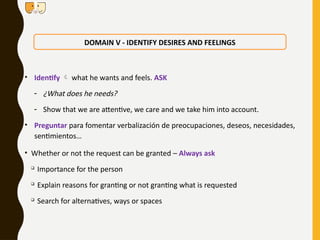
• Identify  what he wants and feels. ASK
- ¿What does he needs?
- Show that we are attentive, we care and we take him into account.
• Preguntar para fomentar verbalización de preocupaciones, deseos, necesidades,
sentimientos…
DOMAIN V - IDENTIFY DESIRES AND FEELINGS
• Whether or not the request can be granted – Always ask

Importance for the person

Explain reasons for granting or not granting what is requested

Search for alternatives, ways or spaces
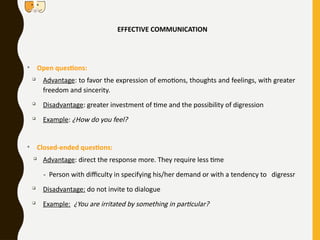
EFFECTIVE COMMUNICATION
• Open questions:

Advantage: to favor the expression of emotions, thoughts and feelings, with greater
freedom and sincerity.

Disadvantage: greater investment of time and the possibility of digression

Example: ¿How do you feel?
• Closed-ended questions:

Advantage: direct the response more. They require less time
- Person with difficulty in specifying his/her demand or with a tendency to digressr

Disadvantage: do not invite to dialogue

Example: ¿You are irritated by something in particular?
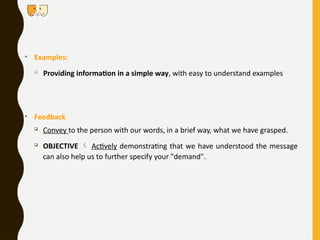
• Examples:

Providing information in a simple way, with easy to understand examples
• Feedback

Convey to the person with our words, in a brief way, what we have grasped.

OBJECTIVE  Actively demonstrating that we have understood the message
can also help us to further specify your "demand".
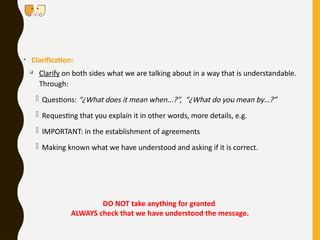
• Clarification:

Clarify on both sides what we are talking about in a way that is understandable.
Through:
- Questions: “¿What does it mean when...?”, “¿What do you mean by…?”
- Requesting that you explain it in other words, more details, e.g.
- IMPORTANT: in the establishment of agreements
- Making known what we have understood and asking if it is correct.
DO NOT take anything for granted
ALWAYS check that we have understood the message.
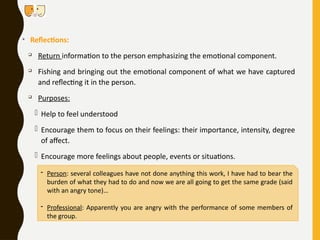
• Reflections:

Return information to the person emphasizing the emotional component.

Fishing and bringing out the emotional component of what we have captured
and reflecting it in the person.

Purposes:
- Help to feel understood
- Encourage them to focus on their feelings: their importance, intensity, degree
of affect.
- Encourage more feelings about people, events or situations.
- Person: several colleagues have not done anything this work, I have had to bear the
burden of what they had to do and now we are all going to get the same grade (said
with an angry tone)…
- Professional: Apparently you are angry with the performance of some members of
the group.
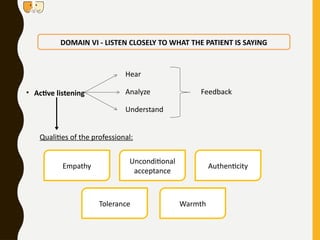
• Active listening
DOMAIN VI - LISTEN CLOSELY TO WHAT THE PATIENT IS SAYING
Hear
Analyze
Understand
Feedback
Qualities of the professional:
Empathy
Unconditional
acceptance
Authenticity
Tolerance Warmth
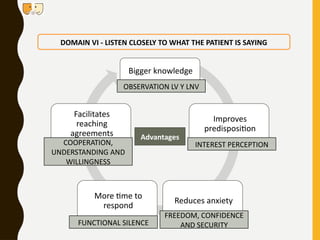
Bigger knowledge
Improves
predisposition
Reduces anxiety
More time to
respond
Facilitates
reaching
agreements
DOMAIN VI - LISTEN CLOSELY TO WHAT THE PATIENT IS SAYING
Advantages
OBSERVATION LV Y LNV
INTEREST PERCEPTION
FREEDOM, CONFIDENCE
AND SECURITY
FUNCTIONAL SILENCE
COOPERATION,
UNDERSTANDING AND
WILLINGNESS
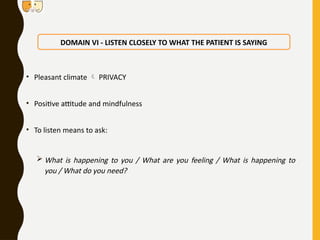
• Pleasant climate  PRIVACY
• Positive attitude and mindfulness
• To listen means to ask:
 What is happening to you / What are you feeling / What is happening to
you / What do you need?
DOMAIN VI - LISTEN CLOSELY TO WHAT THE PATIENT IS SAYING
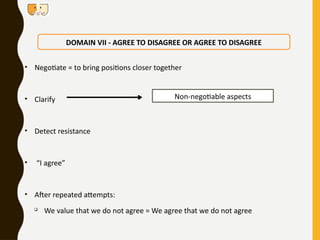
• Negotiate = to bring positions closer together
• Clarify
• Detect resistance
• “I agree”
• After repeated attempts:

We value that we do not agree = We agree that we do not agree
DOMAIN VII - AGREE TO DISAGREE OR AGREE TO DISAGREE
Non-negotiable aspects
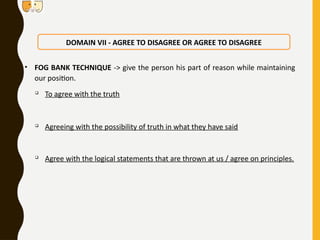
• FOG BANK TECHNIQUE -> give the person his part of reason while maintaining
our position.

To agree with the truth

Agreeing with the possibility of truth in what they have said

Agree with the logical statements that are thrown at us / agree on principles.
DOMAIN VII - AGREE TO DISAGREE OR AGREE TO DISAGREE
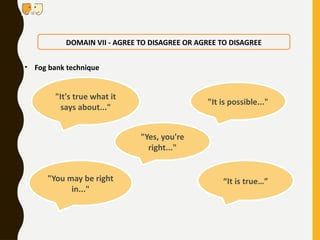
• Fog bank technique
DOMAIN VII - AGREE TO DISAGREE OR AGREE TO DISAGREE
"It's true what it
says about..."
"You may be right
in..."
"It is possible..."
"Yes, you're
right..."
“It is true…”
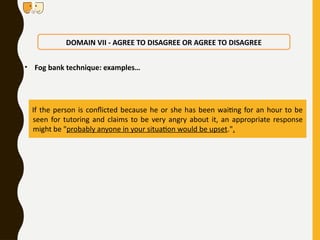
• Fog bank technique: examples…
DOMAIN VII - AGREE TO DISAGREE OR AGREE TO DISAGREE
If the person is conflicted because he or she has been waiting for an hour to be
seen for tutoring and claims to be very angry about it, an appropriate response
might be "probably anyone in your situation would be upset.".
• Explain the center's rules
• Setting reasonable limits: empathy and tact
• Establish good working conditions -> RESPECT AND DIGNITY
• Informing the person of the effect of his or her behavior: BE HONEST/SINCERE
DOMINIO VIII – ESTABLECER NORMAS Y LÍMITES
"Delicate / gentle" confrontation
• Examples:
DOMAIN VIII - SETTING STANDARDS AND LIMITS
"When you behave like that, I feel scared, and I can't pay
attention to what you're telling me."
"I think it may help me understand your concerns if you speak to
me in a calmer manner."
• Choice -> only source of empowerment for a person who believes that violence
is a necessary response

Propose alternatives -> choice= resistance and successful intervention

Previous successful strategies

REALISTIC and possible alternatives:  Do NOT cheat
DOMAIN IX - OFFERING OPTIONS AND OPTIMISM
CHOICE = PERSONAL EMPOWERMENT= CALM
FÓRMULA
– Being optimistic

Providing hope

Realistic time frames
DOMAIN IX - OFFERING OPTIONS AND OPTIMISM
“Things are going to get better, this is a passing thing,
we are sure of that."
DOMAIN X - REPORT TO THE PERSON AND TEAM
 After intervention  restore relationship
 Evaluate the whole process, bring the team together - ENRICHING!
CONCLUSIONS
• Climbing process
• Early intervention in initial phases. BEST time for intervention
• Multifactorial ORIGIN - Same objective: Rapid tranquilization
• professional's ATTITUDE
ESKERRIK ASKO
“CONFLICT PREVENTION IS THE BEST WAY TO
DEAL WITH IT.”

PRESENTACIÓN ingléss Verbal Escalation

  • 1.
    AUTHORS: • SORAYA VEGAMARTÍNEZ • GERMÁN BOLA SAIZ VERBAL DE- ESCALATION TOOL FOR THE CONFLICT MANAGEMENT Bilbao, February 27th 2024
  • 2.
    "Use of strategiesaimed at achieving quick tranquility of the person, facilitating the transition from a potentially threatening stimulus to a more harmless one." It is based on the use of language along with other communication techniques to mitigate, redirect or de-escalate a conflictive situation.. VERBAL DE-ESCALATION
  • 3.
     Emotional cognitive process  “Situationsin which two or more people come into opposition or disagreement because their positions, interests, needs, desires or values ​ ​ are incompatible or are perceived as such.” CONFLICT
  • 4.
    CONFLICTO COGNITIVE CHARACTERISTICS:  Ownstate of agitation  Consequence levels of distress  Feelings of threat Significant frustration + Cognitive blockage - Alteration of perceptions - Difficulty following instructions - Poor reasoning
  • 5.
  • 6.
    TRIGGERS PROFESSIONALS  Personal qualities Professional skills: knowledge Positive or negative influence PRECIPITATION AND WORSENING CRISIS SITUATION "IATROGENIC ESCALATION"
  • 7.
    TRIGGERS PROFESSIONALS a) Personal qualities:attitudes  Defensive attitude  Authoritarian and managerial attitude: position of superiority  Rigidities and lack of information  Failure to listen actively  Delaying answers  Blaming and judging  Not respecting interpersonal space
  • 8.
    TRIGGERS PROFESSIONALS a) Personal qualities:skills  Early detection capability  Communication skills
  • 9.
    • Regardless ofits origin  “Escalation of agitation”  ES  development of a series of SIGNALS that will emerge along a continuum over time  From motor restlessness to total loss of control and cooperation  Overall concept - DV Home ESCALATING UNREST (Continuum in time)
  • 10.
    SERIOUS TIME MEDIUM INTENSITY LOW Calm Trigger 1 2 3 4 5 6 7 ESCALADA DEAGITACIÓN Peak De-escalation Recovery Acceleration Concerns ESCALATION PROCESS
  • 11.
    • APA 2010 – work groups • Target  Create new effective, safe and satisfactory guidelines • Establish  The 10 Domains of DV • They recommend  DV as 1st line of intervention
  • 12.
    THE 10 DOMAINSOF VERBAL DE-ESCALATION 1 RESPECTING PERSONAL SPACE 2 NOT TO BE PROVOCATIVE 3 ESTABLISH VERBAL CONTACT 4 BEING CONCISE 5 IDENTIFY DESIRES AND FEELINGS 6 LISTEN CLOSELY TO WHAT THE PATIENT IS SAYING 7 AGREE TO DISAGREE OR AGREE ABOUT THE DISAGREMENT 8 ESTABLISH RULES AND LIMITS 9 OFFER OPTIONS AND OPTIMISM 10 INFORM THE PATIENT AND STAFF
  • 13.
    • Provide sufficientspace  To place oneself out of personal space Approx. distance of 2 arms. • Offering a starting line Do not block the way  Position  angled, non-dominant side  NEVER facing the person – Avoid trusting attitudes (touching) or approaching from behind. DOMAIN I - RESPECTING PERSONAL SPACE
  • 14.
    • Do notfeed back agitation – Iatrogenic Escalation  PREVENT • Failure to act in accordance  Show a calm attitude  Relaxed posture and body language  Speaking softly DOMAIN II - DO NOT BE PROVOCATIVE ATTITUDE Fundamental throughout the process Positive, open and calm Inviting dialogue and privacy Soft, relaxed and confident tone of voice  “NO mimic the person” AVOID giving orders
  • 15.
    DOMAIN II -DO NOT BE PROVOCATIVE o Expresión facial o La mirada  Mantener mirada sin resultar invasivos. Paciente dentro del campo visual - La mirada excesiva y directa – amenazante e invasivo - La evitación – signo debilidad y miedo o Postura corporal: - Hands visible and open - Knees slightly bent - Arms uncrossed - Non-threatening and non-defensive gestures – avoiding sudden and spontaneous gestures • Non-Verbal Communication  up to 60-70% of information transmitted is non-verbal As the look, posture, gestures…
  • 16.
    • Before verbalcontact:  Get as much information as possible about the person • Situation analysis  What is happening, who is involved, and what are the possible reactions?  Removal of dangerous objects DOMAIN III - ESTABLISHING VERBAL CONTACT
  • 17.
    • START verbalcontact  ONE person ONLY  ERROR: Multiple people interacting  Person who knows the patient best or with > DV experience/training  Introduce yourself: name, profession…  Express our intentions DOMAIN III - ESTABLISHING VERBAL CONTACT Show our concern and intentions “I'm here to help you, not to harm you, I'm not here to tell you what to do, but to help you regain control. to tell you what to do, but to help you regain control."
  • 18.
    • AP (Alt.Psico-motor)  difficulty in information processing • Be concise simple and neutral vocabulary (little emotional impact)  No technicalities: short, clear and simple messages  REPEAT – Essential in the de-escalation process  Information contribution  Set boundaries  Provide options  Suggest alternatives DOMAIN IV - BE CONCISE GIVE TIME (Process and answer) FUNCTIONAL SILENCE
  • 19.
    • Identify what he wants and feels. ASK - ¿What does he needs? - Show that we are attentive, we care and we take him into account. • Preguntar para fomentar verbalización de preocupaciones, deseos, necesidades, sentimientos… DOMAIN V - IDENTIFY DESIRES AND FEELINGS • Whether or not the request can be granted – Always ask  Importance for the person  Explain reasons for granting or not granting what is requested  Search for alternatives, ways or spaces
  • 20.
    EFFECTIVE COMMUNICATION • Openquestions:  Advantage: to favor the expression of emotions, thoughts and feelings, with greater freedom and sincerity.  Disadvantage: greater investment of time and the possibility of digression  Example: ¿How do you feel? • Closed-ended questions:  Advantage: direct the response more. They require less time - Person with difficulty in specifying his/her demand or with a tendency to digressr  Disadvantage: do not invite to dialogue  Example: ¿You are irritated by something in particular?
  • 21.
    • Examples:  Providing informationin a simple way, with easy to understand examples • Feedback  Convey to the person with our words, in a brief way, what we have grasped.  OBJECTIVE  Actively demonstrating that we have understood the message can also help us to further specify your "demand".
  • 22.
    • Clarification:  Clarify onboth sides what we are talking about in a way that is understandable. Through: - Questions: “¿What does it mean when...?”, “¿What do you mean by…?” - Requesting that you explain it in other words, more details, e.g. - IMPORTANT: in the establishment of agreements - Making known what we have understood and asking if it is correct. DO NOT take anything for granted ALWAYS check that we have understood the message.
  • 23.
    • Reflections:  Return informationto the person emphasizing the emotional component.  Fishing and bringing out the emotional component of what we have captured and reflecting it in the person.  Purposes: - Help to feel understood - Encourage them to focus on their feelings: their importance, intensity, degree of affect. - Encourage more feelings about people, events or situations. - Person: several colleagues have not done anything this work, I have had to bear the burden of what they had to do and now we are all going to get the same grade (said with an angry tone)… - Professional: Apparently you are angry with the performance of some members of the group.
  • 24.
    • Active listening DOMAINVI - LISTEN CLOSELY TO WHAT THE PATIENT IS SAYING Hear Analyze Understand Feedback Qualities of the professional: Empathy Unconditional acceptance Authenticity Tolerance Warmth
  • 25.
    Bigger knowledge Improves predisposition Reduces anxiety Moretime to respond Facilitates reaching agreements DOMAIN VI - LISTEN CLOSELY TO WHAT THE PATIENT IS SAYING Advantages OBSERVATION LV Y LNV INTEREST PERCEPTION FREEDOM, CONFIDENCE AND SECURITY FUNCTIONAL SILENCE COOPERATION, UNDERSTANDING AND WILLINGNESS
  • 26.
    • Pleasant climate PRIVACY • Positive attitude and mindfulness • To listen means to ask:  What is happening to you / What are you feeling / What is happening to you / What do you need? DOMAIN VI - LISTEN CLOSELY TO WHAT THE PATIENT IS SAYING
  • 27.
    • Negotiate =to bring positions closer together • Clarify • Detect resistance • “I agree” • After repeated attempts:  We value that we do not agree = We agree that we do not agree DOMAIN VII - AGREE TO DISAGREE OR AGREE TO DISAGREE Non-negotiable aspects
  • 28.
    • FOG BANKTECHNIQUE -> give the person his part of reason while maintaining our position.  To agree with the truth  Agreeing with the possibility of truth in what they have said  Agree with the logical statements that are thrown at us / agree on principles. DOMAIN VII - AGREE TO DISAGREE OR AGREE TO DISAGREE
  • 29.
    • Fog banktechnique DOMAIN VII - AGREE TO DISAGREE OR AGREE TO DISAGREE "It's true what it says about..." "You may be right in..." "It is possible..." "Yes, you're right..." “It is true…”
  • 30.
    • Fog banktechnique: examples… DOMAIN VII - AGREE TO DISAGREE OR AGREE TO DISAGREE If the person is conflicted because he or she has been waiting for an hour to be seen for tutoring and claims to be very angry about it, an appropriate response might be "probably anyone in your situation would be upset.".
  • 31.
    • Explain thecenter's rules • Setting reasonable limits: empathy and tact • Establish good working conditions -> RESPECT AND DIGNITY • Informing the person of the effect of his or her behavior: BE HONEST/SINCERE DOMINIO VIII – ESTABLECER NORMAS Y LÍMITES "Delicate / gentle" confrontation
  • 32.
    • Examples: DOMAIN VIII- SETTING STANDARDS AND LIMITS "When you behave like that, I feel scared, and I can't pay attention to what you're telling me." "I think it may help me understand your concerns if you speak to me in a calmer manner."
  • 33.
    • Choice ->only source of empowerment for a person who believes that violence is a necessary response  Propose alternatives -> choice= resistance and successful intervention  Previous successful strategies  REALISTIC and possible alternatives:  Do NOT cheat DOMAIN IX - OFFERING OPTIONS AND OPTIMISM CHOICE = PERSONAL EMPOWERMENT= CALM FÓRMULA
  • 34.
    – Being optimistic  Providinghope  Realistic time frames DOMAIN IX - OFFERING OPTIONS AND OPTIMISM “Things are going to get better, this is a passing thing, we are sure of that."
  • 35.
    DOMAIN X -REPORT TO THE PERSON AND TEAM  After intervention  restore relationship  Evaluate the whole process, bring the team together - ENRICHING!
  • 36.
    CONCLUSIONS • Climbing process •Early intervention in initial phases. BEST time for intervention • Multifactorial ORIGIN - Same objective: Rapid tranquilization • professional's ATTITUDE
  • 37.
    ESKERRIK ASKO “CONFLICT PREVENTIONIS THE BEST WAY TO DEAL WITH IT.”