Danielle J. Powers, Director of Admissions and Registration Services
 Ever had someone stand so close when they talked to you
that you could actually smell the fragrance of their shampoo or
the gum they were chewing?
 Or, has anybody ever struck up a conversation in a public
restroom, while you were still busy in the cubicle?
 Every time someone tries to break into that little bubble we
carry around us – our “personal space”- an alarm should go
off inside our head.
 Crossing or entering someone else’s personal space creates
discomfort because he/she feels the physical intimacy
exceeds the relational intimacy.
 The definition of a boundary is the ability to know
where you end and where another person begins.
When we talk about needing space, setting limits or
determining acceptable behavior, we are really talking
about boundaries.
 Boundaries can be a difficult concept to grasp because
they aren’t something that we can see and sometimes
they are questionable. But just because we can’t see
them, it doesn’t mean that they aren’t there or that they
aren’t important.
 Boundaries can pertain to physical or verbal proximity.
 Boundaries are important because they
define the limits and responsibilities of the
people with whom you interact.
 Setting proper boundaries can result in a
sense of accountability for all staff members.
 Boundaries are important to maintaining good
productivity and social dynamics within the
work environment.
Coworkers
Students and Staff
Supervisors and Students
Coworkers and Supervisors
 Our values, assumptions, biases, and communication styles
are some of the things that turn up in our cultural baggage.
 Neatly folded into one corner of the bag might be your views
of time.
 In the other corner, your expectations about gender roles.
 Check that zippered side pouch and you may find your sense
of personal space and comfort level with confrontation.
 And then there are the countless gestures and mannerisms
that inevitably tumble out of your overstuffed bag when you
least expect it.
 A lack of awareness of your own cultural traits can
make you feel vulnerable, frustrated and fearful.
Interactions with people from other cultures might
leave you thinking; “That’s so backward”, “They’re
so lazy!”, “How uptight!”
 Although some of these reactions—or judgments—
are based on individual personality, many of them
are based on a set of expectations and
perceptions instilled in us by our respective
cultures. Becoming aware of the nuances that
comprise our own cultures is extremely important.
 How comfortable are you when a friend touches
your shoulder or pats your arm while talking with
you? A colleague? An acquaintance? When does it
become too much?
 Do you usually get directly to the point? Beat
around the bush? Somewhere in between? Why?
 When showing someone where something is, do
you point? Gesture with one finger? The whole
hand? How do you beckon someone? Fingers
inward? Outward? What gestures are taboo?
There are several types of
boundary violations....
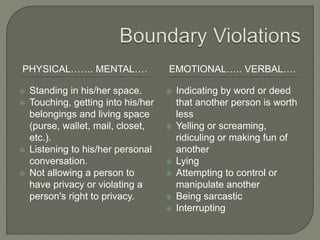
PHYSICAL……. MENTAL…. EMOTIONAL….. VERBAL….
 Standing in his/her space.
 Touching, getting into his/her
belongings and living space
(purse, wallet, mail, closet,
etc.).
 Listening to his/her personal
conversation.
 Not allowing a person to
have privacy or violating a
person's right to privacy.
 Indicating by word or deed
that another person is worth
less
 Yelling or screaming,
ridiculing or making fun of
another
 Lying
 Attempting to control or
manipulate another
 Being sarcastic
 Interrupting
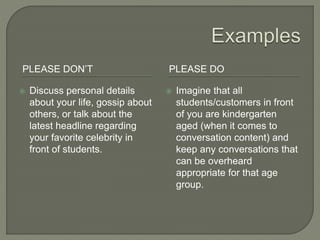
PLEASE DON’T PLEASE DO
 Discuss personal details
about your life, gossip about
others, or talk about the
latest headline regarding
your favorite celebrity in
front of students.
 Imagine that all
students/customers in front
of you are kindergarten
aged (when it comes to
conversation content) and
keep any conversations that
can be overheard
appropriate for that age
group.
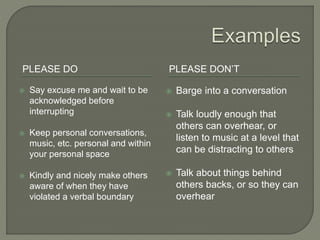
PLEASE DO PLEASE DON’T
 Say excuse me and wait to be
acknowledged before
interrupting
 Keep personal conversations,
music, etc. personal and within
your personal space
 Kindly and nicely make others
aware of when they have
violated a verbal boundary
 Barge into a conversation
 Talk loudly enough that
others can overhear, or
listen to music at a level that
can be distracting to others
 Talk about things behind
others backs, or so they can
overhear
PLEASE DO PLEASE DON’T
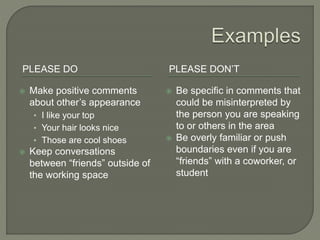
 Make positive comments
about other’s appearance
• I like your top
• Your hair looks nice
• Those are cool shoes
 Keep conversations
between “friends” outside of
the working space
 Be specific in comments that
could be misinterpreted by
the person you are speaking
to or others in the area
 Be overly familiar or push
boundaries even if you are
“friends” with a coworker, or
student
PLEASE DO PLEASE DON’T
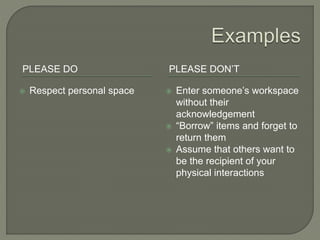
 Respect personal space  Enter someone’s workspace
without their
acknowledgement
 “Borrow” items and forget to
return them
 Assume that others want to
be the recipient of your
physical interactions
PLEASE DO PLEASE DON’T
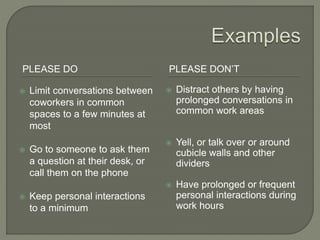
 Limit conversations between
coworkers in common
spaces to a few minutes at
most
 Go to someone to ask them
a question at their desk, or
call them on the phone
 Keep personal interactions
to a minimum
 Distract others by having
prolonged conversations in
common work areas
 Yell, or talk over or around
cubicle walls and other
dividers
 Have prolonged or frequent
personal interactions during
work hours
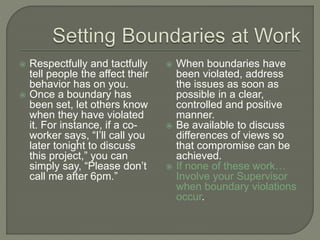
 Respectfully and tactfully
tell people the affect their
behavior has on you.
 Once a boundary has
been set, let others know
when they have violated
it. For instance, if a co-
worker says, “I’ll call you
later tonight to discuss
this project,” you can
simply say, “Please don’t
call me after 6pm.”
 When boundaries have
been violated, address
the issues as soon as
possible in a clear,
controlled and positive
manner.
 Be available to discuss
differences of views so
that compromise can be
achieved.
 If none of these work…
Involve your Supervisor
when boundary violations
occur.
 http://www.art.com/products/p15063225462-sa-i6844424/mick-stevens-
doctors-without-boundaries-new-yorker-cartoon.htm
 http://www.brainyquote.com/
 http://www.culturecrossing.net/explore.php
 http://dilbert.com/strips/
 http://EzineArticles.com/699546
 http://www.internationalstudents.org/culture-etiquette-
space.php?idlv2=62&idlv3=142
 http://www.pennbehavioralhealth.org/documents/settingboun
dariesatwork.pdf
 http://ucsfhr.ucsf.edu/index.php/assist/article/setting-healthy-workplace-
boundaries/

Workplace Boundaries

  • 1.
    Danielle J. Powers,Director of Admissions and Registration Services
  • 2.
     Ever hadsomeone stand so close when they talked to you that you could actually smell the fragrance of their shampoo or the gum they were chewing?  Or, has anybody ever struck up a conversation in a public restroom, while you were still busy in the cubicle?  Every time someone tries to break into that little bubble we carry around us – our “personal space”- an alarm should go off inside our head.  Crossing or entering someone else’s personal space creates discomfort because he/she feels the physical intimacy exceeds the relational intimacy.
  • 3.
     The definitionof a boundary is the ability to know where you end and where another person begins. When we talk about needing space, setting limits or determining acceptable behavior, we are really talking about boundaries.  Boundaries can be a difficult concept to grasp because they aren’t something that we can see and sometimes they are questionable. But just because we can’t see them, it doesn’t mean that they aren’t there or that they aren’t important.  Boundaries can pertain to physical or verbal proximity.
  • 5.
     Boundaries areimportant because they define the limits and responsibilities of the people with whom you interact.  Setting proper boundaries can result in a sense of accountability for all staff members.  Boundaries are important to maintaining good productivity and social dynamics within the work environment.
  • 6.
    Coworkers Students and Staff Supervisorsand Students Coworkers and Supervisors
  • 8.
     Our values,assumptions, biases, and communication styles are some of the things that turn up in our cultural baggage.  Neatly folded into one corner of the bag might be your views of time.  In the other corner, your expectations about gender roles.  Check that zippered side pouch and you may find your sense of personal space and comfort level with confrontation.  And then there are the countless gestures and mannerisms that inevitably tumble out of your overstuffed bag when you least expect it.
  • 9.
     A lackof awareness of your own cultural traits can make you feel vulnerable, frustrated and fearful. Interactions with people from other cultures might leave you thinking; “That’s so backward”, “They’re so lazy!”, “How uptight!”  Although some of these reactions—or judgments— are based on individual personality, many of them are based on a set of expectations and perceptions instilled in us by our respective cultures. Becoming aware of the nuances that comprise our own cultures is extremely important.
  • 10.
     How comfortableare you when a friend touches your shoulder or pats your arm while talking with you? A colleague? An acquaintance? When does it become too much?  Do you usually get directly to the point? Beat around the bush? Somewhere in between? Why?  When showing someone where something is, do you point? Gesture with one finger? The whole hand? How do you beckon someone? Fingers inward? Outward? What gestures are taboo?
  • 11.
    There are severaltypes of boundary violations....
  • 12.
    PHYSICAL……. MENTAL…. EMOTIONAL…..VERBAL….  Standing in his/her space.  Touching, getting into his/her belongings and living space (purse, wallet, mail, closet, etc.).  Listening to his/her personal conversation.  Not allowing a person to have privacy or violating a person's right to privacy.  Indicating by word or deed that another person is worth less  Yelling or screaming, ridiculing or making fun of another  Lying  Attempting to control or manipulate another  Being sarcastic  Interrupting
  • 14.
    PLEASE DON’T PLEASEDO  Discuss personal details about your life, gossip about others, or talk about the latest headline regarding your favorite celebrity in front of students.  Imagine that all students/customers in front of you are kindergarten aged (when it comes to conversation content) and keep any conversations that can be overheard appropriate for that age group.
  • 15.
    PLEASE DO PLEASEDON’T  Say excuse me and wait to be acknowledged before interrupting  Keep personal conversations, music, etc. personal and within your personal space  Kindly and nicely make others aware of when they have violated a verbal boundary  Barge into a conversation  Talk loudly enough that others can overhear, or listen to music at a level that can be distracting to others  Talk about things behind others backs, or so they can overhear
  • 17.
    PLEASE DO PLEASEDON’T  Make positive comments about other’s appearance • I like your top • Your hair looks nice • Those are cool shoes  Keep conversations between “friends” outside of the working space  Be specific in comments that could be misinterpreted by the person you are speaking to or others in the area  Be overly familiar or push boundaries even if you are “friends” with a coworker, or student
  • 18.
    PLEASE DO PLEASEDON’T  Respect personal space  Enter someone’s workspace without their acknowledgement  “Borrow” items and forget to return them  Assume that others want to be the recipient of your physical interactions
  • 19.
    PLEASE DO PLEASEDON’T  Limit conversations between coworkers in common spaces to a few minutes at most  Go to someone to ask them a question at their desk, or call them on the phone  Keep personal interactions to a minimum  Distract others by having prolonged conversations in common work areas  Yell, or talk over or around cubicle walls and other dividers  Have prolonged or frequent personal interactions during work hours
  • 20.
     Respectfully andtactfully tell people the affect their behavior has on you.  Once a boundary has been set, let others know when they have violated it. For instance, if a co- worker says, “I’ll call you later tonight to discuss this project,” you can simply say, “Please don’t call me after 6pm.”  When boundaries have been violated, address the issues as soon as possible in a clear, controlled and positive manner.  Be available to discuss differences of views so that compromise can be achieved.  If none of these work… Involve your Supervisor when boundary violations occur.
  • 21.
     http://www.art.com/products/p15063225462-sa-i6844424/mick-stevens- doctors-without-boundaries-new-yorker-cartoon.htm  http://www.brainyquote.com/ http://www.culturecrossing.net/explore.php  http://dilbert.com/strips/  http://EzineArticles.com/699546  http://www.internationalstudents.org/culture-etiquette- space.php?idlv2=62&idlv3=142  http://www.pennbehavioralhealth.org/documents/settingboun dariesatwork.pdf  http://ucsfhr.ucsf.edu/index.php/assist/article/setting-healthy-workplace- boundaries/