MANAGEMENT OF AN AGGRESSIVE/VIOLENT
PATIENT
Aggression
In social psychology, aggression is most commonly defined as a behavior
that is intended to harm another person who is motivated to avoid that
harm (Bushman & Huesmann, 2010; DeWall, Anderson, & Bushman,
2012).
harm can take many forms such as physical injury, hurt feelings, or
damaged social relationships
Anderson and Bushman (2002) more specifically defined human
aggression as “any behavior directed toward another individual that is
carried out with the proximate (immediate) intent to cause harm. In
addition, the per-petrator must believe that the behavior will harm the
target, and that the target is motivated to avoid the behavior”
Characteristics
• aggression is an observable behavior—not a thought or feeling
• the act must be intentional and be carried out with the goal of
harming another.
• aggression involves people, meaning that damaging inanimate
objects (e.g., kicking a wall, smashing plates, or pounding one’s fists
on a table) is not considered aggression unless it is carried out with
the intention of harming another person (e.g., slashing the tires on
your enemy’s car).
• the recipient of the harm must be motivated to avoid that harm.
VIOLENCE
• the most common scientific definition of violence is as an extreme
form of aggression that has severe physical harm (e.g., serious injury
or death) as its goal (Anderson & Bushman, 2002; Bushman &
Huesmann, 2010; Huesmann & Taylor, 2006).
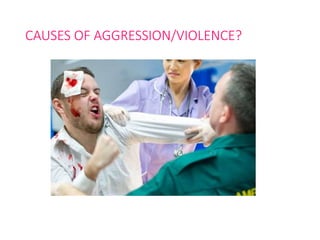
CAUSES OF AGGRESSION/VIOLENCE?
physical health
mental health
family structure
relationships with others
work or school environment
societal or socioeconomic factors
individual traits
life experiences
Hypoglycemia
hypoxia
Head trauma
meningitis/encephalitis
Drug intoxication or withdrawal
HIV virus complications
Sepsis
brain abscesses
Hepatic encephalopathy
Endocrinopathy,including cushing's
syndrome
CO2 retention
CNS tumors
Paradoxical drug reaction in elderly
Dementia
Violence assessment risk factors
• PAST HISTORY OF VIOLENCE
• Agitation, anger, disorganized behavior
• Poor compliance during interview
• Detailed or planned threat of violence
• Possession of weapons
• History of childhood physical or sexual abuse
• Presence of organic disorder
• Presence of psychotic psychopathology- delusions and command
hallucinations
• Substance use
• Borderline or antisocial personality
• Belonging to a demographic group with increased risk of violence
(young, male, socioeconomic group)
o
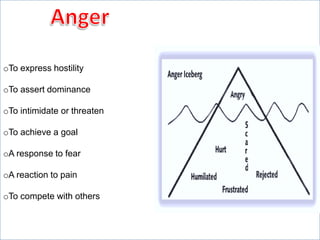
oTo express hostility
oTo assert dominance
oTo intimidate or threaten
oTo achieve a goal
oA response to fear
oA reaction to pain
oTo compete with others
Characteristics of aggressive people
• behavior is communicated verbally or non verbally
• invade the personal space of others
• speak loudly and with greater emphasis
• maintain intrusive eye contact over a prolonged period
• Threatening gestures
-point their finger
-shake their fists
-stamp their feet or
-make slashing motion with their hands
• Posture
-erect
- lean forward slightly towards the other person.
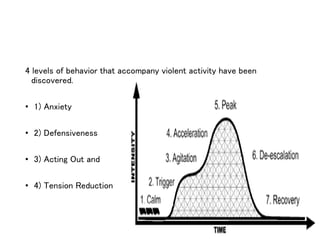
4 levels of behavior that accompany violent activity have been
discovered.
• 1) Anxiety
• 2) Defensiveness
• 3) Acting Out and
• 4) Tension Reduction
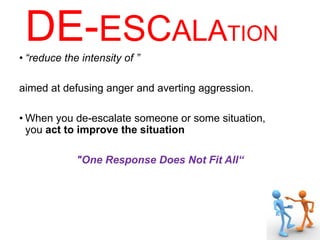
DE-ESCALATION
• “reduce the intensity of ”
aimed at defusing anger and averting aggression.
• When you de-escalate someone or some situation,
you act to improve the situation
"One Response Does Not Fit All“
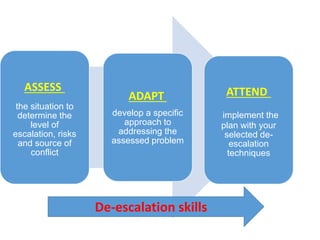
ASSESS
the situation to
determine the
level of
escalation, risks
and source of
conflict
ADAPT
develop a specific
approach to
addressing the
assessed problem
ATTEND
implement the
plan with your
selected de-
escalation
techniques
De-escalation skills
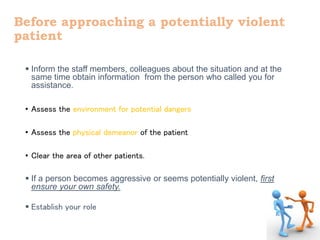
Before approaching a potentially violent
patient
 Inform the staff members, colleagues about the situation and at the
same time obtain information from the person who called you for
assistance.
• Assess the environment for potential dangers
• Assess the physical demeanor of the patient
• Clear the area of other patients.
 If a person becomes aggressive or seems potentially violent, first
ensure your own safety.
 Establish your role
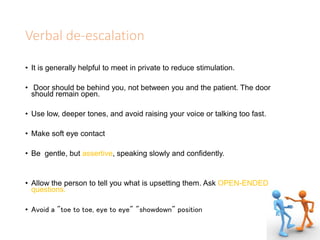
Verbal de-escalation
• It is generally helpful to meet in private to reduce stimulation.
• Door should be behind you, not between you and the patient. The door
should remain open.
• Use low, deeper tones, and avoid raising your voice or talking too fast.
• Make soft eye contact
• Be gentle, but assertive, speaking slowly and confidently.
• Allow the person to tell you what is upsetting them. Ask OPEN-ENDED
questions.
• Avoid a "toe to toe, eye to eye" "showdown" position
• Do not ever leave the patient alone and don’t turn your back to the
patient
• Take verbal threats seriously.
• Remain several feet away to avoid crowding the patient.
• Summon additional help (a "show of force" or a "show of concern");
this is not a time for heroics.
• maintain a confident and competent demeanor, and attempt to
deescalate by engaging the patient in conversation.
Positive engagement
An intervention that aims to empower patients to actively participate
in their care. Rather than 'having things done to' them, patients
negotiate the level of engagement that will be most therapeutic.
• Paraphrase your understanding of the person’s experiences. Set aside
your own thoughts and responses and focus on what you are hearing.
• Validate the person’s possible emotions and what is upsetting them.
• Be specific and gentle, but firmly directive about the behavior that you will
accept.
“please sit down.”
“please lower your voice and do not scream at me.”
“please do not thrash your arms like that’’
‘’Please keep them lowered.’’
• Explain your intent before making any moves
• If the tension in the room is not dissipating, consider taking a quick
break. (Apologize in a calm tone for needing to step out just for a
couple of minutes, stating for example that you would like to
consult with a supervisor; that you would like to get a glass of
water, and offer one to the person; etc.)
• Ask the person what would be helpful from you. Ask for
permission to problem-solve the issue. The person may just be
venting and may not want you to problem-solve with them.
• Summarize what the person has said, and summarize any agreed
upon resolutions.
EFFECTIVE
COMMUNICATION
ACTIVE
LISTENING
FEEDBACK
EMPHATHY
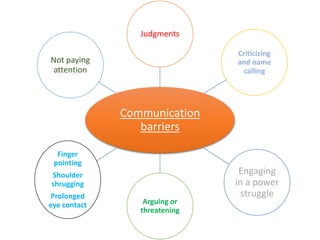
Communication
barriers
Judgments
Criticizing
and name
calling
Engaging
in a power
struggle
Arguing or
threatening
Finger
pointing
Shoulder
shrugging
Prolonged
eye contact
Not paying
attention
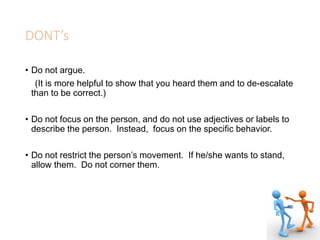
DONT’s
• Do not argue.
(It is more helpful to show that you heard them and to de-escalate
than to be correct.)
• Do not focus on the person, and do not use adjectives or labels to
describe the person. Instead, focus on the specific behavior.
• Do not restrict the person’s movement. If he/she wants to stand,
allow them. Do not corner them.
• Do not meet behind closed door if you foresee possible danger.
• Do not touch the person or make sudden moves.
• Avoid “why” questions; these tend to increase a person’s defenses.
• Do not take the person’s behavior or remarks personally.
Don’t lean over with a stethoscope /id card around your neck
Don’t have scissors , reflex hammers, pens in your pockets
DON’T EVER TAKE A WEAPON DIRECTLY FROM THE PATIENT
(always tell the person to leave the weapon on table or place it on
the floor)
Ignore challenge questions. When the person challenges our position,
authority, training, policies, etc., redirect the individual's attention to
the issue at hand. Answering a challenge question will just fuel a power
struggle.
Indications for Restraining and sedating a
violent and aggressive patient
• Preventing harm to the patient and others
• Preventing serious disruption or damage to the environment
• To assist in assessing and management off the patient
• Restraints should never be use for ease of convenience
The use of physical restraint requires a doctors order. The order
must specify the rationale or intent for use, the type of
restraint, and the length of time to use the restraint.
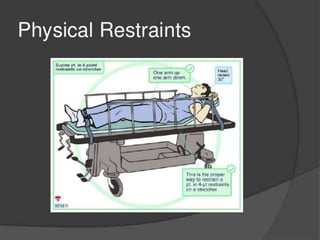
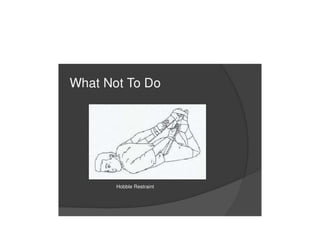
Techniques to restrain
• Proper technique starts with having a sufficient number of personnel.
• Five people should coordinate with restraining the patient, one securing
each limb, and a fifth member to control the patient's head, and prevent
biting. (A sixth person could be used to apply restraints, while others hold
the patient down)
• Hospital security should be called to help subdue a violent patient..
• Staff members should be educated and equipped with skills
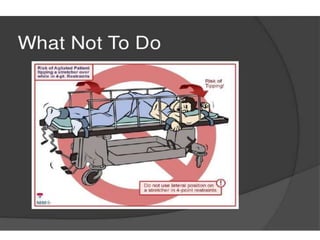
APPROACH TO 4 POINT
RESTRAINT
Clearly explain to the patient and the patient's family what you are doing as the
restraints are being applied and explain why you are applying the restraints.
Restraints may need to be applied one at a time while the other extremities are held
down.
After the restraints are secured, their integrity should be tested and the patient's
extremities should be examined for any signs of circulatory compromise.
Offer the patient medication, but if necessary administer medication
or chemical restraints involuntarily.
After restraint….
• Offer liquid, nutrition, comfort, and bathroom every 2 hours
• Remove restraints every 2 hour for no less than 10-15 minutes for
range of motion and skin care. Ideally open one hand and opposite
lower limb for a brief period and then repeat with other hand and
limb.
• Document the event details in the patients file and duration of
restrain
Chemical restraints
• Non-psychotic-Oral Lorazepam 1-2mg
• Psychotic-oral- lorazepam plus anti psychotic
(Olanzapine, Haloperidol)
First line
• Non –psychotic- I/M Lorazepam
• Psychotic- i/m lorazepam plus I/M haloperidol
• Concider I/M zuclopenthixol 50-150mg
Second line
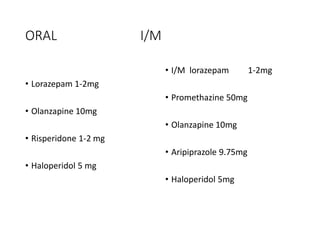
ORAL I/M
• Lorazepam 1-2mg
• Olanzapine 10mg
• Risperidone 1-2 mg
• Haloperidol 5 mg
• I/M lorazepam 1-2mg
• Promethazine 50mg
• Olanzapine 10mg
• Aripiprazole 9.75mg
• Haloperidol 5mg
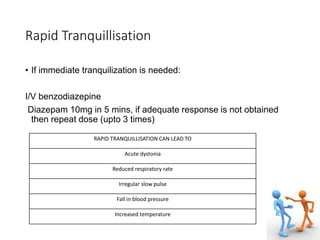
Rapid Tranquillisation
• If immediate tranquilization is needed:
I/V benzodiazepine
Diazepam 10mg in 5 mins, if adequate response is not obtained
then repeat dose (upto 3 times)
RAPID TRANQUILLISATION CAN LEAD TO
Acute dystonia
Reduced respiratory rate
Irregular slow pulse
Fall in blood pressure
Increased temperature
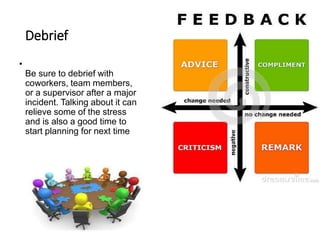
Debrief
•
Be sure to debrief with
coworkers, team members,
or a supervisor after a major
incident. Talking about it can
relieve some of the stress
and is also a good time to
start planning for next time
management of aggression

management of aggression

  • 1.
    MANAGEMENT OF ANAGGRESSIVE/VIOLENT PATIENT
  • 3.
    Aggression In social psychology,aggression is most commonly defined as a behavior that is intended to harm another person who is motivated to avoid that harm (Bushman & Huesmann, 2010; DeWall, Anderson, & Bushman, 2012). harm can take many forms such as physical injury, hurt feelings, or damaged social relationships Anderson and Bushman (2002) more specifically defined human aggression as “any behavior directed toward another individual that is carried out with the proximate (immediate) intent to cause harm. In addition, the per-petrator must believe that the behavior will harm the target, and that the target is motivated to avoid the behavior”
  • 4.
    Characteristics • aggression isan observable behavior—not a thought or feeling • the act must be intentional and be carried out with the goal of harming another. • aggression involves people, meaning that damaging inanimate objects (e.g., kicking a wall, smashing plates, or pounding one’s fists on a table) is not considered aggression unless it is carried out with the intention of harming another person (e.g., slashing the tires on your enemy’s car). • the recipient of the harm must be motivated to avoid that harm.
  • 5.
    VIOLENCE • the mostcommon scientific definition of violence is as an extreme form of aggression that has severe physical harm (e.g., serious injury or death) as its goal (Anderson & Bushman, 2002; Bushman & Huesmann, 2010; Huesmann & Taylor, 2006).
  • 6.
  • 7.
    physical health mental health familystructure relationships with others work or school environment societal or socioeconomic factors individual traits life experiences
  • 8.
    Hypoglycemia hypoxia Head trauma meningitis/encephalitis Drug intoxicationor withdrawal HIV virus complications Sepsis brain abscesses Hepatic encephalopathy Endocrinopathy,including cushing's syndrome CO2 retention CNS tumors Paradoxical drug reaction in elderly Dementia
  • 9.
    Violence assessment riskfactors • PAST HISTORY OF VIOLENCE • Agitation, anger, disorganized behavior • Poor compliance during interview • Detailed or planned threat of violence • Possession of weapons • History of childhood physical or sexual abuse
  • 10.
    • Presence oforganic disorder • Presence of psychotic psychopathology- delusions and command hallucinations • Substance use • Borderline or antisocial personality • Belonging to a demographic group with increased risk of violence (young, male, socioeconomic group)
  • 11.
    o oTo express hostility oToassert dominance oTo intimidate or threaten oTo achieve a goal oA response to fear oA reaction to pain oTo compete with others
  • 12.
    Characteristics of aggressivepeople • behavior is communicated verbally or non verbally • invade the personal space of others • speak loudly and with greater emphasis • maintain intrusive eye contact over a prolonged period • Threatening gestures -point their finger -shake their fists -stamp their feet or -make slashing motion with their hands • Posture -erect - lean forward slightly towards the other person.
  • 13.
    4 levels ofbehavior that accompany violent activity have been discovered. • 1) Anxiety • 2) Defensiveness • 3) Acting Out and • 4) Tension Reduction
  • 14.
    DE-ESCALATION • “reduce theintensity of ” aimed at defusing anger and averting aggression. • When you de-escalate someone or some situation, you act to improve the situation "One Response Does Not Fit All“
  • 15.
    ASSESS the situation to determinethe level of escalation, risks and source of conflict ADAPT develop a specific approach to addressing the assessed problem ATTEND implement the plan with your selected de- escalation techniques De-escalation skills
  • 16.
    Before approaching apotentially violent patient  Inform the staff members, colleagues about the situation and at the same time obtain information from the person who called you for assistance. • Assess the environment for potential dangers • Assess the physical demeanor of the patient • Clear the area of other patients.  If a person becomes aggressive or seems potentially violent, first ensure your own safety.  Establish your role
  • 17.
    Verbal de-escalation • Itis generally helpful to meet in private to reduce stimulation. • Door should be behind you, not between you and the patient. The door should remain open. • Use low, deeper tones, and avoid raising your voice or talking too fast. • Make soft eye contact • Be gentle, but assertive, speaking slowly and confidently. • Allow the person to tell you what is upsetting them. Ask OPEN-ENDED questions. • Avoid a "toe to toe, eye to eye" "showdown" position
  • 18.
    • Do notever leave the patient alone and don’t turn your back to the patient • Take verbal threats seriously. • Remain several feet away to avoid crowding the patient.
  • 19.
    • Summon additionalhelp (a "show of force" or a "show of concern"); this is not a time for heroics. • maintain a confident and competent demeanor, and attempt to deescalate by engaging the patient in conversation. Positive engagement An intervention that aims to empower patients to actively participate in their care. Rather than 'having things done to' them, patients negotiate the level of engagement that will be most therapeutic.
  • 20.
    • Paraphrase yourunderstanding of the person’s experiences. Set aside your own thoughts and responses and focus on what you are hearing. • Validate the person’s possible emotions and what is upsetting them. • Be specific and gentle, but firmly directive about the behavior that you will accept. “please sit down.” “please lower your voice and do not scream at me.” “please do not thrash your arms like that’’ ‘’Please keep them lowered.’’ • Explain your intent before making any moves

  • 21.
    • If thetension in the room is not dissipating, consider taking a quick break. (Apologize in a calm tone for needing to step out just for a couple of minutes, stating for example that you would like to consult with a supervisor; that you would like to get a glass of water, and offer one to the person; etc.) • Ask the person what would be helpful from you. Ask for permission to problem-solve the issue. The person may just be venting and may not want you to problem-solve with them. • Summarize what the person has said, and summarize any agreed upon resolutions.
  • 22.
  • 23.
    Communication barriers Judgments Criticizing and name calling Engaging in apower struggle Arguing or threatening Finger pointing Shoulder shrugging Prolonged eye contact Not paying attention
  • 24.
    DONT’s • Do notargue. (It is more helpful to show that you heard them and to de-escalate than to be correct.) • Do not focus on the person, and do not use adjectives or labels to describe the person. Instead, focus on the specific behavior. • Do not restrict the person’s movement. If he/she wants to stand, allow them. Do not corner them.
  • 25.
    • Do notmeet behind closed door if you foresee possible danger. • Do not touch the person or make sudden moves. • Avoid “why” questions; these tend to increase a person’s defenses. • Do not take the person’s behavior or remarks personally.
  • 26.
    Don’t lean overwith a stethoscope /id card around your neck Don’t have scissors , reflex hammers, pens in your pockets DON’T EVER TAKE A WEAPON DIRECTLY FROM THE PATIENT (always tell the person to leave the weapon on table or place it on the floor) Ignore challenge questions. When the person challenges our position, authority, training, policies, etc., redirect the individual's attention to the issue at hand. Answering a challenge question will just fuel a power struggle.
  • 27.
    Indications for Restrainingand sedating a violent and aggressive patient • Preventing harm to the patient and others • Preventing serious disruption or damage to the environment • To assist in assessing and management off the patient • Restraints should never be use for ease of convenience The use of physical restraint requires a doctors order. The order must specify the rationale or intent for use, the type of restraint, and the length of time to use the restraint.
  • 28.
    Techniques to restrain •Proper technique starts with having a sufficient number of personnel. • Five people should coordinate with restraining the patient, one securing each limb, and a fifth member to control the patient's head, and prevent biting. (A sixth person could be used to apply restraints, while others hold the patient down) • Hospital security should be called to help subdue a violent patient.. • Staff members should be educated and equipped with skills
  • 29.
    APPROACH TO 4POINT RESTRAINT Clearly explain to the patient and the patient's family what you are doing as the restraints are being applied and explain why you are applying the restraints. Restraints may need to be applied one at a time while the other extremities are held down. After the restraints are secured, their integrity should be tested and the patient's extremities should be examined for any signs of circulatory compromise. Offer the patient medication, but if necessary administer medication or chemical restraints involuntarily.
  • 30.
    After restraint…. • Offerliquid, nutrition, comfort, and bathroom every 2 hours • Remove restraints every 2 hour for no less than 10-15 minutes for range of motion and skin care. Ideally open one hand and opposite lower limb for a brief period and then repeat with other hand and limb. • Document the event details in the patients file and duration of restrain
  • 34.
    Chemical restraints • Non-psychotic-OralLorazepam 1-2mg • Psychotic-oral- lorazepam plus anti psychotic (Olanzapine, Haloperidol) First line • Non –psychotic- I/M Lorazepam • Psychotic- i/m lorazepam plus I/M haloperidol • Concider I/M zuclopenthixol 50-150mg Second line
  • 35.
    ORAL I/M • Lorazepam1-2mg • Olanzapine 10mg • Risperidone 1-2 mg • Haloperidol 5 mg • I/M lorazepam 1-2mg • Promethazine 50mg • Olanzapine 10mg • Aripiprazole 9.75mg • Haloperidol 5mg
  • 36.
    Rapid Tranquillisation • Ifimmediate tranquilization is needed: I/V benzodiazepine Diazepam 10mg in 5 mins, if adequate response is not obtained then repeat dose (upto 3 times) RAPID TRANQUILLISATION CAN LEAD TO Acute dystonia Reduced respiratory rate Irregular slow pulse Fall in blood pressure Increased temperature
  • 37.
    Debrief • Be sure todebrief with coworkers, team members, or a supervisor after a major incident. Talking about it can relieve some of the stress and is also a good time to start planning for next time