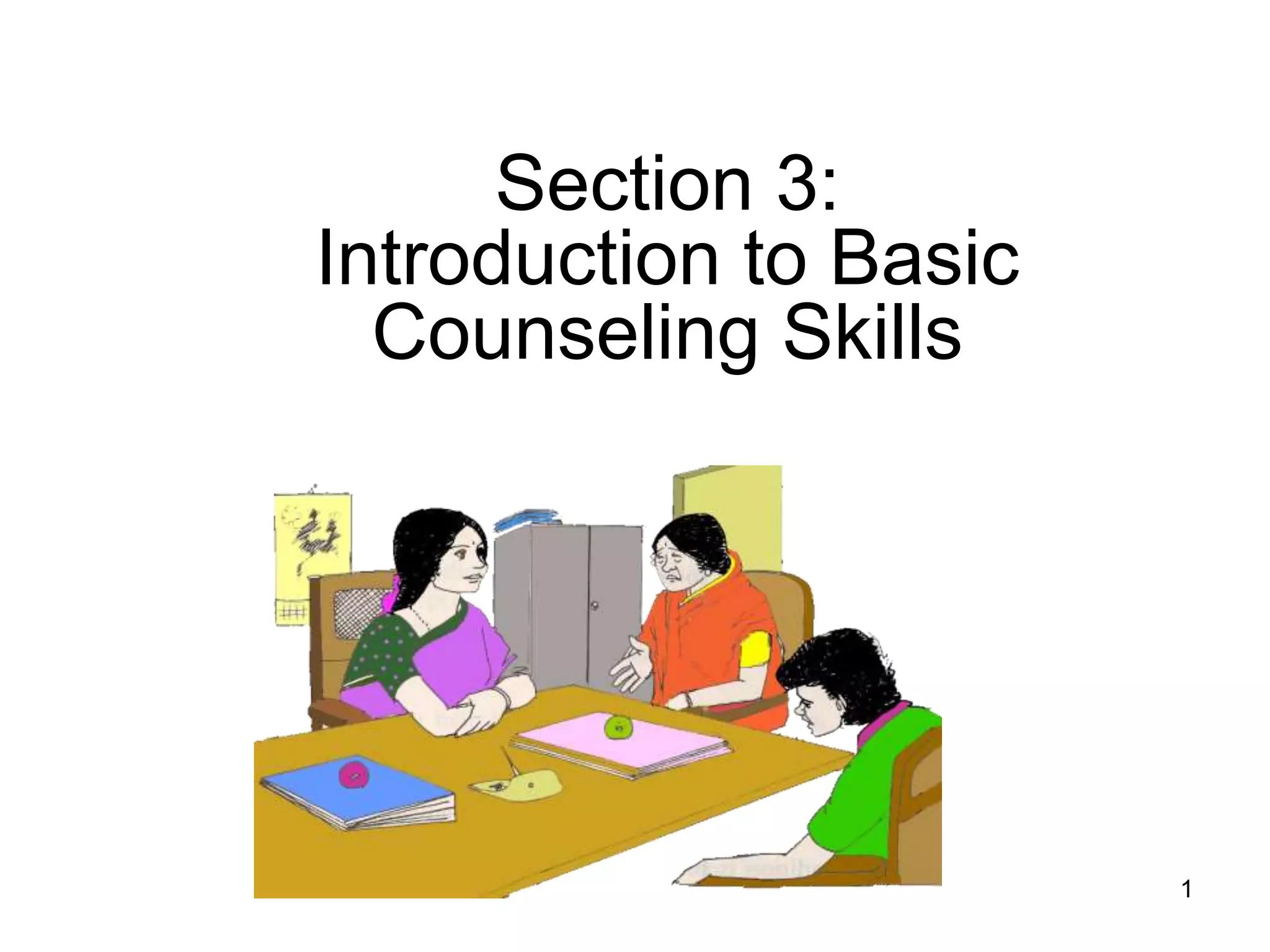

Section 3:
Introduction to Basic
Counseling Skills
1
Training objectives (1)
At the end of this workshop you will be able to:
1. Identify a minimum of 4 counselling strategies useful in
drug abuse treatment
2. Conduct a minimum of 3 counselling strategies
3. Structure a regular counselling session
4. Understand the importance of clinical supervision
5. Conduct a minimum of 3 listening strategies and 3
responding and teaching strategies to be used in
counselling for drug abuse treatment
2
Introduction to Counselling
3
What is counselling? (1)
Counselling involves the following:
• Interactive relationship
• Collaboration
• Set of clinical skills & teaching techniques
• Positive reinforcement
• Emotional support
• Formal record
4
What is counselling? (2)
The purpose of counselling is to establish:
• Goals of treatment
• Treatment modality
• Treatment plan
• Scheduling of sessions
• Frequency and length of treatment
• Potential involvement of others
• Termination of treatment
5
Basic Counselling Skills
6
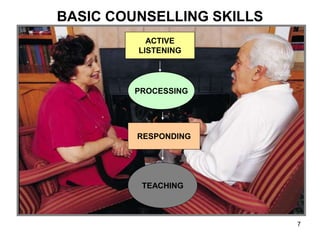
ACTIVE
LISTENING
PROCESSING
RESPONDING
TEACHING
BASIC COUNSELLING SKILLS
7
Active Listening
8
Active listening
Active listening by the clinician encourages
the client to share information by
providing verbal and nonverbal
expressions of interest.
9
Active listening skills
Active listening includes the following skills:
–Attending
–Paraphrasing
–Reflection of feelings
–Summarising
10
Attending (1)
Attending is expressing awareness and
interest in what the client is communicating
both verbally and nonverbally.
11
Attending (2)
Attending helps the clinician
• Better understand the client through careful observation
Attending helps the client
• Relax and feel comfortable
• Express their ideas and feelings freely in their own way
• Trust the counsellor
• Take a more active role in their own sessions
12
Attending (3)
Proper attending involves the following:
• Appropriate eye contact, facial expressions
• Maintaining a relaxed posture and leaning
forward occasionally, using natural hand and
arm movements
• Verbally “following” the client, using a variety of
brief encouragements such as “Um-hm” or
“Yes,” or by repeating key words
• Observing the client’s body language
13
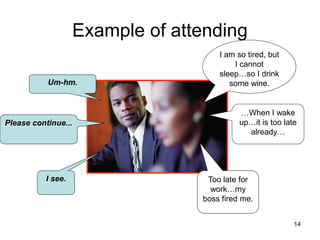
Example of attending
Please continue...
I am so tired, but
I cannot
sleep…so I drink
some wine.
Um-hm.
…When I wake
up…it is too late
already…
I see. Too late for
work…my
boss fired me.
14
Activity 1: Case study
“The client asked the clinician about the
availability of medical help to deal with
his withdrawal symptoms. The clinician
noticed that the client is wringing his
hands and looking very anxious.”
Discuss how the clinician should respond.
15 minutes
15
Paraphrasing (1)
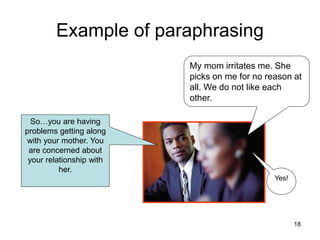
Paraphrasing is when the clinician restates
the content of the client’s previous
statement.
• Paraphrasing uses words that are similar
to the client’s, but fewer.
• The purpose of paraphrasing is to
communicate to the client that you
understand what he or she is saying.
16
Paraphrasing (2)
Paraphrasing helps the clinician
– verify their perceptions of the client’s statements
– spotlight an issue
Paraphrasing helps the client
– realise that the counsellor understands what they are
saying
– clarify their remarks
– focus on what is important and relevant
17
Example of paraphrasing
Yes!
My mom irritates me. She
picks on me for no reason at
all. We do not like each
other.
So…you are having
problems getting along
with your mother. You
are concerned about
your relationship with
her.
18
Reflection of feelings (1)
Reflection of feelings is when the clinician
expresses the client’s feelings, either
stated or implied. The counsellor tries to
perceive the emotional state of the client
and respond in a way that demonstrates
an understanding of the client’s
emotional state.
19
Reflection of feelings (2)
Reflection of feelings helps the clinician
– Check whether or not they accurately understand
what the client is feeling
– Bring out problem areas without the client being
pushed or forced
Reflection of feelings helps the client
– Realise that the counsellor understands what
they feel
– Increase awareness of their feelings
– Learn that feelings and behaviour are connected
20
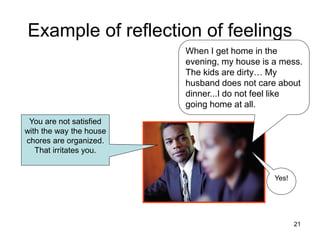
Example of reflection of feelings
Yes!
When I get home in the
evening, my house is a mess.
The kids are dirty… My
husband does not care about
dinner...I do not feel like
going home at all.
You are not satisfied
with the way the house
chores are organized.
That irritates you.
21
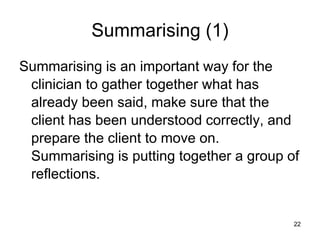
Summarising (1)
Summarising is an important way for the
clinician to gather together what has
already been said, make sure that the
client has been understood correctly, and
prepare the client to move on.
Summarising is putting together a group of
reflections.
22
Summarising (2)
Summarising helps the clinician
• Provide focus for the session
• Confirm the client’s perceptions
• Focus on one issue while acknowledging the
existence of others
• Terminate a session in a logical way
Summarising helps the client
• Clarify what they mean
• Realise that the counsellor understands
• Have a sense of movement and progress
23
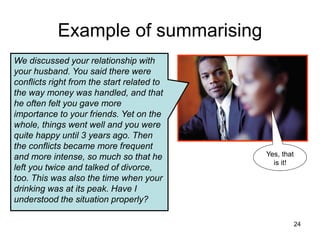
Example of summarising
Yes, that
is it!
We discussed your relationship with
your husband. You said there were
conflicts right from the start related to
the way money was handled, and that
he often felt you gave more
importance to your friends. Yet on the
whole, things went well and you were
quite happy until 3 years ago. Then
the conflicts became more frequent
and more intense, so much so that he
left you twice and talked of divorce,
too. This was also the time when your
drinking was at its peak. Have I
understood the situation properly?
24
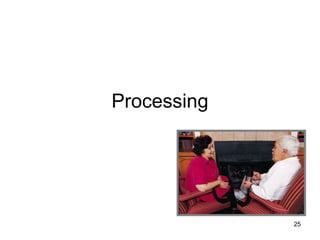
Processing
25
Processing (1)
Processing is the act of the clinician thinking
about his or her observations about the
client and what the client has
communicated.
26
Processing (2)
Processing allows the counsellor to mentally
catalogue the following data:
– Client’s beliefs, knowledge, attitudes, and
expectations
– Information given by his or her family
– Counsellor’s observations
27
Responding
28
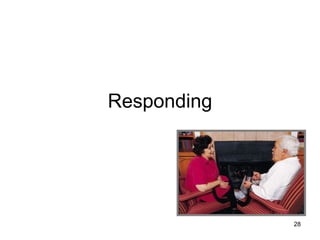
Responding
Responding is the act of communicating
information to the client that includes
providing feedback and emotional
support, addressing issues of concern,
and teaching skills.
29
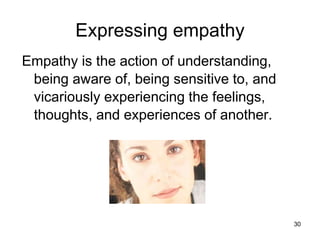
Expressing empathy
Empathy is the action of understanding,
being aware of, being sensitive to, and
vicariously experiencing the feelings,
thoughts, and experiences of another.
30
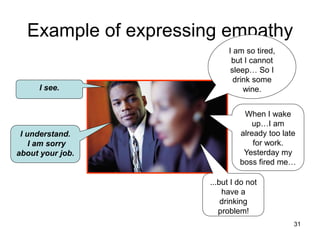
Example of expressing empathy
I am so tired,
but I cannot
sleep… So I
drink some
wine.
I see.
When I wake
up…I am
already too late
for work.
Yesterday my
boss fired me…
I understand.
I am sorry
about your job.
...but I do not
have a
drinking
problem!
31
Probing (1)
Probing is the counsellor’s use of a question
to direct the client’s attention to explore his
or her situation in greater depth.
32
Probing (2)
• A probing question should be open-ended
• Probing helps to focus the client’s attention on a
feeling, situation, or behaviour
• Probing may encourage the client to elaborate,
clarify, or illustrate what he or she has been saying
• Probing may enhance the client’s awareness and
understanding of his or her situation and feelings
• Probing directs the client to areas that need
attention
33
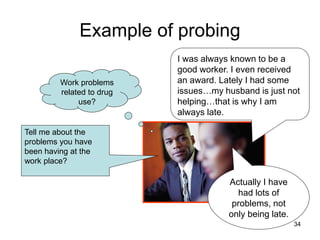
Example of probing
Actually I have
had lots of
problems, not
only being late.
I was always known to be a
good worker. I even received
an award. Lately I had some
issues…my husband is just not
helping…that is why I am
always late.
Tell me about the
problems you have
been having at the
work place?
Work problems
related to drug
use?
34
Interpreting (1)
Interpreting is the clinician’s explanation of
the client’s issues after observing the
client’s behaviour, listening to the client,
and considering other sources of
information.
35
Interpreting (2)
Effective interpreting has three components:
1. Determining and restating basic messages
2. Adding ideas for a new frame of reference
3. Validating these ideas with the client
36
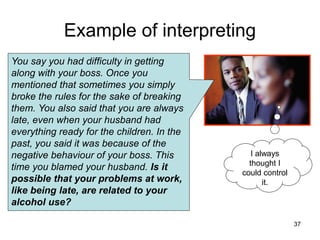
Example of interpreting
You say you had difficulty in getting
along with your boss. Once you
mentioned that sometimes you simply
broke the rules for the sake of breaking
them. You also said that you are always
late, even when your husband had
everything ready for the children. In the
past, you said it was because of the
negative behaviour of your boss. This
time you blamed your husband. Is it
possible that your problems at work,
like being late, are related to your
alcohol use?
I always
thought I
could control
it.
37
Silence
Silence can encourage the client to reflect
and continue sharing. It also can allow the
client to experience the power of his or her
own words.
38
Activity 2: Now it’s your turn!
Rotating Roles
This role-play gives you and your colleagues an opportunity
to practise as clinicians and clients.
• Role-play with one of your partners the new
counselling skills you have learned. A third partner will
be an observer. After 10 minutes switch roles (30
minutes total).
• Each observer will provide feedback at the end of each
role-play (5 minutes).
35 minutes
39

Section 3_ Intro to Basic Counseling Skills (5).ppt

  • 1.
    Section 3: Introduction toBasic Counseling Skills 1
  • 2.
    Training objectives (1) Atthe end of this workshop you will be able to: 1. Identify a minimum of 4 counselling strategies useful in drug abuse treatment 2. Conduct a minimum of 3 counselling strategies 3. Structure a regular counselling session 4. Understand the importance of clinical supervision 5. Conduct a minimum of 3 listening strategies and 3 responding and teaching strategies to be used in counselling for drug abuse treatment 2
  • 3.
  • 4.
    What is counselling?(1) Counselling involves the following: • Interactive relationship • Collaboration • Set of clinical skills & teaching techniques • Positive reinforcement • Emotional support • Formal record 4
  • 5.
    What is counselling?(2) The purpose of counselling is to establish: • Goals of treatment • Treatment modality • Treatment plan • Scheduling of sessions • Frequency and length of treatment • Potential involvement of others • Termination of treatment 5
  • 6.
  • 7.
  • 8.
  • 9.
    Active listening Active listeningby the clinician encourages the client to share information by providing verbal and nonverbal expressions of interest. 9
  • 10.
    Active listening skills Activelistening includes the following skills: –Attending –Paraphrasing –Reflection of feelings –Summarising 10
  • 11.
    Attending (1) Attending isexpressing awareness and interest in what the client is communicating both verbally and nonverbally. 11
  • 12.
    Attending (2) Attending helpsthe clinician • Better understand the client through careful observation Attending helps the client • Relax and feel comfortable • Express their ideas and feelings freely in their own way • Trust the counsellor • Take a more active role in their own sessions 12
  • 13.
    Attending (3) Proper attendinginvolves the following: • Appropriate eye contact, facial expressions • Maintaining a relaxed posture and leaning forward occasionally, using natural hand and arm movements • Verbally “following” the client, using a variety of brief encouragements such as “Um-hm” or “Yes,” or by repeating key words • Observing the client’s body language 13
  • 14.
    Example of attending Pleasecontinue... I am so tired, but I cannot sleep…so I drink some wine. Um-hm. …When I wake up…it is too late already… I see. Too late for work…my boss fired me. 14
  • 15.
    Activity 1: Casestudy “The client asked the clinician about the availability of medical help to deal with his withdrawal symptoms. The clinician noticed that the client is wringing his hands and looking very anxious.” Discuss how the clinician should respond. 15 minutes 15
  • 16.
    Paraphrasing (1) Paraphrasing iswhen the clinician restates the content of the client’s previous statement. • Paraphrasing uses words that are similar to the client’s, but fewer. • The purpose of paraphrasing is to communicate to the client that you understand what he or she is saying. 16
  • 17.
    Paraphrasing (2) Paraphrasing helpsthe clinician – verify their perceptions of the client’s statements – spotlight an issue Paraphrasing helps the client – realise that the counsellor understands what they are saying – clarify their remarks – focus on what is important and relevant 17
  • 18.
    Example of paraphrasing Yes! Mymom irritates me. She picks on me for no reason at all. We do not like each other. So…you are having problems getting along with your mother. You are concerned about your relationship with her. 18
  • 19.
    Reflection of feelings(1) Reflection of feelings is when the clinician expresses the client’s feelings, either stated or implied. The counsellor tries to perceive the emotional state of the client and respond in a way that demonstrates an understanding of the client’s emotional state. 19
  • 20.
    Reflection of feelings(2) Reflection of feelings helps the clinician – Check whether or not they accurately understand what the client is feeling – Bring out problem areas without the client being pushed or forced Reflection of feelings helps the client – Realise that the counsellor understands what they feel – Increase awareness of their feelings – Learn that feelings and behaviour are connected 20
  • 21.
    Example of reflectionof feelings Yes! When I get home in the evening, my house is a mess. The kids are dirty… My husband does not care about dinner...I do not feel like going home at all. You are not satisfied with the way the house chores are organized. That irritates you. 21
  • 22.
    Summarising (1) Summarising isan important way for the clinician to gather together what has already been said, make sure that the client has been understood correctly, and prepare the client to move on. Summarising is putting together a group of reflections. 22
  • 23.
    Summarising (2) Summarising helpsthe clinician • Provide focus for the session • Confirm the client’s perceptions • Focus on one issue while acknowledging the existence of others • Terminate a session in a logical way Summarising helps the client • Clarify what they mean • Realise that the counsellor understands • Have a sense of movement and progress 23
  • 24.
    Example of summarising Yes,that is it! We discussed your relationship with your husband. You said there were conflicts right from the start related to the way money was handled, and that he often felt you gave more importance to your friends. Yet on the whole, things went well and you were quite happy until 3 years ago. Then the conflicts became more frequent and more intense, so much so that he left you twice and talked of divorce, too. This was also the time when your drinking was at its peak. Have I understood the situation properly? 24
  • 25.
  • 26.
    Processing (1) Processing isthe act of the clinician thinking about his or her observations about the client and what the client has communicated. 26
  • 27.
    Processing (2) Processing allowsthe counsellor to mentally catalogue the following data: – Client’s beliefs, knowledge, attitudes, and expectations – Information given by his or her family – Counsellor’s observations 27
  • 28.
  • 29.
    Responding Responding is theact of communicating information to the client that includes providing feedback and emotional support, addressing issues of concern, and teaching skills. 29
  • 30.
    Expressing empathy Empathy isthe action of understanding, being aware of, being sensitive to, and vicariously experiencing the feelings, thoughts, and experiences of another. 30
  • 31.
    Example of expressingempathy I am so tired, but I cannot sleep… So I drink some wine. I see. When I wake up…I am already too late for work. Yesterday my boss fired me… I understand. I am sorry about your job. ...but I do not have a drinking problem! 31
  • 32.
    Probing (1) Probing isthe counsellor’s use of a question to direct the client’s attention to explore his or her situation in greater depth. 32
  • 33.
    Probing (2) • Aprobing question should be open-ended • Probing helps to focus the client’s attention on a feeling, situation, or behaviour • Probing may encourage the client to elaborate, clarify, or illustrate what he or she has been saying • Probing may enhance the client’s awareness and understanding of his or her situation and feelings • Probing directs the client to areas that need attention 33
  • 34.
    Example of probing ActuallyI have had lots of problems, not only being late. I was always known to be a good worker. I even received an award. Lately I had some issues…my husband is just not helping…that is why I am always late. Tell me about the problems you have been having at the work place? Work problems related to drug use? 34
  • 35.
    Interpreting (1) Interpreting isthe clinician’s explanation of the client’s issues after observing the client’s behaviour, listening to the client, and considering other sources of information. 35
  • 36.
    Interpreting (2) Effective interpretinghas three components: 1. Determining and restating basic messages 2. Adding ideas for a new frame of reference 3. Validating these ideas with the client 36
  • 37.
    Example of interpreting Yousay you had difficulty in getting along with your boss. Once you mentioned that sometimes you simply broke the rules for the sake of breaking them. You also said that you are always late, even when your husband had everything ready for the children. In the past, you said it was because of the negative behaviour of your boss. This time you blamed your husband. Is it possible that your problems at work, like being late, are related to your alcohol use? I always thought I could control it. 37
  • 38.
    Silence Silence can encouragethe client to reflect and continue sharing. It also can allow the client to experience the power of his or her own words. 38
  • 39.
    Activity 2: Nowit’s your turn! Rotating Roles This role-play gives you and your colleagues an opportunity to practise as clinicians and clients. • Role-play with one of your partners the new counselling skills you have learned. A third partner will be an observer. After 10 minutes switch roles (30 minutes total). • Each observer will provide feedback at the end of each role-play (5 minutes). 35 minutes 39