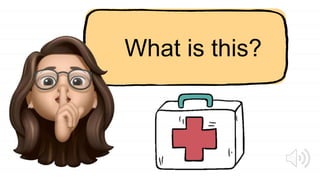
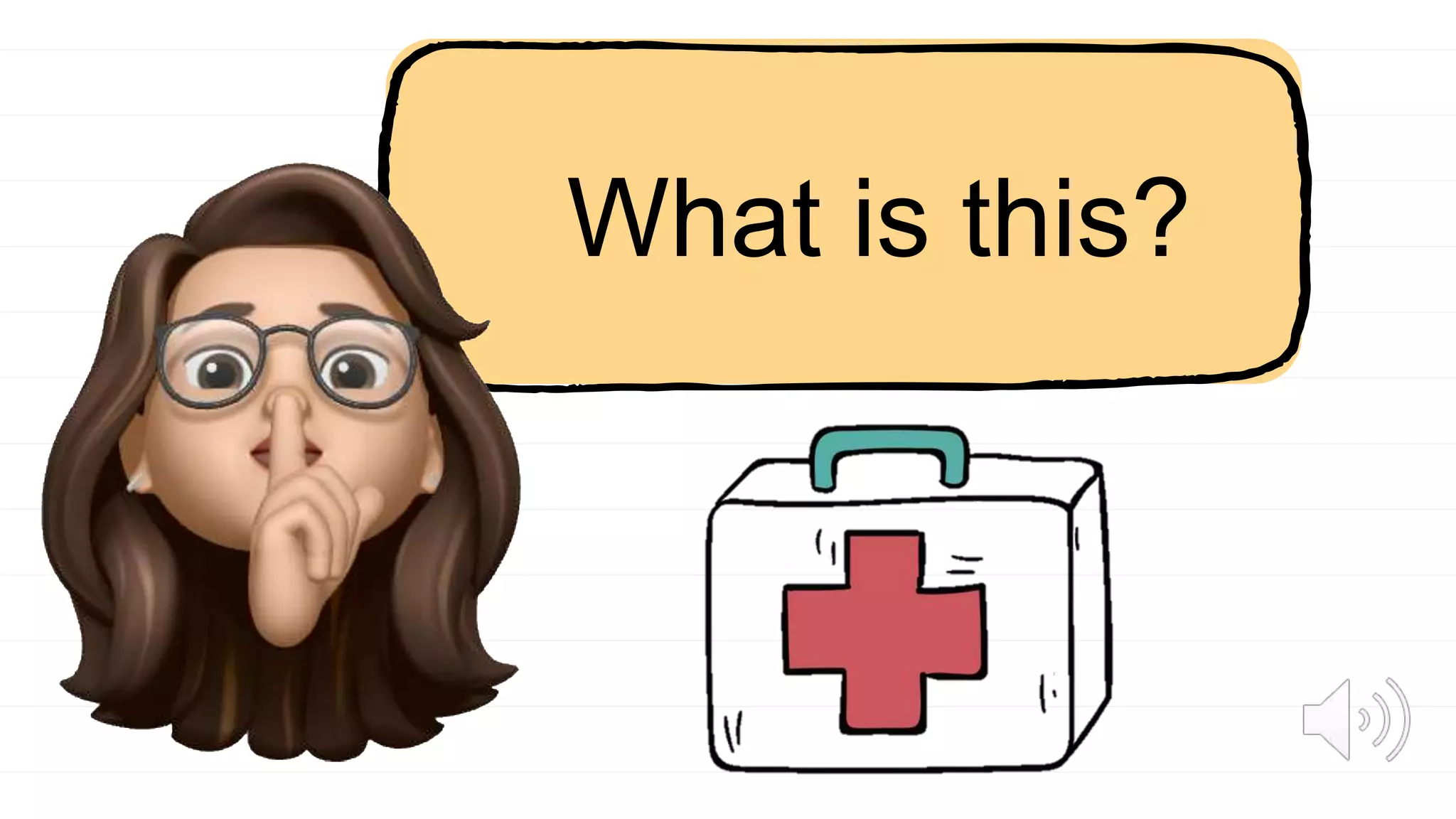
What is this?
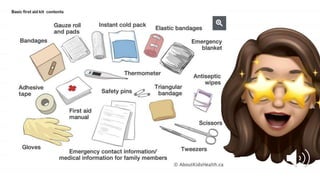
First Aid Kit
What’s inside of
this kit?
5
4
3
2
1
0
When your friend gets cut on
the arm, you clean the wound,
apply medicine, and cover it up
with a bandage. That’s basic
first aid.
But what do you do
if your friend’s mind
is wounded?
?
?
?
STATUS CHECK:
When to Give
Psychological First Aid?
September 18, 2020, Friday
Talipan National High School
Good Morning
I’m
SARAH CATRINA B. DE MESA-
PORTES
SHS Teacher II
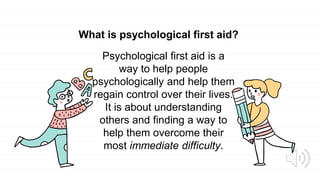
What is psychological first aid?
Psychological first aid is a
way to help people
psychologically and help them
regain control over their lives.
It is about understanding
others and finding a way to
help them overcome their
most immediate difficulty.
A picture is worth a
thousand words
What to do?
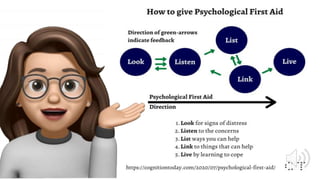
● You Look for signs of distress – breathlessness, panic,
running away, overeating, yelling
● You Listen to their suffering – “I am scared” I can’t
● You List what resources they can find to feel better and
certain
● You Link them to people and things which can help
● You help them Live by adapting to their new situation
?
Medical analogy: You look for the
wound person. You listen to the
person’s pain. You list all things
that can help with recovery and
prevent further damage. You link
them to medicine. And finally, help
them live through the discomfort.
● The good thing is that anyone can learn to
provide psychological first aid. Before an
asteroid destroys us or aliens harvest us, the
world needs people to help us maintain our
sanity. With psychological first aid, you can help
anyone who is suffering!
● Fast Fact: Healthcare workers get traumatized
caring for people. All that death and sickness.
You can help them with PFA.
Understanding the crises
● According to Dr. Raakesh Kriplani, there are at least 5
types of pandemics going on right now in 2020.
● The coronavirus pandemic – The invisible virus that took
over the world.
● The informational pandemic (infodemic) – The
information we see is almost always scary and
heartbreaking. Some of it induces panic. And a lot of it is
simply fake like denying the coronavirus. So we find it hard
to believe and trust others.
Understanding the crises
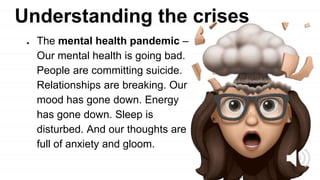
● The mental health pandemic –
Our mental health is going bad.
People are committing suicide.
Relationships are breaking. Our
mood has gone down. Energy
has gone down. Sleep is
disturbed. And our thoughts are
full of anxiety and gloom.
Understanding the crises
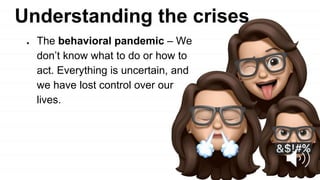
● The behavioral pandemic – We
don’t know what to do or how to
act. Everything is uncertain, and
we have lost control over our
lives.
Understanding the crises
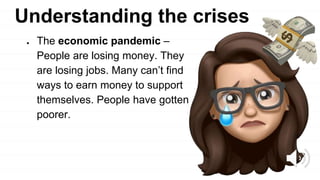
● The economic pandemic –
People are losing money. They
are losing jobs. Many can’t find
ways to earn money to support
themselves. People have gotten
poorer.
Understanding the crises
What do 5 crises do to us?
They spoil our quality of life and
cause all sorts of mental health
issues. And above all, we are
stressed because we find it hard to
handle them.
Basic needs
A crisis kills our sense of safety and stability. Basic needs
are those things that we need in our lives to lead a satisfying
life. An emergency means our most basic needs, like getting
food/water and feeling safe, are not met. Safety is a big
issue. People are scared because they are always worried
about their loved ones and don’t know if they can cope with
the pandemic.
Basic needs
We see death, depression, panic, and suffering. Many of us
have lost loved ones to the pandemic; some have lost
relationships; and even jobs. The pandemic has cut our
connectedness and every other aspect of our well-being.
The very thing that supports our mental health and improves
the quality of life has taken a hit.
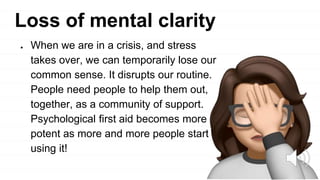
Loss of mental clarity
● When we are in a crisis, and stress
takes over, we can temporarily lose our
common sense. It disrupts our routine.
People need people to help them out,
together, as a community of support.
Psychological first aid becomes more
potent as more and more people start
using it!
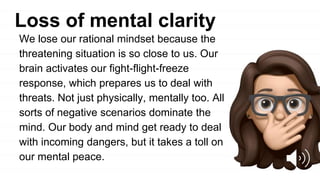
Loss of mental clarity
We lose our rational mindset because the
threatening situation is so close to us. Our
brain activates our fight-flight-freeze
response, which prepares us to deal with
threats. Not just physically, mentally too. All
sorts of negative scenarios dominate the
mind. Our body and mind get ready to deal
with incoming dangers, but it takes a toll on
our mental peace.
Loss of mental clarity
All of this puts immense stress on us. But
what is stress? It’s just us trying to adapt
but don’t have the right methods and
resources to adapt.
How to give
psychological first
aid?
Guidelines for Look
● Before you give psychological first aid,
you have to spot who needs it. For
that, we look at the signs of suffering,
pain, and stress.
● Easy to Spot- Screaming, yelling,
crying, irritability, changes in
sleep/appetite, easily distracted/lost in
thoughts all the time, breathlessness
Guidelines for Look
● Difficult to Spot- Social withdrawal,
low mood, denial of the situation, loss
of interest in previously enjoyed
activities, frequently referring to or
joking about death or dying
Guidelines for Listening
Listening is about keen observation,
empathizing, giving space, and reflecting
on their concerns to identify their unmet
needs. It’s important to tell others that you
are available to help in any way you can.
This is the part where comfort and rapport
are set.
Guidelines for Listening
Dos
● Carefully observe the signs of distress
● Give others the time and space to share
● Consider a person’s cultural, ethnic, and
religious background to talk healthily and
respectably
● Adjust your responses to a neutral state to
be sensitive to social identity and social
status
Guidelines for Listening
Dos
● Cooperative conversation
● Confirm that you understand their
concern.
● Be okay with moments of silence, wait for
the other person to speak but still ‘be
there’ for that person
● Ask open-ended questions without
probing too much or putting pressure (ex:
What is bothering you?)
Guidelines for Listening
Dos
● Ask how you can help in small ways
(accompanying a person for an activity
such as walks, meditation, etc.)
● Draw on your experience if you feel it
helps the conversation
Guidelines for Listening
Don’ts
● Don’t pressurize others to talk or
respond. Let them take their time.
● Don’t get distracted by your
experiences in similar situations.
Focus on listening to theirs and
identify their mental state.
● Don’t probe or nag
● Don’t dictate how others should feel
Guidelines for Listening
Don’ts
● Don’t respond with statements which
challenge their psychological state
● Don’t give advice prematurely without
fully listening to a person
● Don’t trivialize the intensity of their
concern (Ex: oh, it’s just a phase;
you’re just overthinking.)
Guidelines for Listing
● You have now identified the signs of distress and learned to
listen. Your next step in giving psychological first aid is to list
resources to solve problems, offer support, and
then link people to those resources.
● Resources are all actions, people, and technologies that
help to improve one’s mental status. So resources include
various apps, activities, professionals, and help-lines that
address a concern you identified while looking and listening.
These resources are some of the most trusted ways to help
someone calm down.
Guidelines for Listing
People
● Ask the person to talk with someone they
respect and value. It could be a:
● A trusted family member
● A trusted friend or a mentor/teacher
● Your family doctor/ Physician
● Mental health professional
(psychiatrist/clinical
psychologist/counselor)
Here are a few common ways to help:
Guidelines for Listing
Actions
● Many physical and mental activities can help us cope
with stress and challenging times. Psychological first
aid looks at two very useful approaches to deal with
the pandemic and any other. These coping
mechanisms can help you and manage everything
from anxiety to frustration. The first approach is
problem-focused coping, and the second is emotion-
focused coping.
Here are a few common ways to help:
Guidelines for Listing
Problem-focused coping
● is all about finding solutions to immediate needs people
have. You might have to improvise and get creative.
Sometimes the biggest problems are those that interfere
with our most basic needs – food, water, clothing, safety,
independence, connectedness, & stability. Your job as a
psychological first aid provider would be to recognize
people’s unmet needs, current problems, and help them
meet those needs. Even better if you can show them how
they can help others meet similar needs.
Here are a few common ways to help:
● Get the ‘facts’ of the situation.
● List out possible solutions, even the silly ones, in order
from best to worst.
● Work on acceptance if the problem cannot be solved then
& there (link to emotion-focused coping)
● Examples:
● Secure food, water
● Share the workload
● Giving company to carry out activities
● Emotion-focused coping is all about
managing emotions in a useful way.
That means handling negative
emotions and creating opportunities
for positive emotions. Panic attacks,
acting out, aggressive behavior,
extreme frustration, are all common in
a crisis and a few coping techniques
can help! Here are some strategies.
● Examples:
● Breathing exercises (useful for those who are having
a panic attack)
● 54321 technique grounding technique – Find 5
things you can see, 4 things you can hear, 3 things
you can touch, 2 things you can smell, & 1 thing you
can taste
● Listen to music
● Exercise, meditation, yoga, stretching
Technologies
● Almost everyone has access to a phone, and fortunately, we
can use it to aid mental health. Here is a list of all the apps
that can quickly help people regain control, reduce anxiety
and stress, and feel they have a mental security blanket.
● Headspace – for breathing, mindfulness, meditation
● Calm – for meditation and sleep
● Simple Habit – for overall wellness
● What’s Up?- A Mental Health App – for app-based therapy
● Wysa – a chatbot for stress, depression, and anxiety
● As a psychological first aid agent, you help
others use the best solutions and resources
they have to deal with the most immediate
concerns. While solving problems with
others, you follow 4 steps:
● Identify the facts and define the problem.
● Judge the potency of solutions/resources to
solve a problem.
Guidelines for Linking
● If no solution works, help the person accept the
current state using emotion-focused coping.
● Move on to work on other solvable issues.
● It is valuable to discuss what solutions and
resources a person is comfortable and willing to
use while linking. Brainstorming solutions in a
considerate way can help you make the best
recommendations and encourage solutions.
Guidelines for Linking
Guidelines for Live
● The hard part of giving psychological first
aid is over! All of these steps help others
become resilient and practical. PFA is
about supporting others to adapt to their
new circumstances so they can live and
restore their disturbed life in a way they
like. These 7 factors will help you complete
your PFA in a way others feel supported,
comforted, and in control.
Guidelines for Live
● Focus on adjustment – sleep hygiene, diet,
exercise, mental health or self-care
● Encourage protective factors like self-care,
hygiene, clear communication, and social
support
● Identify strengths and encourage using them
● Ignore the weaknesses that prevent coping
and highlight the strengths
Guidelines for Live
● Encourage healthy sustainable behavior
and motivate others to use whatever they
have access to
● Foster independence, instead of getting
into a baby-sitting role
● Protect your mental health too
Why do we need
psychological first
aid?
?
?
?
You might wonder, why should others
give psychological first aid when you
can just ask them to use their common
sense?
Firstly
a crisis can be traumatic and completely freeze a
person’s ability to think. People get quarantined and
isolated. People die, and others can’t even grieve
properly. Loneliness cripples many. Some are on
edge. PFA addresses people’s immediate needs
and comfort when they are unable to handle them.
Their brains are not in a state to perform at their
best.
Secondly,
it helps people feel a sense of security and safety.
Thirdly,
● our psychological status directly affects our
immune system. Better mental health means
better immunity.
● Have you ever felt you are good at solving
someone else’s problems but fail to solve your
personal problems? Even if they are similar? Like
giving fantastic advice to deal with a break-up but
still fail to use it yourself?
● Think about it. The very fact that you can do
this shows why giving psychological first aid is
important. We can solve problems better when
the problem is not very close to us. It’s called
psychological distance, the closer your
emotions are, the more difficult it gets. But if
the feelings are slightly far away, like in a
different person, it gets easier to solve
problems.
● In a crisis, solving each other’s problems may
be better than trying to stay isolated and deal
with them privately. If everyone does this, we
can finally restore our collective well-being.
CREDITS: This presentation template was created by Slidesgo,
including icons by Flaticon, and infographics & images by
Freepik.
THANKS!
Do you have any questions?
demesa.xakie@gmail.com
4TH floor SHS Building
Please keep this slide for attribution.
RESOURCES
Did you like the resources on this template? Get
them for free at our other websites.
VECTORS
● Hand drawn icons collection
● Realistic math chalkboard background
● Hand drawn school items for back to
school
● Pricing table design
● Hand drawn map with travel elements
● Sketches of blog elements
● Organization chart design
● Chalkboard back to school background
● Hand drawn children back to school
background
● Infographic element collection
● Hand drawn children back to school
background
● Animal cute collection flat design
● Abstract hand-drawn flowers and leaves
● Healthy fresh fruits card collection
● Hand drawn children back to school

Psychological First Aid

  • 1.
  • 2.
  • 3.
  • 4.
  • 5.
  • 6.
  • 7.
  • 8.
  • 9.
  • 11.
    When your friendgets cut on the arm, you clean the wound, apply medicine, and cover it up with a bandage. That’s basic first aid.
  • 12.
    But what doyou do if your friend’s mind is wounded? ? ? ?
  • 13.
    STATUS CHECK: When toGive Psychological First Aid? September 18, 2020, Friday Talipan National High School
  • 14.
    Good Morning I’m SARAH CATRINAB. DE MESA- PORTES SHS Teacher II
  • 15.
    What is psychologicalfirst aid? Psychological first aid is a way to help people psychologically and help them regain control over their lives. It is about understanding others and finding a way to help them overcome their most immediate difficulty.
  • 16.
    A picture isworth a thousand words
  • 17.
    What to do? ●You Look for signs of distress – breathlessness, panic, running away, overeating, yelling ● You Listen to their suffering – “I am scared” I can’t ● You List what resources they can find to feel better and certain ● You Link them to people and things which can help ● You help them Live by adapting to their new situation ?
  • 18.
    Medical analogy: Youlook for the wound person. You listen to the person’s pain. You list all things that can help with recovery and prevent further damage. You link them to medicine. And finally, help them live through the discomfort.
  • 19.
    ● The goodthing is that anyone can learn to provide psychological first aid. Before an asteroid destroys us or aliens harvest us, the world needs people to help us maintain our sanity. With psychological first aid, you can help anyone who is suffering! ● Fast Fact: Healthcare workers get traumatized caring for people. All that death and sickness. You can help them with PFA.
  • 20.
    Understanding the crises ●According to Dr. Raakesh Kriplani, there are at least 5 types of pandemics going on right now in 2020. ● The coronavirus pandemic – The invisible virus that took over the world. ● The informational pandemic (infodemic) – The information we see is almost always scary and heartbreaking. Some of it induces panic. And a lot of it is simply fake like denying the coronavirus. So we find it hard to believe and trust others.
  • 21.
    Understanding the crises ●The mental health pandemic – Our mental health is going bad. People are committing suicide. Relationships are breaking. Our mood has gone down. Energy has gone down. Sleep is disturbed. And our thoughts are full of anxiety and gloom.
  • 22.
    Understanding the crises ●The behavioral pandemic – We don’t know what to do or how to act. Everything is uncertain, and we have lost control over our lives.
  • 23.
    Understanding the crises ●The economic pandemic – People are losing money. They are losing jobs. Many can’t find ways to earn money to support themselves. People have gotten poorer.
  • 24.
    Understanding the crises Whatdo 5 crises do to us? They spoil our quality of life and cause all sorts of mental health issues. And above all, we are stressed because we find it hard to handle them.
  • 25.
    Basic needs A crisiskills our sense of safety and stability. Basic needs are those things that we need in our lives to lead a satisfying life. An emergency means our most basic needs, like getting food/water and feeling safe, are not met. Safety is a big issue. People are scared because they are always worried about their loved ones and don’t know if they can cope with the pandemic.
  • 26.
    Basic needs We seedeath, depression, panic, and suffering. Many of us have lost loved ones to the pandemic; some have lost relationships; and even jobs. The pandemic has cut our connectedness and every other aspect of our well-being. The very thing that supports our mental health and improves the quality of life has taken a hit.
  • 27.
    Loss of mentalclarity ● When we are in a crisis, and stress takes over, we can temporarily lose our common sense. It disrupts our routine. People need people to help them out, together, as a community of support. Psychological first aid becomes more potent as more and more people start using it!
  • 28.
    Loss of mentalclarity We lose our rational mindset because the threatening situation is so close to us. Our brain activates our fight-flight-freeze response, which prepares us to deal with threats. Not just physically, mentally too. All sorts of negative scenarios dominate the mind. Our body and mind get ready to deal with incoming dangers, but it takes a toll on our mental peace.
  • 29.
    Loss of mentalclarity All of this puts immense stress on us. But what is stress? It’s just us trying to adapt but don’t have the right methods and resources to adapt.
  • 30.
  • 31.
    Guidelines for Look ●Before you give psychological first aid, you have to spot who needs it. For that, we look at the signs of suffering, pain, and stress. ● Easy to Spot- Screaming, yelling, crying, irritability, changes in sleep/appetite, easily distracted/lost in thoughts all the time, breathlessness
  • 32.
    Guidelines for Look ●Difficult to Spot- Social withdrawal, low mood, denial of the situation, loss of interest in previously enjoyed activities, frequently referring to or joking about death or dying
  • 33.
    Guidelines for Listening Listeningis about keen observation, empathizing, giving space, and reflecting on their concerns to identify their unmet needs. It’s important to tell others that you are available to help in any way you can. This is the part where comfort and rapport are set.
  • 34.
    Guidelines for Listening Dos ●Carefully observe the signs of distress ● Give others the time and space to share ● Consider a person’s cultural, ethnic, and religious background to talk healthily and respectably ● Adjust your responses to a neutral state to be sensitive to social identity and social status
  • 35.
    Guidelines for Listening Dos ●Cooperative conversation ● Confirm that you understand their concern. ● Be okay with moments of silence, wait for the other person to speak but still ‘be there’ for that person ● Ask open-ended questions without probing too much or putting pressure (ex: What is bothering you?)
  • 36.
    Guidelines for Listening Dos ●Ask how you can help in small ways (accompanying a person for an activity such as walks, meditation, etc.) ● Draw on your experience if you feel it helps the conversation
  • 37.
    Guidelines for Listening Don’ts ●Don’t pressurize others to talk or respond. Let them take their time. ● Don’t get distracted by your experiences in similar situations. Focus on listening to theirs and identify their mental state. ● Don’t probe or nag ● Don’t dictate how others should feel
  • 38.
    Guidelines for Listening Don’ts ●Don’t respond with statements which challenge their psychological state ● Don’t give advice prematurely without fully listening to a person ● Don’t trivialize the intensity of their concern (Ex: oh, it’s just a phase; you’re just overthinking.)
  • 39.
    Guidelines for Listing ●You have now identified the signs of distress and learned to listen. Your next step in giving psychological first aid is to list resources to solve problems, offer support, and then link people to those resources. ● Resources are all actions, people, and technologies that help to improve one’s mental status. So resources include various apps, activities, professionals, and help-lines that address a concern you identified while looking and listening. These resources are some of the most trusted ways to help someone calm down.
  • 40.
    Guidelines for Listing People ●Ask the person to talk with someone they respect and value. It could be a: ● A trusted family member ● A trusted friend or a mentor/teacher ● Your family doctor/ Physician ● Mental health professional (psychiatrist/clinical psychologist/counselor) Here are a few common ways to help:
  • 41.
    Guidelines for Listing Actions ●Many physical and mental activities can help us cope with stress and challenging times. Psychological first aid looks at two very useful approaches to deal with the pandemic and any other. These coping mechanisms can help you and manage everything from anxiety to frustration. The first approach is problem-focused coping, and the second is emotion- focused coping. Here are a few common ways to help:
  • 42.
    Guidelines for Listing Problem-focusedcoping ● is all about finding solutions to immediate needs people have. You might have to improvise and get creative. Sometimes the biggest problems are those that interfere with our most basic needs – food, water, clothing, safety, independence, connectedness, & stability. Your job as a psychological first aid provider would be to recognize people’s unmet needs, current problems, and help them meet those needs. Even better if you can show them how they can help others meet similar needs. Here are a few common ways to help:
  • 43.
    ● Get the‘facts’ of the situation. ● List out possible solutions, even the silly ones, in order from best to worst. ● Work on acceptance if the problem cannot be solved then & there (link to emotion-focused coping) ● Examples: ● Secure food, water ● Share the workload ● Giving company to carry out activities
  • 44.
    ● Emotion-focused copingis all about managing emotions in a useful way. That means handling negative emotions and creating opportunities for positive emotions. Panic attacks, acting out, aggressive behavior, extreme frustration, are all common in a crisis and a few coping techniques can help! Here are some strategies.
  • 45.
    ● Examples: ● Breathingexercises (useful for those who are having a panic attack) ● 54321 technique grounding technique – Find 5 things you can see, 4 things you can hear, 3 things you can touch, 2 things you can smell, & 1 thing you can taste ● Listen to music ● Exercise, meditation, yoga, stretching
  • 46.
    Technologies ● Almost everyonehas access to a phone, and fortunately, we can use it to aid mental health. Here is a list of all the apps that can quickly help people regain control, reduce anxiety and stress, and feel they have a mental security blanket. ● Headspace – for breathing, mindfulness, meditation ● Calm – for meditation and sleep ● Simple Habit – for overall wellness ● What’s Up?- A Mental Health App – for app-based therapy ● Wysa – a chatbot for stress, depression, and anxiety
  • 47.
    ● As apsychological first aid agent, you help others use the best solutions and resources they have to deal with the most immediate concerns. While solving problems with others, you follow 4 steps: ● Identify the facts and define the problem. ● Judge the potency of solutions/resources to solve a problem. Guidelines for Linking
  • 48.
    ● If nosolution works, help the person accept the current state using emotion-focused coping. ● Move on to work on other solvable issues. ● It is valuable to discuss what solutions and resources a person is comfortable and willing to use while linking. Brainstorming solutions in a considerate way can help you make the best recommendations and encourage solutions. Guidelines for Linking
  • 49.
    Guidelines for Live ●The hard part of giving psychological first aid is over! All of these steps help others become resilient and practical. PFA is about supporting others to adapt to their new circumstances so they can live and restore their disturbed life in a way they like. These 7 factors will help you complete your PFA in a way others feel supported, comforted, and in control.
  • 50.
    Guidelines for Live ●Focus on adjustment – sleep hygiene, diet, exercise, mental health or self-care ● Encourage protective factors like self-care, hygiene, clear communication, and social support ● Identify strengths and encourage using them ● Ignore the weaknesses that prevent coping and highlight the strengths
  • 51.
    Guidelines for Live ●Encourage healthy sustainable behavior and motivate others to use whatever they have access to ● Foster independence, instead of getting into a baby-sitting role ● Protect your mental health too
  • 53.
    Why do weneed psychological first aid? ? ? ? You might wonder, why should others give psychological first aid when you can just ask them to use their common sense?
  • 54.
    Firstly a crisis canbe traumatic and completely freeze a person’s ability to think. People get quarantined and isolated. People die, and others can’t even grieve properly. Loneliness cripples many. Some are on edge. PFA addresses people’s immediate needs and comfort when they are unable to handle them. Their brains are not in a state to perform at their best.
  • 55.
    Secondly, it helps peoplefeel a sense of security and safety.
  • 56.
    Thirdly, ● our psychologicalstatus directly affects our immune system. Better mental health means better immunity. ● Have you ever felt you are good at solving someone else’s problems but fail to solve your personal problems? Even if they are similar? Like giving fantastic advice to deal with a break-up but still fail to use it yourself?
  • 57.
    ● Think aboutit. The very fact that you can do this shows why giving psychological first aid is important. We can solve problems better when the problem is not very close to us. It’s called psychological distance, the closer your emotions are, the more difficult it gets. But if the feelings are slightly far away, like in a different person, it gets easier to solve problems.
  • 58.
    ● In acrisis, solving each other’s problems may be better than trying to stay isolated and deal with them privately. If everyone does this, we can finally restore our collective well-being.
  • 60.
    CREDITS: This presentationtemplate was created by Slidesgo, including icons by Flaticon, and infographics & images by Freepik. THANKS! Do you have any questions? demesa.xakie@gmail.com 4TH floor SHS Building Please keep this slide for attribution.
  • 61.
    RESOURCES Did you likethe resources on this template? Get them for free at our other websites. VECTORS ● Hand drawn icons collection ● Realistic math chalkboard background ● Hand drawn school items for back to school ● Pricing table design ● Hand drawn map with travel elements ● Sketches of blog elements ● Organization chart design ● Chalkboard back to school background ● Hand drawn children back to school background ● Infographic element collection ● Hand drawn children back to school background ● Animal cute collection flat design ● Abstract hand-drawn flowers and leaves ● Healthy fresh fruits card collection ● Hand drawn children back to school ● Hand drawn children back to school ● Hand drawn children back to school