CDPVTC Mission
Statement

• To assist Kentuckians with
disabilities to achieve suitable
employment and independence.
What Can Cause an Outburst
• Outside Issues
Often we are unaware of a consumers home life.
Abuse, mental or physical or can even be
emotional. Also we have consumers that have been
neglected for many years, making it difficult for
them to conform to our rules and the over all
setting of this large facility. Many of our consumers
are used to small class rooms and just seeing the
same few people most of the day.
• Our consumers may act out if there's a death
in the family or the close friend. Just a change
in someone's routine can cause issues to arise.
A change in medication, or just being away
from home for the first time.
All of these issues and so many more we face
and understanding the consumers needs will
help us in assisting those needs. As well as the
behavior that the outburst can trigger.
First
Responder

• Reasons why.
Better understanding
When you’re the May have better rapport
first staff
Something may be lost in
member to
arrive, you
communicating it to others
should be the
Easier on the consumer ( to
primary staff
many staff may cause
interacting with
the
confusion)
consumer, unless
May intimidate consumer
it becomes to
emotional for
with many staff present
yourself.
Public Outburst
• If a consumer is in a public setting if you can’t
get them away from the situation then it is
often best to clear the area if possible.
• This will take away the audience and tends to
lead them to cooperate with less stress on the
consumer.
• This also will help the consumers private
information from being exposed to other
consumers.
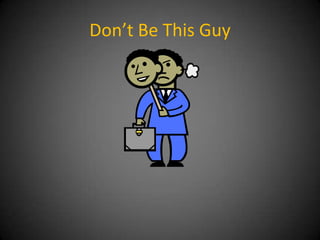
Don’t Be This Guy
• It is important to be sincere when dealing with
a consumer. They can pick up on being “fake”.
• This can make the issue escalate even further
and cause the consumer to lose trust in staff.
• Consumers will be more likely to discuss
further issues with you as opposed to other
consumers.
Rapport
• Building rapport can assist you when there is a
crisis later on.
• Consumers are more likely to discuss issues with
staff they feel comfortable with.
• Rapport can be established by remembering a
first name or taking an interest in their hobbies.
• Congratulate them on any milestone no matter
how big or small. (i.e Birthdays, passing
test, completing training)
• De-escalation Techniques
Verbal and Non-Verbal Deescalation Techniques
Non-verbal Intervention
• When a person begins acting out we can
sometimes intervene without speaking a
word.
• Making eye contact-allows the person to know
we see what they are doing.
• We want to appear neutral, not nervous; we
want to come across as natural and not fake.
• Proxemics- we want to be three to four feet
from client, standing to the side of them.*
• We want our movements to not be jerky or
fast.
• No clinched fists or pointing. Hands should not
be in pockets and arms should not be crossed.
• Moving closer to acting out individual or
group can sometimes be enough to bring the
situation under control.
•

Adapted from http:// crisis prevention.com
Para-Verbal Communication
Para-verbal communication simply means how we
say things; it has 3 components:
*Tone-inflection of voice
*Cadence-rate of speech
*Volume-lowering or raising of our voice.
93% of communication is non-verbal according to
an UCLA study
* Adapted from http://crisisprevention.com
Verbal Intervention
* In a verbal intervention we want to show the
individual that we care.
* We want to show empathy
*Be calm, but confident
*Don’t confuse the individual with lengthy or
elaborate directions
*Get individual into new environment
especially if you are in an open area with an
audience.
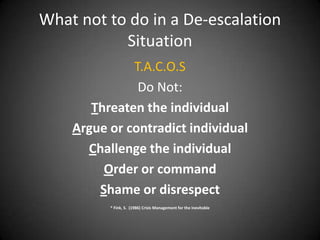
What not to do in a De-escalation
Situation
T.A.C.O.S
Do Not:
Threaten the individual
Argue or contradict individual
Challenge the individual
Order or command
Shame or disrespect
* Fink, S. (1986) Crisis Management for the inevitable
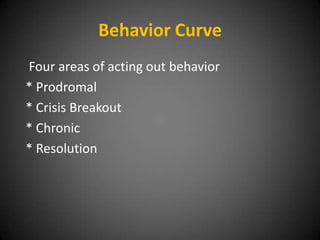
Behavior Curve
Four areas of acting out behavior
* Prodromal
* Crisis Breakout
* Chronic
* Resolution
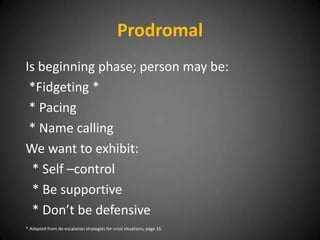
Prodromal
Is beginning phase; person may be:
*Fidgeting *
* Pacing
* Name calling
We want to exhibit:
* Self –control
* Be supportive
* Don’t be defensive
* Adapted from de-escalation strategies for crisis situations, page 16
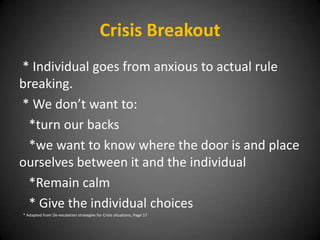
Crisis Breakout
* Individual goes from anxious to actual rule
breaking.
* We don’t want to:
*turn our backs
*we want to know where the door is and place
ourselves between it and the individual
*Remain calm
* Give the individual choices
* Adapted from De-escalation strategies for Crisis situations, Page 17
Chronic
* Height of acting out behavior when person is
doing harm to themselves or others.
* Explain limits; be firm but respectful
*Empathize with the individual
* Suggest alternatives
Resolution
* The individual has calmed and may appear
tired
* If individual is able we can explain
consequences of the behavior
*If individual is tired we may allow them time
to be alone
Things to remember
• It is important to not take acting out
individual personally; Their behavior is usually
not about you, you just become the focus
when you intervene
• “When you’re a hammer, everything looks
like a nail…” By Bernard Baruch
Verbal and non verbal techniques

Verbal and non verbal techniques

  • 1.
    CDPVTC Mission Statement • Toassist Kentuckians with disabilities to achieve suitable employment and independence.
  • 2.
    What Can Causean Outburst • Outside Issues Often we are unaware of a consumers home life. Abuse, mental or physical or can even be emotional. Also we have consumers that have been neglected for many years, making it difficult for them to conform to our rules and the over all setting of this large facility. Many of our consumers are used to small class rooms and just seeing the same few people most of the day.
  • 3.
    • Our consumersmay act out if there's a death in the family or the close friend. Just a change in someone's routine can cause issues to arise. A change in medication, or just being away from home for the first time. All of these issues and so many more we face and understanding the consumers needs will help us in assisting those needs. As well as the behavior that the outburst can trigger.
  • 4.
    First Responder • Reasons why. Betterunderstanding When you’re the May have better rapport first staff Something may be lost in member to arrive, you communicating it to others should be the Easier on the consumer ( to primary staff many staff may cause interacting with the confusion) consumer, unless May intimidate consumer it becomes to emotional for with many staff present yourself.
  • 5.
    Public Outburst • Ifa consumer is in a public setting if you can’t get them away from the situation then it is often best to clear the area if possible. • This will take away the audience and tends to lead them to cooperate with less stress on the consumer. • This also will help the consumers private information from being exposed to other consumers.
  • 6.
  • 7.
    • It isimportant to be sincere when dealing with a consumer. They can pick up on being “fake”. • This can make the issue escalate even further and cause the consumer to lose trust in staff. • Consumers will be more likely to discuss further issues with you as opposed to other consumers.
  • 8.
    Rapport • Building rapportcan assist you when there is a crisis later on. • Consumers are more likely to discuss issues with staff they feel comfortable with. • Rapport can be established by remembering a first name or taking an interest in their hobbies. • Congratulate them on any milestone no matter how big or small. (i.e Birthdays, passing test, completing training)
  • 9.
  • 10.
    Verbal and Non-VerbalDeescalation Techniques
  • 11.
    Non-verbal Intervention • Whena person begins acting out we can sometimes intervene without speaking a word. • Making eye contact-allows the person to know we see what they are doing. • We want to appear neutral, not nervous; we want to come across as natural and not fake.
  • 12.
    • Proxemics- wewant to be three to four feet from client, standing to the side of them.* • We want our movements to not be jerky or fast. • No clinched fists or pointing. Hands should not be in pockets and arms should not be crossed. • Moving closer to acting out individual or group can sometimes be enough to bring the situation under control. • Adapted from http:// crisis prevention.com
  • 13.
    Para-Verbal Communication Para-verbal communicationsimply means how we say things; it has 3 components: *Tone-inflection of voice *Cadence-rate of speech *Volume-lowering or raising of our voice. 93% of communication is non-verbal according to an UCLA study * Adapted from http://crisisprevention.com
  • 14.
    Verbal Intervention * Ina verbal intervention we want to show the individual that we care. * We want to show empathy *Be calm, but confident *Don’t confuse the individual with lengthy or elaborate directions *Get individual into new environment especially if you are in an open area with an audience.
  • 15.
    What not todo in a De-escalation Situation T.A.C.O.S Do Not: Threaten the individual Argue or contradict individual Challenge the individual Order or command Shame or disrespect * Fink, S. (1986) Crisis Management for the inevitable
  • 16.
    Behavior Curve Four areasof acting out behavior * Prodromal * Crisis Breakout * Chronic * Resolution
  • 17.
    Prodromal Is beginning phase;person may be: *Fidgeting * * Pacing * Name calling We want to exhibit: * Self –control * Be supportive * Don’t be defensive * Adapted from de-escalation strategies for crisis situations, page 16
  • 18.
    Crisis Breakout * Individualgoes from anxious to actual rule breaking. * We don’t want to: *turn our backs *we want to know where the door is and place ourselves between it and the individual *Remain calm * Give the individual choices * Adapted from De-escalation strategies for Crisis situations, Page 17
  • 19.
    Chronic * Height ofacting out behavior when person is doing harm to themselves or others. * Explain limits; be firm but respectful *Empathize with the individual * Suggest alternatives
  • 20.
    Resolution * The individualhas calmed and may appear tired * If individual is able we can explain consequences of the behavior *If individual is tired we may allow them time to be alone
  • 21.
    Things to remember •It is important to not take acting out individual personally; Their behavior is usually not about you, you just become the focus when you intervene • “When you’re a hammer, everything looks like a nail…” By Bernard Baruch