Chapter 7 Atomic Structure  pp
7.1 Electromagnetic Radiation Light  is made up of  electromagnetic radiation . Waves of electric and magnetic fields at  right angles  to each other. LD 1: 4-1 Electromagnetic radiation
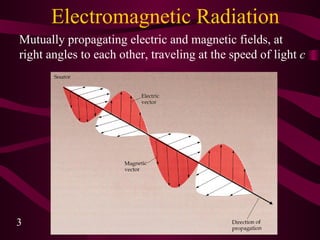
Electromagnetic Radiation Mutually propagating electric and magnetic fields, at right angles to each other, traveling at the speed of light  c
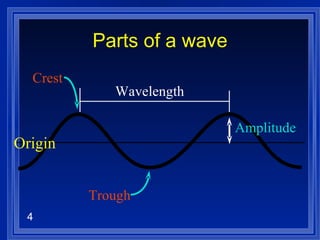
Parts of a wave Origin Wavelength Amplitude Crest Trough
Parts of Wave Origin  - the  base line  of the energy. Crest  -  high  point on a wave Trough  -  Low  point on a wave Amplitude  - distance from  origin  to crest Wavelength  - distance from  crest to crest Wavelength - is abbreviated    Greek letter  lambda .
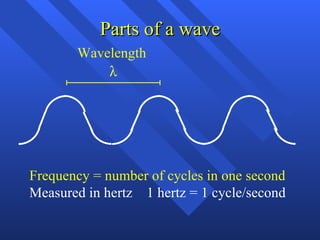
Parts of a wave  Wavelength Frequency = number of cycles in one second Measured in hertz  1 hertz = 1 cycle/second
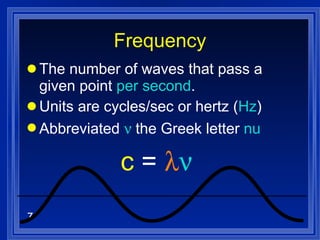
Frequency The number of waves that pass a given point  per second . Units are cycles/sec or hertz ( Hz ) Abbreviated    the Greek letter  nu c  =    
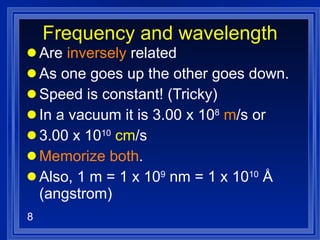
Frequency and wavelength Are  inversely  related As one goes up the other goes down. Speed is constant! (Tricky) In a vacuum it is 3.00 x 10 8   m /s or  3.00 x 10 10   cm /s Memorize both . Also, 1 m = 1 x 10 9  nm = 1 x 10 10  Å (angstrom)
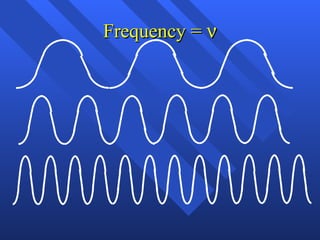
Frequency =  
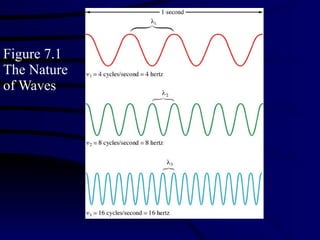
Figure 7.1 The Nature of Waves
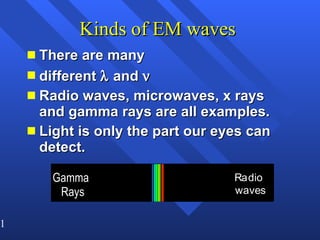
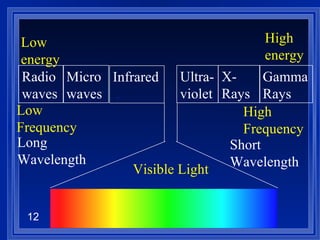
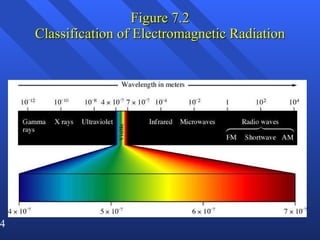
Kinds of EM waves  There are many  different    and   Radio waves, microwaves, x rays and gamma rays are all examples. Light is only the part our eyes can detect. G a m m a R a y s R a d i o w a v e s
Radio waves Microwaves Infrared  .   Ultra-violet X-Rays Gamma Rays Long Wavelength Short Wavelength Visible Light Low energy High energy Low Frequency High Frequency
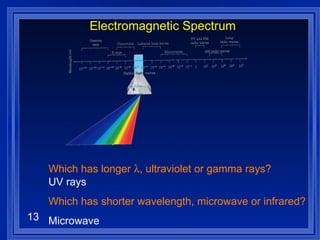
Electromagnetic Spectrum Which has longer   , ultraviolet or gamma rays? UV rays Which has shorter wavelength, microwave or infrared? Microwave
Figure 7.2 Classification of Electromagnetic Radiation
The speed of light In a vacuum is 2.998 x 10 8  m/s = c c  =    What is the  wavelength  of light with a  frequency  5.89 x 10 5  Hz? Ans . . . 509 m  (using 2.998 x 10 8 m/s) What is the  frequency  of blue light with a  wavelength  of  484 nm ? 6.19 x 10 14  Hz
7.2 The Nature of Matter In 1900  Matter and energy were seen as different from each other in fundamental ways. It was thought that matter was particles. It was thought that energy could come in waves,  with any frequency . Max Planck found the cooling of hot objects could  not  be explained by viewing energy as a wave.
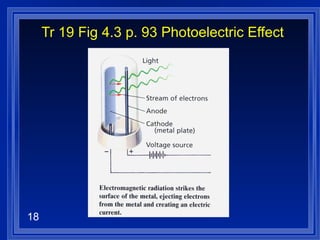
The Photoelectric Effect Photoelectric Effect  - the emission of  electrons  from a  metal  when light shines on it.
Tr 19 Fig 4.3 p. 93 Photoelectric Effect
The Photoelectric Effect Problem What was  predicted  . . . Wave  theory said light of  any     would have enough energy to eject an electrons. What was  observed  . . . For a given metal, no e- are emitted if    is  below  a certain frequency  no matter how long the light shines . The explanation . . .
Light is a  Particle  as well as a  Wave Energy is  quantized . Light is energy Light must be quantized These smallest pieces of light are called  photons . Energy and frequency are  directly  related.
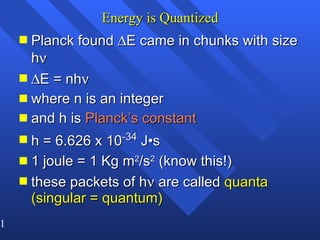
Energy is Quantized Planck found   E came in chunks with size h     E = nh    where n is an integer and h is  Planck’s constant   h = 6.626 x 10 -34  J•s 1 joule = 1 Kg m 2 /s 2  (know this!) these packets of h   are called  quanta (singular = quantum)
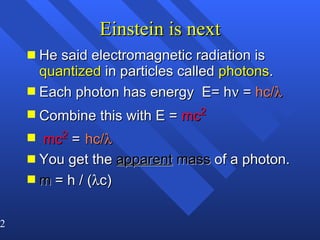
Einstein is next He said electromagnetic radiation is  quantized  in particles called  photons . Each photon has energy  E= h   =  hc/    Combine this with E =  mc 2 mc 2  =   hc/    You get the  apparent  mass  of a photon. m  = h / (  c)
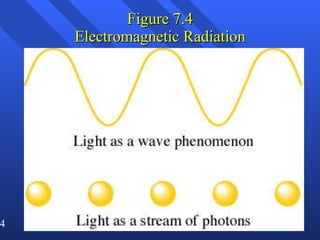
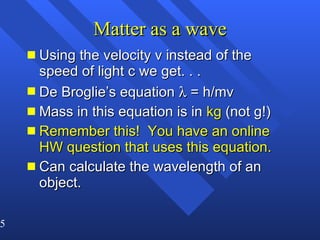
Which is Energy? Is energy a wave like light, or a particle? Both.  Concept is called the Wave-Particle duality. What about the other way, is matter a wave?  Yes
Figure 7.4 Electromagnetic Radiation
Matter as a wave Using the velocity v instead of the speed of light c we get. . .  De Broglie’s equation    = h/mv Mass in this equation is in  kg  (not g!) Remember this!  You have an online HW question that uses this equation. Can calculate the wavelength of an object.
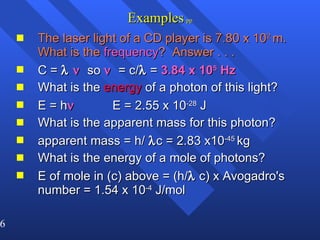
Examples   pp The laser light of a CD player is 7.80 x 10 2  m. What is the  frequency ?  Answer . . . C =      so      = c/   =  3.84 x 10 5  Hz What is the  energy  of a photon of this light? E = h    E = 2.55 x 10 -28  J What is the apparent mass for this photon? apparent mass = h/   c = 2.83 x10 -45  kg What is the energy of a mole of photons? E of mole in (c) above = (h/   c) x Avogadro's number = 1.54 x 10 -4  J/mol
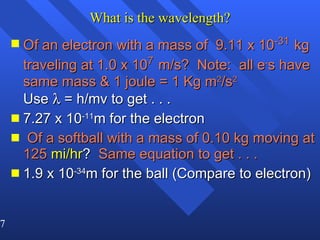
What is the wavelength? Of an electron with a mass of  9.11 x 10 -31   kg traveling at 1.0 x 10 7   m/s?  Note:  all e - s have same mass & 1 joule = 1 Kg m 2 /s 2   Use    = h/mv to get . . . 7.27 x 10 -11 m for the electron Of a softball with a mass of 0.10 kg moving at 125   mi/hr ?  Same equation to get . . . 1.9 x 10 -34 m for the ball (Compare to electron)
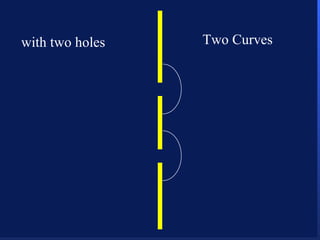
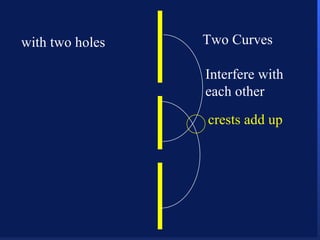
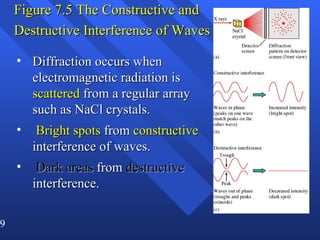
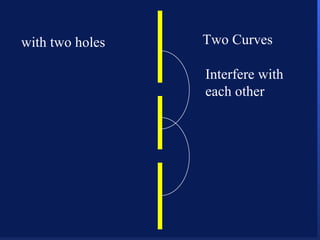
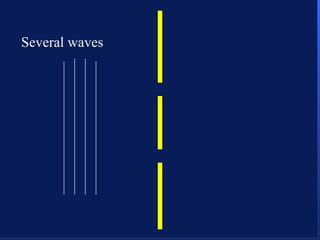
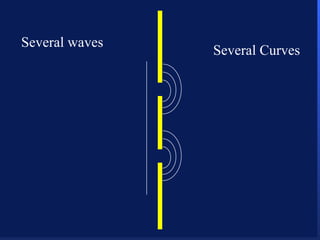
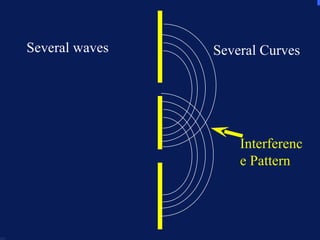
Diffraction When light passes through, or reflects off, a series of thinly spaced lines, it creates a rainbow effect.  This is because the waves  interfere  with each other.  LD 1:  4.14
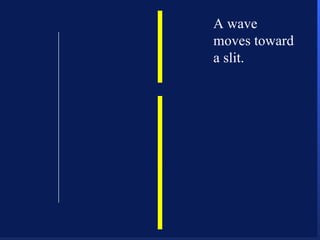
A wave moves toward a slit.
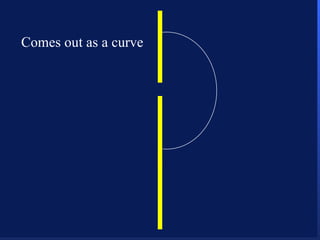
Comes out as a curve
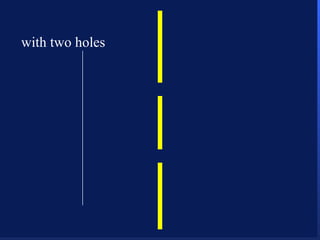
with two holes
with two holes Two Curves
Two Curves with two holes Interfere with each other
Two Curves with two holes Interfere with each other crests add up
Several waves
Several waves Several Curves
Several waves Several waves Interference Pattern Several Curves
What will an electron do if diffracted? It has  mass , so it is matter. A  particle  can only go through  one  hole. A  wave  can go through  both  holes. An  electron  does go though both, and makes an  interference pattern . It behaves like a wave. Other matter have wavelengths too short to notice.
Figure 7.5 The Constructive and Destructive Interference of Waves   Diffraction occurs when electromagnetic radiation is  scattered  from a regular array such as NaCl crystals. Bright spots  from  constructive  interference of waves. Dark areas  from  destructive  interference.
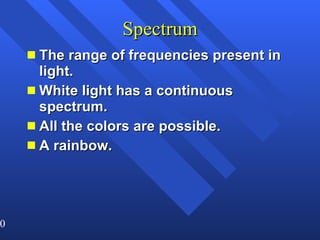
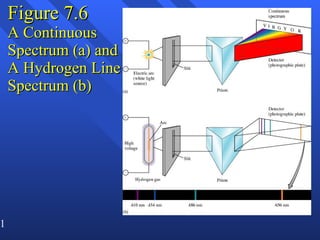
Spectrum The range of frequencies present in light. White light has a continuous spectrum. All the colors are possible. A rainbow.
Figure 7.6 A Continuous Spectrum (a) and A Hydrogen Line Spectrum (b)
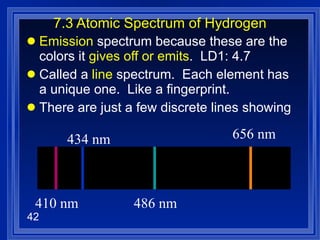
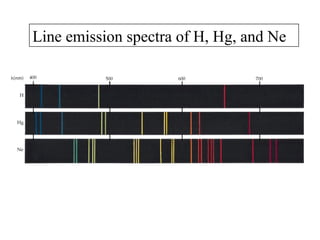
7.3 Atomic Spectrum of Hydrogen Emission  spectrum because these are the colors it  gives off or emits .  LD1: 4.7 Called a  line  spectrum.  Each element has a unique one.  Like a fingerprint. There are just a few discrete lines showing 410 nm 434 nm 486 nm 656 nm
Line emission spectra of H, Hg, and Ne
What this means Only certain energies  are  allowed  for the  electron  in an hydrogen atom. Can only give off certain energies. Use   E = h  = hc /   Energy in the in the atom is  quantized .  This is where we get  quantum  theory.
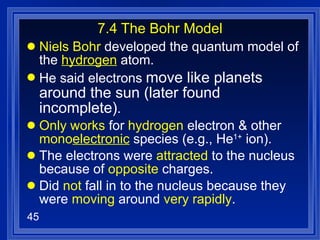
7.4 The Bohr Model Niels Bohr  developed the quantum model of the  hydrogen  atom. He said electrons  move like planets around the sun (later found incomplete) . Only works  for  hydrogen  electron & other  mono electronic  species (e.g., He 1+  ion). The electrons were  attracted  to the nucleus because of  opposite  charges. Did  not  fall in to the nucleus because they were  moving  around  very rapidly .
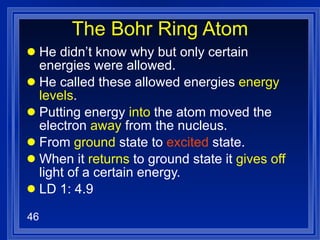
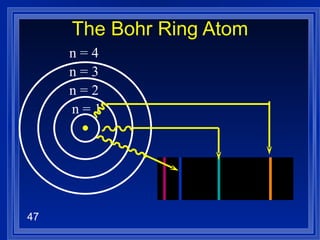
The Bohr Ring Atom He didn’t know why but only certain energies were allowed. He called these allowed energies  energy levels . Putting energy  into  the atom moved the electron  away  from the nucleus. From  ground  state to  excited  state. When it  returns  to ground state it  gives off  light of a certain energy. LD 1: 4.9
The Bohr Ring Atom n = 3 n = 4 n = 2 n = 1
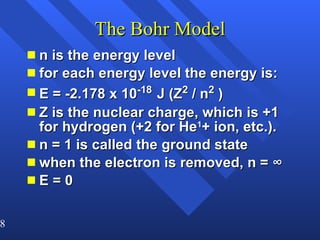
The Bohr Model n is the energy level for each energy level the energy is: E = -2.178 x 10 -18   J (Z 2  / n 2  ) Z is the nuclear charge, which is +1 for hydrogen (+2 for He 1 + ion, etc.). n = 1 is called the ground state when the electron is removed, n = ∞ E = 0
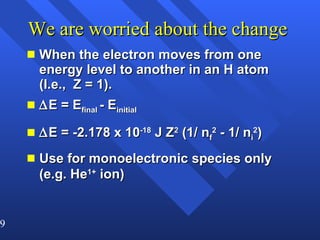
We are worried about the change  When the electron moves from one energy level to another in an H atom (I.e.,  Z = 1).  E = E final  - E initial  E = -2.178 x 10 -18  J Z 2  (1/ n f 2  - 1/ n i 2 ) Use for monoelectronic species only   (e.g. He 1+  ion)
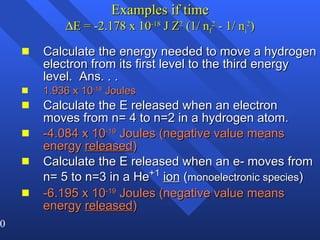
Examples if time  E = -2.178 x 10 -18  J Z 2  (1/ n f 2  - 1/ n i 2 ) Calculate the energy needed to move a hydrogen electron from its first level to the third energy level.  Ans. . . 1.936 x 10 -18  Joules Calculate the E released when an electron moves from n= 4 to n=2 in a hydrogen atom. -4.084 x 10 -19  Joules (negative value means energy  released ) Calculate the E released when an e- moves from n= 5 to n=3 in a He +1   ion  ( monoelectronic species ) -6.195 x 10 -19  Joules (negative value means energy  released )
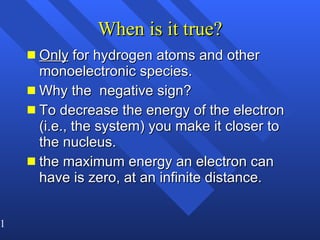
When is it true? Only  for hydrogen atoms and other monoelectronic species. Why the  negative sign? To decrease the energy of the electron (i.e., the system) you make it closer to the nucleus. the maximum energy an electron can have is zero, at an infinite distance.
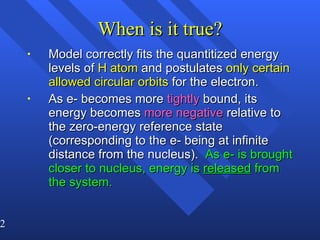
When is it true? Model correctly fits the quantitized energy levels of  H atom  and postulates  only certain allowed circular orbits  for the electron. As e- becomes more  tightly  bound, its energy becomes  more negative  relative to the zero-energy reference state (corresponding to the e- being at infinite distance from the nucleus).  As e- is brought closer to nucleus, energy is  released  from the system.
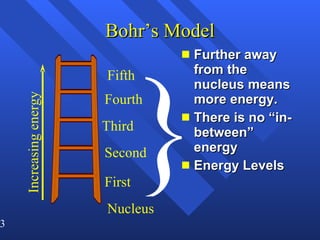
Bohr’s Model Further away from the nucleus means more energy. There is no “in-between” energy Energy Levels Increasing energy Nucleus First Second Third Fourth Fifth }
The Bohr Model Doesn’t work generally. Only works for hydrogen atoms (and other monoelectronic species). Electrons do  not move  in  circles . The energy quantization is right,  but  not  because they are circling like planets. So, we need another model (LD 4.12)
7.5 The Quantum Mechanical Model A totally new approach. De Broglie said matter could be like a wave. De Broglie said they were like standing waves. The vibrations of a stringed instrument.
 
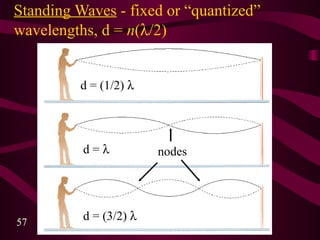
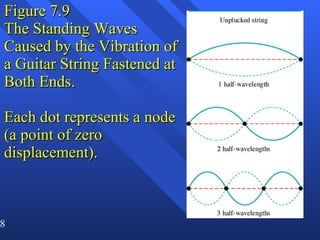
Standing Waves  - fixed or “quantized” wavelengths, d =  n (  /2) nodes d = (1/2)   d =   d = (3/2)  
Figure 7.9 The Standing Waves Caused by the Vibration of a Guitar String Fastened at Both Ends.   Each dot represents a node (a point of zero displacement).
What’s possible? You can only have a standing wave if you have  complete  waves (standing wave generator demo). There are only certain allowed waves. In the  atom  there are certain allowed waves called electrons. 1925 Erwin Schrödinger described the  wave function  of the electron. Much math but what is important are the solutions.
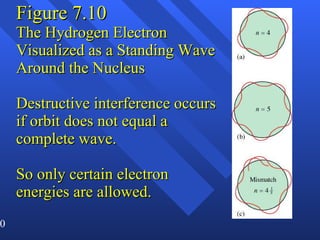
Figure 7.10 The Hydrogen Electron Visualized as a Standing Wave Around the Nucleus Destructive interference occurs if orbit does not equal a complete wave. So only certain electron energies are allowed.
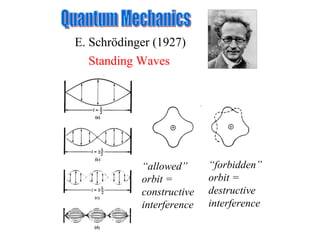
“ allowed” orbit = constructive interference “ forbidden” orbit = destructive interference Standing Waves Quantum Mechanics E. Schrödinger (1927)
The Schrodinger Wave Equation Energy is  quantized .  It comes in chunks. A quanta is the amount of energy needed to move  from one energy level to another . Since the energy of an atom is never “in-between” there must be a quantum  leap  in energy. Schrodinger derived an equation that described the  energy  and   probable  position  of the electrons in an atom.
Schrödinger’s Equation The wave function is a F(x, y, z) Solutions to the equation are called  orbitals . These are  not  Bohr orbits. Each solution is tied to a certain energy. These are the  energy levels .
There is a limit to what we can know We can’t know how the electron is moving or how  it gets from one energy level to another. The Heisenberg Uncertainty Principle. There is a limit to how well we can know both the position and the momentum of an object.
Heisenberg Uncertainty Principle It is  impossible  to know exactly the position  and  velocity of a particle  at the same time . The better we know one, the less we know the other. The act of measuring changes the properties.
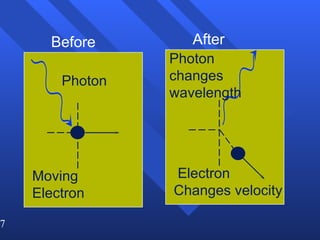
More obvious with the very small To measure  where  a electron is, we use light. But  the light  moves  the electron And hitting the electron  changes  the  frequency of the light . Both the electron and the light are changed by the collision. Light photons are too small to affect anything other than electrons in the manner.
Moving Electron Photon Before Electron Changes velocity Photon changes wavelength After
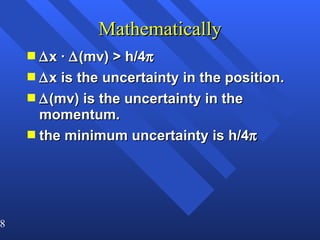
Mathematically  x ·   (mv) > h/4   x is the uncertainty in the position.  (mv) is the uncertainty in the momentum. the minimum uncertainty is h/4 
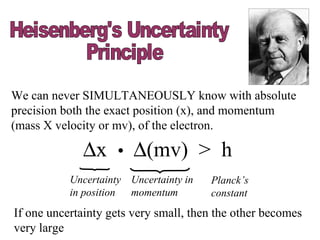
Heisenberg's Uncertainty Principle We can never SIMULTANEOUSLY know with absolute precision both the exact position (x), and momentum (mass X velocity or mv), of the electron. If one uncertainty gets very small, then the other becomes very large  x  •   (mv)  >  h Uncertainty in momentum Uncertainty in position Planck’s constant
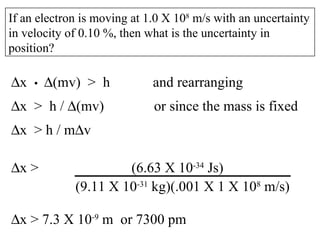
If an electron is moving at 1.0 X 10 8  m/s with an uncertainty in velocity of 0.10 %, then what is the uncertainty in position?  x  •   (mv)  >  h  and rearranging  x  >  h /   (mv)  or since the mass is fixed  x  > h / m  v  x > 7.3 X 10 -9  m  or 7300 pm  x >  (6.63 X 10 -34  Js)   (9.11 X 10 -31  kg)(.001 X 1 X 10 8  m/s)
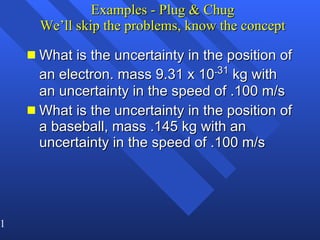
Examples - Plug & Chug We’ll skip the problems, know the concept What is the uncertainty in the position of an electron. mass 9.31 x 10 - 31  kg with an uncertainty in the speed of .100 m/s What is the uncertainty in the position of a baseball, mass .145 kg with an uncertainty in the speed of .100 m/s
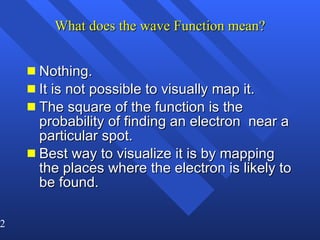
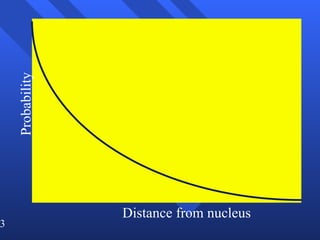
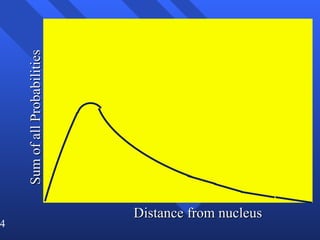
What does the wave Function mean? Nothing. It is not possible to visually map it. The square of the function is the probability of finding an electron  near a particular spot. Best way to visualize it is by mapping the places where the electron is likely to be found.
Probability Distance from nucleus
Sum of all Probabilities Distance from nucleus
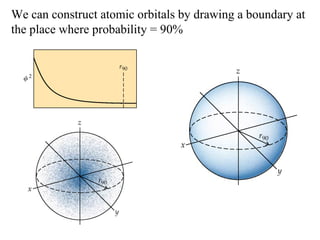
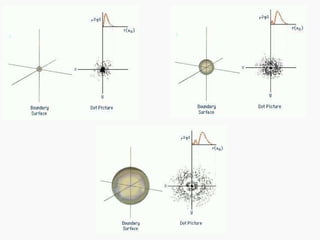
Defining the size The nodal surface. The size that  encloses 90% to the total electron probability. NOT at a certain distance, but a most likely distance. For the first solution it is a sphere.
We can construct atomic orbitals by drawing a boundary at the place where probability = 90%
Note on online HW  pp #6 is correct - check your units!. When a question asks, “how much heat is  liberated ,” your answer will be positive because there is no “negative” heat.  When a question asks, “what is the  change  in heat” then you have to indicate the change by a (+) or (-) sign. When you use energy or heat in a mathematical equation (e.g., q = m∆TC p  then you also have to show the sign.
7.6  Quantum Numbers There are many solutions to Schrödinger’s equation Each solution can be described with  4 quantum numbers  (n, l, m, s) that describe some aspect of the solution. Analogous to y = mx + b describing a line (4 variables).
Atomic Orbitals & Quantum Numbers Principal Quantum Number  ( n ) = the  main  energy level of the electron. Tells us the  size  (distance from the nucleus)  and energy  of an orbital. Has integer values of n = 1, 2, 3, . . .
Angular Momentum Quantum Number (l) Within  each energy level the complex math of Schrodinger’s equation describes several  shapes  ( l ). These shapes are called  atomic orbitals They are regions where there is a  high probability  of finding an electron.
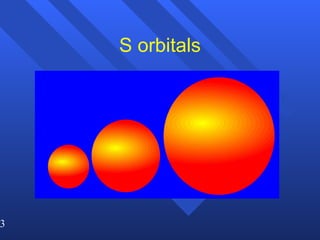
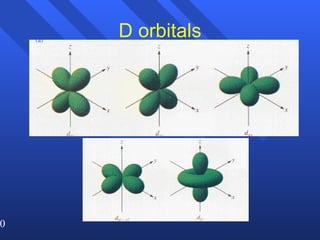
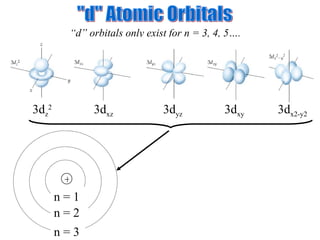
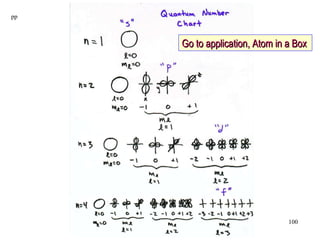
The 2nd quantum number Angular momentum quantum number  l  . Describes the  shape  of the orbital. Has integer values from 0 to n-1 l  = 0  is called s and has shape of? l  = 1 is called p l  = 2 is called d l  = 3 is called f l  = 4 is called g
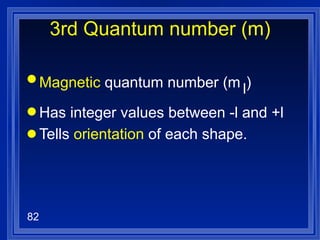
3rd Quantum number (m) Magnetic  quantum number (m   l )  Has integer values between - l  and + l   Tells  orientation  of each shape.
S orbitals
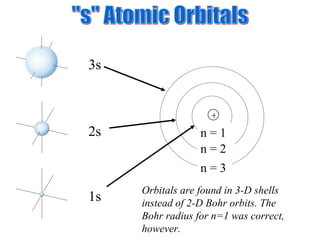
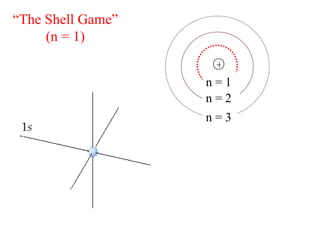
"s" Atomic Orbitals 1s 2s 3s Orbitals are found in 3-D shells instead of 2-D Bohr orbits. The Bohr radius for n=1 was correct, however. + n = 1 n = 2 n = 3
 
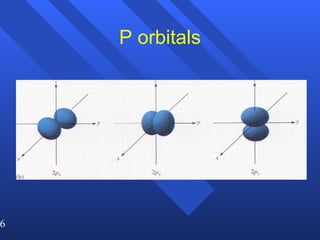
P orbitals
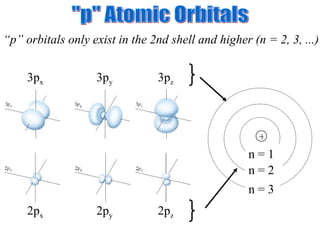
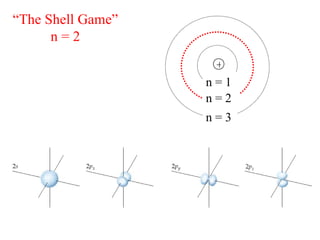
"p" Atomic Orbitals “ p” orbitals only exist in the 2nd shell and higher (n = 2, 3, ...) + n = 1 n = 2 n = 3 3p x 3p y 3p z 2p x 2p y 2p z
 
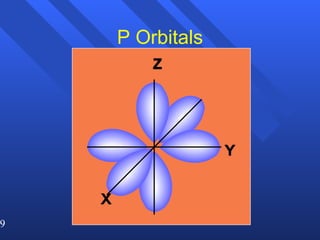
P Orbitals
D orbitals
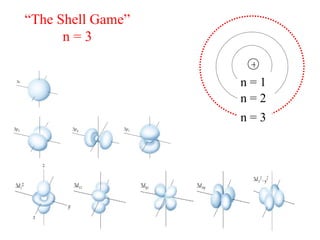
"d" Atomic Orbitals “ d” orbitals only exist for n = 3, 4, 5…. + n = 1 n = 2 n = 3 3d z 2 3d xz 3d yz 3d xy 3d x2-y2
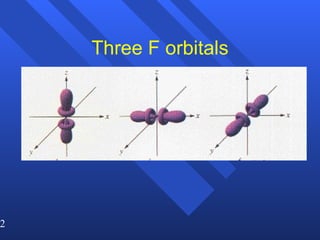
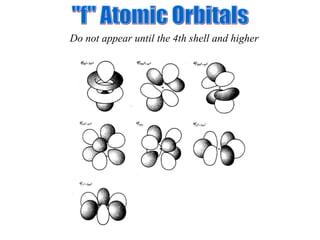
Three F orbitals
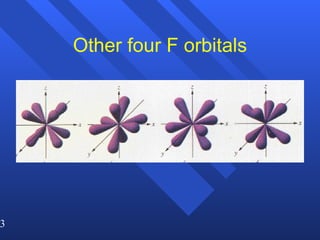
Other four F orbitals
"f" Atomic Orbitals Do not appear until the 4th shell and higher
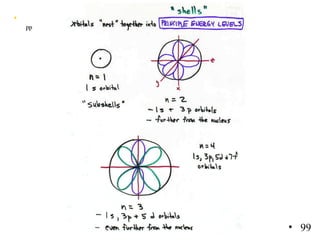
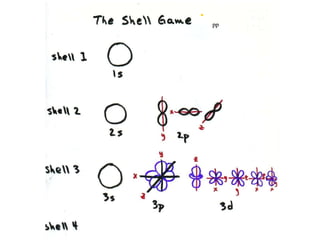
“ The Shell Game” (n = 1) n = 1 n = 2 n = 3 +
“ The Shell Game” n = 2 + n = 1 n = 2 n = 3
“ The Shell Game” n = 3 + n = 1 n = 2 n = 3
pp
pp
Go to application, Atom in a Box pp
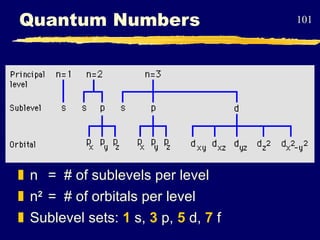
Quantum Numbers n = # of sublevels per level n 2 = # of orbitals per level Sublevel sets:  1  s,  3  p,  5  d,  7  f
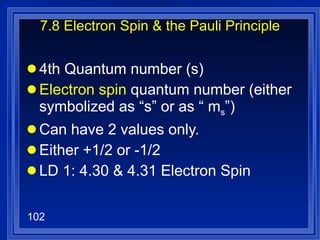
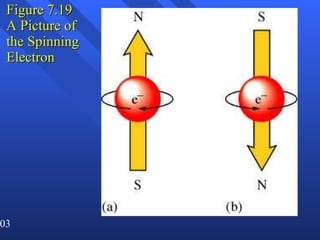
7.8 Electron Spin & the Pauli Principle 4th Quantum number (s) Electron spin  quantum number (either symbolized as “s” or as “ m s ”)  Can have 2 values only. Either +1/2 or -1/2 LD 1: 4.30 & 4.31 Electron Spin
Figure 7.19 A Picture of the Spinning Electron
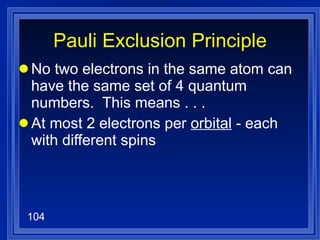
Pauli Exclusion Principle No two electrons in the same atom can have the same set of 4 quantum numbers.  This means . . . At most 2 electrons per  orbital  - each with different spins
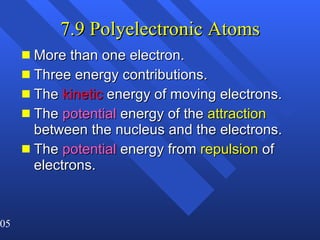
7.9 Polyelectronic Atoms More than one electron. Three energy contributions. The  kinetic  energy of moving electrons. The  potential  energy of the  attraction  between the nucleus and the electrons. The  potential  energy from  repulsion  of electrons.
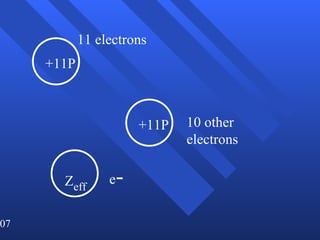
Polyelectronic atoms Can’t solve Schrödinger's equation exactly. Difficulty is  repulsion  of other electrons. Solution is to treat each electron as if it were affected by the  net field  of charge from the attraction of the nucleus and the repulsion of the electrons. Effective  nuclear charge
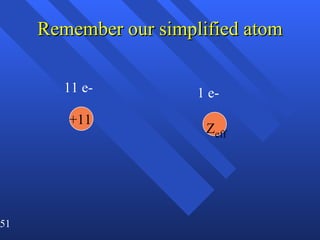
+11P 11 electrons +11P 10 other electrons e - Z eff
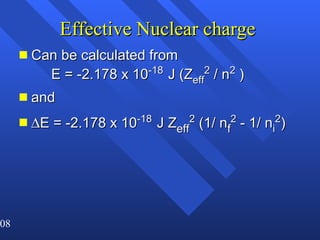
Effective Nuclear charge  Can be calculated from E = -2.178 x 10 -18   J (Z eff 2  / n 2  ) and  E = -2.178 x 10 -18   J Z eff 2  (1/ n f 2  - 1/ n i 2 )
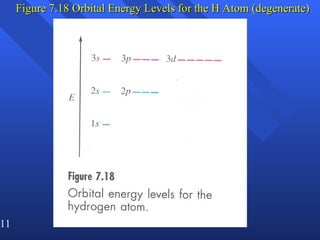
Summary: Polyelectronic Effect In a hydrogen atom there is only one electron. So, its energy  sublevels  (orbitals) are equal (because no interference from other electrons).
Figure 7.18 Orbital Energy Levels for the Hydrogen Atom (degenerate)
Figure 7.18 Orbital Energy Levels for the H Atom (degenerate)
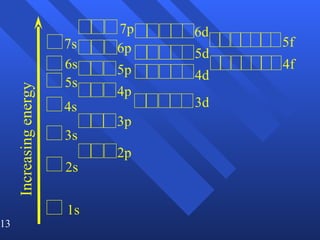
Summary continued But, in a polyelectronic orbital the sublevels are not equal in energy. Electrons “prefer” the order  s, p, d, f . E.g.,  the 2s electron “penetrates” to the nucleus more than the 2p e - . So, the 2s orbital is lower in energy. Penetration effects produces the Aufbau principle (arrow diagram)
Increasing energy 1s 2s 3s 4s 5s 6s 7s 2p 3p 4p 5p 6p 3d 4d 5d 7p 6d 4f 5f
7.10 The History of the Periodic Table   Developed independently by German Julius Lothar Meyer and Russian Dmitri Mendeleev (1870”s). Didn’t know much about the atom. Put in columns by similar properties. Predicted properties of missing elements.
History of the Periodic Table Russian scientist, Dmitri Mendeleev, taught chemistry in terms of properties. Mid 1800 - molar masses of elements were known. He wrote down the elements in order of increasing atomic  mass . He found a pattern of  repeating properties .
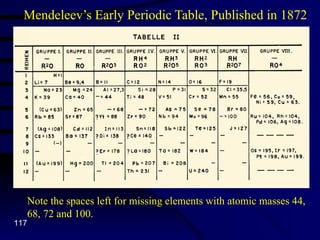
Mendeleev’s Table Grouped elements in  columns  by  similar properties  in order of increasing  atomic  mass . Found some inconsistencies - felt that the  properties  were more important than the mass, so switched order for some. He found some  gaps .  He concluded . . . Must be undiscovered elements. Predicted  their properties  before  they were found.  (Sc, Ga, Ge)
Mendeleev’s Early Periodic Table, Published in 1872 Note the spaces left for missing elements with atomic masses 44, 68, 72 and 100.
Mendeleev’s Table Two questions remained: Why can  most  elements be arranged in order of atomic  mass ,  but a few can’t ? What was the  reason  for chemical periodicity? Mosely :  found the patterns fit better when arranged in order of  nuclear charge  (the atomic  number   vs . mass).
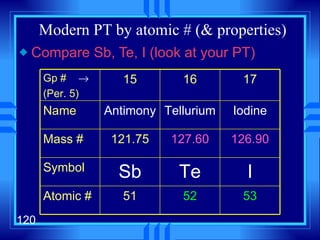
The modern table The Periodic  Law :  physical & chemical properties of the elements are  periodic  functions of their atomic  numbers . The Periodic  Table :  Arranges elements in order of increasing atomic  number  (not mass), so  elements with similar properties are in the same group  (column). Let’s look at an example of this . . .
Modern PT by atomic # (& properties) Compare Sb, Te, I (look at your PT) 53 52 51 Atomic # I Te Sb Symbol 126.90 127.60 121.75 Mass # Iodine Tellurium Antimony Name 17 16 15 Gp #     (Per. 5)
The Modern Table Elements still grouped by  properties . Similar properties in the  same column . Order is in increasing atomic  number . Added a column  of elements Mendeleev didn’t know about (noble gases). The  noble gases  weren’t found because  they didn’t react with anything . Last column  on the Periodic Table Also  added  lanthanides  &  actinides .
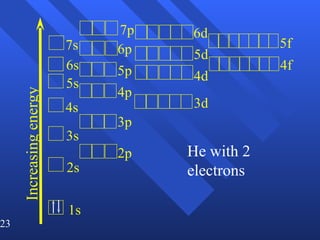
7.11 The Aufbau Principle & the Periodic Table Aufbau is German for building up. As the protons are added one by one, the electrons fill up hydrogen-like orbitals. Fill up in order of energy levels. This causes difficulties because of the overlap of orbitals of different energies.
He with 2 electrons Increasing energy 1s 2s 3s 4s 5s 6s 7s 2p 3p 4p 5p 6p 3d 4d 5d 7p 6d 4f 5f
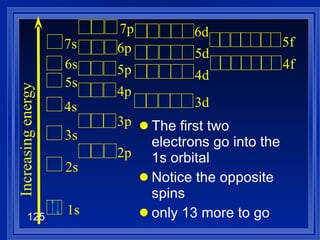
Hund’s Rule When electrons occupy orbitals of equal energy they do  not  pair up until they have to.  (Each gets its own room) Let’s determine the electron configuration for  Phosphorus   Need to account for 15 electrons (same as atomic number)
The first two electrons go into the 1s orbital Notice the opposite spins only 13 more to go Increasing energy 1s 2s 3s 4s 5s 6s 7s 2p 3p 4p 5p 6p 3d 4d 5d 7p 6d 4f 5f
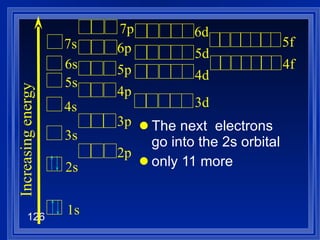
The next  electrons go into the 2s orbital only 11 more Increasing energy 1s 2s 3s 4s 5s 6s 7s 2p 3p 4p 5p 6p 3d 4d 5d 7p 6d 4f 5f
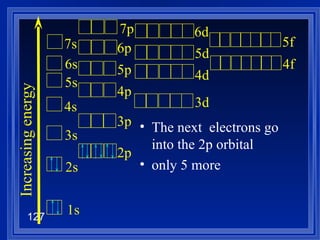
The next  electrons go into the 2p orbital only 5 more Increasing energy 1s 2s 3s 4s 5s 6s 7s 2p 3p 4p 5p 6p 3d 4d 5d 7p 6d 4f 5f
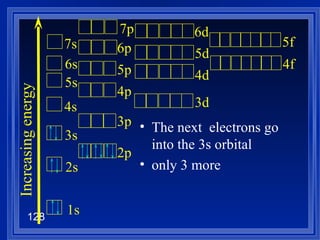
The next  electrons go into the 3s orbital only 3 more Increasing energy 1s 2s 3s 4s 5s 6s 7s 2p 3p 4p 5p 6p 3d 4d 5d 7p 6d 4f 5f
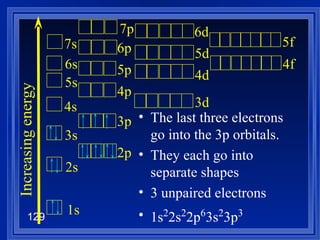
The last three electrons go into the 3p orbitals. They each go into separate shapes 3 unpaired electrons 1s 2 2s 2 2p 6 3s 2 3p 3   Increasing energy 1s 2s 3s 4s 5s 6s 7s 2p 3p 4p 5p 6p 3d 4d 5d 7p 6d 4f 5f
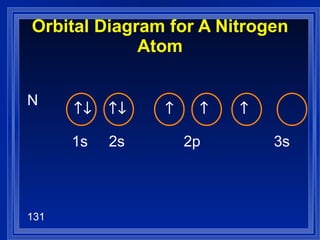
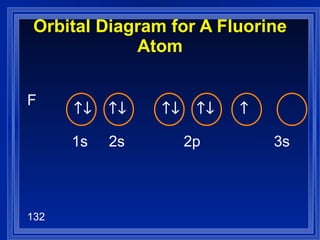
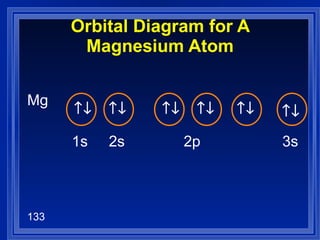
Orbital Diagrams Use individual orbitals Give subshell arrangement Each orbital takes one electron before any other orbital in the same subshell can receive a second electron
Orbital Diagram for A Nitrogen Atom N   1s  2s  2p   3s     
Orbital Diagram for A Fluorine Atom F   1s  2s  2p   3s     
Orbital Diagram for A Magnesium Atom Mg   1s  2s  2p   3s      
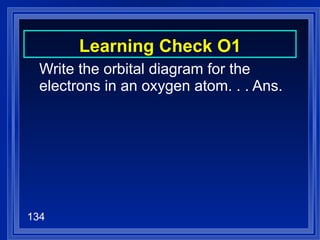
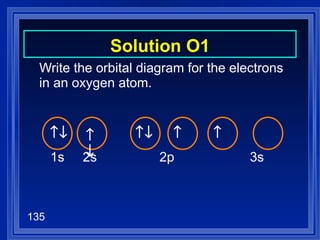
Learning Check O1 Write the orbital diagram for the electrons in an oxygen atom. . . Ans.
Solution O1 Write the orbital diagram for the electrons in an oxygen atom.   1s  2s  2p   3s     
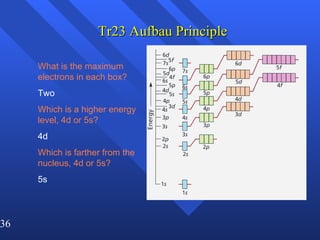
Tr23 Aufbau Principle What is the maximum electrons in each box? Two Which is a higher energy level, 4d or 5s? 4d Which is farther from the nucleus, 4d or 5s? 5s
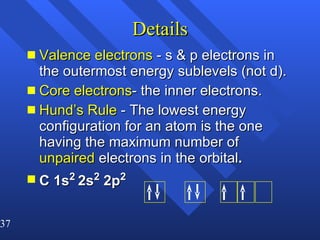
Details Valence electrons  - s & p electrons in the outermost energy sublevels (not d). Core electrons - the inner electrons. Hund’s Rule  - The lowest energy configuration for an atom is the one having the maximum number of  unpaired  electrons in the orbital . C 1s 2  2s 2  2p 2
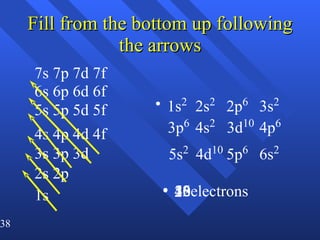
Fill from the bottom up following the arrows 1s 2 2 electrons 2s 2 4 2p 6 3s 2 12 3p 6 4s 2 20 3d 10 4p 6 5s 2 38 4d 10 5p 6 6s 2 56 1s 2s 2p 3s 3p 3d 4s 4p 4d 4f 5s 5p 5d 5f 6s 6p 6d 6f 7s 7p 7d 7f
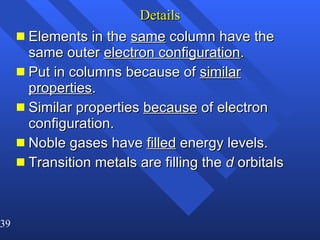
Details Elements in the  same  column have the same outer  electron configuration . Put in columns because of  similar   properties . Similar properties  because  of electron configuration. Noble gases have  filled  energy levels. Transition metals are filling the  d  orbitals
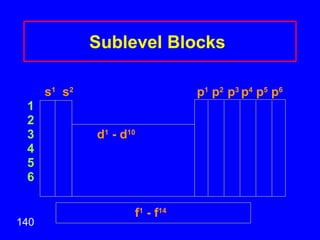
Sublevel Blocks   s 1   s 2   p 1  p 2  p 3  p 4  p 5  p 6 1 2 3   d 1  - d 10 4 5 6 f 1  - f 14
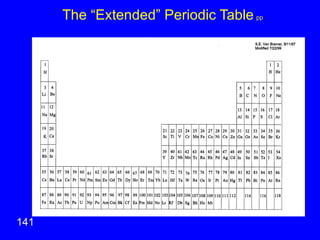
The “Extended” Periodic Table   pp
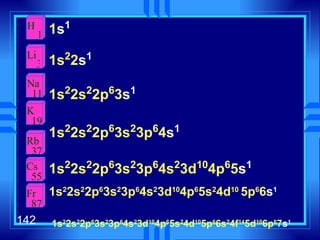
1 s 1 1s 2 2 s 1 1s 2 2s 2 2p 6 3 s 1 1s 2 2s 2 2p 6 3s 2 3p 6 4 s 1 1s 2 2s 2 2p 6 3s 2 3p 6 4s 2 3d 10 4p 6 5 s 1 1s 2 2s 2 2p 6 3s 2 3p 6 4s 2 3d 10 4p 6 5s 2 4d 10  5p 6 6 s 1 1s 2 2s 2 2p 6 3s 2 3p 6 4s 2 3d 10 4p 6 5s 2 4d 10 5p 6 6s 2 4f 14 5d 10 6p 6 7 s 1 H 1 Li 3 Na 11 K 19 Rb 37 Cs 55 Fr 87
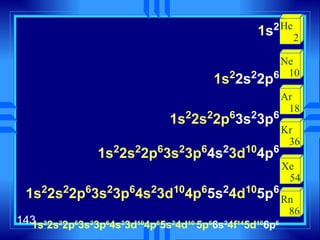
1 s 2 1s 2 2s 2 2p 6 1s 2 2s 2 2p 6 3s 2 3p 6 1s 2 2s 2 2p 6 3s 2 3p 6 4s 2 3d 10 4p 6 1s 2 2s 2 2p 6 3s 2 3p 6 4s 2 3d 10 4p 6 5s 2 4d 10 5p 6 1s 2 2s 2 2p 6 3s 2 3p 6 4s 2 3d 10 4p 6 5s 2 4d 10  5p 6 6s 2 4f 14 5d 10 6p 6 He 2 Ne 10 Ar 18 Kr 36 Xe 54 Rn 86
Exceptions Ti = [Ar] 4s 2  3d 2   V = [Ar] 4s 2  3d 3 Cr = [Ar] 4s 1  3d 5  Mn = [Ar] 4s 2  3d 5 Half filled orbitals (only with d-orbitals). Scientists aren’t sure of why it happens. same for Cu  [Ar] 4s 1  3d 10
Aufbau Web Graphic http://intro.chem.okstate.edu/WorkshopFolder/Electronconfnew.html
More exceptions Lanthanum La: [Xe] 6s 2  5d 1   Cerium Ce: [Xe] 6s 2  4f 1  5d 1 Promethium Pr: [Xe] 6s 2  4f 3  5d 0 Gadolinium Gd: [Xe] 6s 2  4f 7  5d 1 Lutetium Pr: [Xe] 6s 2  4f 14  5d 1 Then we go back to Aufbau filling: Hafnium Hf: [Xe] 6s 2  4f 14  5d 2 We’ll just pretend that all except Cu and Cr follow the rules.
A Quick Detour The concept of shielding and penetration of electrons in orbitals. Catch the concepts, don’t worry too much about the math. Some AP questions. This detour includes next 18 slides.
More Polyelectronic We can use Z eff  to  predict properties , if we determine its pattern on the periodic table. Can use the amount of energy it takes to  remove  an electron for this. Ionization Energy  - The energy necessary to remove an electron from a  gaseous  atom.
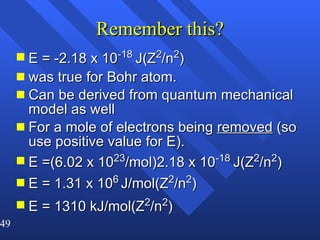
Remember this? E = -2.18 x 10 -18  J(Z 2 /n 2 ) was true for Bohr atom. Can be derived from quantum mechanical model as well For a mole of electrons being  removed  (so use positive value for E).  E =(6.02 x 10 23 /mol)2.18 x 10 -18  J(Z 2 /n 2 ) E = 1.31 x 10 6   J/mol(Z 2 /n 2 ) E = 1310 kJ/mol(Z 2 /n 2 )
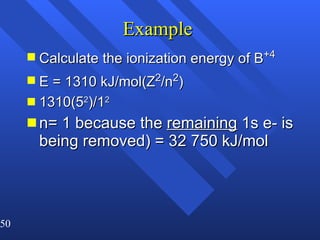
Example  Calculate the ionization energy of B +4 E = 1310 kJ/mol(Z 2 /n 2 ) 1310(5 2 )/1 2   n= 1 because the  remaining  1s e- is being removed) = 32 750 kJ/mol
Remember our simplified atom +11 11 e- Z eff 1 e-
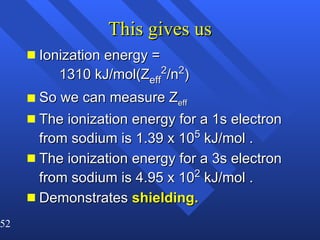
This gives us Ionization energy =  1310 kJ/mol(Z eff 2 /n 2 ) So we can measure Z eff The ionization energy for a 1s electron from sodium is 1.39 x 10 5  kJ/mol . The ionization energy for a 3s electron from sodium is 4.95 x 10 2  kJ/mol . Demonstrates   shielding.
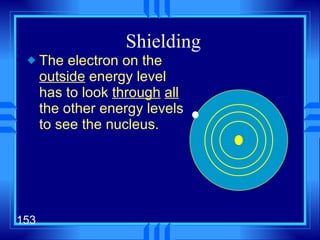
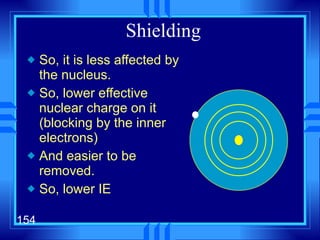
Shielding The electron on the  outside  energy level has to look  through   all  the other energy levels to see the nucleus.
Shielding So, it is less affected by the nucleus. So, lower effective nuclear charge on it (blocking by the inner electrons) And easier to be removed. So, lower IE
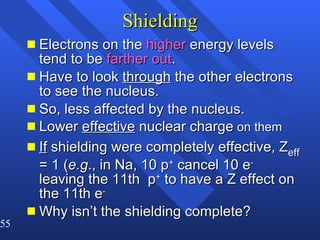
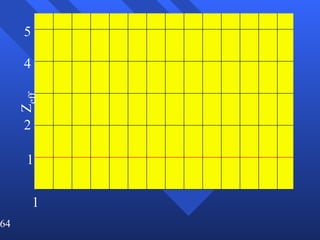
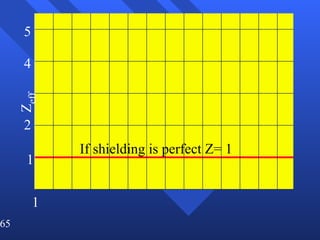
Shielding Electrons on the  higher  energy levels tend to be  farther out . Have to look  through  the other electrons to see the nucleus. So, less affected by the nucleus. Lower  effective  nuclear charge  on them If  shielding were completely effective, Z eff  = 1 ( e.g ., in Na, 10 p +  cancel 10 e -  leaving the 11th  p +  to have a Z effect on the 11th e - Why isn’t the shielding complete?
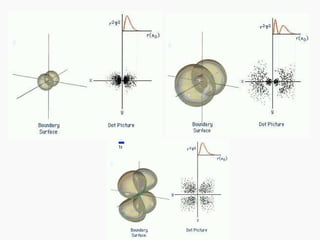
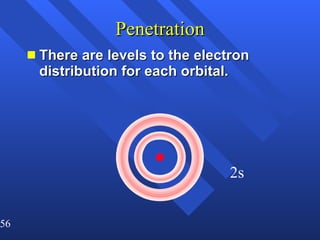
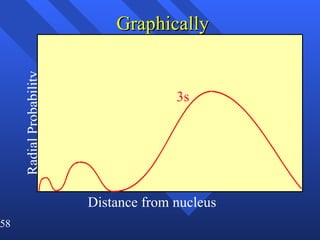
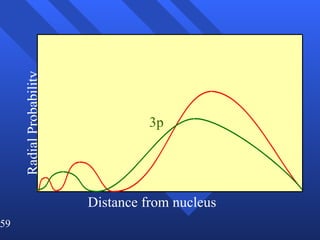
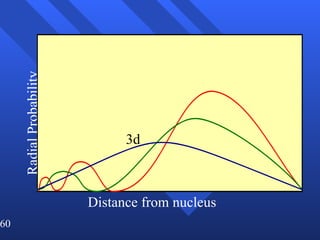
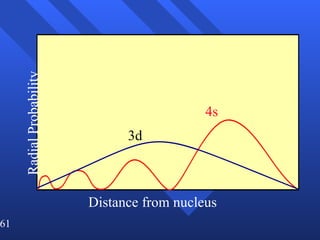
Penetration There are levels to the electron distribution for each orbital. 2s
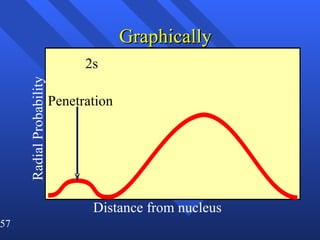
Graphically Penetration 2s Radial Probability Distance from nucleus
Graphically Radial Probability Distance from nucleus 3s
Radial Probability Distance from nucleus 3p
Radial Probability Distance from nucleus 3d
Radial Probability Distance from nucleus 4s 3d
Penetration effect The outer energy levels  penetrate  the inner levels so the shielding of the  core  electrons is not totally effective. From most penetration to least penetration  the order is ns > np > nd > nf  (within the  same  energy level). This is what gives us our order of  filling, electrons prefer s and p.
How orbitals differ The more positive the nucleus, the smaller the orbital. A sodium 1s orbital is the same  shape  as a hydrogen 1s orbital, but it is  smaller  because the electron is more strongly attracted to the nucleus (11 P +  vs. 1 P +  ). The helium 1s is smaller than H’s 1s also. This provides for better shielding.
Z eff 1 2 4 5 1
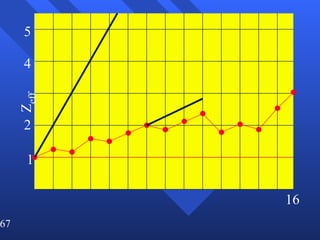
Z eff 1 2 4 5 1 If shielding is perfect Z= 1
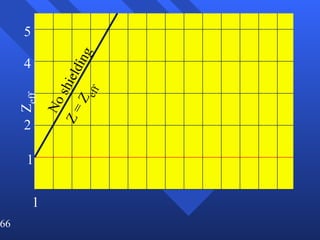
Z eff 1 2 4 5 1 No shielding Z = Z eff
Z eff 1 2 4 5 16
Back To Basics Now Let’s look at periodic trends.
7.12 Periodic Trends in Atomic Properties Ionization energy is the energy required to  remove  an electron from a  gaseous  atom. X (g)  + energy    X + (g)  + e - Highest  energy electron removed  first .  First ionization energy ( I 1 ) is that required to remove the first electron. Second ionization energy ( I 2 ) - the second electron etc. etc.
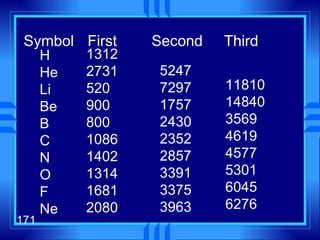
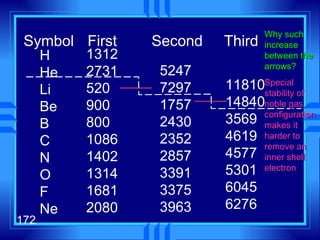
Trends in ionization energy for Mg  I 1  = 735 kJ/mole I 2  = 1445 kJ/mole I 3  = 7730 kJ/mole The  effective  nuclear charge  increases  as you remove electrons. Notice the big jump between I 2  and I 3. It takes much more energy to remove a  core  electron than a valence electron because there is  less  shielding.
Symbol First Second   Third HHeLiBeBCNO F Ne 1312 2731 520 900 800 1086 1402 1314 1681 2080  5247 7297 1757 2430 2352 2857 3391 3375 3963   11810 14840 3569 4619 4577 5301 6045 6276
Symbol First Second   Third HHeLiBeBCNO F Ne 1312 2731 520 900 800 1086 1402 1314 1681 2080  5247 7297 1757 2430 2352 2857 3391 3375 3963   11810 14840 3569 4619 4577 5301 6045 6276  Why such increase between the arrows? Special stability of noble gas configuration makes it harder to remove an inner shell electron
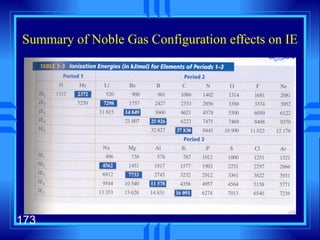
Summary of Noble Gas Configuration effects on IE
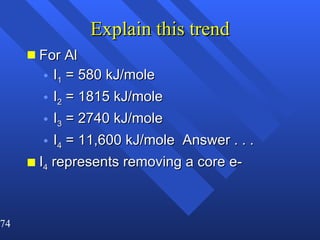
Explain this trend For Al I 1  = 580 kJ/mole I 2  = 1815 kJ/mole I 3  = 2740 kJ/mole I 4  = 11,600 kJ/mole  Answer . . . I 4  represents removing a core e-
Across a  Period  & Down a Group Generally from left to right,  I 1  increases because . . .  There is a greater  nuclear charge  with the same  shielding . As you go  down  a  group   I 1  decreases because . . .  Electrons are  farther  away.
Sample FR Problem Given 3 different atoms   1s 2 2s 2 2p 6 1s 2 2s 2 2p 6 3s 1 1s 2 2s 2 2p 6 3s 2 Which has  largest  I 1 ? . . . 1s 2 2s 2 2p 6  (Ne) - found at  right end of PT ; also,  2p  electrons  not effective  shielders and the other two choices have  3s  electrons, which are effectively shielded by the  core  electrons  and farther  from the nucleus.
Sample FR Problem Given 3 different atoms   1s 2 2s 2 2p 6 1s 2 2s 2 2p 6 3s 1 1s 2 2s 2 2p 6 3s 2 Which has  smallest  I 2 ? . . . 1s 2 2s 2 2p 6 3s 2  (Mg) - both I 1  & I 2  involve valence electrons (s electrons). The Na  1s 2 2s 2 2p 6 3s 1  would lose both a valence and a core  electron from a p-orbital (hard to do).  The Ne  1s 2 2s 2 2p 6  has ineffective shielding so its IE is relatively large.
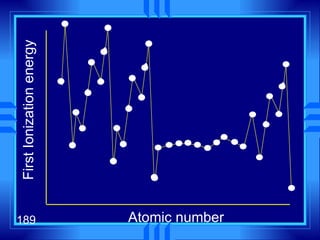
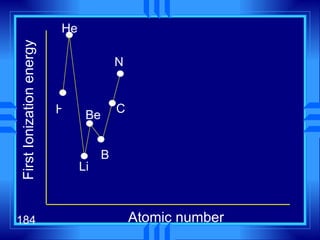
It is not that simple, though Z eff   changes  as you go across a period, so will  I 1 .   Half filled and filled orbitals are harder to remove electrons from. So those have higher I 1  energies. Here’s what it looks like.
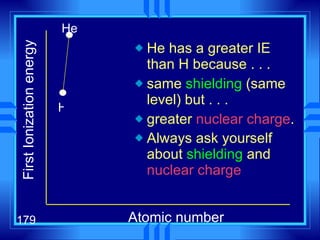
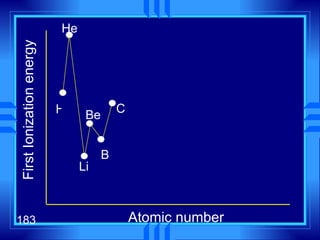
He has a greater IE than H because . . . same  shielding  (same level) but . . .  greater  nuclear charge . Always ask yourself about  shielding  and  nuclear charge   First Ionization energy Atomic number He H
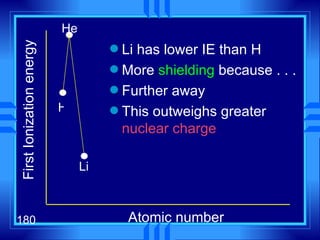
First Ionization energy Atomic number H He Li has lower IE than H More  shielding  because . . . Further away This outweighs greater  nuclear charge   Li
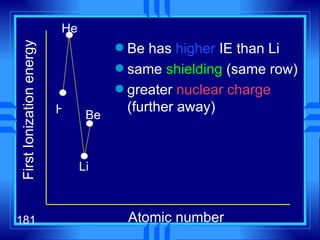
First Ionization energy Atomic number H He Be has  higher  IE than Li same  shielding  (same row) greater  nuclear charge  (further away)  Li Be
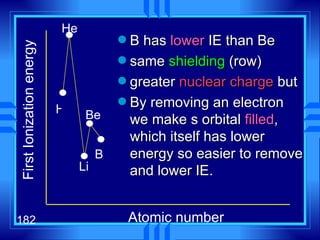
First Ionization energy Atomic number H He B has  lower  IE than Be same  shielding  (row) greater  nuclear charge  but By removing an electron we make s orbital  filled , which itself has lower energy so easier to remove and lower IE.  Li Be B
First Ionization energy Atomic number H He Li Be B C
First Ionization energy Atomic number H He Li Be B C N
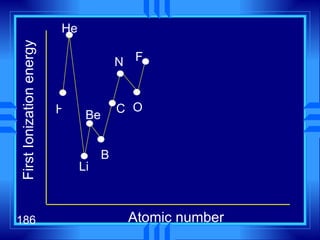
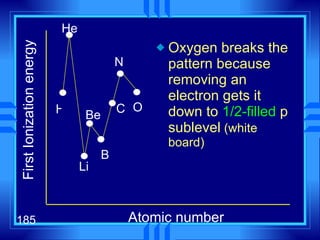
Oxygen breaks the pattern because removing an electron gets it down to  1/2-filled  p sublevel  (white board) First Ionization energy Atomic number H He Li Be B C N O
First Ionization energy Atomic number H He Li Be B C N O F
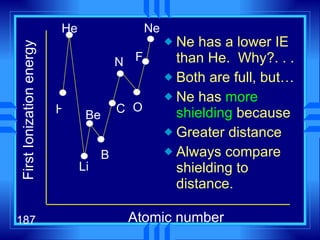
Ne has a lower IE than He.  Why?. . . Both are full, but… Ne has  more shielding  because Greater distance Always compare shielding to distance. First Ionization energy Atomic number H He Li Be B C N O F Ne
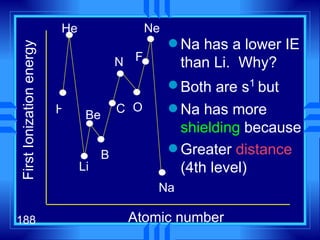
First Ionization energy Atomic number H He Li Be B C N O F Ne Na has a lower IE than Li.  Why? Both are s 1  but Na has more  shielding  because Greater  distance  (4th level) Na
First Ionization energy Atomic number
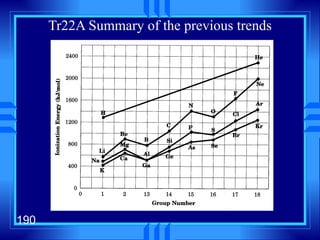
Tr22A Summary of the previous trends
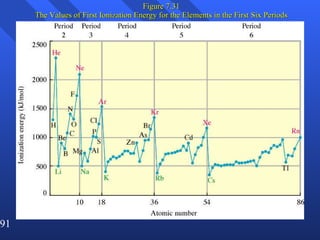
Figure 7.31 The Values of First Ionization Energy for the Elements in the First Six Periods
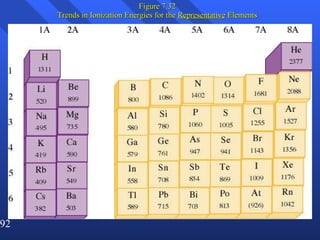
Figure 7.32 Trends in Ionization Energies for the  Representative  Elements
Electron Affinity The energy change associated with  adding  an electron to a gaseous atom Opposite to IE  (which is energy for  losing  an electron.  A + energy    A +  + e - ) Has negative value (since energy is  lost ) A + e -    A -  + energy Easiest to add e - s to group 17 (why?). Gets to full energy level (noble gas). LD 1: 5.32 Electron affinity of Chlorine
Electron Affinity Trends Period (row) Trends Increases  from  left to right  because  atoms get smaller , with  greater nuclear charge . Group (column) Trends Decreases  as we go down a group  (i.e ., harder to add an e -  (shielding from nucleus) Adding electrons to (-) ions Always more difficult to add another e -  to an already (-) charged ion, so these affinities have (+) values.
Electron Affinity Trends Adding electrons to  negative  ions Always more difficult to add another e -  to an already (-) charged ion, so these affinities have (+) values.
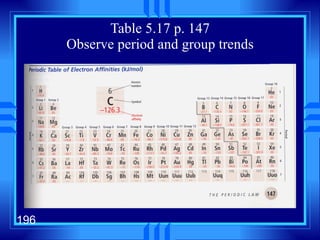
Table 5.17 p. 147 Observe period and group trends
Atomic  Size First problem:  Where  do you start  measuring . The electron cloud does  not  have a definite edge. We get around this by measuring more than 1 atom at a time as follows . . .
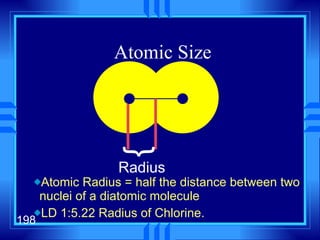
Atomic Size Atomic Radius = half the distance between two nuclei of a diatomic molecule  LD 1:5.22 Radius of Chlorine. } Radius
Trends  in Atomic Size  Influenced by  two  factors: Energy Level . . . Higher  energy level is  further  away. Charge on the nucleus More  charge  pulls  electrons in  closer . These are  competing factors .
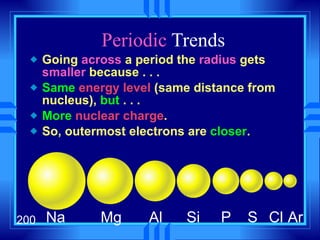
Periodic  Trends Going  across  a period the  radius  gets  smaller  because . . . Same   energy level  (same distance from nucleus),  but  . . . More   nuclear charge . So, outermost electrons are  closer . Na Mg Al Si P S Cl Ar
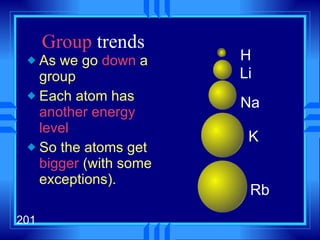
Group  trends As we go  down  a group Each atom has  another energy level So the atoms get  bigger  (with some exceptions). H Li Na K Rb
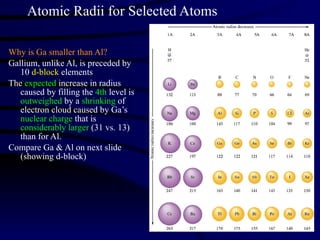
Atomic Radii for Selected Atoms Why is Ga smaller than Al? Gallium, unlike Al, is preceded by 10  d-block  elements The  expected  increase in radius caused by filling the  4th  level is  outweighed  by a  shrinking  of electron cloud caused by Ga’s  nuclear charge  that is  considerably larger  (31 vs. 13) than for Al. Compare Ga & Al on next slide (showing d-block)
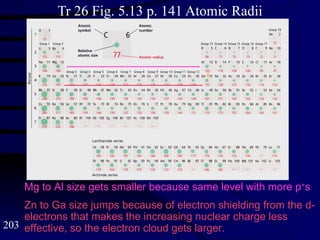
Tr 26 Fig. 5.13 p. 141 Atomic Radii Mg to Al size gets smaller because same level with more p + s Zn to Ga size jumps because of electron shielding from the d-electrons that makes the increasing nuclear charge less effective, so the electron cloud gets larger.
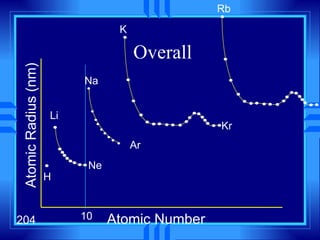
Overall Atomic Number Atomic Radius (nm) H Li Ne Ar 10 Na K Kr Rb
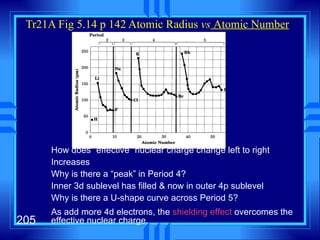
Tr21A Fig 5.14 p 142 Atomic Radius  vs   Atomic Number How does “effective” nuclear charge change left to right Increases Why is there a “peak” in Period 4? Inner 3d sublevel has filled & now in outer 4p sublevel Why is there a U-shape curve across Period 5? As add more 4d electrons, the  shielding effect  overcomes the effective nuclear charge.
Parts of the Periodic Table
The information it hides Know the special groups. It is the  number  and  type  of valence electrons that determine an atom’s  chemistry . You can get the electron configuration from the periodic table. Metals  lose  electrons and have the  lowest  IE Nonmetals -  gain  electrons and have the  most negative  electron affinities.
The Properties of a Group: The Alkali Metals Doesn’t include hydrogen - behaves as a nonmetal.  Going down, get: Decrease in IE increase in radius Decrease in density decrease in melting point Behave as reducing agents
Reducing ability Lower IE = better reducing agents. Cs > Rb > K > Na > Li in reducing ability Works for  solids , but  not  in aqueous solutions.  Get opposite effect. In solution Li > K > Na Why? It’s the water - there is an energy change associated with dissolving.
Hydration Energy It is exothermic for Li +  =  -510 kJ/mol for Na +  =  -402 kJ/mol for K +  =  -314 kJ/mol Li’s is so big because it has a high charge density; i.e., a lot of charge on a small atom. Li loses its electron more easily because of this in aqueous solutions
The reaction with water Na and K react explosively with water. Li doesn’t.  LD 1:  5.8, 5.10, 5.11, braniacs Even though Li’s reaction has a more negative   H than that of Na and K. Na and K melt.  H does not tell you speed of reaction More about that in Chapter 12.
Periodic (row) Trend Metals  are at the left end. They let their electrons go easily So, have  low  electronegativity At the right end are the  nonmetals . They  want  more electrons. Try to take them away from their playmates. So, have  high  electronegativity.
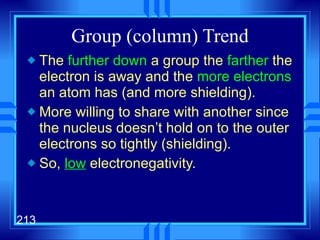
Group (column) Trend The  further down  a group the  farther  the electron is away and the  more electrons  an atom has (and more shielding). More willing to share with another since the nucleus doesn’t hold on to the outer electrons so tightly (shielding). So,  low  electronegativity.
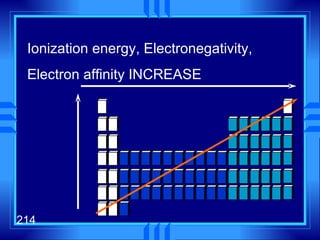
Ionization energy, Electronegativity,  Electron affinity INCREASE
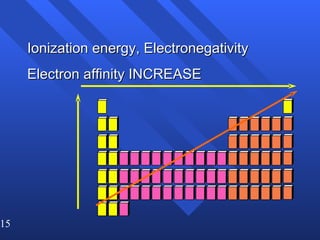
Ionization energy, Electronegativity Electron affinity INCREASE
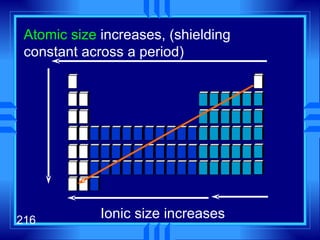
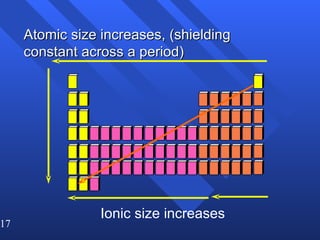
Atomic size  increases, (shielding constant across a period) Ionic size increases
Atomic size increases, (shielding constant across a period) Ionic size increases
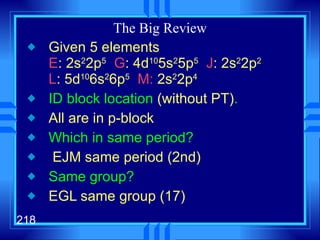
The Big Review Given 5 elements E : 2s 2 2p 5   G : 4d 10 5s 2 5p 5   J : 2s 2 2p 2   L : 5d 10 6s 2 6p 5   M:  2s 2 2p 4   ID block location  (without PT) . All are in p-block Which in same period? EJM same period (2nd) Same group? EGL same group (17)
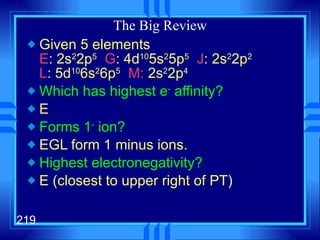
The Big Review Given 5 elements  E : 2s 2 2p 5   G : 4d 10 5s 2 5p 5   J : 2s 2 2p 2   L : 5d 10 6s 2 6p 5   M:  2s 2 2p 4   Which has highest e -  affinity? E Forms 1 -  ion? EGL form 1 minus ions. Highest electronegativity? E (closest to upper right of PT)
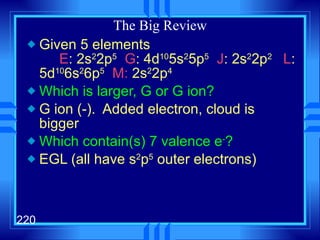
The Big Review Given 5 elements  E : 2s 2 2p 5   G : 4d 10 5s 2 5p 5   J : 2s 2 2p 2   L : 5d 10 6s 2 6p 5   M:  2s 2 2p 4   Which is larger, G or G ion? G ion (-).  Added electron, cloud is bigger Which contain(s) 7 valence e - ? EGL (all have s 2 p 5  outer electrons)

Ch7 z5e at structure

  • 1.
    Chapter 7 AtomicStructure pp
  • 2.
    7.1 Electromagnetic RadiationLight is made up of electromagnetic radiation . Waves of electric and magnetic fields at right angles to each other. LD 1: 4-1 Electromagnetic radiation
  • 3.
    Electromagnetic Radiation Mutuallypropagating electric and magnetic fields, at right angles to each other, traveling at the speed of light c
  • 4.
    Parts of awave Origin Wavelength Amplitude Crest Trough
  • 5.
    Parts of WaveOrigin - the base line of the energy. Crest - high point on a wave Trough - Low point on a wave Amplitude - distance from origin to crest Wavelength - distance from crest to crest Wavelength - is abbreviated   Greek letter lambda .
  • 6.
    Parts of awave  Wavelength Frequency = number of cycles in one second Measured in hertz 1 hertz = 1 cycle/second
  • 7.
    Frequency The numberof waves that pass a given point per second . Units are cycles/sec or hertz ( Hz ) Abbreviated   the Greek letter nu c =   
  • 8.
    Frequency and wavelengthAre inversely related As one goes up the other goes down. Speed is constant! (Tricky) In a vacuum it is 3.00 x 10 8 m /s or 3.00 x 10 10 cm /s Memorize both . Also, 1 m = 1 x 10 9 nm = 1 x 10 10 Å (angstrom)
  • 9.
  • 10.
    Figure 7.1 TheNature of Waves
  • 11.
    Kinds of EMwaves There are many different  and  Radio waves, microwaves, x rays and gamma rays are all examples. Light is only the part our eyes can detect. G a m m a R a y s R a d i o w a v e s
  • 12.
    Radio waves MicrowavesInfrared . Ultra-violet X-Rays Gamma Rays Long Wavelength Short Wavelength Visible Light Low energy High energy Low Frequency High Frequency
  • 13.
    Electromagnetic Spectrum Whichhas longer  , ultraviolet or gamma rays? UV rays Which has shorter wavelength, microwave or infrared? Microwave
  • 14.
    Figure 7.2 Classificationof Electromagnetic Radiation
  • 15.
    The speed oflight In a vacuum is 2.998 x 10 8 m/s = c c =   What is the wavelength of light with a frequency 5.89 x 10 5 Hz? Ans . . . 509 m (using 2.998 x 10 8 m/s) What is the frequency of blue light with a wavelength of 484 nm ? 6.19 x 10 14 Hz
  • 16.
    7.2 The Natureof Matter In 1900 Matter and energy were seen as different from each other in fundamental ways. It was thought that matter was particles. It was thought that energy could come in waves, with any frequency . Max Planck found the cooling of hot objects could not be explained by viewing energy as a wave.
  • 17.
    The Photoelectric EffectPhotoelectric Effect - the emission of electrons from a metal when light shines on it.
  • 18.
    Tr 19 Fig4.3 p. 93 Photoelectric Effect
  • 19.
    The Photoelectric EffectProblem What was predicted . . . Wave theory said light of any   would have enough energy to eject an electrons. What was observed . . . For a given metal, no e- are emitted if   is below a certain frequency no matter how long the light shines . The explanation . . .
  • 20.
    Light is a Particle as well as a Wave Energy is quantized . Light is energy Light must be quantized These smallest pieces of light are called photons . Energy and frequency are directly related.
  • 21.
    Energy is QuantizedPlanck found  E came in chunks with size h   E = nh  where n is an integer and h is Planck’s constant h = 6.626 x 10 -34 J•s 1 joule = 1 Kg m 2 /s 2 (know this!) these packets of h  are called quanta (singular = quantum)
  • 22.
    Einstein is nextHe said electromagnetic radiation is quantized in particles called photons . Each photon has energy E= h  = hc/  Combine this with E = mc 2 mc 2 = hc/  You get the apparent mass of a photon. m = h / (  c)
  • 23.
    Which is Energy?Is energy a wave like light, or a particle? Both. Concept is called the Wave-Particle duality. What about the other way, is matter a wave? Yes
  • 24.
  • 25.
    Matter as awave Using the velocity v instead of the speed of light c we get. . . De Broglie’s equation  = h/mv Mass in this equation is in kg (not g!) Remember this! You have an online HW question that uses this equation. Can calculate the wavelength of an object.
  • 26.
    Examples pp The laser light of a CD player is 7.80 x 10 2 m. What is the frequency ? Answer . . . C =   so  = c/  = 3.84 x 10 5 Hz What is the energy of a photon of this light? E = h  E = 2.55 x 10 -28 J What is the apparent mass for this photon? apparent mass = h/  c = 2.83 x10 -45 kg What is the energy of a mole of photons? E of mole in (c) above = (h/  c) x Avogadro's number = 1.54 x 10 -4 J/mol
  • 27.
    What is thewavelength? Of an electron with a mass of 9.11 x 10 -31 kg traveling at 1.0 x 10 7 m/s? Note: all e - s have same mass & 1 joule = 1 Kg m 2 /s 2 Use  = h/mv to get . . . 7.27 x 10 -11 m for the electron Of a softball with a mass of 0.10 kg moving at 125 mi/hr ? Same equation to get . . . 1.9 x 10 -34 m for the ball (Compare to electron)
  • 28.
    Diffraction When lightpasses through, or reflects off, a series of thinly spaced lines, it creates a rainbow effect. This is because the waves interfere with each other. LD 1: 4.14
  • 29.
    A wave movestoward a slit.
  • 30.
    Comes out asa curve
  • 31.
  • 32.
    with two holesTwo Curves
  • 33.
    Two Curves withtwo holes Interfere with each other
  • 34.
    Two Curves withtwo holes Interfere with each other crests add up
  • 35.
  • 36.
  • 37.
    Several waves Severalwaves Interference Pattern Several Curves
  • 38.
    What will anelectron do if diffracted? It has mass , so it is matter. A particle can only go through one hole. A wave can go through both holes. An electron does go though both, and makes an interference pattern . It behaves like a wave. Other matter have wavelengths too short to notice.
  • 39.
    Figure 7.5 TheConstructive and Destructive Interference of Waves Diffraction occurs when electromagnetic radiation is scattered from a regular array such as NaCl crystals. Bright spots from constructive interference of waves. Dark areas from destructive interference.
  • 40.
    Spectrum The rangeof frequencies present in light. White light has a continuous spectrum. All the colors are possible. A rainbow.
  • 41.
    Figure 7.6 AContinuous Spectrum (a) and A Hydrogen Line Spectrum (b)
  • 42.
    7.3 Atomic Spectrumof Hydrogen Emission spectrum because these are the colors it gives off or emits . LD1: 4.7 Called a line spectrum. Each element has a unique one. Like a fingerprint. There are just a few discrete lines showing 410 nm 434 nm 486 nm 656 nm
  • 43.
    Line emission spectraof H, Hg, and Ne
  • 44.
    What this meansOnly certain energies are allowed for the electron in an hydrogen atom. Can only give off certain energies. Use  E = h  = hc /  Energy in the in the atom is quantized . This is where we get quantum theory.
  • 45.
    7.4 The BohrModel Niels Bohr developed the quantum model of the hydrogen atom. He said electrons move like planets around the sun (later found incomplete) . Only works for hydrogen electron & other mono electronic species (e.g., He 1+ ion). The electrons were attracted to the nucleus because of opposite charges. Did not fall in to the nucleus because they were moving around very rapidly .
  • 46.
    The Bohr RingAtom He didn’t know why but only certain energies were allowed. He called these allowed energies energy levels . Putting energy into the atom moved the electron away from the nucleus. From ground state to excited state. When it returns to ground state it gives off light of a certain energy. LD 1: 4.9
  • 47.
    The Bohr RingAtom n = 3 n = 4 n = 2 n = 1
  • 48.
    The Bohr Modeln is the energy level for each energy level the energy is: E = -2.178 x 10 -18 J (Z 2 / n 2 ) Z is the nuclear charge, which is +1 for hydrogen (+2 for He 1 + ion, etc.). n = 1 is called the ground state when the electron is removed, n = ∞ E = 0
  • 49.
    We are worriedabout the change When the electron moves from one energy level to another in an H atom (I.e., Z = 1).  E = E final - E initial  E = -2.178 x 10 -18 J Z 2 (1/ n f 2 - 1/ n i 2 ) Use for monoelectronic species only (e.g. He 1+ ion)
  • 50.
    Examples if time E = -2.178 x 10 -18 J Z 2 (1/ n f 2 - 1/ n i 2 ) Calculate the energy needed to move a hydrogen electron from its first level to the third energy level. Ans. . . 1.936 x 10 -18 Joules Calculate the E released when an electron moves from n= 4 to n=2 in a hydrogen atom. -4.084 x 10 -19 Joules (negative value means energy released ) Calculate the E released when an e- moves from n= 5 to n=3 in a He +1 ion ( monoelectronic species ) -6.195 x 10 -19 Joules (negative value means energy released )
  • 51.
    When is ittrue? Only for hydrogen atoms and other monoelectronic species. Why the negative sign? To decrease the energy of the electron (i.e., the system) you make it closer to the nucleus. the maximum energy an electron can have is zero, at an infinite distance.
  • 52.
    When is ittrue? Model correctly fits the quantitized energy levels of H atom and postulates only certain allowed circular orbits for the electron. As e- becomes more tightly bound, its energy becomes more negative relative to the zero-energy reference state (corresponding to the e- being at infinite distance from the nucleus). As e- is brought closer to nucleus, energy is released from the system.
  • 53.
    Bohr’s Model Furtheraway from the nucleus means more energy. There is no “in-between” energy Energy Levels Increasing energy Nucleus First Second Third Fourth Fifth }
  • 54.
    The Bohr ModelDoesn’t work generally. Only works for hydrogen atoms (and other monoelectronic species). Electrons do not move in circles . The energy quantization is right, but not because they are circling like planets. So, we need another model (LD 4.12)
  • 55.
    7.5 The QuantumMechanical Model A totally new approach. De Broglie said matter could be like a wave. De Broglie said they were like standing waves. The vibrations of a stringed instrument.
  • 56.
  • 57.
    Standing Waves - fixed or “quantized” wavelengths, d = n (  /2) nodes d = (1/2)  d =  d = (3/2) 
  • 58.
    Figure 7.9 TheStanding Waves Caused by the Vibration of a Guitar String Fastened at Both Ends. Each dot represents a node (a point of zero displacement).
  • 59.
    What’s possible? Youcan only have a standing wave if you have complete waves (standing wave generator demo). There are only certain allowed waves. In the atom there are certain allowed waves called electrons. 1925 Erwin Schrödinger described the wave function of the electron. Much math but what is important are the solutions.
  • 60.
    Figure 7.10 TheHydrogen Electron Visualized as a Standing Wave Around the Nucleus Destructive interference occurs if orbit does not equal a complete wave. So only certain electron energies are allowed.
  • 61.
    “ allowed” orbit= constructive interference “ forbidden” orbit = destructive interference Standing Waves Quantum Mechanics E. Schrödinger (1927)
  • 62.
    The Schrodinger WaveEquation Energy is quantized . It comes in chunks. A quanta is the amount of energy needed to move from one energy level to another . Since the energy of an atom is never “in-between” there must be a quantum leap in energy. Schrodinger derived an equation that described the energy and probable position of the electrons in an atom.
  • 63.
    Schrödinger’s Equation Thewave function is a F(x, y, z) Solutions to the equation are called orbitals . These are not Bohr orbits. Each solution is tied to a certain energy. These are the energy levels .
  • 64.
    There is alimit to what we can know We can’t know how the electron is moving or how it gets from one energy level to another. The Heisenberg Uncertainty Principle. There is a limit to how well we can know both the position and the momentum of an object.
  • 65.
    Heisenberg Uncertainty PrincipleIt is impossible to know exactly the position and velocity of a particle at the same time . The better we know one, the less we know the other. The act of measuring changes the properties.
  • 66.
    More obvious withthe very small To measure where a electron is, we use light. But the light moves the electron And hitting the electron changes the frequency of the light . Both the electron and the light are changed by the collision. Light photons are too small to affect anything other than electrons in the manner.
  • 67.
    Moving Electron PhotonBefore Electron Changes velocity Photon changes wavelength After
  • 68.
    Mathematically  x·  (mv) > h/4   x is the uncertainty in the position.  (mv) is the uncertainty in the momentum. the minimum uncertainty is h/4 
  • 69.
    Heisenberg's Uncertainty PrincipleWe can never SIMULTANEOUSLY know with absolute precision both the exact position (x), and momentum (mass X velocity or mv), of the electron. If one uncertainty gets very small, then the other becomes very large  x •  (mv) > h Uncertainty in momentum Uncertainty in position Planck’s constant
  • 70.
    If an electronis moving at 1.0 X 10 8 m/s with an uncertainty in velocity of 0.10 %, then what is the uncertainty in position?  x •  (mv) > h and rearranging  x > h /  (mv) or since the mass is fixed  x > h / m  v  x > 7.3 X 10 -9 m or 7300 pm  x > (6.63 X 10 -34 Js) (9.11 X 10 -31 kg)(.001 X 1 X 10 8 m/s)
  • 71.
    Examples - Plug& Chug We’ll skip the problems, know the concept What is the uncertainty in the position of an electron. mass 9.31 x 10 - 31 kg with an uncertainty in the speed of .100 m/s What is the uncertainty in the position of a baseball, mass .145 kg with an uncertainty in the speed of .100 m/s
  • 72.
    What does thewave Function mean? Nothing. It is not possible to visually map it. The square of the function is the probability of finding an electron near a particular spot. Best way to visualize it is by mapping the places where the electron is likely to be found.
  • 73.
  • 74.
    Sum of allProbabilities Distance from nucleus
  • 75.
    Defining the sizeThe nodal surface. The size that encloses 90% to the total electron probability. NOT at a certain distance, but a most likely distance. For the first solution it is a sphere.
  • 76.
    We can constructatomic orbitals by drawing a boundary at the place where probability = 90%
  • 77.
    Note on onlineHW pp #6 is correct - check your units!. When a question asks, “how much heat is liberated ,” your answer will be positive because there is no “negative” heat. When a question asks, “what is the change in heat” then you have to indicate the change by a (+) or (-) sign. When you use energy or heat in a mathematical equation (e.g., q = m∆TC p then you also have to show the sign.
  • 78.
    7.6 QuantumNumbers There are many solutions to Schrödinger’s equation Each solution can be described with 4 quantum numbers (n, l, m, s) that describe some aspect of the solution. Analogous to y = mx + b describing a line (4 variables).
  • 79.
    Atomic Orbitals &Quantum Numbers Principal Quantum Number ( n ) = the main energy level of the electron. Tells us the size (distance from the nucleus) and energy of an orbital. Has integer values of n = 1, 2, 3, . . .
  • 80.
    Angular Momentum QuantumNumber (l) Within each energy level the complex math of Schrodinger’s equation describes several shapes ( l ). These shapes are called atomic orbitals They are regions where there is a high probability of finding an electron.
  • 81.
    The 2nd quantumnumber Angular momentum quantum number l . Describes the shape of the orbital. Has integer values from 0 to n-1 l = 0 is called s and has shape of? l = 1 is called p l = 2 is called d l = 3 is called f l = 4 is called g
  • 82.
    3rd Quantum number(m) Magnetic quantum number (m l ) Has integer values between - l and + l Tells orientation of each shape.
  • 83.
  • 84.
    "s" Atomic Orbitals1s 2s 3s Orbitals are found in 3-D shells instead of 2-D Bohr orbits. The Bohr radius for n=1 was correct, however. + n = 1 n = 2 n = 3
  • 85.
  • 86.
  • 87.
    "p" Atomic Orbitals“ p” orbitals only exist in the 2nd shell and higher (n = 2, 3, ...) + n = 1 n = 2 n = 3 3p x 3p y 3p z 2p x 2p y 2p z
  • 88.
  • 89.
  • 90.
  • 91.
    "d" Atomic Orbitals“ d” orbitals only exist for n = 3, 4, 5…. + n = 1 n = 2 n = 3 3d z 2 3d xz 3d yz 3d xy 3d x2-y2
  • 92.
  • 93.
    Other four Forbitals
  • 94.
    "f" Atomic OrbitalsDo not appear until the 4th shell and higher
  • 95.
    “ The ShellGame” (n = 1) n = 1 n = 2 n = 3 +
  • 96.
    “ The ShellGame” n = 2 + n = 1 n = 2 n = 3
  • 97.
    “ The ShellGame” n = 3 + n = 1 n = 2 n = 3
  • 98.
  • 99.
  • 100.
    Go to application,Atom in a Box pp
  • 101.
    Quantum Numbers n= # of sublevels per level n 2 = # of orbitals per level Sublevel sets: 1 s, 3 p, 5 d, 7 f
  • 102.
    7.8 Electron Spin& the Pauli Principle 4th Quantum number (s) Electron spin quantum number (either symbolized as “s” or as “ m s ”) Can have 2 values only. Either +1/2 or -1/2 LD 1: 4.30 & 4.31 Electron Spin
  • 103.
    Figure 7.19 APicture of the Spinning Electron
  • 104.
    Pauli Exclusion PrincipleNo two electrons in the same atom can have the same set of 4 quantum numbers. This means . . . At most 2 electrons per orbital - each with different spins
  • 105.
    7.9 Polyelectronic AtomsMore than one electron. Three energy contributions. The kinetic energy of moving electrons. The potential energy of the attraction between the nucleus and the electrons. The potential energy from repulsion of electrons.
  • 106.
    Polyelectronic atoms Can’tsolve Schrödinger's equation exactly. Difficulty is repulsion of other electrons. Solution is to treat each electron as if it were affected by the net field of charge from the attraction of the nucleus and the repulsion of the electrons. Effective nuclear charge
  • 107.
    +11P 11 electrons+11P 10 other electrons e - Z eff
  • 108.
    Effective Nuclear charge Can be calculated from E = -2.178 x 10 -18 J (Z eff 2 / n 2 ) and  E = -2.178 x 10 -18 J Z eff 2 (1/ n f 2 - 1/ n i 2 )
  • 109.
    Summary: Polyelectronic EffectIn a hydrogen atom there is only one electron. So, its energy sublevels (orbitals) are equal (because no interference from other electrons).
  • 110.
    Figure 7.18 OrbitalEnergy Levels for the Hydrogen Atom (degenerate)
  • 111.
    Figure 7.18 OrbitalEnergy Levels for the H Atom (degenerate)
  • 112.
    Summary continued But,in a polyelectronic orbital the sublevels are not equal in energy. Electrons “prefer” the order s, p, d, f . E.g., the 2s electron “penetrates” to the nucleus more than the 2p e - . So, the 2s orbital is lower in energy. Penetration effects produces the Aufbau principle (arrow diagram)
  • 113.
    Increasing energy 1s2s 3s 4s 5s 6s 7s 2p 3p 4p 5p 6p 3d 4d 5d 7p 6d 4f 5f
  • 114.
    7.10 The Historyof the Periodic Table Developed independently by German Julius Lothar Meyer and Russian Dmitri Mendeleev (1870”s). Didn’t know much about the atom. Put in columns by similar properties. Predicted properties of missing elements.
  • 115.
    History of thePeriodic Table Russian scientist, Dmitri Mendeleev, taught chemistry in terms of properties. Mid 1800 - molar masses of elements were known. He wrote down the elements in order of increasing atomic mass . He found a pattern of repeating properties .
  • 116.
    Mendeleev’s Table Groupedelements in columns by similar properties in order of increasing atomic mass . Found some inconsistencies - felt that the properties were more important than the mass, so switched order for some. He found some gaps . He concluded . . . Must be undiscovered elements. Predicted their properties before they were found. (Sc, Ga, Ge)
  • 117.
    Mendeleev’s Early PeriodicTable, Published in 1872 Note the spaces left for missing elements with atomic masses 44, 68, 72 and 100.
  • 118.
    Mendeleev’s Table Twoquestions remained: Why can most elements be arranged in order of atomic mass , but a few can’t ? What was the reason for chemical periodicity? Mosely : found the patterns fit better when arranged in order of nuclear charge (the atomic number vs . mass).
  • 119.
    The modern tableThe Periodic Law : physical & chemical properties of the elements are periodic functions of their atomic numbers . The Periodic Table : Arranges elements in order of increasing atomic number (not mass), so elements with similar properties are in the same group (column). Let’s look at an example of this . . .
  • 120.
    Modern PT byatomic # (& properties) Compare Sb, Te, I (look at your PT) 53 52 51 Atomic # I Te Sb Symbol 126.90 127.60 121.75 Mass # Iodine Tellurium Antimony Name 17 16 15 Gp #  (Per. 5)
  • 121.
    The Modern TableElements still grouped by properties . Similar properties in the same column . Order is in increasing atomic number . Added a column of elements Mendeleev didn’t know about (noble gases). The noble gases weren’t found because they didn’t react with anything . Last column on the Periodic Table Also added lanthanides & actinides .
  • 122.
    7.11 The AufbauPrinciple & the Periodic Table Aufbau is German for building up. As the protons are added one by one, the electrons fill up hydrogen-like orbitals. Fill up in order of energy levels. This causes difficulties because of the overlap of orbitals of different energies.
  • 123.
    He with 2electrons Increasing energy 1s 2s 3s 4s 5s 6s 7s 2p 3p 4p 5p 6p 3d 4d 5d 7p 6d 4f 5f
  • 124.
    Hund’s Rule Whenelectrons occupy orbitals of equal energy they do not pair up until they have to. (Each gets its own room) Let’s determine the electron configuration for Phosphorus Need to account for 15 electrons (same as atomic number)
  • 125.
    The first twoelectrons go into the 1s orbital Notice the opposite spins only 13 more to go Increasing energy 1s 2s 3s 4s 5s 6s 7s 2p 3p 4p 5p 6p 3d 4d 5d 7p 6d 4f 5f
  • 126.
    The next electrons go into the 2s orbital only 11 more Increasing energy 1s 2s 3s 4s 5s 6s 7s 2p 3p 4p 5p 6p 3d 4d 5d 7p 6d 4f 5f
  • 127.
    The next electrons go into the 2p orbital only 5 more Increasing energy 1s 2s 3s 4s 5s 6s 7s 2p 3p 4p 5p 6p 3d 4d 5d 7p 6d 4f 5f
  • 128.
    The next electrons go into the 3s orbital only 3 more Increasing energy 1s 2s 3s 4s 5s 6s 7s 2p 3p 4p 5p 6p 3d 4d 5d 7p 6d 4f 5f
  • 129.
    The last threeelectrons go into the 3p orbitals. They each go into separate shapes 3 unpaired electrons 1s 2 2s 2 2p 6 3s 2 3p 3 Increasing energy 1s 2s 3s 4s 5s 6s 7s 2p 3p 4p 5p 6p 3d 4d 5d 7p 6d 4f 5f
  • 130.
    Orbital Diagrams Useindividual orbitals Give subshell arrangement Each orbital takes one electron before any other orbital in the same subshell can receive a second electron
  • 131.
    Orbital Diagram forA Nitrogen Atom N 1s 2s 2p 3s     
  • 132.
    Orbital Diagram forA Fluorine Atom F 1s 2s 2p 3s     
  • 133.
    Orbital Diagram forA Magnesium Atom Mg 1s 2s 2p 3s      
  • 134.
    Learning Check O1Write the orbital diagram for the electrons in an oxygen atom. . . Ans.
  • 135.
    Solution O1 Writethe orbital diagram for the electrons in an oxygen atom. 1s 2s 2p 3s     
  • 136.
    Tr23 Aufbau PrincipleWhat is the maximum electrons in each box? Two Which is a higher energy level, 4d or 5s? 4d Which is farther from the nucleus, 4d or 5s? 5s
  • 137.
    Details Valence electrons - s & p electrons in the outermost energy sublevels (not d). Core electrons - the inner electrons. Hund’s Rule - The lowest energy configuration for an atom is the one having the maximum number of unpaired electrons in the orbital . C 1s 2 2s 2 2p 2
  • 138.
    Fill from thebottom up following the arrows 1s 2 2 electrons 2s 2 4 2p 6 3s 2 12 3p 6 4s 2 20 3d 10 4p 6 5s 2 38 4d 10 5p 6 6s 2 56 1s 2s 2p 3s 3p 3d 4s 4p 4d 4f 5s 5p 5d 5f 6s 6p 6d 6f 7s 7p 7d 7f
  • 139.
    Details Elements inthe same column have the same outer electron configuration . Put in columns because of similar properties . Similar properties because of electron configuration. Noble gases have filled energy levels. Transition metals are filling the d orbitals
  • 140.
    Sublevel Blocks s 1 s 2 p 1 p 2 p 3 p 4 p 5 p 6 1 2 3 d 1 - d 10 4 5 6 f 1 - f 14
  • 141.
  • 142.
    1 s 11s 2 2 s 1 1s 2 2s 2 2p 6 3 s 1 1s 2 2s 2 2p 6 3s 2 3p 6 4 s 1 1s 2 2s 2 2p 6 3s 2 3p 6 4s 2 3d 10 4p 6 5 s 1 1s 2 2s 2 2p 6 3s 2 3p 6 4s 2 3d 10 4p 6 5s 2 4d 10 5p 6 6 s 1 1s 2 2s 2 2p 6 3s 2 3p 6 4s 2 3d 10 4p 6 5s 2 4d 10 5p 6 6s 2 4f 14 5d 10 6p 6 7 s 1 H 1 Li 3 Na 11 K 19 Rb 37 Cs 55 Fr 87
  • 143.
    1 s 21s 2 2s 2 2p 6 1s 2 2s 2 2p 6 3s 2 3p 6 1s 2 2s 2 2p 6 3s 2 3p 6 4s 2 3d 10 4p 6 1s 2 2s 2 2p 6 3s 2 3p 6 4s 2 3d 10 4p 6 5s 2 4d 10 5p 6 1s 2 2s 2 2p 6 3s 2 3p 6 4s 2 3d 10 4p 6 5s 2 4d 10 5p 6 6s 2 4f 14 5d 10 6p 6 He 2 Ne 10 Ar 18 Kr 36 Xe 54 Rn 86
  • 144.
    Exceptions Ti =[Ar] 4s 2 3d 2 V = [Ar] 4s 2 3d 3 Cr = [Ar] 4s 1 3d 5 Mn = [Ar] 4s 2 3d 5 Half filled orbitals (only with d-orbitals). Scientists aren’t sure of why it happens. same for Cu [Ar] 4s 1 3d 10
  • 145.
    Aufbau Web Graphichttp://intro.chem.okstate.edu/WorkshopFolder/Electronconfnew.html
  • 146.
    More exceptions LanthanumLa: [Xe] 6s 2 5d 1 Cerium Ce: [Xe] 6s 2 4f 1 5d 1 Promethium Pr: [Xe] 6s 2 4f 3 5d 0 Gadolinium Gd: [Xe] 6s 2 4f 7 5d 1 Lutetium Pr: [Xe] 6s 2 4f 14 5d 1 Then we go back to Aufbau filling: Hafnium Hf: [Xe] 6s 2 4f 14 5d 2 We’ll just pretend that all except Cu and Cr follow the rules.
  • 147.
    A Quick DetourThe concept of shielding and penetration of electrons in orbitals. Catch the concepts, don’t worry too much about the math. Some AP questions. This detour includes next 18 slides.
  • 148.
    More Polyelectronic Wecan use Z eff to predict properties , if we determine its pattern on the periodic table. Can use the amount of energy it takes to remove an electron for this. Ionization Energy - The energy necessary to remove an electron from a gaseous atom.
  • 149.
    Remember this? E= -2.18 x 10 -18 J(Z 2 /n 2 ) was true for Bohr atom. Can be derived from quantum mechanical model as well For a mole of electrons being removed (so use positive value for E). E =(6.02 x 10 23 /mol)2.18 x 10 -18 J(Z 2 /n 2 ) E = 1.31 x 10 6 J/mol(Z 2 /n 2 ) E = 1310 kJ/mol(Z 2 /n 2 )
  • 150.
    Example Calculatethe ionization energy of B +4 E = 1310 kJ/mol(Z 2 /n 2 ) 1310(5 2 )/1 2 n= 1 because the remaining 1s e- is being removed) = 32 750 kJ/mol
  • 151.
    Remember our simplifiedatom +11 11 e- Z eff 1 e-
  • 152.
    This gives usIonization energy = 1310 kJ/mol(Z eff 2 /n 2 ) So we can measure Z eff The ionization energy for a 1s electron from sodium is 1.39 x 10 5 kJ/mol . The ionization energy for a 3s electron from sodium is 4.95 x 10 2 kJ/mol . Demonstrates shielding.
  • 153.
    Shielding The electronon the outside energy level has to look through all the other energy levels to see the nucleus.
  • 154.
    Shielding So, itis less affected by the nucleus. So, lower effective nuclear charge on it (blocking by the inner electrons) And easier to be removed. So, lower IE
  • 155.
    Shielding Electrons onthe higher energy levels tend to be farther out . Have to look through the other electrons to see the nucleus. So, less affected by the nucleus. Lower effective nuclear charge on them If shielding were completely effective, Z eff = 1 ( e.g ., in Na, 10 p + cancel 10 e - leaving the 11th p + to have a Z effect on the 11th e - Why isn’t the shielding complete?
  • 156.
    Penetration There arelevels to the electron distribution for each orbital. 2s
  • 157.
    Graphically Penetration 2sRadial Probability Distance from nucleus
  • 158.
    Graphically Radial ProbabilityDistance from nucleus 3s
  • 159.
  • 160.
  • 161.
    Radial Probability Distancefrom nucleus 4s 3d
  • 162.
    Penetration effect Theouter energy levels penetrate the inner levels so the shielding of the core electrons is not totally effective. From most penetration to least penetration the order is ns > np > nd > nf (within the same energy level). This is what gives us our order of filling, electrons prefer s and p.
  • 163.
    How orbitals differThe more positive the nucleus, the smaller the orbital. A sodium 1s orbital is the same shape as a hydrogen 1s orbital, but it is smaller because the electron is more strongly attracted to the nucleus (11 P + vs. 1 P + ). The helium 1s is smaller than H’s 1s also. This provides for better shielding.
  • 164.
    Z eff 12 4 5 1
  • 165.
    Z eff 12 4 5 1 If shielding is perfect Z= 1
  • 166.
    Z eff 12 4 5 1 No shielding Z = Z eff
  • 167.
    Z eff 12 4 5 16
  • 168.
    Back To BasicsNow Let’s look at periodic trends.
  • 169.
    7.12 Periodic Trendsin Atomic Properties Ionization energy is the energy required to remove an electron from a gaseous atom. X (g) + energy  X + (g) + e - Highest energy electron removed first . First ionization energy ( I 1 ) is that required to remove the first electron. Second ionization energy ( I 2 ) - the second electron etc. etc.
  • 170.
    Trends in ionizationenergy for Mg I 1 = 735 kJ/mole I 2 = 1445 kJ/mole I 3 = 7730 kJ/mole The effective nuclear charge increases as you remove electrons. Notice the big jump between I 2 and I 3. It takes much more energy to remove a core electron than a valence electron because there is less shielding.
  • 171.
    Symbol First Second Third HHeLiBeBCNO F Ne 1312 2731 520 900 800 1086 1402 1314 1681 2080 5247 7297 1757 2430 2352 2857 3391 3375 3963 11810 14840 3569 4619 4577 5301 6045 6276
  • 172.
    Symbol First Second Third HHeLiBeBCNO F Ne 1312 2731 520 900 800 1086 1402 1314 1681 2080 5247 7297 1757 2430 2352 2857 3391 3375 3963 11810 14840 3569 4619 4577 5301 6045 6276 Why such increase between the arrows? Special stability of noble gas configuration makes it harder to remove an inner shell electron
  • 173.
    Summary of NobleGas Configuration effects on IE
  • 174.
    Explain this trendFor Al I 1 = 580 kJ/mole I 2 = 1815 kJ/mole I 3 = 2740 kJ/mole I 4 = 11,600 kJ/mole Answer . . . I 4 represents removing a core e-
  • 175.
    Across a Period & Down a Group Generally from left to right, I 1 increases because . . . There is a greater nuclear charge with the same shielding . As you go down a group I 1 decreases because . . . Electrons are farther away.
  • 176.
    Sample FR ProblemGiven 3 different atoms 1s 2 2s 2 2p 6 1s 2 2s 2 2p 6 3s 1 1s 2 2s 2 2p 6 3s 2 Which has largest I 1 ? . . . 1s 2 2s 2 2p 6 (Ne) - found at right end of PT ; also, 2p electrons not effective shielders and the other two choices have 3s electrons, which are effectively shielded by the core electrons and farther from the nucleus.
  • 177.
    Sample FR ProblemGiven 3 different atoms 1s 2 2s 2 2p 6 1s 2 2s 2 2p 6 3s 1 1s 2 2s 2 2p 6 3s 2 Which has smallest I 2 ? . . . 1s 2 2s 2 2p 6 3s 2 (Mg) - both I 1 & I 2 involve valence electrons (s electrons). The Na 1s 2 2s 2 2p 6 3s 1 would lose both a valence and a core electron from a p-orbital (hard to do). The Ne 1s 2 2s 2 2p 6 has ineffective shielding so its IE is relatively large.
  • 178.
    It is notthat simple, though Z eff changes as you go across a period, so will I 1 . Half filled and filled orbitals are harder to remove electrons from. So those have higher I 1 energies. Here’s what it looks like.
  • 179.
    He has agreater IE than H because . . . same shielding (same level) but . . . greater nuclear charge . Always ask yourself about shielding and nuclear charge First Ionization energy Atomic number He H
  • 180.
    First Ionization energyAtomic number H He Li has lower IE than H More shielding because . . . Further away This outweighs greater nuclear charge Li
  • 181.
    First Ionization energyAtomic number H He Be has higher IE than Li same shielding (same row) greater nuclear charge (further away) Li Be
  • 182.
    First Ionization energyAtomic number H He B has lower IE than Be same shielding (row) greater nuclear charge but By removing an electron we make s orbital filled , which itself has lower energy so easier to remove and lower IE. Li Be B
  • 183.
    First Ionization energyAtomic number H He Li Be B C
  • 184.
    First Ionization energyAtomic number H He Li Be B C N
  • 185.
    Oxygen breaks thepattern because removing an electron gets it down to 1/2-filled p sublevel (white board) First Ionization energy Atomic number H He Li Be B C N O
  • 186.
    First Ionization energyAtomic number H He Li Be B C N O F
  • 187.
    Ne has alower IE than He. Why?. . . Both are full, but… Ne has more shielding because Greater distance Always compare shielding to distance. First Ionization energy Atomic number H He Li Be B C N O F Ne
  • 188.
    First Ionization energyAtomic number H He Li Be B C N O F Ne Na has a lower IE than Li. Why? Both are s 1 but Na has more shielding because Greater distance (4th level) Na
  • 189.
  • 190.
    Tr22A Summary ofthe previous trends
  • 191.
    Figure 7.31 TheValues of First Ionization Energy for the Elements in the First Six Periods
  • 192.
    Figure 7.32 Trendsin Ionization Energies for the Representative Elements
  • 193.
    Electron Affinity Theenergy change associated with adding an electron to a gaseous atom Opposite to IE (which is energy for losing an electron. A + energy  A + + e - ) Has negative value (since energy is lost ) A + e -  A - + energy Easiest to add e - s to group 17 (why?). Gets to full energy level (noble gas). LD 1: 5.32 Electron affinity of Chlorine
  • 194.
    Electron Affinity TrendsPeriod (row) Trends Increases from left to right because atoms get smaller , with greater nuclear charge . Group (column) Trends Decreases as we go down a group (i.e ., harder to add an e - (shielding from nucleus) Adding electrons to (-) ions Always more difficult to add another e - to an already (-) charged ion, so these affinities have (+) values.
  • 195.
    Electron Affinity TrendsAdding electrons to negative ions Always more difficult to add another e - to an already (-) charged ion, so these affinities have (+) values.
  • 196.
    Table 5.17 p.147 Observe period and group trends
  • 197.
    Atomic SizeFirst problem: Where do you start measuring . The electron cloud does not have a definite edge. We get around this by measuring more than 1 atom at a time as follows . . .
  • 198.
    Atomic Size AtomicRadius = half the distance between two nuclei of a diatomic molecule LD 1:5.22 Radius of Chlorine. } Radius
  • 199.
    Trends inAtomic Size Influenced by two factors: Energy Level . . . Higher energy level is further away. Charge on the nucleus More charge pulls electrons in closer . These are competing factors .
  • 200.
    Periodic TrendsGoing across a period the radius gets smaller because . . . Same energy level (same distance from nucleus), but . . . More nuclear charge . So, outermost electrons are closer . Na Mg Al Si P S Cl Ar
  • 201.
    Group trendsAs we go down a group Each atom has another energy level So the atoms get bigger (with some exceptions). H Li Na K Rb
  • 202.
    Atomic Radii forSelected Atoms Why is Ga smaller than Al? Gallium, unlike Al, is preceded by 10 d-block elements The expected increase in radius caused by filling the 4th level is outweighed by a shrinking of electron cloud caused by Ga’s nuclear charge that is considerably larger (31 vs. 13) than for Al. Compare Ga & Al on next slide (showing d-block)
  • 203.
    Tr 26 Fig.5.13 p. 141 Atomic Radii Mg to Al size gets smaller because same level with more p + s Zn to Ga size jumps because of electron shielding from the d-electrons that makes the increasing nuclear charge less effective, so the electron cloud gets larger.
  • 204.
    Overall Atomic NumberAtomic Radius (nm) H Li Ne Ar 10 Na K Kr Rb
  • 205.
    Tr21A Fig 5.14p 142 Atomic Radius vs Atomic Number How does “effective” nuclear charge change left to right Increases Why is there a “peak” in Period 4? Inner 3d sublevel has filled & now in outer 4p sublevel Why is there a U-shape curve across Period 5? As add more 4d electrons, the shielding effect overcomes the effective nuclear charge.
  • 206.
    Parts of thePeriodic Table
  • 207.
    The information ithides Know the special groups. It is the number and type of valence electrons that determine an atom’s chemistry . You can get the electron configuration from the periodic table. Metals lose electrons and have the lowest IE Nonmetals - gain electrons and have the most negative electron affinities.
  • 208.
    The Properties ofa Group: The Alkali Metals Doesn’t include hydrogen - behaves as a nonmetal. Going down, get: Decrease in IE increase in radius Decrease in density decrease in melting point Behave as reducing agents
  • 209.
    Reducing ability LowerIE = better reducing agents. Cs > Rb > K > Na > Li in reducing ability Works for solids , but not in aqueous solutions. Get opposite effect. In solution Li > K > Na Why? It’s the water - there is an energy change associated with dissolving.
  • 210.
    Hydration Energy Itis exothermic for Li + = -510 kJ/mol for Na + = -402 kJ/mol for K + = -314 kJ/mol Li’s is so big because it has a high charge density; i.e., a lot of charge on a small atom. Li loses its electron more easily because of this in aqueous solutions
  • 211.
    The reaction withwater Na and K react explosively with water. Li doesn’t. LD 1: 5.8, 5.10, 5.11, braniacs Even though Li’s reaction has a more negative  H than that of Na and K. Na and K melt.  H does not tell you speed of reaction More about that in Chapter 12.
  • 212.
    Periodic (row) TrendMetals are at the left end. They let their electrons go easily So, have low electronegativity At the right end are the nonmetals . They want more electrons. Try to take them away from their playmates. So, have high electronegativity.
  • 213.
    Group (column) TrendThe further down a group the farther the electron is away and the more electrons an atom has (and more shielding). More willing to share with another since the nucleus doesn’t hold on to the outer electrons so tightly (shielding). So, low electronegativity.
  • 214.
    Ionization energy, Electronegativity, Electron affinity INCREASE
  • 215.
    Ionization energy, ElectronegativityElectron affinity INCREASE
  • 216.
    Atomic size increases, (shielding constant across a period) Ionic size increases
  • 217.
    Atomic size increases,(shielding constant across a period) Ionic size increases
  • 218.
    The Big ReviewGiven 5 elements E : 2s 2 2p 5 G : 4d 10 5s 2 5p 5 J : 2s 2 2p 2 L : 5d 10 6s 2 6p 5 M: 2s 2 2p 4 ID block location (without PT) . All are in p-block Which in same period? EJM same period (2nd) Same group? EGL same group (17)
  • 219.
    The Big ReviewGiven 5 elements E : 2s 2 2p 5 G : 4d 10 5s 2 5p 5 J : 2s 2 2p 2 L : 5d 10 6s 2 6p 5 M: 2s 2 2p 4 Which has highest e - affinity? E Forms 1 - ion? EGL form 1 minus ions. Highest electronegativity? E (closest to upper right of PT)
  • 220.
    The Big ReviewGiven 5 elements E : 2s 2 2p 5 G : 4d 10 5s 2 5p 5 J : 2s 2 2p 2 L : 5d 10 6s 2 6p 5 M: 2s 2 2p 4 Which is larger, G or G ion? G ion (-). Added electron, cloud is bigger Which contain(s) 7 valence e - ? EGL (all have s 2 p 5 outer electrons)