De Broglie
wavelength
Prepared by:
Daniel B. Anore
SORT THEM OUT
Rearrange the letter and form a word
MMTUMEO
MOMENTUM
WVAELEGTHN
WAVELENGTH
ASSM
MASS
VLCTYEOI
VELOCITY
OBJECTIVE
At the end of 60 minutes lesson, 85% of the
students CAN:
 recognize that all particles have an associated
wavelength called the de Broglie wavelength;
 describe de Broglie’s hypothesis of matter waves;
and
 calculate de Broglie wavelength of massive
particles that have a given momentum or velocity.
PRESENT YOUR IDEA
Make a concept about the topic below and
present it in class.
GROUP 1: Who is Louis de Broglie
GROUP 2: Explain de Broglie wavelength
Louis de Broglie
 Famous physicist, mostly known for his
contributions to the field of quantum mechanics.
 He revolutionized that field by introducing the idea
of the wave nature of electrons and particle-
wave duality.
 This theory started the branch of wave mechanics
and Louis de Broglie received the Nobel Prize in
Physics for this work in 1929
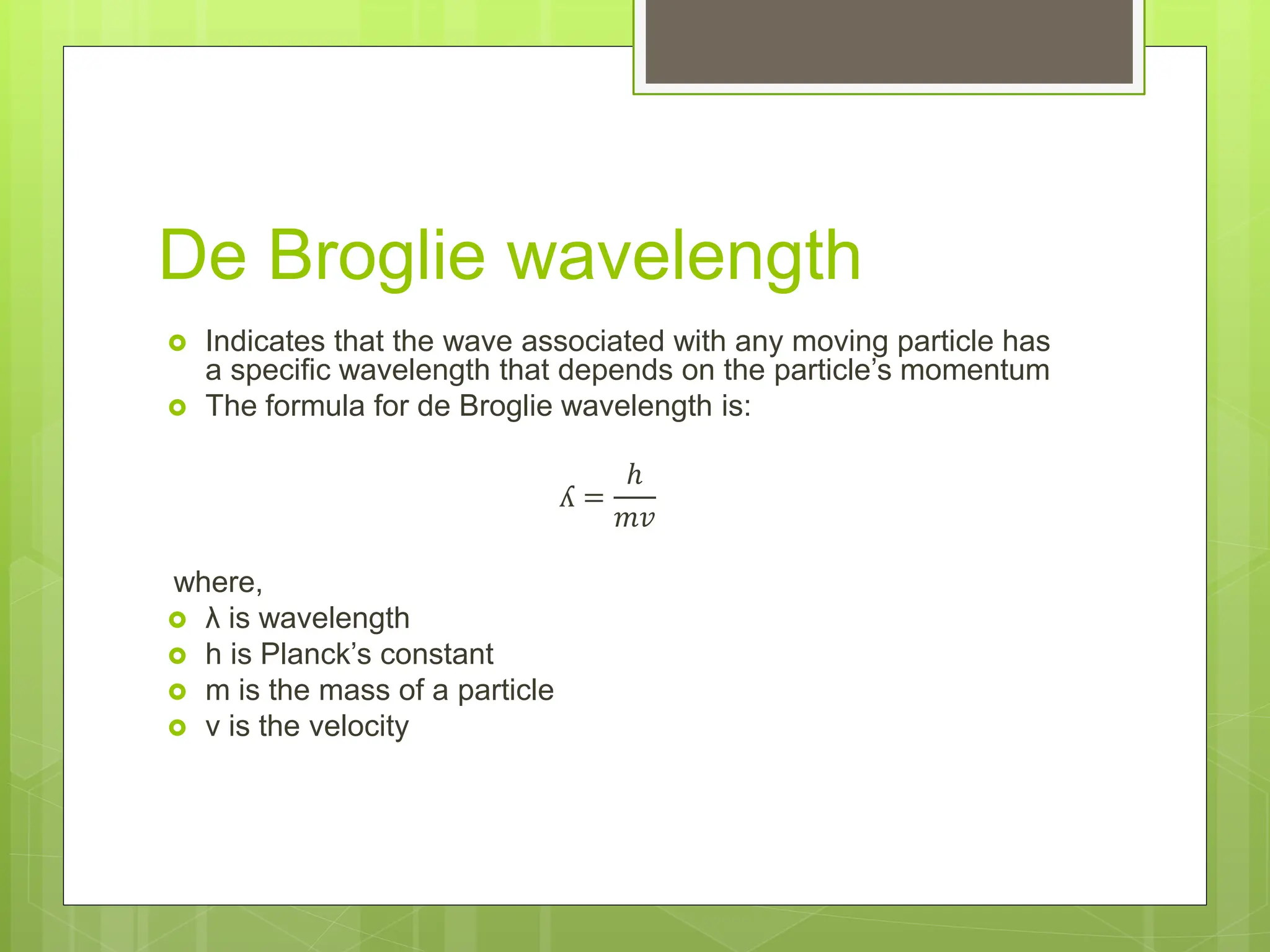
De Broglie wavelength
 Indicates that the wave associated with any moving particle has
a specific wavelength that depends on the particle’s momentum
 The formula for de Broglie wavelength is:
ʎ =
ℎ
𝑚𝑣
where,
 λ is wavelength
 h is Planck’s constant
 m is the mass of a particle
 v is the velocity
LIGHT
WAVE PARTICLE
Refraction &
Diffraction
Photoelectric
effect
De Broglie wavelength
 In 20th century, physicist Louis de Broglie
suggested that particle with mass such as
electron and protons could behave as a
wave.
E = 𝑚𝑐2
Where,
E = energy,
m = mass,
c = speed of light
EINSTEIN Planck’s theory
E = ℎ𝑓
Where,
E = energy,
h = Planck's constant
(6.626 x 10^-34 J*s)
f = frequency
𝑚𝑐2
= ℎ𝑓
v = 𝑓λ
𝑚𝑣2 = ℎ𝑓
𝑓 =
𝑣
λ
𝑚𝑣2
=
ℎ𝑣
λ
(
λ
𝑚𝑣2
)𝑚𝑣2
=
ℎ𝑣
λ
(
λ
𝑚𝑣2
)
𝝀 =
𝒉
𝒎𝒗
𝑚𝑣2 = ℎ𝑓
𝑃 = 𝑚𝑣
𝝀 =
𝒉
𝒑
De Broglie formula
ʎ =
𝒉
𝒑
=
𝒉
𝒎𝒗
Calculating the de Broglie
Wavelength of a Particle
 A muon has a rest mass of 1.89×10⁻²⁸ kg. If
the muon is moving at a speed of 20 m/s,
what is its de Broglie wavelength?
ʎ =
ℎ
𝑝
=
ℎ
𝑚𝑣
ʎ =
ℎ
𝑚𝑣
ʎ =
6.626𝑥10−34
𝐽 · 𝑠
(1.89×10⁻²⁸ kg)(20 m/s)
ʎ =
6.626𝑥10−34𝑘𝑔
𝑚2
𝑠2 · 𝑠
(1.89×10⁻²⁸ kg)(20 m/s)
ʎ =
6.626𝑥10−34𝑚
3.78×10⁻²⁷
ʎ = 1.75×10⁻⁷m
Calculating the de Broglie
Wavelength of a Particle
 Find the de Broglie wavelength for an electron
moving at the speed of 5.0×10⁶ m/s (mass of
an electron is 9.11×10⁻³¹kg )
ʎ =
ℎ
𝑝
=
ℎ
𝑚𝑣
ʎ =
ℎ
𝑚𝑣
ʎ =
6.626𝑥10−34
𝐽 · 𝑠
(9.11×10⁻³¹kg)(5×10⁶m/s)
ʎ =
6.626𝑥10−34𝑘𝑔
𝑚2
𝑠2 · 𝑠
(9.11×10⁻³¹kg)(5×10⁶m/s)
ʎ =
6.626𝑥10−34𝑚
4.56×10⁻²⁴
ʎ = 1.5×10⁻¹⁰m
What is de Broglie
wavelength?
De Broglie wavelength indicates that the wave associated
with any moving particle has a specific wavelength that
depends on the particle’s momentum.
What is the formula for de
Broglie wavelength?
ʎ =
𝒉
𝒑
=
𝒉
𝒎𝒗
DE BROGLIE
WAVELENGTH
THANK YOU FOR
LISTENING!!

De Broglie wavelenghjjhgghhhhhhhhhth.pptx

  • 1.
  • 2.
    SORT THEM OUT Rearrangethe letter and form a word
  • 3.
  • 4.
  • 5.
  • 6.
  • 7.
    OBJECTIVE At the endof 60 minutes lesson, 85% of the students CAN:  recognize that all particles have an associated wavelength called the de Broglie wavelength;  describe de Broglie’s hypothesis of matter waves; and  calculate de Broglie wavelength of massive particles that have a given momentum or velocity.
  • 8.
    PRESENT YOUR IDEA Makea concept about the topic below and present it in class. GROUP 1: Who is Louis de Broglie GROUP 2: Explain de Broglie wavelength
  • 9.
    Louis de Broglie Famous physicist, mostly known for his contributions to the field of quantum mechanics.  He revolutionized that field by introducing the idea of the wave nature of electrons and particle- wave duality.  This theory started the branch of wave mechanics and Louis de Broglie received the Nobel Prize in Physics for this work in 1929
  • 10.
    De Broglie wavelength Indicates that the wave associated with any moving particle has a specific wavelength that depends on the particle’s momentum  The formula for de Broglie wavelength is: ʎ = ℎ 𝑚𝑣 where,  λ is wavelength  h is Planck’s constant  m is the mass of a particle  v is the velocity
  • 11.
  • 12.
    De Broglie wavelength In 20th century, physicist Louis de Broglie suggested that particle with mass such as electron and protons could behave as a wave.
  • 13.
    E = 𝑚𝑐2 Where, E= energy, m = mass, c = speed of light EINSTEIN Planck’s theory E = ℎ𝑓 Where, E = energy, h = Planck's constant (6.626 x 10^-34 J*s) f = frequency 𝑚𝑐2 = ℎ𝑓 v = 𝑓λ 𝑚𝑣2 = ℎ𝑓 𝑓 = 𝑣 λ 𝑚𝑣2 = ℎ𝑣 λ ( λ 𝑚𝑣2 )𝑚𝑣2 = ℎ𝑣 λ ( λ 𝑚𝑣2 ) 𝝀 = 𝒉 𝒎𝒗 𝑚𝑣2 = ℎ𝑓 𝑃 = 𝑚𝑣 𝝀 = 𝒉 𝒑
  • 14.
    De Broglie formula ʎ= 𝒉 𝒑 = 𝒉 𝒎𝒗
  • 15.
    Calculating the deBroglie Wavelength of a Particle  A muon has a rest mass of 1.89×10⁻²⁸ kg. If the muon is moving at a speed of 20 m/s, what is its de Broglie wavelength?
  • 16.
    ʎ = ℎ 𝑝 = ℎ 𝑚𝑣 ʎ = ℎ 𝑚𝑣 ʎ= 6.626𝑥10−34 𝐽 · 𝑠 (1.89×10⁻²⁸ kg)(20 m/s) ʎ = 6.626𝑥10−34𝑘𝑔 𝑚2 𝑠2 · 𝑠 (1.89×10⁻²⁸ kg)(20 m/s) ʎ = 6.626𝑥10−34𝑚 3.78×10⁻²⁷ ʎ = 1.75×10⁻⁷m
  • 17.
    Calculating the deBroglie Wavelength of a Particle  Find the de Broglie wavelength for an electron moving at the speed of 5.0×10⁶ m/s (mass of an electron is 9.11×10⁻³¹kg )
  • 18.
    ʎ = ℎ 𝑝 = ℎ 𝑚𝑣 ʎ = ℎ 𝑚𝑣 ʎ= 6.626𝑥10−34 𝐽 · 𝑠 (9.11×10⁻³¹kg)(5×10⁶m/s) ʎ = 6.626𝑥10−34𝑘𝑔 𝑚2 𝑠2 · 𝑠 (9.11×10⁻³¹kg)(5×10⁶m/s) ʎ = 6.626𝑥10−34𝑚 4.56×10⁻²⁴ ʎ = 1.5×10⁻¹⁰m
  • 19.
    What is deBroglie wavelength? De Broglie wavelength indicates that the wave associated with any moving particle has a specific wavelength that depends on the particle’s momentum.
  • 20.
    What is theformula for de Broglie wavelength? ʎ = 𝒉 𝒑 = 𝒉 𝒎𝒗
  • 21.
  • 22.