 NAME - SUMIT KUMAR DAS
 CLASS ROLL NO.- 11/ME/14
 WBUT ROLL NO.- 14800711061
 REGISTRATION NO.- 11148011404
 Before starting I would like to take this
opportunity to express my sincere thanks to
respected “ SIR ” for giving me this project…
 Apart from that I also want to thank my
FRIENDS for helping me throughout the project
with his inputs..
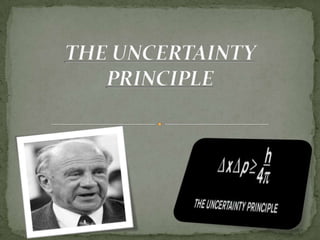
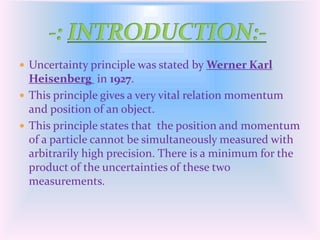
 Uncertainty principle was stated by Werner Karl
Heisenberg in 1927.
 This principle gives a very vital relation momentum
and position of an object.
 This principle states that the position and momentum
of a particle cannot be simultaneously measured with
arbitrarily high precision. There is a minimum for the
product of the uncertainties of these two
measurements.
Continued………..
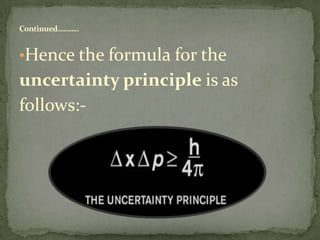
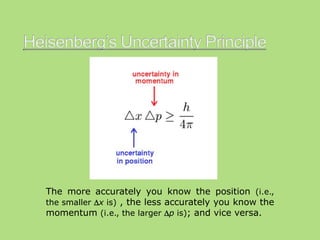
•Hence the formula for the
uncertainty principle is as
follows:-
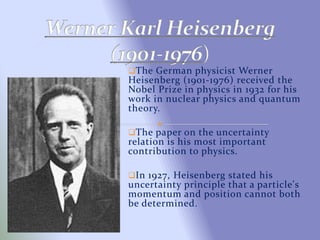
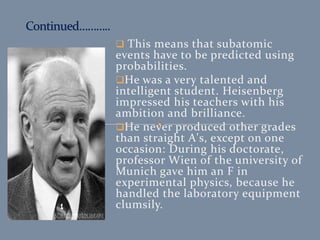
The German physicist Werner
Heisenberg (1901-1976) received the
Nobel Prize in physics in 1932 for his
work in nuclear physics and quantum
theory.
The paper on the uncertainty
relation is his most important
contribution to physics.
In 1927, Heisenberg stated his
uncertainty principle that a particle's
momentum and position cannot both
be determined.
 This means that subatomic
events have to be predicted using
probabilities.
He was a very talented and
intelligent student. Heisenberg
impressed his teachers with his
ambition and brilliance.
He never produced other grades
than straight A's, except on one
occasion: During his doctorate,
professor Wien of the university of
Munich gave him an F in
experimental physics, because he
handled the laboratory equipment
clumsily.
 In the world of very small particles, one cannot
measure any property of a particle without
interacting with it in some way
 This introduces an unavoidable uncertainty into the
result
 One can never measure all the
properties exactly
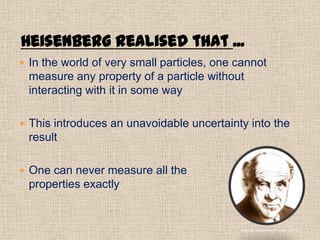
Werner Heisenberg (1901-1976)
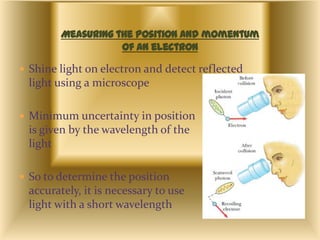
 Shine light on electron and detect reflected
light using a microscope
 Minimum uncertainty in position
is given by the wavelength of the
light
 So to determine the position
accurately, it is necessary to use
light with a short wavelength
 By Planck’s law E = hc/l, a photon with a short
wavelength has a large energy
 Thus, it would impart a large ‘kick’ to the electron
 But to determine its momentum accurately,
electron must only be given a small kick
 This means using light of long wavelength!
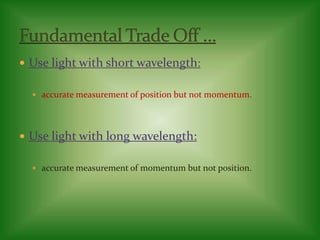
 Use light with short wavelength:
 accurate measurement of position but not momentum.
 Use light with long wavelength:
 accurate measurement of momentum but not position.
The more accurately you know the position (i.e.,
the smaller Dx is) , the less accurately you know the
momentum (i.e., the larger Dp is); and vice versa.
 It is impossible to know both the position and
momentum exactly, i.e., Dx=0 and Dp=0.
 These uncertainties are inherent in the physical world
and have nothing to do with the skill of the observer.
 Because h is so small, these uncertainties are not
observable in normal everyday situations.
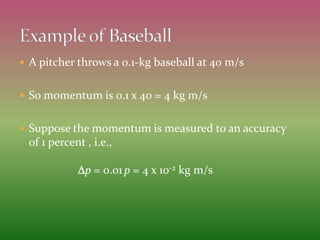
 A pitcher throws a 0.1-kg baseball at 40 m/s
 So momentum is 0.1 x 40 = 4 kg m/s
 Suppose the momentum is measured to an accuracy
of 1 percent , i.e.,
Dp = 0.01 p = 4 x 10⁻² kg m/s
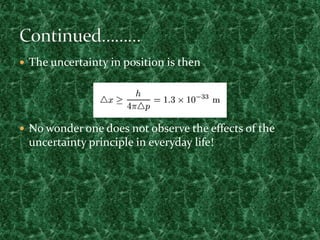
 The uncertainty in position is then
 No wonder one does not observe the effects of the
uncertainty principle in everyday life!
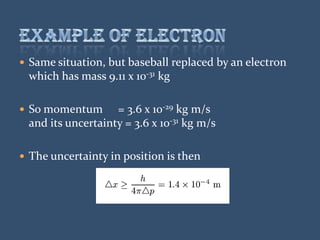
 Same situation, but baseball replaced by an electron
which has mass 9.11 x 10⁻³¹ kg
 So momentum = 3.6 x 10⁻²⁹ kg m/s
and its uncertainty = 3.6 x 10⁻³¹ kg m/s
 The uncertainty in position is then
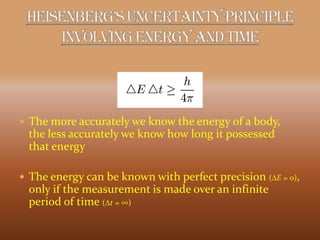
 The more accurately we know the energy of a body,
the less accurately we know how long it possessed
that energy
 The energy can be known with perfect precision (DE = 0),
only if the measurement is made over an infinite
period of time (Dt = ∞)
• www.google.com
• www.wikipedia.com
The uncertainty principle

The uncertainty principle

  • 2.
     NAME -SUMIT KUMAR DAS  CLASS ROLL NO.- 11/ME/14  WBUT ROLL NO.- 14800711061  REGISTRATION NO.- 11148011404
  • 3.
     Before startingI would like to take this opportunity to express my sincere thanks to respected “ SIR ” for giving me this project…  Apart from that I also want to thank my FRIENDS for helping me throughout the project with his inputs..
  • 4.
     Uncertainty principlewas stated by Werner Karl Heisenberg in 1927.  This principle gives a very vital relation momentum and position of an object.  This principle states that the position and momentum of a particle cannot be simultaneously measured with arbitrarily high precision. There is a minimum for the product of the uncertainties of these two measurements.
  • 5.
    Continued……….. •Hence the formulafor the uncertainty principle is as follows:-
  • 6.
    The German physicistWerner Heisenberg (1901-1976) received the Nobel Prize in physics in 1932 for his work in nuclear physics and quantum theory. The paper on the uncertainty relation is his most important contribution to physics. In 1927, Heisenberg stated his uncertainty principle that a particle's momentum and position cannot both be determined.
  • 7.
     This meansthat subatomic events have to be predicted using probabilities. He was a very talented and intelligent student. Heisenberg impressed his teachers with his ambition and brilliance. He never produced other grades than straight A's, except on one occasion: During his doctorate, professor Wien of the university of Munich gave him an F in experimental physics, because he handled the laboratory equipment clumsily.
  • 8.
     In theworld of very small particles, one cannot measure any property of a particle without interacting with it in some way  This introduces an unavoidable uncertainty into the result  One can never measure all the properties exactly Werner Heisenberg (1901-1976)
  • 9.
     Shine lighton electron and detect reflected light using a microscope  Minimum uncertainty in position is given by the wavelength of the light  So to determine the position accurately, it is necessary to use light with a short wavelength
  • 10.
     By Planck’slaw E = hc/l, a photon with a short wavelength has a large energy  Thus, it would impart a large ‘kick’ to the electron  But to determine its momentum accurately, electron must only be given a small kick  This means using light of long wavelength!
  • 11.
     Use lightwith short wavelength:  accurate measurement of position but not momentum.  Use light with long wavelength:  accurate measurement of momentum but not position.
  • 12.
    The more accuratelyyou know the position (i.e., the smaller Dx is) , the less accurately you know the momentum (i.e., the larger Dp is); and vice versa.
  • 13.
     It isimpossible to know both the position and momentum exactly, i.e., Dx=0 and Dp=0.  These uncertainties are inherent in the physical world and have nothing to do with the skill of the observer.  Because h is so small, these uncertainties are not observable in normal everyday situations.
  • 14.
     A pitcherthrows a 0.1-kg baseball at 40 m/s  So momentum is 0.1 x 40 = 4 kg m/s  Suppose the momentum is measured to an accuracy of 1 percent , i.e., Dp = 0.01 p = 4 x 10⁻² kg m/s
  • 15.
     The uncertaintyin position is then  No wonder one does not observe the effects of the uncertainty principle in everyday life!
  • 16.
     Same situation,but baseball replaced by an electron which has mass 9.11 x 10⁻³¹ kg  So momentum = 3.6 x 10⁻²⁹ kg m/s and its uncertainty = 3.6 x 10⁻³¹ kg m/s  The uncertainty in position is then
  • 17.
     The moreaccurately we know the energy of a body, the less accurately we know how long it possessed that energy  The energy can be known with perfect precision (DE = 0), only if the measurement is made over an infinite period of time (Dt = ∞)
  • 18.