For 
Second Year 
( Department of Electrical Engineering) 
ROLL No: 01, 03, 04, 05, 07, 09, 11, 12, 13, 14 
Batch : 12 Electrical 
Department: Electrical Engineering 
Subject: DC Machine 
Class Advisor: Ahsanullah Memon 
Supervised by: Ahsanullah Memon (Lecturer) 
Complied by: Group No. 1 
ELECTRICAL MACHINES LAB 
DEPARTMENT OF ELECTRICAL ENGINEERING 
Mehran University of Engineering and Technology SZAB Campus.
INDEX 
S.NO 
& DATE EXPERIMENTS 
01. 
28-08-13 
Introduction to Electrical Machines, and Transformer. 
02. 
04-09-13 
Verification of O.C.C of Seprately Excited DC Generator 
03. 
23.09.13 
Verification of O.C.C of Self Excited Series DC Generator. 
04. 
23.09.13 
To verify Internal Characteristics of Separately excited DC 
Generator (Verification of Armature reaction.) 
05. 
24.09.13 
Verification of Characteristics of DC Shunt Generator. 
06. 
24.09.13 
Verification of Characteristics of Over Compound 
Generator 
07. 
27.09.13 
Effect of Field current on back EMF & Speed of Separately 
excited DC Motor. 
08. 
27.09.13 
Effect of Line resistance on Back EMF of Separately excited 
DC Motor. 
09. 
27.09.13 
Effect of Load on Back EMF & Armature current of Separately 
excited DC Motor. 
10. 
5.10.2013 
Speed Control of DC Motor by Ward-Leonard System 
(Voltage Control). 
11. 
09.10.2013 
Speed Control of DC Series motor by putting diverter in 
parallel to field winding. 
12. 
15.10.2013 
Speed Control of DC Series Motor by putting diverters in 
parallel to armature.
Practical # 01 
OBJECT :- 
Introduction of Electrical Machines equipments and transformer 
Equipment :- 
1. DC Motor 
2. DC Generator 
3. Transformer 
4. YL-195 Motor, Electric traction and Electrical control trainer 
1. DC Motor: 
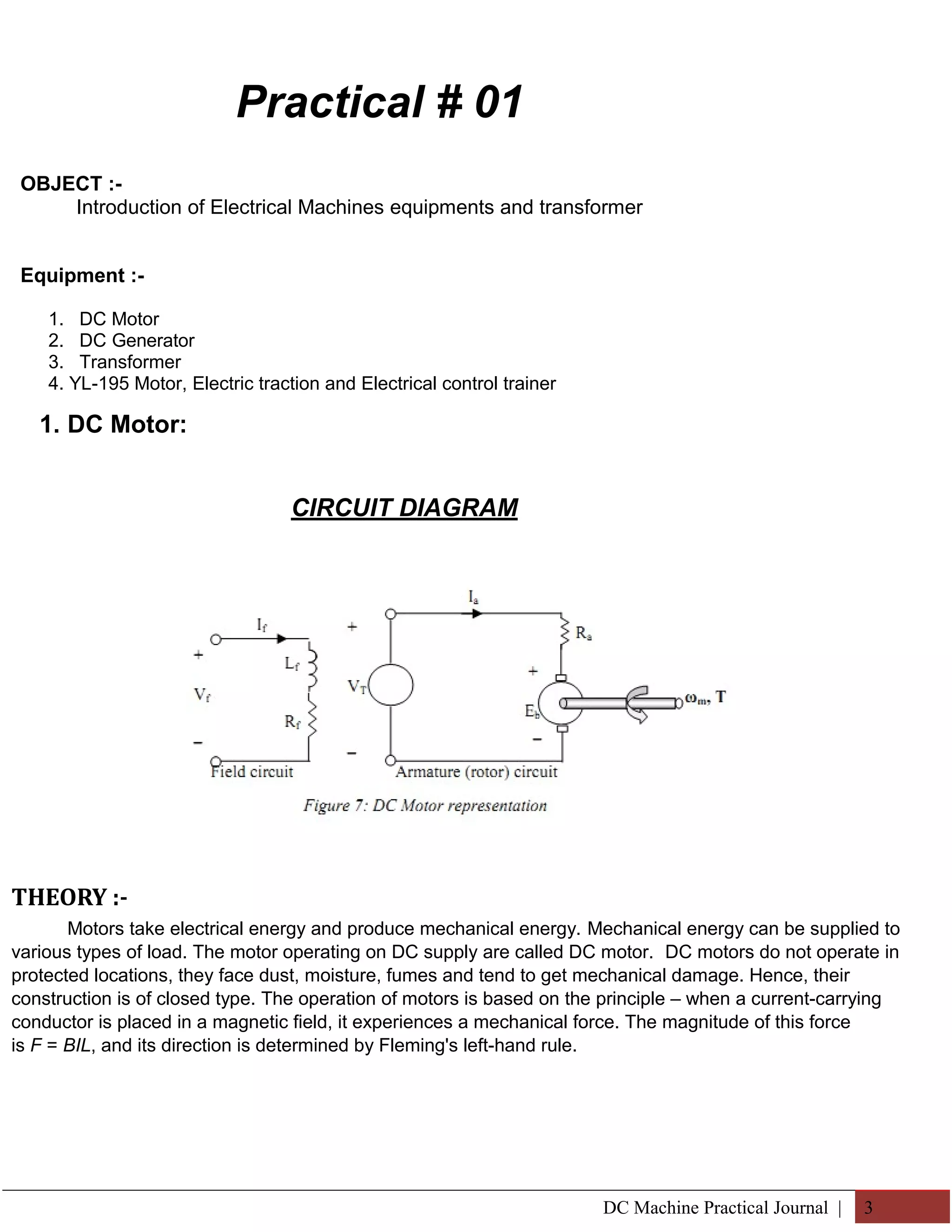
CIRCUIT DIAGRAM 
THEORY :- 
Motors take electrical energy and produce mechanical energy. Mechanical energy can be supplied to 
various types of load. The motor operating on DC supply are called DC motor. DC motors do not operate in 
protected locations, they face dust, moisture, fumes and tend to get mechanical damage. Hence, their 
construction is of closed type. The operation of motors is based on the principle – when a current-carrying 
conductor is placed in a magnetic field, it experiences a mechanical force. The magnitude of this force 
is F = BIL, and its direction is determined by Fleming's left-hand rule. 
DC Machine Practical Journal | 3
Working of D.C. Motor 
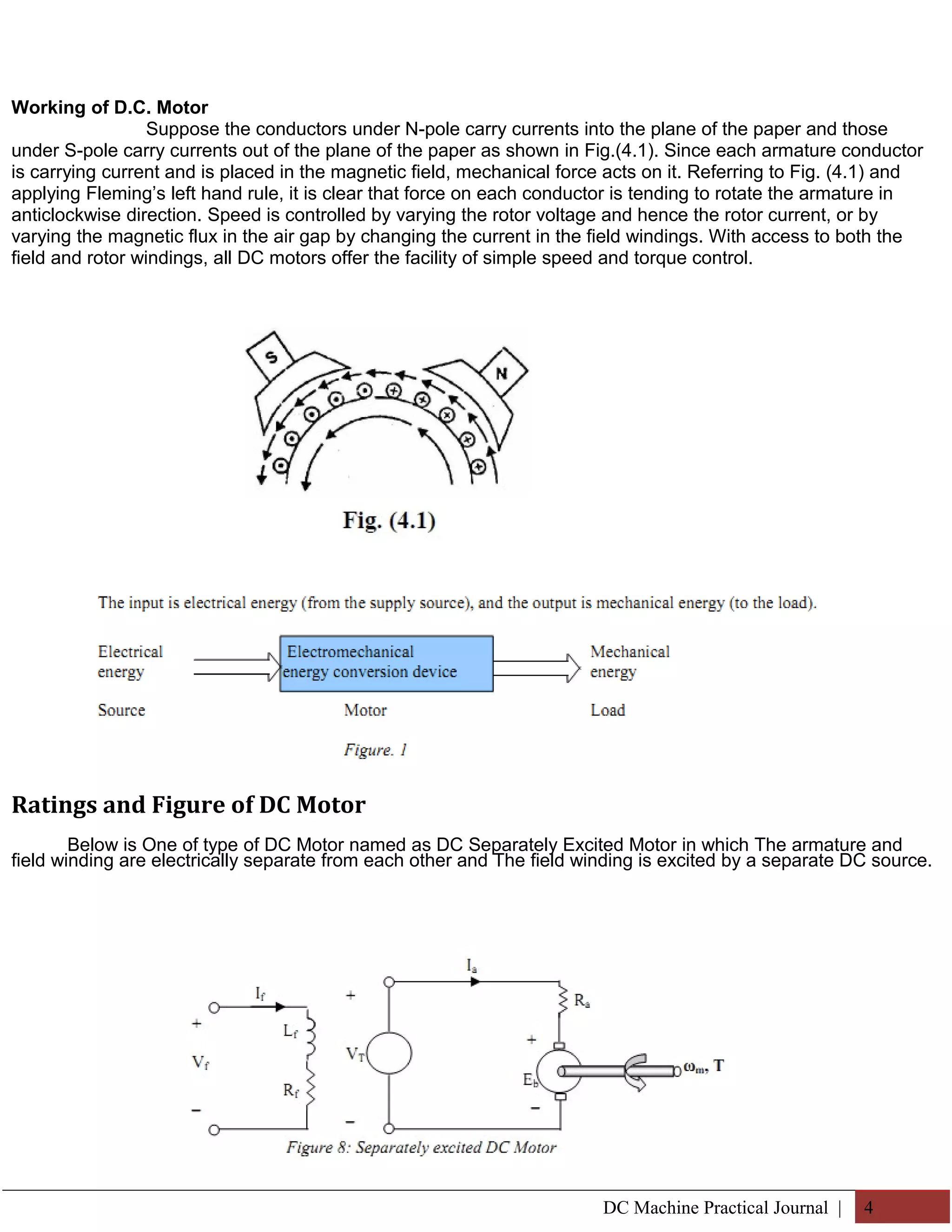
Suppose the conductors under N-pole carry currents into the plane of the paper and those 
under S-pole carry currents out of the plane of the paper as shown in Fig.(4.1). Since each armature conductor 
is carrying current and is placed in the magnetic field, mechanical force acts on it. Referring to Fig. (4.1) and 
applying Fleming’s left hand rule, it is clear that force on each conductor is tending to rotate the armature in 
anticlockwise direction. Speed is controlled by varying the rotor voltage and hence the rotor current, or by 
varying the magnetic flux in the air gap by changing the current in the field windings. With access to both the 
field and rotor windings, all DC motors offer the facility of simple speed and torque control. 
Ratings and Figure of DC Motor 
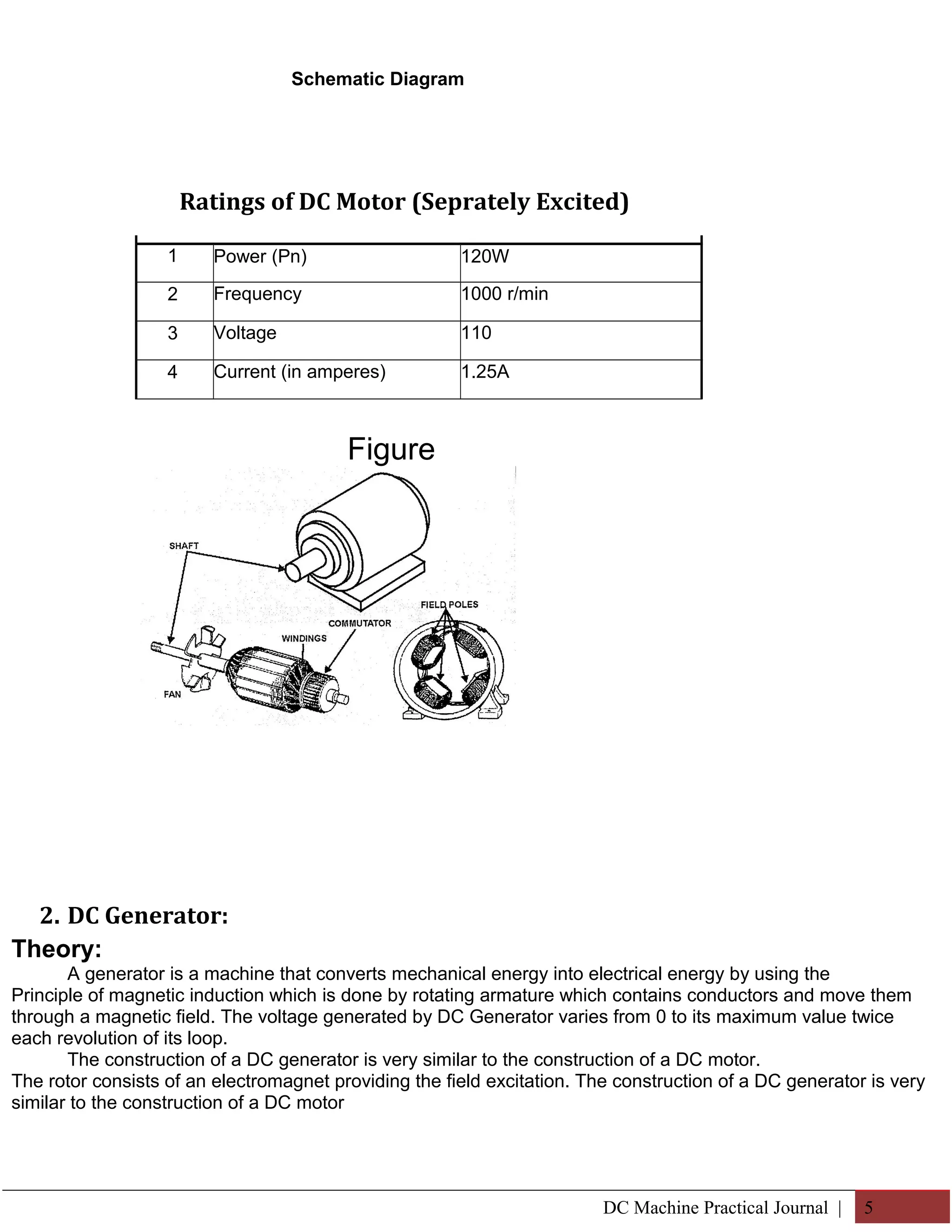
Below is One of type of DC Motor named as DC Separately Excited Motor in which The armature and 
field winding are electrically separate from each other and The field winding is excited by a separate DC source. 
DC Machine Practical Journal | 4
Schematic Diagram 
Ratings of DC Motor (Seprately Excited) 
1 Power (Pn) 120W 
2 Frequency 1000 r/min 
3 Voltage 110 
4 Current (in amperes) 1.25A 
Figure 
2. DC Generator: 
Theory: 
A generator is a machine that converts mechanical energy into electrical energy by using the 
Principle of magnetic induction which is done by rotating armature which contains conductors and move them 
through a magnetic field. The voltage generated by DC Generator varies from 0 to its maximum value twice 
each revolution of its loop. 
The construction of a DC generator is very similar to the construction of a DC motor. 
The rotor consists of an electromagnet providing the field excitation. The construction of a DC generator is very 
similar to the construction of a DC motor 
DC Machine Practical Journal | 5
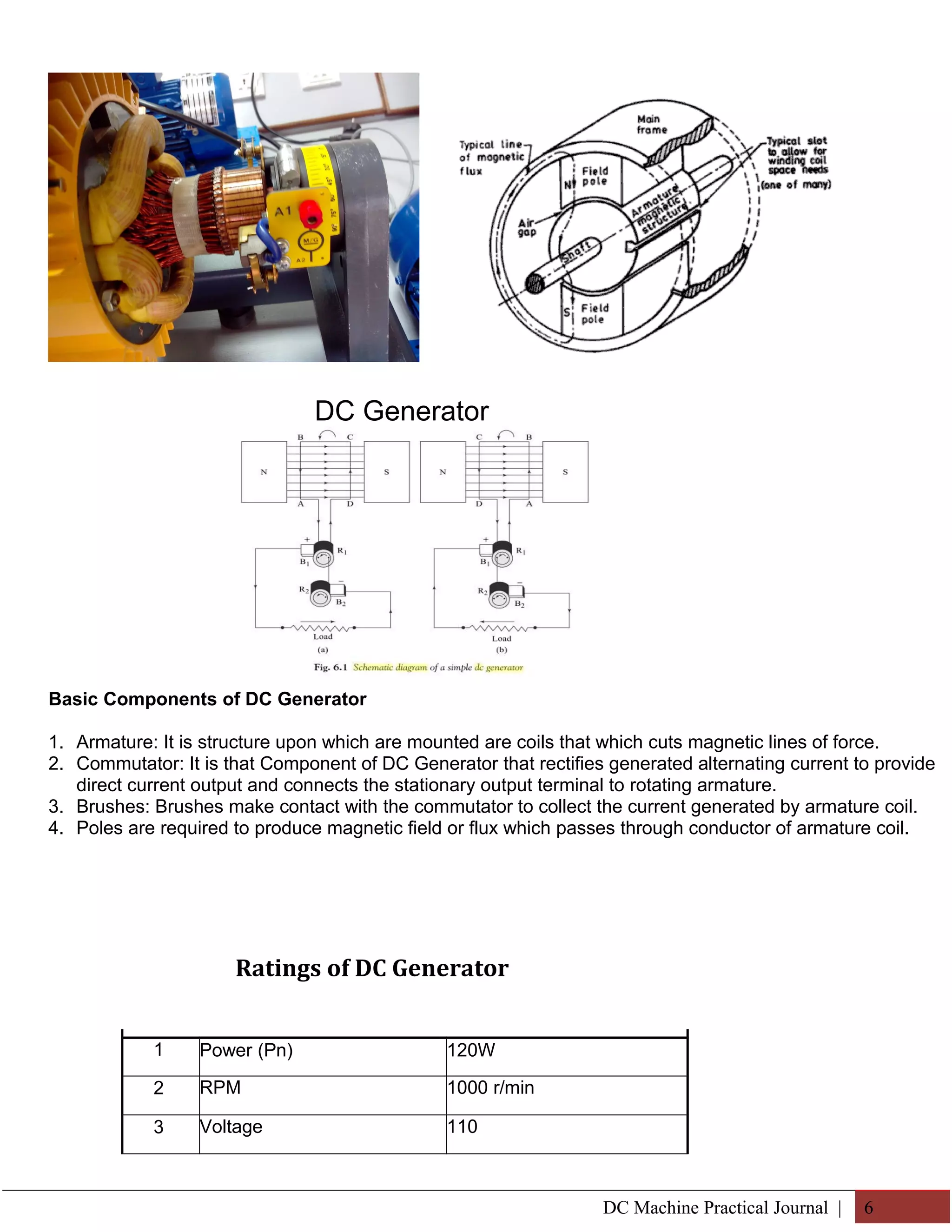
DC Generator 
Basic Components of DC Generator 
1. Armature: It is structure upon which are mounted are coils that which cuts magnetic lines of force. 
2. Commutator: It is that Component of DC Generator that rectifies generated alternating current to provide 
direct current output and connects the stationary output terminal to rotating armature. 
3. Brushes: Brushes make contact with the commutator to collect the current generated by armature coil. 
4. Poles are required to produce magnetic field or flux which passes through conductor of armature coil. 
Ratings of DC Generator 
1 Power (Pn) 120W 
2 RPM 1000 r/min 
3 Voltage 110 
DC Machine Practical Journal | 6
4 Current (in amperes) 1.25A 
3. Transformer: 
Theory: 
A transformer is a device having no movable parts that transfer power from one circuit to another 
circuit usually with changes values of both current and voltage. As current vary in primary coil will 
creates a varying magnetic flux in the transformer's core as a result magnetic flux vary in secondary 
coil. The variation in secondary coil will induces emf or voltage in secondary coil. Transformers can link 
two or more electric circuits. In its simple form two electric circuits can be linked by a magnetic circuit, 
one of the electric coils is used for the creation induced voltage in the same. 
Transformers have good applications in High voltage Power Transmission. 
Ratings of Transformer 
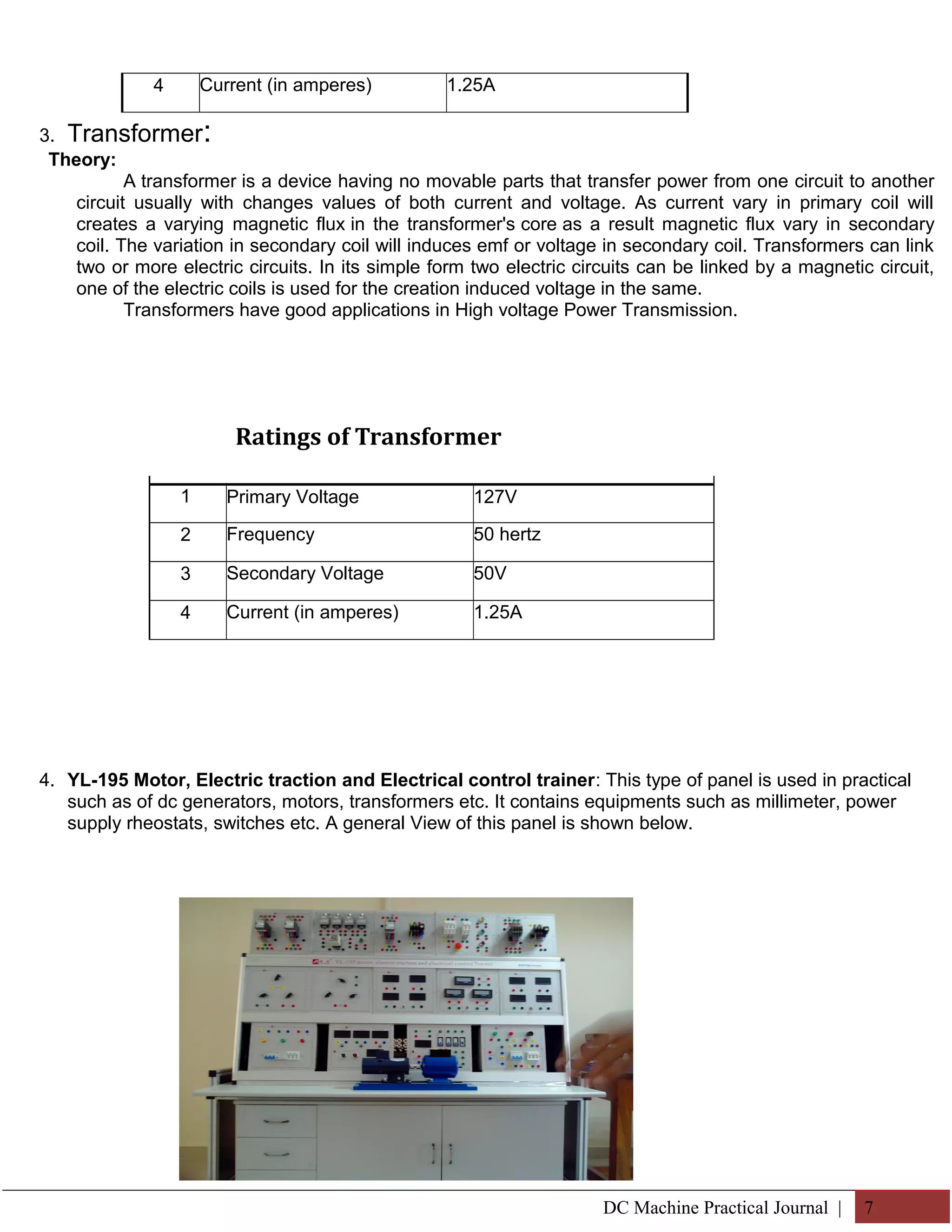
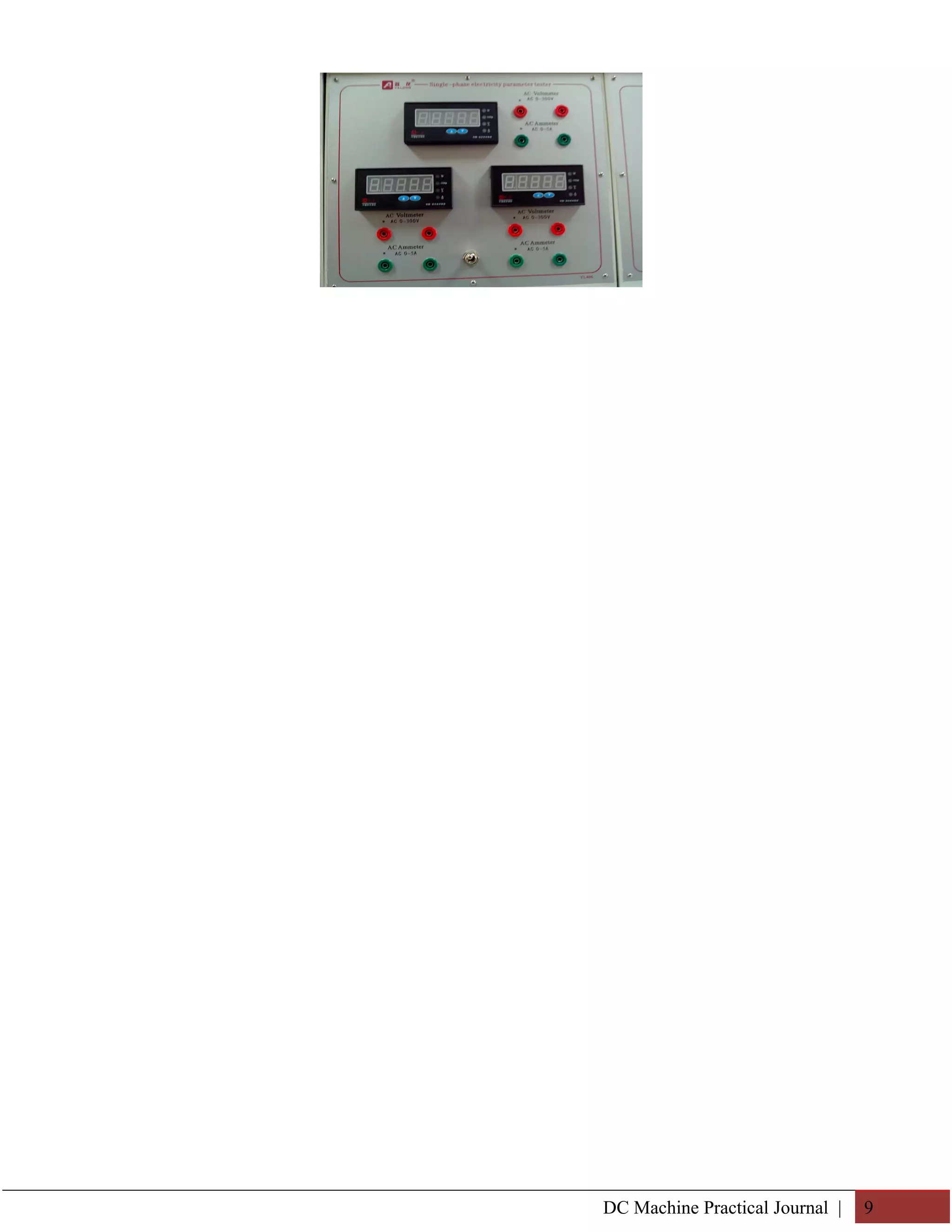
4. YL-195 Motor, Electric traction and Electrical control trainer: This type of panel is used in practical 
such as of dc generators, motors, transformers etc. It contains equipments such as millimeter, power 
supply rheostats, switches etc. A general View of this panel is shown below. 
DC Machine Practical Journal | 7 
1 Primary Voltage 127V 
2 Frequency 50 hertz 
3 Secondary Voltage 50V 
4 Current (in amperes) 1.25A
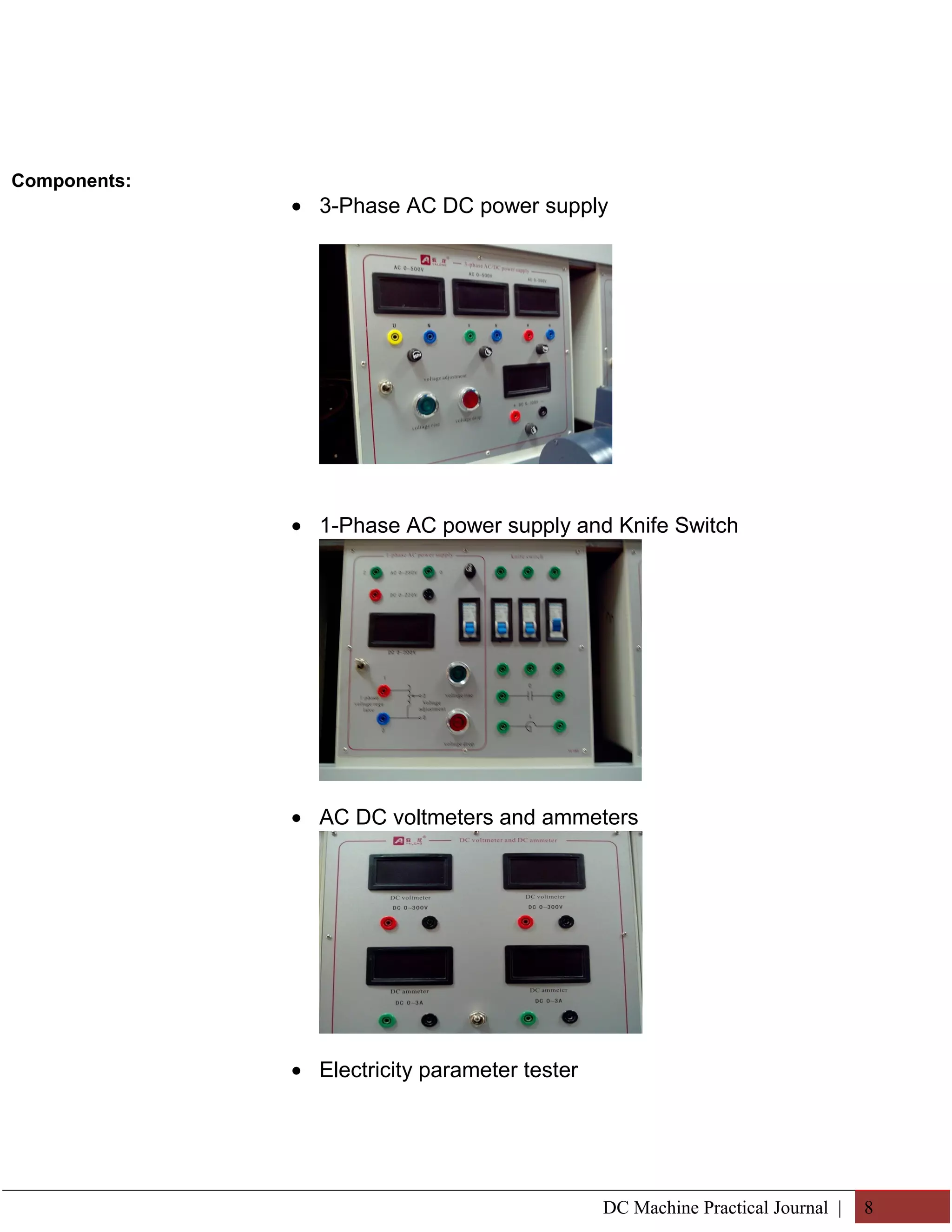
Components: 
· 3-Phase AC DC power supply 
· 1-Phase AC power supply and Knife Switch 
· AC DC voltmeters and ammeters 
· Electricity parameter tester 
DC Machine Practical Journal | 8
DC Machine Practical Journal | 9
Practical # 02 
Objective: 
Verification of O.C.C (Open Circuit Characteristics) of Separately Excited DC Generator. 
Equipments: 
Power Supply 
DC Voltmeter 
DC Ammeter 
DC Supply 
3-Phase Induction Motor 
The separately excited motor has independent voltage supplies to the field and rotor windings allowing more 
control over the motor performance. 
Characteristics 
The voltage on either the field or the rotor windings can be used to control the speed and torque of a 
separately excited motor. 
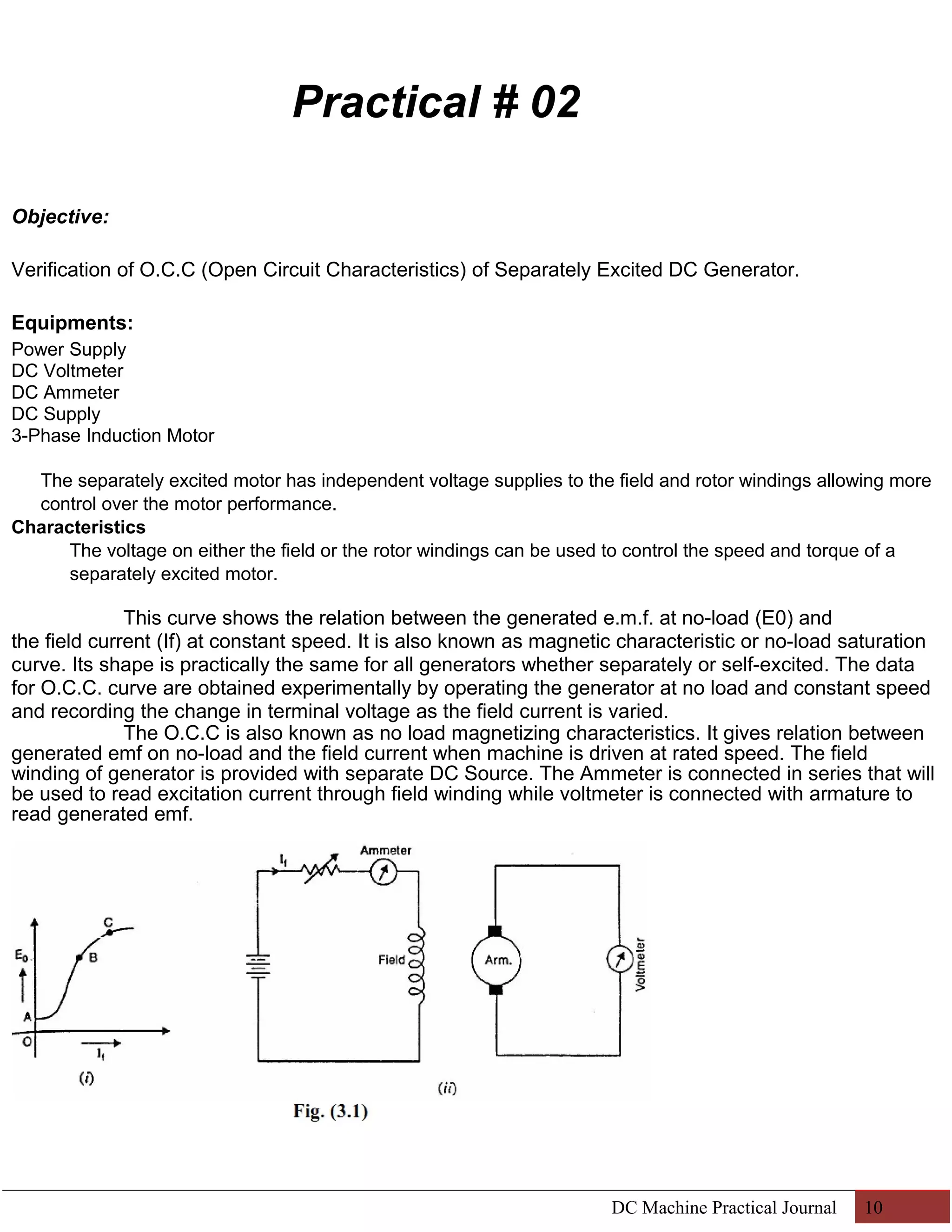
This curve shows the relation between the generated e.m.f. at no-load (E0) and 
the field current (If) at constant speed. It is also known as magnetic characteristic or no-load saturation 
curve. Its shape is practically the same for all generators whether separately or self-excited. The data 
for O.C.C. curve are obtained experimentally by operating the generator at no load and constant speed 
and recording the change in terminal voltage as the field current is varied. 
The O.C.C is also known as no load magnetizing characteristics. It gives relation between 
generated emf on no-load and the field current when machine is driven at rated speed. The field 
winding of generator is provided with separate DC Source. The Ammeter is connected in series that will 
be used to read excitation current through field winding while voltmeter is connected with armature to 
read generated emf. 
DC Machine Practical Journal 10
Procedure: 
The O.C.C. for a d.c. generator is determined and verified as follows 
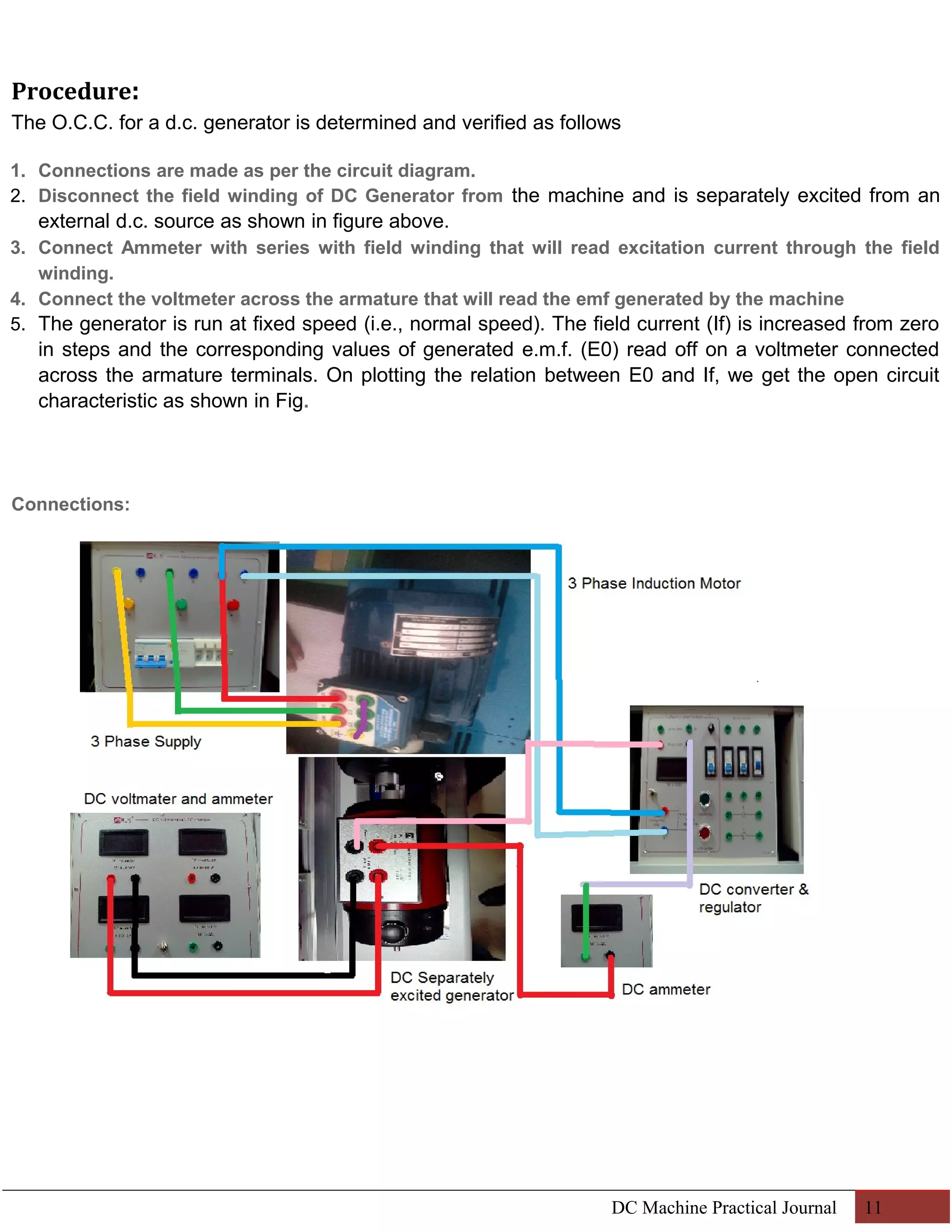
1. Connections are made as per the circuit diagram. 
2. Disconnect the field winding of DC Generator from the machine and is separately excited from an 
external d.c. source as shown in figure above. 
3. Connect Ammeter with series with field winding that will read excitation current through the field 
winding. 
4. Connect the voltmeter across the armature that will read the emf generated by the machine 
5. The generator is run at fixed speed (i.e., normal speed). The field current (If) is increased from zero 
in steps and the corresponding values of generated e.m.f. (E0) read off on a voltmeter connected 
across the armature terminals. On plotting the relation between E0 and If, we get the open circuit 
characteristic as shown in Fig. 
Connections: 
DC Machine Practical Journal 11
Readings: 
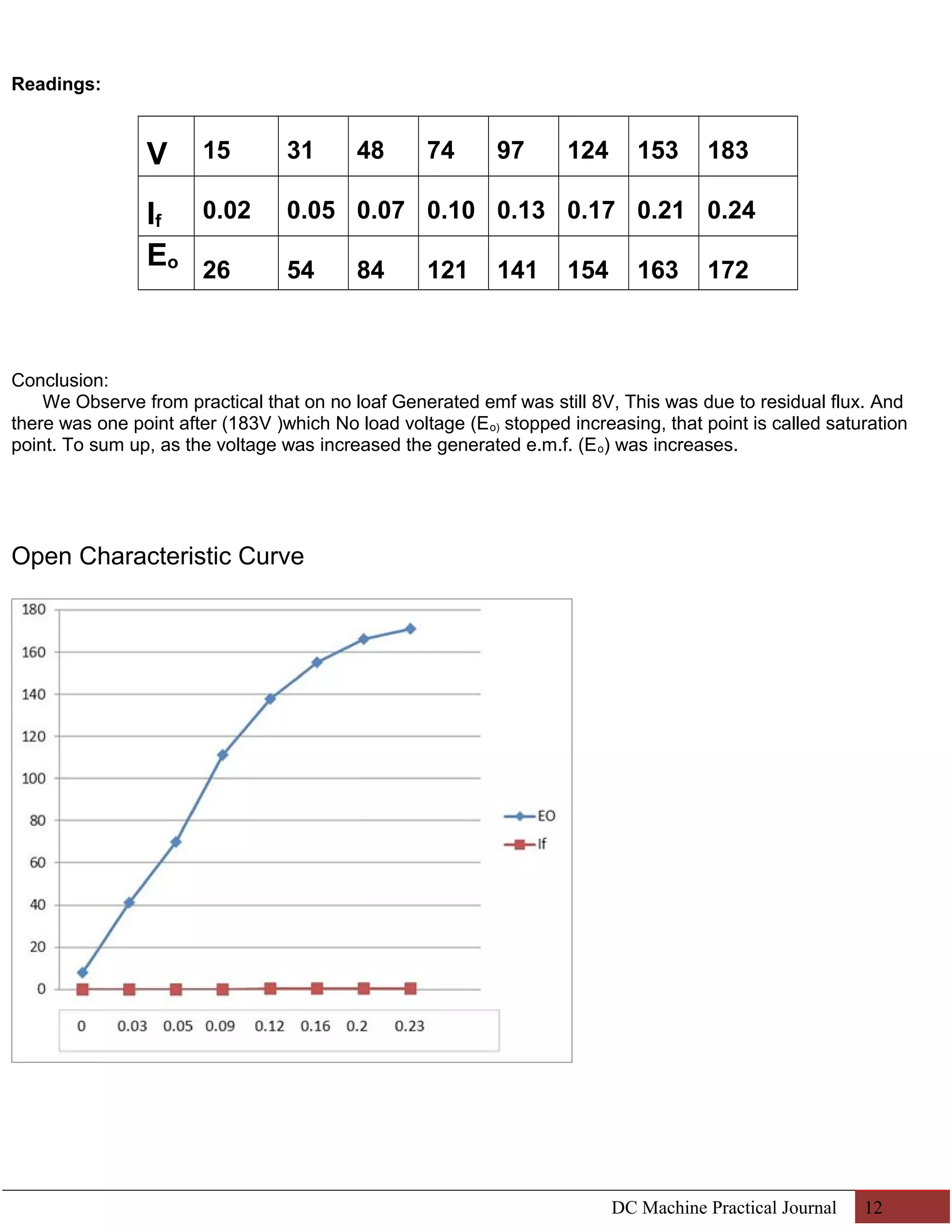
V 15 31 48 74 97 124 153 183 
If 0.02 0.05 0.07 0.10 0.13 0.17 0.21 0.24 
Eo 26 54 84 121 141 154 163 172 
Conclusion: 
We Observe from practical that on no loaf Generated emf was still 8V, This was due to residual flux. And 
there was one point after (183V )which No load voltage (Eo) stopped increasing, that point is called saturation 
point. To sum up, as the voltage was increased the generated e.m.f. (Eo) was increases. 
Open Characteristic Curve 
DC Machine Practical Journal 12
Practical # 03 
Object: 
Verification of O.C.C of Self Excited Series DC Generator. 
Equipment Used: 
· 3-Phase AC Power Supply 
· 3-Phase Induction Motor 
· Self excited series connected DC Generator 
· Fixed & Variable resistive loads 
· DC Voltmeter 
· DC Ammeter 
Theory: 
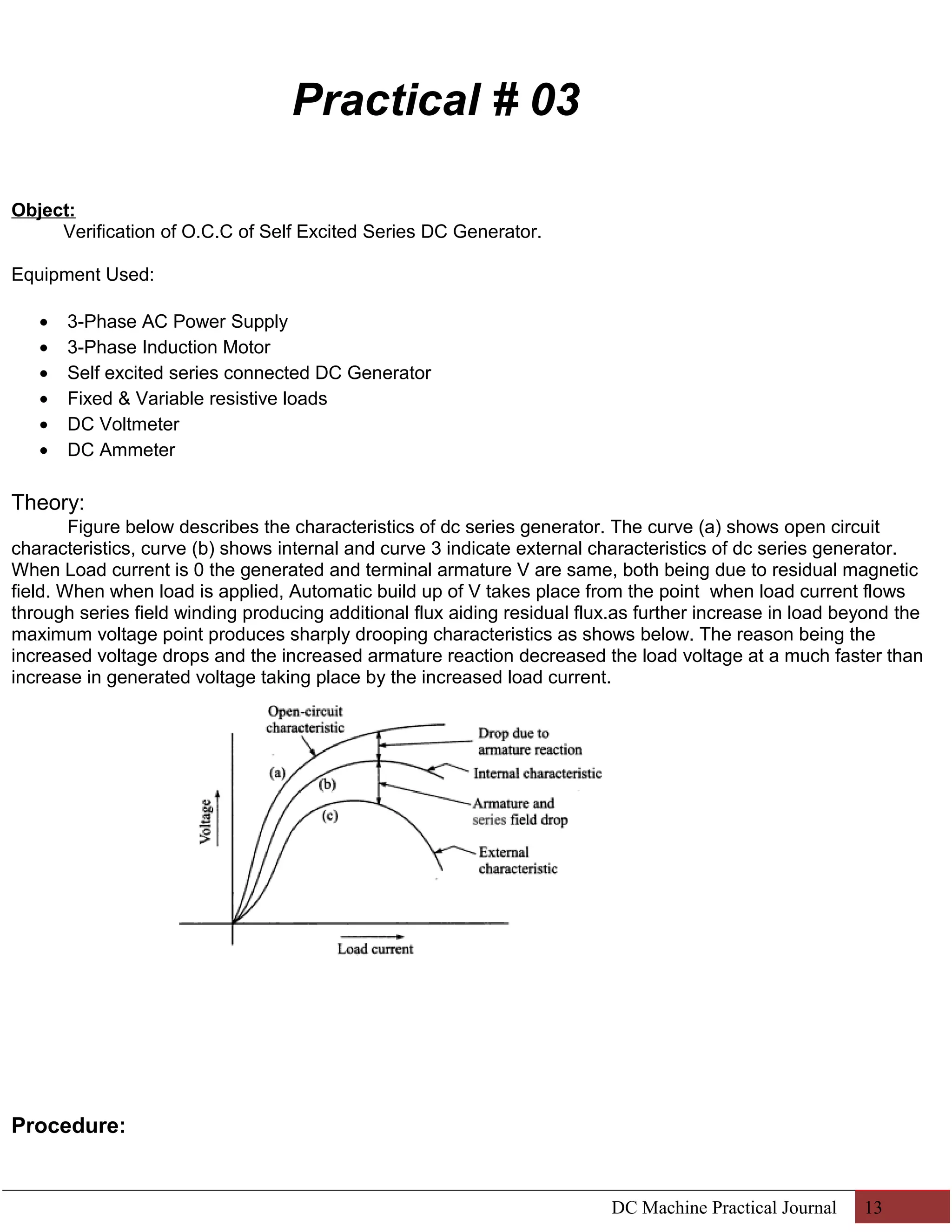
Figure below describes the characteristics of dc series generator. The curve (a) shows open circuit 
characteristics, curve (b) shows internal and curve 3 indicate external characteristics of dc series generator. 
When Load current is 0 the generated and terminal armature V are same, both being due to residual magnetic 
field. When when load is applied, Automatic build up of V takes place from the point when load current flows 
through series field winding producing additional flux aiding residual flux.as further increase in load beyond the 
maximum voltage point produces sharply drooping characteristics as shows below. The reason being the 
increased voltage drops and the increased armature reaction decreased the load voltage at a much faster than 
increase in generated voltage taking place by the increased load current. 
Procedure: 
DC Machine Practical Journal 13
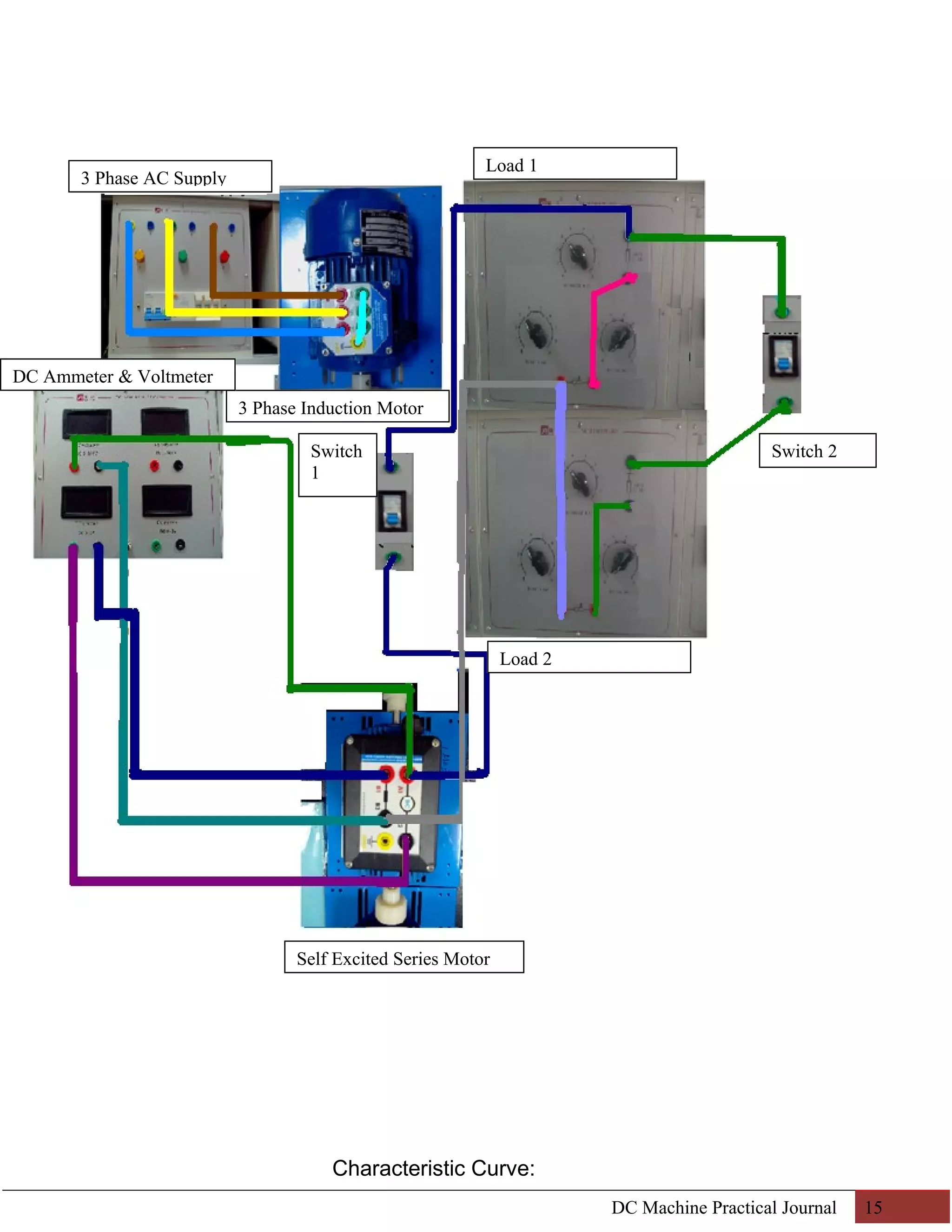
1. Connect the circuit as shown in connection below. (We need to connect the feld winding across the 
armature instead of connecting it to a separate supply). 
2. Slowly increase the input to the prime-mover. Speed of the set will increase. Observe the voltmeter 
connected across the terminals of the dc generator. Above a certain speed the voltmeter reading starts 
increasing (If this does not happen reduce the prime-mover input and switch o® the supply. Interchange the feld 
terminals of the generator and repeat the same procedure). By controlling 
the input to the prime mover adjust the speed to the rated speed of the machine. 
3. Close the main switch S. Load the generator in steps by switching ON the load and for each 
case adjust the prime mover input such that the speed remains constant. Note down the load 
voltage and current, feld current of the generator, armature current and voltage. 
Repeat this procedure till the load current is equal to the rated current of the generator. 
4. Put off all the load, open the main switch S, reduce the prime mover input and put off the AC 
supply to the controller. 
Discription: 
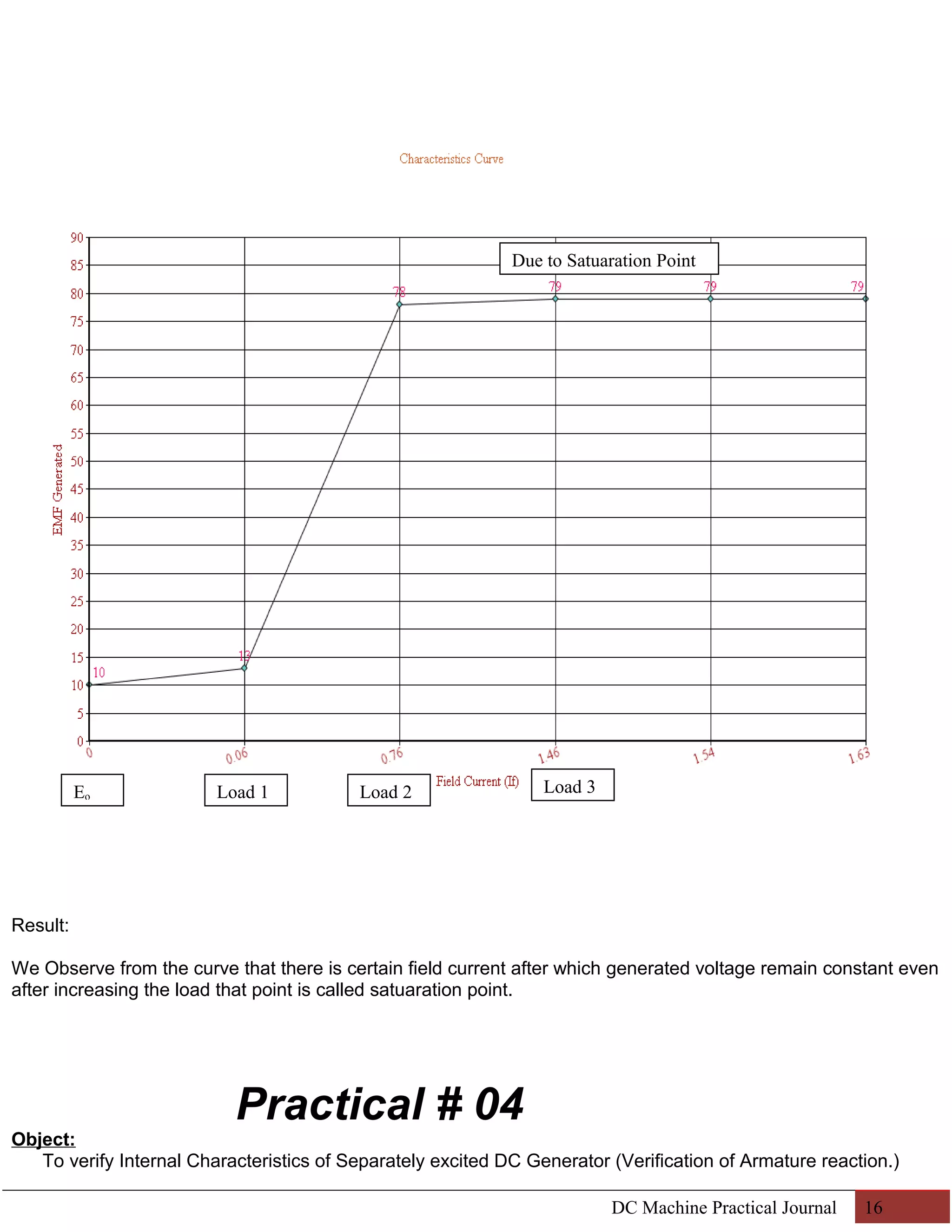
Load Resistance Field Current Generated Voltage 
At No load Eo ∞ 0 10 
At Load 1 200 0.06 13 
At Load 2 300 0.76 78 
At Load 3 400 1.54 79 
Connections: 
DC Machine Practical Journal 14
Characteristic Curve: 
DC Machine Practical Journal 15 
3 Phase AC Supply 
3 Phase Induction Motor 
Load 1 
Load 2 
Self Excited Series Motor 
DC Ammeter & Voltmeter 
Switch Switch 2 
1
Due to Satuaration Point 
Result: 
We Observe from the curve that there is certain field current after which generated voltage remain constant even 
after increasing the load that point is called satuaration point. 
Practical # 04 
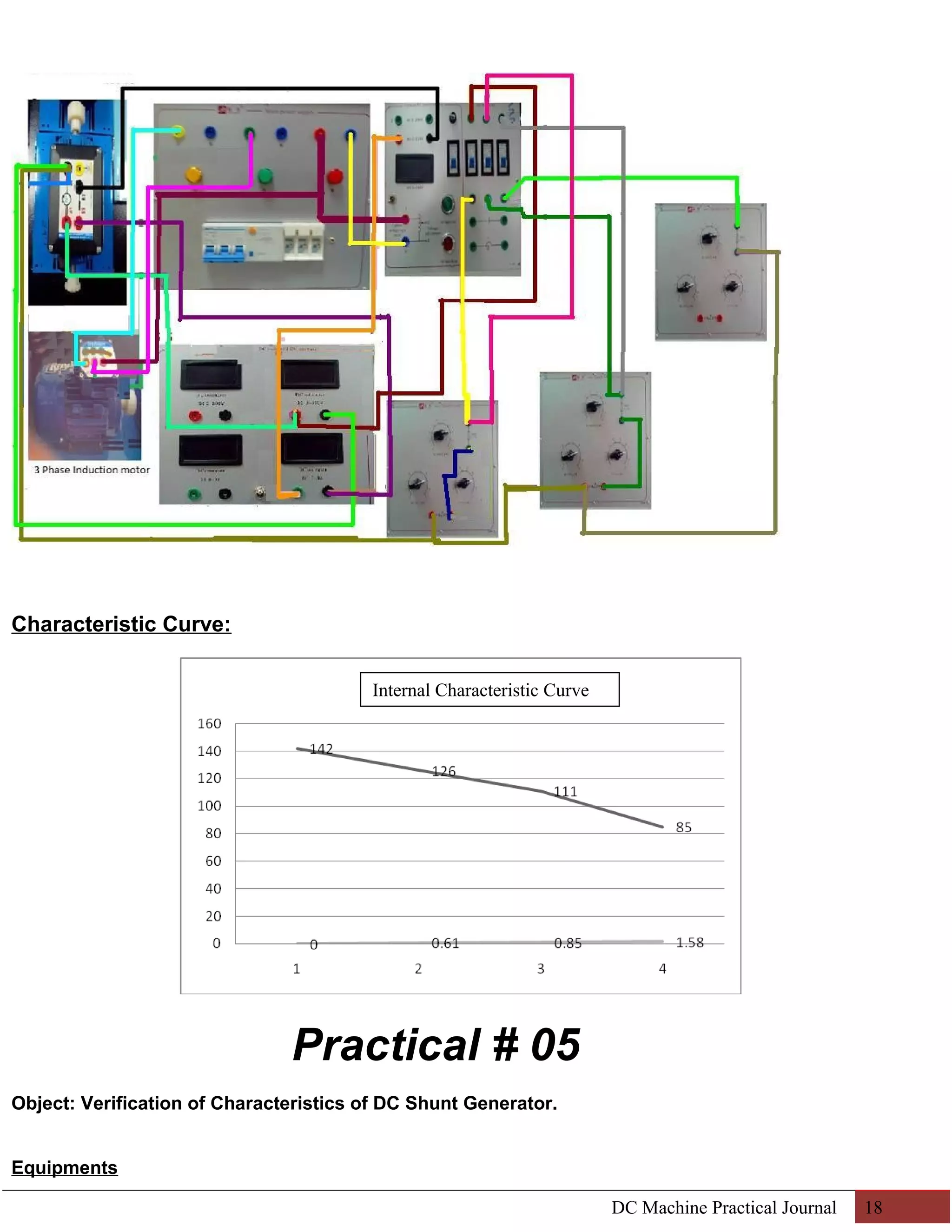
Object: 
To verify Internal Characteristics of Separately excited DC Generator (Verification of Armature reaction.) 
DC Machine Practical Journal 16 
Eo Load 1 Load 2 Load 3
Equipments: 
· 3-Phase AC Power Supply 
· 3-Phase Induction Motor 
· Regulated AC & DC Supply 
· DC Separately excited Generator 
· Variable & Fixed Resistive Loads 
· DC Voltmeter 
· DC Ammeter 
THEORY :- 
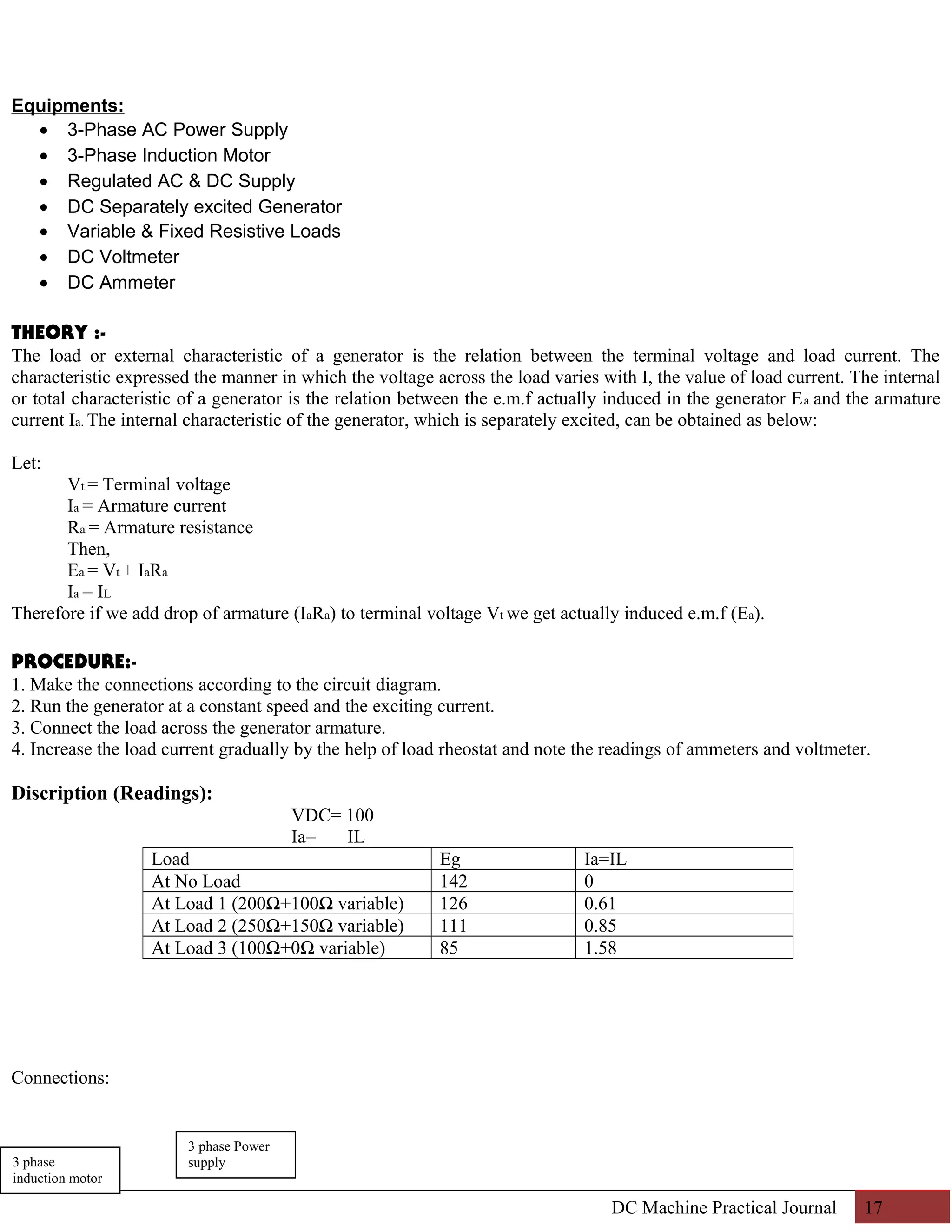
The load or external characteristic of a generator is the relation between the terminal voltage and load current. The 
characteristic expressed the manner in which the voltage across the load varies with I, the value of load current. The internal 
or total characteristic of a generator is the relation between the e.m.f actually induced in the generator Ea and the armature 
current Ia. The internal characteristic of the generator, which is separately excited, can be obtained as below: 
Let: 
Vt = Terminal voltage 
Ia = Armature current 
Ra = Armature resistance 
Then, 
Ea = Vt + IaRa 
Ia = IL 
Therefore if we add drop of armature (IaRa) to terminal voltage Vt we get actually induced e.m.f (Ea). 
PROCEDURE:- 
1. Make the connections according to the circuit diagram. 
2. Run the generator at a constant speed and the exciting current. 
3. Connect the load across the generator armature. 
4. Increase the load current gradually by the help of load rheostat and note the readings of ammeters and voltmeter. 
Discription (Readings): 
VDC= 100 
Ia= IL 
Load Eg Ia=IL 
At No Load 142 0 
At Load 1 (200Ω+100Ω variable) 126 0.61 
At Load 2 (250Ω+150Ω variable) 111 0.85 
At Load 3 (100Ω+0Ω variable) 85 1.58 
Connections: 
DC Machine Practical Journal 17 
3 phase 
induction motor 
3 phase Power 
supply
Characteristic Curve: 
Practical # 05 
Object: Verification of Characteristics of DC Shunt Generator. 
Equipments 
DC Machine Practical Journal 18 
Internal Characteristic Curve
· 3-Phase AC Power Supply 
· 3-Phase Induction Motor 
· DC Self excited Compound Generator 
· DC Voltmeter 
· DC Ammeter 
· Regulated AC & DC Supply 
· Variable & Fixed Resistive Loads 
Theory: 
A generator when operated for the general operation its speed practically is constant under such conditions it gives 
relationship among excitation load current and voltage. These relation when shown by the graphs then they are called 
characteristics which are actually three curves. 
1. Open Circuit Chacteristics 
2. Internal Characteristics 
3. External Characteristics 
OCC show relationship between no load generated emf and field current.when generator builds up small voltage generated 
emf remains constant coz it is not applied to any load. Internal Characteristics shows relationship between on load generated 
emf and armature current. When generator is put on load the emf decreases due to reduction of flux at per pole. So as 
obserbed in practical emf generated on no load condition is greater than the emf generated on load. The external 
characteristics curve show relation between terminal voltage and load current. As we put generator on load, the load current 
was decreased when calucalated this was because of because of amount of ohmic drop. 
Procedure: 
1. Make connection as per given. 
2. Adjust field regulator to the motor so that generator runs at its rated speed. 
3. Adjust generator field regulator so that rated voltage is obtained at its terminals. 
4. Gradually apply load in steps and note down readings of the load. Keep the speed constant at its rated value by 
adjusting motor field regulator throughout experiment. 
5. Plot the external load characteristics from the experiment. 
6. Determine the armature resistance experimentally 
7. Take readings of voltmeter and armature by varying the load resistance and determine average value of armature 
resistance. 
Precautions: 
While sharting the the motor the field regulator (rhostate) must be in minimum position 
Connections: 
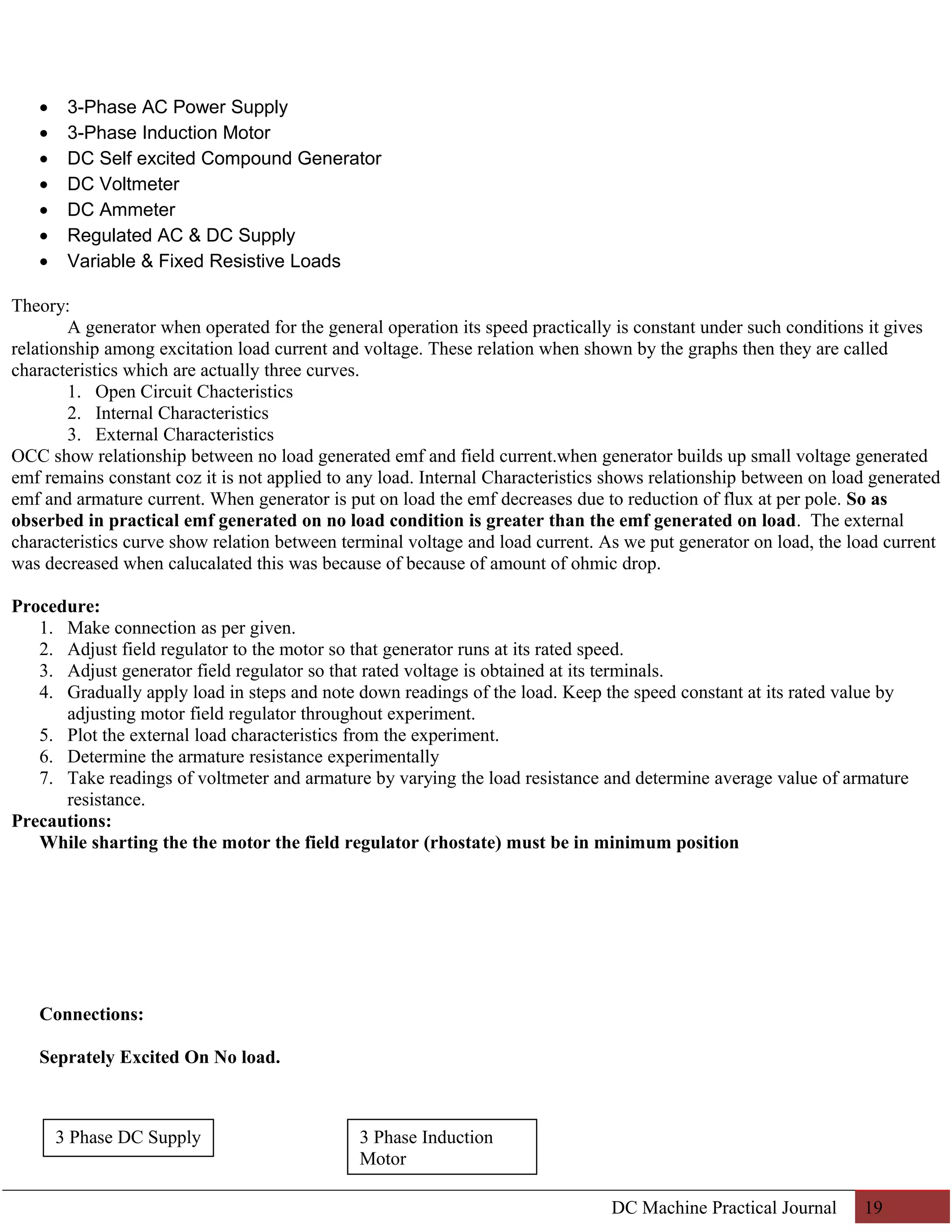
Seprately Excited On No load. 
DC Machine Practical Journal 19 
3 Phase Induction 
Motor 
3 Phase DC Supply
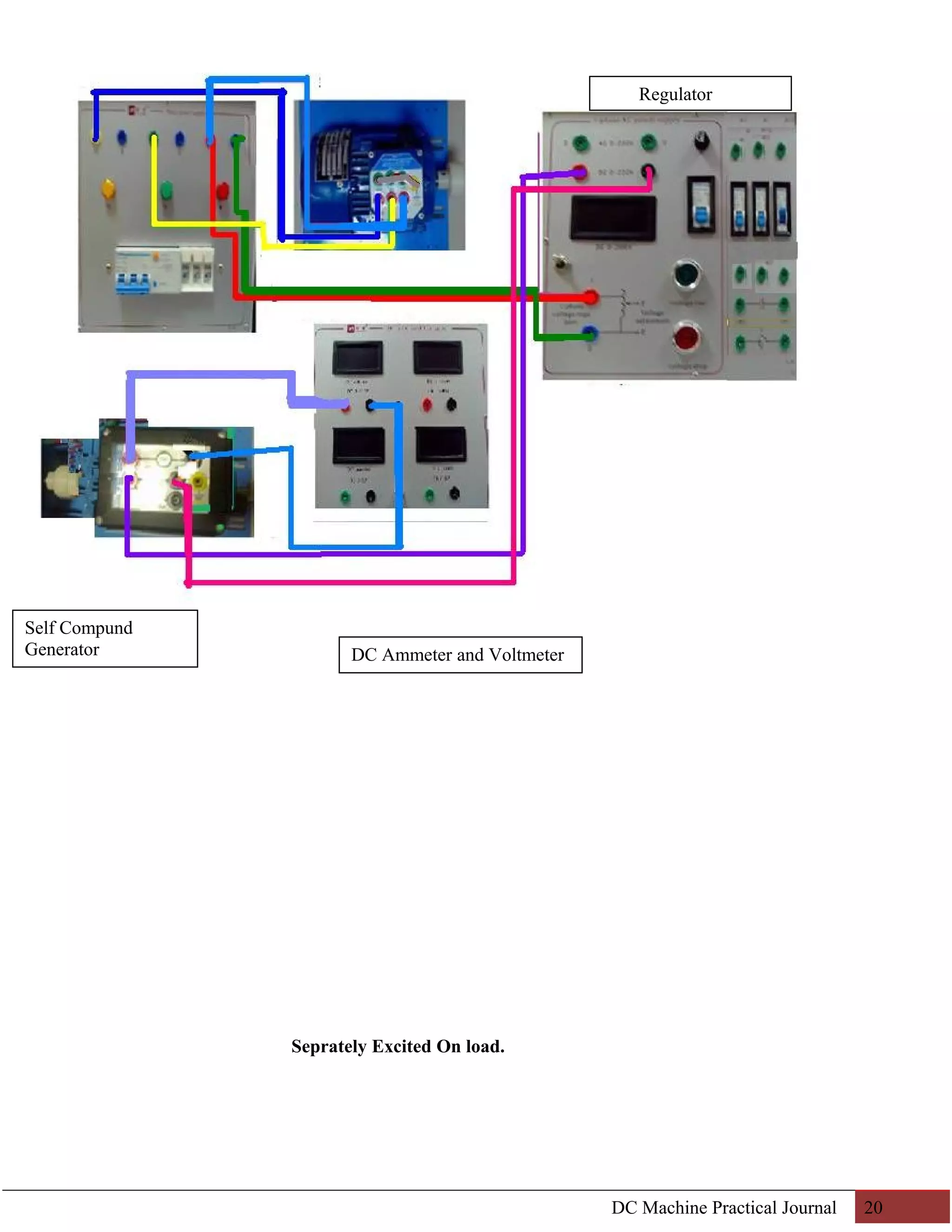
Seprately Excited On load. 
Regulator 
DC Machine Practical Journal 20 
Self Compund 
Generator DC Ammeter and Voltmeter
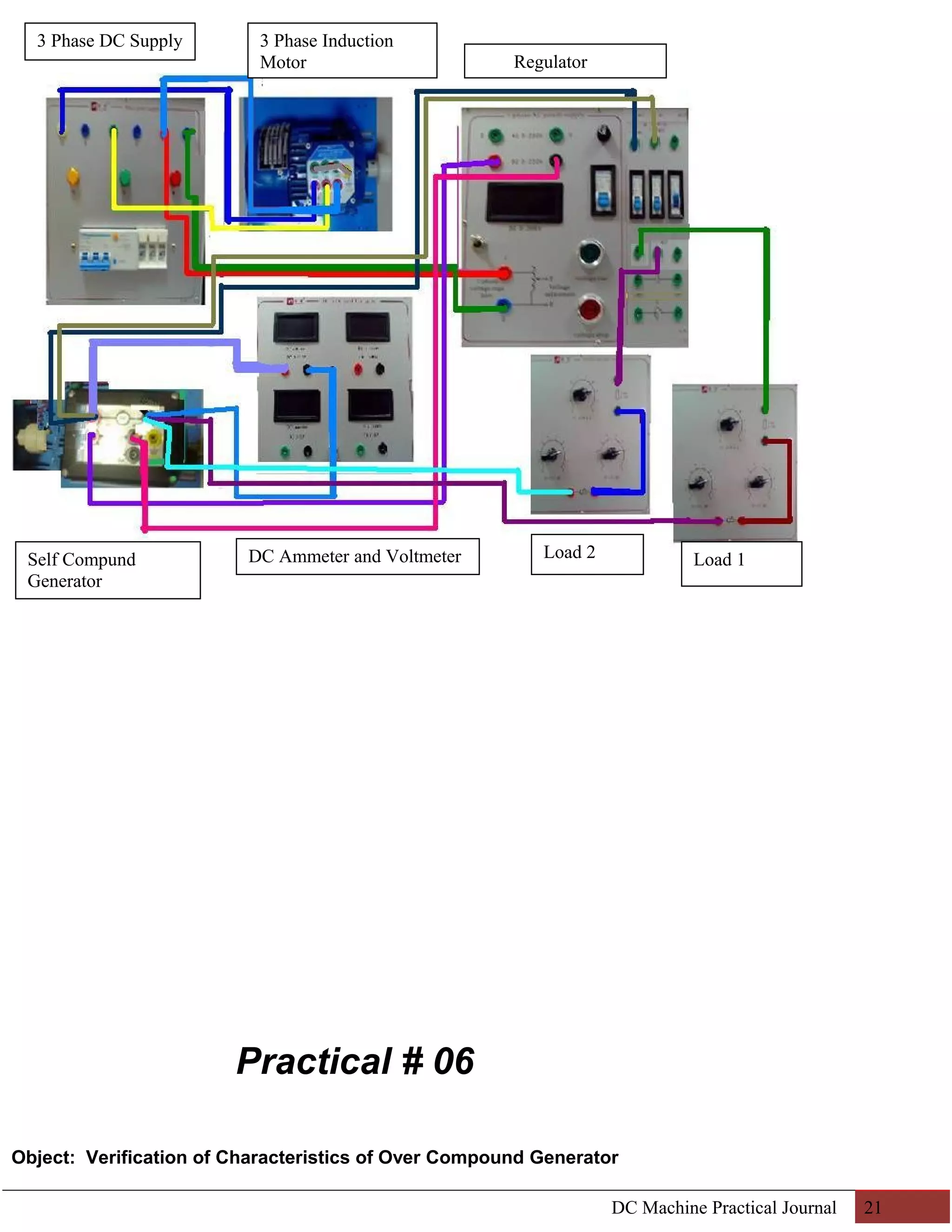
Practical # 06 
Load 2 Load 1 
3 Phase DC Supply 
Object: Verification of Characteristics of Over Compound Generator 
DC Machine Practical Journal 21 
Regulator 
3 Phase Induction 
Motor 
Self Compund DC Ammeter and Voltmeter 
Generator
Equipments: 
· 3-Phase AC Power Supply 
· DC Voltmeter 
· DC Ammeter 
· Regulated AC & DC Supply 
· 3-Phase Induction Motor 
· DC Self excited Compound Generator 
· Variable & Fixed Resistive Loads 
Theory: 
If the series winding turns are so adjusted that with the increase in load current the terminal voltage increases it is 
called over compound. In such case as the load current increases the series field mmf increaes and tends to increase the flux 
and hence the generated voltage. The increase in generated voltage is greater than the IaRa drop so that instead of 
decreasing the terminal voltage increaes. The series excitation aids the shunt excitation. The degree of 
compounding depends upon the increase in series excitation with the increase in load current. 
Discription: 
First we connected series winding, we observed that on no load voltage is 8V due to residual flux as the 
load increases the voltage as well as current increases. Then we will observe parameters for Shunt connected 
also. 
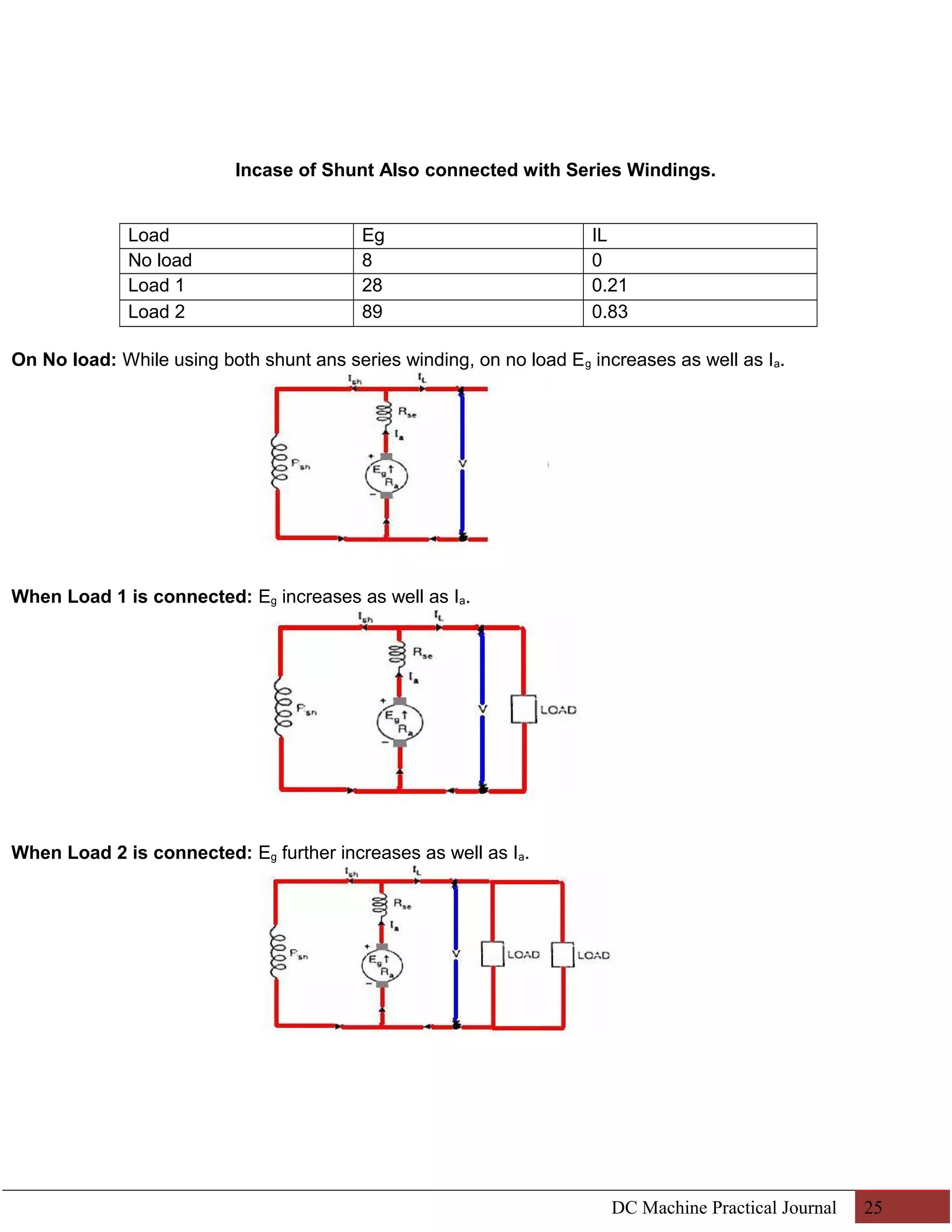
Incase of Series Windings Only. 
Load Eg IL 
No load 8 0 
Load 1 78 0.62 
Load 2 94 0.88 
On No Load: Eg is 8V due to residual Flux, Ia=0 
DC Machine Practical Journal 22
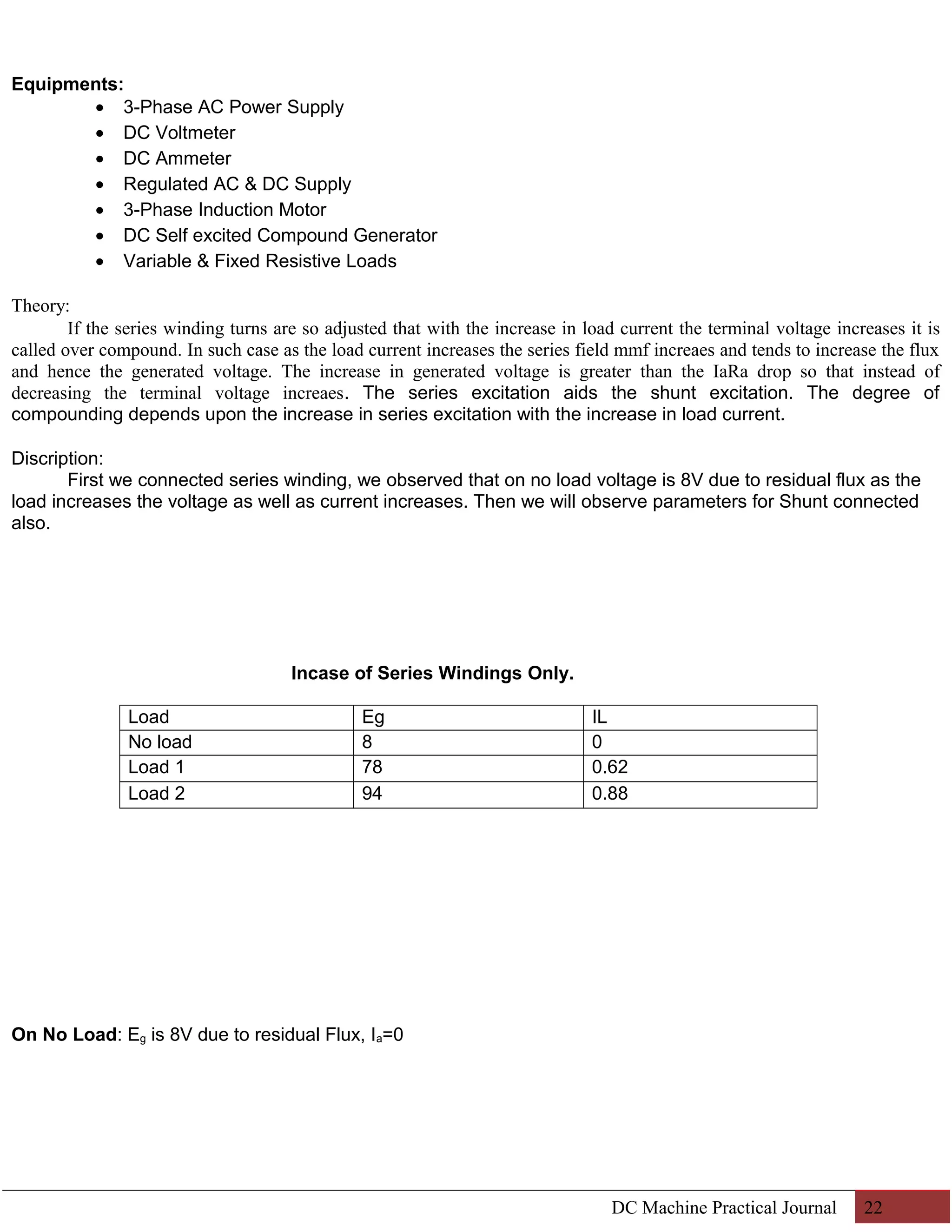
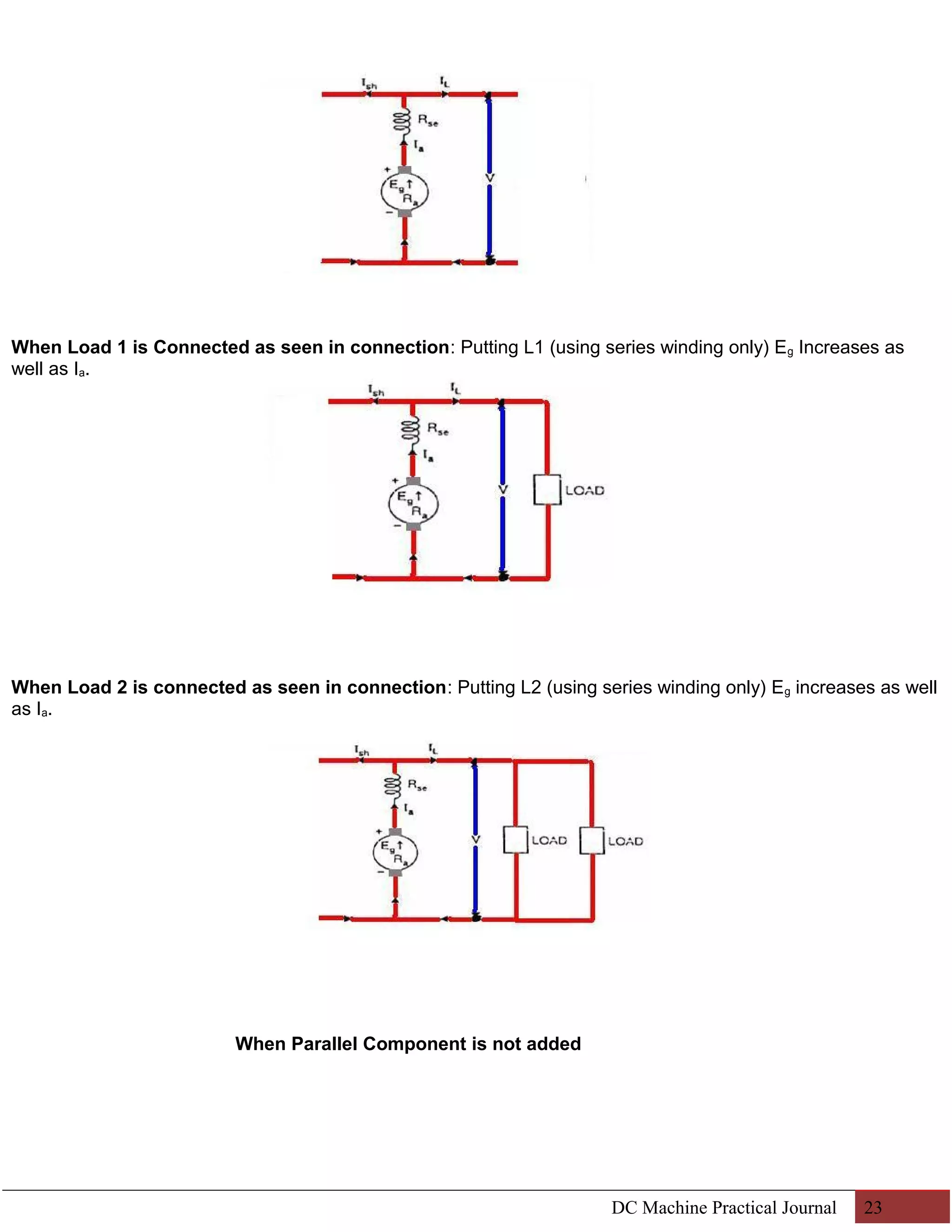
When Load 1 is Connected as seen in connection: Putting L1 (using series winding only) Eg Increases as 
well as Ia. 
When Load 2 is connected as seen in connection: Putting L2 (using series winding only) Eg increases as well 
as Ia. 
When Parallel Component is not added 
DC Machine Practical Journal 23
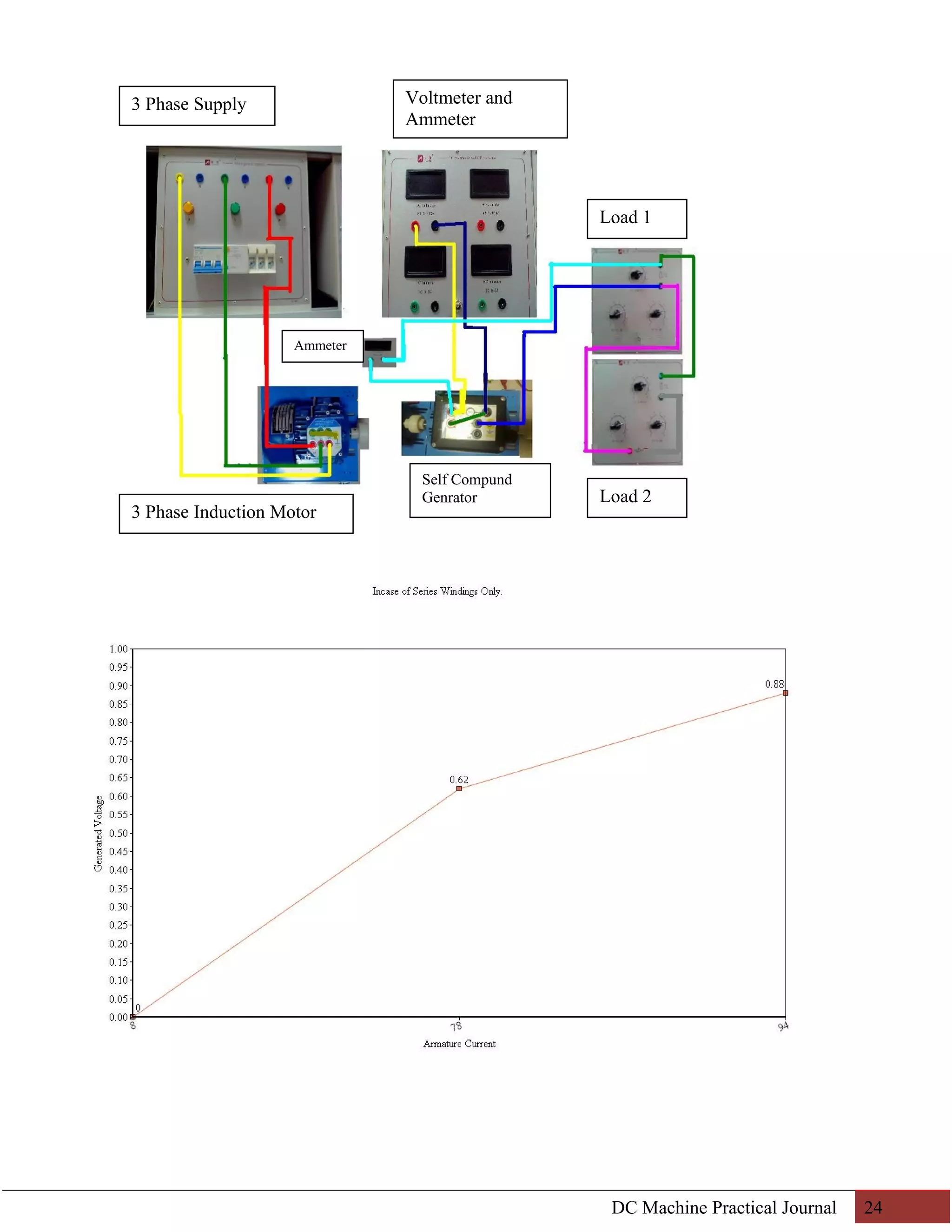
DC Machine Practical Journal 24 
Self Compund 
Genrator 
Load 1 
Ammeter 
Load 2 
Voltmeter and 
Ammeter 
3 Phase Supply 
3 Phase Induction Motor
Incase of Shunt Also connected with Series Windings. 
Load Eg IL 
No load 8 0 
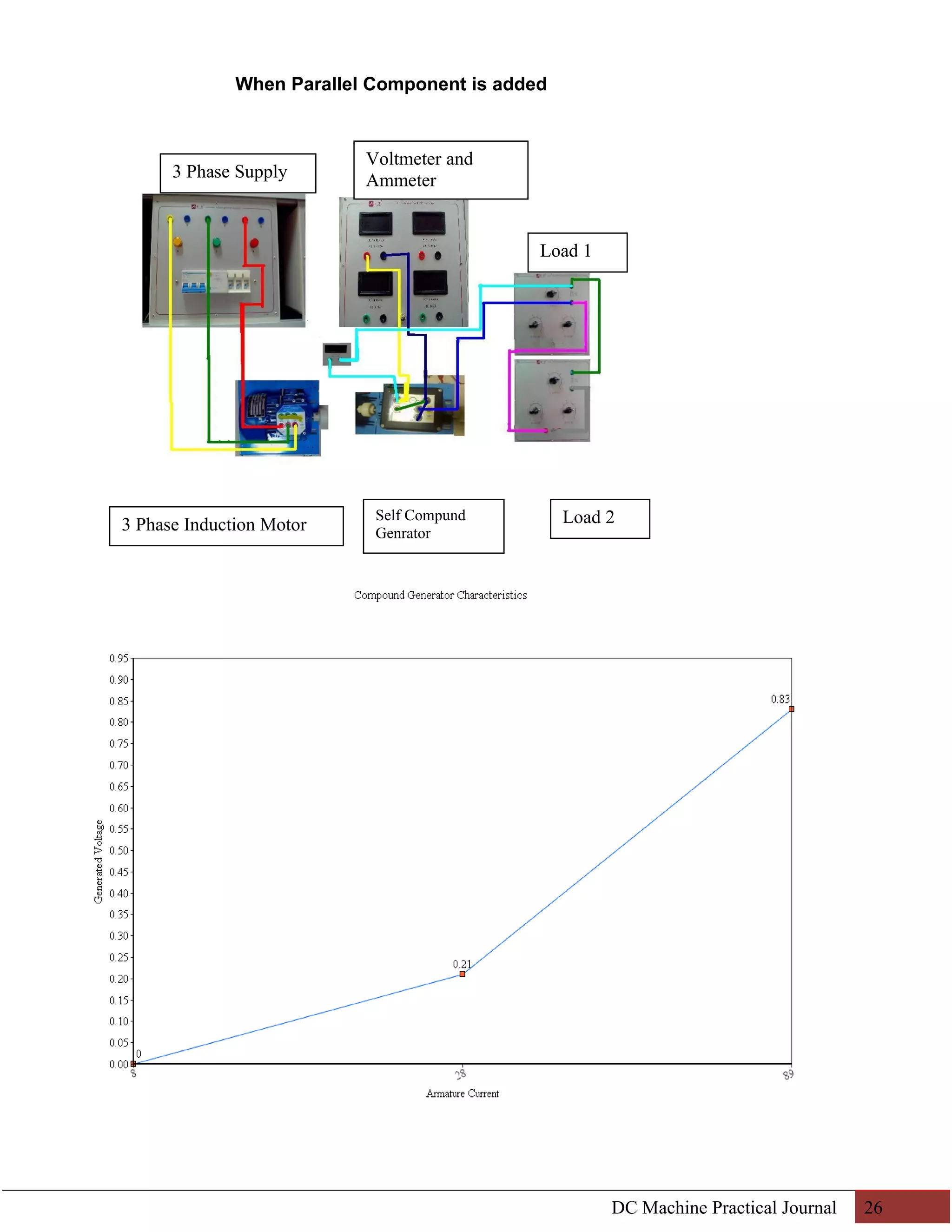
Load 1 28 0.21 
Load 2 89 0.83 
On No load: While using both shunt ans series winding, on no load Eg increases as well as Ia. 
When Load 1 is connected: Eg increases as well as Ia. 
When Load 2 is connected: Eg further increases as well as Ia. 
DC Machine Practical Journal 25
When Parallel Component is added 
DC Machine Practical Journal 26 
3 Phase Induction Motor Self Compund 
Genrator 
Load 1 
Load 2 
Voltmeter and 
3 Phase Supply Ammeter
Practical # 07 
Objective: Effect of Field current on back EMF & Speed of Separately excited DC Motor. 
Equipments 
· 3-Phase AC Power Supply 
· 3-Phase Induction Motor 
· DC Self excited Compound Generator 
· DC Voltmeter 
· DC Ammeter 
· Regulated AC & DC Supply 
· Variable & Fixed Resistive Loads 
Theory: The aim of this Practical is to see the effect of field current on back emf and to observe the speed of separately 
excited dc motor of DC motor speed control. The greatest advantage of DC motors may be speed control. Since speed is 
directly proportional to armature voltage and inversely proportional to the magnetic flux produced by the poles, adjusting 
the armature voltage and/or the field current will change the rotor speed. 
The field current, If, is constant (and hence the flux density B is constant), and the armature voltage is varied. A 
constant field current is obtained by separately exciting the field from fixed dc source. The flux is produced by the field 
current, therefore, essentials constant. Thus the torque is proportional only to the armature current. As we increase the Vdc of 
separately excited motor If increases, flux increases and back emf increases but speed (N) decreases. 
Since we know that 
Eb= V-IaRa, 
Increasing resistance will decrease Eb &As load is increased, armature current also increases. 
DC Machine Practical Journal 27
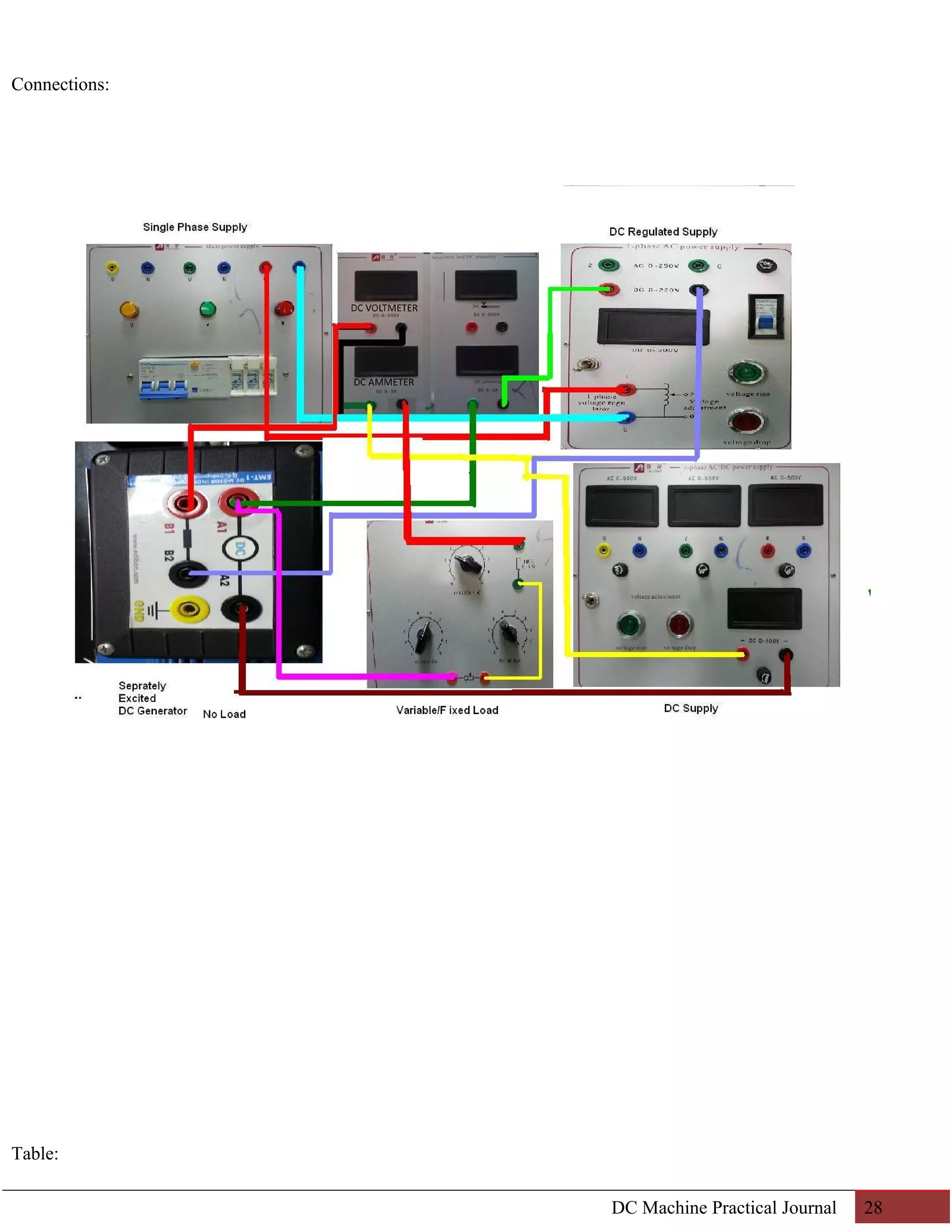
Connections: 
Table: 
DC Machine Practical Journal 28
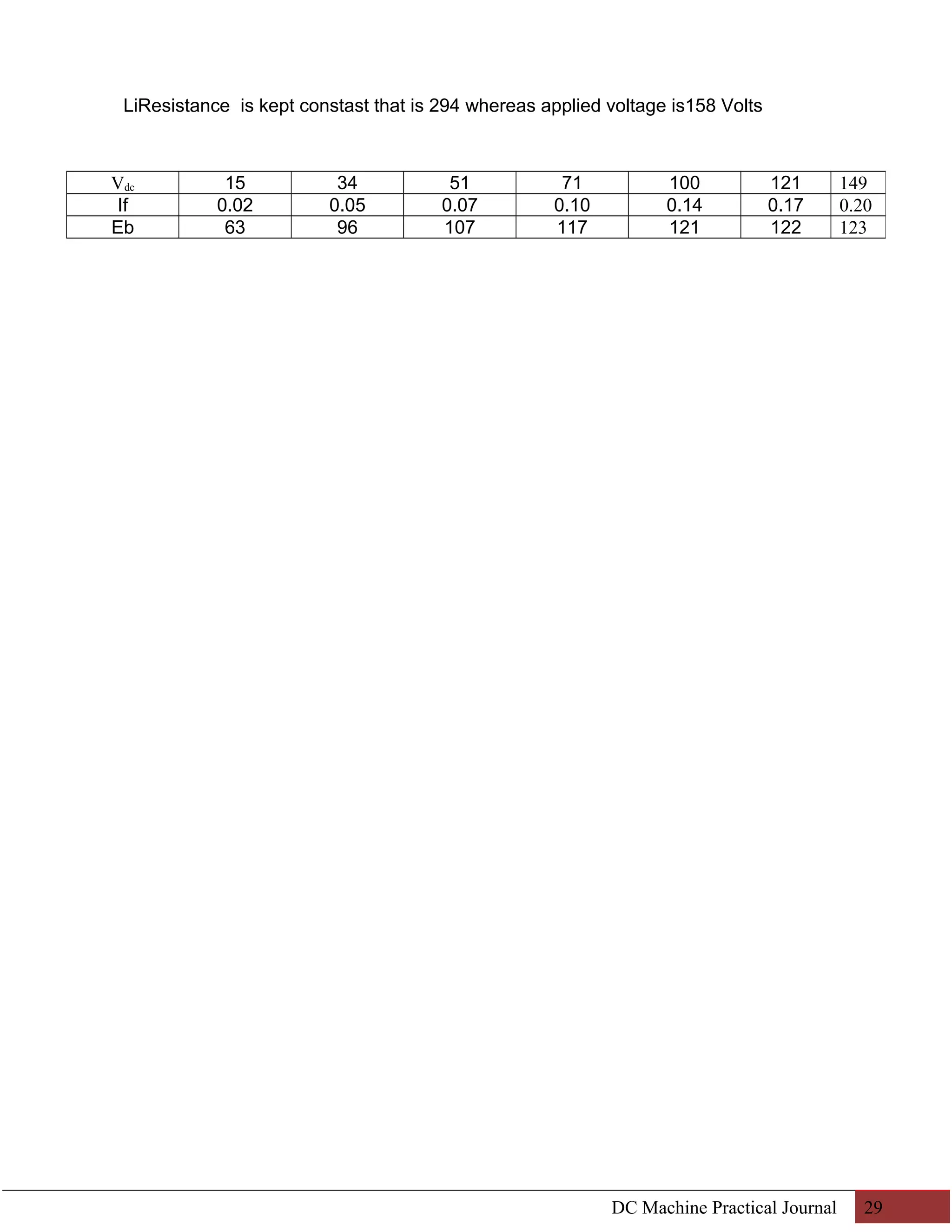
LiResistance is kept constast that is 294 whereas applied voltage is158 Volts 
Vdc 15 34 51 71 100 121 149 
If 0.02 0.05 0.07 0.10 0.14 0.17 0.20 
Eb 63 96 107 117 121 122 123 
DC Machine Practical Journal 29
Practical # 08 
Object: 
Effect of Line resistance on Back EMF of Separately excited DC Motor. 
Equipments: 
· Single Phase Supply 
· AC/DC Converter & Regulator 
· DC Ammeter 
· DC Voltmeter 
· Variable Resistor 
· DC regulated Power Supply 
· Separately Excited DC Generator or Motor 
Theory: 
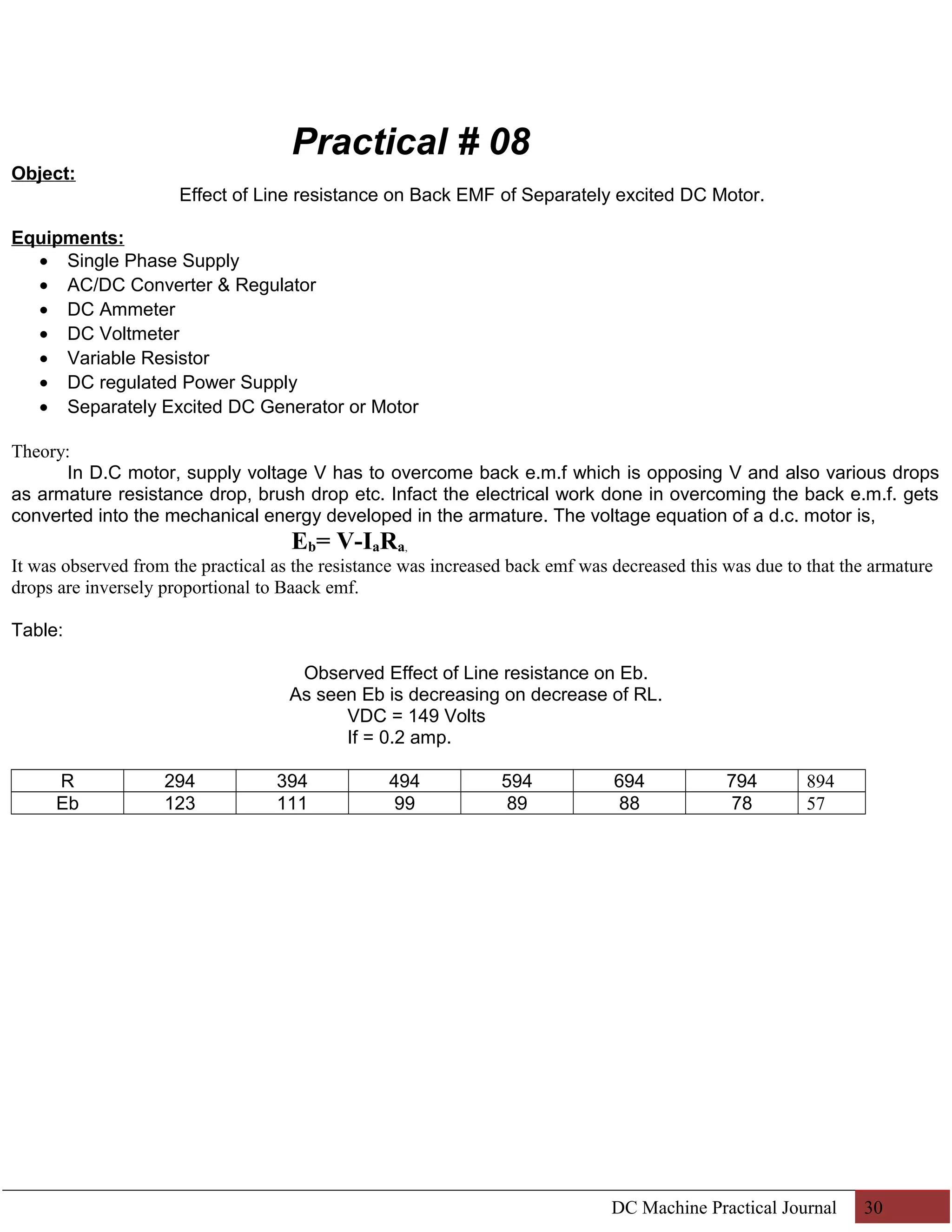
In D.C motor, supply voltage V has to overcome back e.m.f which is opposing V and also various drops 
as armature resistance drop, brush drop etc. Infact the electrical work done in overcoming the back e.m.f. gets 
converted into the mechanical energy developed in the armature. The voltage equation of a d.c. motor is, 
Eb= V-IaRa, 
It was observed from the practical as the resistance was increased back emf was decreased this was due to that the armature 
drops are inversely proportional to Baack emf. 
Table: 
Observed Effect of Line resistance on Eb. 
As seen Eb is decreasing on decrease of RL. 
VDC = 149 Volts 
If = 0.2 amp. 
R 294 394 494 594 694 794 894 
Eb 123 111 99 89 88 78 57 
DC Machine Practical Journal 30
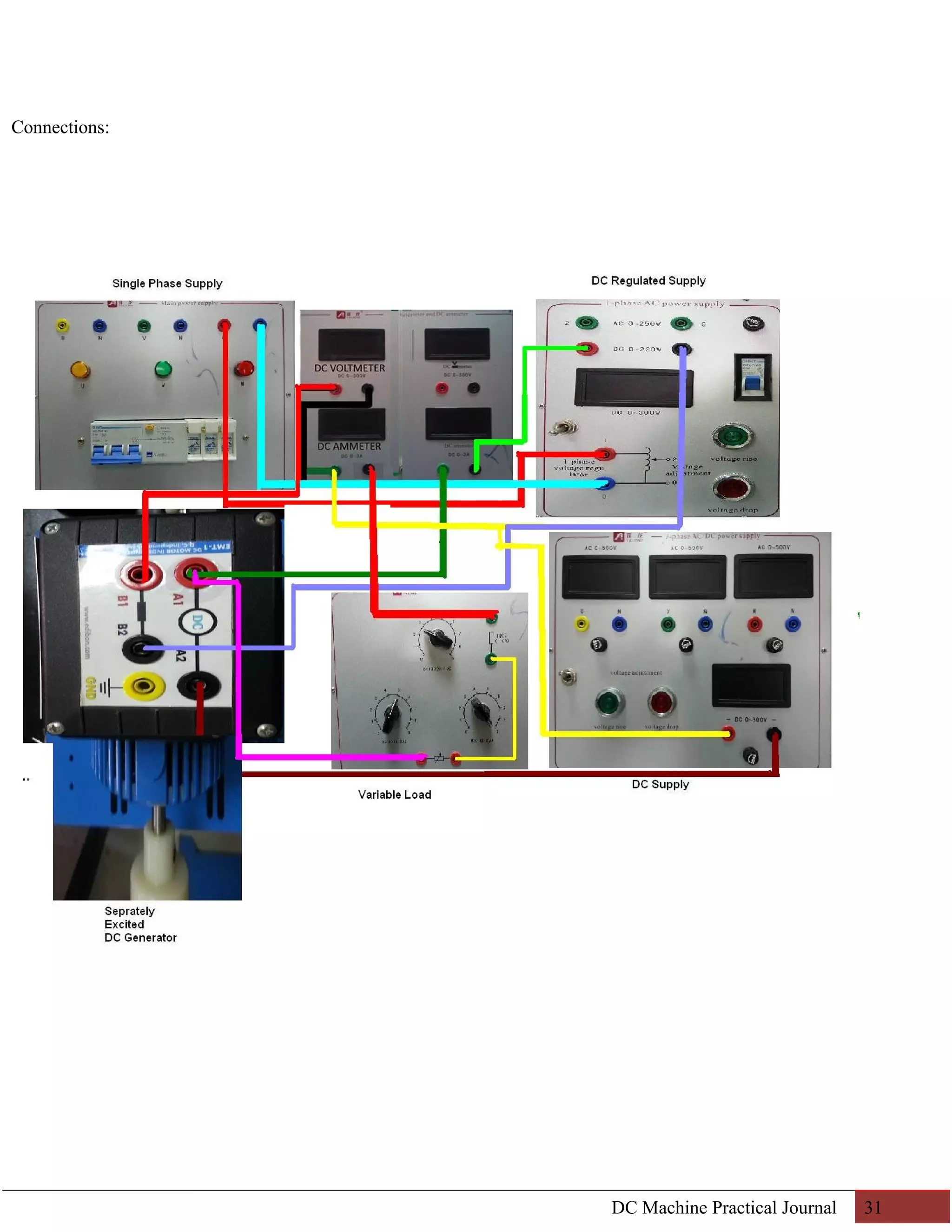
Connections: 
DC Machine Practical Journal 31
Practical # 09 
Object: 
Effect of Load on Back EMF & Armature current of Separately excited DC Motor. 
Equipments: 
· Single Phase Supply 
· AC/DC Converter & Regulator 
· DC Ammeter 
· DC Voltmeter 
· Fixed Resistance 
· DC regulated Power Supply 
· Separately Excited DC Generator or Motor 
· Mechanical Loads 
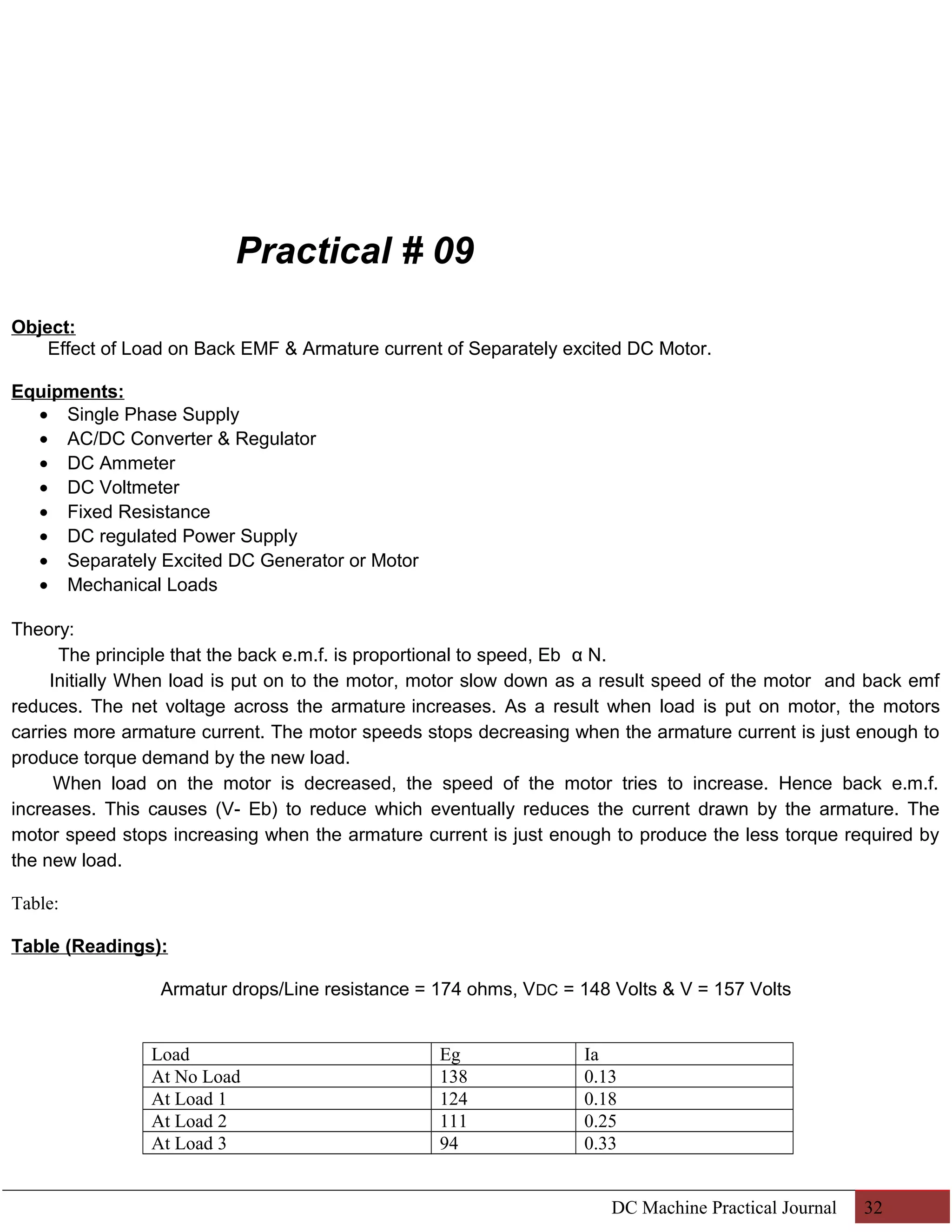
Theory: 
The principle that the back e.m.f. is proportional to speed, Eb α N. 
Initially When load is put on to the motor, motor slow down as a result speed of the motor and back emf 
reduces. The net voltage across the armature increases. As a result when load is put on motor, the motors 
carries more armature current. The motor speeds stops decreasing when the armature current is just enough to 
produce torque demand by the new load. 
When load on the motor is decreased, the speed of the motor tries to increase. Hence back e.m.f. 
increases. This causes (V- Eb) to reduce which eventually reduces the current drawn by the armature. The 
motor speed stops increasing when the armature current is just enough to produce the less torque required by 
the new load. 
Table: 
Table (Readings): 
Armatur drops/Line resistance = 174 ohms, VDC = 148 Volts & V = 157 Volts 
Load Eg Ia 
At No Load 138 0.13 
At Load 1 124 0.18 
At Load 2 111 0.25 
At Load 3 94 0.33 
DC Machine Practical Journal 32
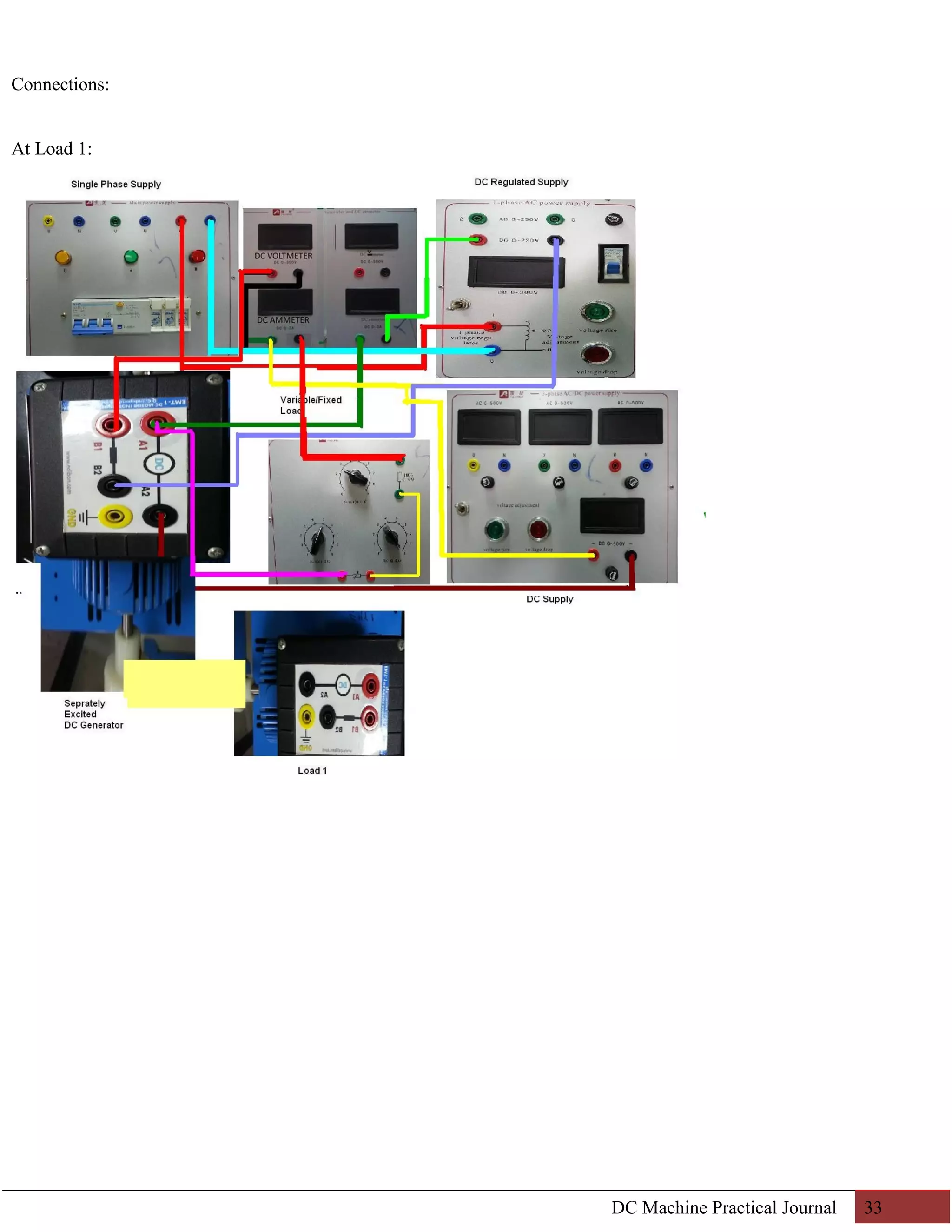
Connections: 
At Load 1: 
DC Machine Practical Journal 33
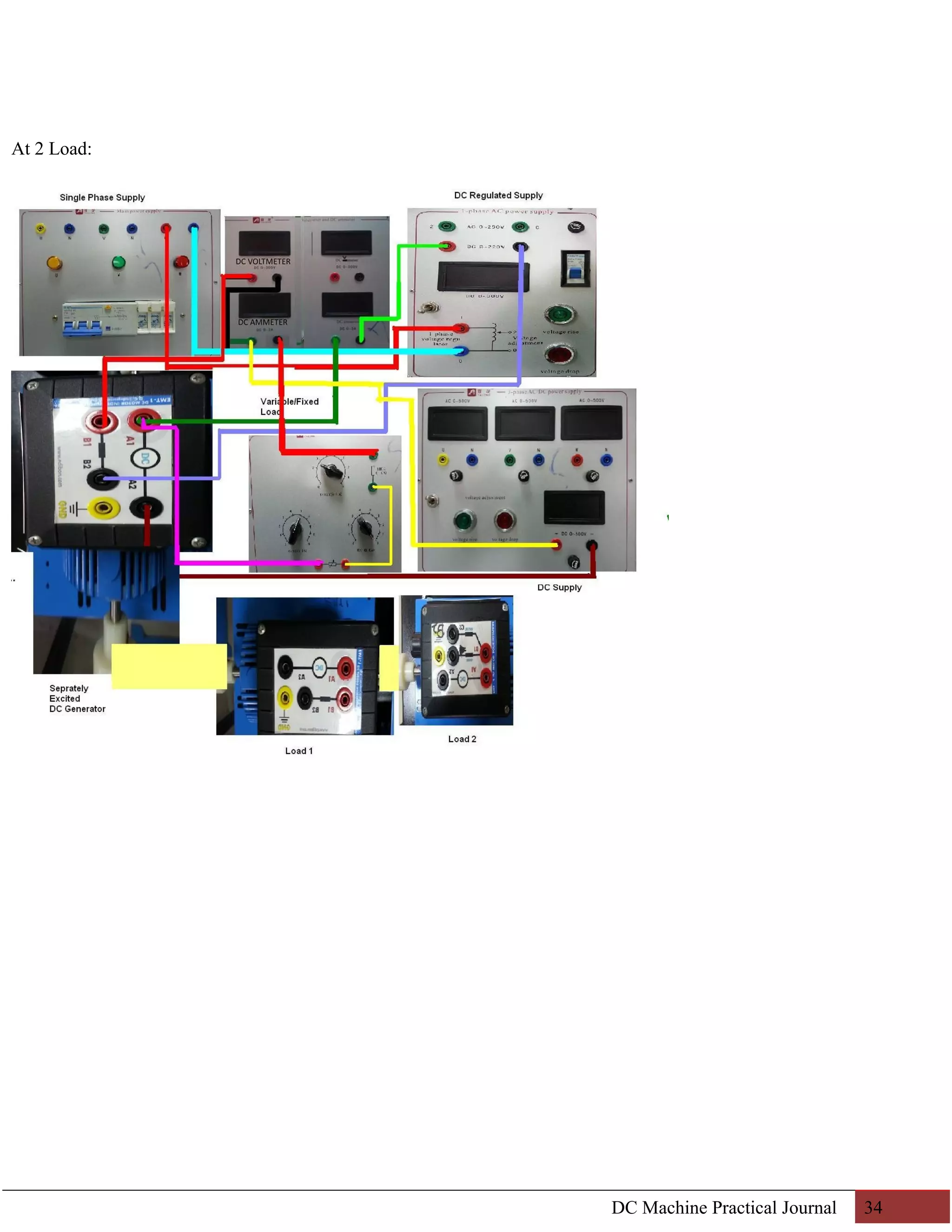
At 2 Load: 
DC Machine Practical Journal 34
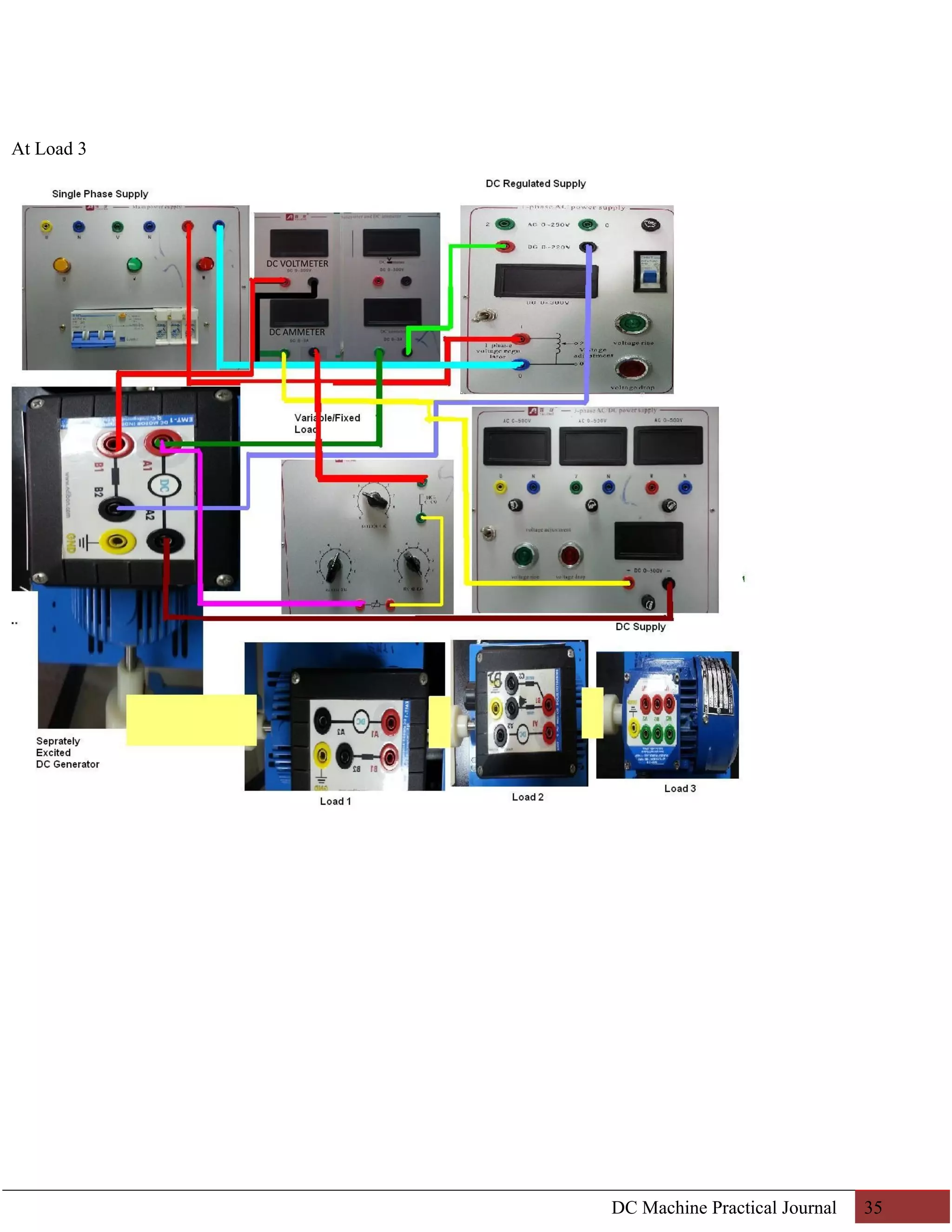
At Load 3 
DC Machine Practical Journal 35
Practical # 10 
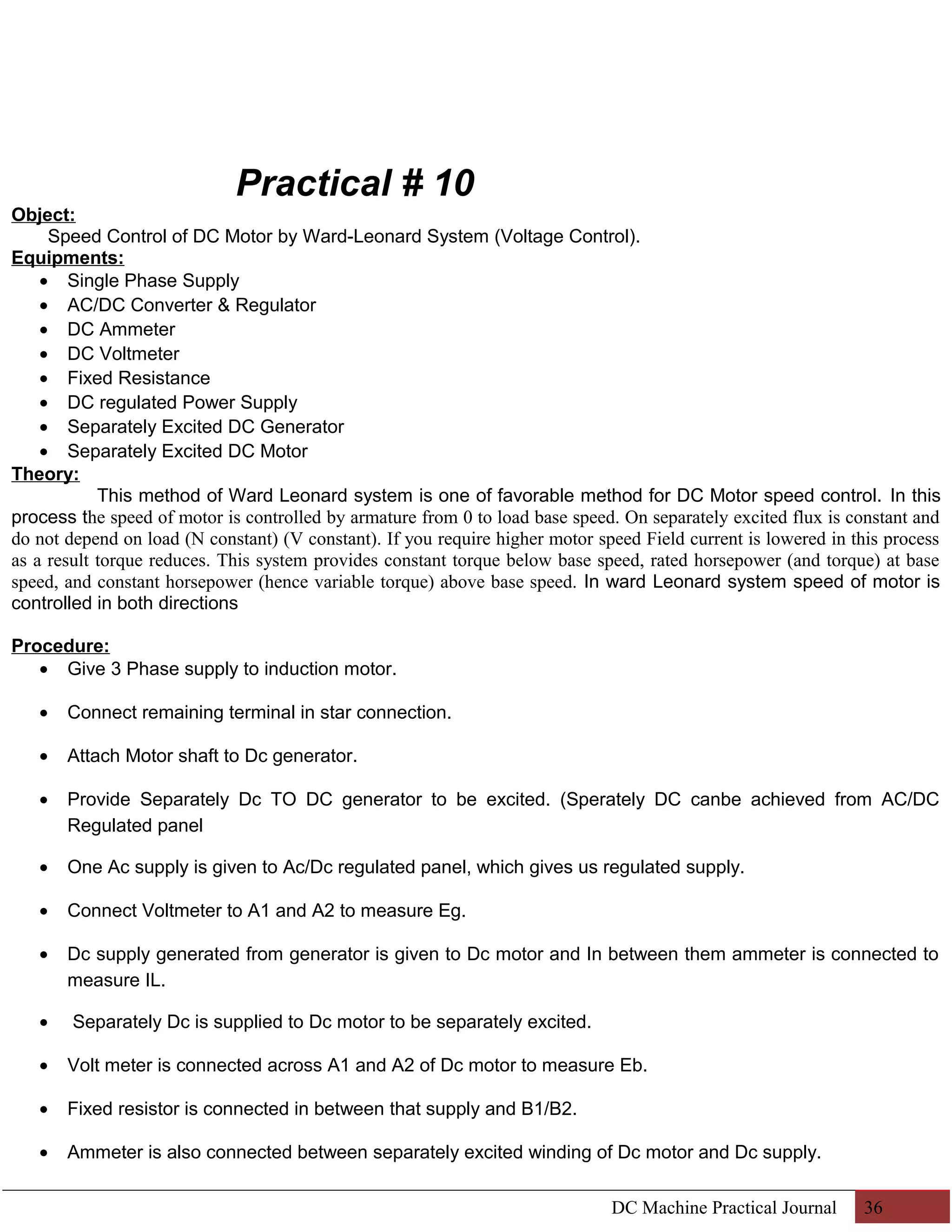
Object: 
Speed Control of DC Motor by Ward-Leonard System (Voltage Control). 
Equipments: 
· Single Phase Supply 
· AC/DC Converter & Regulator 
· DC Ammeter 
· DC Voltmeter 
· Fixed Resistance 
· DC regulated Power Supply 
· Separately Excited DC Generator 
· Separately Excited DC Motor 
Theory: 
This method of Ward Leonard system is one of favorable method for DC Motor speed control. In this 
process the speed of motor is controlled by armature from 0 to load base speed. On separately excited flux is constant and 
do not depend on load (N constant) (V constant). If you require higher motor speed Field current is lowered in this process 
as a result torque reduces. This system provides constant torque below base speed, rated horsepower (and torque) at base 
speed, and constant horsepower (hence variable torque) above base speed. In ward Leonard system speed of motor is 
controlled in both directions 
Procedure: 
· Give 3 Phase supply to induction motor. 
· Connect remaining terminal in star connection. 
· Attach Motor shaft to Dc generator. 
· Provide Separately Dc TO DC generator to be excited. (Sperately DC canbe achieved from AC/DC 
Regulated panel 
· One Ac supply is given to Ac/Dc regulated panel, which gives us regulated supply. 
· Connect Voltmeter to A1 and A2 to measure Eg. 
· Dc supply generated from generator is given to Dc motor and In between them ammeter is connected to 
measure IL. 
· Separately Dc is supplied to Dc motor to be separately excited. 
· Volt meter is connected across A1 and A2 of Dc motor to measure Eb. 
· Fixed resistor is connected in between that supply and B1/B2. 
· Ammeter is also connected between separately excited winding of Dc motor and Dc supply. 
DC Machine Practical Journal 36
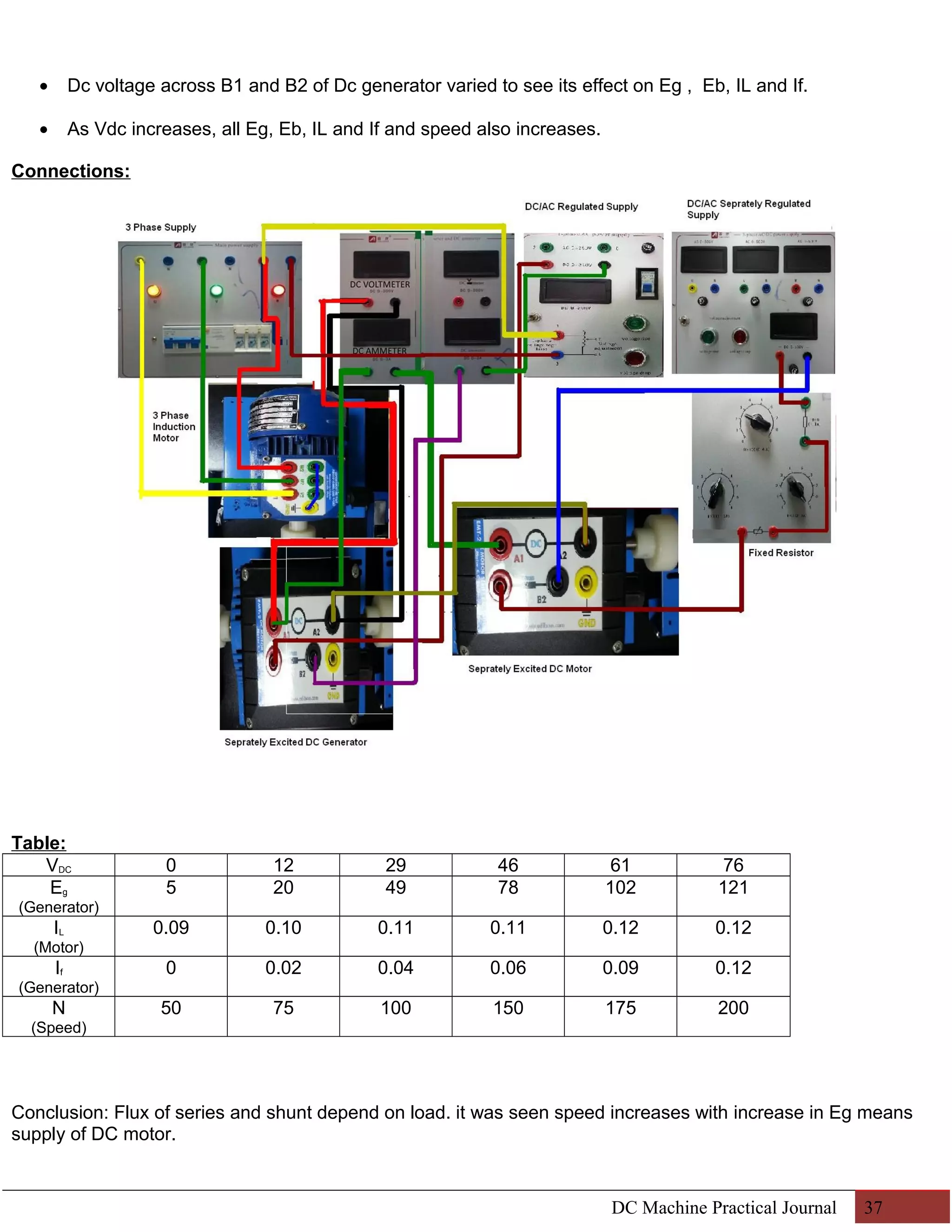
· Dc voltage across B1 and B2 of Dc generator varied to see its effect on Eg , Eb, IL and If. 
· As Vdc increases, all Eg, Eb, IL and If and speed also increases. 
Connections: 
Table: 
VDC 0 12 29 46 61 76 
Eg 
(Generator) 
5 20 49 78 102 121 
IL 
(Motor) 
0.09 0.10 0.11 0.11 0.12 0.12 
If 
(Generator) 
0 0.02 0.04 0.06 0.09 0.12 
N 
(Speed) 
50 75 100 150 175 200 
Conclusion: Flux of series and shunt depend on load. it was seen speed increases with increase in Eg means 
supply of DC motor. 
DC Machine Practical Journal 37
Practical # 11 
Object: 
Speed Control of DC Series motor by putting diverter in parallel to field winding. 
Equipments: 
· Equipments used in practical were: 
· Series DC Motor 
· Loads (DC Generator & 3-Ph Induction Motor) 
· Variable Resistor 
· DC Ammeter & Voltmeter 
Theory: 
In this method variable resistance (called field diverter) is connected parallel with series field winding. The 
main reason to do this is to shunt some portion of the line current from the series field winding, as a result 
weakening the field and increasing the speed. The lowest speed obtainable is that corresponding to zero current 
in the diverter). The lowest speed obtainable is the normal speed of the motor. Consequently, this method can 
only provide speeds above the normal speed. The series field diverter method is often employed in traction 
work. 
Procedure: 
· Apply Vdc is applied across A1 and B2 (VDC Of motor is constant) 
· Connect Ammeter between supply and A1 B2 
· Connect A2 to B1 to connect field winding in series 
· Apply Load through the shaft of motor 
DC Machine Practical Journal 38
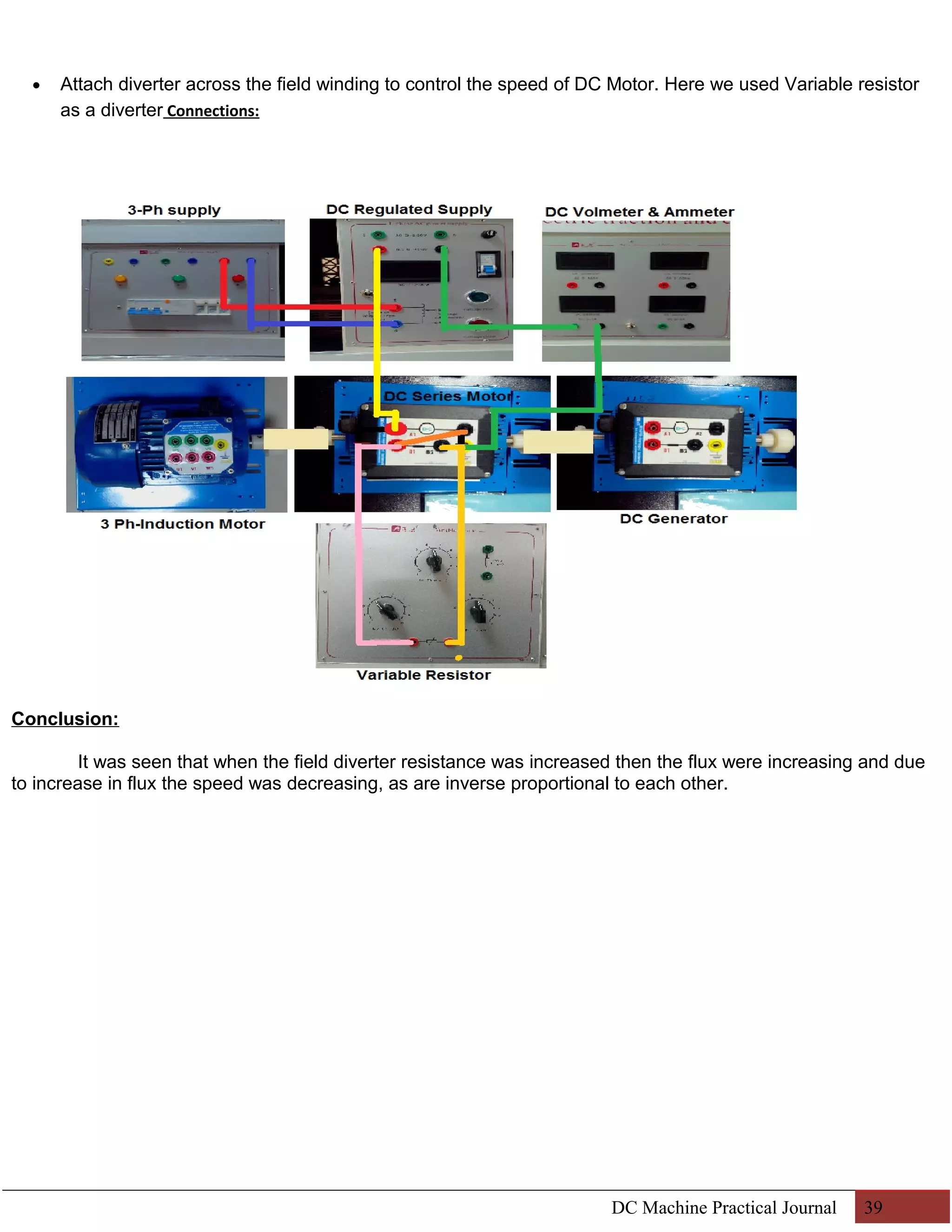
· Attach diverter across the field winding to control the speed of DC Motor. Here we used Variable resistor 
as a diverter Connections: 
Conclusion: 
It was seen that when the field diverter resistance was increased then the flux were increasing and due 
to increase in flux the speed was decreasing, as are inverse proportional to each other. 
DC Machine Practical Journal 39
Practical # 12 
Object: 
Speed Control of DC Series Motor by putting diverters in parallel to armature. 
Equipments: 
· Series DC Motor 
· Loads (DC Generator & 3-Ph Induction Motor) 
· DC Ammeter & Voltmeter 
· Variable Resistor 
Theory: 
We connect variable resistance or armature diverter is connected in parallel with the armature Line current is shunt by 
the diverter that results in reducing the armature current. Now for a given load, if Ia Is decreased, the flux must increase 
Since, the motor speed is decreased. By adjusting the armature diverter, any speed lower than the normal speed can be 
obtained. 
Procedure: 
· Give separately DC Supply to A1 & B2 terminals of DC Series connected Motor. 
· Connect Ammeter in between them to measure Armature Current. 
· Connect Variable resistor in Parallel/Shunt to Armature A1 & A2. 
· Connect Loads to the shaft of DC Series Motor. 
· Vary Resistance to see its effect on armature current. 
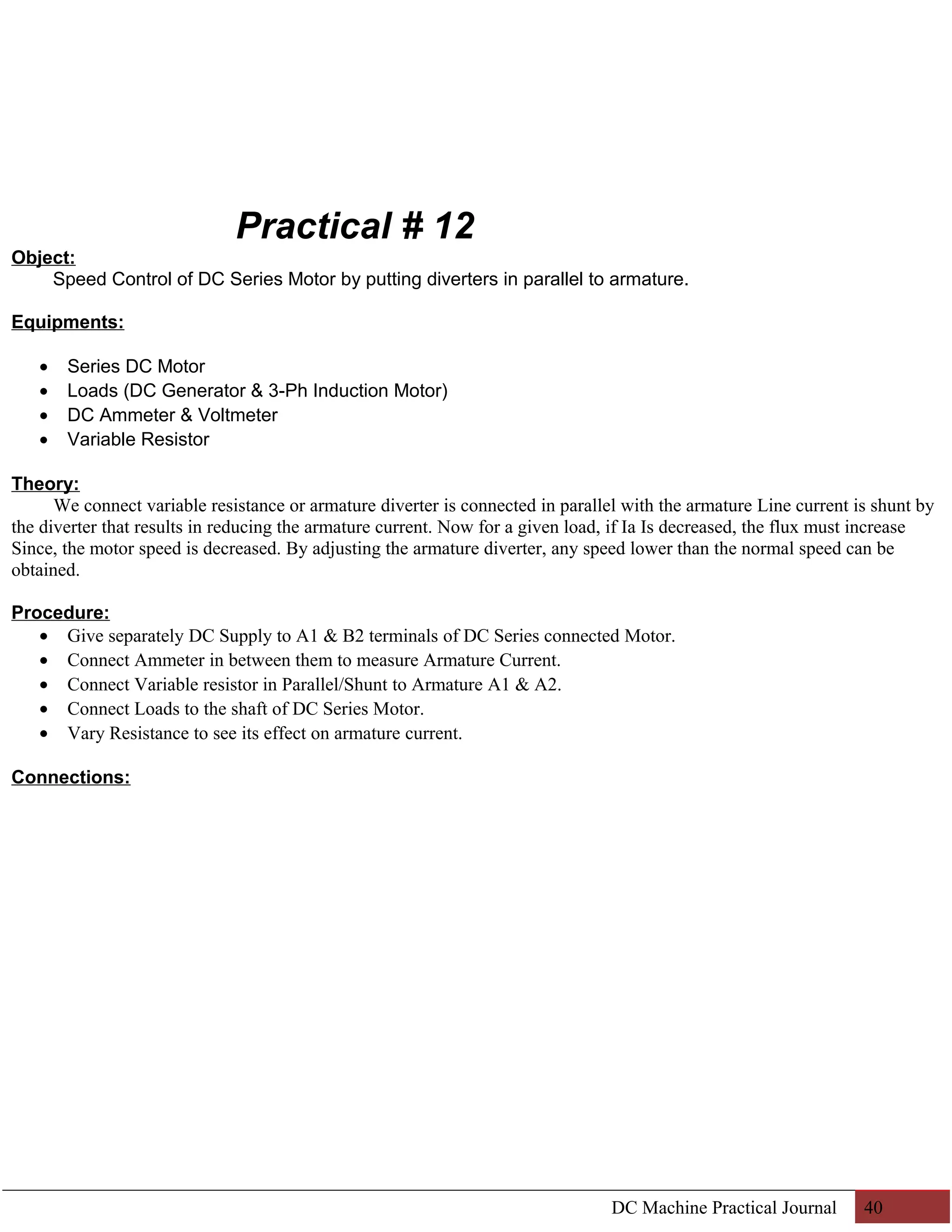
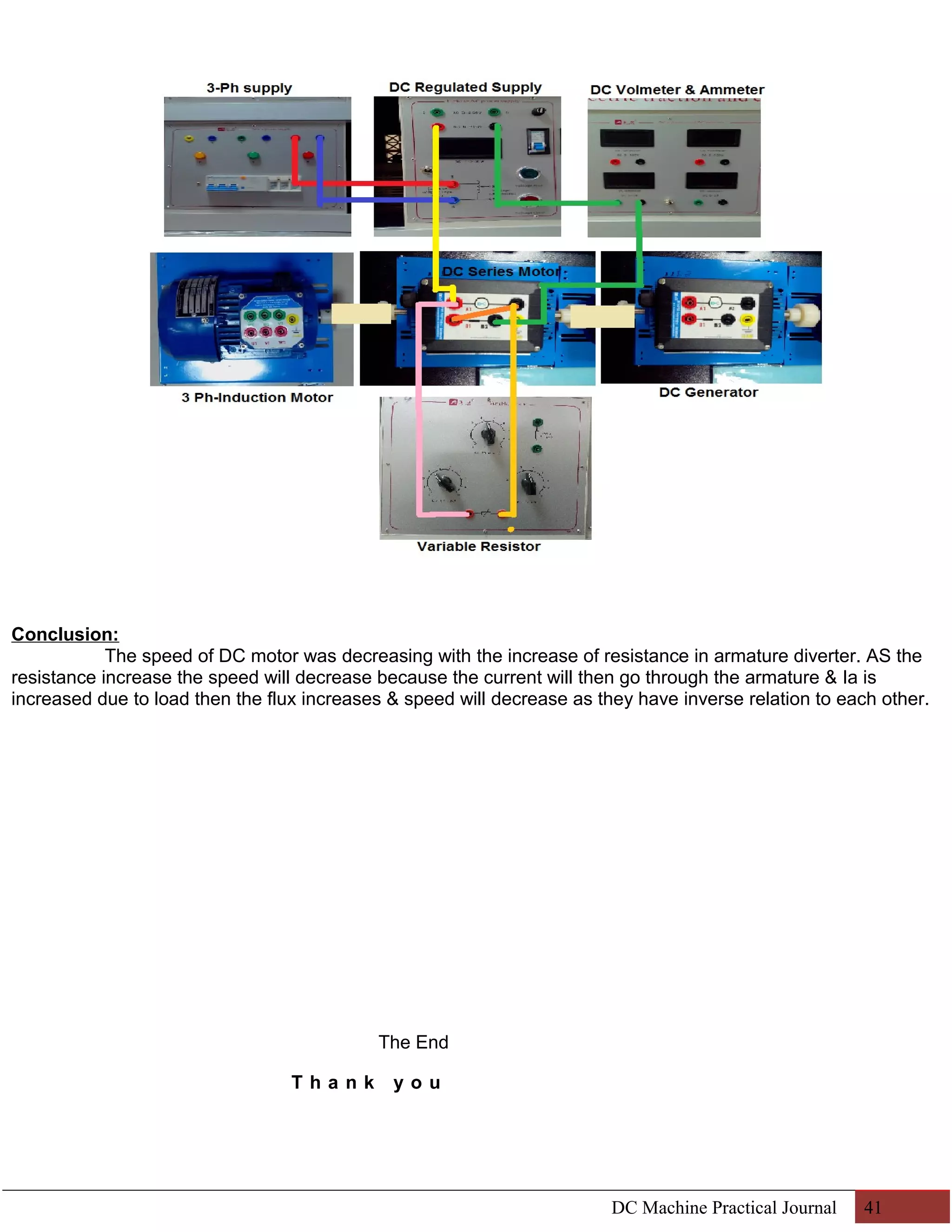
Connections: 
DC Machine Practical Journal 40
Conclusion: 
The speed of DC motor was decreasing with the increase of resistance in armature diverter. AS the 
resistance increase the speed will decrease because the current will then go through the armature & Ia is 
increased due to load then the flux increases & speed will decrease as they have inverse relation to each other. 
The End 
T h a n k y o u 
DC Machine Practical Journal 41

Dc machine practical

  • 1.
    For Second Year ( Department of Electrical Engineering) ROLL No: 01, 03, 04, 05, 07, 09, 11, 12, 13, 14 Batch : 12 Electrical Department: Electrical Engineering Subject: DC Machine Class Advisor: Ahsanullah Memon Supervised by: Ahsanullah Memon (Lecturer) Complied by: Group No. 1 ELECTRICAL MACHINES LAB DEPARTMENT OF ELECTRICAL ENGINEERING Mehran University of Engineering and Technology SZAB Campus.
  • 2.
    INDEX S.NO &DATE EXPERIMENTS 01. 28-08-13 Introduction to Electrical Machines, and Transformer. 02. 04-09-13 Verification of O.C.C of Seprately Excited DC Generator 03. 23.09.13 Verification of O.C.C of Self Excited Series DC Generator. 04. 23.09.13 To verify Internal Characteristics of Separately excited DC Generator (Verification of Armature reaction.) 05. 24.09.13 Verification of Characteristics of DC Shunt Generator. 06. 24.09.13 Verification of Characteristics of Over Compound Generator 07. 27.09.13 Effect of Field current on back EMF & Speed of Separately excited DC Motor. 08. 27.09.13 Effect of Line resistance on Back EMF of Separately excited DC Motor. 09. 27.09.13 Effect of Load on Back EMF & Armature current of Separately excited DC Motor. 10. 5.10.2013 Speed Control of DC Motor by Ward-Leonard System (Voltage Control). 11. 09.10.2013 Speed Control of DC Series motor by putting diverter in parallel to field winding. 12. 15.10.2013 Speed Control of DC Series Motor by putting diverters in parallel to armature.
  • 3.
    Practical # 01 OBJECT :- Introduction of Electrical Machines equipments and transformer Equipment :- 1. DC Motor 2. DC Generator 3. Transformer 4. YL-195 Motor, Electric traction and Electrical control trainer 1. DC Motor: CIRCUIT DIAGRAM THEORY :- Motors take electrical energy and produce mechanical energy. Mechanical energy can be supplied to various types of load. The motor operating on DC supply are called DC motor. DC motors do not operate in protected locations, they face dust, moisture, fumes and tend to get mechanical damage. Hence, their construction is of closed type. The operation of motors is based on the principle – when a current-carrying conductor is placed in a magnetic field, it experiences a mechanical force. The magnitude of this force is F = BIL, and its direction is determined by Fleming's left-hand rule. DC Machine Practical Journal | 3
  • 4.
    Working of D.C.Motor Suppose the conductors under N-pole carry currents into the plane of the paper and those under S-pole carry currents out of the plane of the paper as shown in Fig.(4.1). Since each armature conductor is carrying current and is placed in the magnetic field, mechanical force acts on it. Referring to Fig. (4.1) and applying Fleming’s left hand rule, it is clear that force on each conductor is tending to rotate the armature in anticlockwise direction. Speed is controlled by varying the rotor voltage and hence the rotor current, or by varying the magnetic flux in the air gap by changing the current in the field windings. With access to both the field and rotor windings, all DC motors offer the facility of simple speed and torque control. Ratings and Figure of DC Motor Below is One of type of DC Motor named as DC Separately Excited Motor in which The armature and field winding are electrically separate from each other and The field winding is excited by a separate DC source. DC Machine Practical Journal | 4
  • 5.
    Schematic Diagram Ratingsof DC Motor (Seprately Excited) 1 Power (Pn) 120W 2 Frequency 1000 r/min 3 Voltage 110 4 Current (in amperes) 1.25A Figure 2. DC Generator: Theory: A generator is a machine that converts mechanical energy into electrical energy by using the Principle of magnetic induction which is done by rotating armature which contains conductors and move them through a magnetic field. The voltage generated by DC Generator varies from 0 to its maximum value twice each revolution of its loop. The construction of a DC generator is very similar to the construction of a DC motor. The rotor consists of an electromagnet providing the field excitation. The construction of a DC generator is very similar to the construction of a DC motor DC Machine Practical Journal | 5
  • 6.
    DC Generator BasicComponents of DC Generator 1. Armature: It is structure upon which are mounted are coils that which cuts magnetic lines of force. 2. Commutator: It is that Component of DC Generator that rectifies generated alternating current to provide direct current output and connects the stationary output terminal to rotating armature. 3. Brushes: Brushes make contact with the commutator to collect the current generated by armature coil. 4. Poles are required to produce magnetic field or flux which passes through conductor of armature coil. Ratings of DC Generator 1 Power (Pn) 120W 2 RPM 1000 r/min 3 Voltage 110 DC Machine Practical Journal | 6
  • 7.
    4 Current (inamperes) 1.25A 3. Transformer: Theory: A transformer is a device having no movable parts that transfer power from one circuit to another circuit usually with changes values of both current and voltage. As current vary in primary coil will creates a varying magnetic flux in the transformer's core as a result magnetic flux vary in secondary coil. The variation in secondary coil will induces emf or voltage in secondary coil. Transformers can link two or more electric circuits. In its simple form two electric circuits can be linked by a magnetic circuit, one of the electric coils is used for the creation induced voltage in the same. Transformers have good applications in High voltage Power Transmission. Ratings of Transformer 4. YL-195 Motor, Electric traction and Electrical control trainer: This type of panel is used in practical such as of dc generators, motors, transformers etc. It contains equipments such as millimeter, power supply rheostats, switches etc. A general View of this panel is shown below. DC Machine Practical Journal | 7 1 Primary Voltage 127V 2 Frequency 50 hertz 3 Secondary Voltage 50V 4 Current (in amperes) 1.25A
  • 8.
    Components: · 3-PhaseAC DC power supply · 1-Phase AC power supply and Knife Switch · AC DC voltmeters and ammeters · Electricity parameter tester DC Machine Practical Journal | 8
  • 9.
  • 10.
    Practical # 02 Objective: Verification of O.C.C (Open Circuit Characteristics) of Separately Excited DC Generator. Equipments: Power Supply DC Voltmeter DC Ammeter DC Supply 3-Phase Induction Motor The separately excited motor has independent voltage supplies to the field and rotor windings allowing more control over the motor performance. Characteristics The voltage on either the field or the rotor windings can be used to control the speed and torque of a separately excited motor. This curve shows the relation between the generated e.m.f. at no-load (E0) and the field current (If) at constant speed. It is also known as magnetic characteristic or no-load saturation curve. Its shape is practically the same for all generators whether separately or self-excited. The data for O.C.C. curve are obtained experimentally by operating the generator at no load and constant speed and recording the change in terminal voltage as the field current is varied. The O.C.C is also known as no load magnetizing characteristics. It gives relation between generated emf on no-load and the field current when machine is driven at rated speed. The field winding of generator is provided with separate DC Source. The Ammeter is connected in series that will be used to read excitation current through field winding while voltmeter is connected with armature to read generated emf. DC Machine Practical Journal 10
  • 11.
    Procedure: The O.C.C.for a d.c. generator is determined and verified as follows 1. Connections are made as per the circuit diagram. 2. Disconnect the field winding of DC Generator from the machine and is separately excited from an external d.c. source as shown in figure above. 3. Connect Ammeter with series with field winding that will read excitation current through the field winding. 4. Connect the voltmeter across the armature that will read the emf generated by the machine 5. The generator is run at fixed speed (i.e., normal speed). The field current (If) is increased from zero in steps and the corresponding values of generated e.m.f. (E0) read off on a voltmeter connected across the armature terminals. On plotting the relation between E0 and If, we get the open circuit characteristic as shown in Fig. Connections: DC Machine Practical Journal 11
  • 12.
    Readings: V 1531 48 74 97 124 153 183 If 0.02 0.05 0.07 0.10 0.13 0.17 0.21 0.24 Eo 26 54 84 121 141 154 163 172 Conclusion: We Observe from practical that on no loaf Generated emf was still 8V, This was due to residual flux. And there was one point after (183V )which No load voltage (Eo) stopped increasing, that point is called saturation point. To sum up, as the voltage was increased the generated e.m.f. (Eo) was increases. Open Characteristic Curve DC Machine Practical Journal 12
  • 13.
    Practical # 03 Object: Verification of O.C.C of Self Excited Series DC Generator. Equipment Used: · 3-Phase AC Power Supply · 3-Phase Induction Motor · Self excited series connected DC Generator · Fixed & Variable resistive loads · DC Voltmeter · DC Ammeter Theory: Figure below describes the characteristics of dc series generator. The curve (a) shows open circuit characteristics, curve (b) shows internal and curve 3 indicate external characteristics of dc series generator. When Load current is 0 the generated and terminal armature V are same, both being due to residual magnetic field. When when load is applied, Automatic build up of V takes place from the point when load current flows through series field winding producing additional flux aiding residual flux.as further increase in load beyond the maximum voltage point produces sharply drooping characteristics as shows below. The reason being the increased voltage drops and the increased armature reaction decreased the load voltage at a much faster than increase in generated voltage taking place by the increased load current. Procedure: DC Machine Practical Journal 13
  • 14.
    1. Connect thecircuit as shown in connection below. (We need to connect the feld winding across the armature instead of connecting it to a separate supply). 2. Slowly increase the input to the prime-mover. Speed of the set will increase. Observe the voltmeter connected across the terminals of the dc generator. Above a certain speed the voltmeter reading starts increasing (If this does not happen reduce the prime-mover input and switch o® the supply. Interchange the feld terminals of the generator and repeat the same procedure). By controlling the input to the prime mover adjust the speed to the rated speed of the machine. 3. Close the main switch S. Load the generator in steps by switching ON the load and for each case adjust the prime mover input such that the speed remains constant. Note down the load voltage and current, feld current of the generator, armature current and voltage. Repeat this procedure till the load current is equal to the rated current of the generator. 4. Put off all the load, open the main switch S, reduce the prime mover input and put off the AC supply to the controller. Discription: Load Resistance Field Current Generated Voltage At No load Eo ∞ 0 10 At Load 1 200 0.06 13 At Load 2 300 0.76 78 At Load 3 400 1.54 79 Connections: DC Machine Practical Journal 14
  • 15.
    Characteristic Curve: DCMachine Practical Journal 15 3 Phase AC Supply 3 Phase Induction Motor Load 1 Load 2 Self Excited Series Motor DC Ammeter & Voltmeter Switch Switch 2 1
  • 16.
    Due to SatuarationPoint Result: We Observe from the curve that there is certain field current after which generated voltage remain constant even after increasing the load that point is called satuaration point. Practical # 04 Object: To verify Internal Characteristics of Separately excited DC Generator (Verification of Armature reaction.) DC Machine Practical Journal 16 Eo Load 1 Load 2 Load 3
  • 17.
    Equipments: · 3-PhaseAC Power Supply · 3-Phase Induction Motor · Regulated AC & DC Supply · DC Separately excited Generator · Variable & Fixed Resistive Loads · DC Voltmeter · DC Ammeter THEORY :- The load or external characteristic of a generator is the relation between the terminal voltage and load current. The characteristic expressed the manner in which the voltage across the load varies with I, the value of load current. The internal or total characteristic of a generator is the relation between the e.m.f actually induced in the generator Ea and the armature current Ia. The internal characteristic of the generator, which is separately excited, can be obtained as below: Let: Vt = Terminal voltage Ia = Armature current Ra = Armature resistance Then, Ea = Vt + IaRa Ia = IL Therefore if we add drop of armature (IaRa) to terminal voltage Vt we get actually induced e.m.f (Ea). PROCEDURE:- 1. Make the connections according to the circuit diagram. 2. Run the generator at a constant speed and the exciting current. 3. Connect the load across the generator armature. 4. Increase the load current gradually by the help of load rheostat and note the readings of ammeters and voltmeter. Discription (Readings): VDC= 100 Ia= IL Load Eg Ia=IL At No Load 142 0 At Load 1 (200Ω+100Ω variable) 126 0.61 At Load 2 (250Ω+150Ω variable) 111 0.85 At Load 3 (100Ω+0Ω variable) 85 1.58 Connections: DC Machine Practical Journal 17 3 phase induction motor 3 phase Power supply
  • 18.
    Characteristic Curve: Practical# 05 Object: Verification of Characteristics of DC Shunt Generator. Equipments DC Machine Practical Journal 18 Internal Characteristic Curve
  • 19.
    · 3-Phase ACPower Supply · 3-Phase Induction Motor · DC Self excited Compound Generator · DC Voltmeter · DC Ammeter · Regulated AC & DC Supply · Variable & Fixed Resistive Loads Theory: A generator when operated for the general operation its speed practically is constant under such conditions it gives relationship among excitation load current and voltage. These relation when shown by the graphs then they are called characteristics which are actually three curves. 1. Open Circuit Chacteristics 2. Internal Characteristics 3. External Characteristics OCC show relationship between no load generated emf and field current.when generator builds up small voltage generated emf remains constant coz it is not applied to any load. Internal Characteristics shows relationship between on load generated emf and armature current. When generator is put on load the emf decreases due to reduction of flux at per pole. So as obserbed in practical emf generated on no load condition is greater than the emf generated on load. The external characteristics curve show relation between terminal voltage and load current. As we put generator on load, the load current was decreased when calucalated this was because of because of amount of ohmic drop. Procedure: 1. Make connection as per given. 2. Adjust field regulator to the motor so that generator runs at its rated speed. 3. Adjust generator field regulator so that rated voltage is obtained at its terminals. 4. Gradually apply load in steps and note down readings of the load. Keep the speed constant at its rated value by adjusting motor field regulator throughout experiment. 5. Plot the external load characteristics from the experiment. 6. Determine the armature resistance experimentally 7. Take readings of voltmeter and armature by varying the load resistance and determine average value of armature resistance. Precautions: While sharting the the motor the field regulator (rhostate) must be in minimum position Connections: Seprately Excited On No load. DC Machine Practical Journal 19 3 Phase Induction Motor 3 Phase DC Supply
  • 20.
    Seprately Excited Onload. Regulator DC Machine Practical Journal 20 Self Compund Generator DC Ammeter and Voltmeter
  • 21.
    Practical # 06 Load 2 Load 1 3 Phase DC Supply Object: Verification of Characteristics of Over Compound Generator DC Machine Practical Journal 21 Regulator 3 Phase Induction Motor Self Compund DC Ammeter and Voltmeter Generator
  • 22.
    Equipments: · 3-PhaseAC Power Supply · DC Voltmeter · DC Ammeter · Regulated AC & DC Supply · 3-Phase Induction Motor · DC Self excited Compound Generator · Variable & Fixed Resistive Loads Theory: If the series winding turns are so adjusted that with the increase in load current the terminal voltage increases it is called over compound. In such case as the load current increases the series field mmf increaes and tends to increase the flux and hence the generated voltage. The increase in generated voltage is greater than the IaRa drop so that instead of decreasing the terminal voltage increaes. The series excitation aids the shunt excitation. The degree of compounding depends upon the increase in series excitation with the increase in load current. Discription: First we connected series winding, we observed that on no load voltage is 8V due to residual flux as the load increases the voltage as well as current increases. Then we will observe parameters for Shunt connected also. Incase of Series Windings Only. Load Eg IL No load 8 0 Load 1 78 0.62 Load 2 94 0.88 On No Load: Eg is 8V due to residual Flux, Ia=0 DC Machine Practical Journal 22
  • 23.
    When Load 1is Connected as seen in connection: Putting L1 (using series winding only) Eg Increases as well as Ia. When Load 2 is connected as seen in connection: Putting L2 (using series winding only) Eg increases as well as Ia. When Parallel Component is not added DC Machine Practical Journal 23
  • 24.
    DC Machine PracticalJournal 24 Self Compund Genrator Load 1 Ammeter Load 2 Voltmeter and Ammeter 3 Phase Supply 3 Phase Induction Motor
  • 25.
    Incase of ShuntAlso connected with Series Windings. Load Eg IL No load 8 0 Load 1 28 0.21 Load 2 89 0.83 On No load: While using both shunt ans series winding, on no load Eg increases as well as Ia. When Load 1 is connected: Eg increases as well as Ia. When Load 2 is connected: Eg further increases as well as Ia. DC Machine Practical Journal 25
  • 26.
    When Parallel Componentis added DC Machine Practical Journal 26 3 Phase Induction Motor Self Compund Genrator Load 1 Load 2 Voltmeter and 3 Phase Supply Ammeter
  • 27.
    Practical # 07 Objective: Effect of Field current on back EMF & Speed of Separately excited DC Motor. Equipments · 3-Phase AC Power Supply · 3-Phase Induction Motor · DC Self excited Compound Generator · DC Voltmeter · DC Ammeter · Regulated AC & DC Supply · Variable & Fixed Resistive Loads Theory: The aim of this Practical is to see the effect of field current on back emf and to observe the speed of separately excited dc motor of DC motor speed control. The greatest advantage of DC motors may be speed control. Since speed is directly proportional to armature voltage and inversely proportional to the magnetic flux produced by the poles, adjusting the armature voltage and/or the field current will change the rotor speed. The field current, If, is constant (and hence the flux density B is constant), and the armature voltage is varied. A constant field current is obtained by separately exciting the field from fixed dc source. The flux is produced by the field current, therefore, essentials constant. Thus the torque is proportional only to the armature current. As we increase the Vdc of separately excited motor If increases, flux increases and back emf increases but speed (N) decreases. Since we know that Eb= V-IaRa, Increasing resistance will decrease Eb &As load is increased, armature current also increases. DC Machine Practical Journal 27
  • 28.
    Connections: Table: DCMachine Practical Journal 28
  • 29.
    LiResistance is keptconstast that is 294 whereas applied voltage is158 Volts Vdc 15 34 51 71 100 121 149 If 0.02 0.05 0.07 0.10 0.14 0.17 0.20 Eb 63 96 107 117 121 122 123 DC Machine Practical Journal 29
  • 30.
    Practical # 08 Object: Effect of Line resistance on Back EMF of Separately excited DC Motor. Equipments: · Single Phase Supply · AC/DC Converter & Regulator · DC Ammeter · DC Voltmeter · Variable Resistor · DC regulated Power Supply · Separately Excited DC Generator or Motor Theory: In D.C motor, supply voltage V has to overcome back e.m.f which is opposing V and also various drops as armature resistance drop, brush drop etc. Infact the electrical work done in overcoming the back e.m.f. gets converted into the mechanical energy developed in the armature. The voltage equation of a d.c. motor is, Eb= V-IaRa, It was observed from the practical as the resistance was increased back emf was decreased this was due to that the armature drops are inversely proportional to Baack emf. Table: Observed Effect of Line resistance on Eb. As seen Eb is decreasing on decrease of RL. VDC = 149 Volts If = 0.2 amp. R 294 394 494 594 694 794 894 Eb 123 111 99 89 88 78 57 DC Machine Practical Journal 30
  • 31.
    Connections: DC MachinePractical Journal 31
  • 32.
    Practical # 09 Object: Effect of Load on Back EMF & Armature current of Separately excited DC Motor. Equipments: · Single Phase Supply · AC/DC Converter & Regulator · DC Ammeter · DC Voltmeter · Fixed Resistance · DC regulated Power Supply · Separately Excited DC Generator or Motor · Mechanical Loads Theory: The principle that the back e.m.f. is proportional to speed, Eb α N. Initially When load is put on to the motor, motor slow down as a result speed of the motor and back emf reduces. The net voltage across the armature increases. As a result when load is put on motor, the motors carries more armature current. The motor speeds stops decreasing when the armature current is just enough to produce torque demand by the new load. When load on the motor is decreased, the speed of the motor tries to increase. Hence back e.m.f. increases. This causes (V- Eb) to reduce which eventually reduces the current drawn by the armature. The motor speed stops increasing when the armature current is just enough to produce the less torque required by the new load. Table: Table (Readings): Armatur drops/Line resistance = 174 ohms, VDC = 148 Volts & V = 157 Volts Load Eg Ia At No Load 138 0.13 At Load 1 124 0.18 At Load 2 111 0.25 At Load 3 94 0.33 DC Machine Practical Journal 32
  • 33.
    Connections: At Load1: DC Machine Practical Journal 33
  • 34.
    At 2 Load: DC Machine Practical Journal 34
  • 35.
    At Load 3 DC Machine Practical Journal 35
  • 36.
    Practical # 10 Object: Speed Control of DC Motor by Ward-Leonard System (Voltage Control). Equipments: · Single Phase Supply · AC/DC Converter & Regulator · DC Ammeter · DC Voltmeter · Fixed Resistance · DC regulated Power Supply · Separately Excited DC Generator · Separately Excited DC Motor Theory: This method of Ward Leonard system is one of favorable method for DC Motor speed control. In this process the speed of motor is controlled by armature from 0 to load base speed. On separately excited flux is constant and do not depend on load (N constant) (V constant). If you require higher motor speed Field current is lowered in this process as a result torque reduces. This system provides constant torque below base speed, rated horsepower (and torque) at base speed, and constant horsepower (hence variable torque) above base speed. In ward Leonard system speed of motor is controlled in both directions Procedure: · Give 3 Phase supply to induction motor. · Connect remaining terminal in star connection. · Attach Motor shaft to Dc generator. · Provide Separately Dc TO DC generator to be excited. (Sperately DC canbe achieved from AC/DC Regulated panel · One Ac supply is given to Ac/Dc regulated panel, which gives us regulated supply. · Connect Voltmeter to A1 and A2 to measure Eg. · Dc supply generated from generator is given to Dc motor and In between them ammeter is connected to measure IL. · Separately Dc is supplied to Dc motor to be separately excited. · Volt meter is connected across A1 and A2 of Dc motor to measure Eb. · Fixed resistor is connected in between that supply and B1/B2. · Ammeter is also connected between separately excited winding of Dc motor and Dc supply. DC Machine Practical Journal 36
  • 37.
    · Dc voltageacross B1 and B2 of Dc generator varied to see its effect on Eg , Eb, IL and If. · As Vdc increases, all Eg, Eb, IL and If and speed also increases. Connections: Table: VDC 0 12 29 46 61 76 Eg (Generator) 5 20 49 78 102 121 IL (Motor) 0.09 0.10 0.11 0.11 0.12 0.12 If (Generator) 0 0.02 0.04 0.06 0.09 0.12 N (Speed) 50 75 100 150 175 200 Conclusion: Flux of series and shunt depend on load. it was seen speed increases with increase in Eg means supply of DC motor. DC Machine Practical Journal 37
  • 38.
    Practical # 11 Object: Speed Control of DC Series motor by putting diverter in parallel to field winding. Equipments: · Equipments used in practical were: · Series DC Motor · Loads (DC Generator & 3-Ph Induction Motor) · Variable Resistor · DC Ammeter & Voltmeter Theory: In this method variable resistance (called field diverter) is connected parallel with series field winding. The main reason to do this is to shunt some portion of the line current from the series field winding, as a result weakening the field and increasing the speed. The lowest speed obtainable is that corresponding to zero current in the diverter). The lowest speed obtainable is the normal speed of the motor. Consequently, this method can only provide speeds above the normal speed. The series field diverter method is often employed in traction work. Procedure: · Apply Vdc is applied across A1 and B2 (VDC Of motor is constant) · Connect Ammeter between supply and A1 B2 · Connect A2 to B1 to connect field winding in series · Apply Load through the shaft of motor DC Machine Practical Journal 38
  • 39.
    · Attach diverteracross the field winding to control the speed of DC Motor. Here we used Variable resistor as a diverter Connections: Conclusion: It was seen that when the field diverter resistance was increased then the flux were increasing and due to increase in flux the speed was decreasing, as are inverse proportional to each other. DC Machine Practical Journal 39
  • 40.
    Practical # 12 Object: Speed Control of DC Series Motor by putting diverters in parallel to armature. Equipments: · Series DC Motor · Loads (DC Generator & 3-Ph Induction Motor) · DC Ammeter & Voltmeter · Variable Resistor Theory: We connect variable resistance or armature diverter is connected in parallel with the armature Line current is shunt by the diverter that results in reducing the armature current. Now for a given load, if Ia Is decreased, the flux must increase Since, the motor speed is decreased. By adjusting the armature diverter, any speed lower than the normal speed can be obtained. Procedure: · Give separately DC Supply to A1 & B2 terminals of DC Series connected Motor. · Connect Ammeter in between them to measure Armature Current. · Connect Variable resistor in Parallel/Shunt to Armature A1 & A2. · Connect Loads to the shaft of DC Series Motor. · Vary Resistance to see its effect on armature current. Connections: DC Machine Practical Journal 40
  • 41.
    Conclusion: The speedof DC motor was decreasing with the increase of resistance in armature diverter. AS the resistance increase the speed will decrease because the current will then go through the armature & Ia is increased due to load then the flux increases & speed will decrease as they have inverse relation to each other. The End T h a n k y o u DC Machine Practical Journal 41